Skip to content
recaplica

    One moment: security check

    Cloudflare wants to make sure you're not a robot. Tick the box below and your search will continue on its own.

    IT
    recaplica Intelligence: How Psychology Has Defined and Measured It
    © 2026 Recaplica · recaplica.com — All rights reserved
    Home › Science

    Intelligence: How Psychology Has Defined and Measured It

    By Recaplica Newsroom · Updated on October 2, 2026

    What to print

    Page numbers appear when printing with default margins.

    Slides

    Choose a cut

    Flash10 slidesThe essential thread, to present in classFull15 slidesEvery chapter and the deeper detail

    Both come with speaker notes.

    Telegram channel
    recaplica Clear in 30 seconds, yours in 10 minutes.
    In 30 seconds Key points Figures Deep dive Slides Myths Mind map Quiz Flashcards FAQ

    In 30 seconds quick read

    Psychology has never settled on one definition of intelligence. In 1904, Charles Spearman proposed a single general factor, g, still the dominant view in academic psychology in 2026. Alfred Binet designed the test that gave rise to the intelligence quotient, later adapted by Lewis Terman and then David Wechsler. Howard Gardner, between the late 1970s and early 1980s, took a different route with eight multiple intelligences, a theory still debated in academic psychology.

    Key Points

    • In psychology, intelligence refers to overall intellectual ability: the capacity to learn, remember, solve problems, and adapt to new situations.
    • Charles Spearman proposed in 1904 the idea of a general factor, g, which would explain why people who do well in one intellectual area tend to do well in others too.
    • Alfred Binet created, in the early 1900s and on commission from the French government, the test that gave rise to the concept of intelligence quotient (IQ).
    • Lewis Terman adapted Binet's test into the 1916 Stanford-Binet; David Wechsler later proposed an alternative measure, less centered on verbal ability alone.
    • Howard Gardner proposed, between the late 1970s and early 1980s, the theory of multiple intelligences: a proposal still debated in academic psychology.
    • Modern IQ no longer compares mental age to chronological age, as it did a century ago, but standardized scores against one's own age group.

    Key figures

    • 70+ IQ tests based, in 2026, on Spearman's g factor, including the Stanford-Binet (fifth edition, 2003) and the WAIS (fourth edition, 2008) Source: Harvard Project Zero
    • 1916 the year Lewis Terman published the Stanford-Binet, the adaptation of Binet's test behind the American IQ scale Source: Simply Psychology
    • 1987 the year James Flynn described the rise in average IQ test scores over time, now known as the Flynn effect Source: Noba Project

    Deep Dive

    What psychology means by intelligence

    The Noba Project defines intelligence as the set of abilities a person uses to learn new things, remember them, apply them to solve problems, and adapt to situations never encountered before. It’s a deliberately broad definition, because under that single label the field has built very different theories of what intelligence actually is.

    Readers coming from psychological science will find a useful anchor here: every theory covered in this Recap rests on a testable method, not on an opinion about one’s own way of thinking.

    Spearman’s g factor

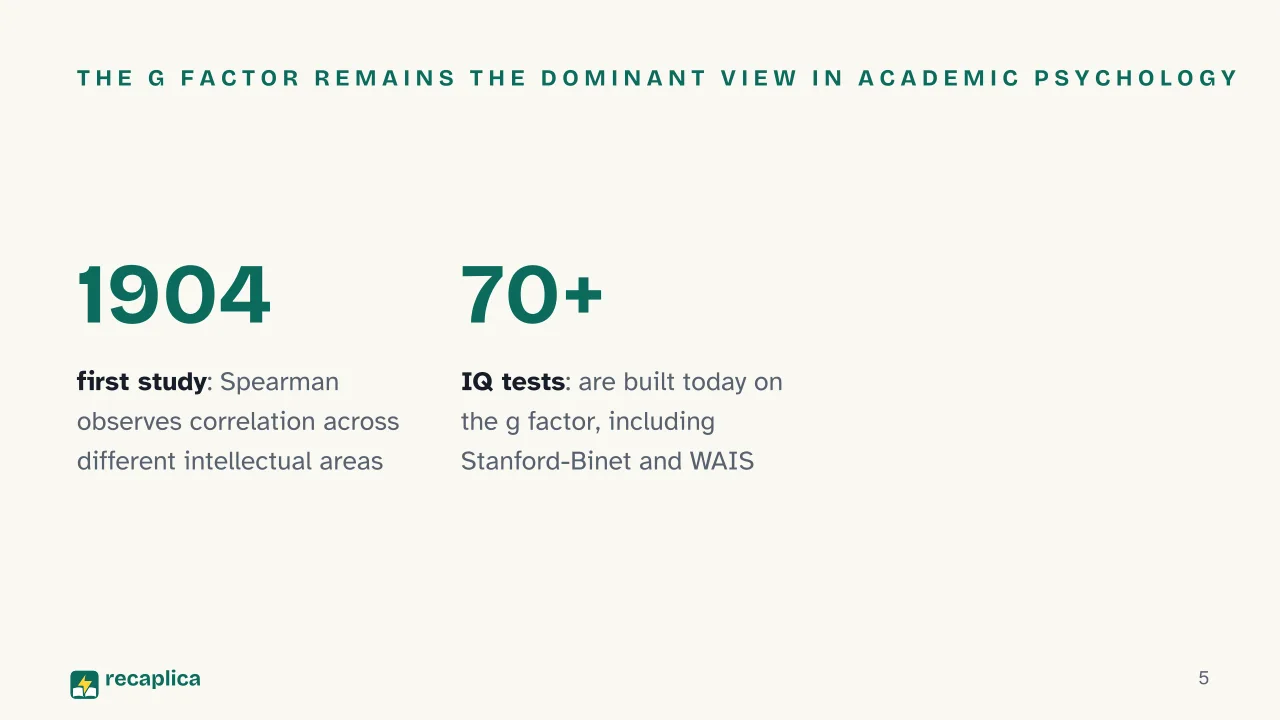
    In 1904, the English psychologist Charles Spearman spotted a recurring pattern in his data: strong performance in one intellectual area, verbal ability, say, tended to come with strong performance in far-removed areas too, from logic to reasoning. From that correlation he drew the idea of a general factor, which he called g: a single underlying ability running through every intellectual task. Alongside g, in Spearman’s two-factor model, sits s, specific to each individual task.

    Within academic psychology, the g-factor theory remains, in 2026, the dominant view of intelligence. It underlies more than 70 IQ tests in current use, including the Stanford-Binet (fifth edition, 2003) and the Wechsler Adult Intelligence Scale (fourth edition, 2008).

    Practical example: a student who scores well on a language exam and, around the same time, also does well on a logical-reasoning test unrelated to reading shows the kind of pattern that led Spearman to propose the g factor: separate areas moving together.

    From Binet to modern IQ

    The intelligence test was not built to measure some abstract trait; it started as a practical assignment. In the early 1900s, the French government asked the psychologist Alfred Binet to identify pupils who needed extra classroom support. Working with his colleague Théodore Simon, Binet introduced the concept of mental age: how a child’s intellectual performance compares with the average of same-age peers — a different idea from the one Jean Piaget would describe years later, with cognitive development unfolding in stages.

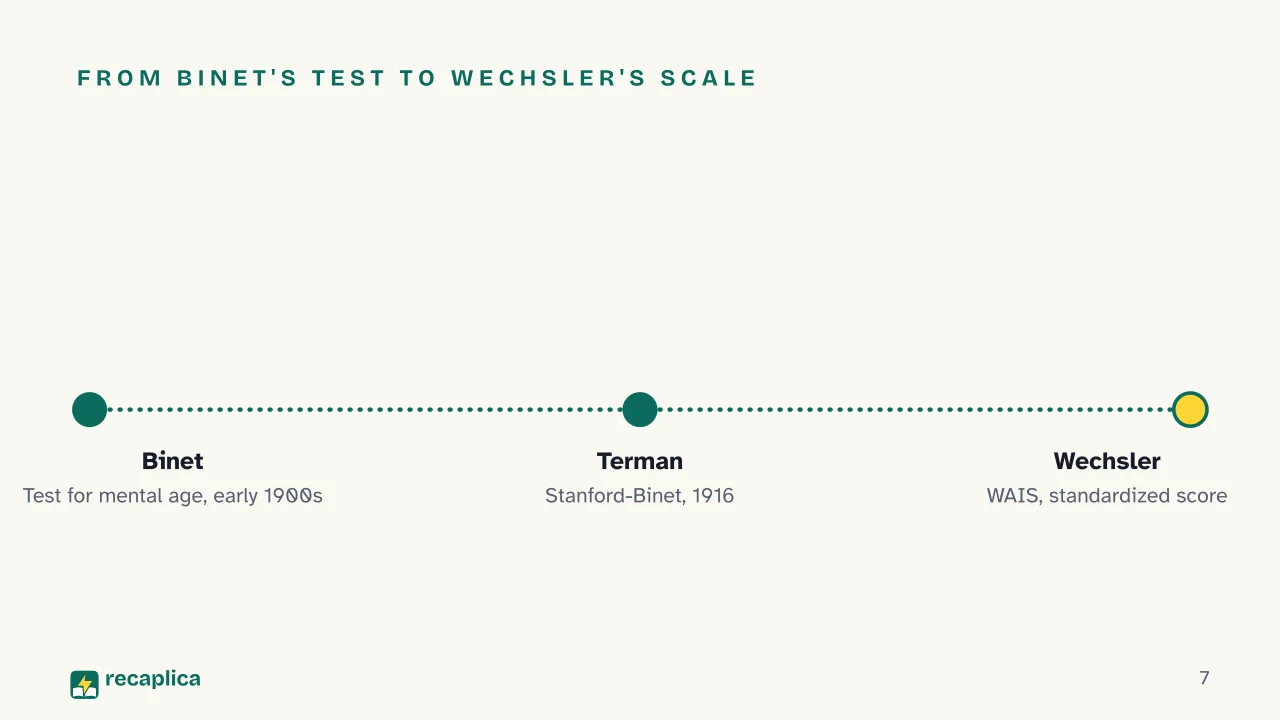
    From that first test, the Stanford professor Lewis Terman adapted the format into the Stanford-Binet, published in 1916; later the psychologist David Wechsler, critical of how heavily the Stanford-Binet leaned on verbal ability and of reducing intelligence to one single score, proposed an alternative measure.

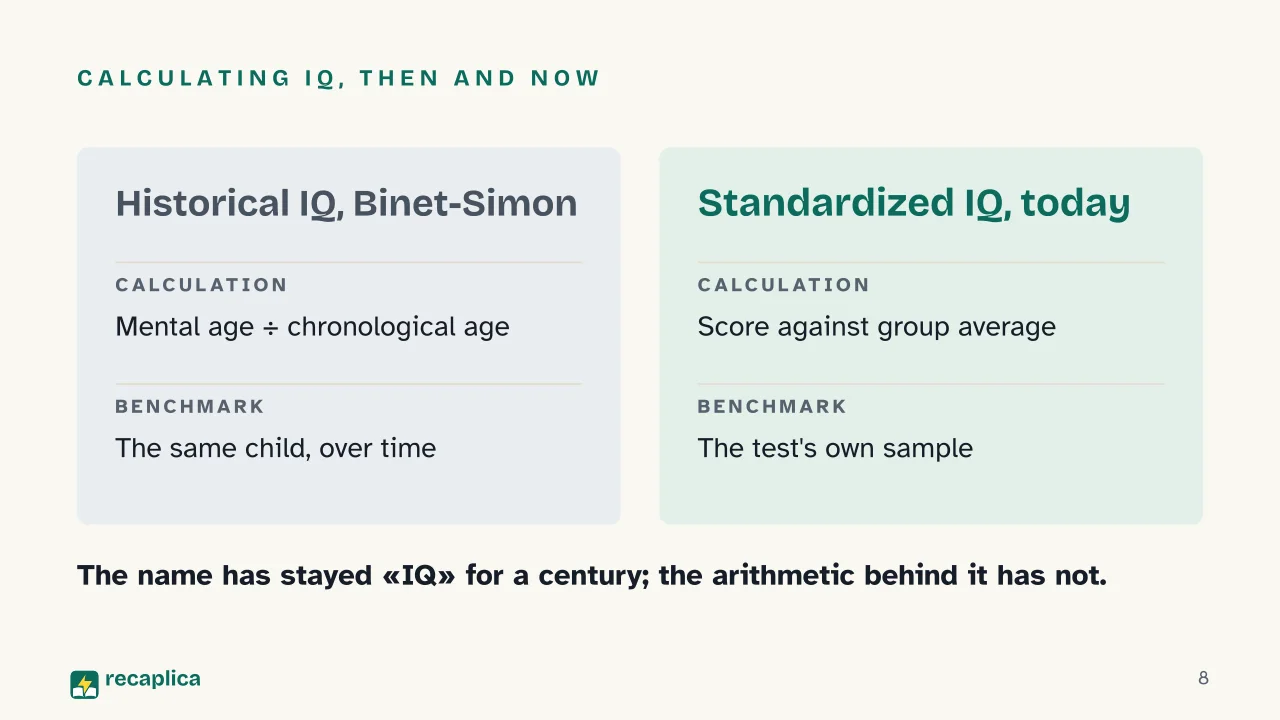
    The way IQ gets calculated has changed along with the tests.

    AspectHistorical IQ (Binet-Simon)Standardized IQ (Wechsler, today)
    CalculationMental age divided by chronological age, times 100Score compared with the average of one’s own age group
    BenchmarkThe same child, at different agesThe test’s own standardization sample
    Average scoreVaries by age100, by design

    Gardner’s multiple intelligences, still an open question

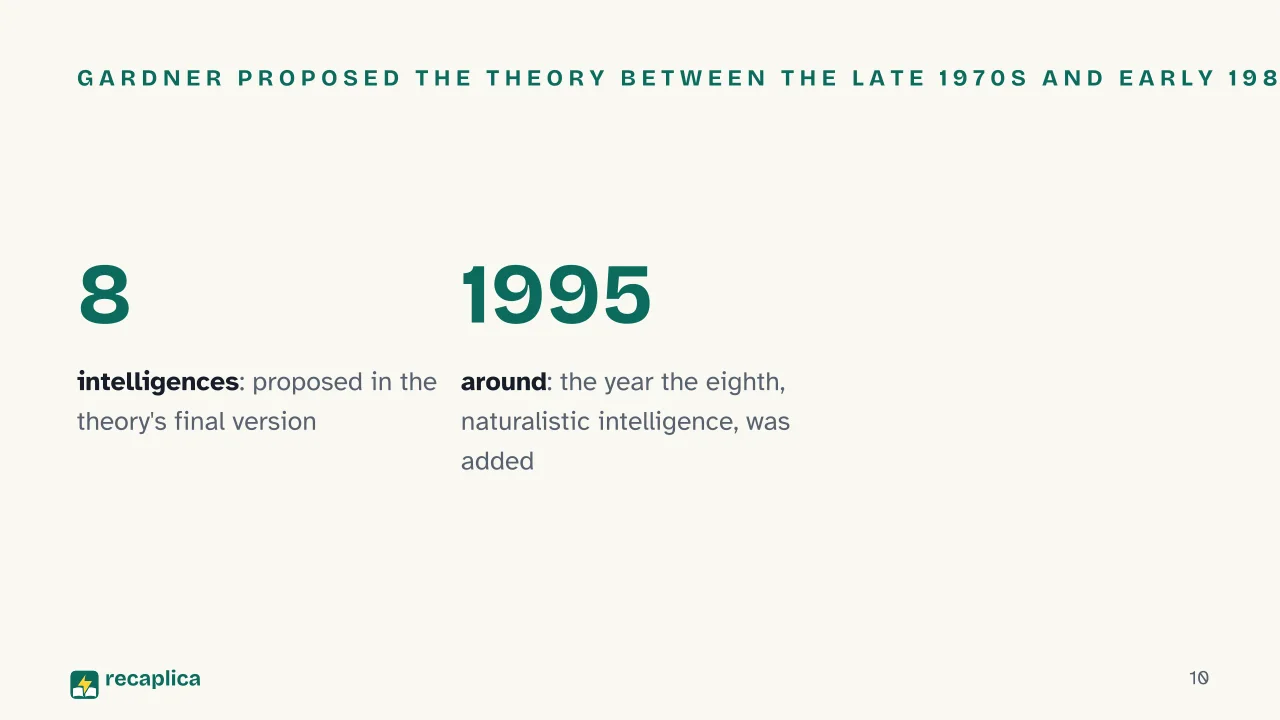
    Between the late 1970s and early 1980s, the psychologist Howard Gardner put forward his theory of multiple intelligences: eight relatively independent intelligences, linguistic, logical-mathematical, spatial, musical, bodily-kinesthetic, naturalistic, interpersonal, and intrapersonal. Gardner had identified seven at first; he added naturalistic intelligence in the mid-1990s.

    Gardner himself later ruled out other candidates, including a proposed existential intelligence and a moral or digital intelligence, because they didn’t meet his own criteria.

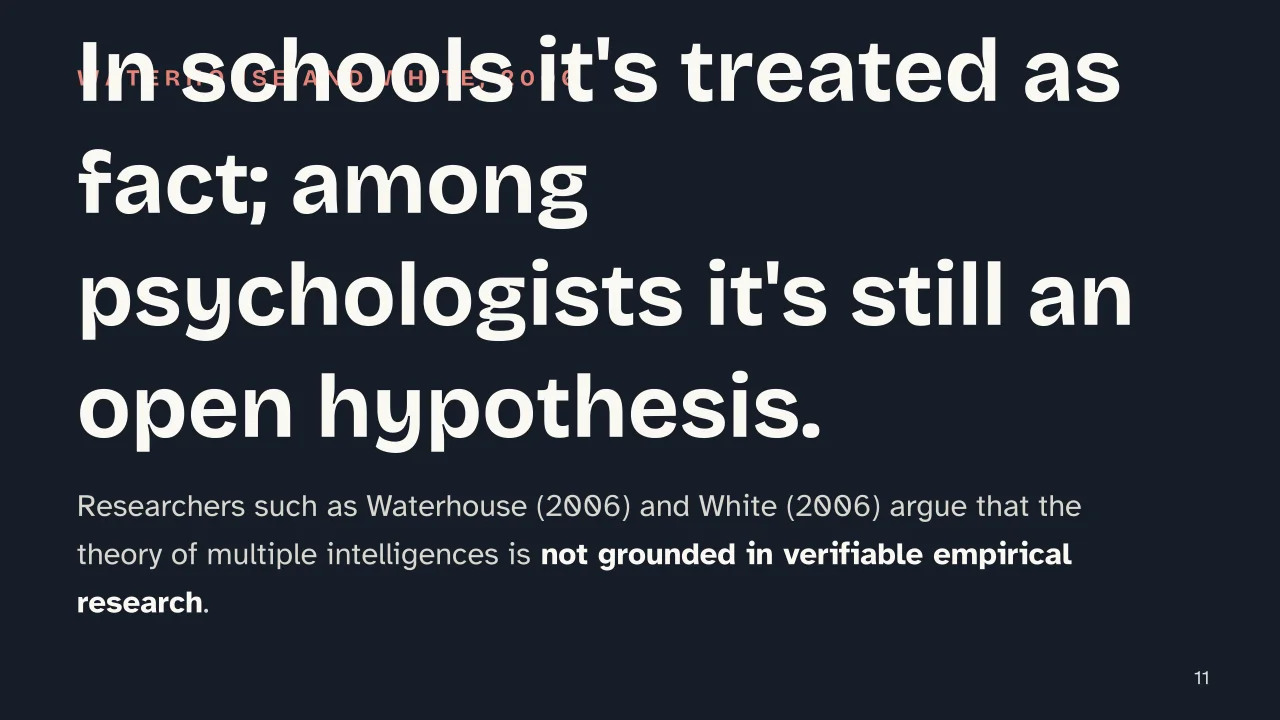
    The theory has spread widely outside academia, in schools and popular science writing. Within academic psychology, its standing is still unsettled: researchers such as Waterhouse (2006) and White (2006) argue the theory lacks solid empirical research to back it up. A 2006 study by Visser and colleagues found a strong correlation between Gardner’s more reasoning-based intelligences and Spearman’s general g factor, a result the authors themselves do not treat as confirming the theory’s stronger claims. A direct experimental test of Gardner’s theory is difficult to design, which is part of why academic psychology has never granted it the same standing as the g factor.

    Readers coming from cognitivism, which treats the mind as a system that processes information, will recognize in this comparison — one single factor against eight separate abilities — one of the most contested questions in the whole psychology of intelligence.

    The limits of intelligence testing

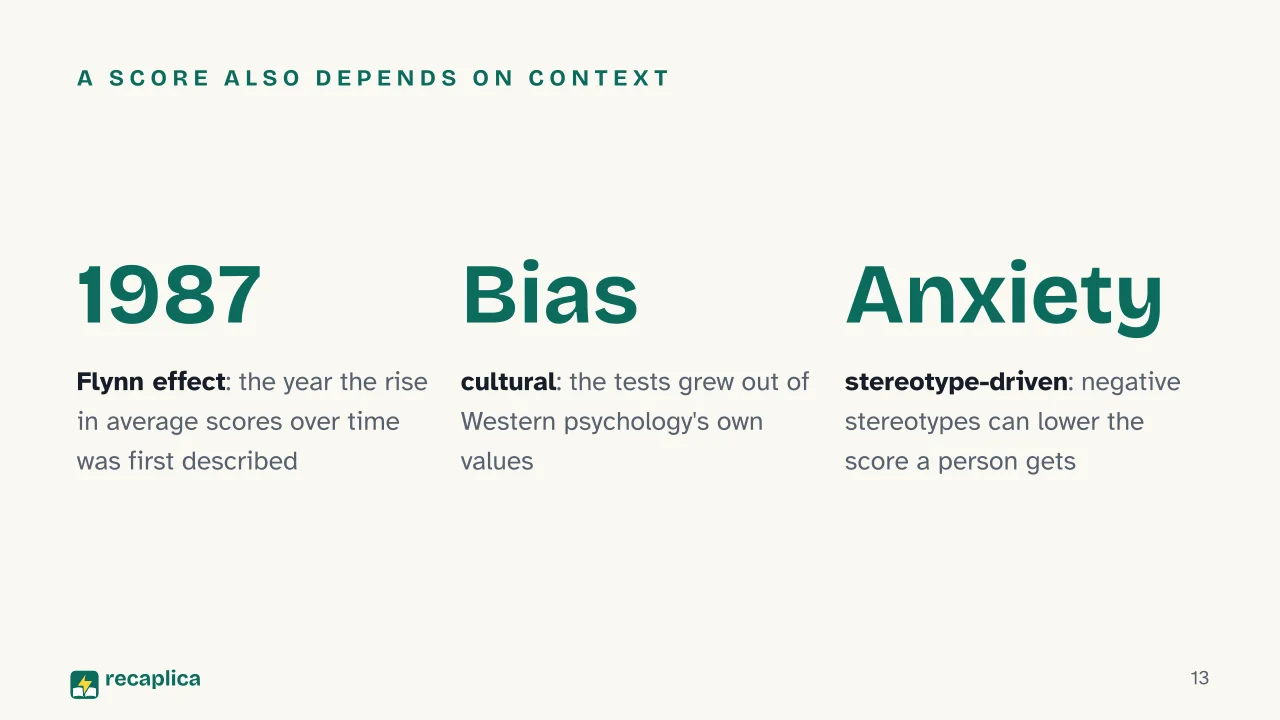
    No test, historical or modern, measures intelligence outside a context. These tests were built by Western psychologists and reflect Western-centric values, a limitation noted for several instruments still in use.

    Negative stereotypes, meanwhile, can raise anxiety in the person being tested and lower their score: a phenomenon known as stereotype threat.

    There’s also an effect tied to time rather than to any one person: average IQ test scores have climbed generation after generation, to the point that younger test-takers, given an older test, tend to score higher than the original sample that test was calibrated on. The psychologist James Flynn described this pattern in 1987, and it now carries his name: the Flynn effect.

    In 1966, the psychologists Horn and Cattell distinguished two further forms of intelligence: fluid, the ability to solve problems on the spot, and crystallized, the ability to draw on accumulated language, skills, and experience. It’s a different split from the one between the g factor and multiple intelligences, but it helps show how much more layered psychology considers intelligence to be than any single number.

    Slide deck

    Slides ready to download and make your own in PowerPoint or Google Slides, with speaker notes. Pick the Flash cut or the Full one.
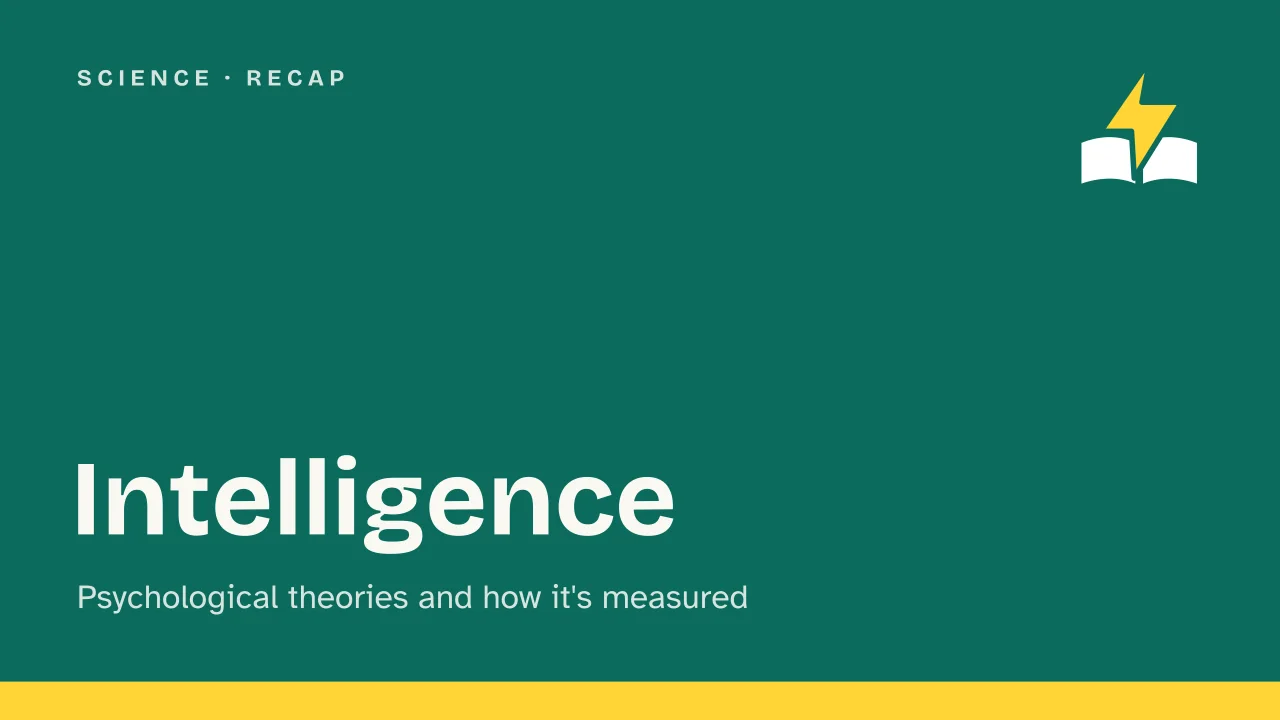
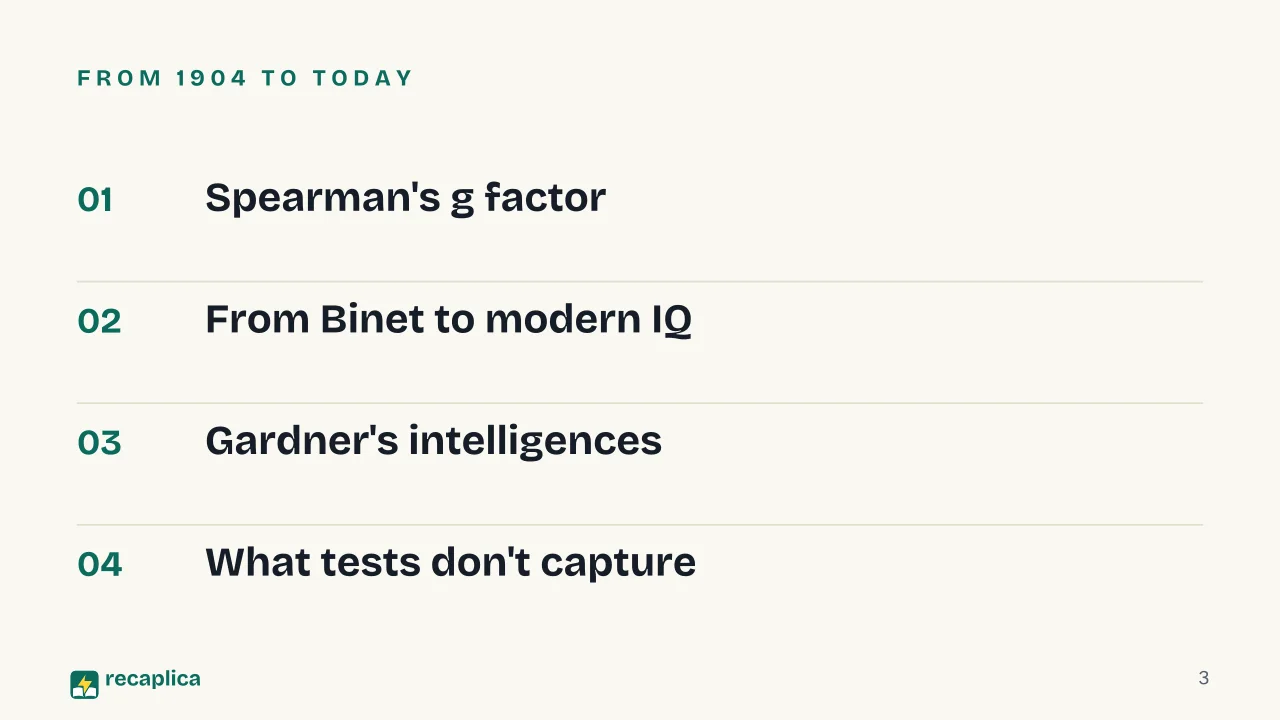
    Slide 1 of the presentation on Intelligence: IntelligenceSlide 2 of the presentation on Intelligence: What actually counts as intelligence?Slide 3 of the presentation on Intelligence: From 1904 to todaySlide 4 of the presentation on Intelligence: Chapter 01: Spearman's g factorSlide 5 of the presentation on Intelligence: The g factor remains the dominant view in academic psychologySlide 6 of the presentation on Intelligence: Chapter 02: From Binet to modern IQSlide 7 of the presentation on Intelligence: From Binet's test to Wechsler's scaleSlide 8 of the presentation on Intelligence: Calculating IQ, then and nowSlide 9 of the presentation on Intelligence: Chapter 03: Gardner's intelligencesSlide 10 of the presentation on Intelligence: Gardner proposed the theory between the late 1970s and early 1980sSlide 11 of the presentation on Intelligence: In schools it's treated as fact; among psychologists it's still an open hypothesis.Slide 12 of the presentation on Intelligence: Chapter 04: What tests don't captureSlide 13 of the presentation on Intelligence: A score also depends on contextSlide 14 of the presentation on Intelligence: How many intelligences does Gardner's theory propose, in its most recent version?Slide 15 of the presentation on Intelligence: Time to review
    Flash10 slidesThe essential thread, to present in classFull15 slidesEvery chapter and the deeper detail

    Common myths

    • ✗ Myth IQ measures a single, fixed intelligence that never changes.

      ✓ Reality IQ rests on the idea of a single general factor, g. Academic psychology also knows alternative proposals, such as Gardner's multiple intelligences, a theory that nonetheless remains debated among psychologists.

    • ✗ Myth Gardner's theory of multiple intelligences is settled science.

      ✓ Reality Gardner himself recognizes only eight proposals that meet his own criteria, and some researchers (Waterhouse 2006, White 2006) argue the theory is hard to test with empirical data: it remains an open proposal within the field.

    Mind map

    Drag the background to move around and the nodes to reposition them; use − and + to collapse and expand branches.
    Customize
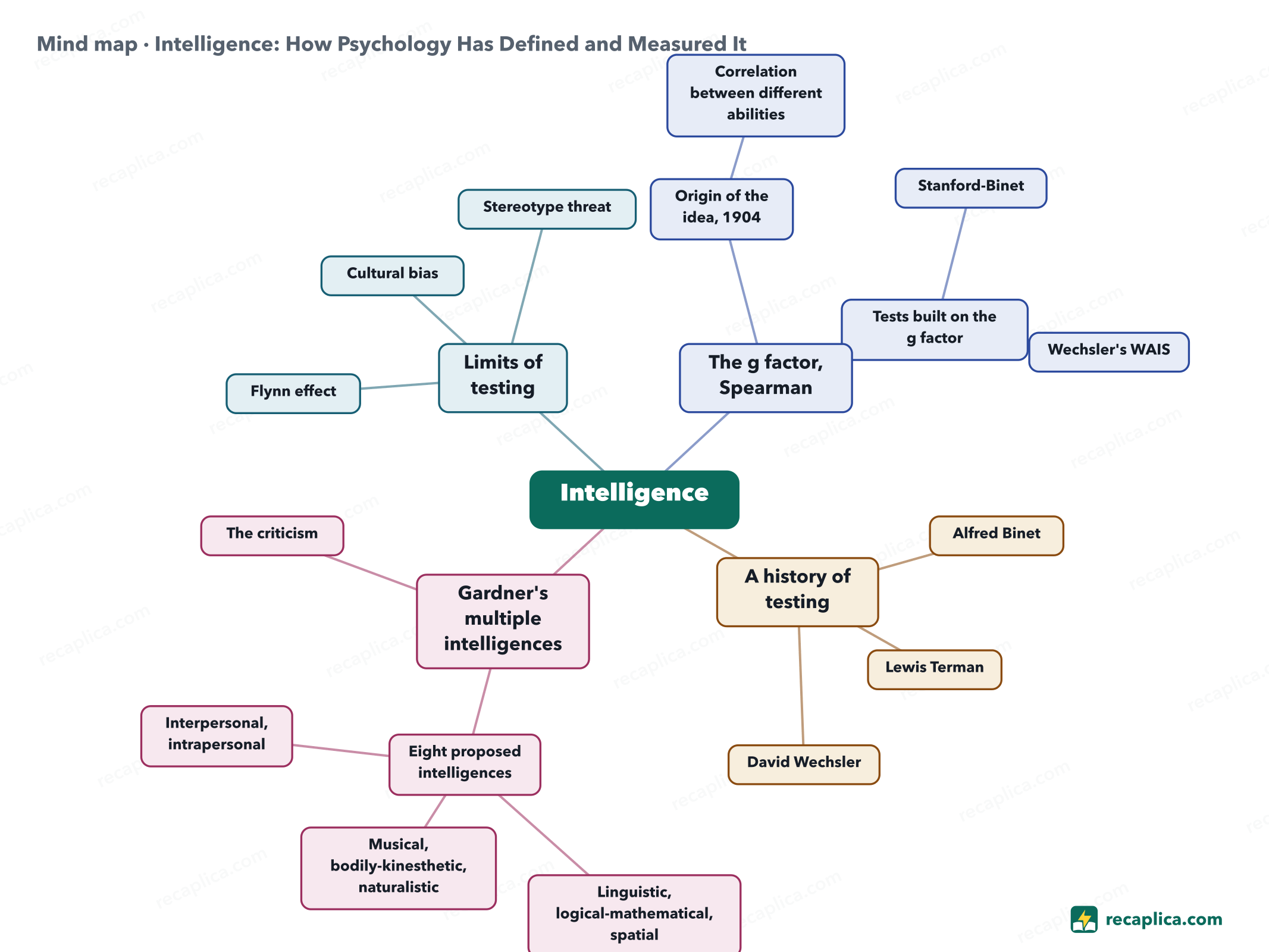
    Mind map: Intelligence: How Psychology Has Defined and Measured It
    • Intelligence
      • The g factor, Spearman Intelligence as a single general ability
        • Origin of the idea, 1904
          • Correlation between different abilities
        • Tests built on the g factor
          • Stanford-Binet
          • Wechsler's WAIS
      • A history of testing
        • Alfred Binet Test for French pupils needing extra support, early 1900s
        • Lewis Terman Stanford-Binet, 1916
        • David Wechsler Standardized score, no longer mental versus chronological age
      • Gardner's multiple intelligences A debated theory, not a consensus
        • Eight proposed intelligences
          • Linguistic, logical-mathematical, spatial
          • Musical, bodily-kinesthetic, naturalistic
          • Interpersonal, intrapersonal
        • The criticism Hard to test with empirical data
      • Limits of testing
        • Flynn effect Average scores rising over time, identified in 1987
        • Cultural bias Built around Western-centric values
        • Stereotype threat Negative stereotypes that can lower scores

    Quiz: test yourself

    Answer the questions to check what you have learned: you get instant feedback and a short explanation.

    Grade 0/10 0/5
    1 According to Charles Spearman, what explains the correlation between good results in different intellectual areas?

    Spearman proposed in 1904 the idea of a general factor, g: one ability that would explain performance across every intellectual task.

    2 Who designed the test that led to the calculation of the intelligence quotient (IQ)?

    Alfred Binet created the test commissioned by the French government to identify pupils who needed extra help in class; the calculation of IQ grew out of that work.

    3 True or false: IQ is still calculated today by dividing mental age by chronological age.

    That was the historical method. A test like Wechsler's WAIS instead uses a standardized score, calibrated against the test-taker's own age group.

    4 How many intelligences does Howard Gardner's theory propose, in its most recent version?

    Gardner first proposed seven; he added the eighth, naturalistic intelligence, in the mid-1990s.

    5 What do some critics of Gardner's theory of multiple intelligences argue?

    Researchers such as Waterhouse (2006) and White (2006) argue the theory lacks solid empirical research behind it; Visser and colleagues, in a separate 2006 paper, linked the theory's more reasoning-based intelligences to Spearman's g factor with a strong correlation.

    Answers: 1-A · 2-A · 3-B · 4-C · 5-A

    Flashcards

    Tap the card to flip it and check whether you remember the answer, then move to the next one.

    1 / 7

    Explain it in your own words

    The ultimate test: if you can explain it in simple words, you've truly understood it. Write your explanation, then compare it with the Recap.

    Your explanation is saved only on this device.

    Psychology has never settled on one definition of intelligence. In 1904, Charles Spearman proposed a single general factor, g, still the dominant view in academic psychology in 2026. Alfred Binet designed the test that gave rise to the intelligence quotient, later adapted by Lewis Terman and then David Wechsler. Howard Gardner, between the late 1970s and early 1980s, took a different route with eight multiple intelligences, a theory still debated in academic psychology.

    Frequently asked questions

    What is IQ?

    IQ is the score an intelligence test assigns to a person. The historical version divided mental age by chronological age; modern tests, such as Wechsler's WAIS, instead compare the score to the average of the test-taker's own age group, through a process called standardization.

    What is the g factor?

    The g factor is the general intelligence factor proposed by Charles Spearman in 1904: the idea that a single underlying ability explains why someone who does well in one intellectual area tends to do well in others too.

    Is Gardner's theory of multiple intelligences accepted by all psychologists?

    No. It is an influential proposal, developed by Howard Gardner around 1980, but some researchers consider it hard to test with empirical data: a 2006 study also found that the theory's more reasoning-based intelligences correlate strongly with Spearman's general g factor.

    What are Gardner's eight proposed intelligences?

    Gardner lists eight: linguistic, logical-mathematical, spatial, musical, bodily-kinesthetic, and three more closely tied to the person, naturalistic, interpersonal, and intrapersonal. The first seven arrived together; naturalistic intelligence was added in the mid-1990s.

    Sources

    • Harvard Project Zero — The Theory of Multiple Intelligences
    • Noba Project — Intelligence
    • Simply Psychology — Theories of Intelligence

    Every Recap goes through an independent review before publication.

    Every evening, the day's new Recaps on our Telegram channel. Join the channel →

    Keep learning

    • Science Correlation: What It Means and How to Read the Coefficient Correlation measures how closely two variables move together, and the most common way to put a number on it is the correlation coefficient, which runs from -1 to +1. A value near +1 means the two variables rise together, near -1 means one rises while the other falls, and near 0 means no linear relationship stands out. The coefficient only captures the strength of a straight-line relationship, and a single unusual data point can push it up or down by a lot. Even when it's strong, a correlation between two variables never shows that one causes the other. Read the Recap →
    • Science Light Refraction: What It Is, the Laws Behind It, and Examples A surface that separates two transparent materials sends some light back, reflecting it, and lets the rest through while bending it toward a new direction. The law of reflection keeps the incoming and outgoing angles equal, both measured from the normal to the surface. Snell's law governs refraction instead, linking the index of each material to how much the ray tilts before and after it crosses over. These two laws alone explain mirrors, lenses, prisms and everyday sights such as a pencil that appears to snap inside a glass of water. Read the Recap →
    • Science Total Internal Reflection and the Critical Angle: Definition and Formula Total internal reflection is what happens when a light ray stops being able to leave a transparent medium and gets sent back inside it completely. It takes place past a specific angle of incidence, called the critical angle, calculated with Snell's law by comparing the refractive indices of the two materials involved. It only happens under one precise condition: the ray must be traveling from an optically denser medium into a less dense one, such as from water into air or from glass into air. Optical fibers and, in part, the sparkle of diamonds rely on this same principle. Read the Recap →

    recaplica

    Clear in 30 seconds, yours in 10 minutes.

    Recaps Mind maps Request a Recap Telegram channel Mind map maker Our method About Privacy & cookies Legal notes & terms of use

    © 2026 Recaplica · A project by Curi S.r.l. — VAT IT05472000750

    Statistics, only if you say so

    To learn which Recaps help most we would use Google Analytics, with aggregate, anonymous data. It starts only with your OK, and you can change your mind anytime. Privacy policy