|
recaplica
Swimming after eating: is the cramp myth actually true? | ||||||||||||
| © 2026 Recaplica · recaplica.com — All rights reserved | ||||||||||||
Swimming after eating: is the cramp myth actually true?What to print Page numbers appear when printing with default margins. SlidesChoose a cut Flash10 slidesThe essential thread, to present in classFull17 slidesEvery chapter and the deeper detailBoth come with speaker notes. In 30 seconds quick readFor generations, parents have warned that swimming right after a meal blocks digestion and triggers cramps severe enough to drown you. The American Red Cross, after reviewing the scientific literature, found no single documented drowning linked to eating beforehand, and the physiology behind the myth runs backwards: resting digestion only shifts blood toward the gut in a mild way. The real, well-documented danger in open water goes by a different name — cold water shock — and it has nothing to do with whether you just ate. Key Points
Key figures
Deep DiveAdvice we’ve all heard foreverAnyone who spent childhood summers at the beach probably remembers the same scene: the moment lunch was over, someone in the family would insist on waiting before jumping back in the water, to avoid a stomach cramp. The idea behind it is that digestion pulls so much blood into the stomach that the muscles are left running on empty, setting up sudden cramps and, in the worst case, drowning. It’s an older idea than it looks. According to the sources consulted, it already shows up in the 1908 British Boy Scout manual “Scouting for Boys,” which warned against swimming in deep water right after a meal because of a supposed cramp risk. The myth is therefore over a century old and has an Anglo-Saxon origin, not just an Italian one: it spread and got passed down for generations long before anyone ran a proper study to confirm or debunk it. What water-safety organizations actually sayThe American Red Cross, among the most authoritative water-safety organizations in the world, has tackled the question directly: after a 2011 review of the scientific literature, it found no documented cases of drowning or near-drowning caused by eating before swimming. A handful of experimental studies from as far back as the 1960s — on freestyle races and one-mile swims timed at different intervals after a meal — found no meaningful effect on swimming performance, only minor side effects. The Red Cross’s conclusion is blunt: no major medical or safety organization recommends waiting before swimming after a meal. What actually happens in your body during digestionThe cramp myth does have a kernel of physiological truth, but it tells the mechanism backwards. A 2014 review in the journal Sports Medicine explains that during maximal physical exertion, blood flow to the splanchnic organs — stomach, intestines, liver — can drop by up to 80%. What triggers this shift is the sympathetic nervous system, which uses noradrenaline to narrow the digestive system’s blood vessels and reroute blood toward the working muscles. In other words: it isn’t digestion that “steals” blood from your muscles; it’s intense exertion that pulls blood away from your gut. The mechanism is real, but it requires intense, sustained physical effort — competitive swimming, endurance racing — not a relaxed swim in the sea or a pool. Fittingly, the gastrointestinal complaints tied to this blood shift mostly affect athletes pushing through long efforts: among triathletes competing in extreme ultra-endurance conditions, the prevalence of these complaints reaches as high as 93% of cases — a world away from someone taking a few laps after lunch.
At rest, during digestion, the blood shift toward the digestive system is real but stays mild: a slight reduction in flow to the limbs, nowhere near enough to cause cramps or meaningful trouble moving. The real risk in the water: cold water shockWhile the digestion-cramp story doesn’t hold up, there is a well-documented and genuinely dangerous mechanism that kicks in when you enter the water: cold water shock. According to the U.S. National Weather Service, sudden immersion in water colder than your body can trigger an involuntary gasp, rapid breathing or hyperventilation — a reaction that, if you happen to inhale water at the wrong moment, can turn into a drowning emergency. A detail that almost always catches people off guard: this reflex doesn’t require icy water. It can appear starting at around 25°C (77°F), and according to the National Weather Service, cold water shock can be just as severe in 10-15°C water as in water close to 2°C — what matters is the gap compared with body temperature, not some absolute threshold. The RNLI, the UK’s leading sea-rescue organization, adds that breathing rate can spike up to ten times the normal rate, while skin blood vessels close off and heart rate accelerates.
Even the amount of water needed to start drowning is modest: according to the RNLI, it only takes about 300 ml — half a pint — of seawater in the lungs for a fully healthy adult to start drowning. It’s a detail that helps explain why caution in open water matters regardless of whether you’ve just eaten. Why the Istituto Superiore di Sanità still advises cautionAmong the official drowning-prevention recommendations from Italy’s Istituto Superiore di Sanità is the advice to avoid diving into the water “abruptly” after eating or after prolonged sun exposure. It’s a recommendation worth reading carefully: the critical factor isn’t having eaten as such, but a sudden, abrupt entry into water — possibly cold — after a long stretch in the sun, a combination of factors that can help trigger exactly the cold water shock described above, not a digestion blockage. The cautious voice also persists in Italian clinical circles: an emergency-room physician, in an article published by the website of a major Italian hospital, recommends waiting 2-3 hours before swimming after heavy, fat-rich meals, listing digestion as a possible risk factor alongside gulping very cold drinks quickly. It’s one possible position on the question, more cautious than the American Red Cross’s conclusion, and it reflects a precautionary approach common among some emergency-medicine professionals rather than a scientifically proven digestion-blockage mechanism. What the numbers on drowning in Italy really sayOfficial statistics from the Istituto Superiore di Sanità help put the myth in perspective. Italy records roughly 400 drowning deaths a year and 800 hospital admissions, a figure that has held steady for decades after a sharp decline between the 1970s and the late 1990s. In the breakdown of causes for 2016-2021, the single most frequent cause is sudden medical episodes, at 58 cases per season; not knowing how to swim (26 deaths a year) and rip currents (another 26 deaths a year) follow behind. A separate category tied to digestion or “swimming after meals” does not appear in this official breakdown. A real phenomenon, distinct from both the cramp myth and cold water shock, may explain part of the unease people report anecdotally: postprandial hypotension, a drop in systolic blood pressure within two hours of a meal. A 2025 study found this in 23% of a sample of 111 healthy adults who reported post-meal symptoms, not just the elderly or people with diabetes, who are among the groups most often affected. It’s a cardiovascular response to the meal — dizziness, blurred vision, a fainting sensation — not a digestion blockage or a mechanism specific to water; a different phenomenon from the vasodilation linked to exercise, though it still involves the width of blood vessels. What’s left, once you strip away the mythAcross the differences between sources, one point comes through clearly: the traditional cramp story — blood “trapped” in the stomach, sudden cramps, drowning — finds no support in the data collected by water-safety organizations, nor in the physiology of resting digestion. The factor the sources actually flag as genuinely dangerous, and one that applies after a meal or at any other time, is a sudden entry into water much colder than the body, especially after a long stretch in the sun. Readers can draw their own practical conclusions from these facts, weighing their own situation. Slide deckSlides ready to download and make your own in PowerPoint or Google Slides, with speaker notes. Pick the Flash cut or the Full one.     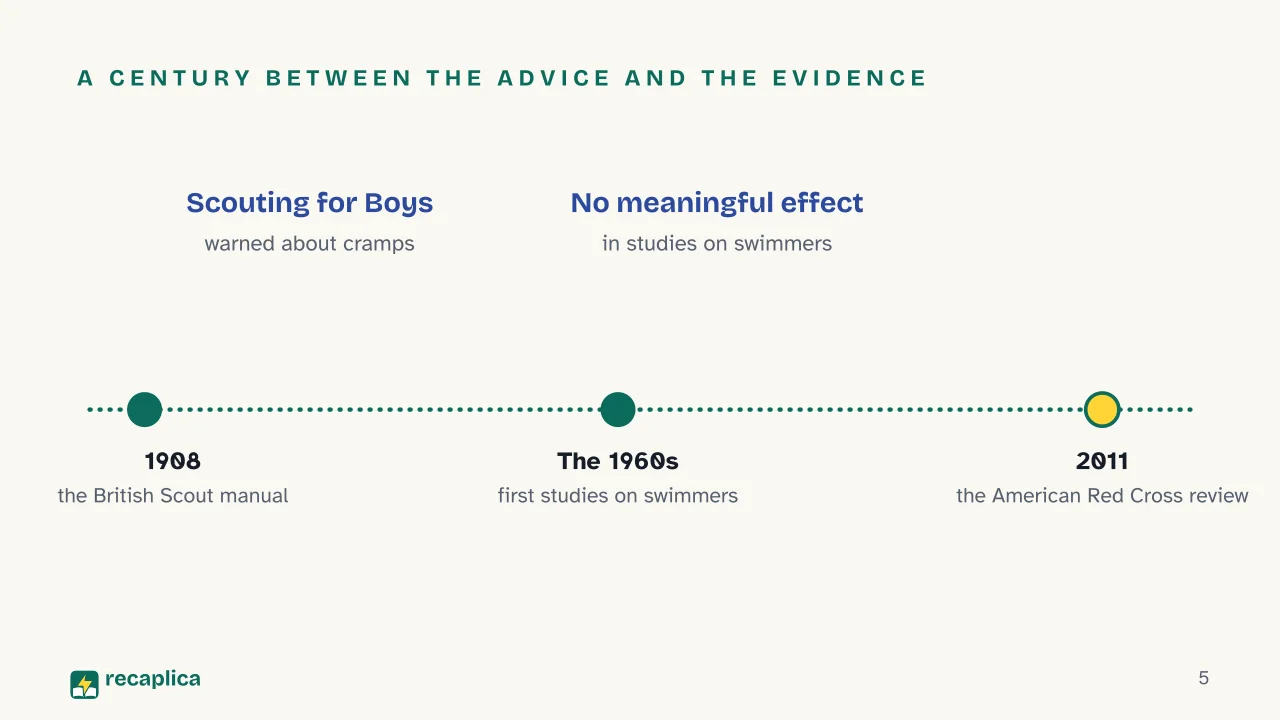  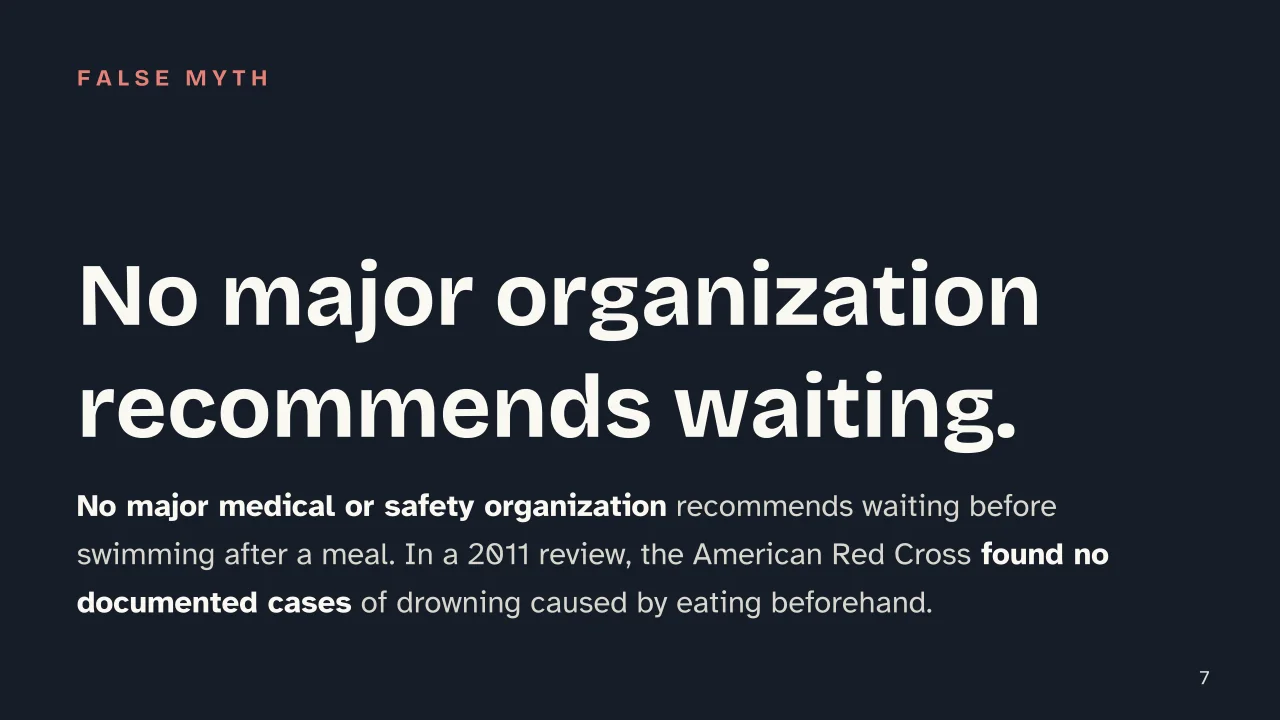 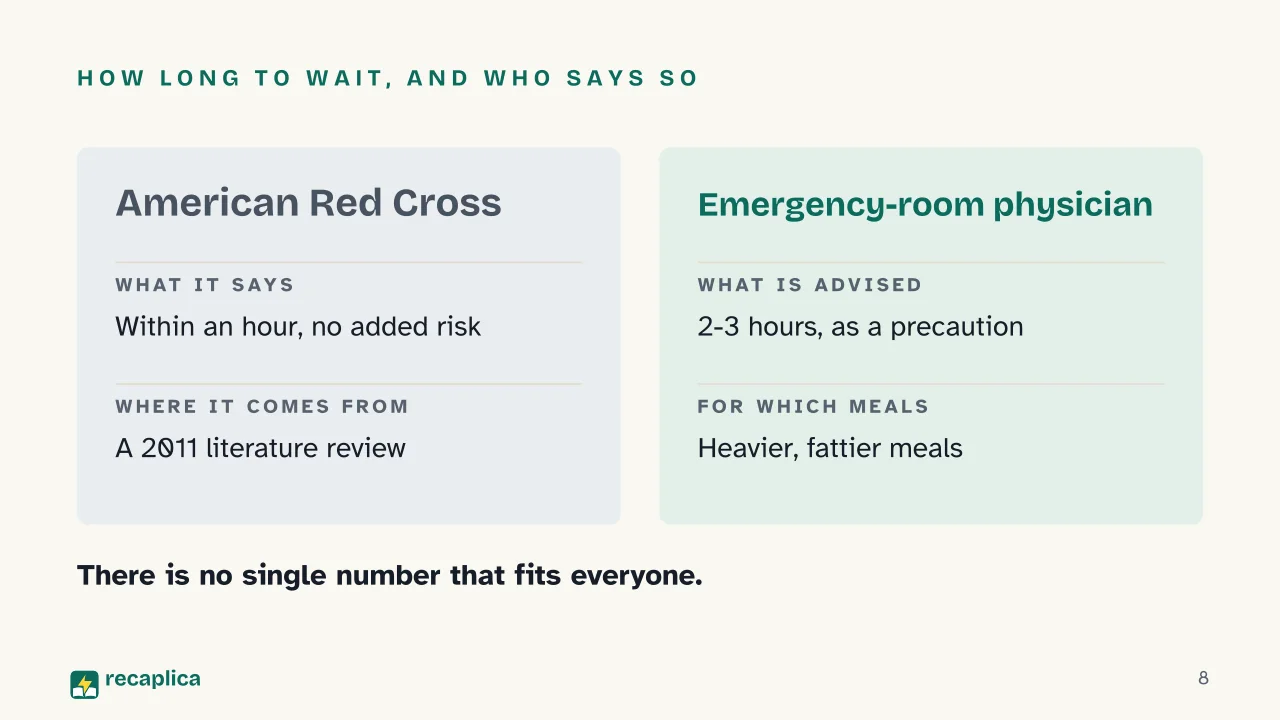  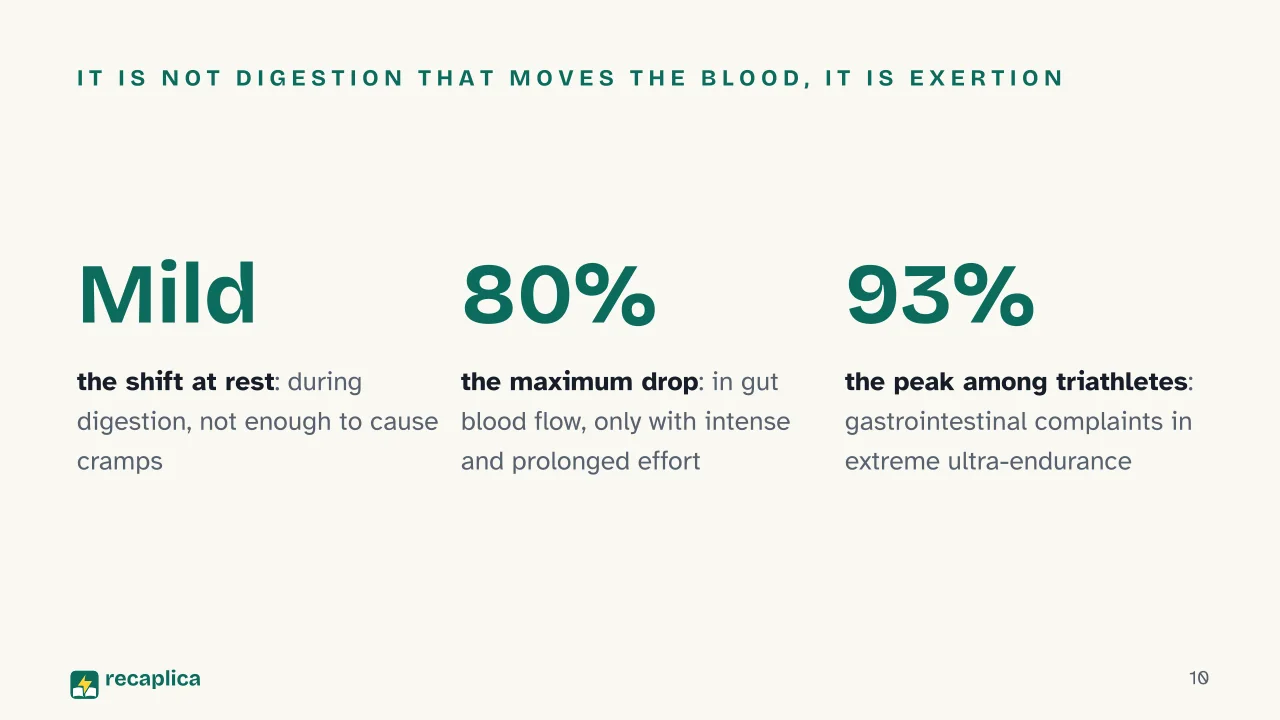   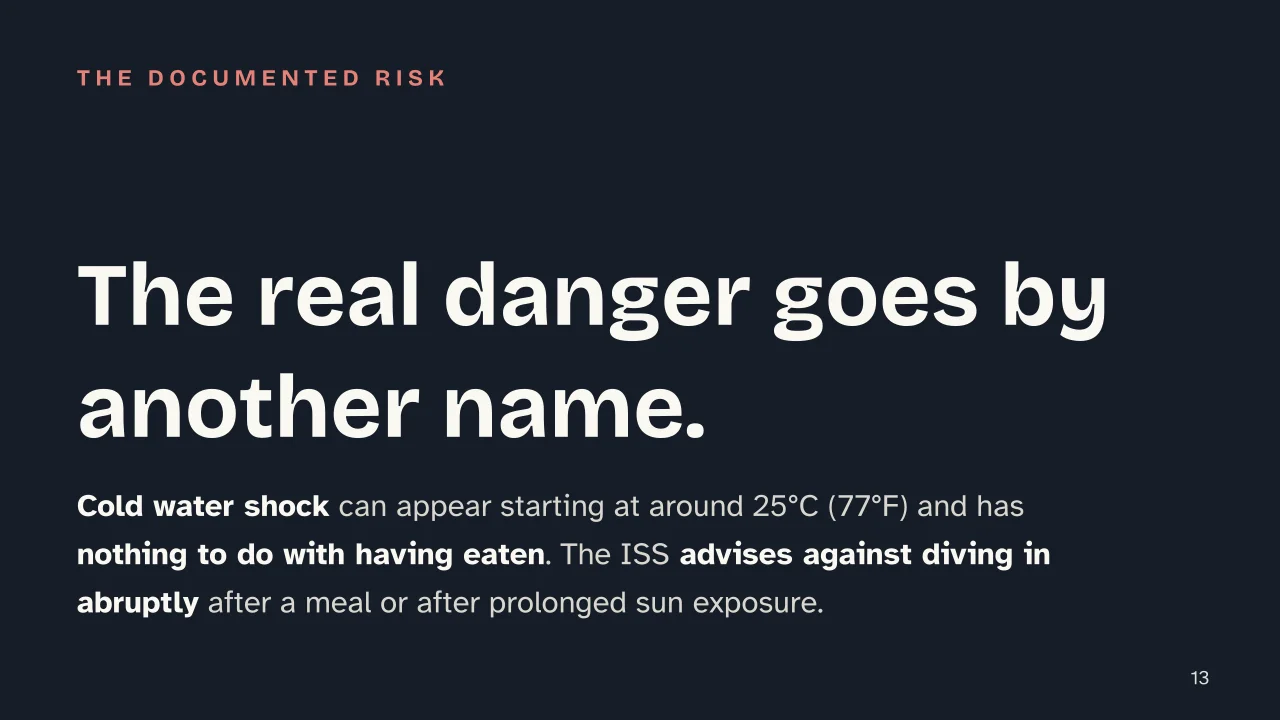 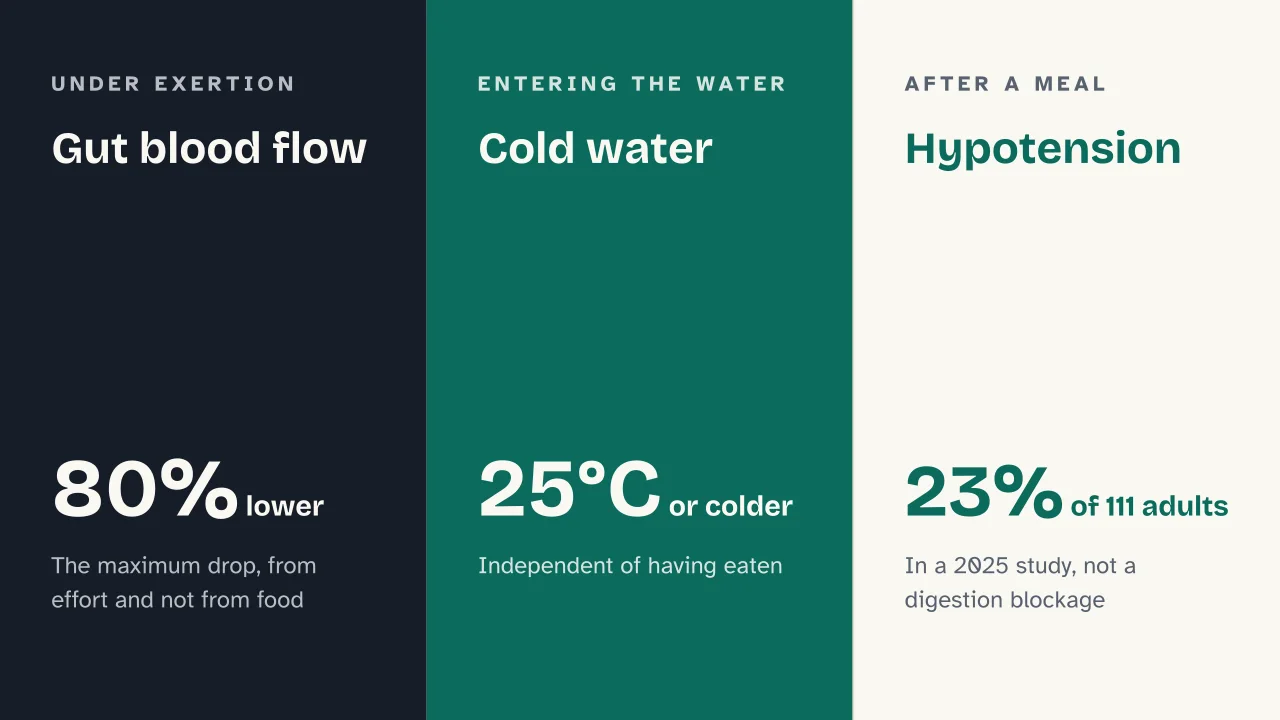 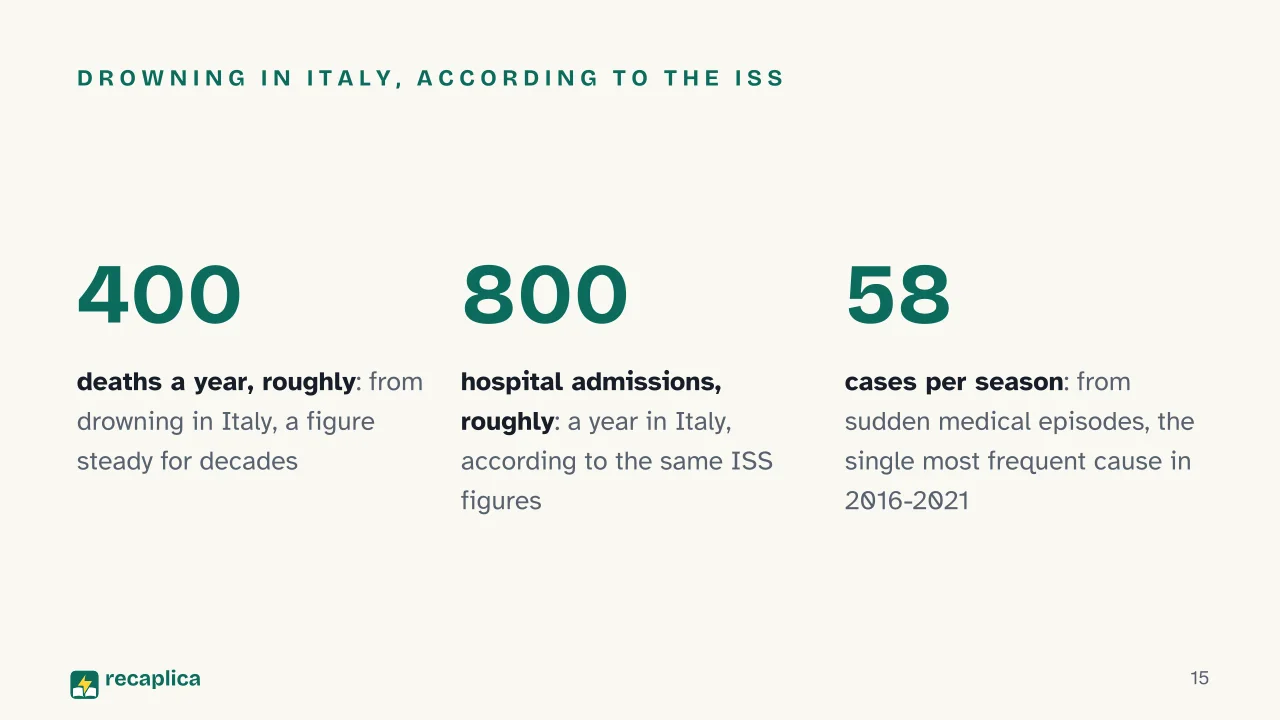 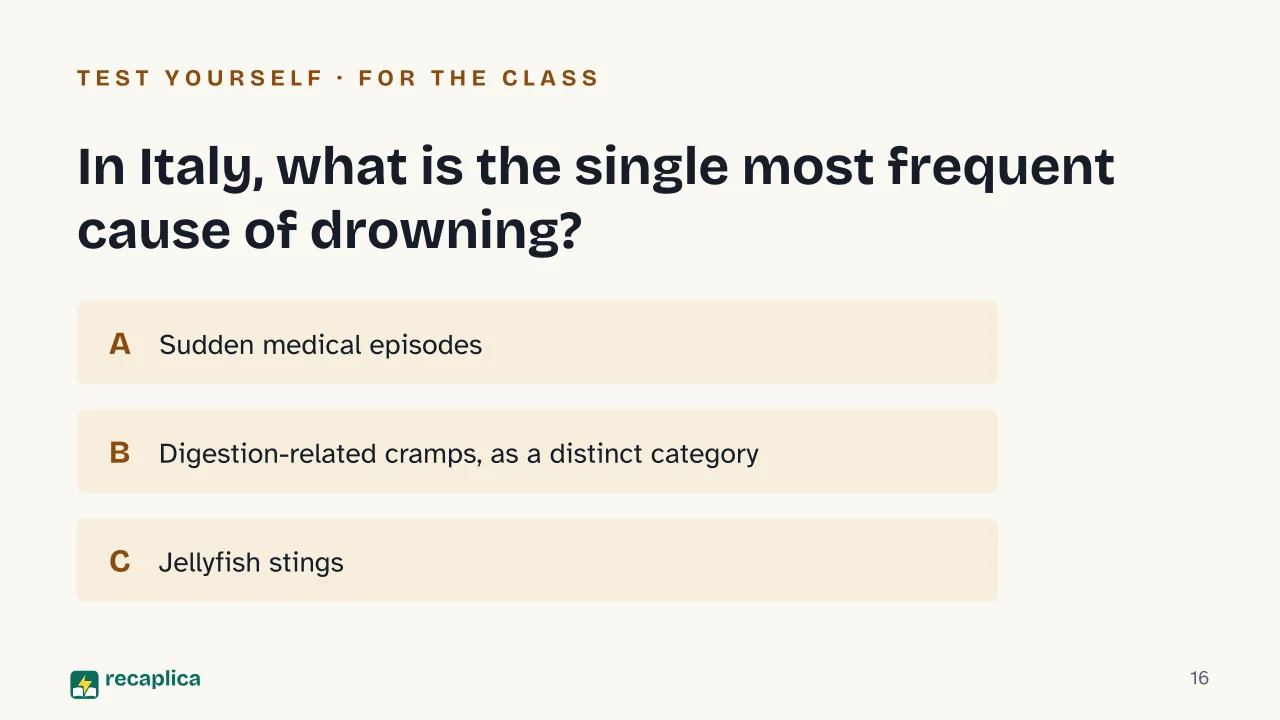  Common myths
Mind mapDrag the background to move around and the nodes to reposition them; use − and + to collapse and expand branches. 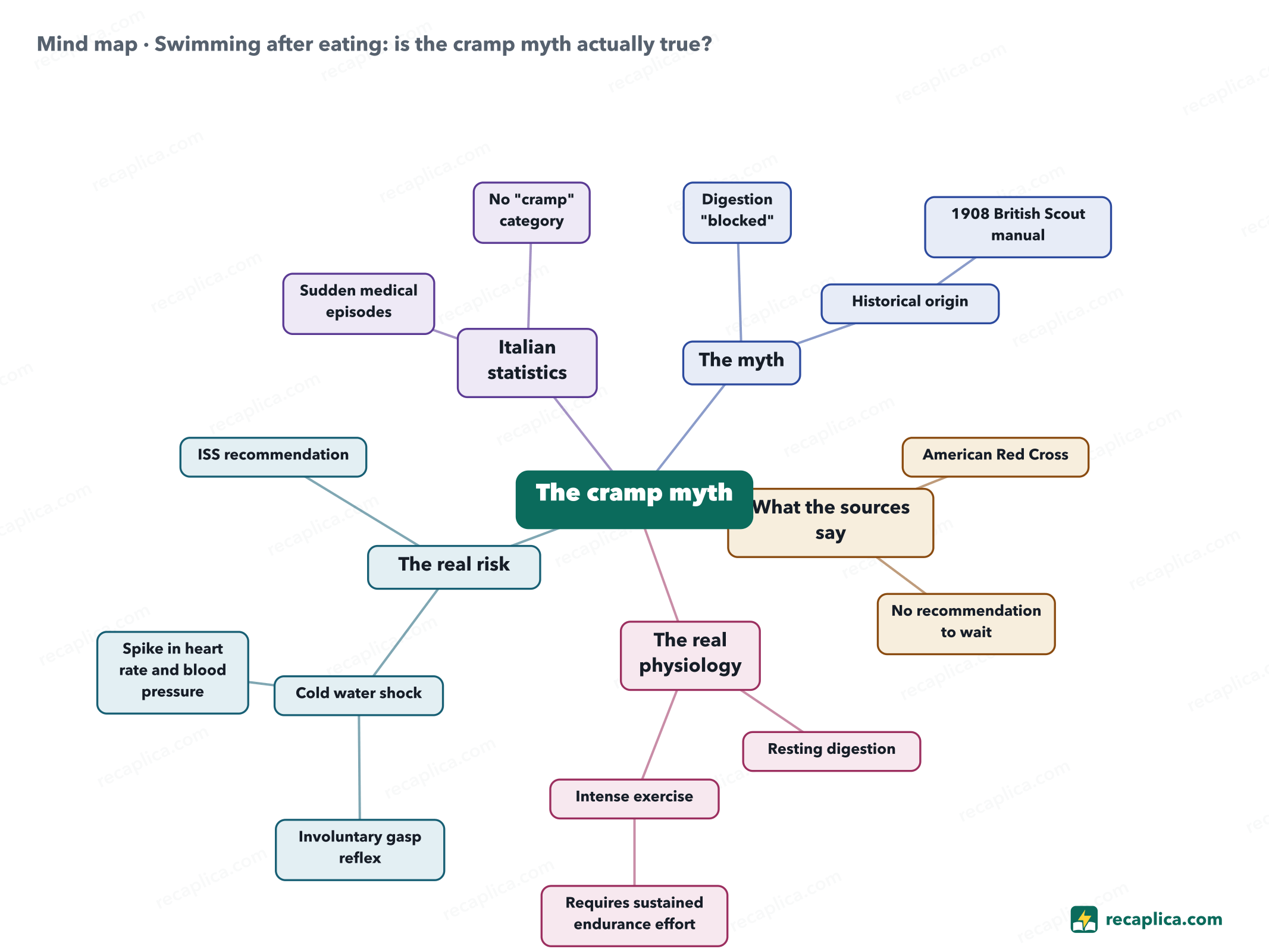
Quiz: test yourselfAnswer the questions to check what you have learned: you get instant feedback and a short explanation. Grade 0/10 0/5
FlashcardsTap the card to flip it and check whether you remember the answer, then move to the next one. 1 / 8 Explain it in your own wordsThe ultimate test: if you can explain it in simple words, you've truly understood it. Write your explanation, then compare it with the Recap. Your explanation is saved only on this device.
Frequently asked questionsDoes swimming right after eating cause cramps and drowning?There's no documented mechanism where digestion 'blocks' the body and triggers cramps that lead to drowning. After reviewing the scientific literature, the American Red Cross found no cases of drowning linked to eating before swimming, and no major medical or safety organization recommends waiting before you swim. How long should you wait after eating before swimming?Sources differ. The American Red Cross says swimming within an hour of a meal does not raise drowning risk. An Italian emergency-room physician (writing for Humanitas) recommends a more cautious 2-3 hours for heavier, fattier meals. There's no single number that fits everyone: it depends on the meal and the person. Why does the Istituto Superiore di Sanità still advise against diving in right after eating?The ISS recommendation is to avoid diving in 'abruptly' after eating or after prolonged sun exposure. It's a caution against a sudden entry into water that's often colder than sun-warmed skin, not a claim that digestion itself causes drowning. So what is the real risk when you get into the water?Cold water shock: a sudden entry into water colder than your body can trigger an involuntary gasp, a sharp jump in heart rate and blood pressure, and in severe cases a temporary inability to swim. It's a mechanism entirely independent of whether you've eaten. Is it normal to feel weak or light-headed after a big meal?A drop in blood pressure after eating (postprandial hypotension) is real and more common than people think, even in young, healthy people, not just the elderly. It's a separate phenomenon from the cramp myth: not a digestion blockage, but a cardiovascular response to the meal. Every Recap goes through an independent review before publication. |