|
recaplica
Heisenberg Uncertainty Principle: What It Says and the Formula | |||||||||||||||
| © 2026 Recaplica · recaplica.com — All rights reserved | |||||||||||||||
Heisenberg Uncertainty Principle: What It Says and the FormulaWhat to print Page numbers appear when printing with default margins. SlidesChoose a cut Flash10 slidesThe essential thread, to present in classFull15 slidesEvery chapter and the deeper detailBoth come with speaker notes. In 30 seconds quick readWerner Heisenberg put forward the uncertainty principle in 1927. It says that for a particle such as an electron, position and momentum cannot both be known with full precision at the same moment. Pin one down more tightly and the spread in the other grows. Kennard wrote the exact formula that same year, Δx · Δp ≥ ħ/2, where ħ is Planck's constant divided by 2π. Behind it sits an idea from Louis de Broglie: particles also behave like waves. Key Points
Key figures
Deep DiveIn classical mechanics, the physics of Newton’s laws, a body has a precise position and velocity at every instant. Know both, along with the forces acting on it, and in theory you can calculate all of its future motion. In 1927 Werner Heisenberg argued that this bookkeeping fails for a particle such as an electron: its exact position and momentum cannot be known at the same moment. How to state the Heisenberg uncertainty principleAs a first approximation, and this is how the Stanford Encyclopedia of Philosophy sums it up, the principle rules out giving position and momentum (mass times velocity) exact values together, at one instant. For each, only a band of uncertainty can be set, and the two bands refuse to shrink together beyond a point. Treccani, the Italian encyclopedia, counts it among the fundamental principles of quantum mechanics and states it in general terms for conjugate quantities, those whose operators do not commute. The standard example is a position coordinate paired with the momentum along the same direction, x and pₓ. The failure to commute comes from the matrix algebra Heisenberg used to build the theory in 1925, later developed with Max Born and Jordan, where a times b does not always equal b times a. Taken on its own, Treccani adds, a single quantity can be measured as precisely as we wish. The constraint appears when we ask for two conjugate quantities together.
The uncertainty principle formula: Δx · Δp ≥ ħ/2In 1927 Heisenberg argued only from qualitative examples. Kennard gave the first exact mathematical version that same year: Δx · Δp ≥ ħ/2 In words, the uncertainty in position multiplied by the uncertainty in momentum is always greater than or equal to ħ over 2. The symbol ħ, read “h-bar”, is the reduced Planck constant: h divided by 2π. In the CODATA 2022 recommended values published by NIST it is 1.054571817… × 10⁻³⁴ joule-seconds (J·s), an exact value. In Kennard’s inequality Δx and Δp are standard deviations. They describe how widely the values of position and momentum scatter when the measurement is repeated on many systems prepared in the same way, an idea taken straight from probability and statistics. The Stanford Encyclopedia of Philosophy observes that linking this spread to the imprecision of an instrument, such as a microscope’s resolving power, is anything but simple. In 1929 Robertson extended the inequality to any pair of observable quantities. The name came later. The first influential author to speak of a “principle” was probably Eddington, in 1928. Heisenberg seems never to have taken up the word and preferred to talk of indeterminacy relations, Unbestimmtheitsrelationen in German.
Heisenberg’s gamma-ray microscopeOn 23 February 1927 Heisenberg described the new principle in a 14-page letter to Wolfgang Pauli, and in March he sent the paper off for publication. Its German title contained the word anschaulich, which literally means visualizable. To make the idea concrete, Heisenberg pictured locating an electron with a microscope. A microscope’s precision depends on the wavelength of the light it uses, so in principle very short-wavelength light such as gamma rays should do. That is where the Compton effect comes in. The photon strikes the electron, the electron recoils and its momentum changes, and the shorter the wavelength, the harder the hit. In the paper, pinning down the position better left the momentum less well known, and the same held the other way round. For the authors of the Stanford Encyclopedia entry, this first version of the principle is about what we can know of the electron.
Niels Bohr read the paper when it had already gone to the publisher, and his criticism ended up in a note added at the proof stage. For him the crux of the microscope lay elsewhere: that change in momentum cannot be determined precisely within the same experiment. He found mistakes in the reasoning but accepted that the principle was correct. Heisenberg gave an improved version in his 1930 Chicago lectures. De Broglie and matter wavesThe principle is easier to grasp if you start from wave-particle duality. Light was already known to behave both as a wave and as a stream of particles. In 1924, according to the Nobel Foundation, Louis de Broglie proposed that the same held for particles such as electrons (HyperPhysics dates the proposal to around 1923). He got there by analogy with the momentum of the photon: a particle has a wavelength λ = h/p, Planck’s constant divided by its momentum. The 1929 Nobel presentation speech recalls that when de Broglie put the idea forward, nothing then known backed it up. Confirmation came from beams of electrons reflected off crystals or sent through thin metal foils, which produced diffraction just as light does. HyperPhysics points to the experiment by Clinton Davisson and Germer. De Broglie received the Nobel Prize in Physics in 1929; Davisson and George Paget Thomson shared it in 1937 for the experimental discovery of electron diffraction by crystals. HyperPhysics treats duality and de Broglie’s hypothesis as the two groundwork steps for understanding the principle. A perfectly regular wave spreads the probability of finding the electron over all of space, and its position is then completely undetermined. For a baseball the de Broglie wavelength is tiny, which is why the wave nature of everyday objects never shows. A limit of nature or of knowledge?HyperPhysics traces the principle to the wave character of the quantum description, and writes that the uncertainty would remain even with ideal apparatus. For the APS article too, it belongs to quantum mechanics itself, whatever the apparatus. The Stanford Encyclopedia of Philosophy notes that the meaning of the relations has been argued over for a long time, and that the debate has never fully closed. The candidate readings treat the principle as a limit on experiments, on knowledge, on concepts or on reality itself, and much depends on how one interprets quantum mechanics as a whole. Heisenberg and Bohr denied that a single particle has a precise position and a precise momentum at once; the interpretation of de Broglie and Bohm says it does. The entry’s authors call it certainly wrong to claim, as many texts of the 1930s did, that Heisenberg had proved definite values could not be assigned to the particle. The reading based on measurement error and disturbance has also stayed controversial. In 2003 Ozawa argued that, with his definitions, Heisenberg’s error-disturbance relation is violated, and whether that really captures the microscope argument is itself disputed. Bohr called his own position complementarity. He had been concerned with wave-particle duality since before modern quantum mechanics, and he sketched the idea early in 1927 on a skiing holiday in Norway, while Heisenberg was writing his paper. Its core is that a single experiment cannot define position and momentum together; for Bohr these two, like time and energy, are complementary quantities. In his later work he always presented the uncertainty relations as a symbolic expression of complementarity. Laboratory tests were slow to arrive. In 1974 Jammer observed that experiments precise enough to put the relations to a real test were still few. Confirmations with uncertainties close to the quantum limit came with work published in 1983, 1985 and 2002. The energy-time uncertainty relationIn the same 1927 paper Heisenberg derived similar relations for energy and time. Treccani writes them as ΔE · ΔT ≥ ħ/2, where ΔT is how long the energy measurement lasts. The Stanford Encyclopedia urges care here: in its authors’ view Heisenberg made the extension look simpler than it is, and the role the time variable plays in his examples is far from clear. Treccani gives the stationary state as an example, whose energy can be measured with an uncertainty as small as we like as long as the measurement runs long enough. Werner HeisenbergHeisenberg was born on 5 December 1901 in Würzburg. After his 1923 doctorate he worked as Born’s assistant in Göttingen and spent a year with Bohr in Copenhagen. In 1925 he built the first consistent quantum mechanics on a strict rule, that only quantities observable at least in principle belong in the theory. In 1926 Erwin Schrödinger presented wave mechanics and proved that the two theories were equivalent. In autumn 1927 he became a professor in Leipzig, the youngest full professor in Germany. The 1932 Nobel Prize in Physics, which he collected in 1933, was awarded for the creation of quantum mechanics, and the citation does not mention the uncertainty principle. During the Second World War he was one of the leaders of the German fission programme, which never produced an atomic bomb; his choices in those years have been debated ever since. He died in Munich on 1 February 1976. Slide deckSlides ready to download and make your own in PowerPoint or Google Slides, with speaker notes. Pick the Flash cut or the Full one.   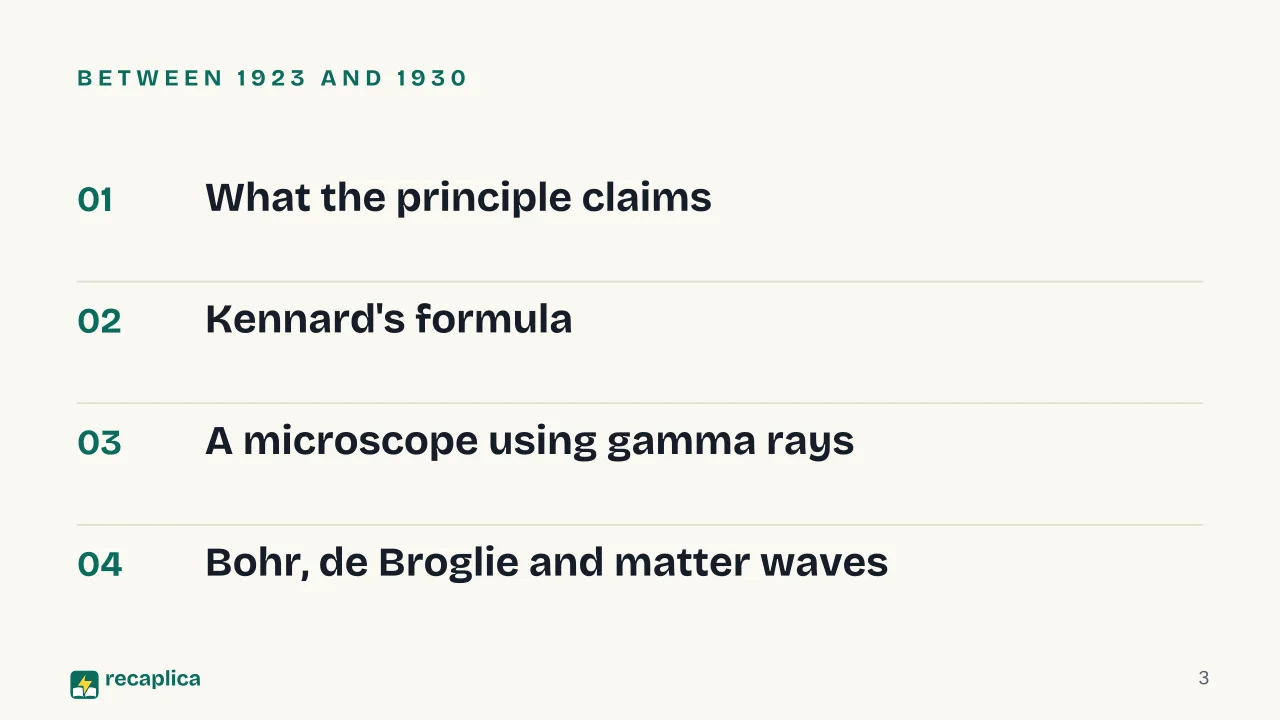  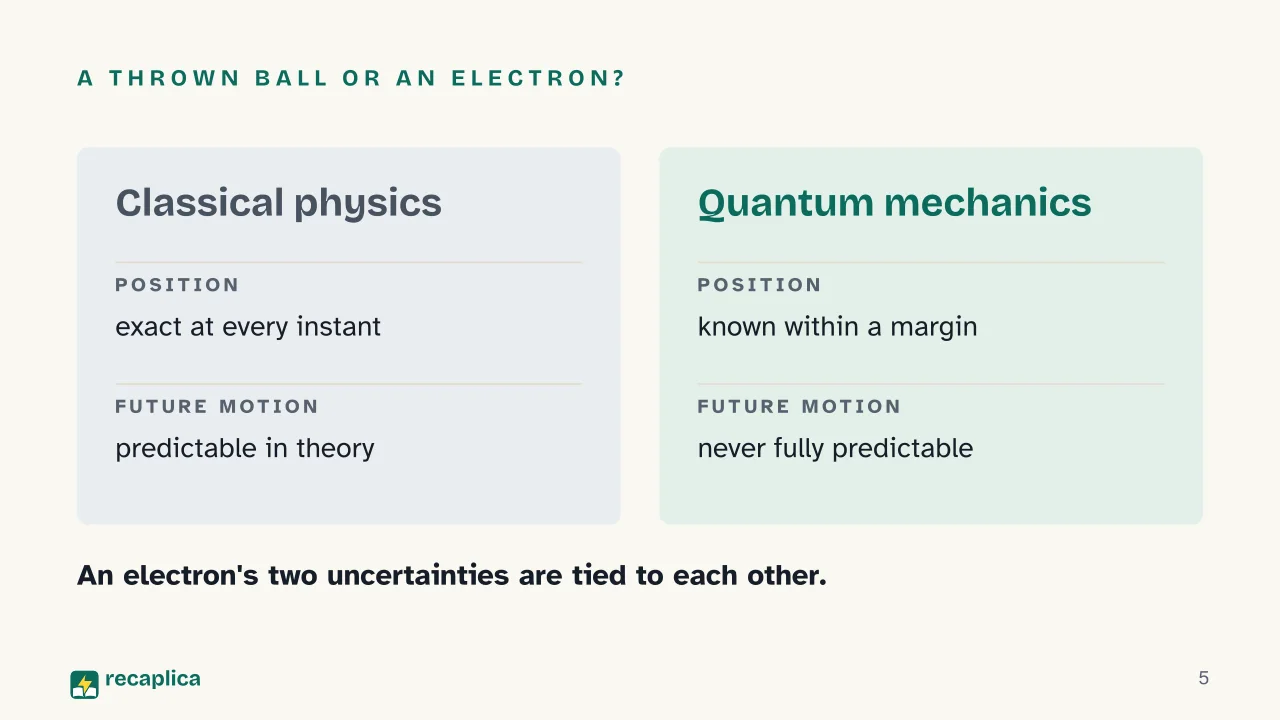  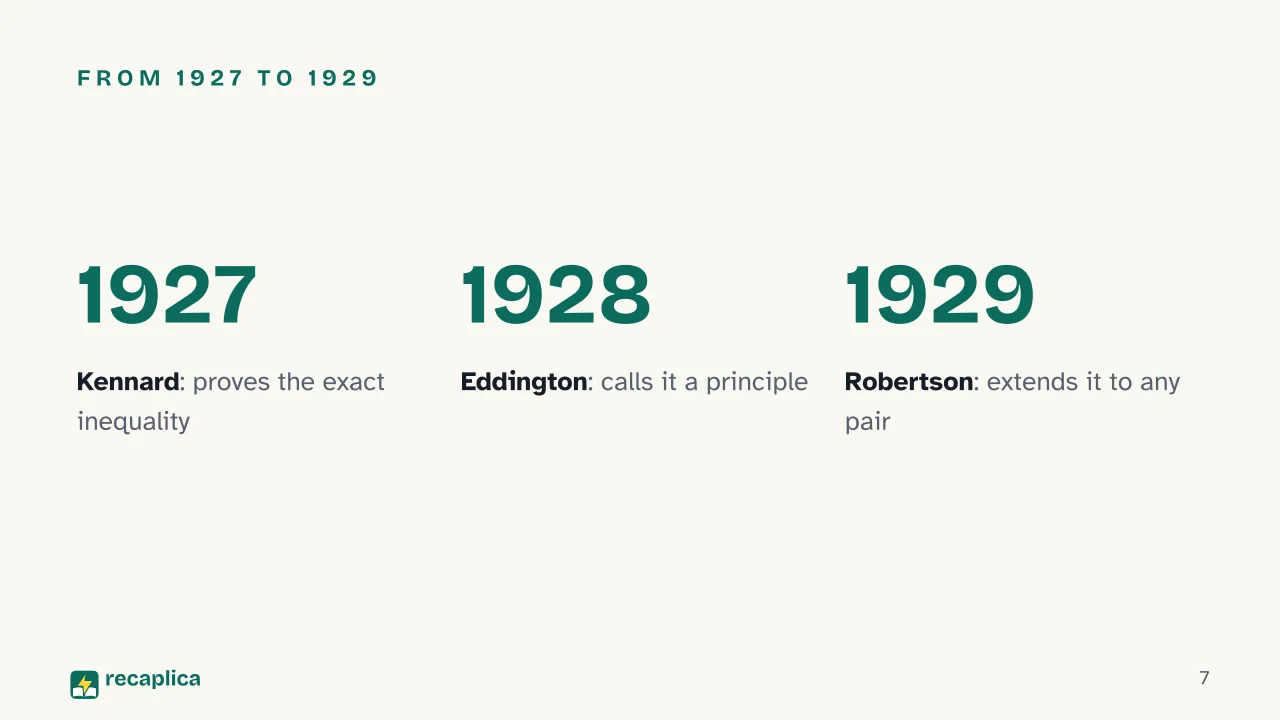  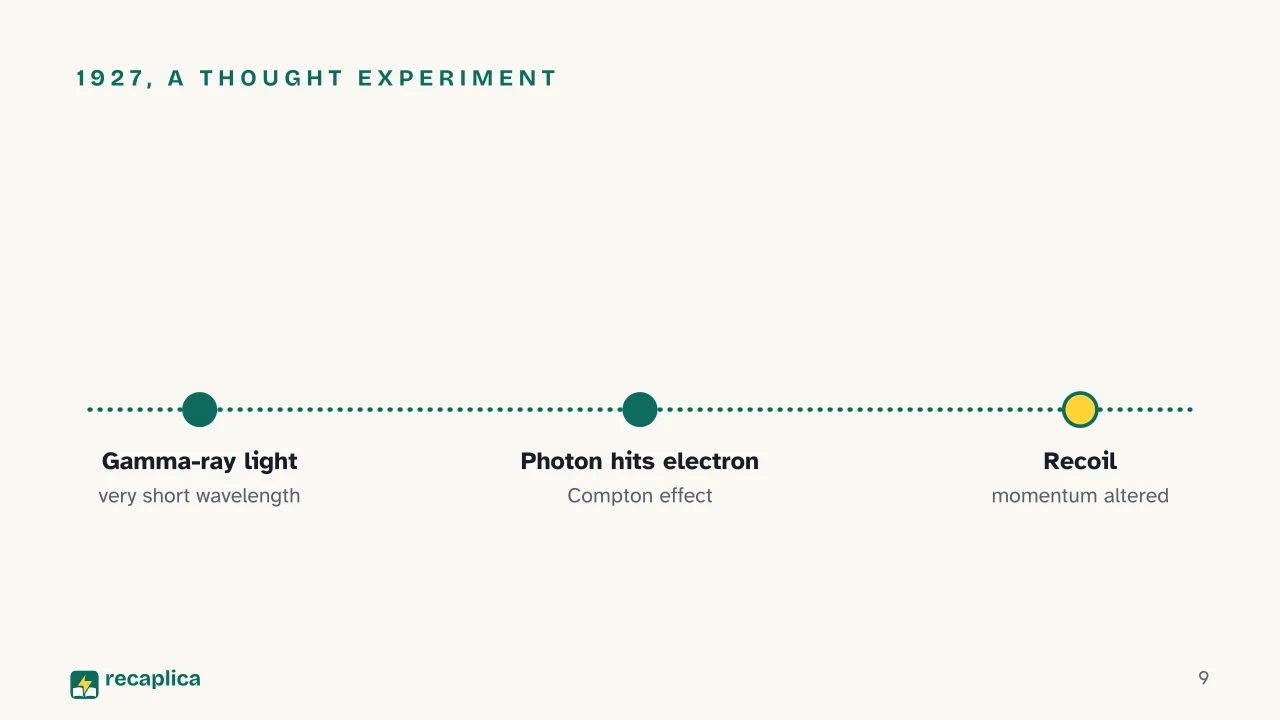 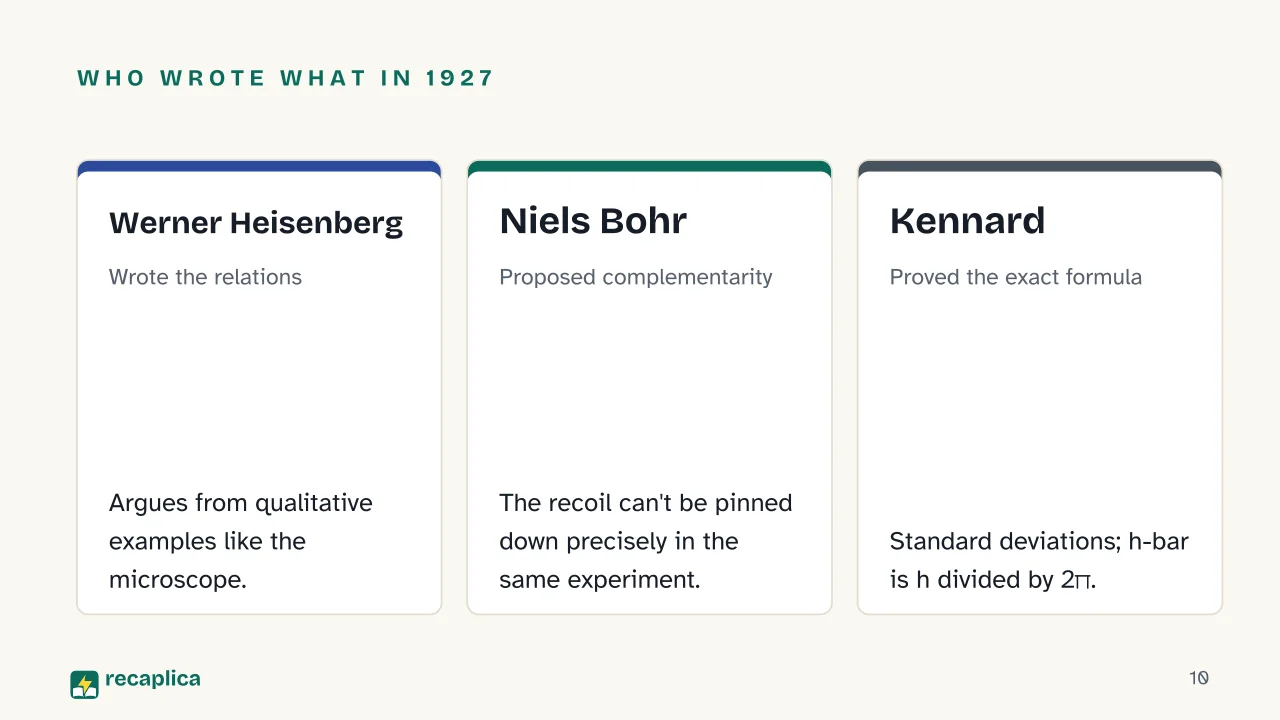  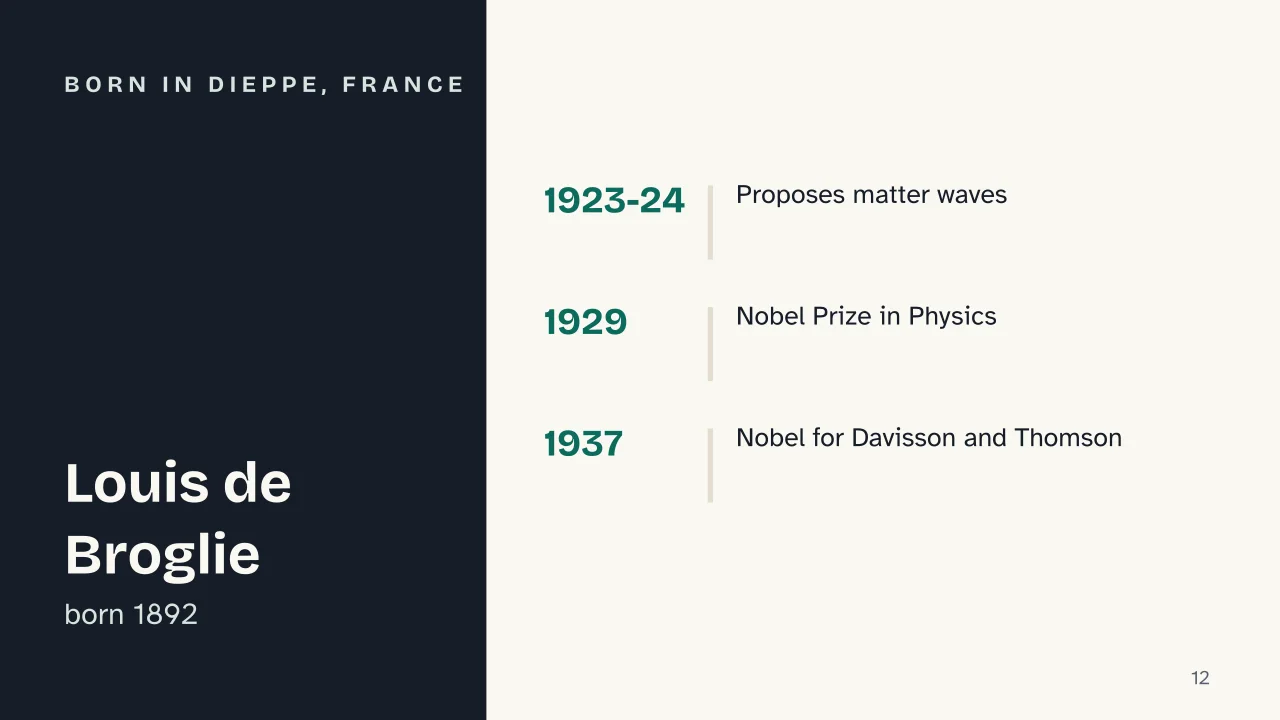 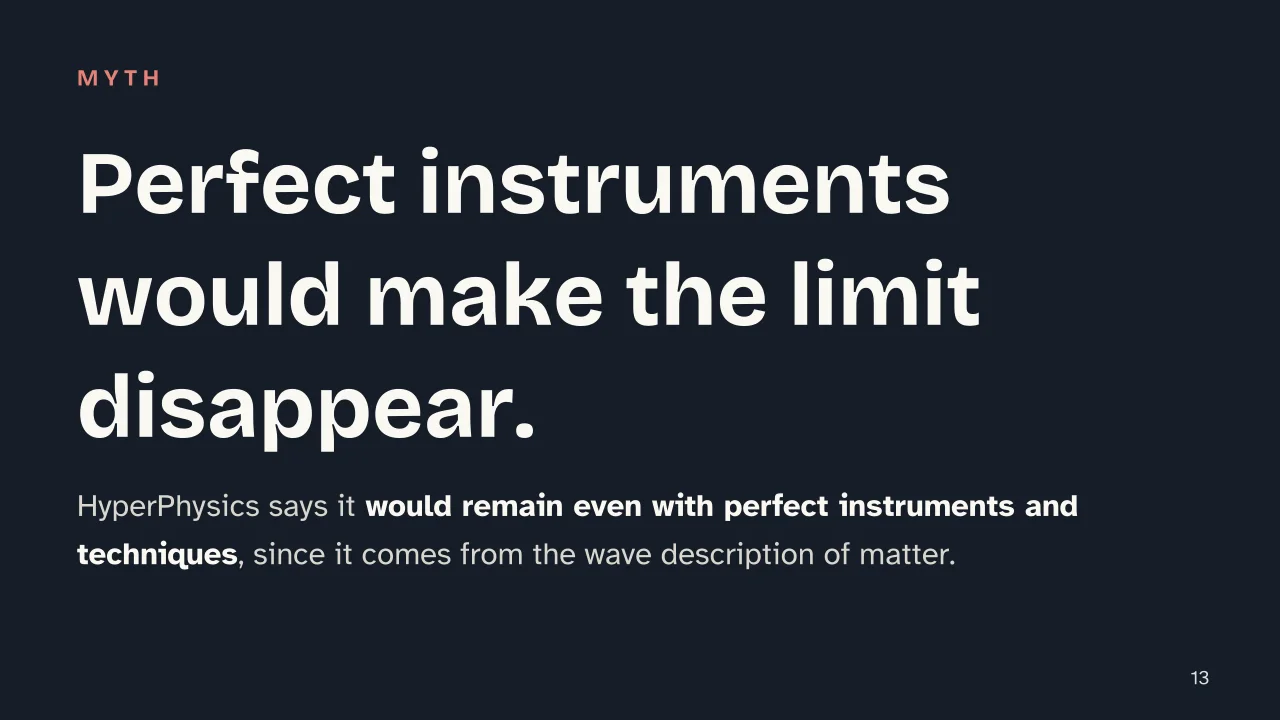 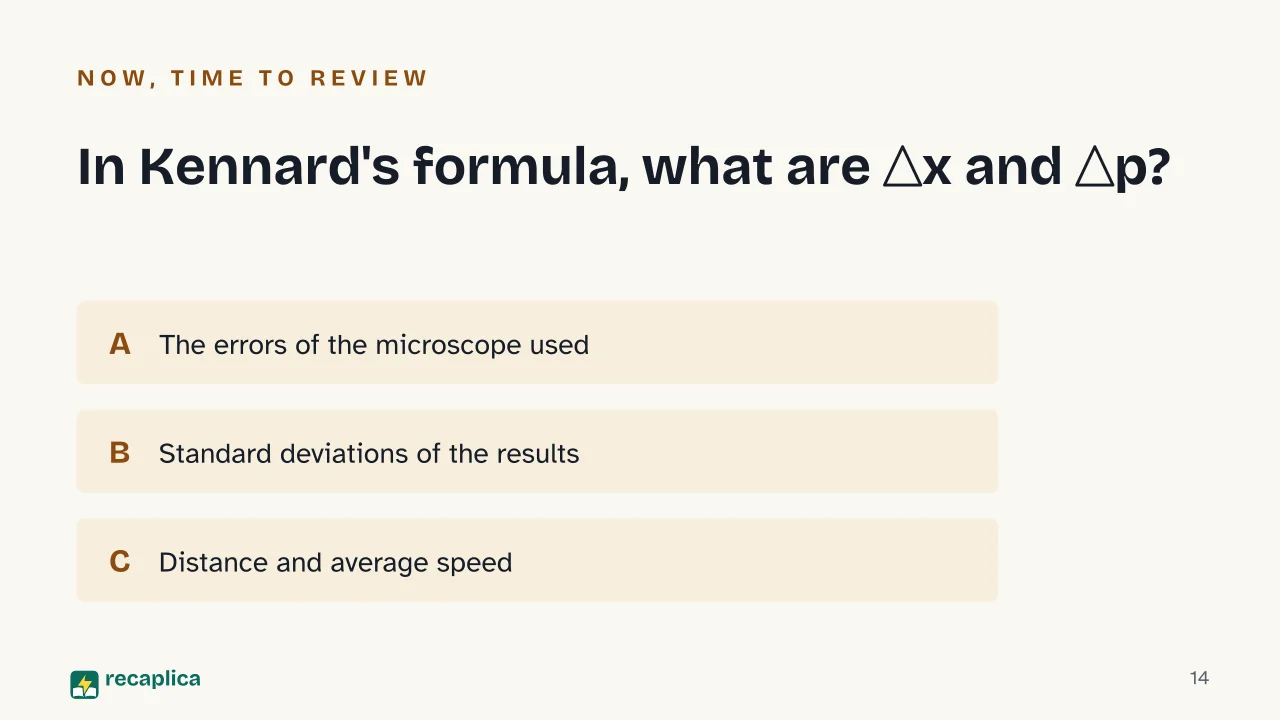  Common myths
Mind mapDrag the background to move around and the nodes to reposition them; use − and + to collapse and expand branches. 
Quiz: test yourselfAnswer the questions to check what you have learned: you get instant feedback and a short explanation. Grade 0/10 0/5
FlashcardsTap the card to flip it and check whether you remember the answer, then move to the next one. 1 / 7 Explain it in your own wordsThe ultimate test: if you can explain it in simple words, you've truly understood it. Write your explanation, then compare it with the Recap. Your explanation is saved only on this device.
Frequently asked questionsHow do you state the Heisenberg uncertainty principle?Put simply, a particle cannot be given exact values of position and momentum at the same moment. The two uncertainties are linked, so as one shrinks the other grows. Heisenberg presented it in 1927 and applied the same reasoning to energy and time. What is the formula for the uncertainty principle?The exact form is Δx · Δp ≥ ħ/2, proved by Kennard in 1927. Δx and Δp are the standard deviations of position and momentum, and ħ is Planck's constant divided by 2π. The product of the two uncertainties can be as large as you like, but it can never be smaller than ħ/2. How does Heisenberg's principle differ from Bohr's complementarity?Heisenberg started from the disturbance a measurement causes, as in his gamma-ray microscope. Bohr argued that in a given experiment position and momentum cannot be defined together. He treated the relations as a symbolic expression of complementarity, the name he gave to his own position. How is de Broglie connected to the uncertainty principle?In 1924, according to the Nobel Foundation, de Broglie proposed that electrons behave as waves too. HyperPhysics names wave-particle duality and his hypothesis as the two steps to take before the principle makes sense. A perfectly regular wave spreads over all of space, which leaves the particle's position completely undetermined. Every Recap goes through an independent review before publication. |