|
recaplica
Gas Laws: What They Are and How Kinetic Theory Explains Them | ||||||
| © 2026 Recaplica · recaplica.com — All rights reserved | ||||||
Gas Laws: What They Are and How Kinetic Theory Explains ThemWhat to print Page numbers appear when printing with default margins. SlidesChoose a cut Flash10 slidesThe essential thread, to present in classFull14 slidesEvery chapter and the deeper detailBoth come with speaker notes. In 30 seconds quick readThe observable behavior of a gas stems from its molecules being in constant, random motion, bouncing endlessly off each other and off the walls of their container. Kinetic theory follows that motion to explain three measurable quantities: pressure, temperature and volume. Pressure comes from molecular collisions. Temperature is tied to the average kinetic energy of the molecules, while volume is simply the space those molecules move through. Named gas laws build on this model by linking pressure, volume and temperature two at a time, each with its own dedicated Recap. This Recap stays at the level of the model itself, before the individual laws. Key Points
Deep DiveTwo ways of looking at the same gasNASA describes a gas as something you can study on two different levels: you can follow the motion of each individual molecule, or you can look at the gas’s combined behavior as a whole system. Those are two levels of description of the same phenomenon. The molecular level is far too small to observe directly — no instrument tracks one molecule at a time inside a container. The level we actually measure is the second one: pressure, volume, temperature are all the combined result of an enormous number of molecules acting together.
The assumptions behind the modelTo move from the molecular level to the macroscopic one, kinetic theory leans on a handful of simplifications. Chemistry LibreTexts (Howard University) lists them this way: molecules never stop moving, in every possible direction; the distance between them is far greater than their own size, so the volume they occupy barely matters; any attractive or repulsive force between them is weak enough to be ignored; and collisions, whether between molecules or against the container walls, leave the overall average kinetic energy unchanged. NASA adds a similar starting condition — molecules have to be very small relative to the distance separating them for the whole model to hold together. Where pressure comes fromIn the kinetic model, pressure comes directly from collisions. NASA ties it to the molecules’ momentum, meaning their mass multiplied by their velocity. Chemistry LibreTexts adds the second ingredient, frequency: pressure climbs when molecules strike the walls more often, or with more force, and drops in the opposite case.
Where temperature comes fromTemperature follows a different logic than pressure. According to Chemistry LibreTexts, the average kinetic energy of a gas’s molecules depends only on temperature: two different gases, brought to the same temperature, end up with the same average kinetic energy, regardless of what they’re made of. HyperPhysics (Georgia State University) narrows the scope of that statement. The average kinetic energy tied to temperature is, as the source notes, limited to the molecules’ translational kinetic energy alone, which excludes any rotation or vibration the molecules might have. HyperPhysics credits this same translational energy with transferring heat from a hotter region, where molecules move faster, to a colder one, through direct collisions between molecules. By comparing the kinetic expression for pressure with the ideal gas law, HyperPhysics arrives at a quantity sometimes called “kinetic temperature.” That’s the quantity that matters when two regions of gas at different temperatures exchange energy. From motion to named lawsThe kinetic model describes the mechanism. The named gas laws describe its measurable effects. Boyle’s, Charles’s and Avogadro’s laws each cross two of these three quantities at a time — every law isolates one pair, and each gets its own dedicated Recap where the details live. What matters here is the framework holding them together: the same molecular motion, seen from three different angles. The same kind of motion that classical mechanics studies through Newton’s laws of motion underlies the behavior of a gas’s individual molecules, even though kinetic theory works with an enormous number of particles at once rather than a single body. The kinetic molecular model is also a good example of how the scientific method works: a simplified hypothesis that lets you calculate testable predictions about measurable quantities. A gas’s molecules are made of atoms that the periodic table organizes by property. The same kinetic behavior described here also underlies how gases act in the atmosphere, a mechanism revisited in connection with the greenhouse effect. Slide deckSlides ready to download and make your own in PowerPoint or Google Slides, with speaker notes. Pick the Flash cut or the Full one.     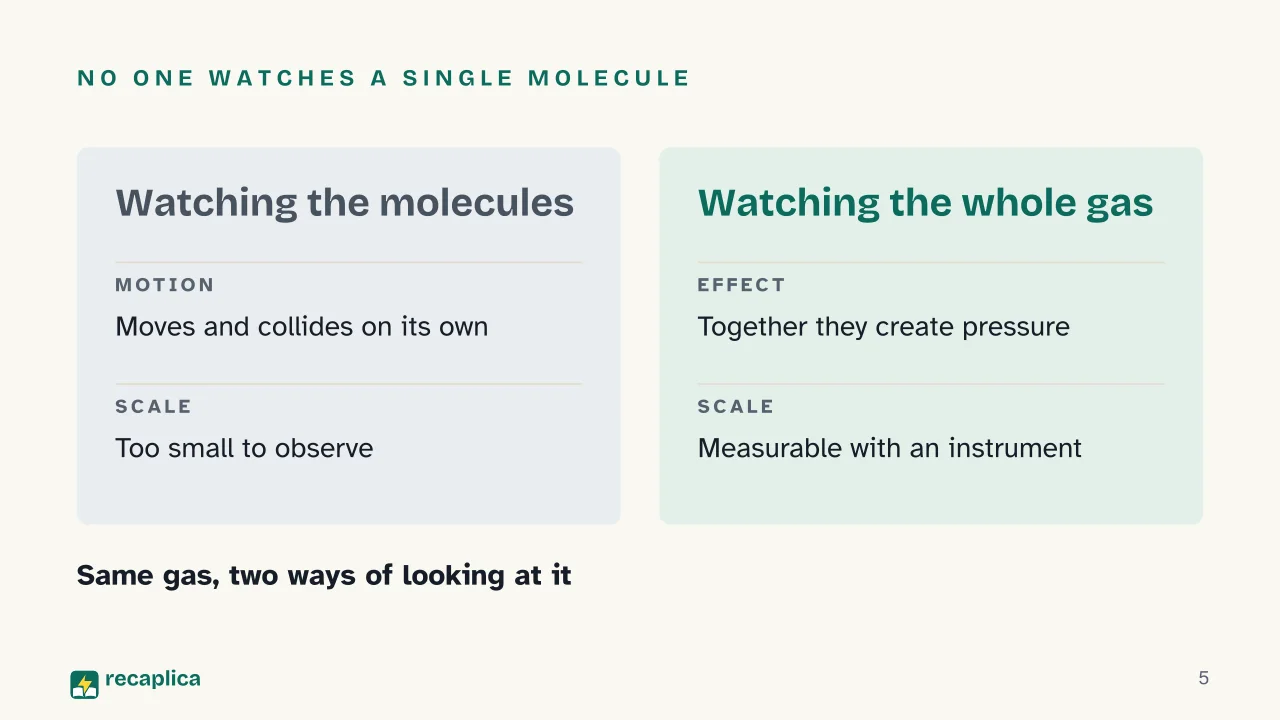 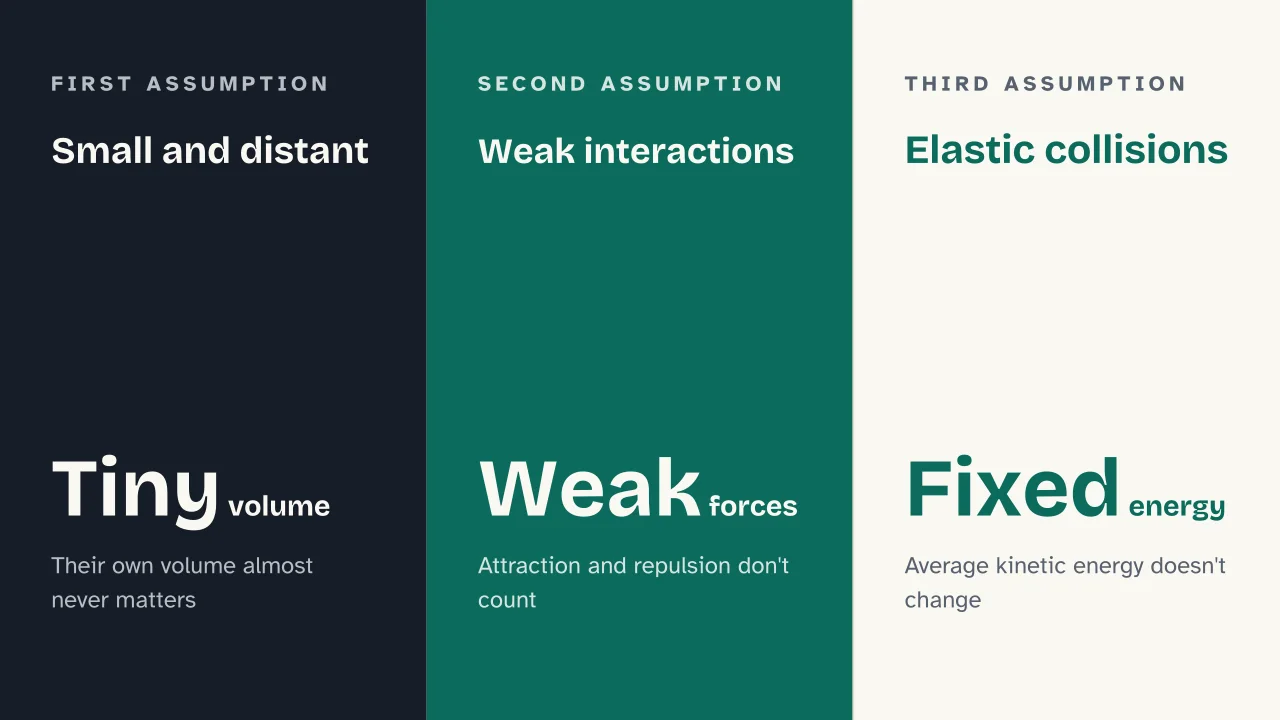  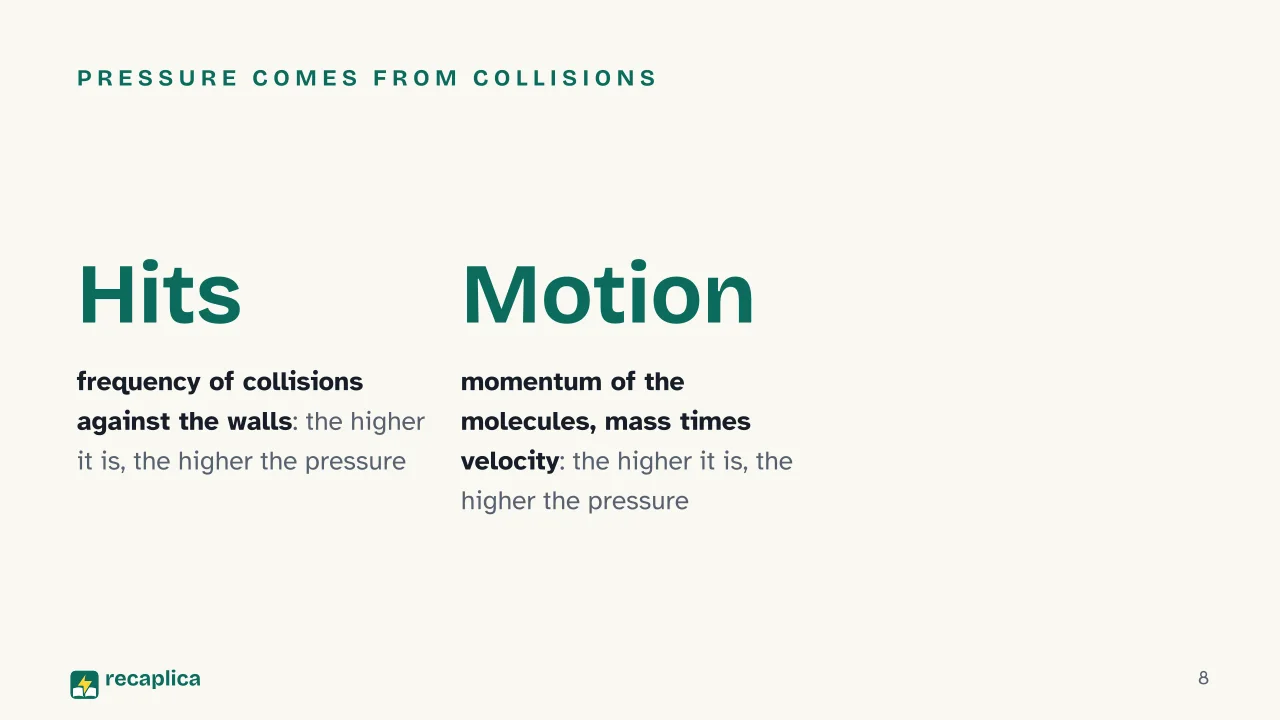  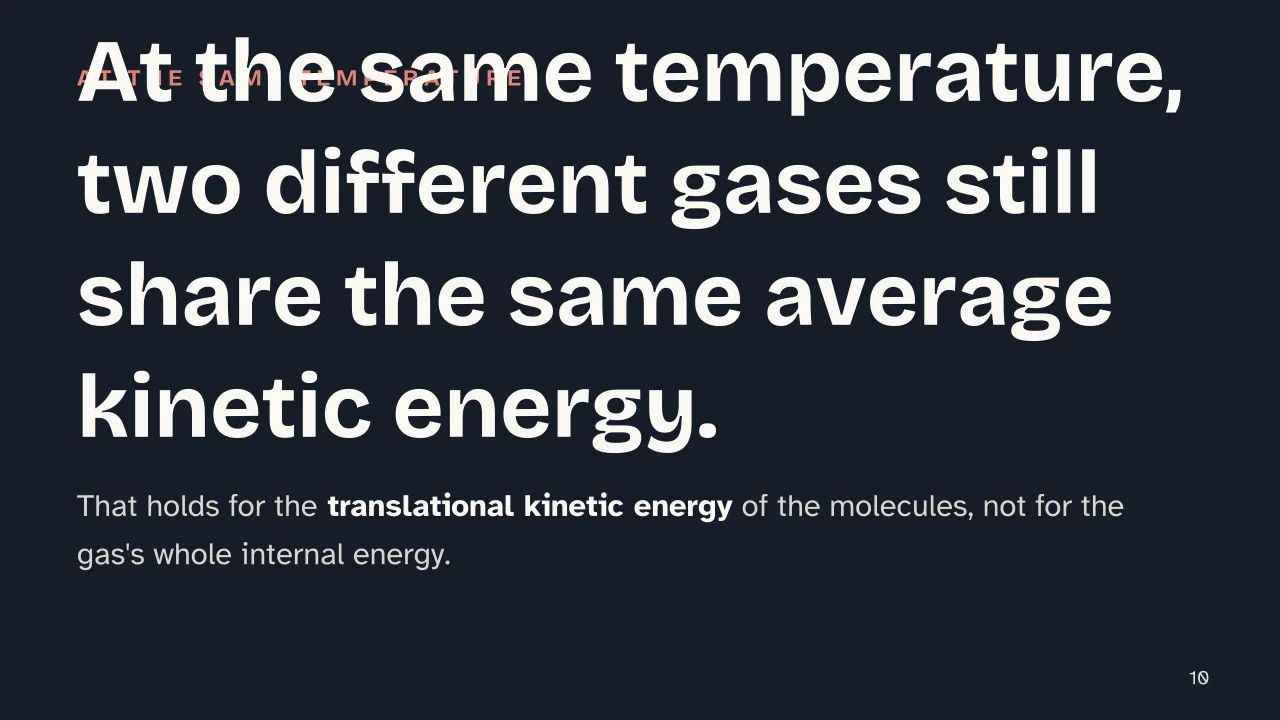  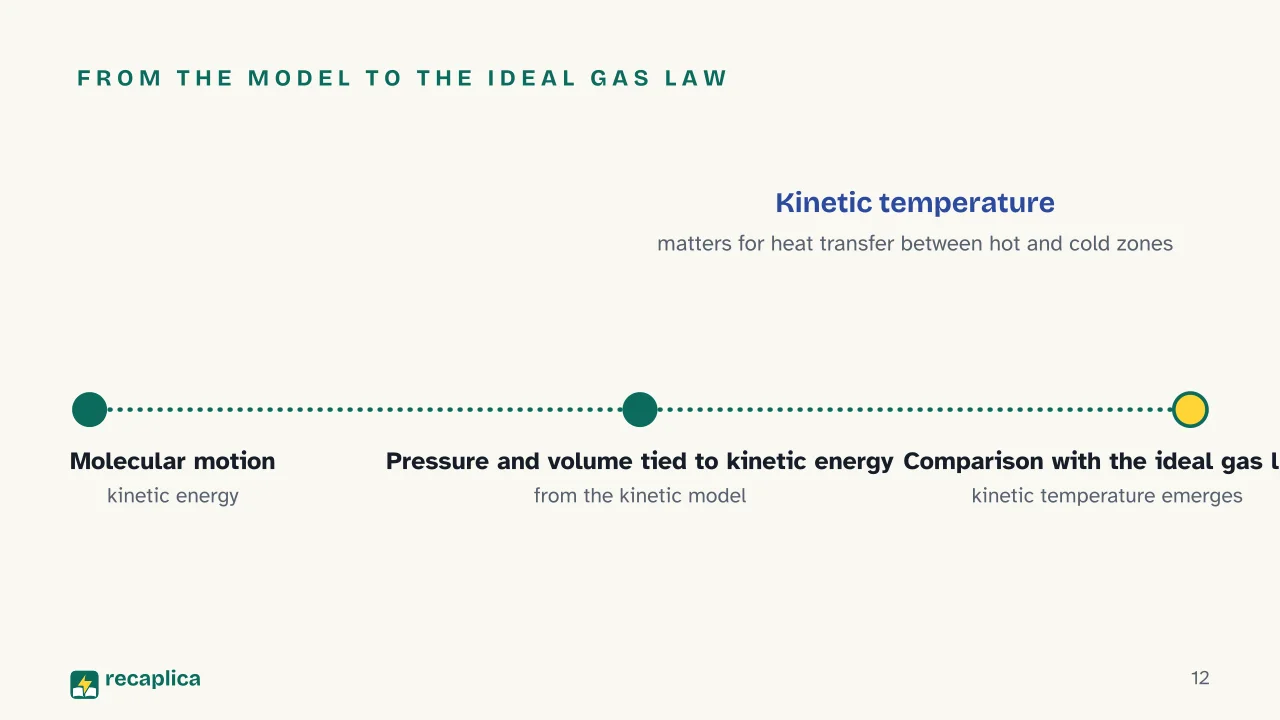 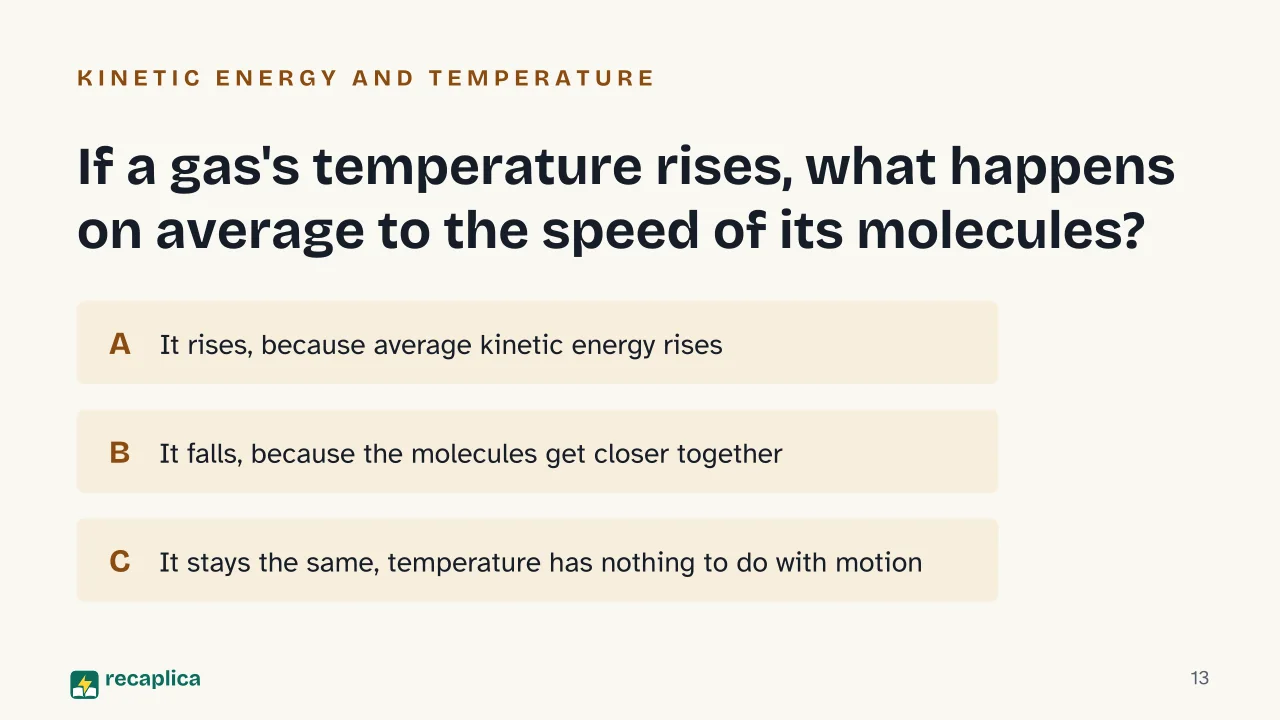  Common myths
Mind mapDrag the background to move around and the nodes to reposition them; use − and + to collapse and expand branches. 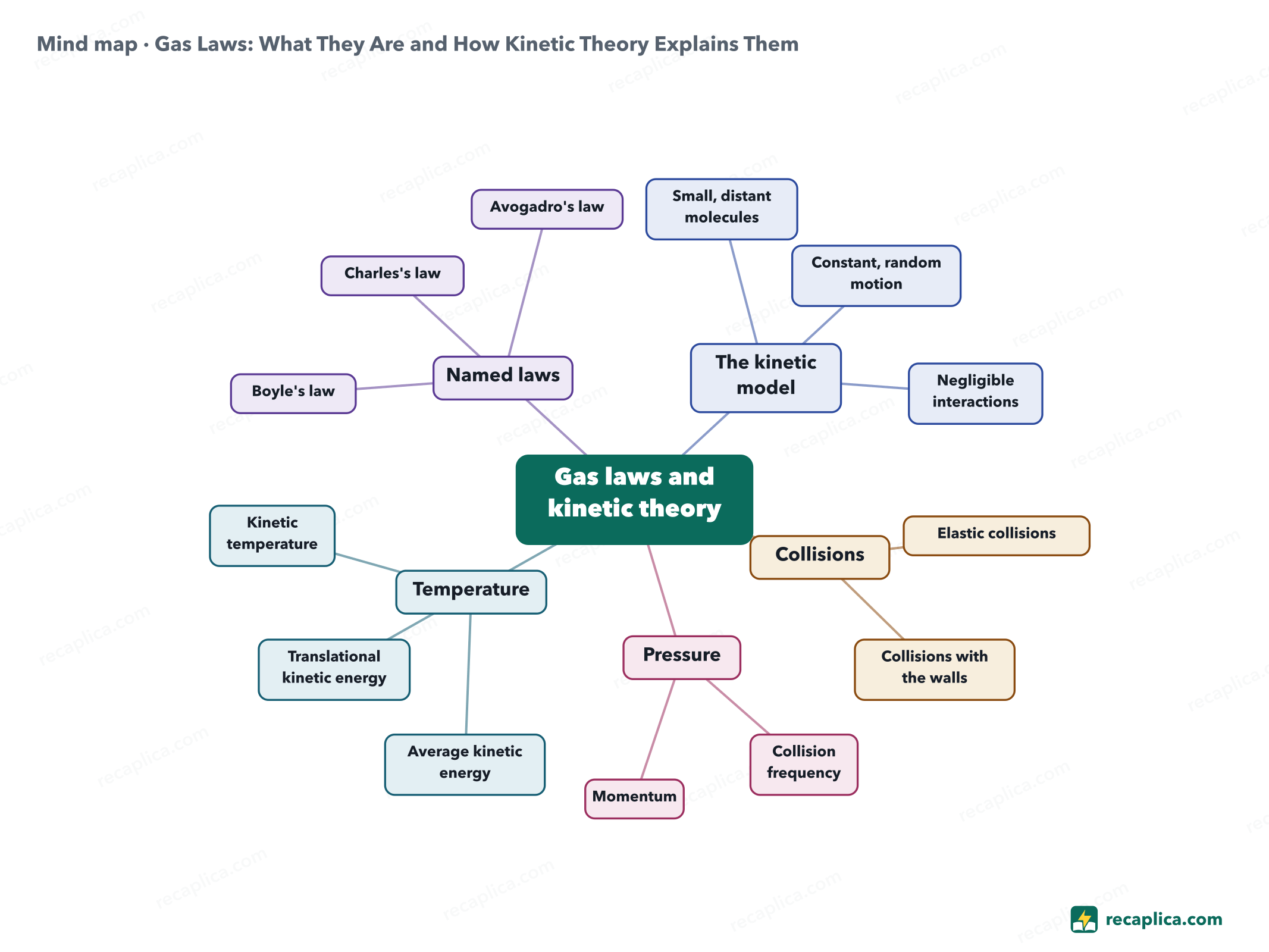
Quiz: test yourselfAnswer the questions to check what you have learned: you get instant feedback and a short explanation. Grade 0/10 0/5
FlashcardsTap the card to flip it and check whether you remember the answer, then move to the next one. 1 / 6 Explain it in your own wordsThe ultimate test: if you can explain it in simple words, you've truly understood it. Write your explanation, then compare it with the Recap. Your explanation is saved only on this device.
Frequently asked questionsWhat is the kinetic theory of gases?It's the model that describes a gas by following the motion of its molecules, always moving in unpredictable directions, in order to explain pressure, temperature and volume. What's the difference between pressure and temperature in the kinetic model?Pressure comes from molecules colliding with the container walls, while temperature reflects how fast the molecules move on average: two different effects of the same underlying motion. Are Boyle's, Charles's and Avogadro's laws part of the kinetic theory of gases?They come from the same kinetic molecular model, but each one pairs up pressure, volume and temperature in its own way, covered in a dedicated Recap. Why does the kinetic model treat collisions between gas molecules as elastic?Because the model assumes those collisions leave the molecules' average kinetic energy unchanged: a simplification Chemistry LibreTexts uses to build up to the gas laws. Every Recap goes through an independent review before publication. |