|
recaplica
What Is an Inertial Reference Frame? Galileo's Principle of Relativity |
| © 2026 Recaplica · recaplica.com — All rights reserved |
What Is an Inertial Reference Frame? Galileo's Principle of RelativityWhat to print Page numbers appear when printing with default margins. SlidesChoose a cut Flash10 slidesThe essential thread, to present in classFull14 slidesEvery chapter and the deeper detailBoth come with speaker notes. In 30 seconds quick readAn inertial reference frame is one where an object with no forces acting on it keeps moving at a constant speed in a straight line. Galileo built a broader idea out of a ship: inside a sealed cabin, no mechanical experiment can tell you whether you're standing still or cruising at a steady speed. That observation became the Galilean principle of relativity. Einstein picked up the same thread centuries later and stretched it to cover all of physics, not just mechanics. Key Points
Deep DiveThe Stanford Encyclopedia of Philosophy defines an inertial reference frame as one equipped with a time scale in which a body free of applied forces moves in a straight line at constant speed. In that frame, accelerations stay proportional to and aligned with the forces producing them, and every force meets an equal and opposite reaction. It’s the same logic behind Newton’s three laws of motion: a frame counts as inertial exactly when the first of those laws, taken literally, still holds. Galileo reached a broader idea from a thought experiment about a ship. Dropping a stone from the mainmast of a vessel moving at constant velocity, he noted that it lands right where the mast meets the deck, because its downward path combines with the ship’s own forward motion — and steady enough motion ends up looking exactly like standing still. Before him, per the same Stanford Encyclopedia entry, Copernicus had already noticed that motion can go unnoticed, watching a ship glide gently across calm water; Galileo picked up that observation and built it into the Galilean principle of relativity, which holds that a mechanical experiment gives the same outcome at rest and in uniform motion.
Inertial and non-inertial frames: where apparent forces come fromNot every reference frame is inertial. Per Physics LibreTexts/OpenStax, when a car accelerates and the passenger feels pressed against the seat, it’s the body tending to stay at rest by inertia; the seat is what pushes the passenger forward. The same holds on a curve, where the sideways push you feel comes from your body continuing straight while the car turns beneath it. These felt pushes, with no real interaction behind them, are called apparent or fictitious forces: only present in an accelerating or rotating non-inertial reference frame. The Galilean transformation, plainlyTo link the coordinates of two inertial frames in uniform relative motion, Galileo works with four relations: x’ = x − vt, y’ = y, z’ = z, t’ = t. Position along the direction of motion depends on the relative velocity and the elapsed time; the other two directions stay identical, and time runs the same way in both frames. Acceleration, force and mass carry over unchanged from one inertial frame to another — a mechanics experiment run aboard the ship gives the same result as one run on the dock. From Galileo’s principle to Einstein’s relativityAccording to the course “Galileo and Einstein” by Michael Fowler (University of Virginia), Galileo observed that watching the motion of objects inside a closed room can’t tell you whether the room is standing still or riding on a boat moving at constant speed in a fixed direction. In its modern phrasing, this idea says the laws of physics stay identical in a room moving at uniform velocity and in a room standing still on the ground. Einstein picked up that thought experiment and turned it into a general principle: physical laws hold identically across every inertial reference frame, mechanics included — and, he added, so do Maxwell’s equations on electric and magnetic fields. In the nineteenth century, though, electrodynamics had complicated that picture: the theory of light as an electromagnetic wave in the ether seemed to require a privileged reference frame, the one at rest in the ether. It was Einstein, per the Stanford Encyclopedia of Philosophy, who resolved the clash between Galilean relativity and electrodynamics, by showing that two frames in relative motion can only agree on the speed of light if they give up a shared notion of simultaneity between events. Slide deckSlides ready to download and make your own in PowerPoint or Google Slides, with speaker notes. Pick the Flash cut or the Full one.     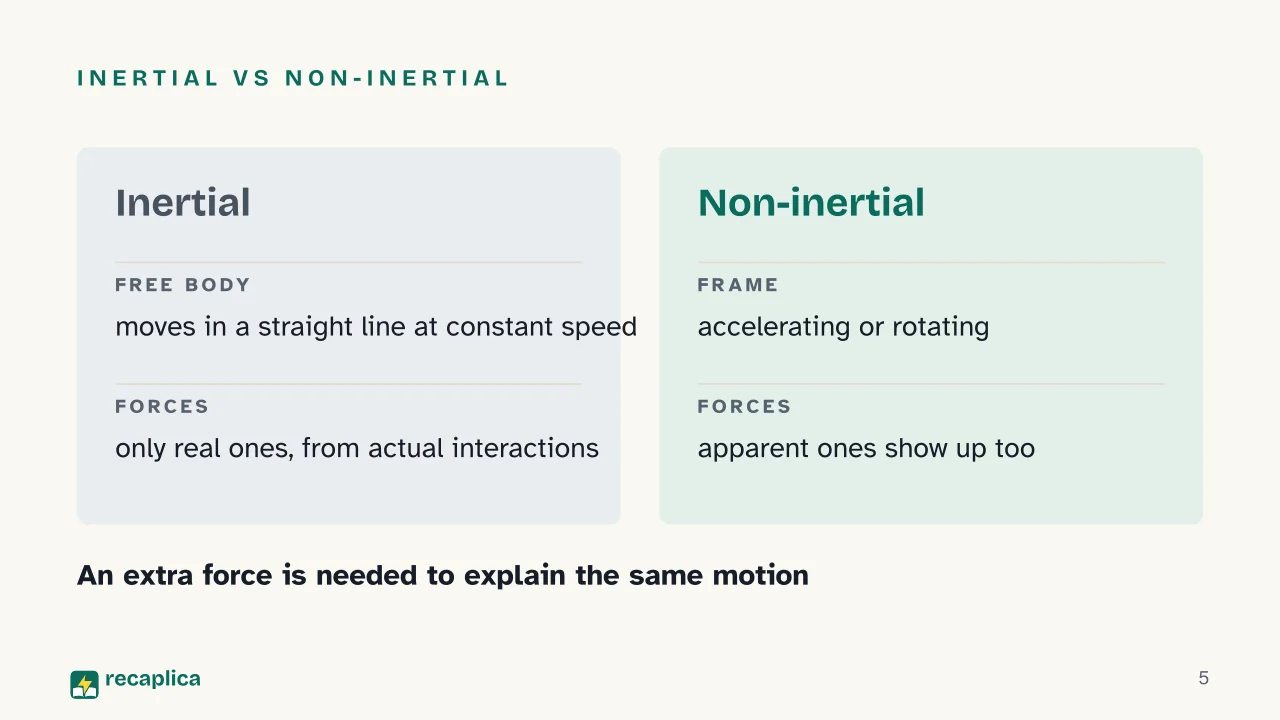  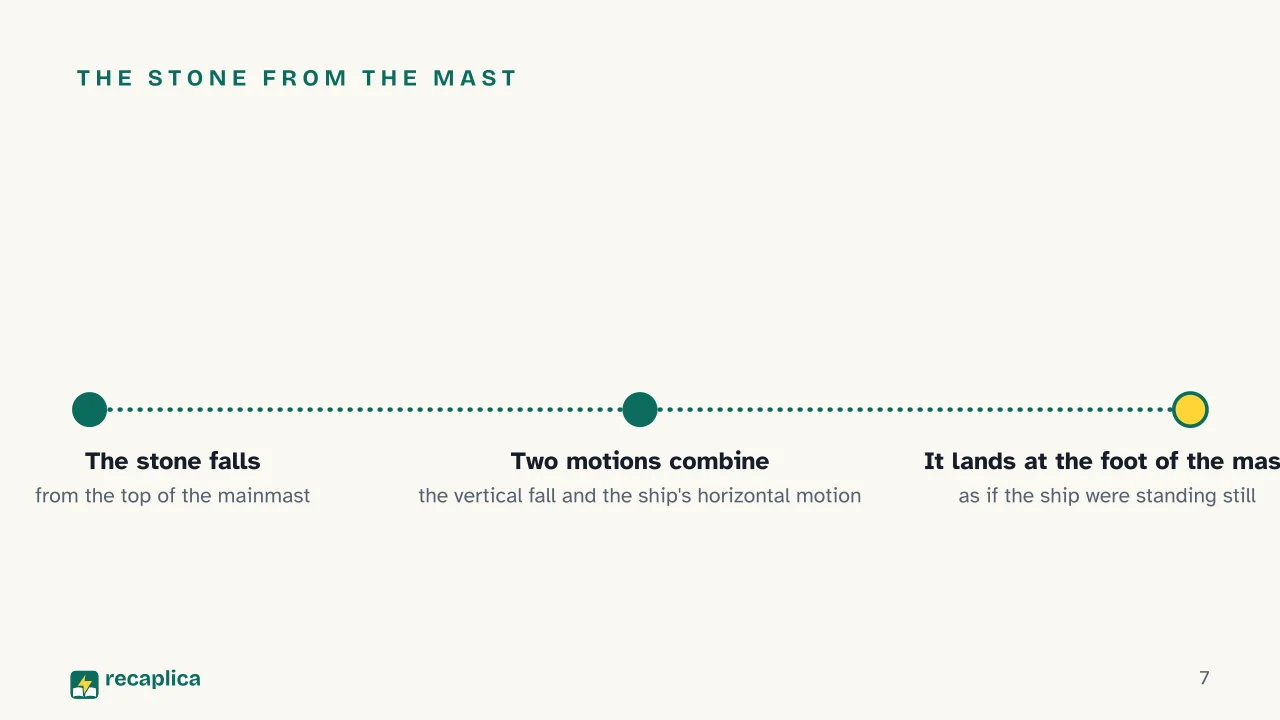   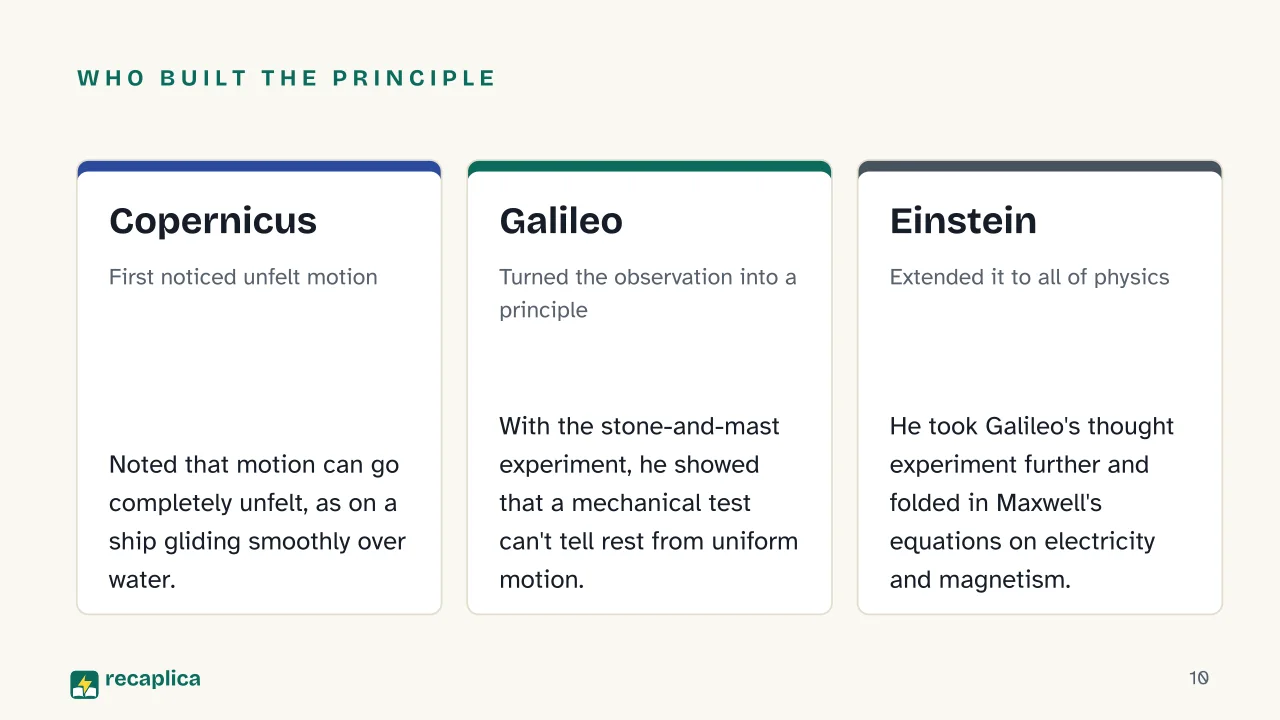  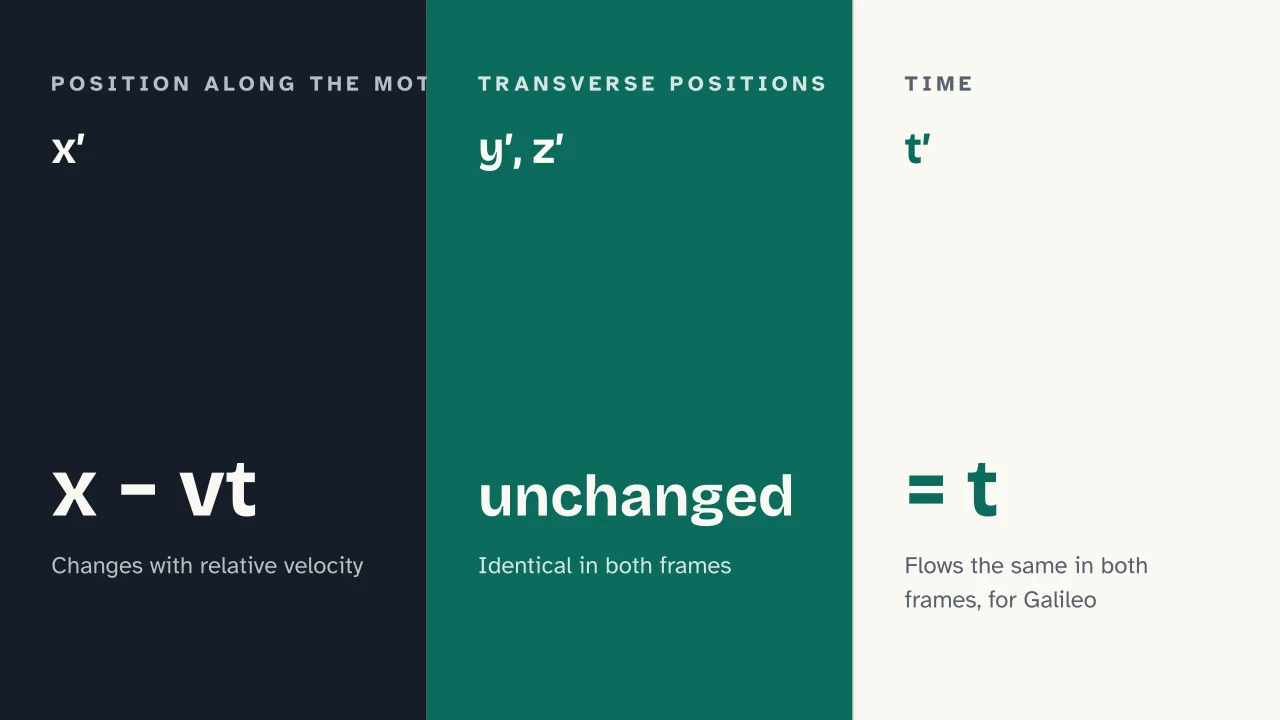 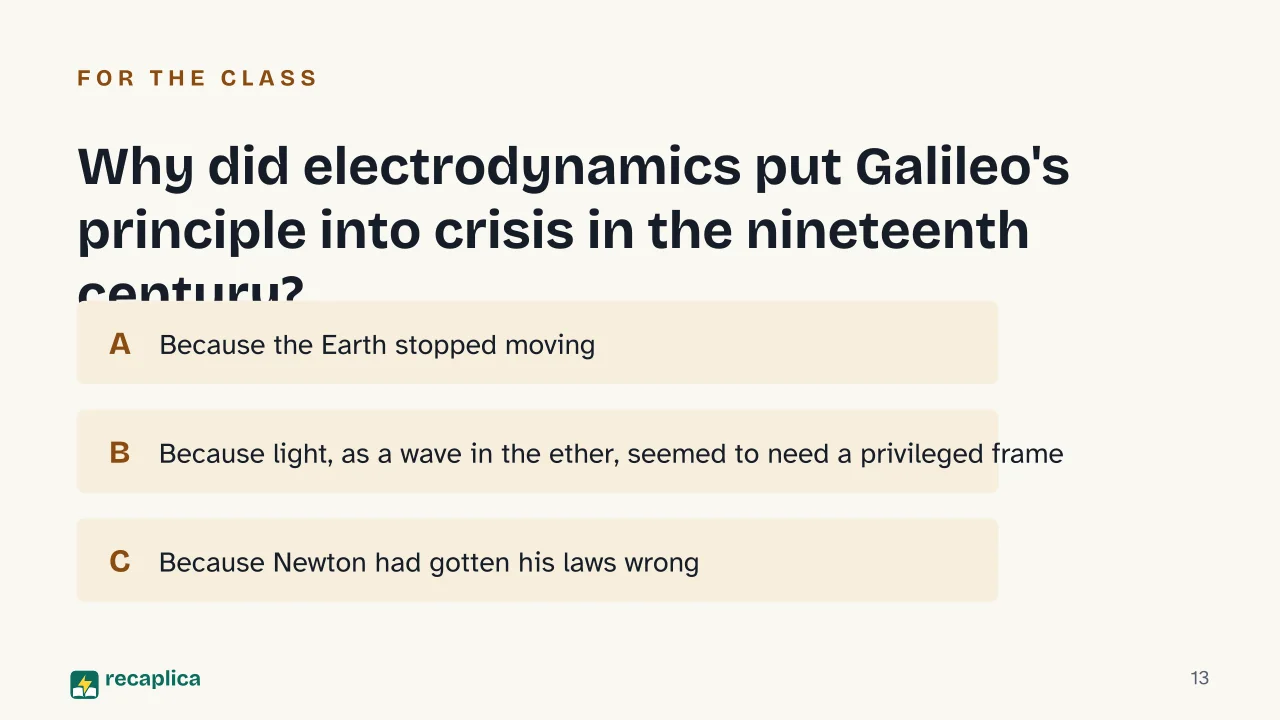  Common myths
Mind mapDrag the background to move around and the nodes to reposition them; use − and + to collapse and expand branches. 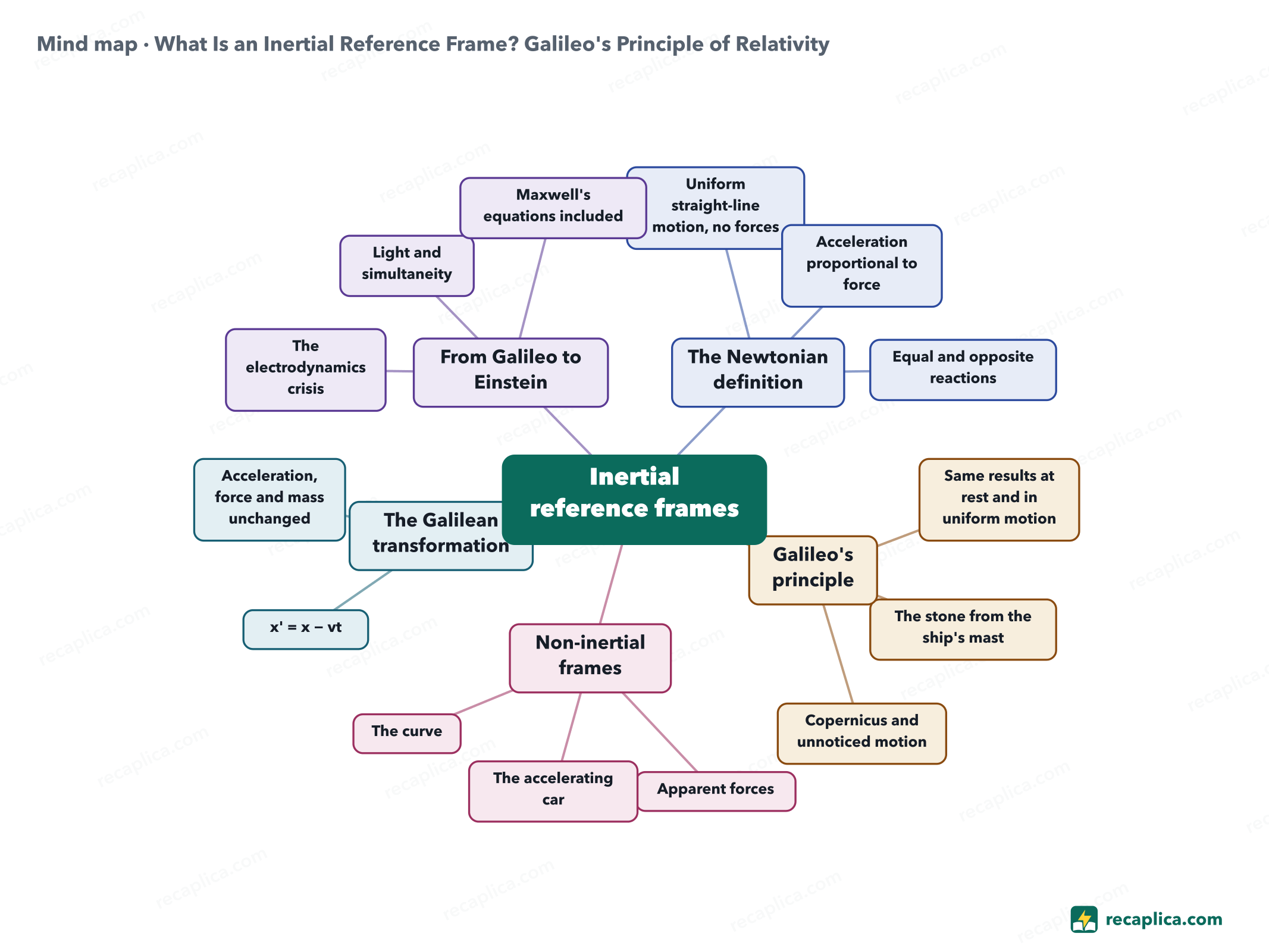
Quiz: test yourselfAnswer the questions to check what you have learned: you get instant feedback and a short explanation. Grade 0/10 0/5
FlashcardsTap the card to flip it and check whether you remember the answer, then move to the next one. 1 / 8 Explain it in your own wordsThe ultimate test: if you can explain it in simple words, you've truly understood it. Write your explanation, then compare it with the Recap. Your explanation is saved only on this device.
Frequently asked questionsWhat's a concrete example of an inertial reference frame?A room standing still on the ground counts as one, and so does the same room aboard a ship moving at constant speed in a straight line: the laws of physics inside don't change either way. What's the practical difference between an inertial and a non-inertial frame?In an inertial frame, a real force is enough to account for any motion; in one that accelerates or rotates, you also need an apparent force, like the one felt when a car brakes or takes a curve. How does Galileo's principle connect to Einstein's relativity?Einstein took Galileo's ship thought experiment and turned it into a principle for all of physics, electromagnetism included. Is the Galilean transformation still valid?It remains a good approximation whenever speeds are far below that of light, which is why it still holds up classical mechanics; its limits showed up with nineteenth-century electrodynamics, later resolved by Einstein. Why do you feel a push in a car even though no real force acts on you?Your body tends to keep its state of motion by inertia while the vehicle changes speed or direction; the sensation comes from that mismatch, not from a real push on the passenger. Every Recap goes through an independent review before publication. |