|
recaplica
Galilean Transformation: The Equations Linking Two Reference Frames |
| © 2026 Recaplica · recaplica.com — All rights reserved |
Galilean Transformation: The Equations Linking Two Reference FramesWhat to print Page numbers appear when printing with default margins. SlidesChoose a cut Flash10 slidesThe essential thread, to present in classFull14 slidesEvery chapter and the deeper detailBoth come with speaker notes. In 30 seconds quick readThe Galilean transformation is the set of equations that converts the space and time coordinates measured in one reference frame into the coordinates measured in another frame, when the two move relative to each other at a constant speed along a straight line. It explains why a player striking a ball and a goalkeeper standing still on the field read off different speeds for the same ball while agreeing on the same laws of mechanics. The equations hold with good accuracy at everyday speeds; above roughly 3,000 kilometers per second they stop working and Einstein's special relativity takes over. The transformation is named after Galileo Galilei, who first stated the principle it rests on. Key Points
Deep DiveWhen two people measure the position of the same object from two different vantage points, they get different numbers while describing the same event. The Galilean transformation is the system of four equations that converts these readings from one observer to another, provided their relative speed stays constant, with neither one accelerating or veering off a straight line. It is the idea underneath nearly all the physics taught before relativity: an inertial reference frame is, in this scheme, one of those two observers who feel no mysterious force pulling them sideways. The Galilean transformation formulaConsider two reference frames that coincide at the starting instant, with the second frame (the “primed” one) moving along the x axis at constant speed v relative to the first. The four equations are:
The sideways coordinates, y and z, do not change: the motion happens only along x. The time t’ equals t, meaning the same clock applies to both observers. From these equations also follows the rule for velocities: if an object moves at speed u in the first frame, its speed measured in the second frame is u’ = u - v.
Why Galileo got there firstThe Galilean principle of relativity states that mechanical experiments give the same result in a frame at rest and in a frame moving at constant velocity in a straight line. Dropping an object, for instance, produces the same outcome whether you stand on a motionless floor or on one gliding forward at constant speed. Galileo used this to tackle an enormous problem for his time: if the Earth orbits the Sun, why don’t we feel it? The answer, under this principle, is that there is no reason we should feel it. Uniform motion leaves no trace in everyday experiments, so the absence of any sensation of movement does not prove the Earth is standing still. Galileo could not reach a decisive proof of the Earth’s motion through the solar system: what he showed instead is that the Copernican hypothesis does not contradict daily experience, which for his era was already a powerful argument against anyone who assumed the Earth’s motion had to be felt somehow. How velocities add upClassical velocity addition, the rule that follows from the Galilean transformation, matches the intuitive way people normally think about motion: velocities add up like ordinary numbers, with no correction needed. That is why the calculation in the player example feels almost too obvious to spell out: Galilean physics lines up with everyday common sense. This same addition rule is also what keeps the Galilean transformation consistent with Newton’s laws of motion: acceleration, force and mass stay unchanged when switching from one inertial reference frame to another. Time, length and the simultaneity of two events also stay unchanged under it. Where the formula stops workingClassical relativity, and with it the Galilean transformation, is an approximation valid when the speeds involved stay below roughly 1% of the speed of light, that is below 3,000 kilometers per second. Within that range, which covers practically every speed encountered in daily life, the equations give correct results with a negligible margin of error. That is why no one driving a car or throwing a ball has ever needed to correct their math with special relativity. The error introduced by the classical approximation grows as speed approaches that threshold, and past a certain point it stops being negligible. Beyond that threshold the symmetry breaks down: time can no longer be treated as the same for every observer, and the Lorentz transformation takes over, at the core of Einstein’s special relativity. The two frameworks are not in competition in the usual sense of the word, because the Galilean transformation still holds, to an excellent approximation, in every slow-speed case that Lorentz treats as a limiting case. Slide deckSlides ready to download and make your own in PowerPoint or Google Slides, with speaker notes. Pick the Flash cut or the Full one.     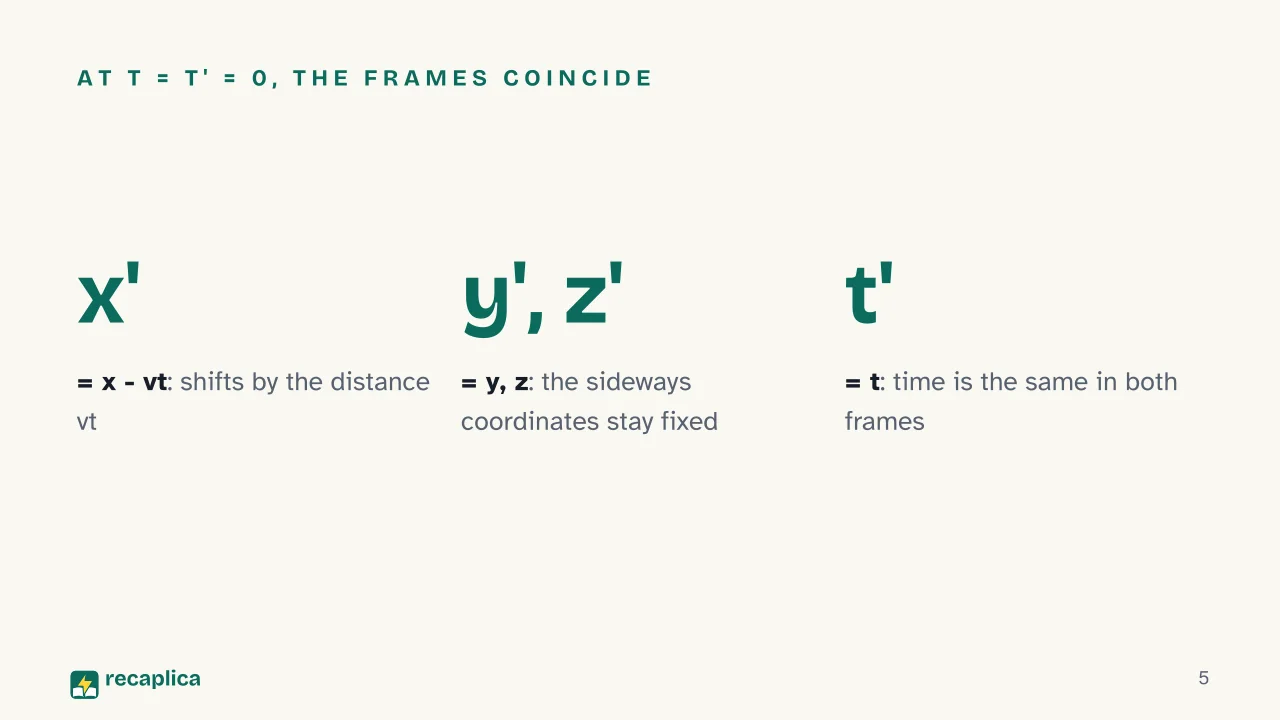  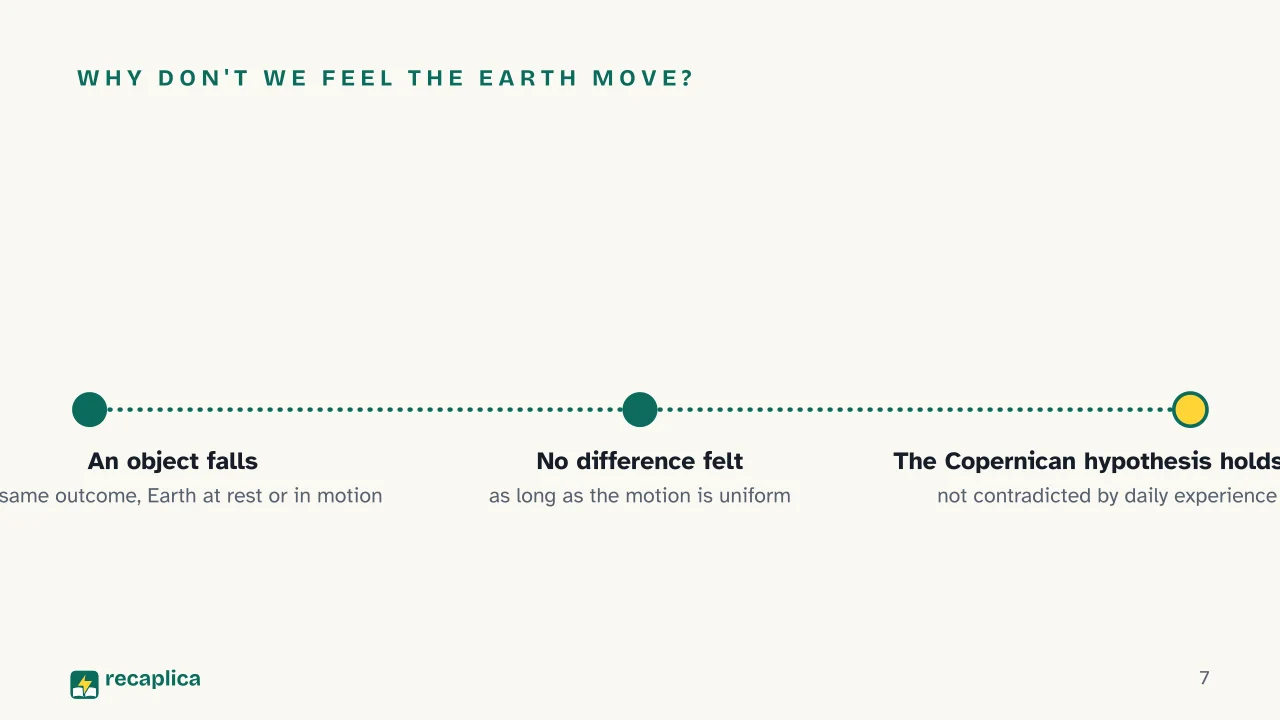  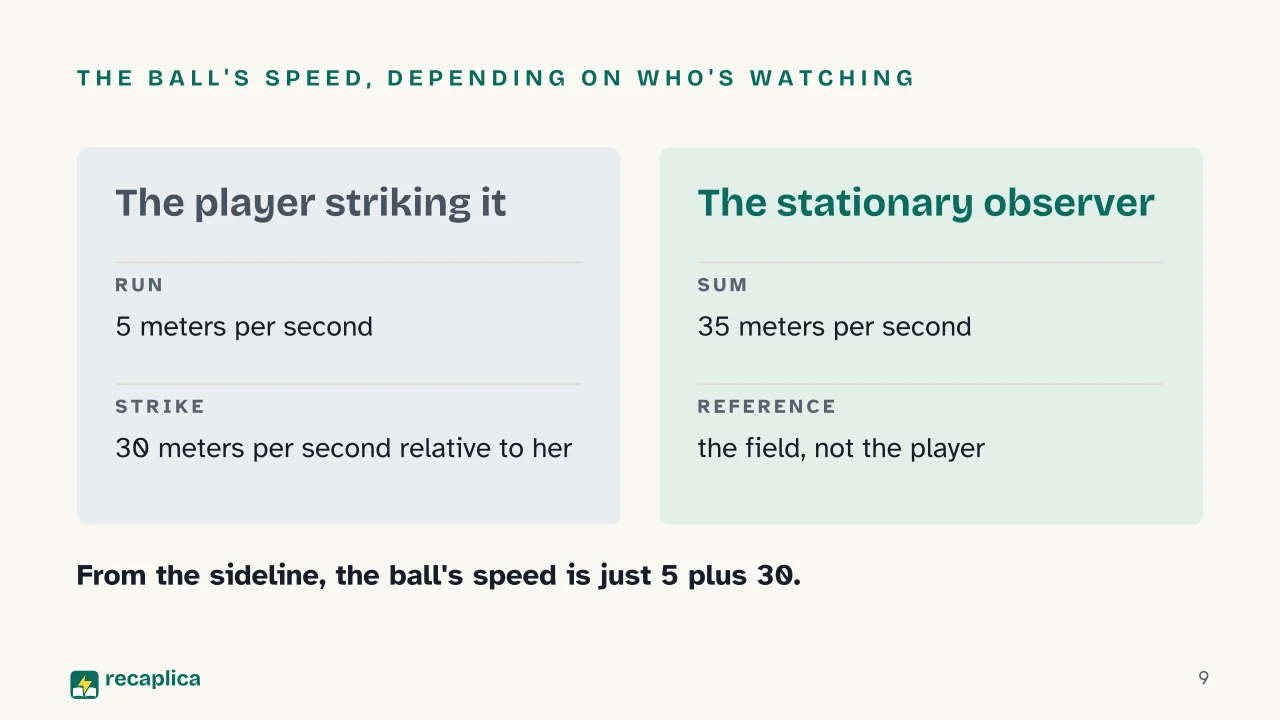 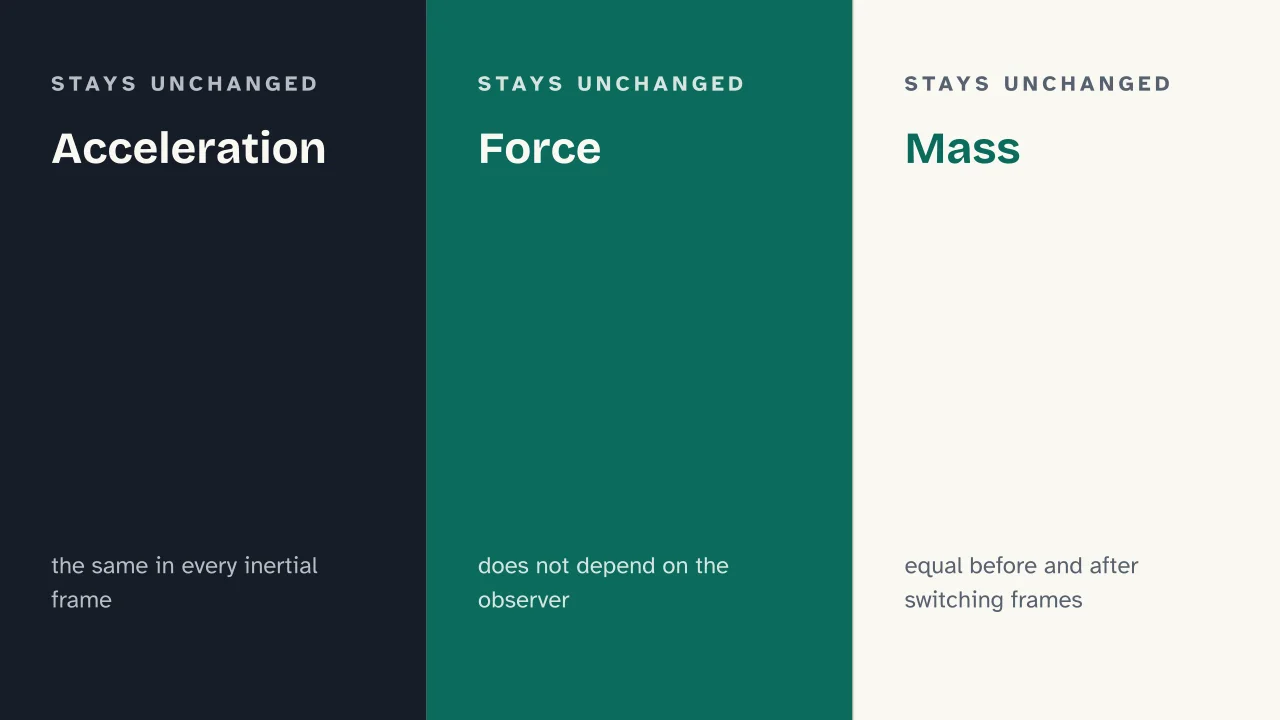     Common myths
Mind mapDrag the background to move around and the nodes to reposition them; use − and + to collapse and expand branches. 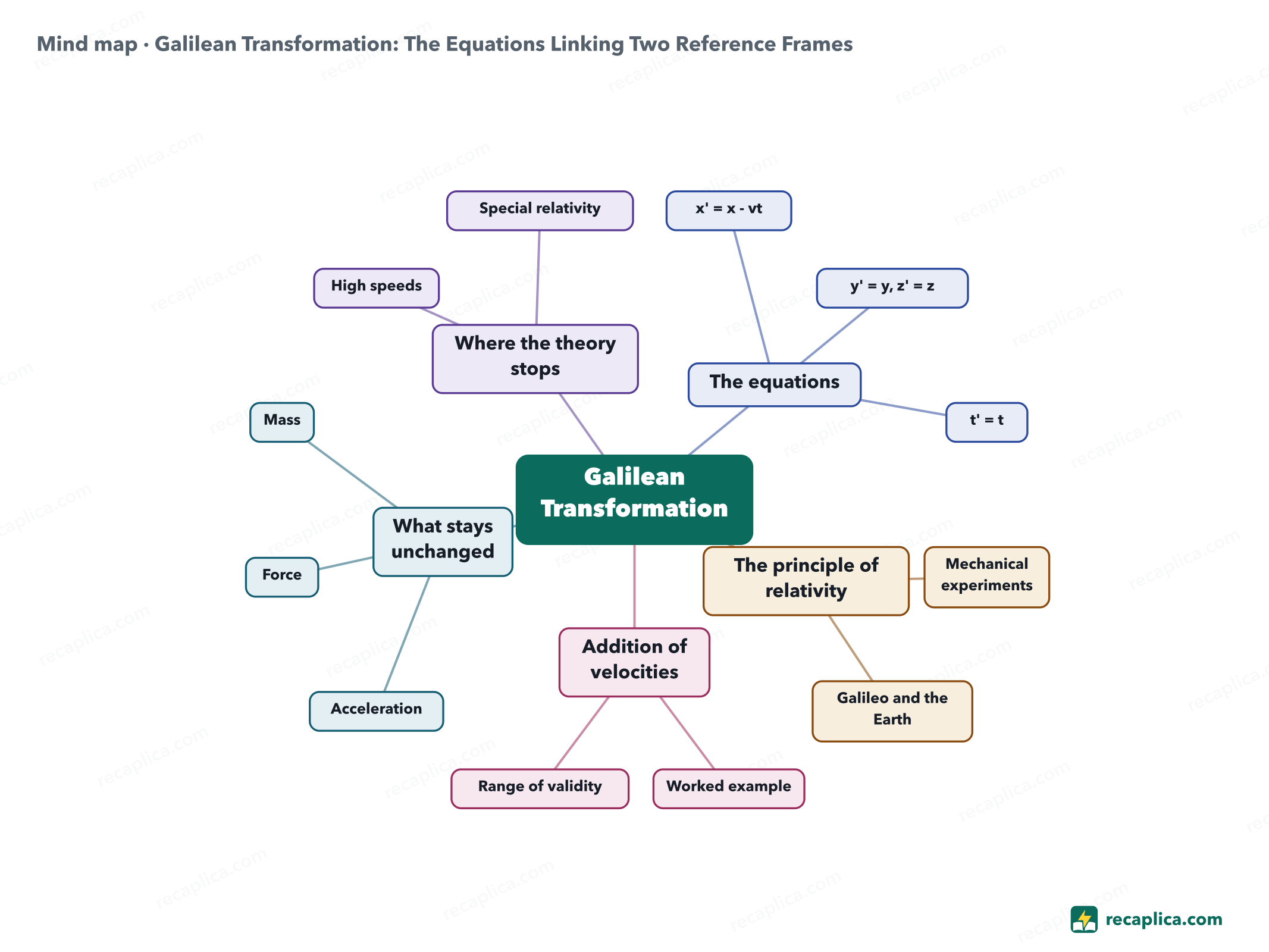
Quiz: test yourselfAnswer the questions to check what you have learned: you get instant feedback and a short explanation. Grade 0/10 0/5
FlashcardsTap the card to flip it and check whether you remember the answer, then move to the next one. 1 / 8 Explain it in your own wordsThe ultimate test: if you can explain it in simple words, you've truly understood it. Write your explanation, then compare it with the Recap. Your explanation is saved only on this device.
Frequently asked questionsWhat is the Galilean transformation formula?x' = x - vt, y' = y, z' = z, t' = t, where v is the constant speed at which the second frame moves along the x axis relative to the first, and the two frames coincide at the instant t = t' = 0. Why do the transformed coordinates carry a prime (') symbol?The prime is just a label for "measured in the moving frame": x, y, z and t belong to the frame treated as fixed, while x', y', z' and t' are the same quantities measured by the observer riding the second frame. It is notation, not a different kind of coordinate. What is Galileo's principle of relativity?It means a frame at rest and one moving at constant speed along a straight line yield identical outcomes in every mechanical experiment, so no such experiment performed from the inside can tell the two situations apart. Does the Galilean transformation always hold?It holds with good accuracy below roughly 3,000 kilometers per second. Beyond that threshold, close to 1% of the speed of light, the results start to drift noticeably and special relativity is needed instead. What changes with the Lorentz transformation compared to the Galilean one?The Lorentz transformation does not assume that time is the same for every observer, and it is used when the speeds involved approach that of light; the Galilean transformation remains the correct approximation at lower speeds. Every Recap goes through an independent review before publication. |