recaplica
Clear in 30 seconds, yours in 10 minutes.
In 30 seconds quick read
A thunderstorm forms when warm, moist air near the ground gets pushed upward, meets unstable air, and keeps rising until it builds a towering cloud, the cumulonimbus. It goes through three stages: developing, then mature, and finally dissipating. A single storm cell typically lasts 30 to 60 minutes, while the whole process takes about an hour. The mature stage is also the most dangerous: updrafts and downdrafts coexist and bring heavy rain, hail, strong wind, and lightning; if the updraft starts rotating because of winds that shift with height, a supercell forms, the longest-lived storm type, and the one most associated with the most violent tornadoes. Some storms, instead of fading away, keep regenerating over the same spot for hours, dumping persistent rain.
Key Points
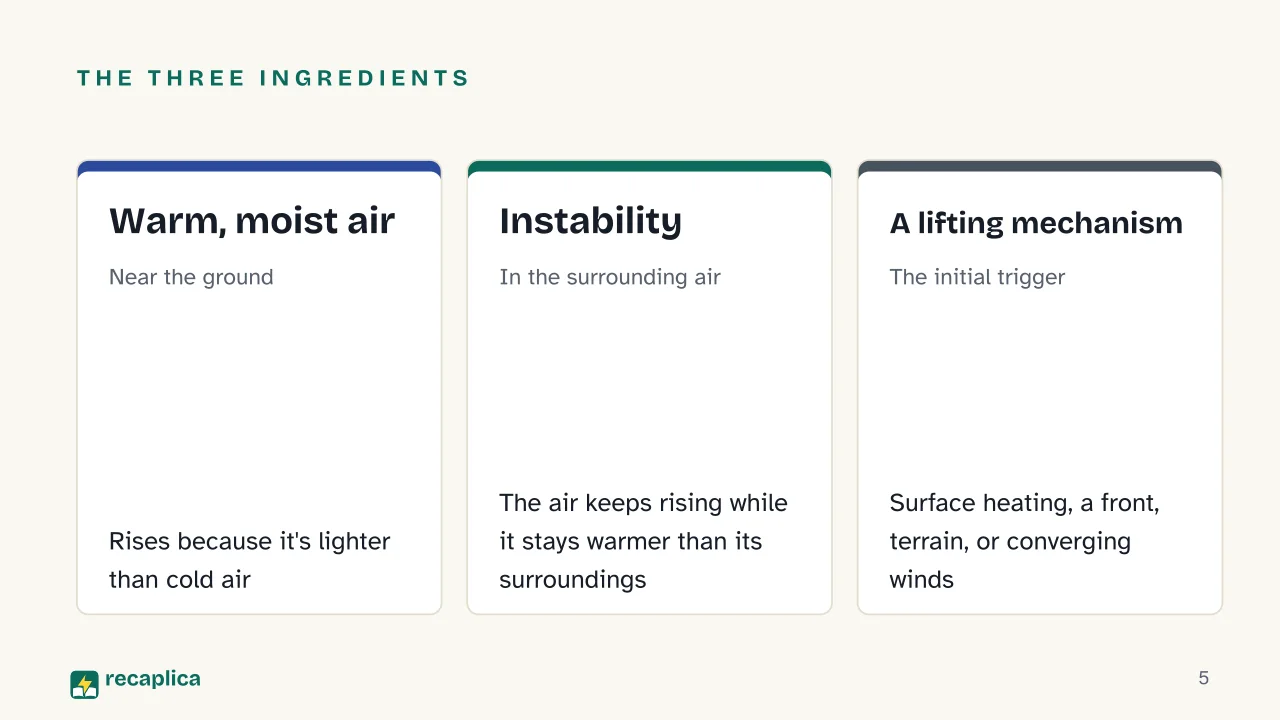
A thunderstorm needs three ingredients to form: warm, moist air near the ground, atmospheric instability, and a lifting mechanism, such as surface heating, a weather front, terrain, or converging winds.
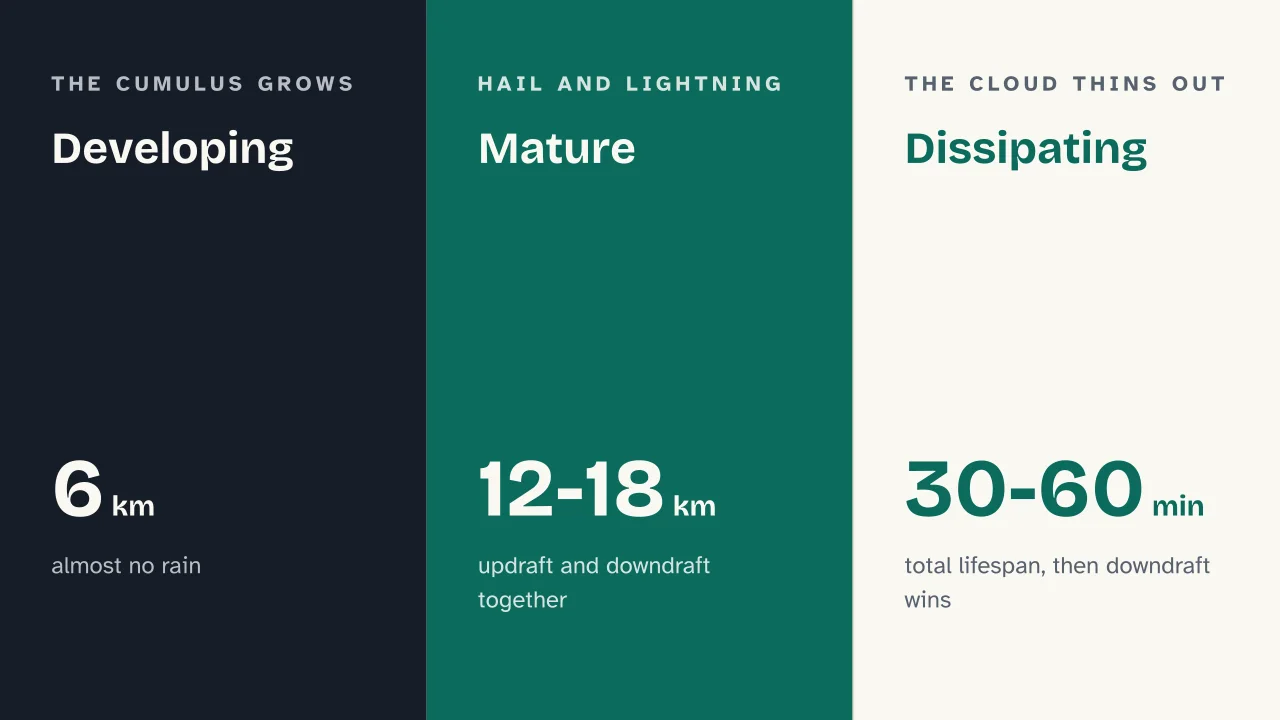
The life cycle has three stages: developing (the cumulus cloud grows, little or no rain), mature (a cumulonimbus 12-18 km tall, with updraft and downdraft together), and dissipating (the downdraft takes over and cuts off the warm air feeding the cloud).
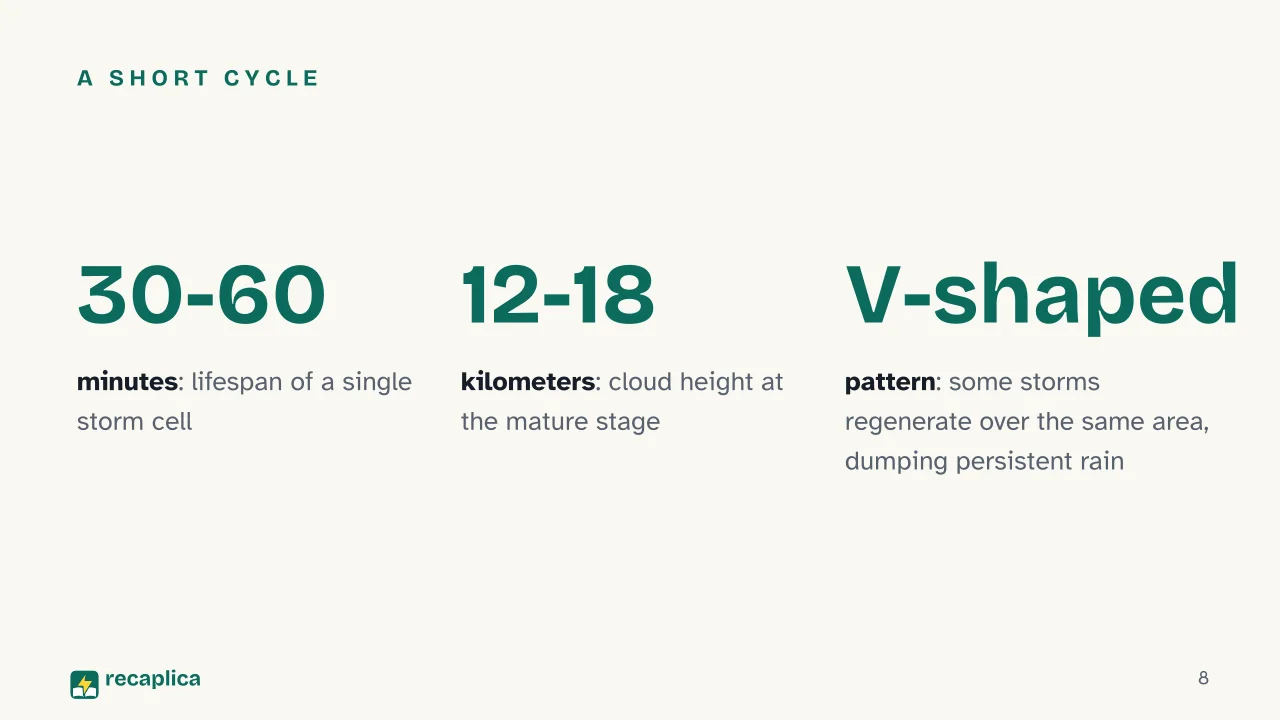
A single storm cell lasts 30-60 minutes on average; the full process, from birth to dissipation, takes about an hour.
A supercell is defined by rotation rather than size: its updraft spins around a vertical axis, the mesocyclone, driven by wind shear, and it's the storm type most linked to hail, damaging wind, and the most violent tornadoes.
Lightning comes from electric charges that moving air builds up as it slides past other air inside the cloud; thunder is heard after the flash because sound travels much more slowly than light.
Some storms are self-regenerating (V-shaped): instead of dissipating, they keep reforming over the same area thanks to a steady supply of warm, moist air, often from the sea, dumping persistent and very intense rain.
Deep Dive
The ingredients: what it takes to build a thunderstorm
A thunderstorm doesn’t appear out of nowhere: three conditions have to
line up. The first is warm, moist air near the ground, lighter than the
cold air around it, so it tends to rise. The second is atmospheric
instability, a situation where that rising air keeps climbing because it
stays warmer than its surroundings as it gains height. The third is a
trigger that actually gets it moving: the sun heating the ground, a
weather front passing through, terrain forcing the air upward, or winds
converging with nowhere to go but up.
The moisture that fuels a thunderstorm comes from the same
water cycle that drives clouds everywhere:
evaporation carries water vapor into the atmosphere, and that vapor
releases heat as it condenses while rising, pushing the cloud higher
still. Surface heating, one of the possible triggers, is also the
mechanism behind a heat wave: afternoon storms
are more common on the hottest days, once the ground has had all day to
warm the air sitting above it.
The life cycle, in three stages
Once it gets going, a thunderstorm nearly always follows the same path,
split into three stages.
Stage
What happens
Cloud height
Developing
Cumulus cloud grows on the updraft, little or no rain
Up to about 6 km
Mature
Cumulonimbus, updraft and downdraft coexist, the most dangerous stage
12-18 km (12-15 km at mid-latitudes in summer)
Dissipating
Downdraft takes over, the gust front cuts off incoming warm air
The cloud thins out
In the developing stage, the cumulus cloud is dominated by rising
currents, the updraft, with only mild turbulence at the edges and almost
no rain. Once the droplets get heavy enough to fall, the storm enters the
mature stage: the precipitation dragging its way down creates a sinking
current, the downdraft, which coexists for a while with the still-active
updraft. This is the most dangerous moment, with hail, frequent
lightning, strong wind, and, in some cases, tornadoes.
The final stage arrives once the downdraft grows stronger than the
updraft that fed the cloud: the gust front pulls away from the storm and
cuts off the warm, moist air that kept it alive. With no more fuel, the
storm fades out. A single cell typically lasts 30 to 60 minutes; the
whole process, from the cloud forming to dissipation, takes about an
hour.
Types of storms, from single cell to supercell
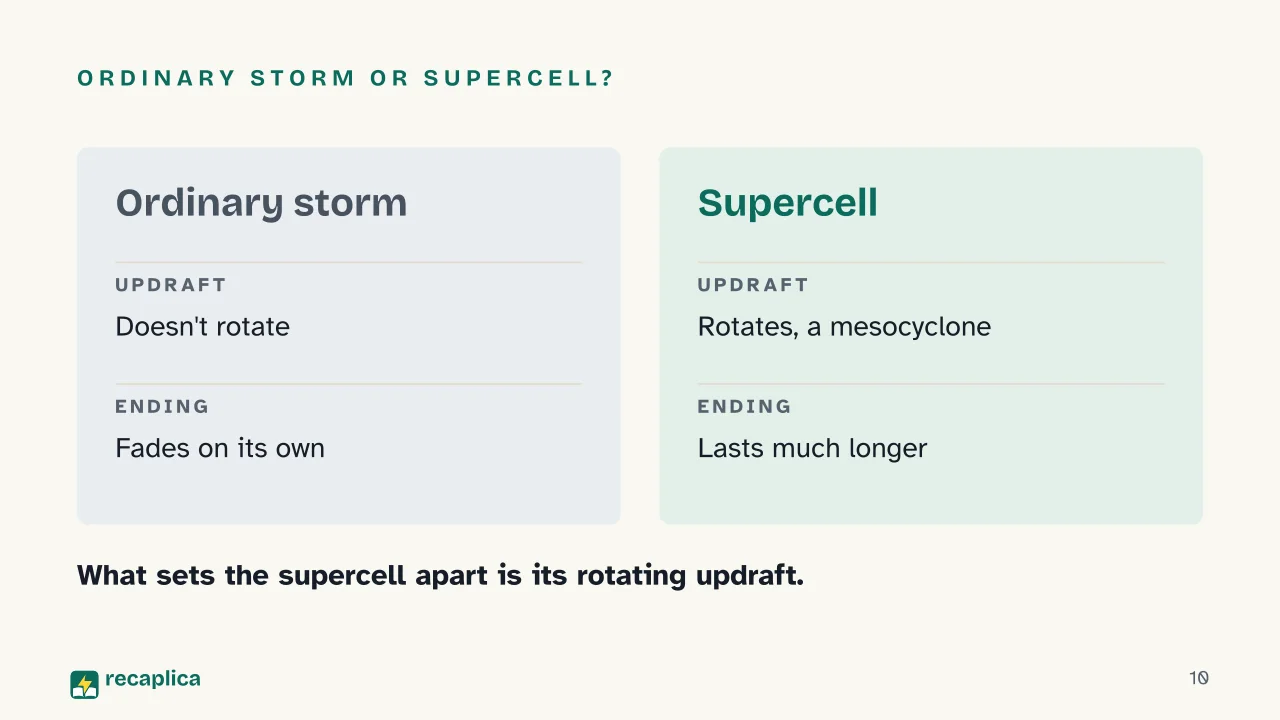
A single-cell storm has just one updraft, doesn’t rotate, and runs
through the whole life cycle just described, born, mature, and gone in
under an hour. A multicell storm,
by contrast, is made up of several cells in sequence, each at its own
stage, so the system as a whole outlasts any single cell within it.
Practical example: the Empire State Building, in New York, is tall
and isolated, and for that reason gets struck by lightning an average
of 23 times a year, according to the National Weather Service. Height,
a pointy shape, and isolation decide where a strike lands.
The supercell is the most distinctive type, and the difference isn’t
size, it’s rotation: its updraft spins around a vertical axis, forming
what meteorologists call a mesocyclone, driven by wind shear, a wind that
changes direction or speed with height. That rotation lets a supercell
outlast the mechanisms that usually shut down an ordinary storm, and it
makes it the type most linked to large hail, damaging wind, and the most
violent tornadoes: anyone curious how a vortex like that forms can read
the recap on how tornadoes form.
There’s also a distinctive case seen over Italy, self-regenerating
storms, sometimes called “V-shaped” for the pattern they trace on radar
images. Instead of dissipating after the mature stage, they keep
reforming over the same area, fed by a steady supply of warm, moist air
that often arrives from the sea or from open plains. The result is
persistent, very intense rain over the same area.
Dangerous phenomena of the mature stage
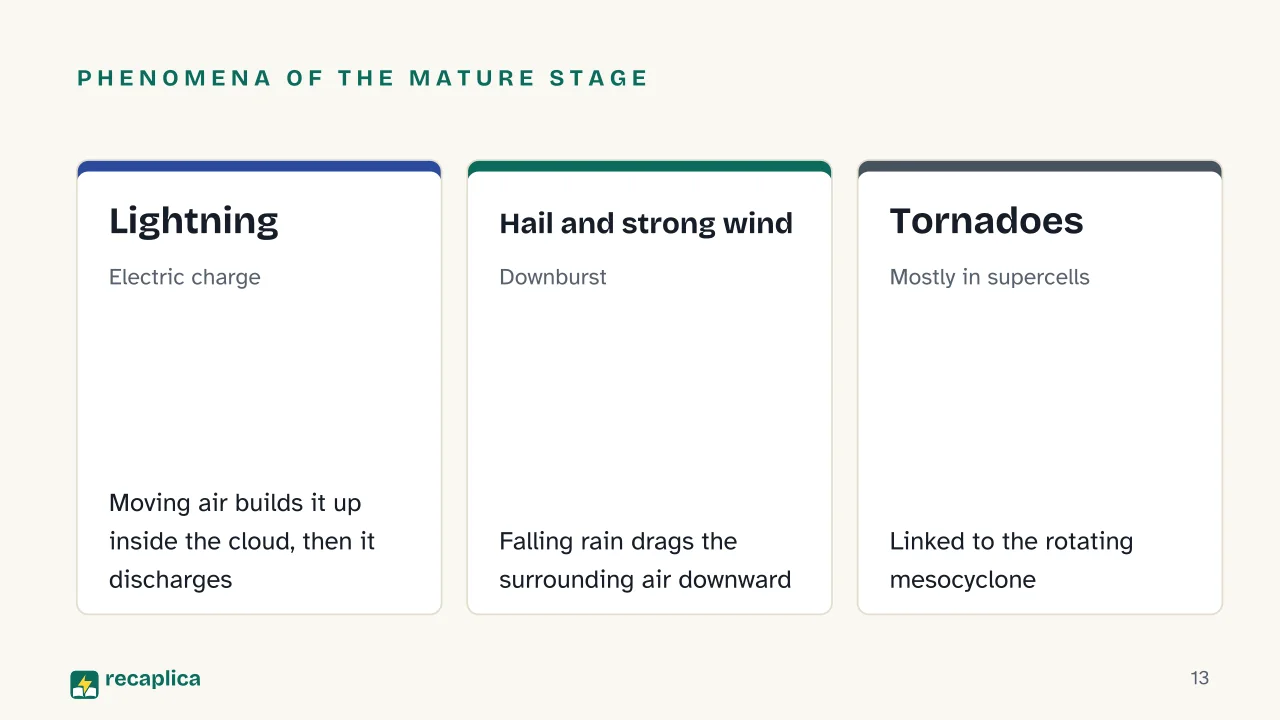
Lightning forms inside the cloud, where moving air builds up electric
charge as it slides past other air; once the charge difference grows
large enough, it discharges as a lightning bolt. The thunder that
follows shares the same origin, but arrives later, because sound travels
far more slowly than light.
A downburst is another hallmark of the mature stage: falling raindrops
drag the surrounding air down with them, generating a flow that sinks
toward the ground and turns into gusts of strong wind on arrival. Hail,
heavy rain, and, within supercells, tornadoes round out the phenomena
that make the mature stage the most dangerous part of the whole life
cycle.
Slide deck
Slides ready to download and make your own in PowerPoint or Google Slides, with speaker notes. Pick the Flash cut or the Full one.
✗ Myth Lightning never strikes the same place twice.
✓ Reality According to the National Weather Service, the opposite often happens: lightning strikes the same spot repeatedly, especially if it's a tall, pointy, isolated object. The Empire State Building, an example the agency itself cites, is hit an average of 23 times a year. What decides where lightning strikes is the object's geometry, not some rule against a repeat visit to the same place.
✗ Myth Metal, worn on the body or in a building, attracts lightning.
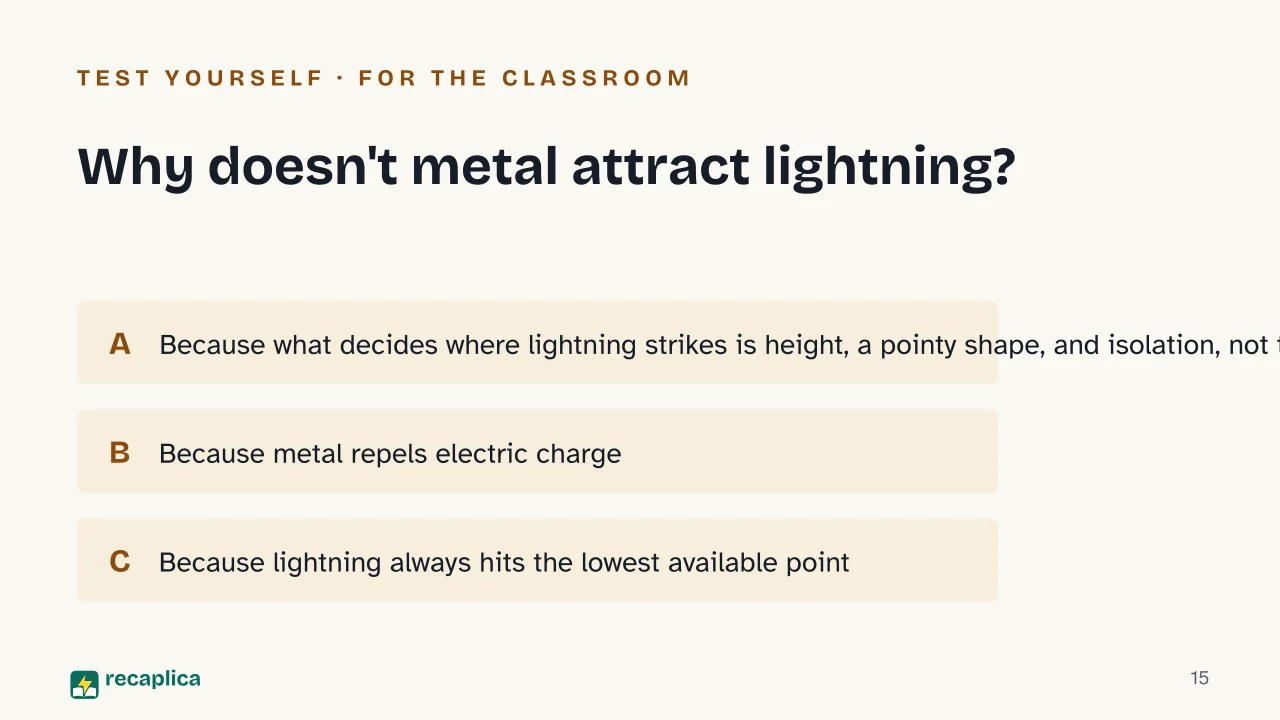
✓ Reality The National Weather Service makes clear that the presence of metal makes no difference to where lightning strikes — height, a pointy shape, and isolation are what decide. Metal is still worth avoiding during a storm, because it conducts electricity, not because it draws lightning in.
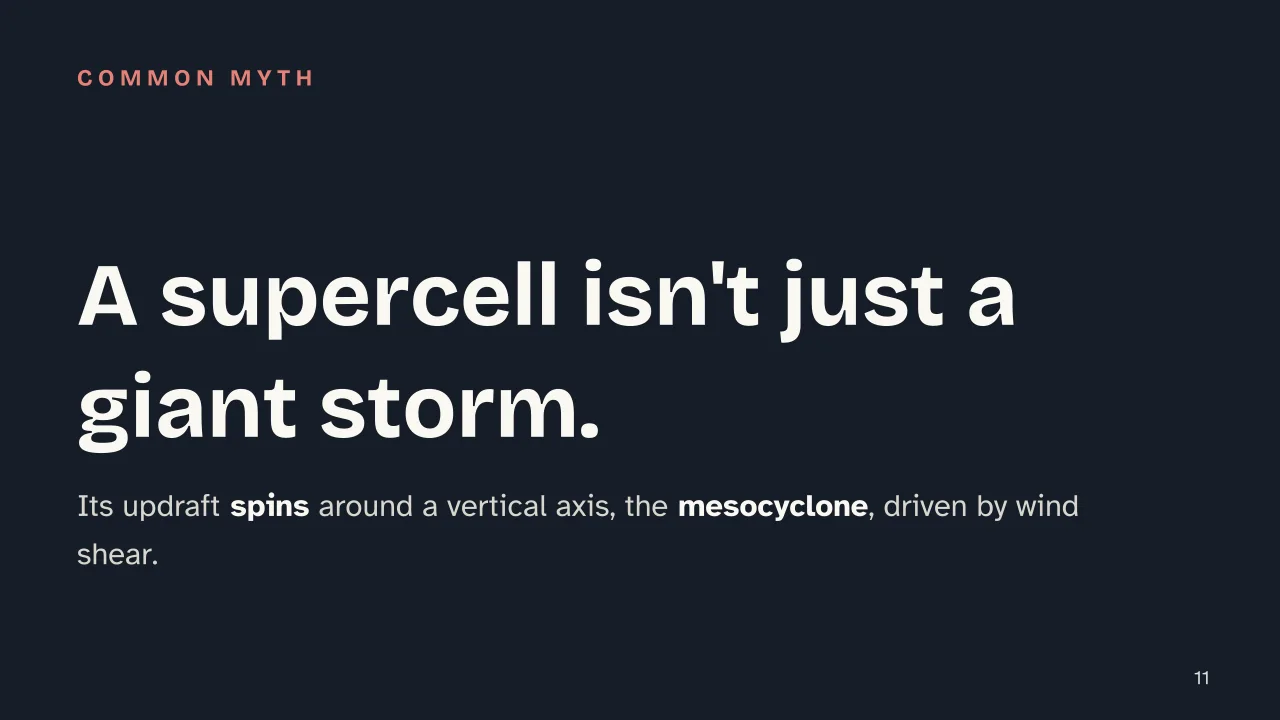
✗ Myth "Supercell" just means a giant or extremely powerful storm.
✓ Reality The technical definition, given by NOAA's Storm Prediction Center, comes down to rotation — a supercell is a thunderstorm whose updraft spins around a vertical axis (the mesocyclone) driven by wind shear. That rotation lets it outlast the mechanisms that usually shut down an ordinary storm, regardless of how big the cloud is.
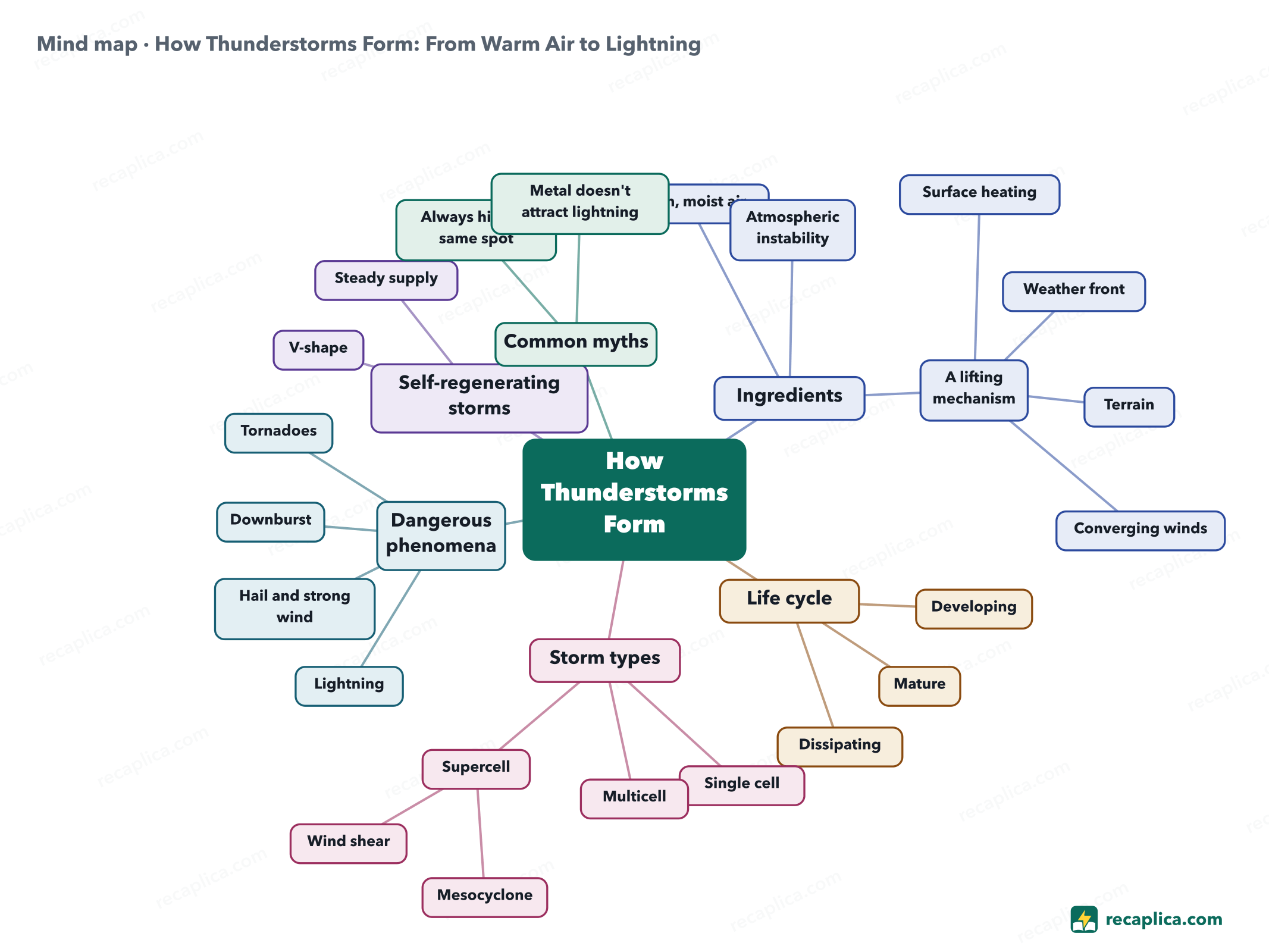
Mind map
Drag the background to move around and the nodes to reposition them; use − and + to collapse and expand branches.
Warm, moist airNear the ground, lighter than cold air
Atmospheric instabilityThe air keeps rising while it stays warmer than its surroundings
A lifting mechanism
Surface heating
Weather front
Terrain
Converging winds
Life cycle
DevelopingGrowing cumulus cloud, little or no rain
MatureCumulonimbus, updraft and downdraft together, 12-18 km tall
DissipatingDowndraft takes over, rain fades
Storm types
Single cellOne updraft, no rotation
MulticellSeveral cells in sequence
Supercell
MesocycloneThe updraft spins around a vertical axis
Wind shearWind that changes direction or speed with height
Dangerous phenomena
LightningElectric charge built up by moving air
Hail and strong wind
DownburstFalling rain drags air downward
TornadoesMostly within supercells
Self-regenerating storms
V-shapeReform over the same area
Steady supplyWarm, moist air, often from the sea
Common myths
Always hits the same spotIf the object is tall, pointy, and isolated
Metal doesn't attract lightningHeight, shape, and isolation decide instead
Quiz: test yourself
Answer the questions to check what you have learned: you get instant feedback and a short explanation.
Grade0/100/5
Answers: 1-A · 2-B · 3-B · 4-B · 5-A
Flashcards
Tap the card to flip it and check whether you remember the answer, then move to the next one.
1 / 8
Explain it in your own words
The ultimate test: if you can explain it in simple words, you've truly understood it. Write your explanation, then compare it with the Recap.
Your explanation is saved only on this device.
A thunderstorm forms when warm, moist air near the ground gets pushed upward, meets unstable air, and keeps rising until it builds a towering cloud, the cumulonimbus. It goes through three stages: developing, then mature, and finally dissipating. A single storm cell typically lasts 30 to 60 minutes, while the whole process takes about an hour. The mature stage is also the most dangerous: updrafts and downdrafts coexist and bring heavy rain, hail, strong wind, and lightning; if the updraft starts rotating because of winds that shift with height, a supercell forms, the longest-lived storm type, and the one most associated with the most violent tornadoes. Some storms, instead of fading away, keep regenerating over the same spot for hours, dumping persistent rain.
Frequently asked questions
How does a thunderstorm form?
It needs warm, moist air near the ground, pushed upward by a trigger (surface heating, a weather front, terrain, or converging winds). If the surrounding atmosphere is unstable, the air keeps rising and builds a cumulus cloud that grows into a cumulonimbus, the classic thunderstorm cloud.
How long does a thunderstorm last?
A single storm cell lasts 30 to 60 minutes on average, according to the National Weather Service (NOAA describes a roughly 30-minute cycle for a single cell). The full process, from the cloud forming to dissipating, takes about an hour according to UCAR.
What's the difference between an ordinary thunderstorm and a supercell?
The key distinction is the rotation of the updraft. In a supercell, the updraft spins around a vertical axis, forming a mesocyclone, driven by wind shear — a wind that changes direction or speed with height. That rotation lets it outlast an ordinary storm and makes it the type most linked to hail, damaging wind, and the most violent tornadoes.
Why is thunder heard after you see lightning?
Because sound travels much more slowly than light. The flash reaches your eyes almost instantly, while the boom of thunder, which has the same electrical origin, takes longer to cover the same distance to your ear.
Is it true that metal attracts lightning?
No. According to the National Weather Service, height, a pointy shape, and isolation are what decide where lightning strikes, not the presence of metal. It's still wise to avoid metal objects during a storm, but because metal conducts electricity.
Every Recap goes through an independent review before publication.
Statistics, only if you say so
To learn which Recaps help most we would use Google Analytics, with aggregate, anonymous data. It starts only with your OK, and you can change your mind anytime. Privacy policy