Skip to content
recaplica

    One moment: security check

    Cloudflare wants to make sure you're not a robot. Tick the box below and your search will continue on its own.

    IT
    recaplica Covalent Bond: Definition, Polar vs Nonpolar, Sigma and Pi Bonds
    © 2026 Recaplica · recaplica.com — All rights reserved
    Home › Science

    Covalent Bond: Definition, Polar vs Nonpolar, Sigma and Pi Bonds

    By Recaplica Newsroom · Updated on October 23, 2026

    What to print

    Page numbers appear when printing with default margins.

    Slides

    Choose a cut

    Flash10 slidesThe essential thread, to present in classFull15 slidesEvery chapter and the deeper detail

    Both come with speaker notes.

    Telegram channel
    recaplica Clear in 30 seconds, yours in 10 minutes.
    In 30 seconds Key points Deep dive Slides Myths Mind map Quiz Flashcards FAQ

    In 30 seconds quick read

    A covalent bond forms when two atoms share a pair of electrons that both nuclei attract. If the two atoms pull on the pair equally the bond is nonpolar, and if one pulls harder it is polar. One, two or three shared pairs give single, double and triple bonds, and every double bond holds one sigma bond and one pi bond. When both electrons of the pair come from one atom, the bond is called dative.

    Key Points

    • A covalent bond comes from a pair of electrons shared by two atoms and attracted by both nuclei.
    • When the electrons are shared equally the bond is nonpolar; when one atom pulls the pair harder, the bond is polar.
    • Nonpolar covalent, polar covalent and ionic bonds sit on a continuum, and the numerical electronegativity cutoffs are textbook conventions.
    • Single, double and triple bonds share one, two and three pairs, and between the same two atoms more pairs means a shorter, stronger bond.
    • A sigma bond comes from head-on overlap of orbitals, a pi bond from sideways overlap of two p orbitals.
    • In a dative bond both electrons of the pair come from the same atom, and once formed it looks like any other covalent bond.

    Deep Dive

    What is a covalent bond and how does it form?

    A covalent bond holds two atoms together through a pair of electrons they share. Both nuclei attract that pair, and the attraction keeps the atoms close. Forming each covalent bond releases energy, which is why the bonded atoms are more stable than the separate ones. Covalent bonds are typical of very electronegative atoms, the nonmetals.

    Hydrogen is the simplest case. Each atom has one electron; by sharing them, both end up with two, the configuration of helium, and the H₂ molecule stops at a single bond.

    Valence bond theory describes this as the overlap of two atomic orbitals, one from each atom, each holding one electron. In the overlap region the two electrons pair up, and the more the orbitals overlap, the stronger the bond. As two atoms approach, their energy falls to a minimum, and the distance between the nuclei at that point is the bond length.

    Octet rule, bonding pairs and Lewis structures

    In most simple molecules, shared electrons give each atom the configuration of a noble gas: eight electrons in the outer shell, two for hydrogen. This is Lewis’s octet rule. Chlorine has seven valence electrons, one short of an octet, and in Cl₂ it fills the shell by sharing a pair.

    In a Lewis drawing the shared pair is the bonding pair, and the pairs that belong to a single atom are lone pairs. In water the oxygen has two bonding pairs and two lone pairs, and each hydrogen, with its shared pair, has a full shell of two electrons. When drawing a more complex structure, the central atom is usually the least electronegative element in the compound.

    Practical example: to draw Cl₂, start from the seven valence electrons of each atom. One pair becomes the line between the two symbols, the bonding pair, and the remaining electrons stay on the atoms as lone pairs.

    The rule has exceptions. In boron trifluoride the boron has only 3 outer electrons and cannot reach eight by sharing. In phosphorus pentachloride the phosphorus has 5 pairs in its outer shell, so more than eight electrons.

    Polar vs nonpolar covalent bond

    To see how the pair is divided you need electronegativity, the relative ability of an atom to attract bonding electrons. On the Pauling scale, the most widely used, fluorine is set at 4.0 by convention; carbon, nitrogen and oxygen are about 2.5, 3.0 and 3.5. The value grows from left to right across a period of the periodic table and falls going down a group. Noble gases are left off the scale because they do not usually share electrons.

    Nonpolar covalent bond

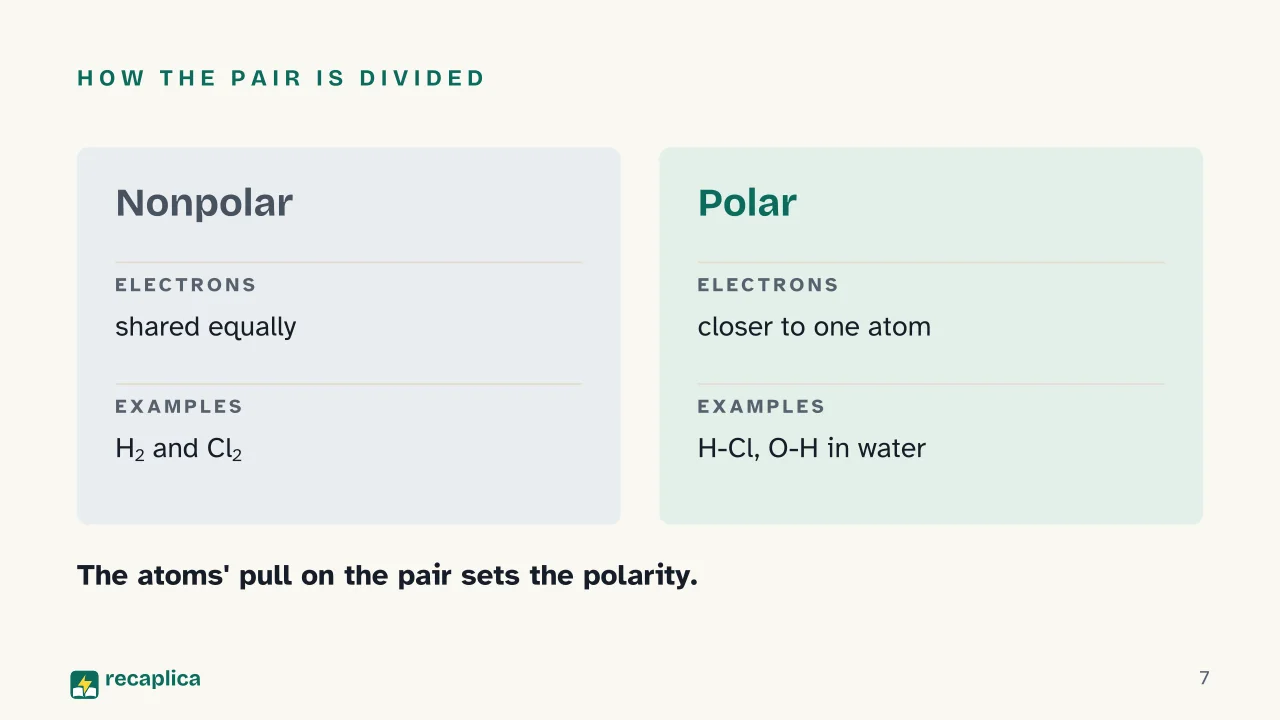
    When the pair is shared in perfectly equal parts, the bond is nonpolar. This normally happens between atoms of the same element, as in H₂ and Cl₂.

    Polar covalent bond

    When one atom pulls the pair harder, the sharing is unequal. The more electronegative atom takes a partial negative charge and the less electronegative one a partial positive charge, both smaller than a whole charge. The H-Cl bond of hydrogen chloride and the O-H bonds of water are the standard examples. The bigger the electronegativity difference, the larger the partial charges. The C-H bond has a small difference and is usually treated as nonpolar.

    From covalent to ionic: a continuum

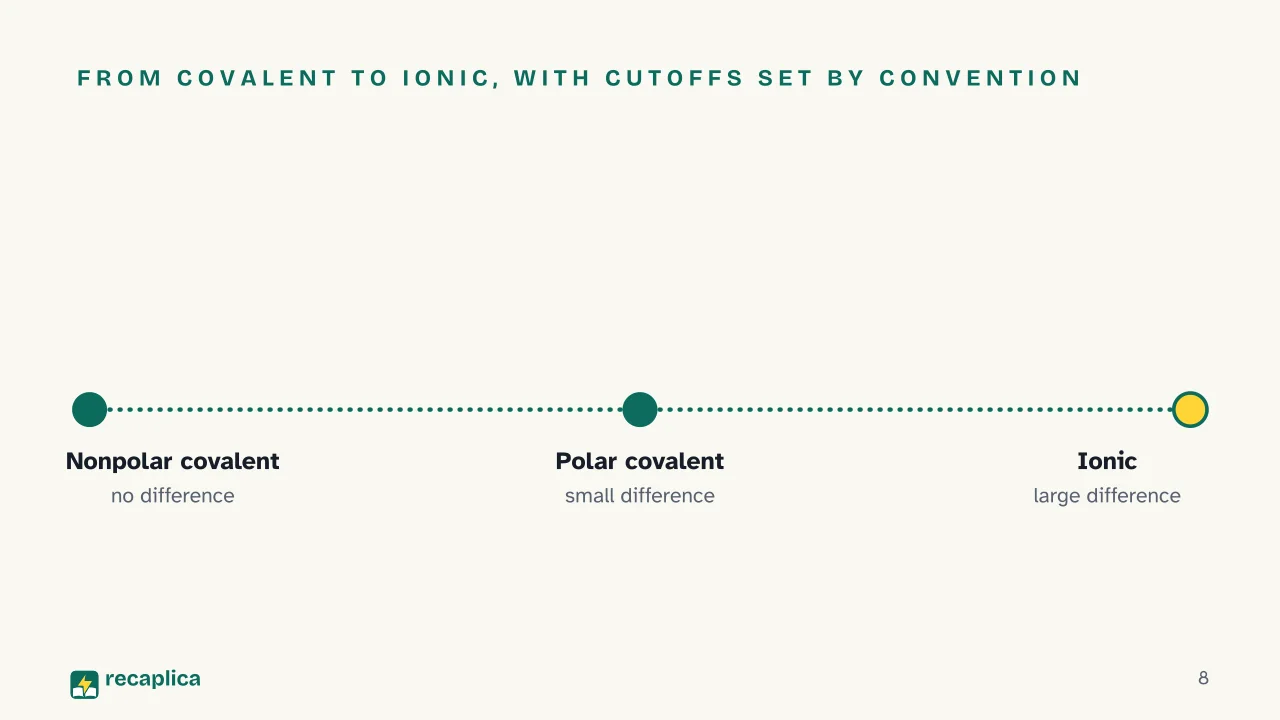
    There is no sharp border between covalent and ionic bonds. A difference of zero gives a nonpolar covalent bond, a small one gives a polar covalent bond, and a large one gives an ionic bond. One teaching source points out that there is no exact answer to where polar ends and ionic begins: lithium iodide, for example, is described as ionic with some covalent character, and it dissolves in organic solvents such as ethanol.

    The numbers in textbooks are conventions. A course based on CK-12 material treats a bond with a difference below 0.4 as nonpolar, between 0.4 and 1.7 as polar covalent, and above 1.7 no longer as mostly covalent. An Italian teaching site puts the upper limit of polar at 1.9, so the two cutoffs differ.

    The ionic bond and the other bond types are compared in the Recap on chemical bonds.

    Single, double and triple covalent bonds

    A double bond is two electron pairs shared between the same two atoms, instead of one. O₂ has a double bond: sharing two pairs gives both oxygen atoms a stable structure. N₂ has a triple bond, since each nitrogen has 5 outer electrons and shares 3. In the Lewis model the number of pairs holding two atoms together is the bond order: 1, 2 or 3.

    For comparable bonds, length falls as bond order rises, and bond energy rises. The relation is not linear: a double bond is not half as long as a single one.

    MoleculeBondOrderLength (pm)Dissociation energy (kJ/mol)
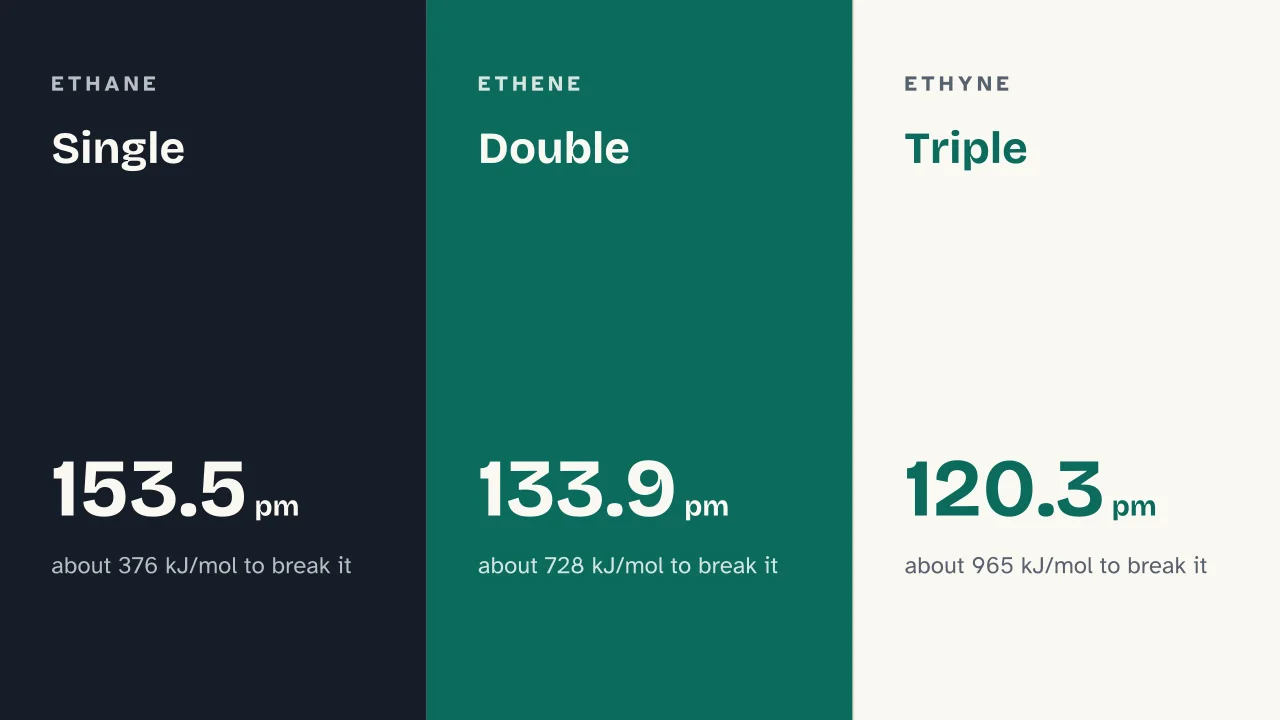
    EthaneC-C1153.5376
    EtheneC=C2133.9728
    EthyneC≡C3120.3965
    Oxygen O₂O=O2120.7498.4
    Nitrogen N₂N≡N3109.8945.3

    The values come from a Chemistry LibreTexts table for gas-phase molecules at 298 K, drawing on the CRC Handbook (2004) and NIST data. Other tables, built on different conditions, give slightly different figures for the same bonds.

    Practical example: breaking the C-C bond of ethane takes about 376 kJ/mol, and the C=C bond of ethene takes about 728. The C=C bond measures 133.9 pm, against 153.5 for C-C.

    Among single bonds, N-N, O-O and F-F are unusually weak compared with those of the heavier elements in the same group. The explanation offered, with caution, is strong repulsion between the lone pairs on neighbouring atoms.

    Sigma and pi bonds

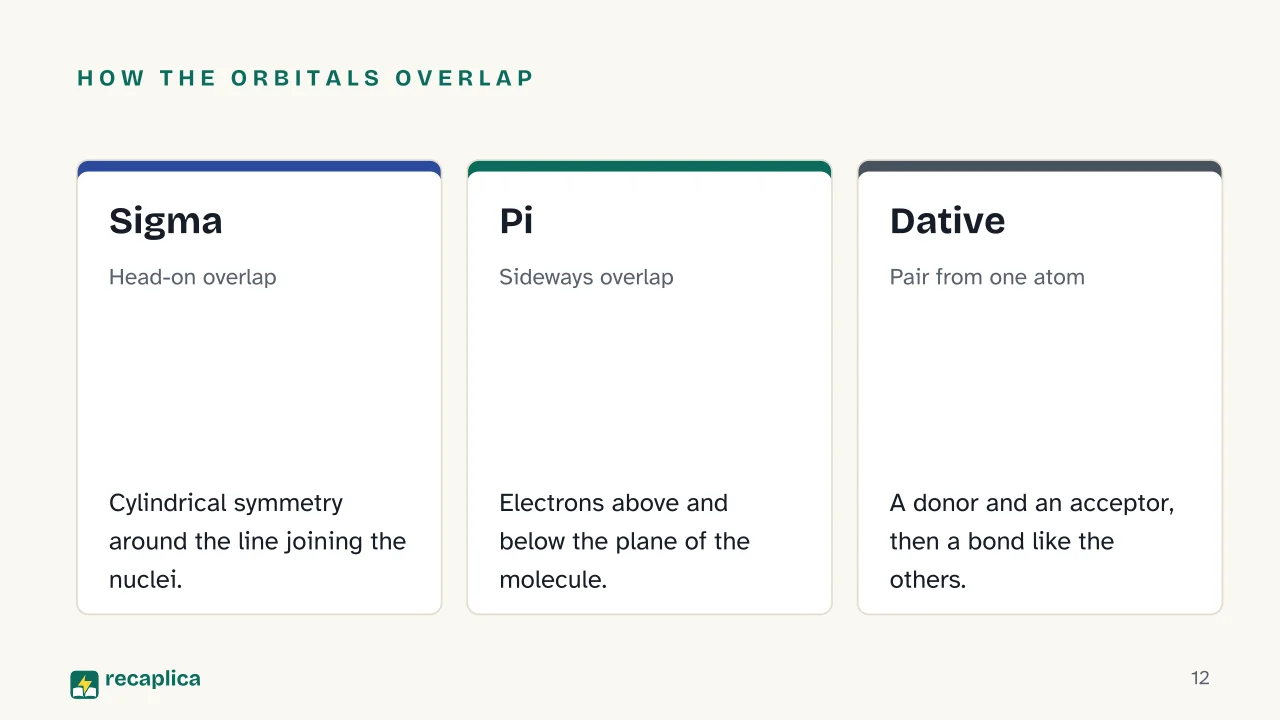
    A sigma bond comes from head-on overlap of two atomic orbitals. In H₂ these are the two 1s orbitals, and the bond has cylindrical symmetry around the line joining the nuclei. A pi bond comes from sideways overlap of two p orbitals. Its electrons are off that line, above and below the plane of the molecule. In ethene the pi bond between the two carbons is weaker than the sigma bond, because it lies a little farther from the control of the nuclei.

    Every double bond, between any pair of atoms, is built from one sigma bond and one pi bond. The triple bond of ethyne has two pi bonds at right angles to each other: one above and below the molecule, the other in front and behind.

    Dative (coordinate) covalent bond

    Usually each atom contributes one electron to the pair, though it can go otherwise. When both electrons come from the same atom, the bond is called dative, or coordinate. It links a donor atom, which has a lone pair, to an acceptor atom, which needs a pair to complete a shell.

    In diagrams an arrow points from donor to acceptor. In the ammonium ion, once formed, it is indistinguishable from the three ordinary covalent bonds.

    Practical example: in boron trifluoride the boron is short of electrons. The lone pair on the nitrogen of ammonia fills the gap, and the compound that forms has a dative bond.

    Covalent bond examples

    SubstanceBondType
    H₂, Cl₂singlenonpolar, atoms of the same element
    O₂doublenonpolar
    N₂triplenonpolar
    H-Clsinglepolar, chlorine pulls the pair
    H₂Otwo O-H bondspolar, polar molecule
    CO₂two C-O bondspolar, nonpolar molecule
    Diamondsingle, through the whole structuregiant covalent network

    Polar bonds and polar molecules

    A molecule’s dipole moment is the vector sum of the dipoles of its bonds. In bigger molecules, three-dimensional geometry and symmetry decide the outcome.

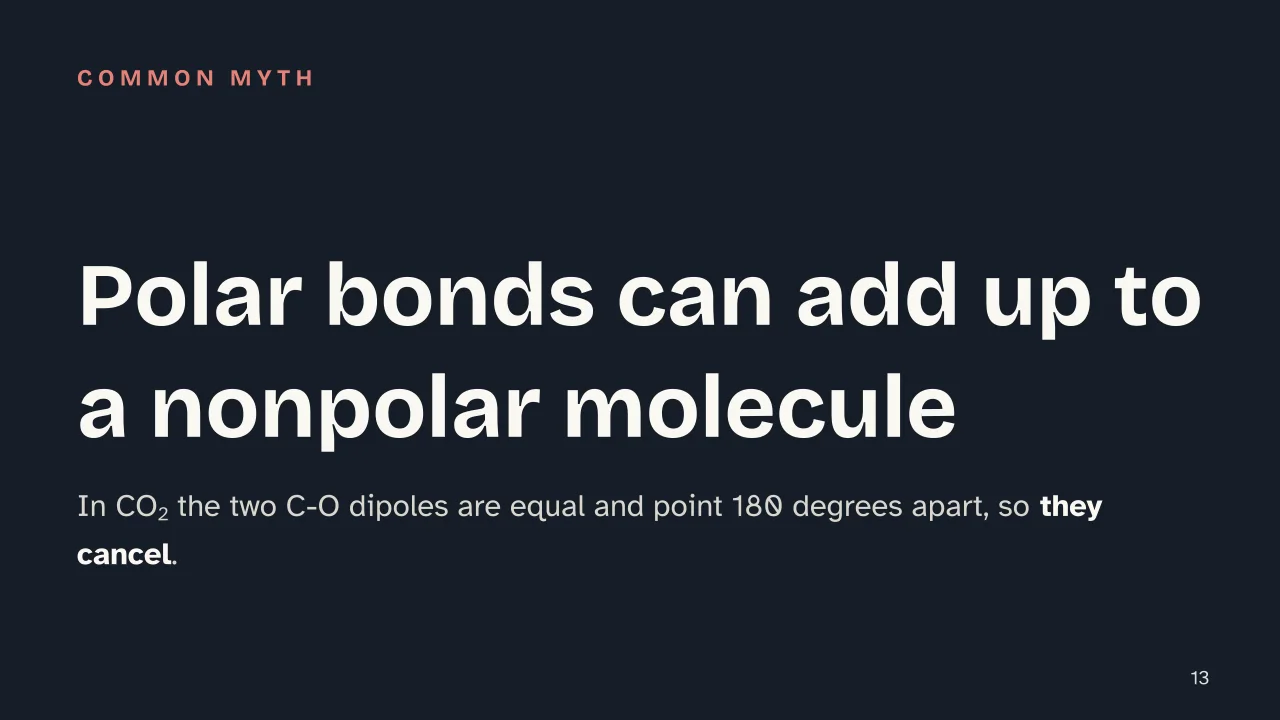
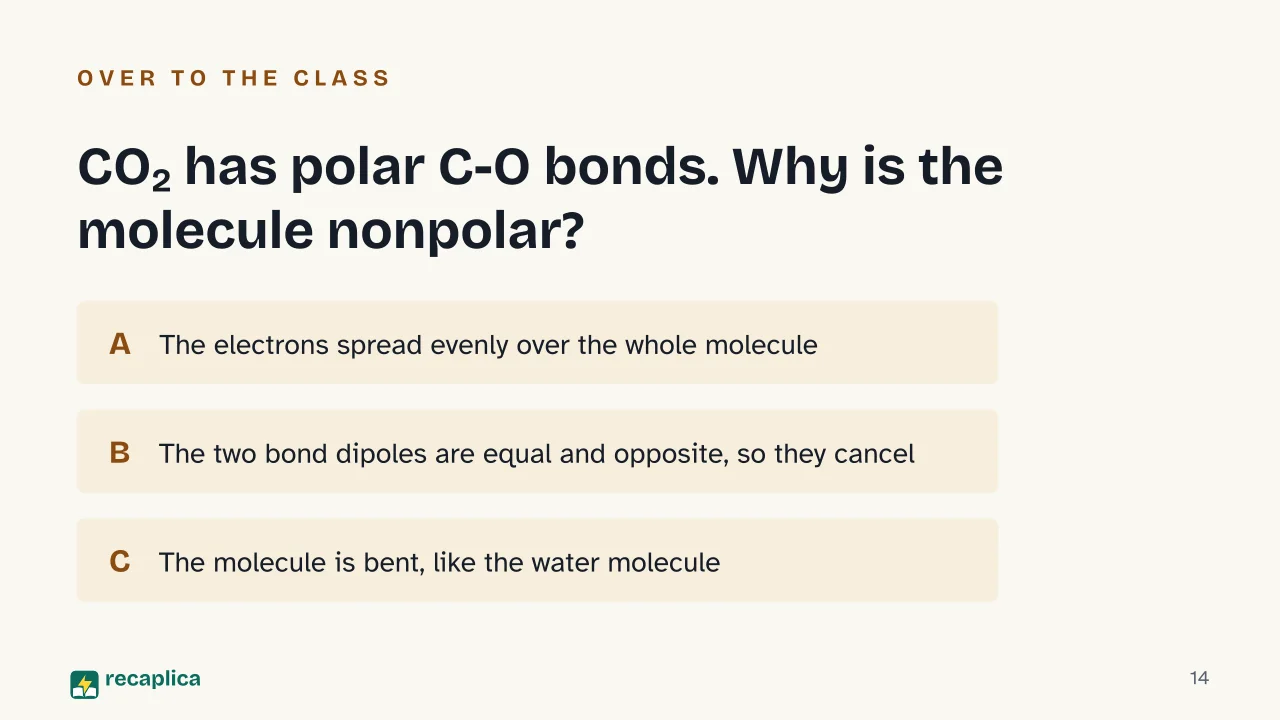
    Practical example: in CO₂ the two C-O bonds are polar, but the molecule is linear. The dipoles are equal and point 180 degrees apart, so they cancel, and experiments find no dipole moment. Water is bent, with an angle of 104.5° between its two O-H dipoles, so they do not cancel.

    In highly symmetric geometries (tetrahedral, square planar, trigonal bipyramidal, octahedral) the bond dipoles cancel completely, as in CCl₄ and BCl₃, while NH₃ and CHCl₃ have a net dipole. The polarity of water lets it form hydrogen bonds with other polar or charged species, including other water molecules.

    Giant covalent structures

    Diamond is a covalent substance with no separate molecules. Each carbon shares electrons with four other carbons through four single bonds, in a structure that extends through all three dimensions. It is not a molecule, since the number of atoms joined depends on the size of the crystal.

    Subliming diamond means breaking the very strong carbon-carbon bonds of the whole structure. The electrons are held tight between the atoms and cannot move, which is why diamond does not conduct electricity. In graphite each carbon forms single bonds with three neighbours, and the fourth electron is delocalised in the plane.

    Slide deck

    Slides ready to download and make your own in PowerPoint or Google Slides, with speaker notes. Pick the Flash cut or the Full one.
    Slide 1 of the presentation on Covalent Bond: The covalent bondSlide 2 of the presentation on Covalent Bond: Why are two hydrogen atoms more stable together than apart?Slide 3 of the presentation on Covalent Bond: From the shared pair to the dative bondSlide 4 of the presentation on Covalent Bond: Chapter 01: How the shared pair formsSlide 5 of the presentation on Covalent Bond: How many electrons each atom reachesSlide 6 of the presentation on Covalent Bond: Chapter 02: Nonpolar or polarSlide 7 of the presentation on Covalent Bond: How the pair is dividedSlide 8 of the presentation on Covalent Bond: From covalent to ionic, with cutoffs set by conventionSlide 9 of the presentation on Covalent Bond: Chapter 03: Single, double and triple bondsSlide 10 of the presentation on Covalent Bond: Single · Double · TripleSlide 11 of the presentation on Covalent Bond: Chapter 04: Sigma, pi and dative bondsSlide 12 of the presentation on Covalent Bond: How the orbitals overlap: Sigma, Pi, DativeSlide 13 of the presentation on Covalent Bond: Polar bonds can add up to a nonpolar moleculeSlide 14 of the presentation on Covalent Bond: CO₂ has polar C-O bonds. Why is the molecule nonpolar?Slide 15 of the presentation on Covalent Bond: For revision
    Flash10 slidesThe essential thread, to present in classFull15 slidesEvery chapter and the deeper detail

    Common myths

    • ✗ Myth Electrons in a covalent bond are always shared fifty-fifty.

      ✓ Reality Perfectly equal sharing normally needs two atoms of the same element, as in H₂ or Cl₂. In hydrogen chloride the chlorine atom pulls the pair harder than hydrogen does, so the bond is polar covalent. The electrons are still shared, just sitting closer to one atom.

    • ✗ Myth A molecule with polar bonds is always a polar molecule.

      ✓ Reality A molecule's dipole is the vector sum of its bond dipoles. In CO₂ the two C–O bonds are polar, but the molecule is linear and the two equal dipoles point 180 degrees apart and cancel; experiments find no dipole moment. Water is bent, so its two O–H dipoles do not cancel.

    • ✗ Myth A dative bond is a different kind of bond from a covalent one.

      ✓ Reality A dative bond, also called a coordinate bond, is a covalent bond whose electron pair comes from one atom only. In the ammonium ion all four N-H bonds look identical once the ion exists. Only the origin of one pair differs.

    Mind map

    Drag the background to move around and the nodes to reposition them; use − and + to collapse and expand branches.
    Customize
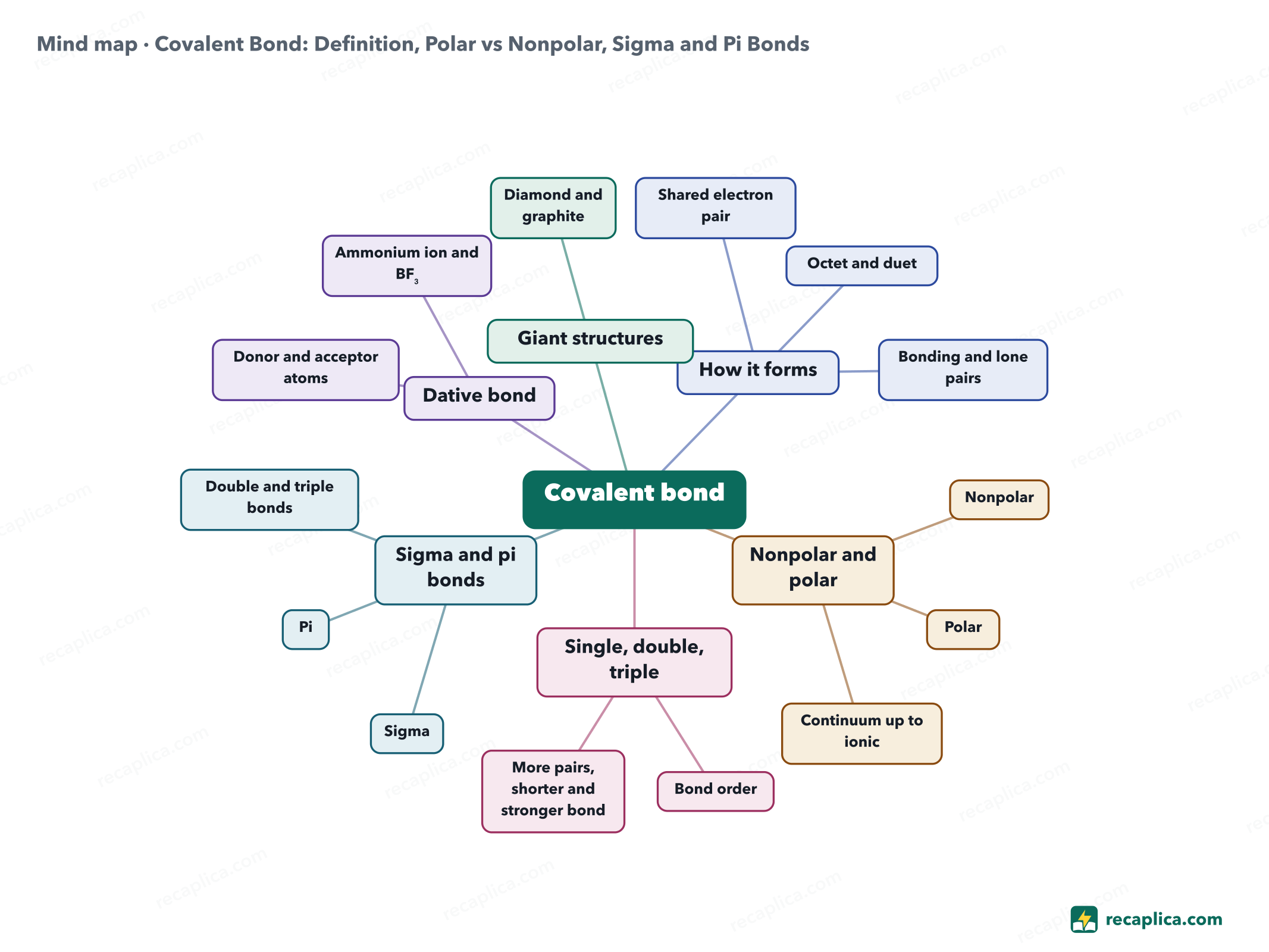
    Mind map: Covalent Bond: Definition, Polar vs Nonpolar, Sigma and Pi Bonds
    • Covalent bond
      • How it forms
        • Shared electron pair attracted by both nuclei
        • Octet and duet noble gas configuration
        • Bonding and lone pairs
      • Nonpolar and polar
        • Nonpolar equal sharing, H₂ and Cl₂
        • Polar partial charges, H-Cl and water
        • Continuum up to ionic
      • Single, double, triple
        • Bond order
        • More pairs, shorter and stronger bond ethane, ethene, ethyne
      • Sigma and pi bonds
        • Sigma head-on overlap
        • Pi sideways overlap
        • Double and triple bonds one sigma and one pi in a double bond, two pi in a triple
      • Dative bond
        • Donor and acceptor atoms
        • Ammonium ion and BF₃
      • Giant structures
        • Diamond and graphite

    Quiz: test yourself

    Answer the questions to check what you have learned: you get instant feedback and a short explanation.

    Grade 0/10 0/5
    1 What do two atoms share when they form a covalent bond?

    A covalent bond comes from a shared electron pair: both nuclei attract it, and that attraction holds the atoms together. A complete transfer of an electron belongs to the ionic bond.

    2 The bond in hydrogen chloride (H-Cl) is polar covalent. Why?

    Chlorine is more electronegative than hydrogen, so the shared pair sits closer to chlorine, which takes a partial negative charge.

    3 Among ethane (C-C), ethene (C=C) and ethyne (C≡C), which carbon-carbon bond is the shortest and the strongest?

    Between the same two atoms, more shared pairs give a shorter and stronger bond. Ethyne, with its triple bond, measures 120.3 pm and takes about 965 kJ/mol to break.

    4 How does a pi bond form?

    The electrons of a pi bond lie above and below the plane of the molecule. Head-on overlap gives a sigma bond instead.

    5 CO₂ has polar C-O bonds. Why is the molecule nonpolar?

    The molecule is linear. The two bond dipoles are equal and point 180 degrees apart, so their vector sum is zero. Bent water has a net dipole moment.

    Answers: 1-B · 2-C · 3-C · 4-A · 5-B

    Flashcards

    Tap the card to flip it and check whether you remember the answer, then move to the next one.

    1 / 8

    Explain it in your own words

    The ultimate test: if you can explain it in simple words, you've truly understood it. Write your explanation, then compare it with the Recap.

    Your explanation is saved only on this device.

    A covalent bond forms when two atoms share a pair of electrons that both nuclei attract. If the two atoms pull on the pair equally the bond is nonpolar, and if one pulls harder it is polar. One, two or three shared pairs give single, double and triple bonds, and every double bond holds one sigma bond and one pi bond. When both electrons of the pair come from one atom, the bond is called dative.

    Frequently asked questions

    How strong is a covalent bond?

    It depends on the bond. Each covalent bond has its own characteristic strength: between carbon atoms at 298 K it takes about 376 kJ/mol to break the single bond of ethane and about 965 kJ/mol to break the triple bond of ethyne (Chemistry LibreTexts table, CRC 2004 data). In crystals such as diamond the bonds repeat through the whole structure, and subliming diamond means breaking all of them.

    What is the difference between a polar and a nonpolar covalent bond?

    In a nonpolar bond the electron pair is shared equally, as in H₂ and Cl₂. In a polar bond one atom pulls the pair harder, so it takes a partial negative charge and the other atom a partial positive one, as in H-Cl and in the O-H bonds of water. The measure is the difference in electronegativity between the two atoms.

    What is the difference between a covalent bond and a dative bond?

    In an ordinary covalent bond each atom usually contributes one electron to the pair. In a dative bond both electrons come from one atom, the donor, and go to the acceptor, which needs a pair to fill a shell. Once formed, the bond behaves like any other covalent bond.

    What are some examples of covalent bonds?

    H₂ and Cl₂ have a single nonpolar bond, O₂ a double bond and N₂ a triple bond. Hydrogen chloride and water have polar covalent bonds, and carbon dioxide has two polar bonds in a nonpolar molecule. Diamond is a giant covalent structure.

    What is a giant covalent structure?

    It is a solid in which covalent bonds link atoms in a network with no separate molecules. Diamond is the standard case: each carbon is bonded to four others, in a lattice that extends in three dimensions. In graphite, each carbon is bonded to three neighbours.

    Sources

    • Chemguide (Jim Clark) - Covalent bonding, single bonds
    • Chemguide (Jim Clark) - Covalent bonding, double bonds
    • Chemguide (Jim Clark) - Dative covalent (coordinate) bonding
    • Chemguide (Jim Clark) - Electronegativity
    • Chemguide (Jim Clark) - Giant covalent structures
    • Chemguide (Jim Clark) - Bonding in ethyne
    • Chemistry LibreTexts (Howard University) - Lewis structures
    • Chemistry LibreTexts (Howard University) - Properties of covalent bonds
    • Chemistry LibreTexts (Morsch et al.) - Describing chemical bonds, valence bond theory
    • Chemistry LibreTexts (Morsch et al.) - Polar covalent bonds and electronegativity
    • Chemistry LibreTexts (Rio Hondo College) - Bond polarity
    • Chemistry LibreTexts (Athabasca University) - Polar covalent bonds and dipole moments
    • Treccani, Vocabolario - Dativo
    • WAU University - Legami covalenti, cosa sono e quali

    Every Recap goes through an independent review before publication.

    Every evening, the day's new Recaps on our Telegram channel. Join the channel →

    Keep learning

    • Science Balancing Redox Reactions: Half-Reaction and Oxidation Number Methods A redox reaction is balanced when every element has the same number of atoms on both sides and the total charge is the same too. There are two routes. With the half-reaction method you write oxidation and reduction separately, add water, H⁺ and electrons, and then add the two halves together. With the oxidation number method you look at how much each element's number rises and falls, and pick coefficients that make the total rise equal the total fall. In basic solution you start as in acid, and at the end the H⁺ ions are turned into water with OH⁻. Read the Recap →
    • Science Brønsted-Lowry theory: definition of acids, bases and conjugate pairs In 1923 Johannes Brønsted and Thomas Lowry, working independently, defined an acid as a species that gives away a proton and a base as a species that takes one in. An acid-base reaction is therefore a transfer of a proton, and every transfer produces two conjugate pairs. Water can act as either an acid or a base, and ammonia is a base even though its formula has no OH-. The theory generalizes Arrhenius's, which holds only for water solutions. Read the Recap →
    • Science Chemical Equilibrium: Definition, the Constant K and the Reaction Quotient Q A reversible reaction can run in either direction, and in a closed system it reaches a point where the amounts of reactants and products stop changing. At that point the forward and reverse reactions keep going at the same rate. The equilibrium constant K depends on temperature. Comparing the reaction quotient Q with K shows which way the reaction is heading. An ICE table handles the calculations. Read the Recap →

    recaplica

    Clear in 30 seconds, yours in 10 minutes.

    Recaps Mind maps Request a Recap Telegram channel Mind map maker Our method About Privacy & cookies Legal notes & terms of use

    © 2026 Recaplica · A project by Curi S.r.l. — VAT IT05472000750

    Statistics, only if you say so

    To learn which Recaps help most we would use Google Analytics, with aggregate, anonymous data. It starts only with your OK, and you can change your mind anytime. Privacy policy