|
recaplica
Chemical Bonds: Ionic, Covalent and Metallic Bond Types | ||||||||||||||||||||||||
| © 2026 Recaplica · recaplica.com — All rights reserved | ||||||||||||||||||||||||
Chemical Bonds: Ionic, Covalent and Metallic Bond TypesWhat to print Page numbers appear when printing with default margins. SlidesChoose a cut Flash10 slidesThe essential thread, to present in classFull15 slidesEvery chapter and the deeper detailBoth come with speaker notes. In 30 seconds quick readTwo atoms bond when, together, they have lower energy than they do apart. In an ionic bond one or more electrons move from one atom to the other and the ions attract each other. In a covalent bond two atoms share one or more pairs of electrons, while in a metallic bond the valence electrons move freely through the whole metal. The difference in electronegativity between the atoms points to the most likely type of bond, but the categories blend into one another. Key Points
Deep DiveTwo atoms bond when the system they form together has lower potential energy than the separate atoms. The underlying mechanism is electrostatic: opposite charges attract, so nuclei and electrons of neighboring atoms pull the system into a steadier state. For sodium and chlorine, for example, a solid of ions has less energy than the same atoms scattered as a gas. Chemical bonding definition: why atoms bondThe electrons that take part are the ones in the outer shell, the valence electrons. A widely used explanation puts the stability down to the electron configuration of the noble gases, and it is the basis of the octet rule: atoms tend to reach eight valence electrons. LibreTexts presents it as an interpretation. The rule has three kinds of exception. In some molecules the central atom has fewer than eight electrons, as in BeH2 and BCl3. Others have an odd number of valence electrons: NO2 has 17. And from the third period onward atoms can hold more than eight electrons, as in PCl5 and SF6. Types of chemical bonds: ionic, covalent and metallicTextbooks distinguish three types: in an ionic bond electrons pass from one atom to another, in a covalent bond they are shared in pairs, and in a metallic bond the valence electrons are mobile throughout the solid. Ionic bond and examples of ionic compoundsAn ionic bond is the attraction between positive and negative ions. When sodium reacts with chlorine, each chlorine atom takes an electron from a sodium atom and Na+ and Cl- form. After the transfer each ion has eight electrons in its valence shell. Bringing oppositely charged ions together is strongly favorable in energy terms, and the energy released as the lattice forms stabilizes the solid.
In ionic crystals each ion is attracted to many oppositely charged ions at once, which makes the lattice very strong: NaCl melts at about 800 °C. Molten or dissolved, ionic compounds conduct current, because free ions can move and carry it. In the solid they are locked in the lattice. The crystals are generally hard but brittle. If one is struck, layers slide, ions of the same charge find themselves side by side, and the repulsion shatters the crystal. Covalent bond: shared pairs of electronsIn a covalent bond the outer electrons are pulled by the nuclei of both atoms at the same time, and a shared pair creates a mutual attraction. As a rule each atom contributes one of its valence electrons. The hydrogen molecule, H2, is the simplest model: with the shared pair, each atom reaches two valence electrons. One shared pair is a single bond, two pairs a double bond, three pairs a triple bond. Many molecules complete their octet by sharing more than one pair. Nitrogen, N2, is rather inert because of the strong triple bond between its two atoms. Sometimes the whole pair comes from a single atom. That is called a dative, or coordinate, bond, and the ammonium ion, NH4+, is an example: the fourth hydrogen attaches using the lone pair on the nitrogen of ammonia. Single, double and triple bonds: sigma and pi bondsSigma and pi bonds describe how these bonds are built. A sigma bond comes from head-on overlap of orbitals, with the electron density concentrated between the two nuclei. A pi bond comes from sideways overlap, with the electron density on either side of the plane that holds the nuclei. Every single bond is a sigma bond. A double bond is one sigma and one pi, and a triple bond is one sigma and two pi. Bond order also changes length and energy. The Howard University textbook gives these values for the bond between two carbon atoms (the energies are dissociation energies, measured in gas-phase molecules at 298 K):
The higher the bond order, the closer the nuclei and the more energy it takes to break the bond. Energy does not rise in proportion, though. Polar and nonpolar bondsElectronegativity is the relative ability of an atom in a bond to attract electrons. There are several scales, all of them conventions; the best known is the Pauling scale, which runs from 0 to 4. Between identical atoms, as in H2, O2 or N2, the electronegativity difference is zero and the pair is shared equally. The bond is nonpolar. Between different atoms the pair shifts toward the more electronegative one. The bond is then polar and has partial ionic character, which can be expressed as a percentage. A polar bond and a polar molecule are different things. A molecule needs at least one polar bond to be polar, but that is not sufficient. CO2 has two polar C=O bonds, yet they are dipoles of equal strength pointing in opposite directions: they cancel, and the molecule is nonpolar. Water’s O-H dipoles do not cancel, which makes that molecule polar. A polar molecule behaves as an electric dipole, and its polarity is measured by the permanent electric dipole moment. “Polar” is also often a relative term: one molecule can be more or less polar than another. Metallic bond: definition and exampleThe metallic bond model says the valence electrons are free, delocalized and mobile, with no particular atom as their owner. A metal is sometimes described as a lattice of positive ions in a sea of electrons, a simplified picture. Because the electrons move freely, metals conduct electric current. The electron sea also acts as a cushion: when a metal is hammered, the atoms slide past one another and the bond holds. That accounts for malleability, the ability to be shaped into thin sheets such as aluminum foil, and for ductility, which allows the metal to be drawn into wires such as copper wire. Telling the bond type from electronegativityTo judge which type a bond between two different atoms resembles, look at the electronegativity difference. An introductory Fresno City College textbook, on the Pauling scale, uses these cut-offs:
The cut-offs vary from textbook to textbook and are only indicative. Real substances often mix the characters of the three types in varying degrees, and even within covalent bonding the polar kind has a share of ionic character.
Covalent vs non-covalent bonds: the weak forces between moleculesThe attractions between molecules are usually far weaker than a covalent bond. All molecules, polar or nonpolar, attract one another through London dispersion forces, which for similar substances grow with the size of the molecule. Dipole-dipole interactions are much weaker than those between two ions. A hydrogen bond is a particularly strong dipole-dipole interaction between molecules, formed when hydrogen is attached to a highly electronegative atom such as O, N or F. According to Fresno City College, its typical dissociation energies are only 15 to 25 kJ/mol, far less than a covalent bond. Hydrogen bonding between its molecules gives water an unusually high boiling point. Slide deckSlides ready to download and make your own in PowerPoint or Google Slides, with speaker notes. Pick the Flash cut or the Full one.     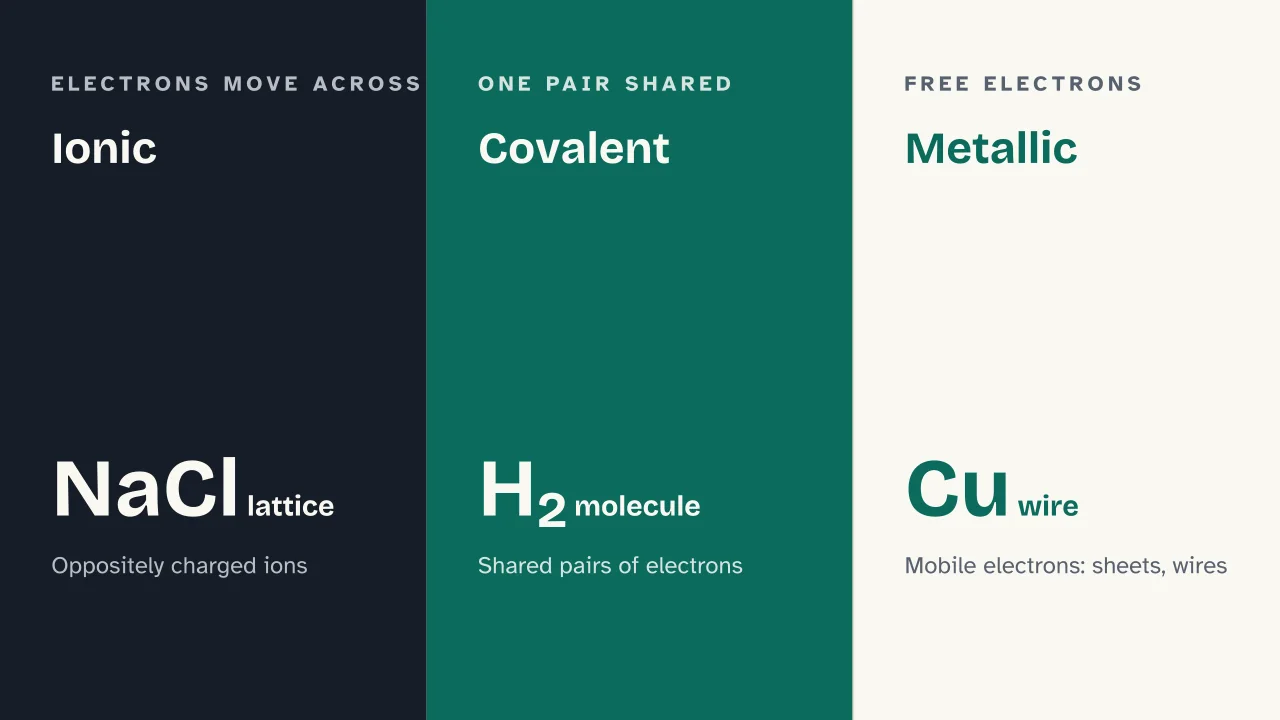  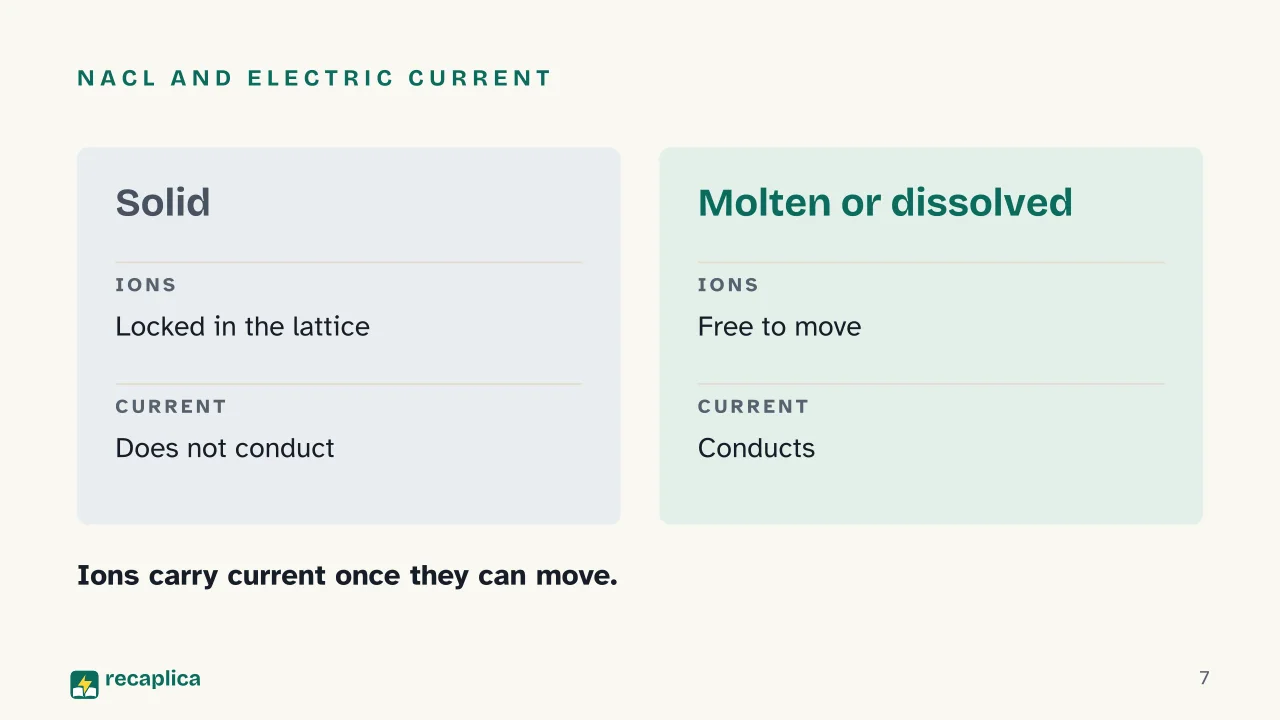  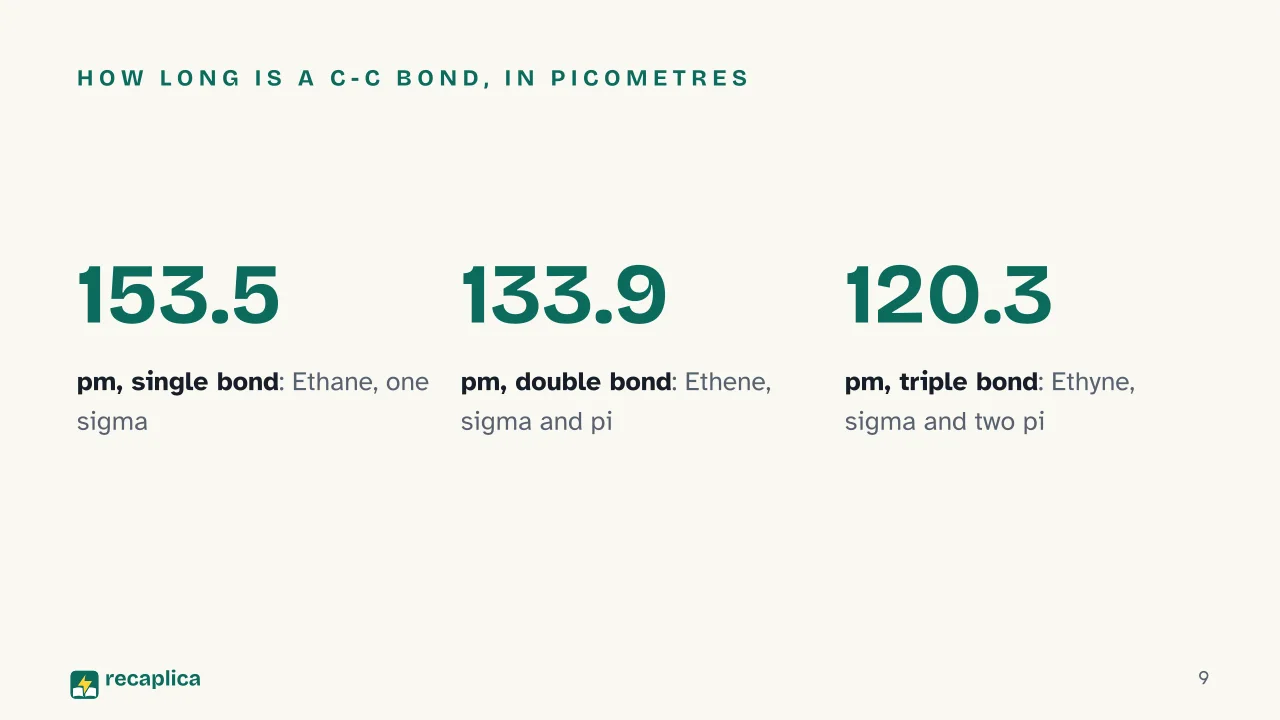 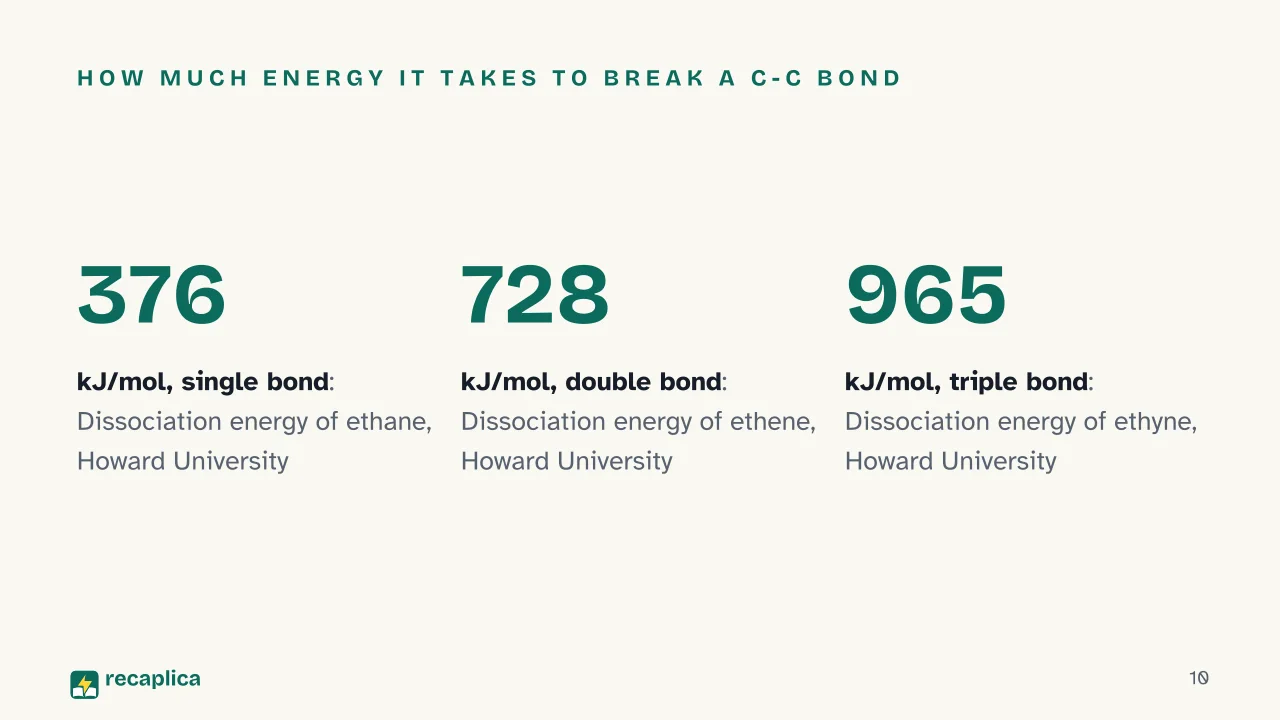  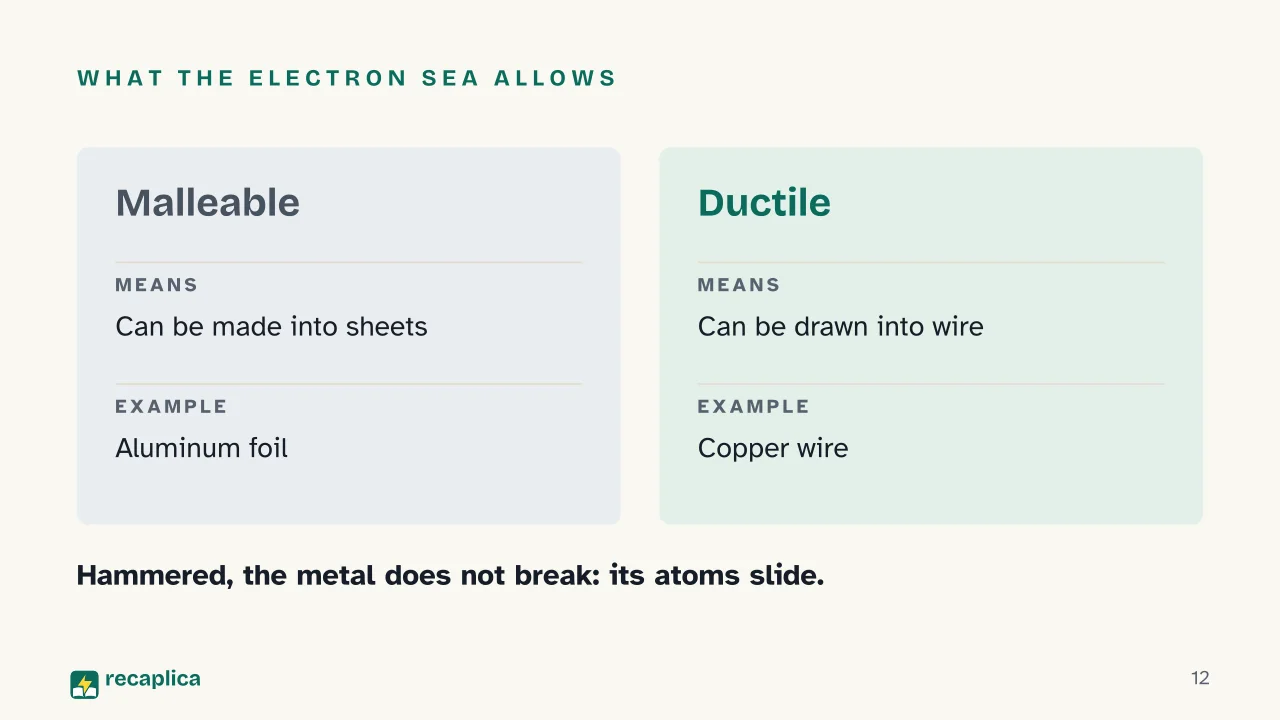 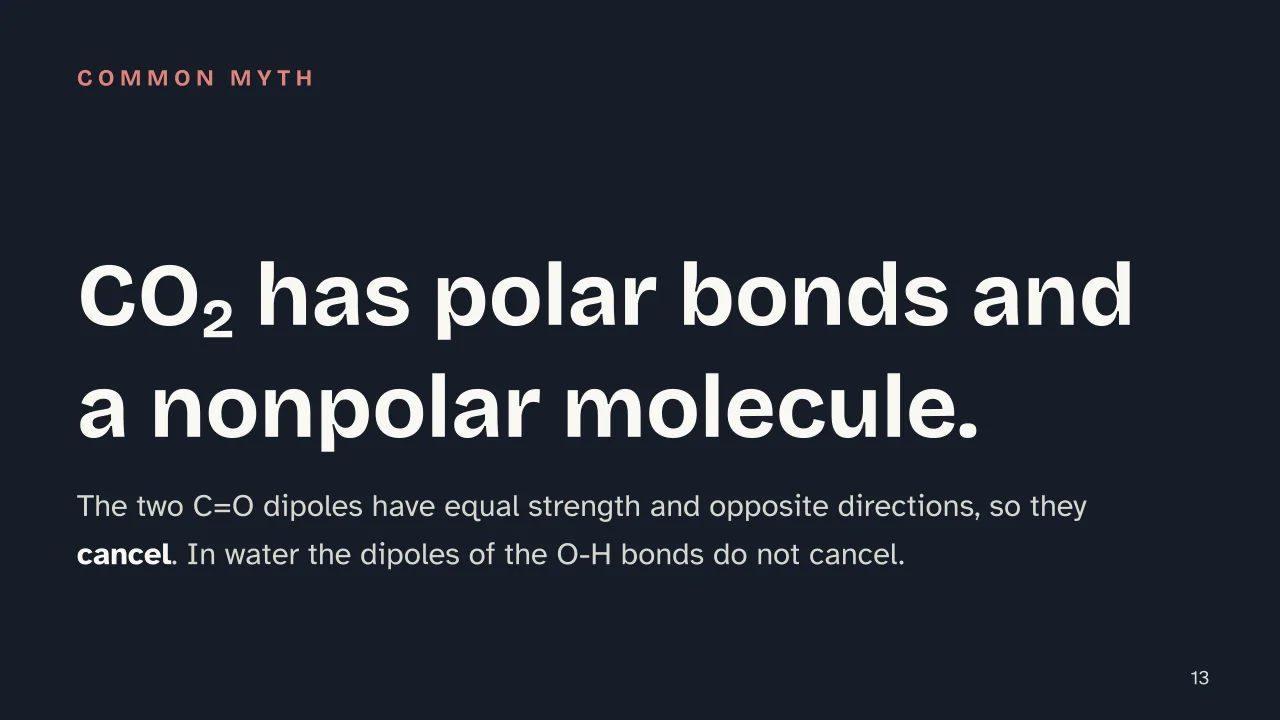 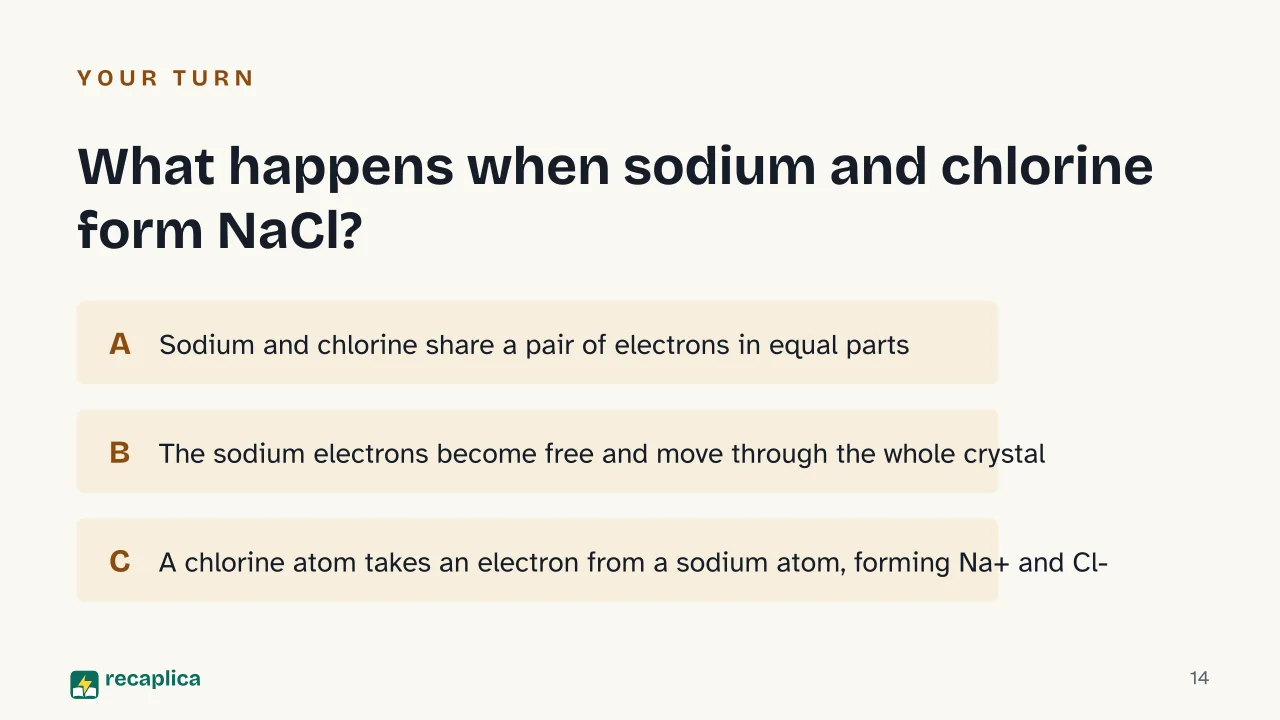  Common myths
Mind mapDrag the background to move around and the nodes to reposition them; use − and + to collapse and expand branches. 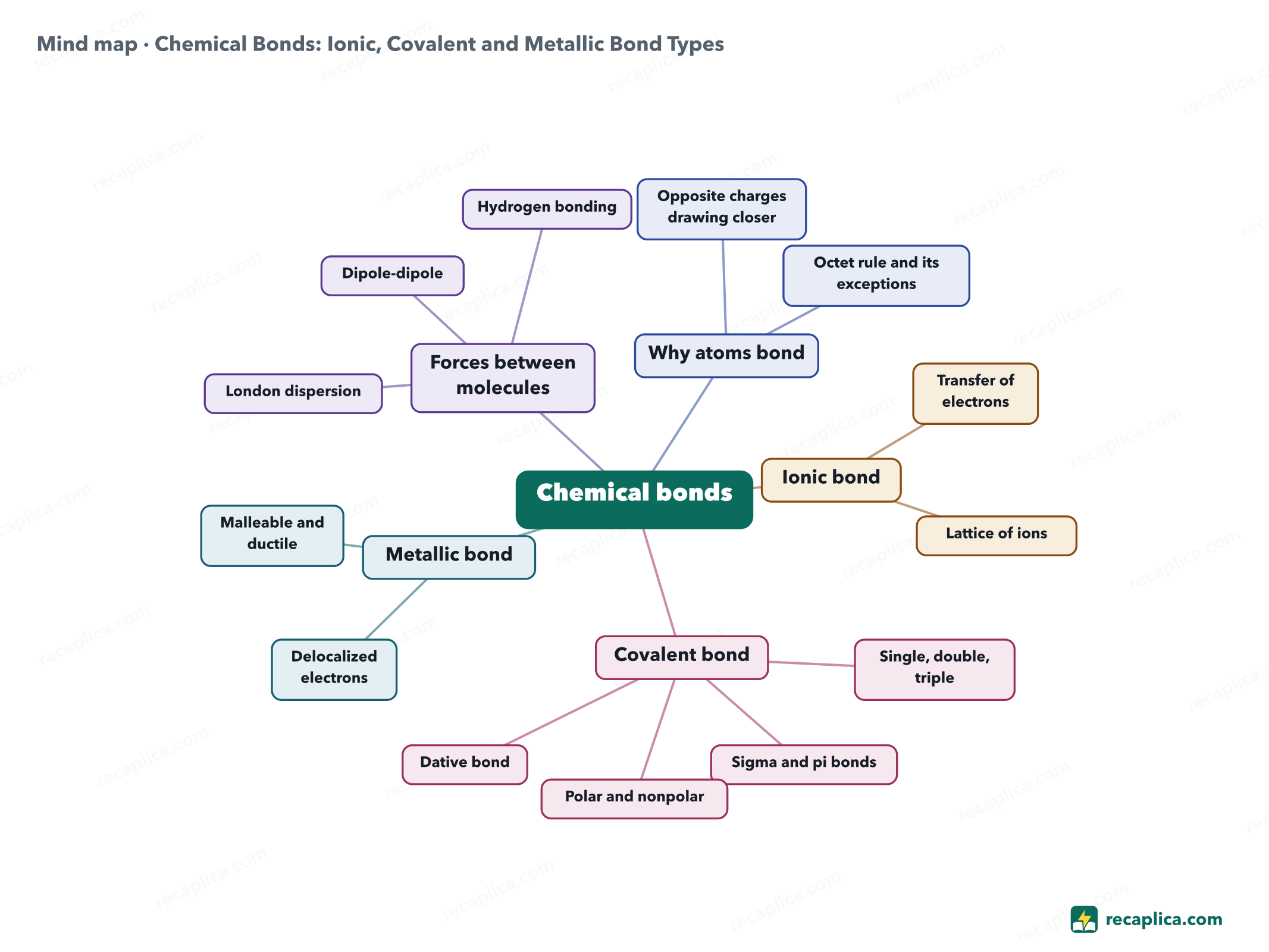
Quiz: test yourselfAnswer the questions to check what you have learned: you get instant feedback and a short explanation. Grade 0/10 0/5
FlashcardsTap the card to flip it and check whether you remember the answer, then move to the next one. 1 / 8 Explain it in your own wordsThe ultimate test: if you can explain it in simple words, you've truly understood it. Write your explanation, then compare it with the Recap. Your explanation is saved only on this device.
Frequently asked questionsWhat are the types of chemical bonds?The three main types are the ionic bond, the covalent bond and the metallic bond. Covalent bonds are further sorted into polar and nonpolar, and into single, double and triple. The scheme is a convenient model, and some substances mix the three characters in varying degrees. How can you tell whether a bond is ionic or covalent?Look at the electronegativity difference between the two atoms. An introductory textbook from Fresno City College, using the Pauling scale, gives 0 to 0.4 as pure covalent, 0.5 to 2.0 as polar covalent, and above 2.0 as probably ionic. The cut-offs vary from textbook to textbook, so treat them as a guide and not as a sharp boundary. What is the difference between polar and nonpolar bonds?In a nonpolar bond the electron pair is shared equally, as between identical atoms in H2, O2 or N2. In a polar bond the two atoms differ in electronegativity and the pair shifts toward the more electronegative atom, leaving a partial negative charge on that side and a partial positive charge on the other. What is the definition of a metallic bond?In a metal the valence electrons are free to move, so no single atom owns them. A familiar example is copper, which carries current and can be drawn into wire. What is the difference between covalent and non-covalent bonds?A covalent bond is a pair of electrons shared inside a molecule. The best-known non-covalent attractions act between molecules: London dispersion forces, dipole-dipole interactions and hydrogen bonds. They are generally much weaker. According to Fresno City College, hydrogen bonds typically take only 15 to 25 kJ/mol to break. Every Recap goes through an independent review before publication. |