|
recaplica
Autumn: When It Starts and Why Leaves Change Color | ||||||||||||
| © 2026 Recaplica · recaplica.com — All rights reserved | ||||||||||||
Autumn: When It Starts and Why Leaves Change ColorWhat to print Page numbers appear when printing with default margins. SlidesChoose a cut Flash10 slidesThe essential thread, to present in classFull18 slidesEvery chapter and the deeper detailBoth come with speaker notes. In 30 seconds quick readAutumn is the transitional season between summer and winter, and it has two different starting points depending on who is measuring it: the meteorological version always begins on September 1, while the astronomical version begins with the equinox, on September 22 or 23, when the Sun sits directly over the equator and daylight and darkness nearly even out almost everywhere. As the days grow shorter, temperatures drop, and toward the end of the season Atlantic weather systems bring more frequent rain and strong gales. The most recognizable sign of autumn, the color change in leaves, is not decay: it is an active chemical reaction, in which chlorophyll breaks down and reveals pigments already present in the leaf, while other pigments are produced specifically for the occasion. In the human body, reduced daylight is linked to the most common pattern of seasonal affective disorder, and the clock change in late October, an administrative convention rather than an astronomical event, shifts daily habits once again. Key Points
Key figures
Deep DiveTwo autumns, one meteorological and one astronomicalLike the other seasons, autumn can be measured in two different ways, and the two measurements don’t start on the same day. According to the Met Office, the UK’s national weather service, meteorological autumn always begins on September 1 and ends on November 30: a fixed three-month block, designed to make it easier to compare climate statistics from one year to the next without the start date shifting every time. Astronomical autumn, instead, begins with the equinox, which usually falls on September 22 or 23: the Treccani encyclopedia cites September 23 as a reference point, but the exact date shifts from year to year because Earth’s orbit is not a perfectly regular circuit around the Sun. On that day, by definition, the Sun crosses directly over the celestial equator and daylight nearly evens out with darkness almost everywhere on Earth. It is the same mechanism behind every season, the tilt of Earth’s axis relative to the plane of its orbit, not distance from the Sun: the full explanation of that point, along with the most common myth about it debunked with data, is in the article on winter. After the autumn equinox, nights grow longer than days, and stay that way until the spring equinox, when the exact opposite happens, at the same instant, in the other hemisphere.
Why leaves change color, and why it isn’t decayThe most recognizable sign of autumn is not a decline in the plant, it is a multi-stage chemical reaction. According to the SUNY College of Environmental Science and Forestry, a public US university specializing in environmental and forest science, during spring and summer the leaf is dominated by the green of chlorophyll, the pigment that makes photosynthesis possible. In autumn, as day length and temperature change together, chlorophyll breaks down and the green fades: underneath it, yellow and orange pigments emerge, carotenoids and xanthophylls, which were present in the leaf throughout the growing season but simply stayed masked. Red follows a different logic: it wasn’t there waiting, it is produced specifically by the plant through new pigments, anthocyanins, responsible for the red and purplish colors typical of maples and other species. Cold but not freezing nights favor anthocyanin production, while an early frost tends to weaken the brightest reds; rainy or overcast days, in turn, tend to increase the overall intensity of the colors. The Met Office notes that the most vivid shades appear when a dry summer is followed by an autumn with dry, sunny days and cold, but not freezing, nights. Even the leaf’s fall, finally, is not simple drying out: at the point where the stem attaches to the branch, a layer of specialized cells forms, the abscission layer, which gradually detaches the tissue holding the leaf in place. It is the plant itself that governs the detachment, an active process rather than passive decay.
Climate and the clock change, two separate eventsOn the climate side, according to the Met Office, autumn brings falling temperatures, shorter days and often unsettled weather: toward the end of the season Atlantic weather systems become more frequent and can bring heavy rain and strong gales. In the UK, the average autumn temperature, based on the 1991-2020 long-term average, is 9.71°C: a figure specific to that country, not a universal value, but useful for getting a concrete sense of what a “mild but unsettled” season means in numbers. There is then an event many people mistakenly link to the equinox, but which follows its own calendar entirely: the clock change. According to GOV.UK, the official website of the British government, in countries that observe it clocks go back an hour at 2 a.m. on the last Sunday of October; in 2026 that date falls on October 25. It is an administrative convention, set by law, not an astronomical phenomenon: the equinox, which truly marks the start of astronomical autumn, arrives more than a month earlier. The clock change shifts how daylight is distributed across the day, moving more hours of light to the morning and fewer to the evening.
Effects on people and animalsAutumn is felt in the body and in behavior too. On the mood side, the National Institute of Mental Health describes seasonal affective disorder as a form of depression with a recurring seasonal pattern; the more common pattern often begins in late autumn, with symptoms such as excessive sleepiness and a stronger craving for carbohydrate-rich foods. Reduced daylight after the equinox is linked, per the NIMH, to a drop in serotonin, the neurotransmitter that helps regulate mood: the same mechanism involving light and the circadian rhythm is explored further in the article on human emotions. Clinical caution is warranted, though: an occasional dip in mood is not the disorder, diagnosis requires recurring episodes for at least two consecutive years in the same season, with symptoms that typically last around 4-5 months a year. Some animals respond to autumn with measurable behavior too. Many bird species migrate toward warmer climates as the season arrives, a widespread and well-known phenomenon, though there are no verified figures to cite here on that point. For the North American monarch butterfly, though, the U.S. Fish and Wildlife Service provides precise data: every autumn the eastern population enters diapause, a state of suspended reproduction, and begins migrating toward overwintering sites in Mexico. The trip can reach 3,000 miles, about 4,800 km, lasts more than two months, and proceeds at an average of 70-75 miles a day; the longest single-day distance recorded for one tracked butterfly is 265 miles, about 425 km.
Autumn, finally, brings along seasonal habits tied more to tradition than to climate: it is the period traditionally associated with the grape harvest and the picking of chestnuts and other seasonal fruit, though there is no up-to-date, verified quantitative data to cite here on that scale. Slide deckSlides ready to download and make your own in PowerPoint or Google Slides, with speaker notes. Pick the Flash cut or the Full one.     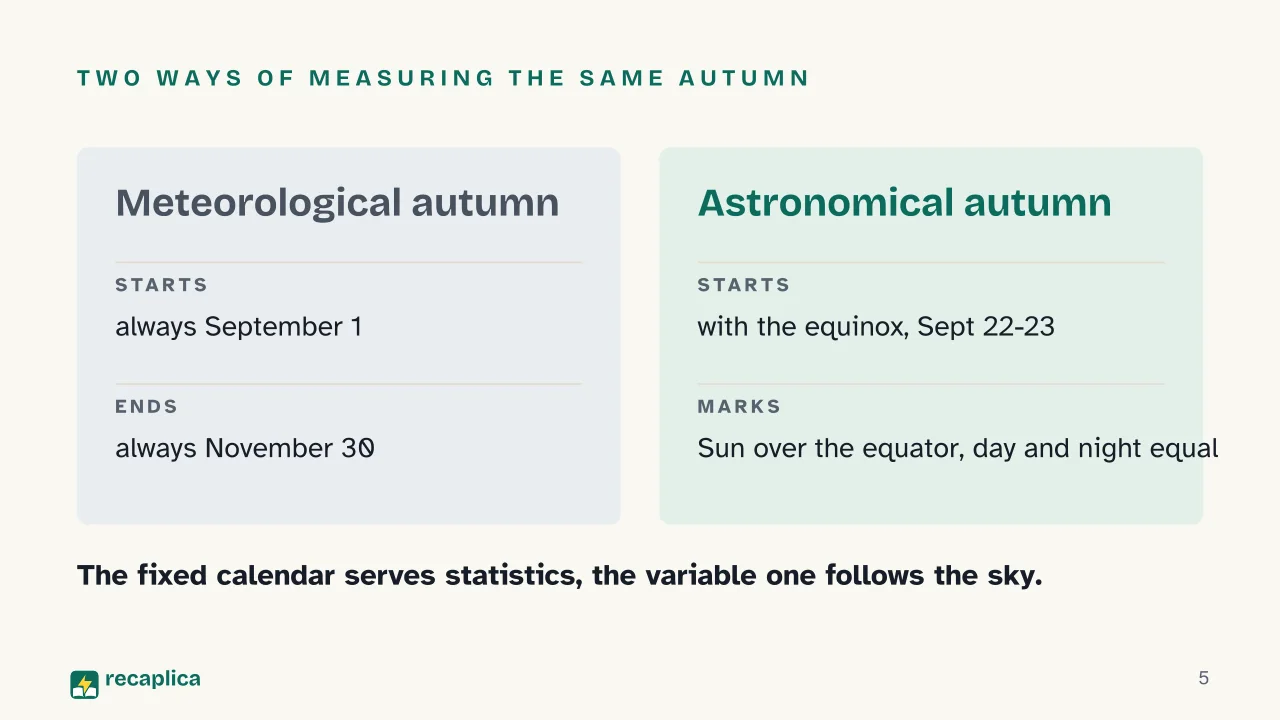 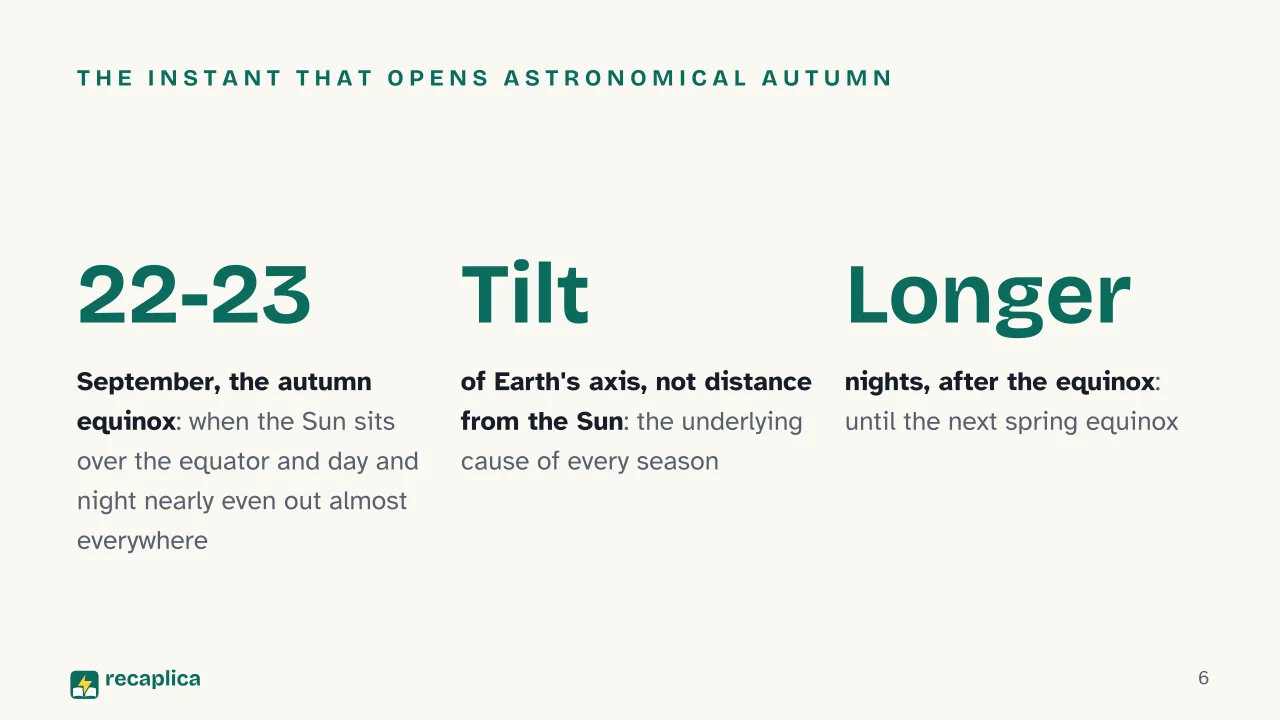  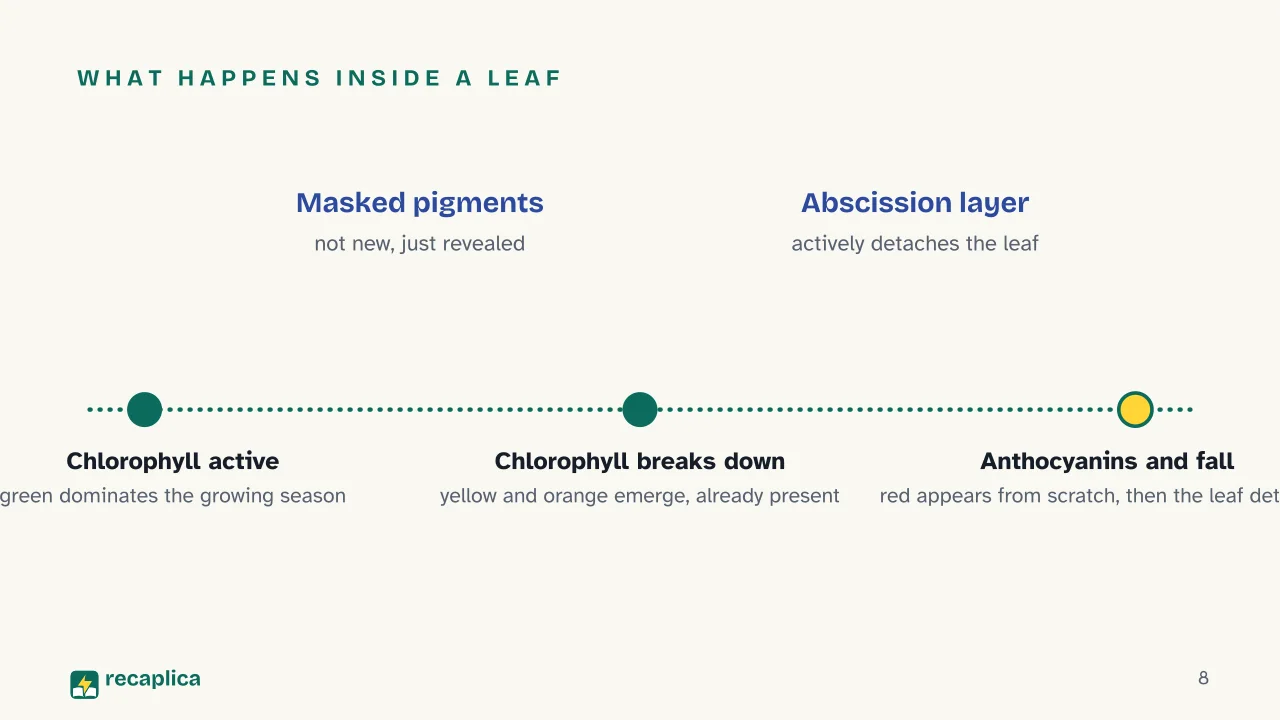 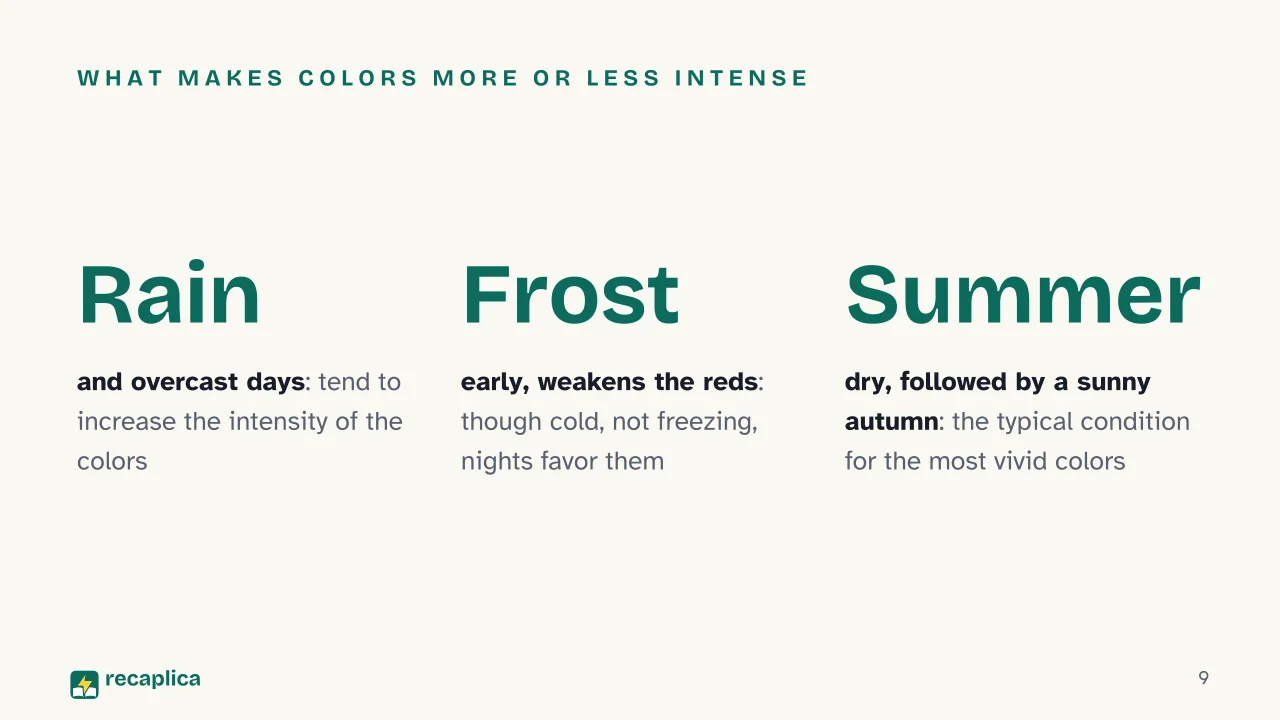 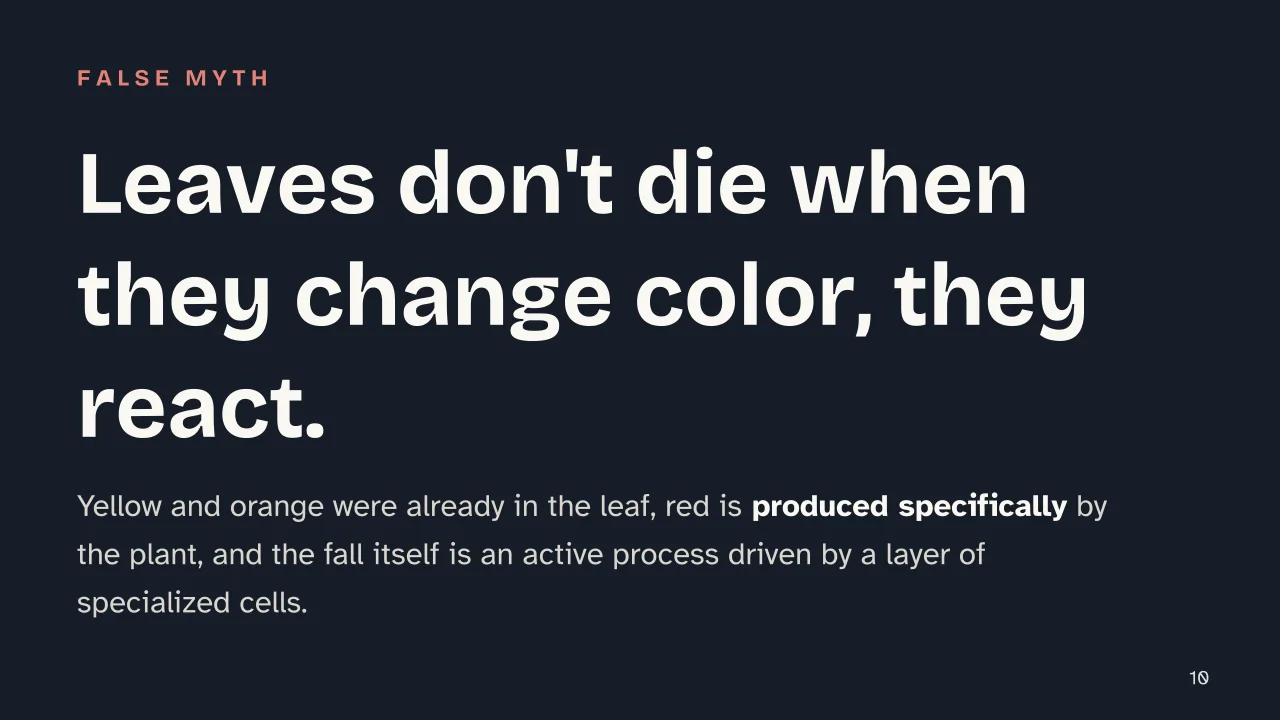  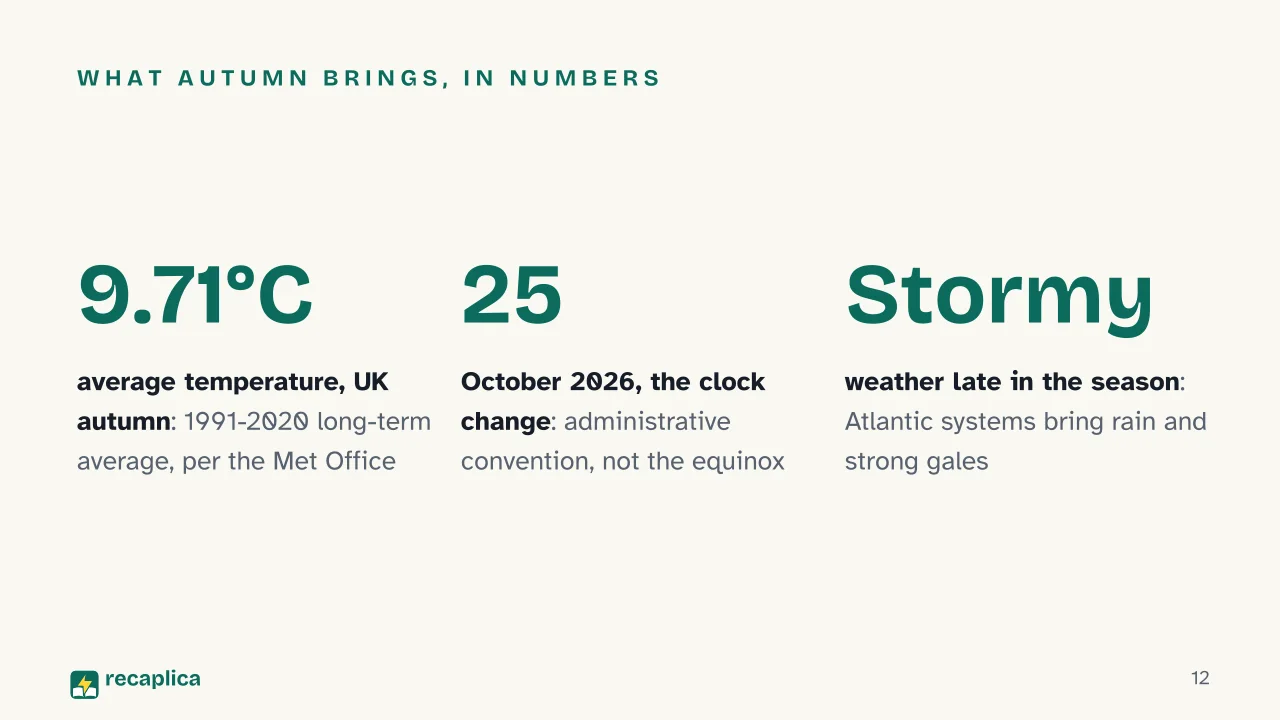 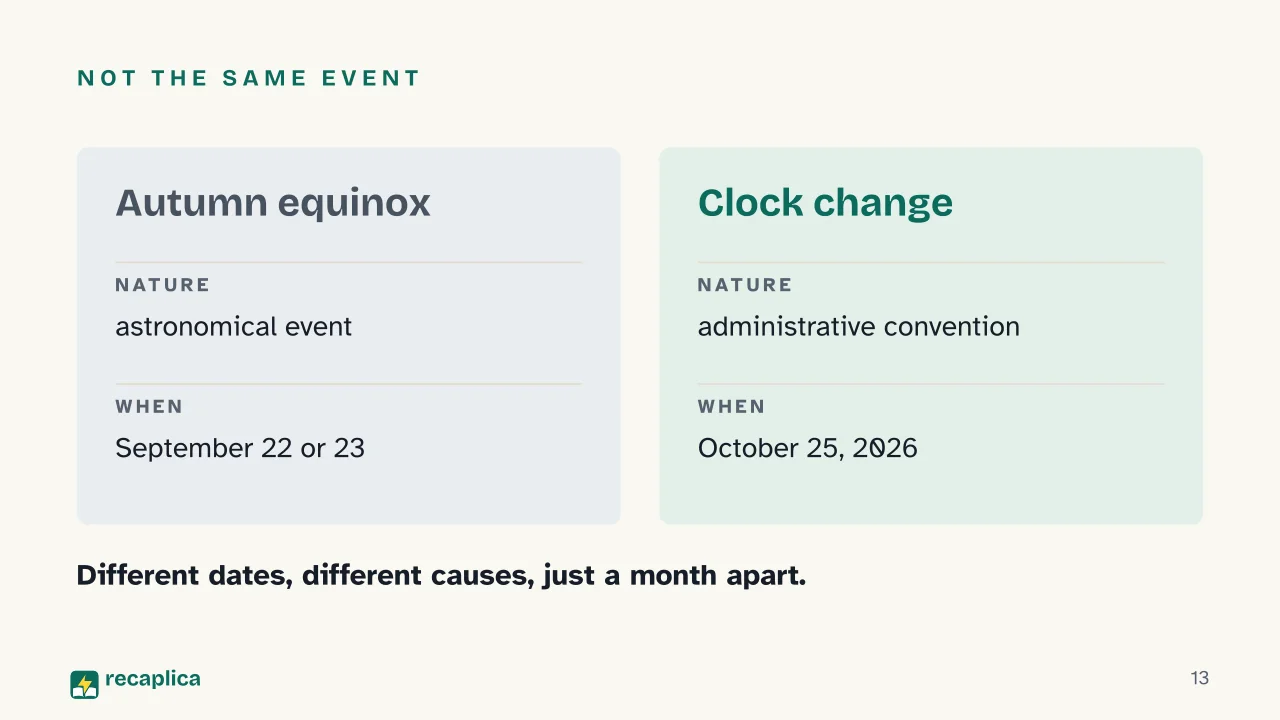  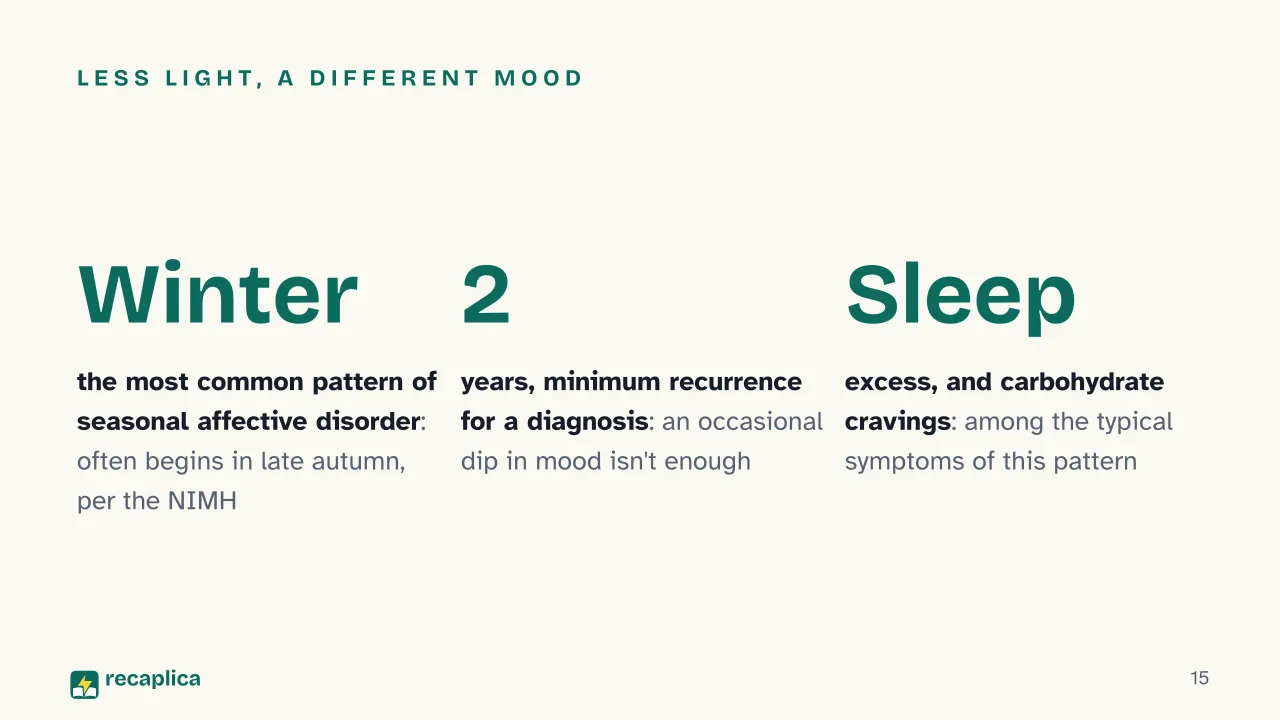 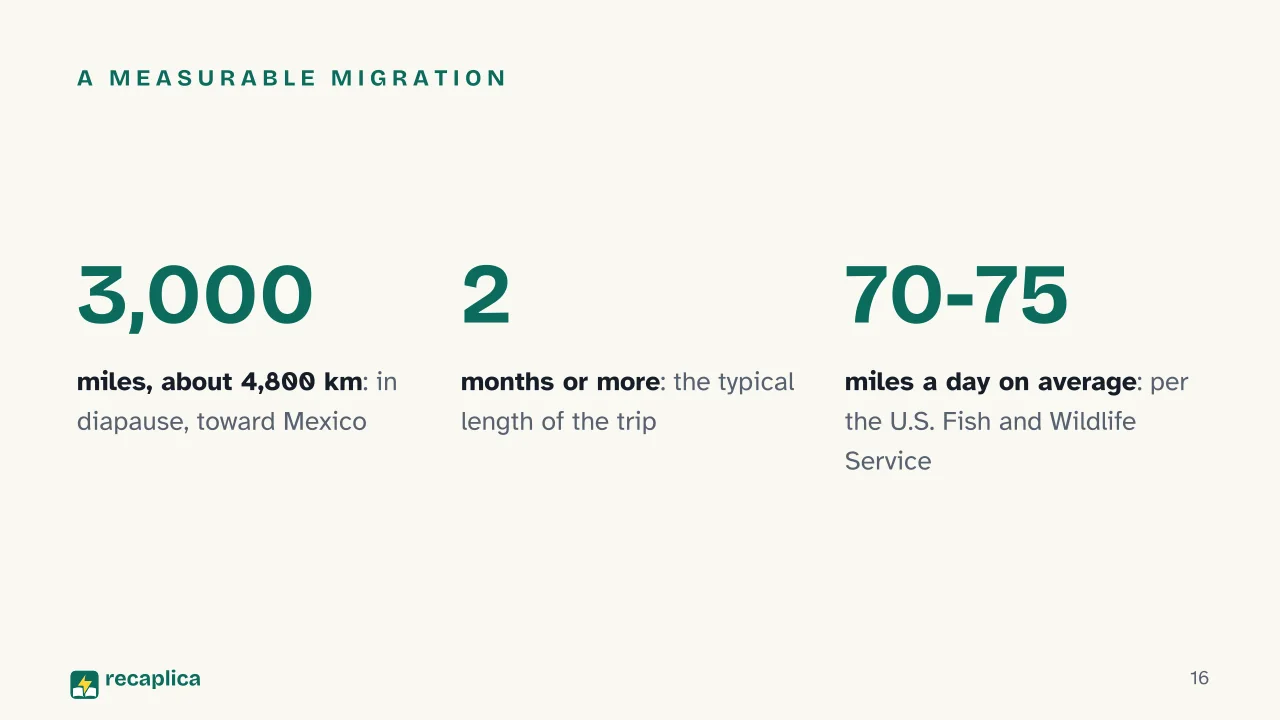 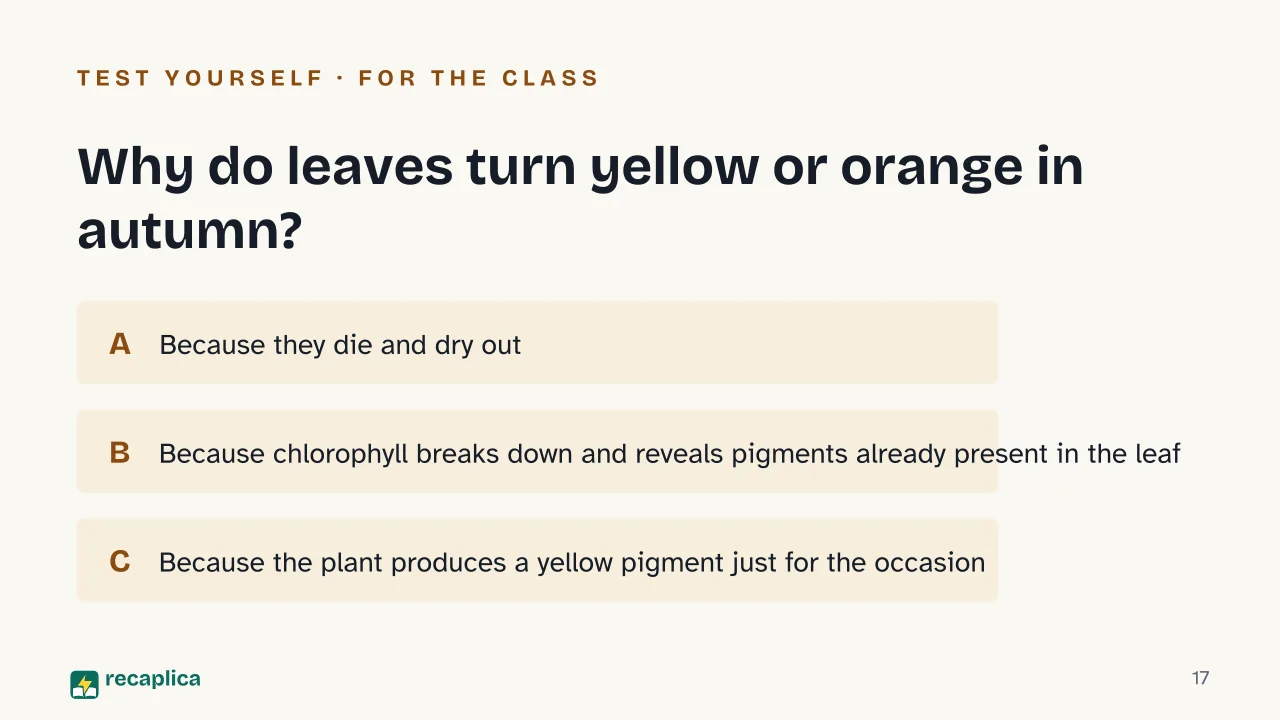  Common myths
Mind mapDrag the background to move around and the nodes to reposition them; use − and + to collapse and expand branches. 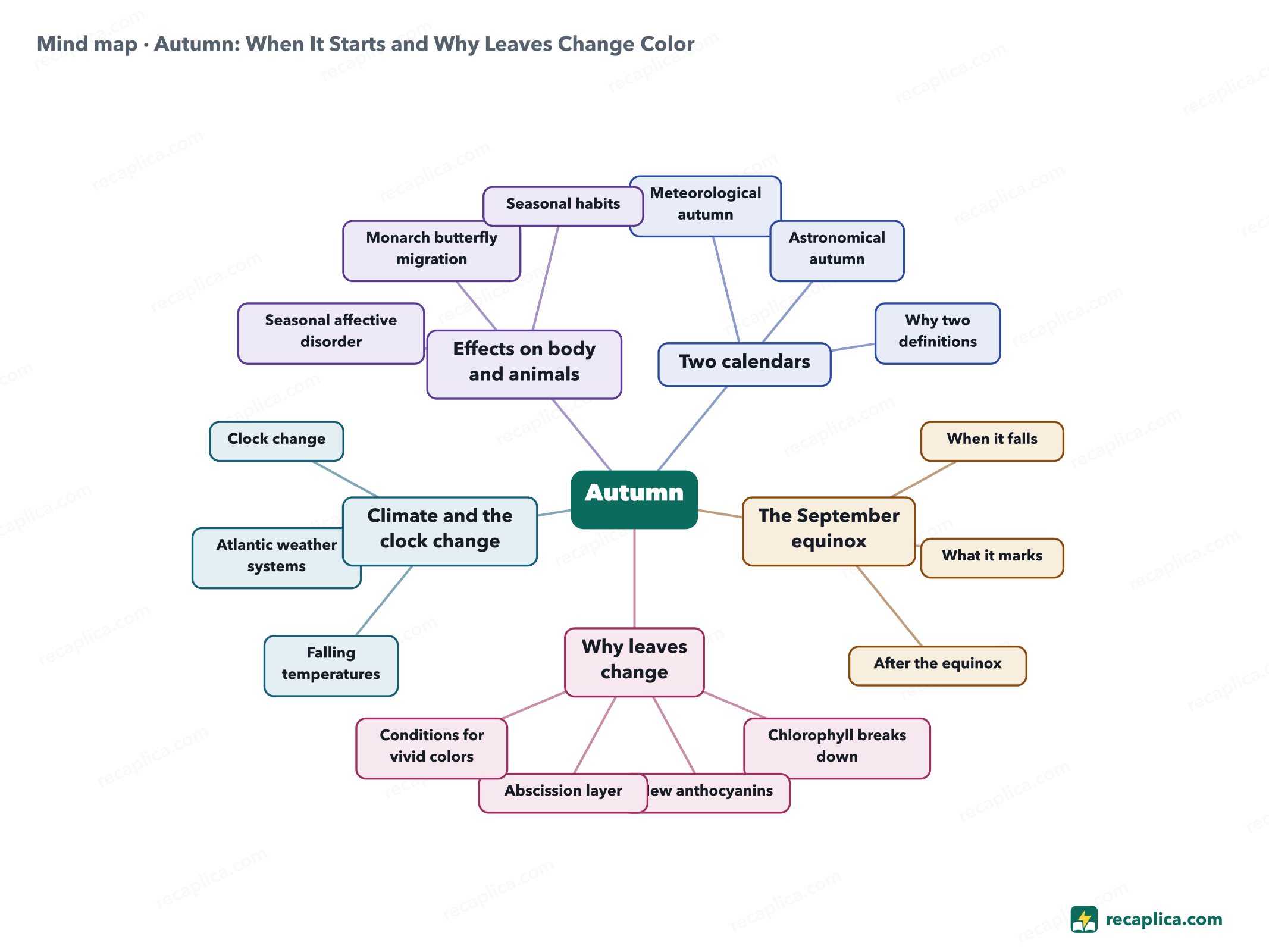
Quiz: test yourselfAnswer the questions to check what you have learned: you get instant feedback and a short explanation. Grade 0/10 0/5
FlashcardsTap the card to flip it and check whether you remember the answer, then move to the next one. 1 / 8 Explain it in your own wordsThe ultimate test: if you can explain it in simple words, you've truly understood it. Write your explanation, then compare it with the Recap. Your explanation is saved only on this device.
Frequently asked questionsWhen does autumn start in 2026?It depends on who is measuring it. Meteorological autumn, used by meteorologists and climatologists, always begins on September 1 and ends on November 30, according to the Met Office. Astronomical autumn instead begins with the equinox, which falls on September 22 or 23 in 2026; the exact instant shifts slightly from year to year because of Earth's orbit. Why do leaves change color in autumn?Because chlorophyll, the green pigment that makes photosynthesis possible, breaks down as day length and temperature change: underneath it, yellow and orange pigments emerge (carotenoids and xanthophylls), already present in the leaf all year but masked until then. Red, on the other hand, is produced specifically by the plant through new pigments, anthocyanins, according to the SUNY College of Environmental Science and Forestry. Is the October clock change linked to the autumn equinox?No, they are two separate events. The autumn equinox is an astronomical phenomenon tied to Earth's position relative to the Sun and falls on September 22 or 23; the clock change is instead an administrative convention, set in countries that observe it for the last Sunday of October (October 25 in 2026, according to GOV.UK), which sets clocks back an hour. What animals migrate in autumn?Many bird species move toward warmer climates as autumn arrives, though there are no verified figures to cite here for that phenomenon. For the North American monarch butterfly, though, the U.S. Fish and Wildlife Service provides precise data: the eastern population travels up to 3,000 miles (about 4,800 km) over more than two months, at an average of 70-75 miles a day, toward overwintering sites in Mexico. Does autumn affect mood?For some people, yes. According to the National Institute of Mental Health, reduced daylight after the equinox is linked to the most common pattern of seasonal affective disorder, which often begins in late autumn with symptoms such as excessive sleepiness and carbohydrate cravings; it should not be confused with an occasional dip in mood, since diagnosis requires recurring episodes for at least two consecutive years in the same season. Every Recap goes through an independent review before publication. |