recaplica
Clear in 30 seconds, yours in 10 minutes.
In 30 seconds quick read
Photosynthesis is the process by which plants turn sunlight, water and carbon dioxide into glucose (their food) and oxygen. It happens in the leaves thanks to chlorophyll, the green pigment that captures the energy of light. It is the process that feeds almost all life on Earth and produces the oxygen we breathe.
Key Points
Ingredients: water (from the roots), carbon dioxide (from the air) and light energy (from the sun).
Products: glucose, the sugar that feeds the plant, and oxygen, released into the air.
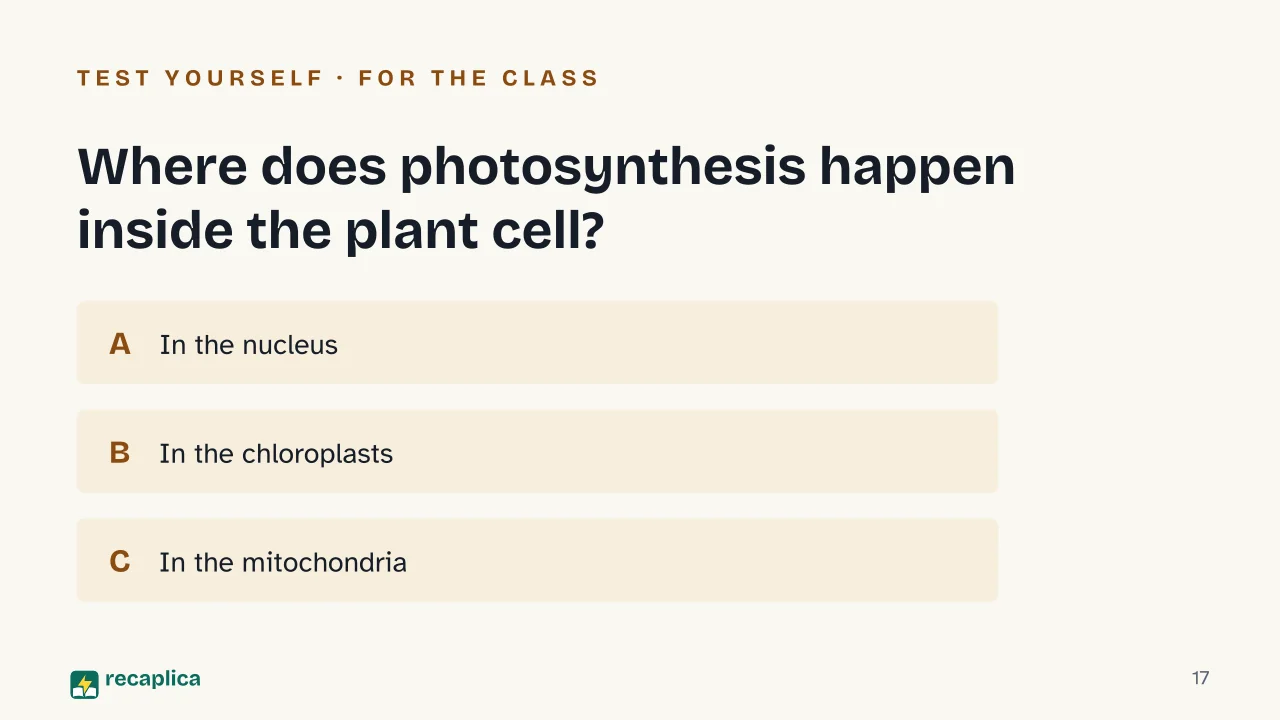
It takes place in chloroplasts, organelles of plant cells that contain chlorophyll.
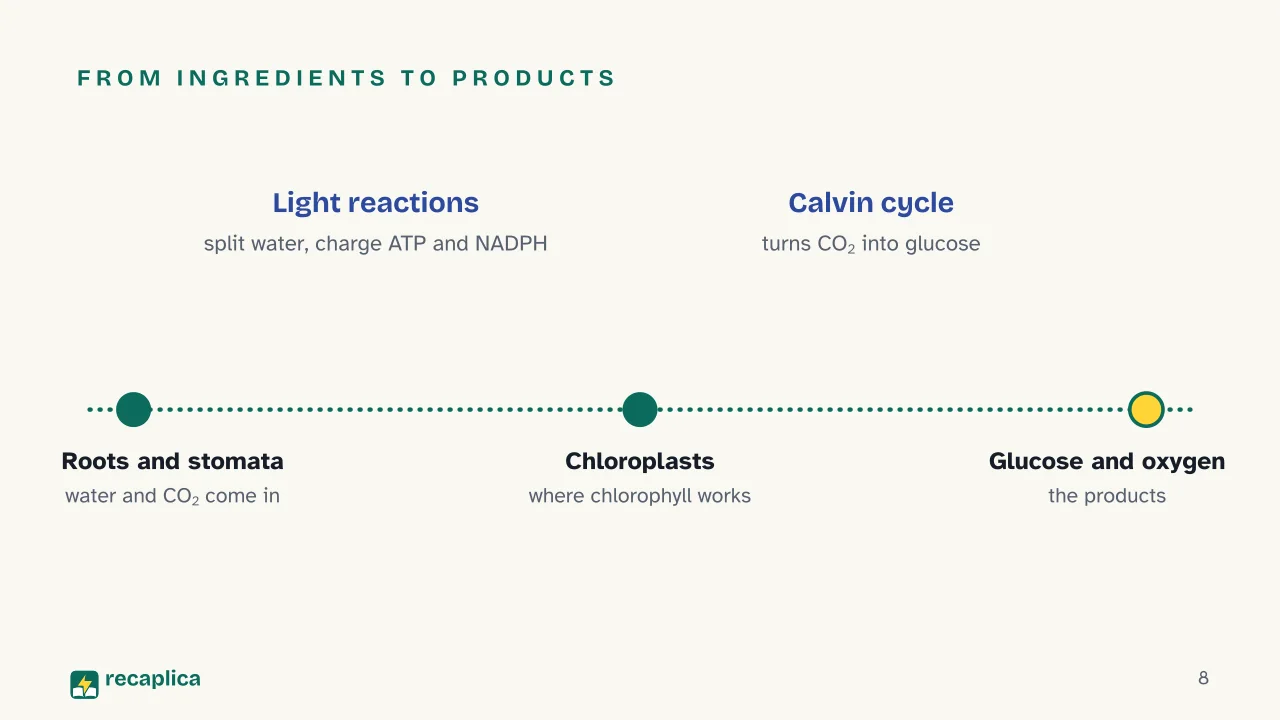
It has two stages: the light-dependent reactions and the Calvin cycle (the 'dark' stage).
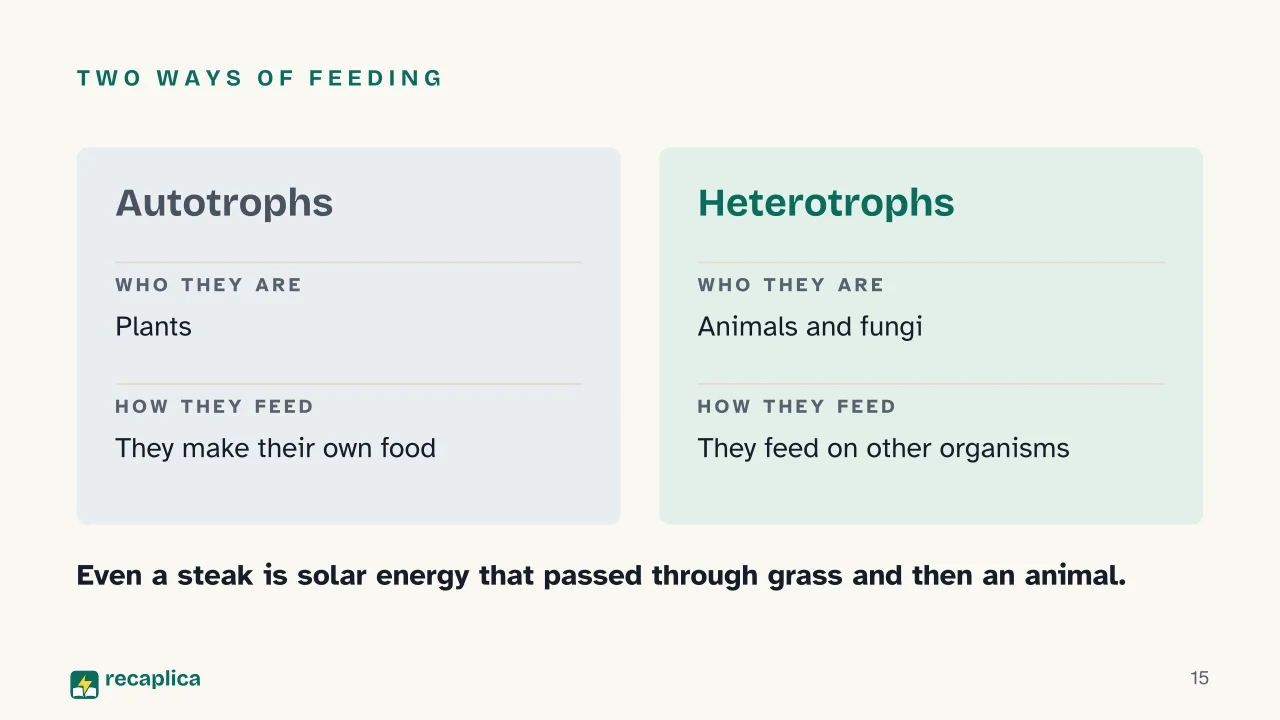
Plants are autotrophs: they make their own food, unlike animals (heterotrophs).
Key figures
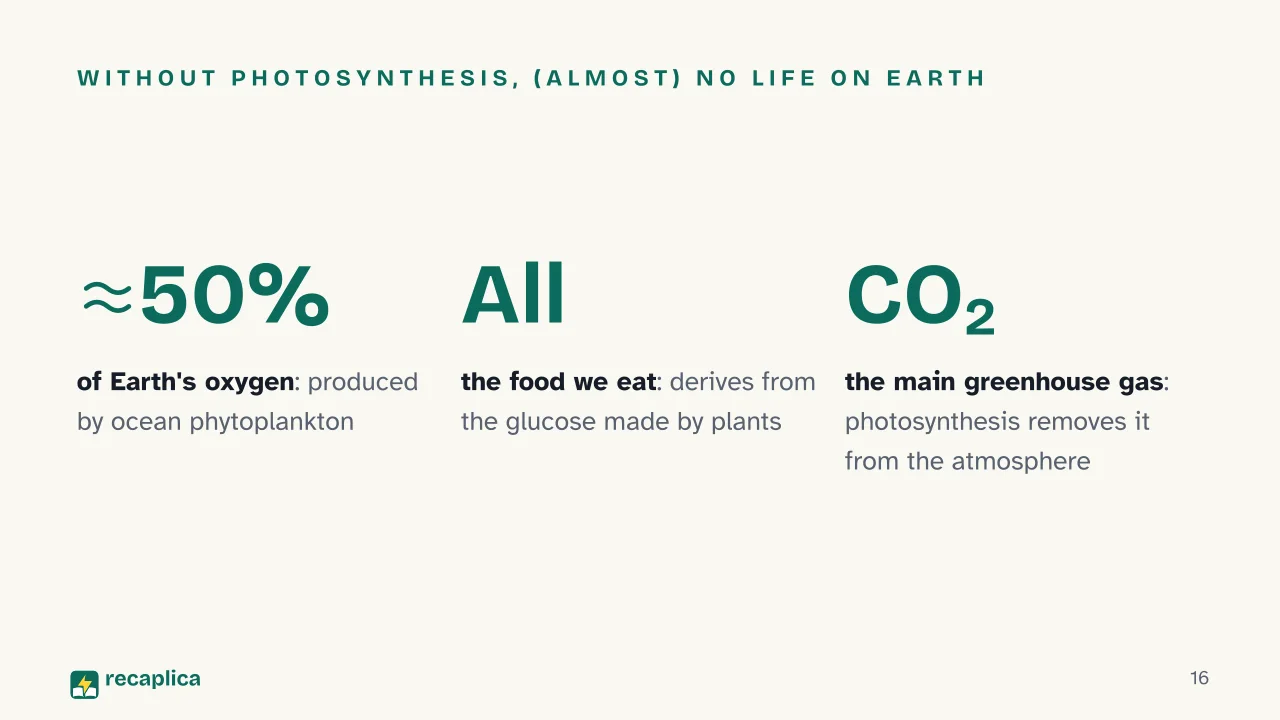
≈50% the share of Earth's oxygen produced by ocean phytoplankton Source: NOAA
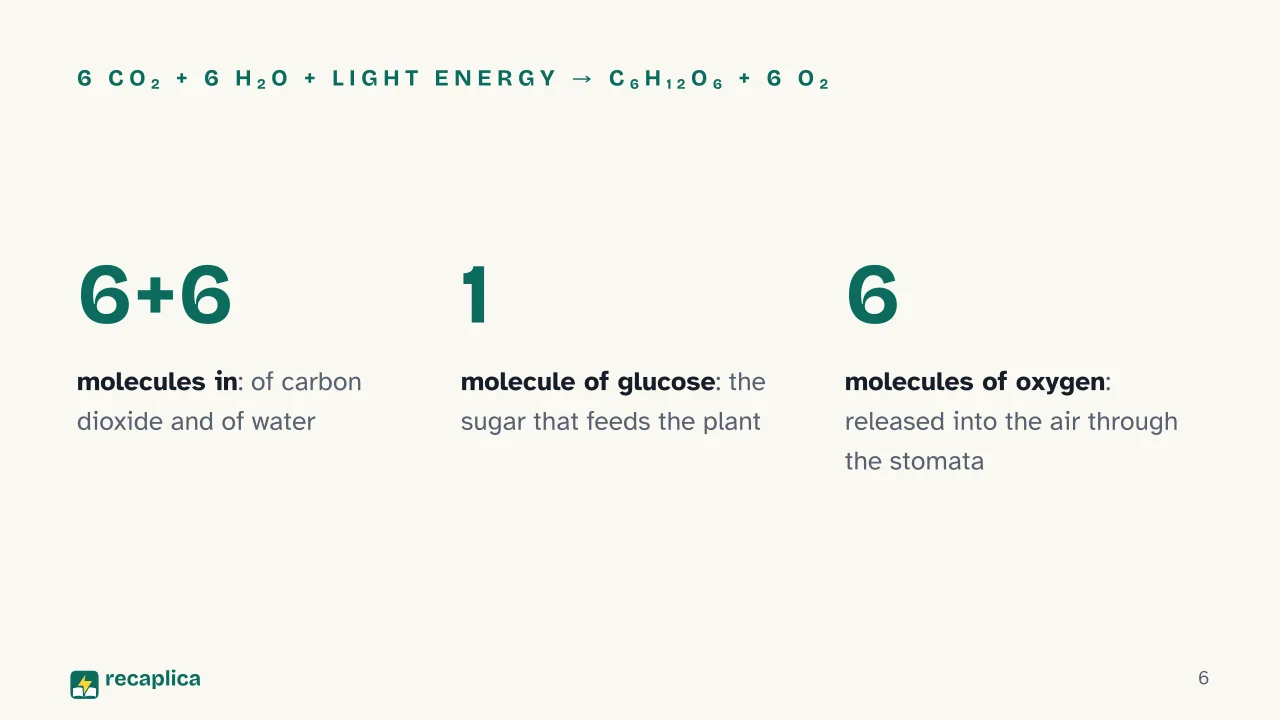
6+6 the CO₂ and water molecules needed to produce one molecule of glucose
Deep Dive
The oldest food factory in the world
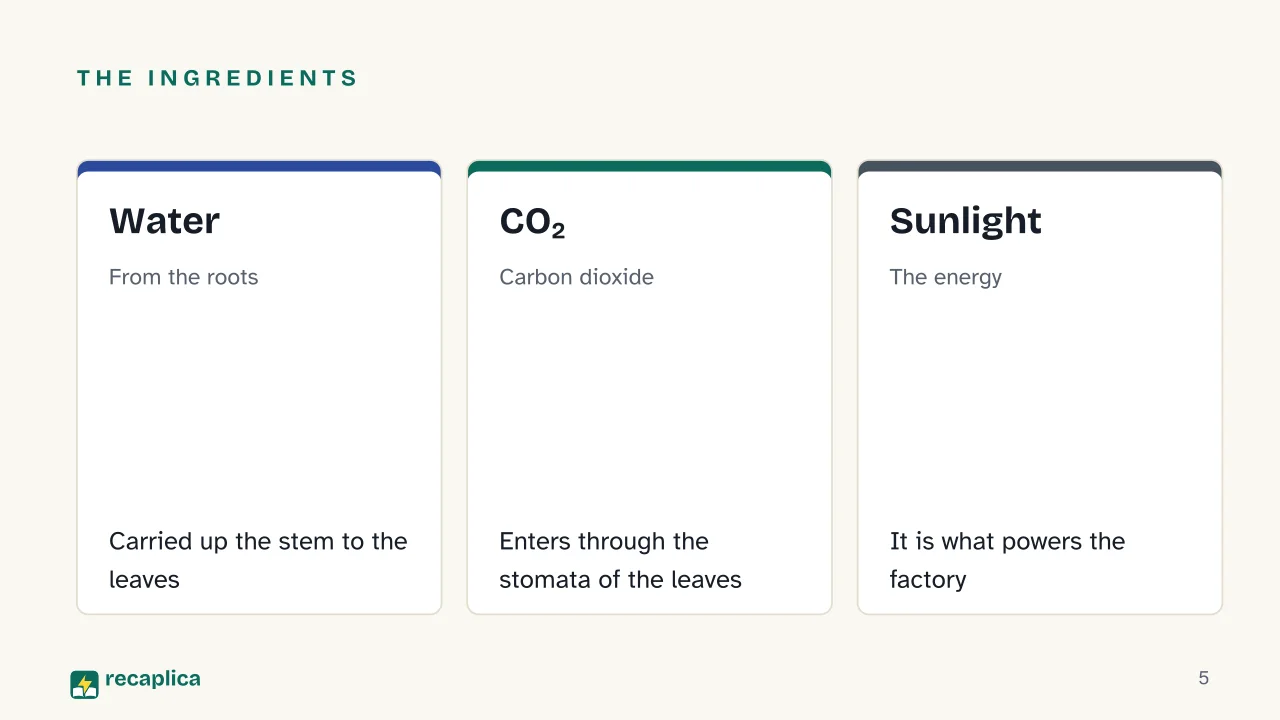
Every green leaf is a tiny chemical factory. The raw materials come in
through two doors: water, absorbed by the roots and carried up the
stem, and carbon dioxide (CO₂), entering the leaves through microscopic
openings called stomata. The energy that powers the factory comes from
the sun.
The final product is glucose, a sugar that is the plant’s food, plus a
“waste” by-product that for us is anything but waste: oxygen.
The whole process fits in one formula worth remembering:
6 CO₂ + 6 H₂O + light energy → C₆H₁₂O₆ + 6 O₂
Six molecules of carbon dioxide plus six of water, powered by light,
become one molecule of glucose and six of oxygen.
Where it happens: chloroplasts and chlorophyll
Photosynthesis runs inside specialized organelles of plant cells, the
chloroplasts. Inside them sits chlorophyll, the pigment that gives
plants their green color and works like a natural solar panel: it captures
the energy of light and makes it available for chemical reactions.
Fun fact: leaves are green precisely because chlorophyll doesn’t
use green light: it absorbs mostly red and blue, and reflects the green
component — which is what reaches our eyes.
The two stages of photosynthesis
Stage 1: the light reactions
They only happen in the presence of light. Chlorophyll captures solar
energy and uses it to split water molecules: the oxygen is released
into the air through the stomata, while the energy is stored in two
molecules that act as chemical “batteries”, called ATP and NADPH.
Stage 2: the Calvin cycle (the “dark” stage)
Using the energy from the “batteries” charged in the first stage, the
plant turns carbon dioxide into glucose. It’s called the “dark” stage
because it doesn’t directly need light — not because it happens at
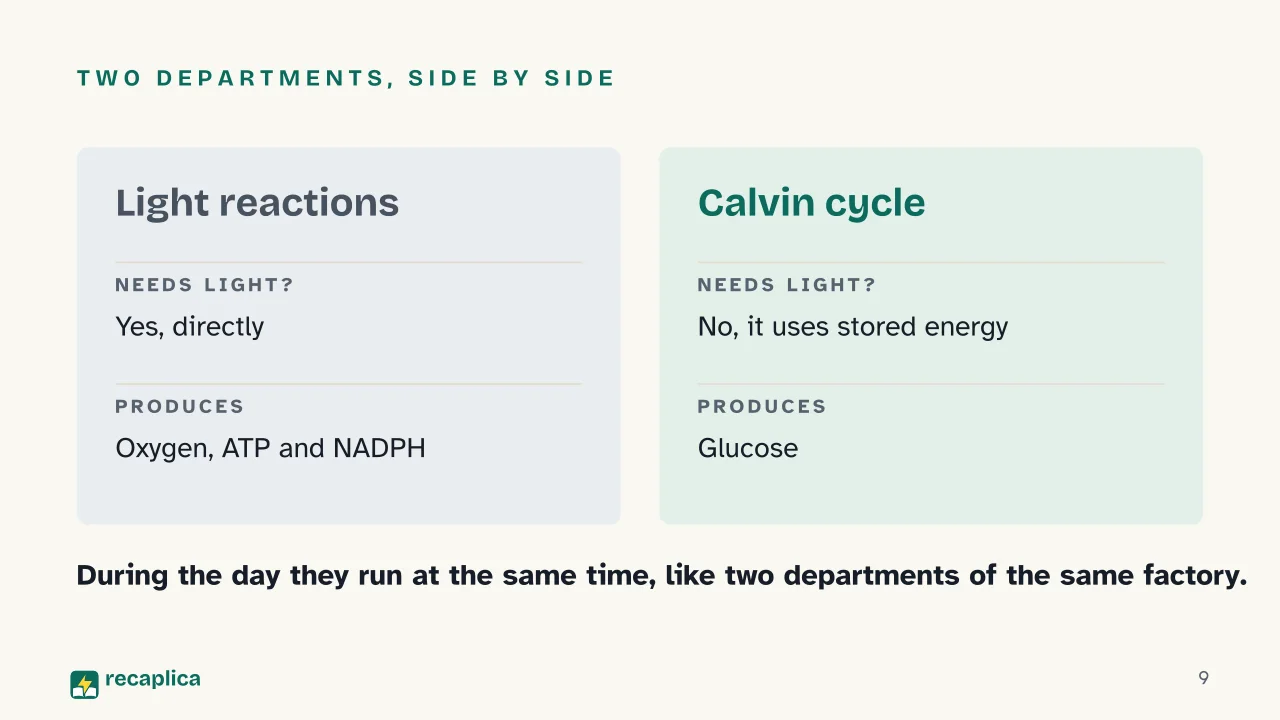
night: during the day the two stages run at the same time, like two
departments of the same factory.
Light reactions
Calvin cycle
Needs light?
Yes, directly
No (uses stored energy)
Consumes
Water and light
CO₂, ATP and NADPH
Produces
Oxygen, ATP and NADPH
Glucose
What the plant does with the glucose
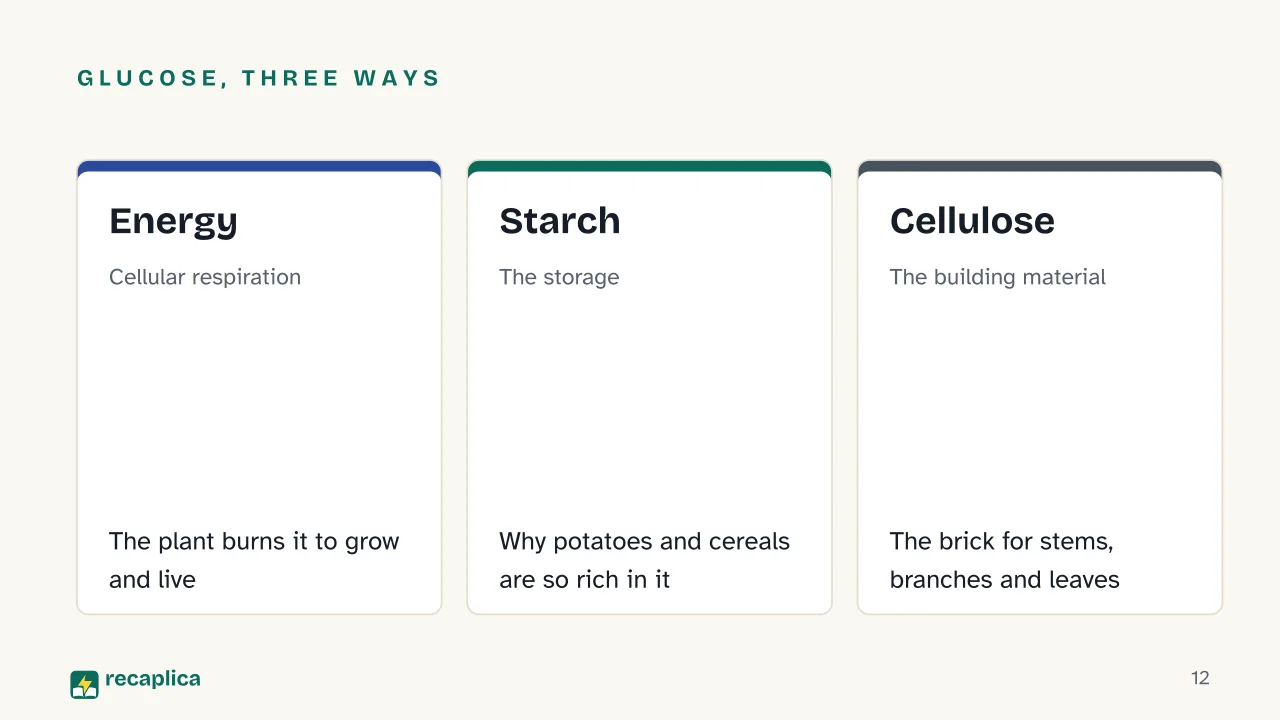
The plant uses glucose in three ways:
Immediate energy: it “burns” it through cellular respiration to
grow and live, exactly as we burn food.
Storage: it stores it as starch (which is why potatoes and cereals
are so rich in starch).
Building material: it turns it into cellulose, the brick it uses to
build stems, branches and leaves.
Why it matters to us
Without photosynthesis there would be (almost) no life on Earth, for three
reasons:
The oxygen we breathe comes from the photosynthesis of plants, algae
and cyanobacteria — the latter, in the oceans, produce more of it than
forests do.
All the food we eat derives, directly or indirectly, from the glucose
made by plants: even a steak is “solar energy” that passed through grass
and then an animal.
CO₂ absorption: photosynthesis removes the main greenhouse gas from
the atmosphere, which is why forests are called “the lungs of the
planet”.
Slide deck
Slides ready to download and make your own in PowerPoint or Google Slides, with speaker notes. Pick the Flash cut or the Full one.
✗ Myth Plants 'breathe in reverse': they inhale CO₂ instead of oxygen.
✓ Reality Plants breathe oxygen day and night, exactly like us. Photosynthesis is a separate process that, during the day, absorbs CO₂ and produces far more oxygen than respiration consumes.
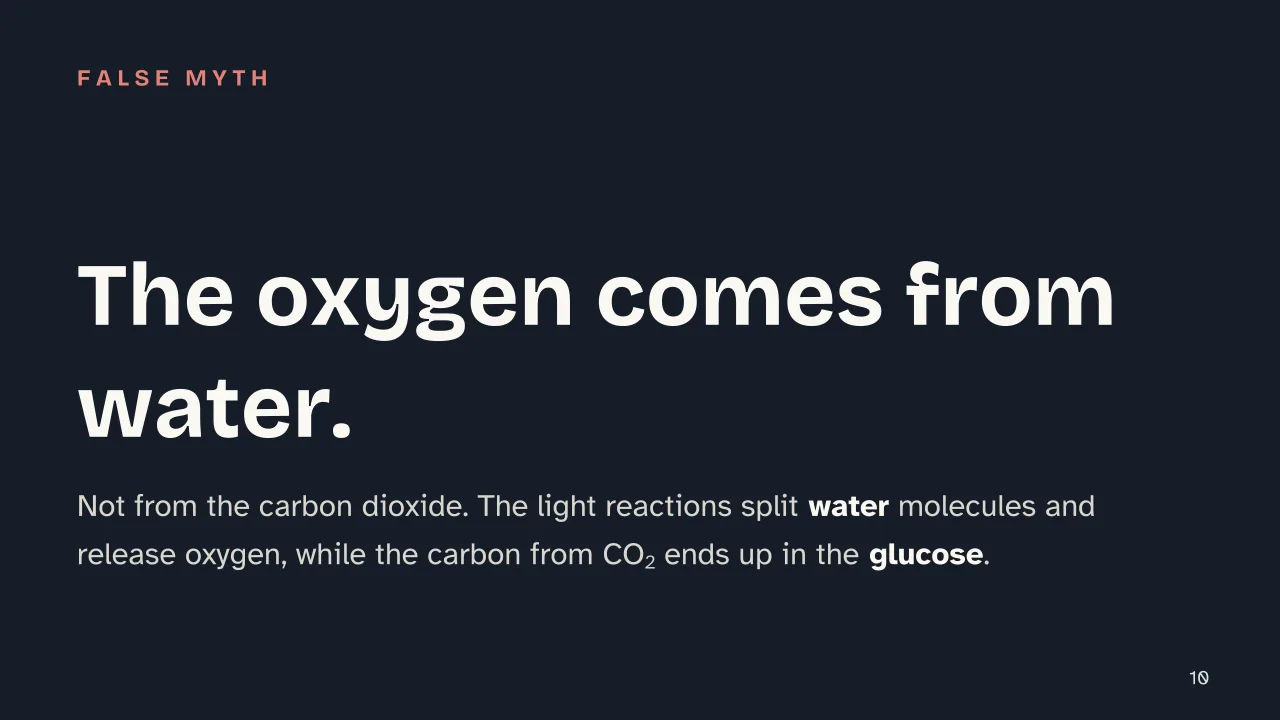
✗ Myth The oxygen produced comes from the carbon dioxide.
✓ Reality The released oxygen comes from splitting water molecules in the light reactions; the carbon from CO₂ ends up in the glucose instead.
✗ Myth The oxygen we breathe comes mostly from forests.
✓ Reality Ocean phytoplankton alone produces about half of Earth's oxygen — forests matter enormously, but the true 'lungs of the planet' are also microscopic and marine.
Mind map
Drag the background to move around and the nodes to reposition them; use − and + to collapse and expand branches.
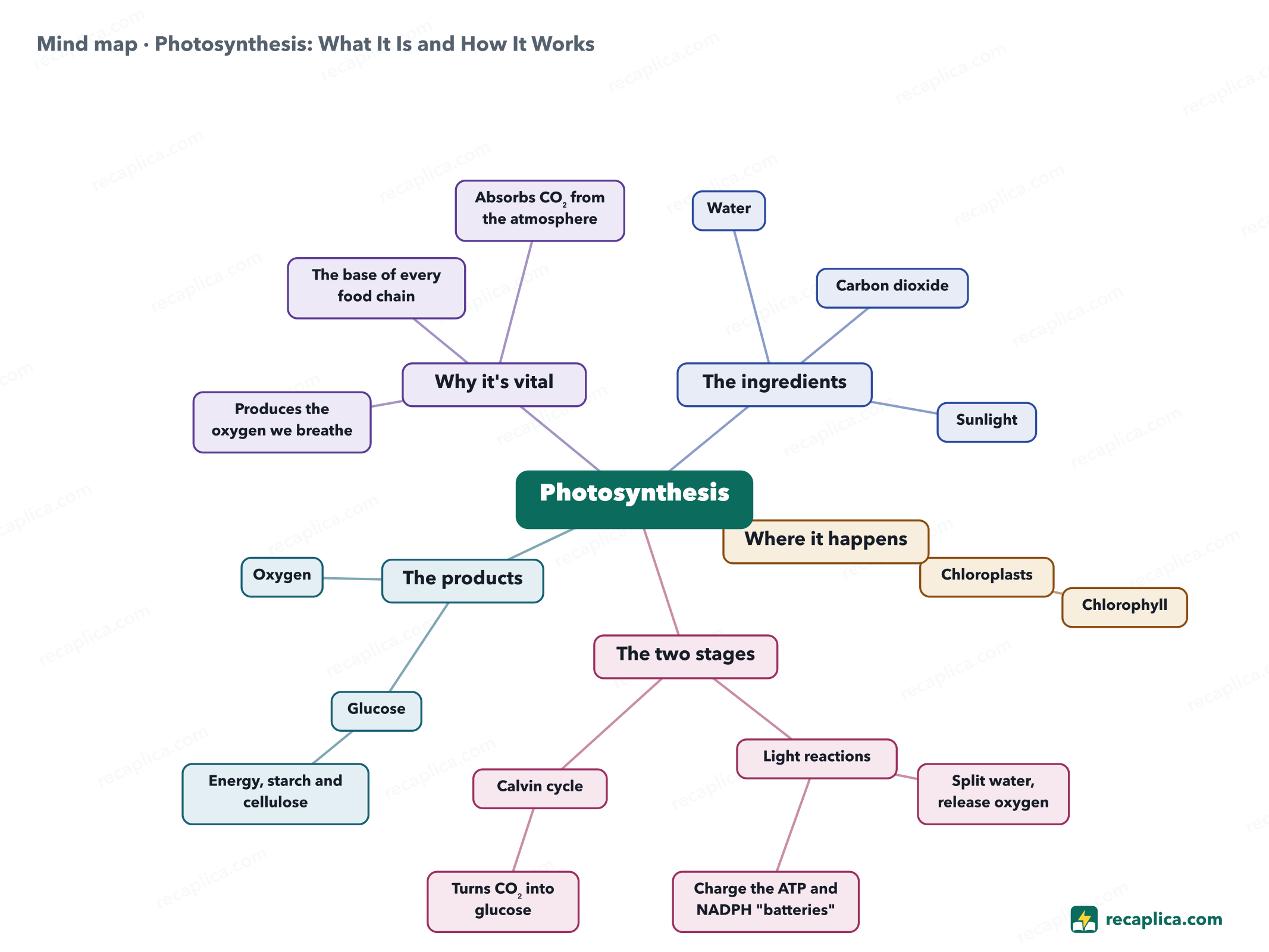
Carbon dioxideEnters through the stomata of the leaves.
Sunlight
Where it happens
Chloroplasts
ChlorophyllCaptures light and reflects green.
The two stages
Light reactions
Split water, release oxygen
Charge the ATP and NADPH "batteries"
Calvin cycle
Turns CO₂ into glucose
The products
Glucose
Energy, starch and cellulose
Oxygen
Why it's vital
Produces the oxygen we breathe
The base of every food chain
Absorbs CO₂ from the atmosphere
Quiz: test yourself
Answer the questions to check what you have learned: you get instant feedback and a short explanation.
Grade0/100/5
Answers: 1-A · 2-B · 3-B · 4-C · 5-A
Flashcards
Tap the card to flip it and check whether you remember the answer, then move to the next one.
1 / 8
Explain it in your own words
The ultimate test: if you can explain it in simple words, you've truly understood it. Write your explanation, then compare it with the Recap.
Your explanation is saved only on this device.
Photosynthesis is the process by which plants turn sunlight, water and carbon dioxide into glucose (their food) and oxygen. It happens in the leaves thanks to chlorophyll, the green pigment that captures the energy of light. It is the process that feeds almost all life on Earth and produces the oxygen we breathe.
Frequently asked questions
Why are leaves green?
Because of chlorophyll: this pigment absorbs red and blue light, which are useful for photosynthesis, and reflects green light. That reflected green is what we see.
Do plants breathe as well as photosynthesize?
Yes, day and night: like us, they consume oxygen and glucose to produce energy (cellular respiration). During the day photosynthesis produces far more oxygen than respiration consumes.
What happens to a plant without light?
Without light the light reactions stop and the plant can't make new glucose: it burns through its reserves and, if darkness continues, turns yellow (losing chlorophyll) and wastes away.
Why does photosynthesis matter to humans?
For two vital reasons: it produces the oxygen we breathe and it sits at the base of every food chain — even the meat we eat comes from animals fed, directly or indirectly, by plants. On top of that, it absorbs CO₂, the main greenhouse gas.
Every Recap goes through an independent review before publication.
Statistics, only if you say so
To learn which Recaps help most we would use Google Analytics, with aggregate, anonymous data. It starts only with your OK, and you can change your mind anytime. Privacy policy