|
recaplica
Spring: What It Is and When It Starts, From Equinox to Climate | ||||||||||||
| © 2026 Recaplica · recaplica.com — All rights reserved | ||||||||||||
Spring: What It Is and When It Starts, From Equinox to ClimateWhat to print Page numbers appear when printing with default margins. SlidesChoose a cut Flash10 slidesThe essential thread, to present in classFull18 slidesEvery chapter and the deeper detailBoth come with speaker notes. In 30 seconds quick readSpring is the season of awakening, between winter and summer, and it begins with the March equinox, the moment when the center of the Sun crosses the plane of Earth's equator and both hemispheres receive almost equal amounts of daylight. There are two ways to measure it, though: the astronomical definition, with a variable length, and the meteorological one, always March through May in the Northern Hemisphere, which climatologists use for their statistics. On the natural side, spring marks the return of plants and animals to activity, the subject phenology studies. On the human body it brings two opposite effects, a rise in pollen allergies and, for a minority of people, a less common form of seasonal affective disorder. Key Points
Key figures
Deep DiveWhy spring begins, and what the equinox marksIn the Northern Hemisphere, spring begins, astronomically speaking, with the March equinox: the moment when, according to NASA, the center of the Sun crosses the plane of Earth’s equator. It is the same mechanism behind every season, the tilt of Earth’s axis relative to the plane of its orbit and the planet’s position along that orbit, not its distance from the Sun. That day the Sun lights up both hemispheres almost equally, one of the few moments of the year when both poles receive sunlight at the same instant. In 2026 the March equinox falls on March 20, at 14:46 UTC, according to NASA Science. From that moment on, the Northern Hemisphere sees the sun rise a touch earlier and set a touch later, while the air gradually turns milder; at that exact same instant, the Southern Hemisphere shifts into autumn, with later sunrises, earlier sunsets, and the first dry leaves dropping to the ground. The two hemispheres are always in opposite seasons, when it’s spring in the north it’s autumn in the south, and the roles swap right on schedule at the September equinox. The word “equinox” comes from Latin, “equal night” (equi-, equal, and nox, night), but the balance between hours of daylight and hours of darkness is not perfect. As NASA notes, Earth’s atmosphere refracts sunlight, slightly stretching the perceived length of daylight beyond a precise 12 hours: at the equator, an equinox produces about 12 hours of daylight and 12 of darkness, but not down to the minute.
Astronomical spring vs meteorological spring: two calendarsThere is more than one way to mark the start of spring. According to NOAA/NCEI, seasons can be defined in two ways: the astronomical ones, based on Earth’s position relative to the Sun and bounded by two equinoxes and two solstices, and the meteorological ones, which meteorologists and climatologists group into three-month blocks based on the annual temperature cycle. The practical difference is in the length. Astronomical seasons last between 89 and 93 days, because Earth’s orbit around the Sun is slightly elliptical; meteorological seasons, instead, always cover March, April and May in the Northern Hemisphere, a fixed length that makes it simpler to compare climate statistics from one year to the next.
One example of how spring climate is measured in practice comes from the United States: according to NOAA/NCEI, meteorological spring 2025 (March-May) in the contiguous United States recorded an average temperature of 54.1°F, about 12.3°C, 1.8°C above the historical average, the second warmest spring in a 131-year record; average precipitation was 8.90 inches, about 226 mm, in the wettest third of the same historical record. These are US figures, not a universal value, but they illustrate well the variability in temperature and precipitation that characterizes seasonal statistics wherever they are gathered; the same underlying warming trend is described, on a global scale, in the article on the greenhouse effect. The natural world waking up: phenologySpring’s most visible effects are not only climatic. Phenology, as the USA National Phenology Network defines it, is the study of the timing and cyclical patterns of natural events, in particular those tied to the annual life cycles of plants and animals: the budding of leaves, the arrival of migratory birds, the flowering of plants, the onset of fruit ripening. With the first flowers, what USA National Phenology Network scientists call the season’s first food web switches on: native bees, flies and beetles feed on nectar and pollen, and in turn become an early food source for birds and other animals emerging from winter. It is the same moment when, leaf by leaf, photosynthesis restarts in plants that had slowed down or paused through the winter. Phenology is not just observation: it has concrete applications. It helps predict events tied to human health such as allergies and mosquito season, optimize planting, fertilizing and harvest in agriculture, manage invasive species and forest pests, and understand how carbon cycles in ecosystems change over time. The US environmental agency EPA, for instance, uses an index of leaf and bloom dates as a climate change indicator: scientists compare, year over year, when flowers bloom and when leaves emerge to measure, indirectly, how much the climate is warming. What happens to the body: allergies and moodSpring makes itself felt on the body too, and not always pleasantly. The main effect is pollen allergies: according to the AAAAI (American Academy of Allergy, Asthma & Immunology), in spring the biggest culprits are trees, in particular birch, cedar, cottonwood and pine; grasses dominate in summer and ragweed in autumn. Pollen irritates the nose, roof of the mouth, throat and eyes, causing sneezing, nasal congestion, a runny nose and watery eyes; in the more troublesome cases it can lead to sinus infections, disrupt sleep and reduce performance at school or work. The numbers, in the United States, are not marginal. According to a CDC analysis based on the 2024 National Health Interview Survey, 31.7% of US adults have a diagnosed allergic condition (seasonal, eczema or food); the pollen component alone affects 25.2% of adults, with a marked gender gap, 29.5% of women against 20.7% of men. These are US figures, but the underlying biological mechanism, the immune system reacting to pollen, does not change from one continent to another.
The other effect involves mood. Seasonal affective disorder (SAD), described by the NIMH as a form of depression with a recurring seasonal pattern, is best known in its winter version, with symptoms that begin in late autumn and resolve in spring or summer; it is the same mechanism of light and circadian rhythm explored in the article on human emotions. There is also a less common pattern, though, that shows up in spring or summer itself, with symptoms opposite to the winter ones, insomnia instead of oversleeping, poor appetite instead of carbohydrate cravings, restlessness and agitation instead of social withdrawal. The NIMH lists reduced serotonin levels, disrupted melatonin production and, in some cases, a vitamin D deficiency among the biological causes common to both patterns; the disorder affects women more often, and people living at northern latitudes. It is, in a sense, the opposite of what happens during heat waves, where it is an extended excess of heat, not a change of season, that puts the body under stress. Slide deckSlides ready to download and make your own in PowerPoint or Google Slides, with speaker notes. Pick the Flash cut or the Full one.     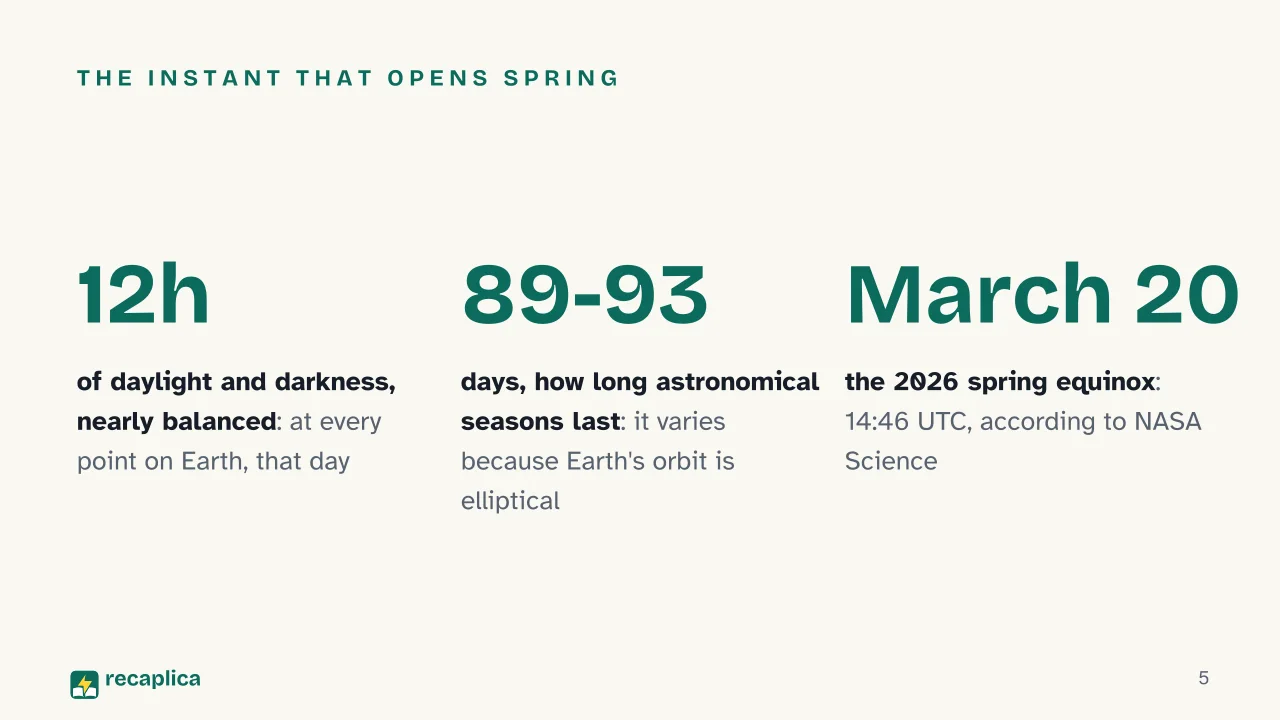   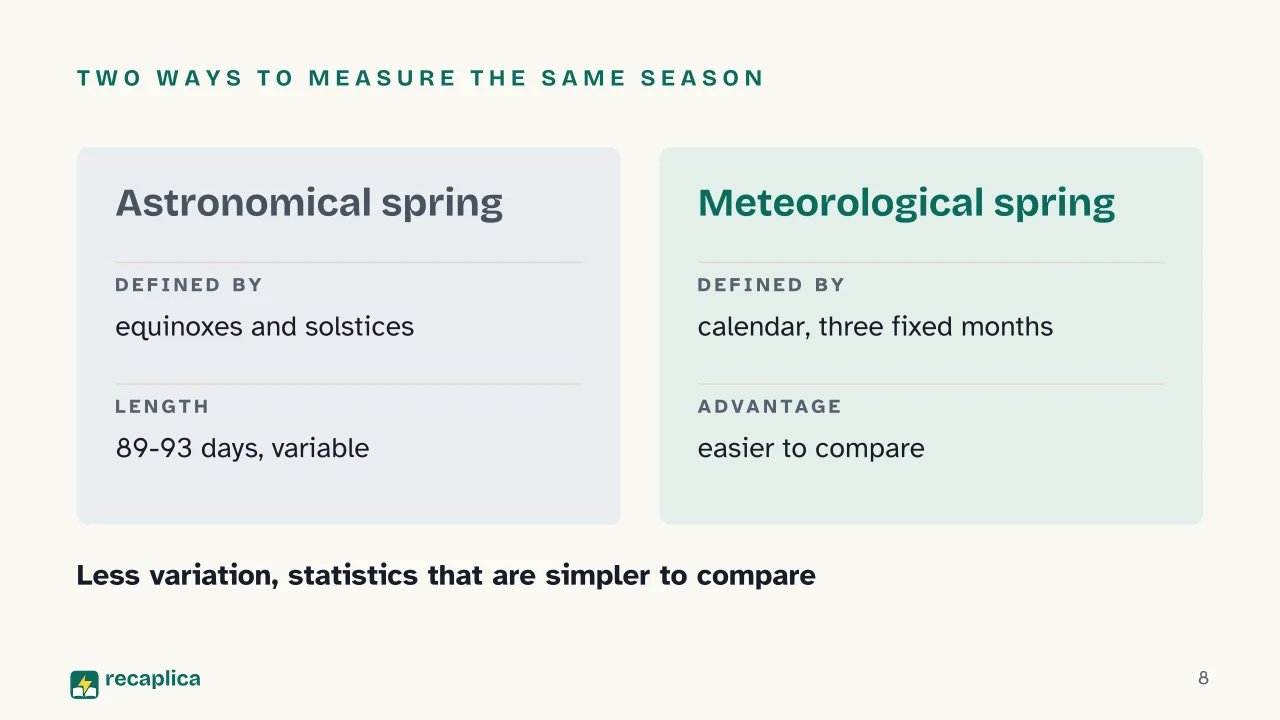 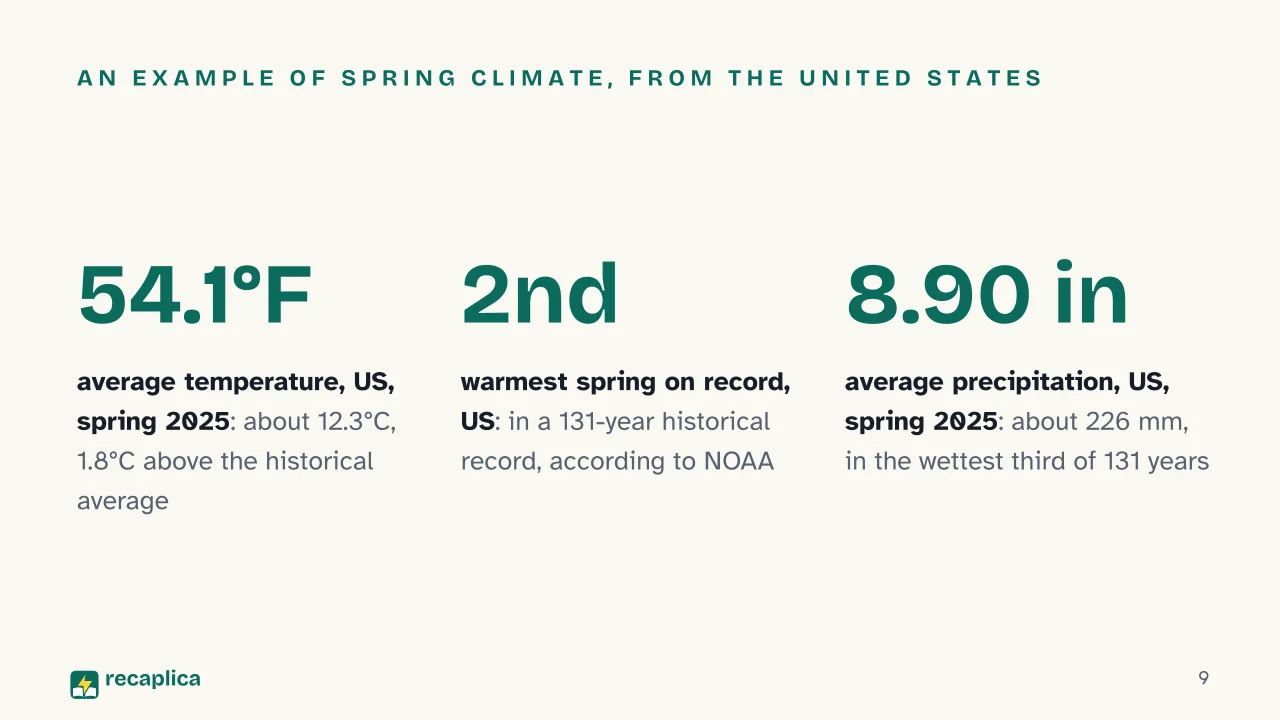  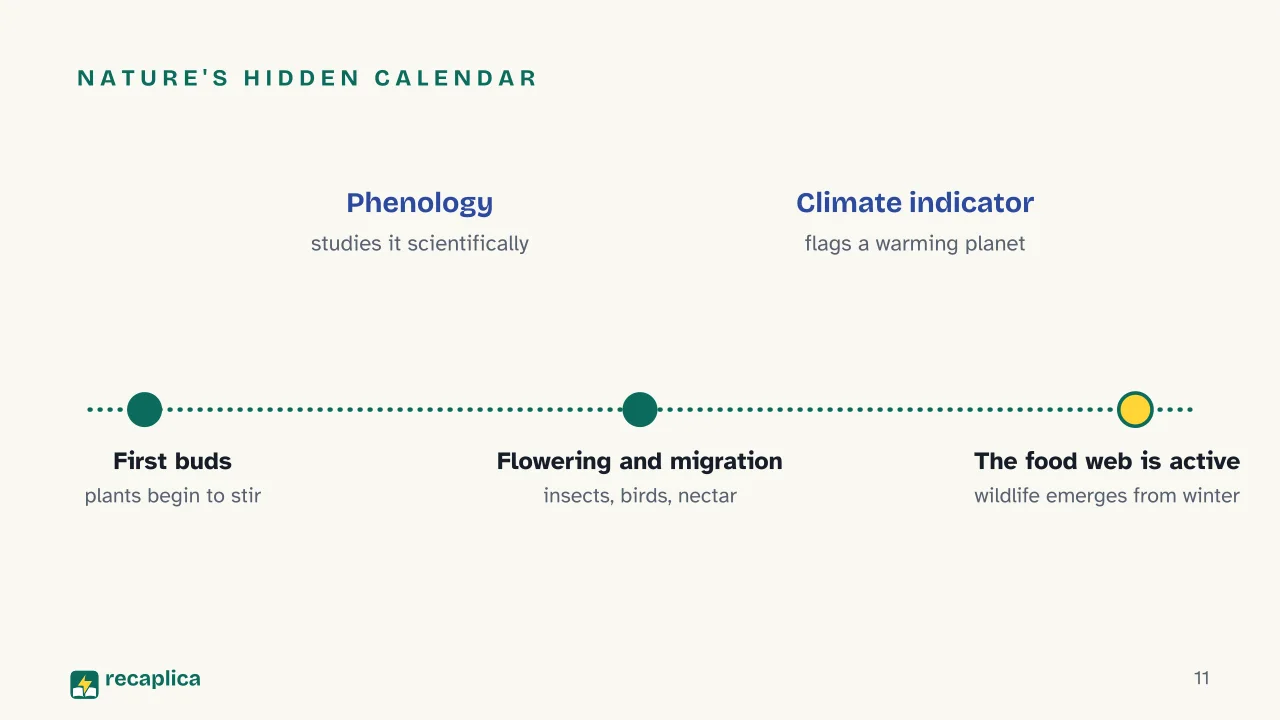 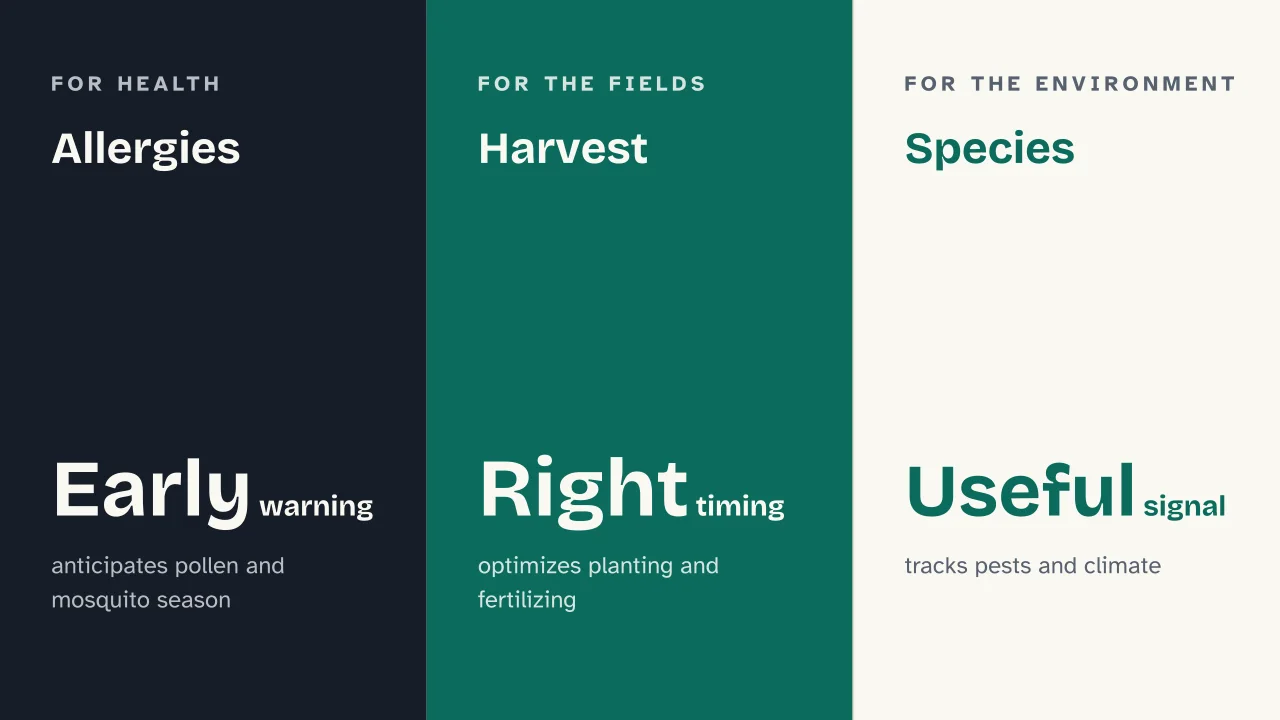  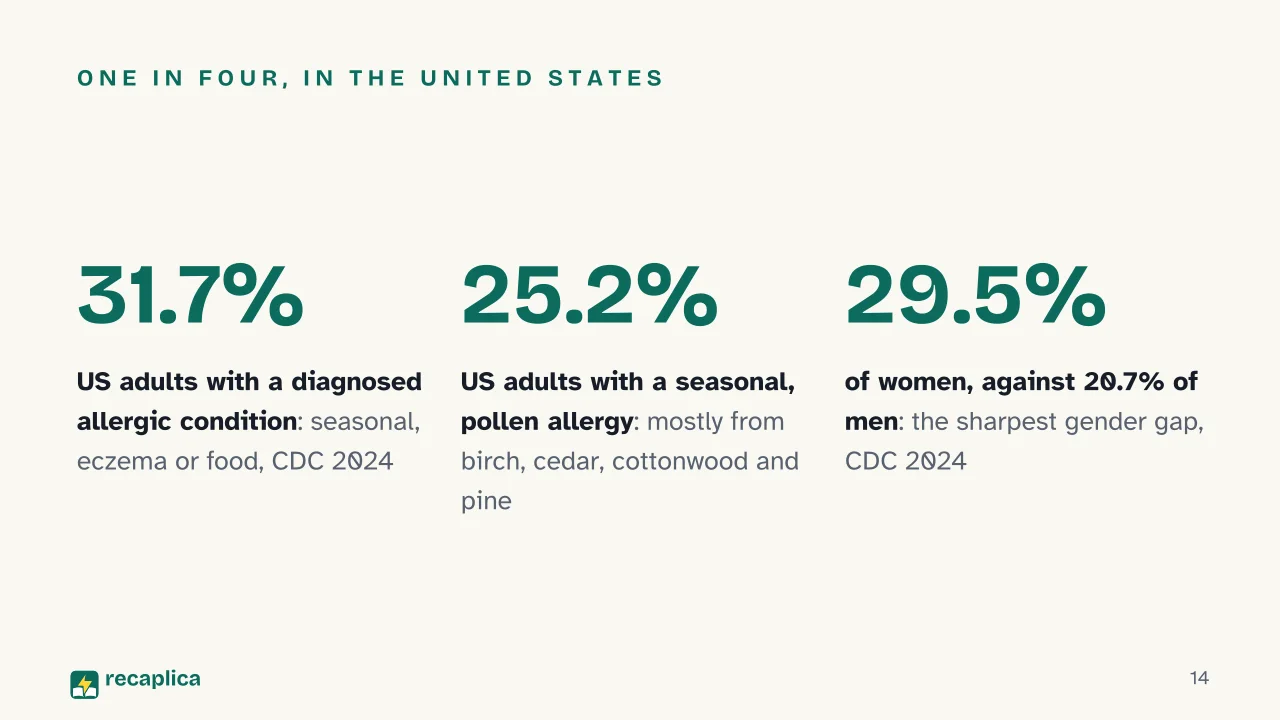 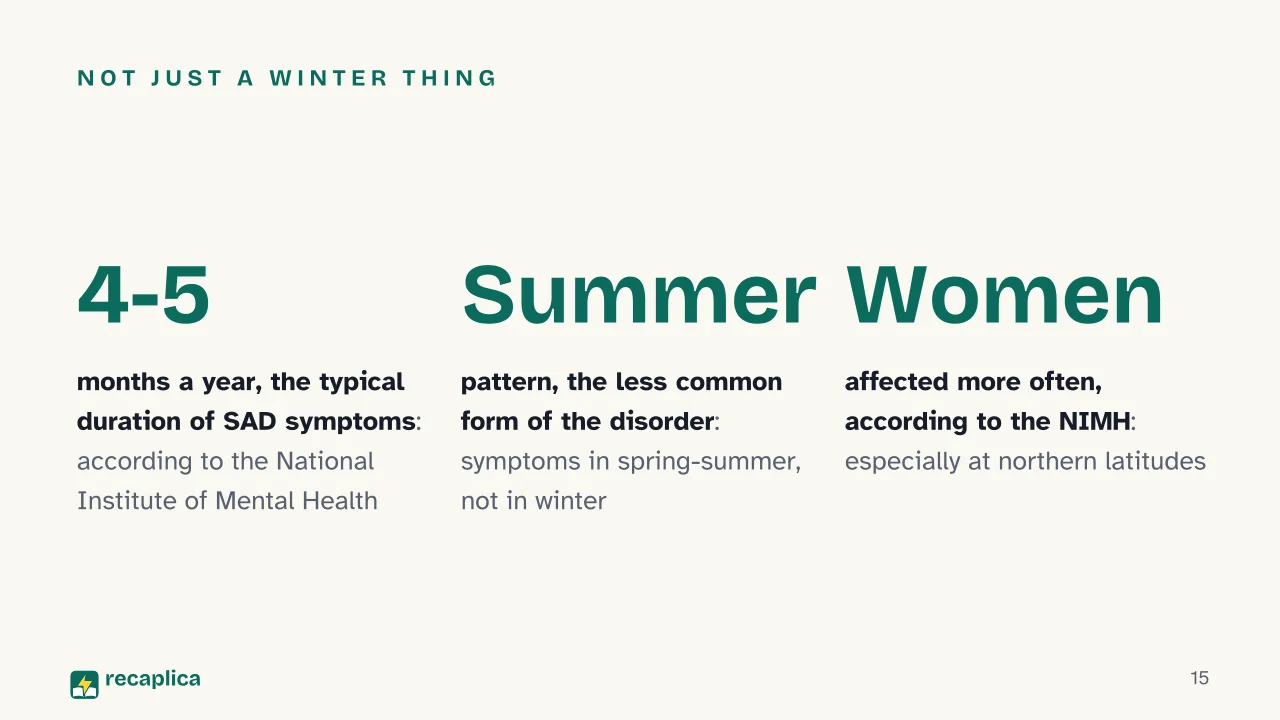 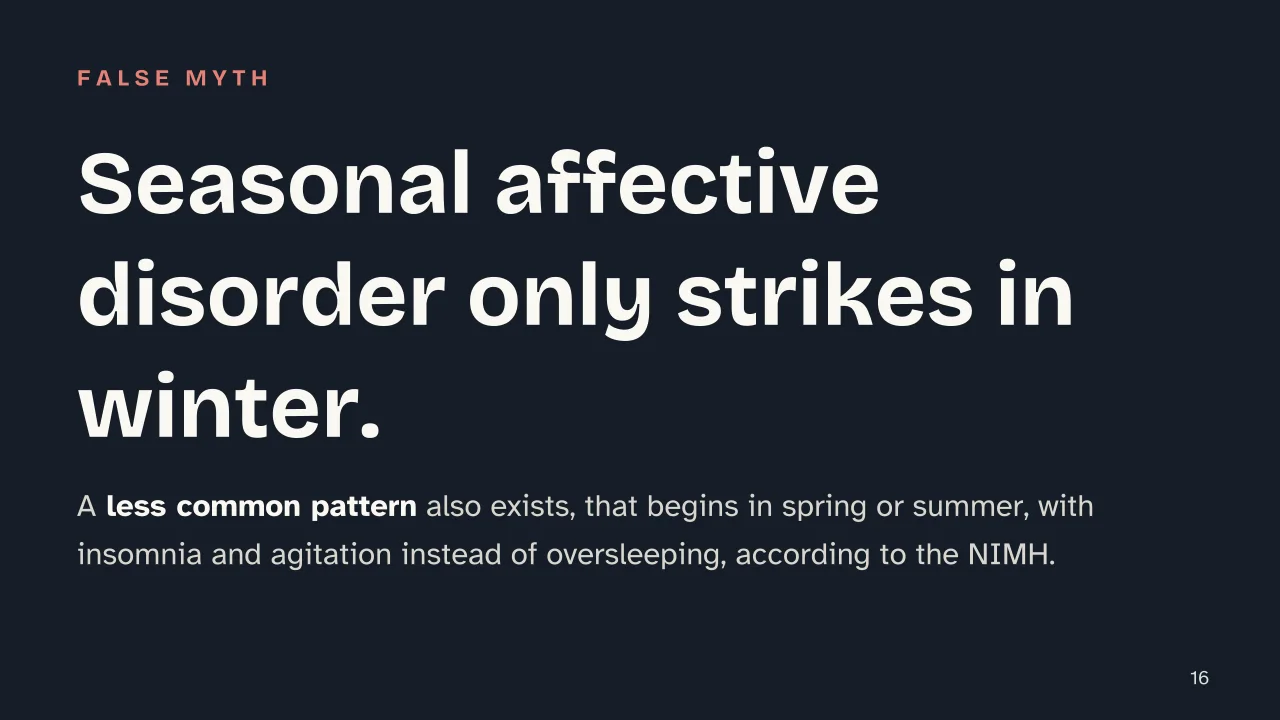 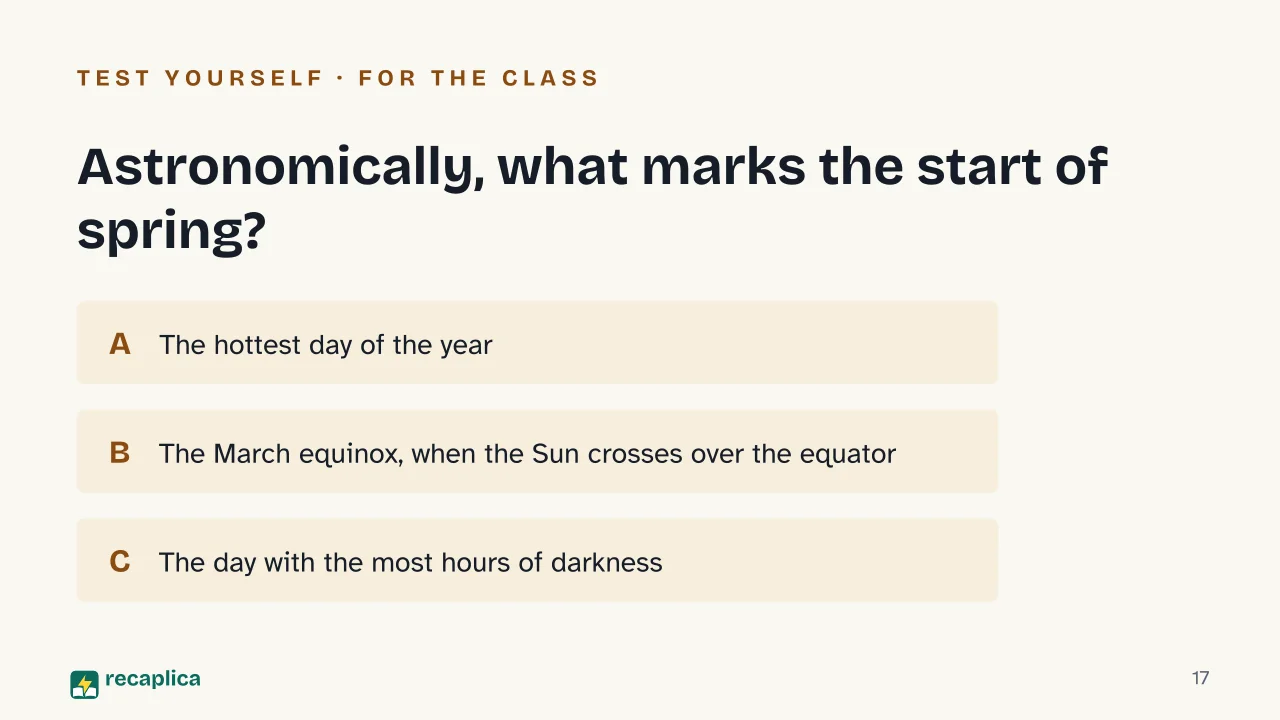  Common myths
Mind mapDrag the background to move around and the nodes to reposition them; use − and + to collapse and expand branches. 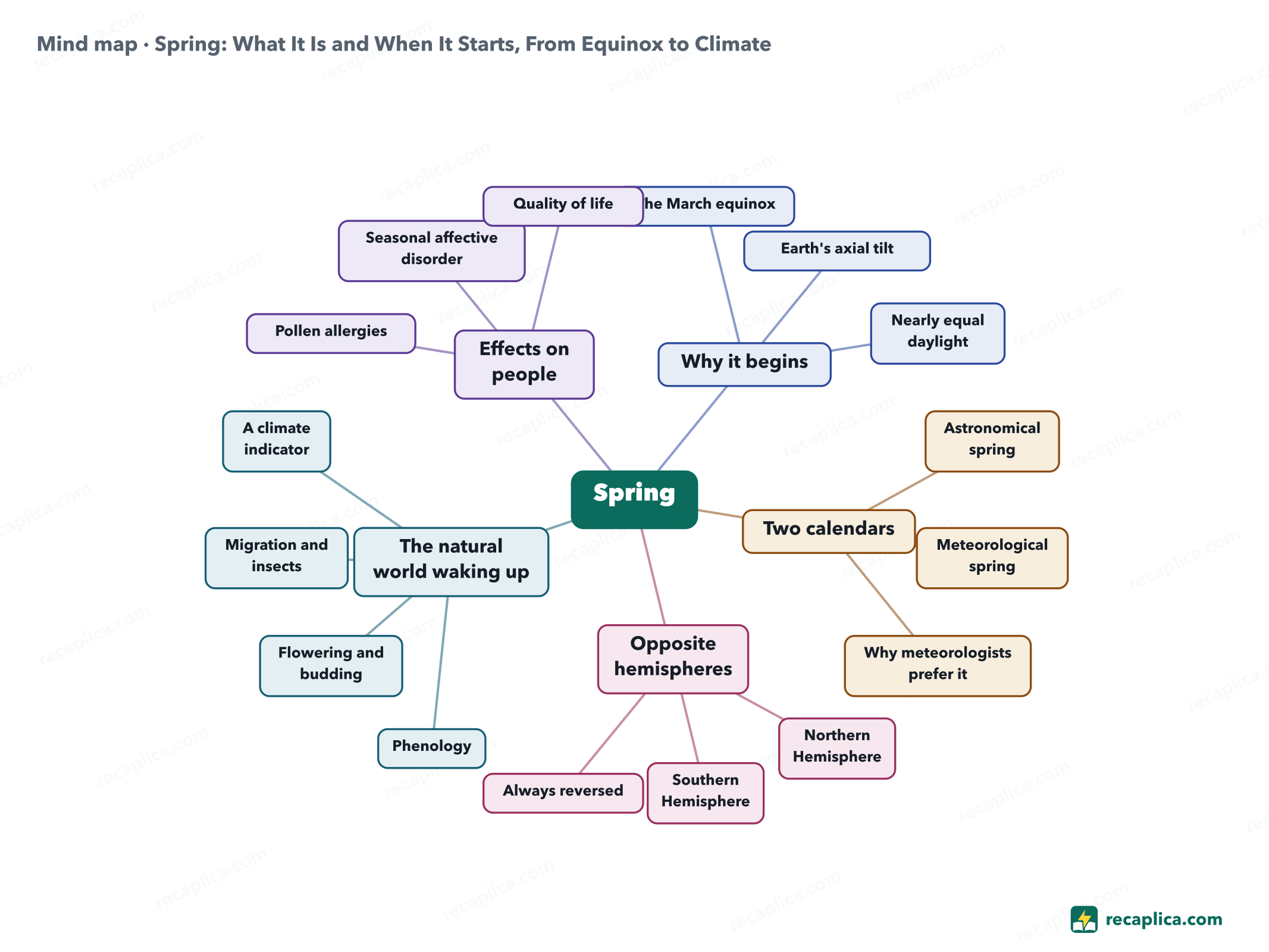
Quiz: test yourselfAnswer the questions to check what you have learned: you get instant feedback and a short explanation. Grade 0/10 0/5
FlashcardsTap the card to flip it and check whether you remember the answer, then move to the next one. 1 / 7 Explain it in your own wordsThe ultimate test: if you can explain it in simple words, you've truly understood it. Write your explanation, then compare it with the Recap. Your explanation is saved only on this device.
Frequently asked questionsWhen does spring start in 2026?In the Northern Hemisphere, astronomical spring begins on March 20, 2026, at 14:46 UTC, with the March equinox, according to NASA Science; meteorological spring, used by meteorologists and climatologists, always covers March, April and May, according to NOAA/NCEI. Why do allergies flare up in spring?Because the air fills with more pollen released by trees, in particular birch, cedar, cottonwood and pine, according to the AAAAI; the pollen irritates the nose, roof of the mouth, throat and eyes, causing sneezing, congestion and watery eyes. What is phenology and what is it used for?It is the study of the timing of cyclical natural events, such as flowering, leaf budding and migration; according to the USA National Phenology Network, it helps predict allergy and mosquito seasons, optimize planting and harvest in agriculture, and monitor the effects of climate change. Does seasonal affective disorder only strike in winter?No. The most common pattern begins in late autumn or early winter, but the NIMH also describes a less frequent pattern that begins in spring or summer, with opposite symptoms, insomnia, poor appetite and agitation instead of oversleeping and increased appetite. Every Recap goes through an independent review before publication. |