|
recaplica
Torquato Tasso: The Poet Behind Jerusalem Delivered | ||||||||||||
| © 2026 Recaplica · recaplica.com — All rights reserved | ||||||||||||
Torquato Tasso: The Poet Behind Jerusalem DeliveredWhat to print Page numbers appear when printing with default margins. SlidesChoose a cut Flash10 slidesThe essential thread, to present in classFull17 slidesEvery chapter and the deeper detailBoth come with speaker notes. In 30 seconds quick readTorquato Tasso was born in Sorrento in 1544 and died in Rome in 1595, having spent most of his adult life at the Este court in Ferrara. His masterwork is Jerusalem Delivered, a twenty-canto poem about the First Crusade and the fall of Jerusalem, published in its final form in 1581 after more than two decades of work. The story follows Godfrey of Bouillon as he leads the Christian army, but it keeps breaking away into private tales of love and duty: the knight Tancred, the sorceress Armida, the paladin Rinaldo. In 1593 Tasso issued a stricter revision titled Jerusalem Conquered, which never won over readers the way the original did. Key Points
Deep DiveA poet who barely left the courtTorquato Tasso was born in Sorrento on 11 March 1544. He spent his childhood and teenage years moving around with his family: he joined his father in Rome in 1556, found him again in Venice in 1559, and between 1560 and 1564 studied law, philosophy and rhetoric between Padua and Bologna, already publishing an early poem, Rinaldo, in those same years. In 1565 he entered the service of Cardinal Luigi d’Este in Ferrara, the start of a bond with the Este court that would shape most of his adult life. In 1572 he moved into the direct service of Duke Alfonso II, and in 1573 wrote Aminta, a pastoral drama. Between 1570 and 1571 he also traveled to France, but it was in Ferrara that the plan for his major poem took shape. Between 1577 and 1579 Tasso went through a period of mental crisis that drove him to flee the Este court; on his return he was confined at the Sant’Anna hospital. Biographical sources don’t point to a single cause for that crisis: what’s recorded is its length and how it played out. He was freed only in 1586, by Vincenzo Gonzaga, and moved to Mantua. He spent his final years, between 1588 and 1595, moving between Naples, Rome and other cities, until his death, in Rome, on 25 April 1595. Twenty years to write a poemThe project that would become Jerusalem Delivered started early: Tasso began a first version of the work at around sixteen. He took up the composition again under its final design in 1570 and finished writing it in 1575, sending the cantos to reviewers in Rome starting that February. Publication came later, and in two stages. In 1580 only part of the text appeared, under the provisional title Il Goffredo; the complete edition, under the title that would endure, Jerusalem Delivered, came out in 1581. It’s the poem that placed Tasso, alongside Dante and Petrarch, among the names at the core of the Italian literary canon taught in schools. Even after publication, Tasso didn’t set the text aside: over the following years he reworked it repeatedly, until in 1593 he issued a thoroughly revised version, titled Jerusalem Conquered, stricter on religious grounds. Even so, it’s the original version that stayed the point of reference: Jerusalem Conquered remained a minor chapter in the poem’s history.
Twenty cantos, five partsThe poem is written in ottava rima, the eight-line hendecasyllabic stanza Tasso inherited from Italy’s chivalric poem tradition, the same form used before him by writers like Ariosto. In total it runs to 1,917 stanzas, for 15,336 hendecasyllabic lines, spread across twenty cantos of varying length. The twenty cantos are grouped into five parts, matching the five acts of classical tragedy. The proem opens with two lines that became famous: “Canto l’arme pietose, e ‘l Capitano / Che ‘l gran sepolcro liberò di Cristo” (“I sing the pious weapons and the Captain / who freed the great sepulcher of Christ”), referring to Godfrey of Bouillon, and moves straight into an invocation to the Muse and an explicit dedication to Duke Alfonso II d’Este, “Tu magnanimo Alfonso” — a direct tribute to the ruler of the court where the poem was born.
The poem’s subject is the First Crusade, and specifically the final siege that leads to the fall of Jerusalem — the same historical event told, in a different register, in the Recap on the Middle Ages. Tasso, though, doesn’t write a chronicle: he builds a personal epic that looks to ancient models like Virgil’s Aeneid and the Iliad, as well as crusade chronicles and Italian chivalric poems. Godfrey of Bouillon and the siege of JerusalemAt the head of the Christian expedition is Godfrey of Bouillon, who receives a visit from the archangel Gabriel and leads the army to the siege of the holy city. In the poem’s tradition he is the most complete and severe figure, close to a model of military and moral perfection, untouched by the doubts that overwhelm the other characters. Around him the story fills with knights who carry their own stories, and much of the poem’s appeal lies in that contrast: while Godfrey pursues a single goal, the other main characters are pulled between the war and their private lives. Tancred, Clorinda and Erminia: love that can’t be resolvedTancred is, among the Christian knights, the one most shaped by doubt and romantic turmoil. He loves Clorinda, a Muslim warrior and daughter of the king of Ethiopia, without ever managing to build an openly declared bond with her. Erminia, a princess of Antioch, loves Tancred in turn: to reach him at the Christian camp she puts on Clorinda’s armor, and Tancred, believing he is chasing Clorinda, ends up chasing her instead. The poem’s most dramatic episode comes in a nighttime duel. Tancred faces an armored opponent without recognizing him: it is Clorinda. He wounds her fatally, and only then does she reveal herself; before she dies, she asks to be baptized. Erminia, for her part, after failing to reach Tancred, takes refuge among shepherds, in an episode of the poem distinct from that of Olindo and Sofronia. Rinaldo, Armida and the enchanted gardenRinaldo is another of the Christian paladins, caught up in a story that opens with a serious mistake: he unknowingly kills his companion Gernando. He then falls prisoner to Armida, a beautiful sorceress sent by her uncle Idraote to capture as many Christians as she can. Armida seduces Rinaldo and keeps him in her enchanted garden, away from the war. Two companions, Charles and Ubaldo, bring him back to battle. On the opposing side fights Solyman, sultan of the Turks, who in the poem dies at Rinaldo’s hand. Good and evil, love and dutyThe poem’s dominant theme is epic and religious, and a sharp dualism between Good and Evil, embodied in the clash between Christians and Muslims, runs through the whole text. Over that framework sits another, subtler one: the never-fully-resolved tension between the religious drive behind the crusade and the earthly love that ties Tancred to Clorinda, Rinaldo to Armida, Erminia to Tancred. That tension reflects the religious mood of the age Tasso wrote in, marked by the Counter-Reformation — a historical and cultural backdrop covered in the Recap on the Renaissance, the period in which the poet’s formation took place. A reputation that has lasted for centuriesJerusalem Delivered found a wide and fast audience: it was translated into several languages and became a model for countless imitations. Its most famous episode, the duel between Tancred and Clorinda, inspired a musical work by Claudio Monteverdi, Il Combattimento di Tancredi e Clorinda, published in 1638. Slide deckSlides ready to download and make your own in PowerPoint or Google Slides, with speaker notes. Pick the Flash cut or the Full one.     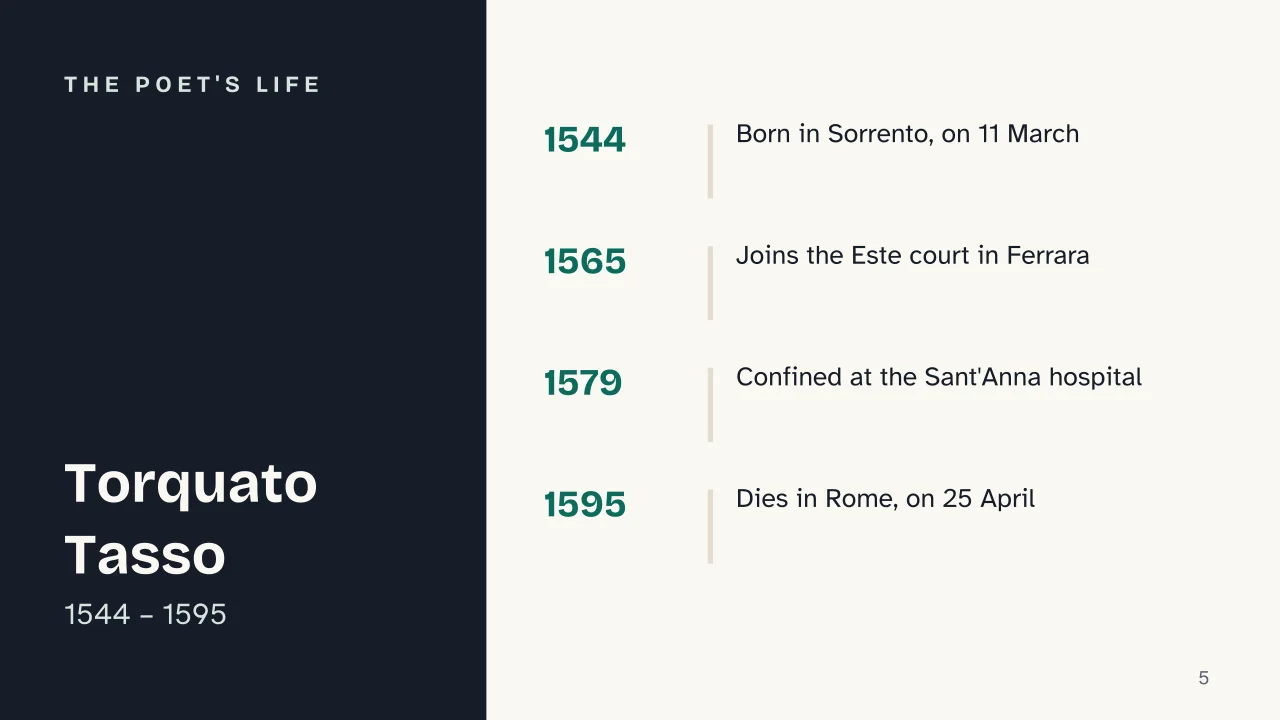   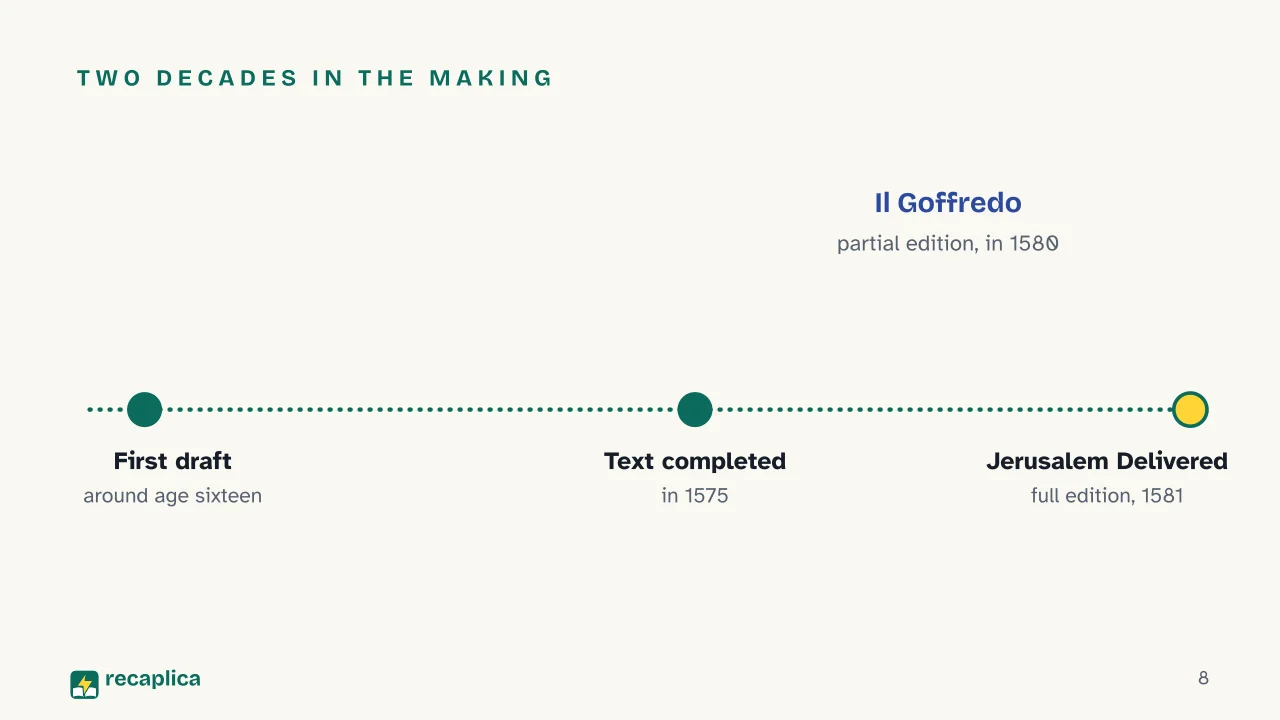 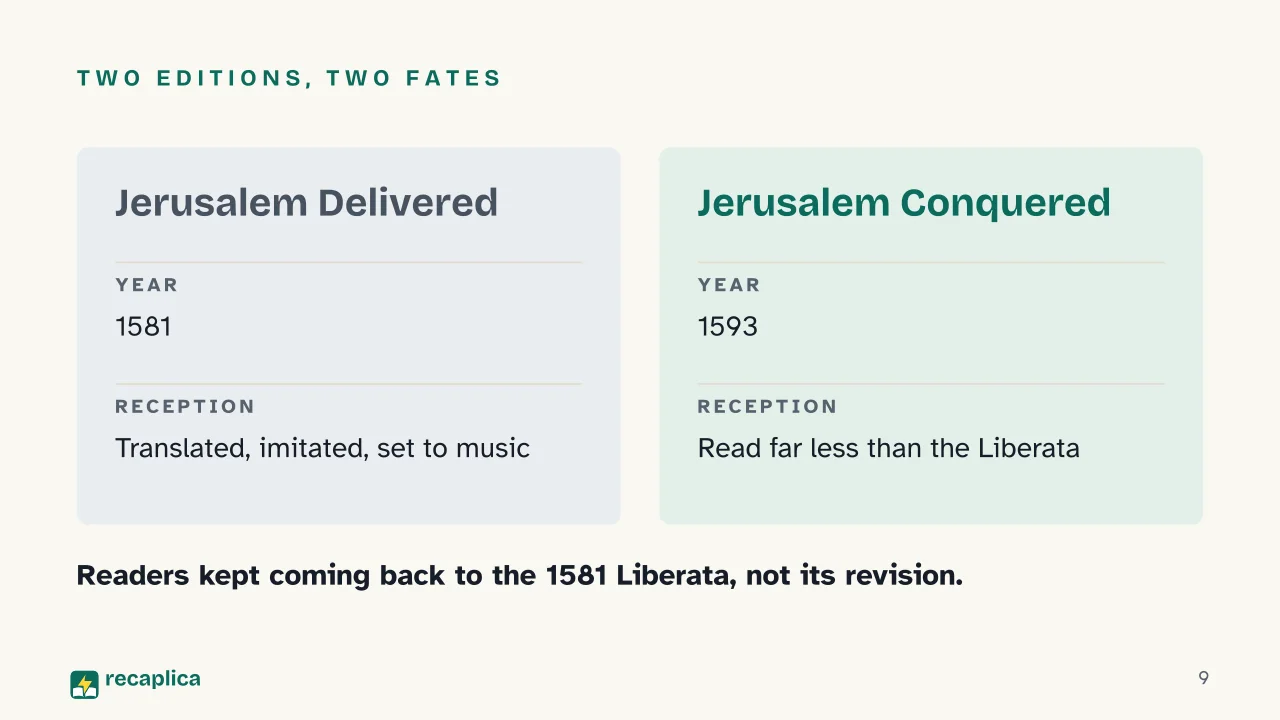  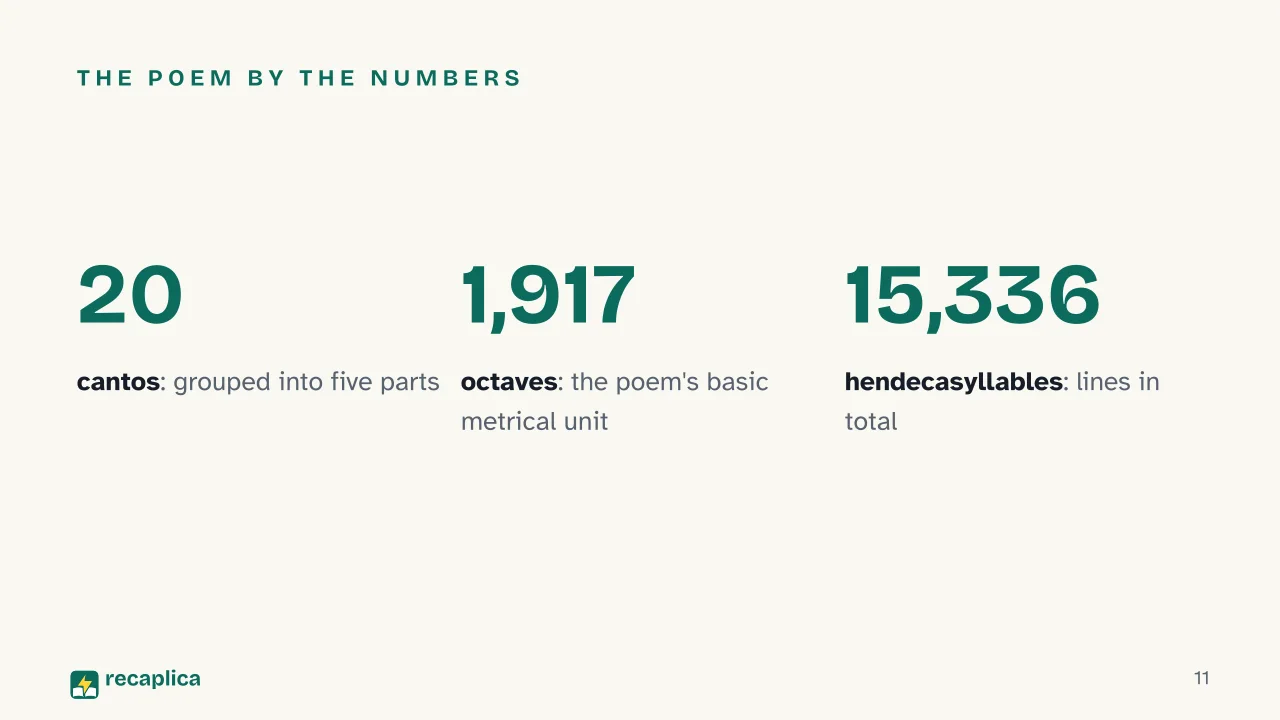  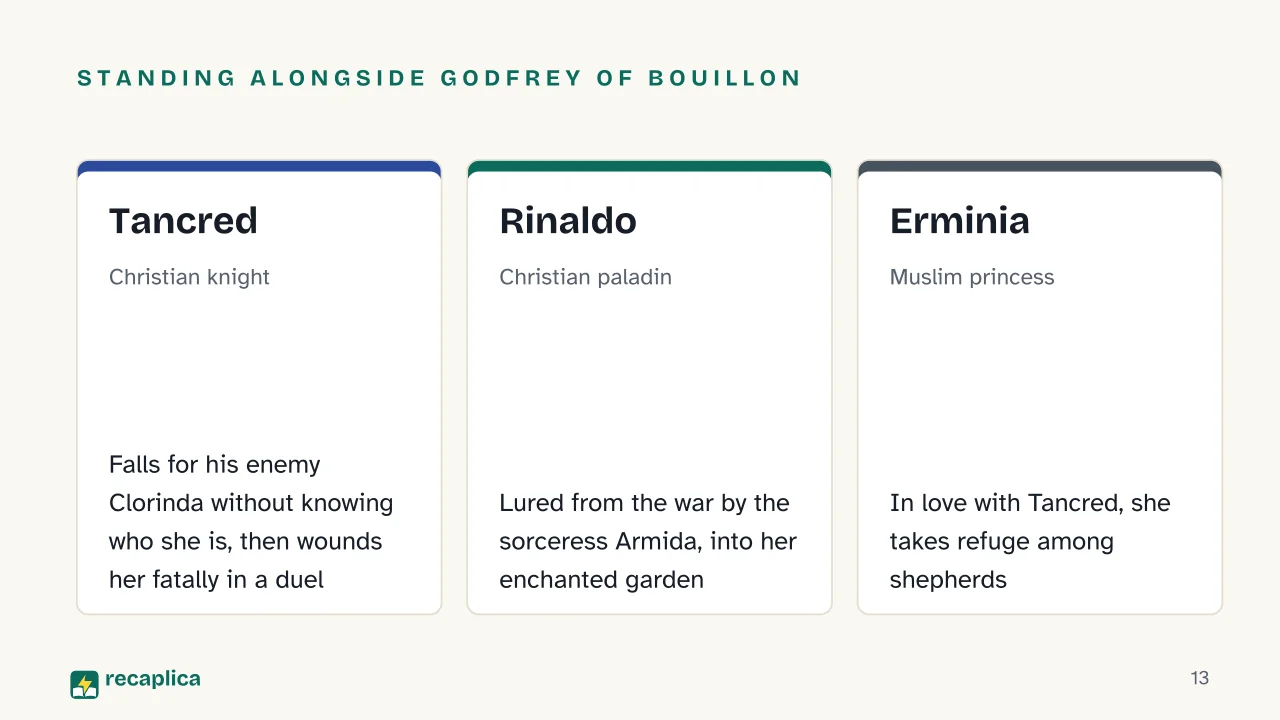  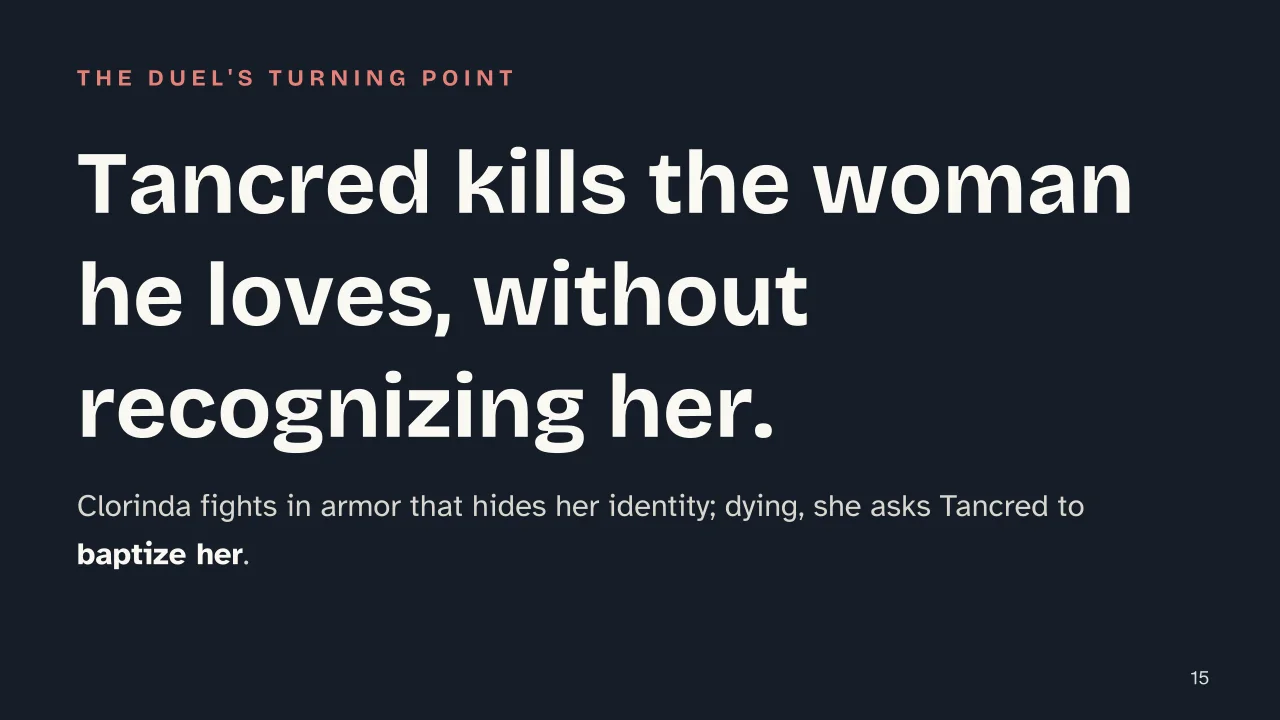 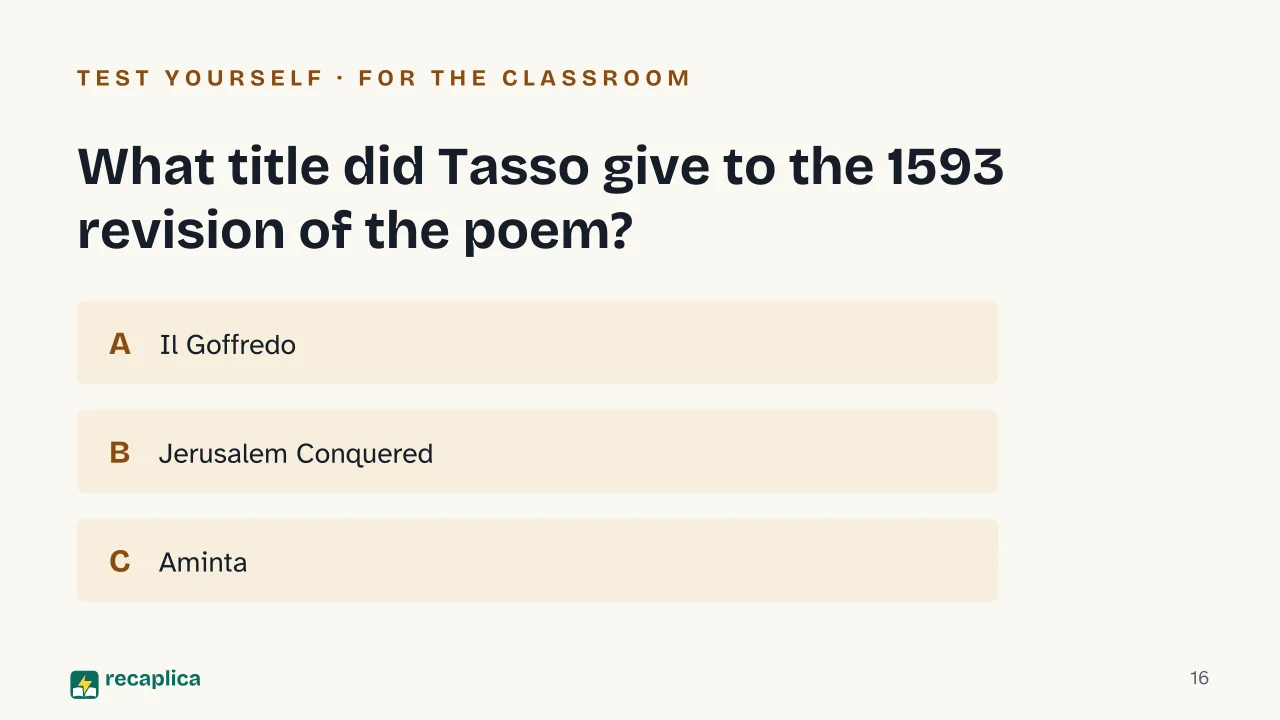  Common myths
Mind mapDrag the background to move around and the nodes to reposition them; use − and + to collapse and expand branches. 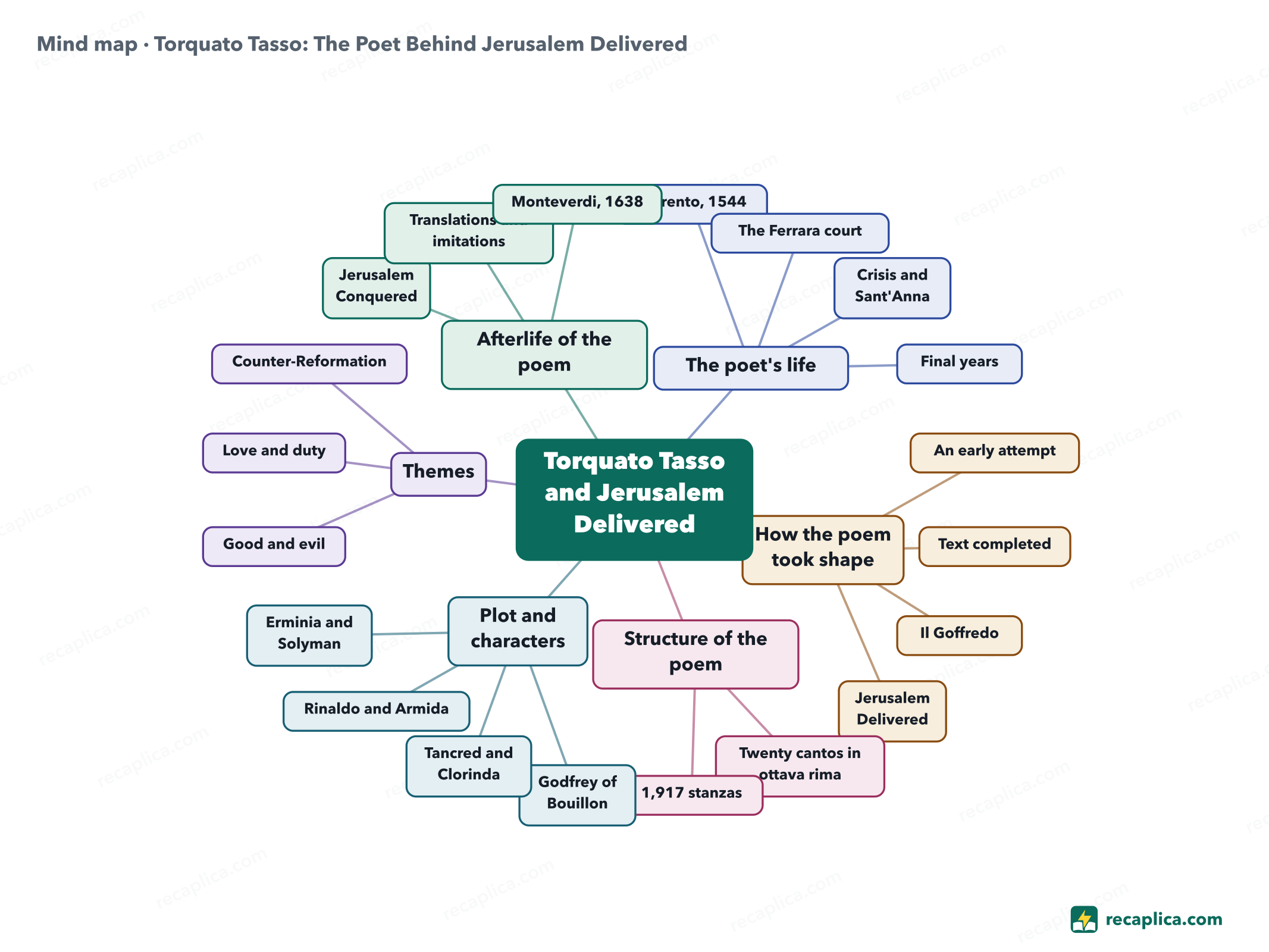
Quiz: test yourselfAnswer the questions to check what you have learned: you get instant feedback and a short explanation. Grade 0/10 0/5
FlashcardsTap the card to flip it and check whether you remember the answer, then move to the next one. 1 / 8 Explain it in your own wordsThe ultimate test: if you can explain it in simple words, you've truly understood it. Write your explanation, then compare it with the Recap. Your explanation is saved only on this device.
Frequently asked questionsWhat is Jerusalem Delivered about?The poem tells the story of the First Crusade and the final siege of Jerusalem, led by Godfrey of Bouillon. Woven through the war are the stories of individual knights, like Tancred, who falls in love with his enemy Clorinda without knowing it; Rinaldo, drawn away by the sorceress Armida into her enchanted garden and later brought back to the war by his companions; and Erminia, a Muslim princess in love with Tancred, who takes shelter among shepherds. Who is Tancred in Jerusalem Delivered?He is one of the main Christian knights, portrayed in the poem as the opposite of Godfrey of Bouillon in temperament, prone to doubt and romantic turmoil. He is at the center of two parallel love stories, with the Muslim warrior Clorinda, whom he kills without recognizing her in a nighttime duel, and with Erminia, who loves him in secret. Who was Torquato Tasso?A poet born in Sorrento in 1544, educated between Rome, Venice, Padua and Bologna, who from 1565 worked at the Este court in Ferrara. He wrote Jerusalem Delivered and the pastoral drama Aminta; he went through difficult years marked by a mental breakdown and a long confinement, and died in Rome in 1595. What is the difference between Jerusalem Delivered and Jerusalem Conquered?Jerusalem Delivered, published in 1581, is the poem that made Tasso famous and that continues to be read, translated and imitated. Jerusalem Conquered, published in 1593, is a later, more rigid rewrite on religious grounds, which Tasso produced after the years of his breakdown, and it remained secondary to the original. Why was Torquato Tasso confined at Sant'Anna?Between 1577 and 1579 Tasso went through a period of mental crisis, which led him, among other things, to flee Ferrara; on his return he was confined at the Sant'Anna hospital, where he stayed until 1586. Biographical sources don't point to a single cause for that crisis, only its length and how it ended, with his release secured by Vincenzo Gonzaga. Every Recap goes through an independent review before publication. |