Skip to content
recaplica

    One moment: security check

    Cloudflare wants to make sure you're not a robot. Tick the box below and your search will continue on its own.

    IT
    recaplica Petrarch and the Canzoniere: The Poet's Life and His Masterwork
    © 2026 Recaplica · recaplica.com — All rights reserved
    Home › Literature

    Petrarch and the Canzoniere: The Poet's Life and His Masterwork

    By Recaplica Newsroom · Updated on September 17, 2026

    What to print

    Page numbers appear when printing with default margins.

    Slides

    Choose a cut

    Flash10 slidesThe essential thread, to present in classFull15 slidesEvery chapter and the deeper detail

    Both come with speaker notes.

    Telegram channel
    recaplica Clear in 30 seconds, yours in 10 minutes.
    In 30 seconds Key points Figures Deep dive Slides Myths Mind map Quiz Flashcards FAQ

    In 30 seconds quick read

    Francesco Petrarch was born in Arezzo in 1304 and died in Arquà in 1374, after a life spent between Avignon, Milan, Venice, and Padua. He wrote the Canzoniere, a collection of 366 poems that he titled in Latin Rerum vulgarium fragmenta and that only began circulating under its better-known name from the 16th century onward. At the center of the work is his love for Laura, whom, according to a note Petrarch left, he first met on April 6, 1327, in Avignon; her real identity, however, remains uncertain, as several sources point out. The Canzoniere established the sonnet as a major poetic form and inspired centuries of love poetry across Europe, from 16th-century Italy to Shakespeare's English sonnets.

    Key Points

    • Francesco Petrarch was born in Arezzo in 1304 and died in Arquà in 1374.
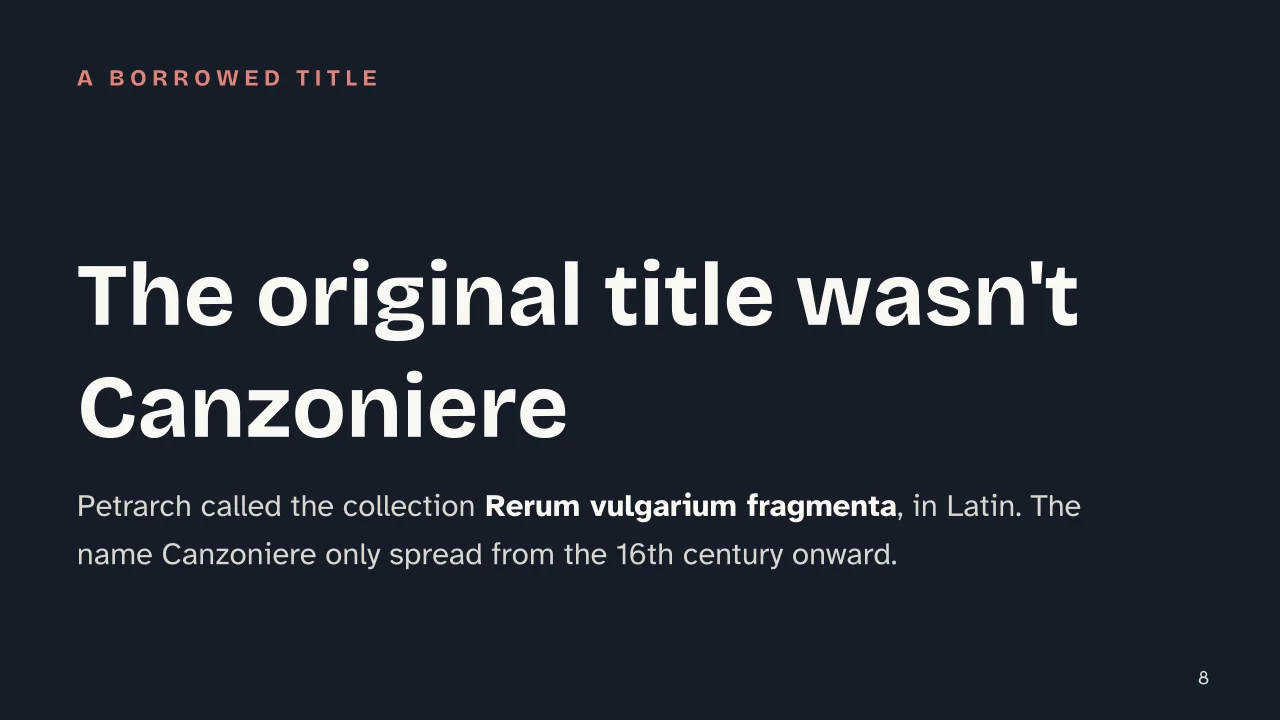
    • His poetry collection's original title was Latin, Rerum vulgarium fragmenta; the name "Canzoniere" only spread from the 16th century onward.
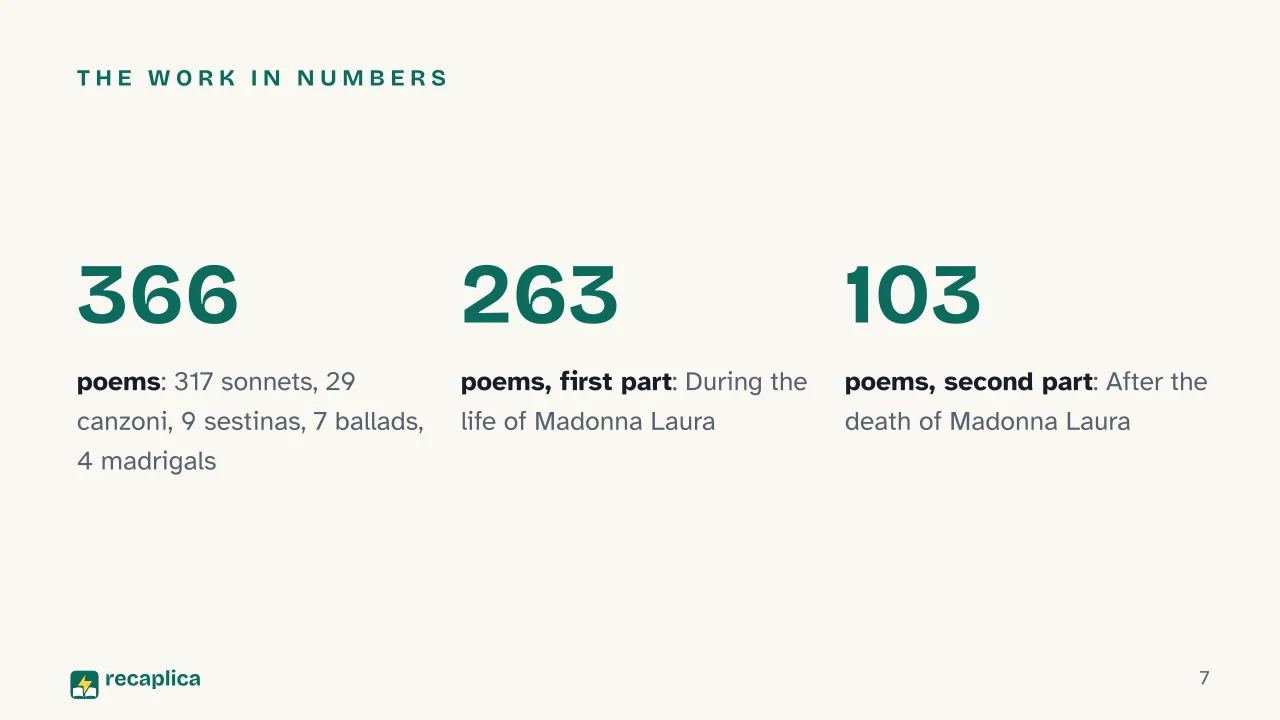
    • The work contains 366 poems (317 sonnets, 29 canzoni, 9 sestinas, 7 ballads, 4 madrigals), split into two parts of 263 and 103 poems.
    • The collection's muse is Laura, whom Petrarch, in his own note, says he first met on April 6, 1327, in Avignon; her real identity has never been established with certainty.
    • Besides the Canzoniere, Petrarch also wrote the Triumphs, the Secretum, and the epic poem Africa.
    • The imitation of his love poetry, known as Petrarchism, peaked in the 16th century and influenced English poets such as Shakespeare.

    Key figures

    • 1304-1374 Francesco Petrarch's birth and death years: born in Arezzo, died in Arquà on the eve of his seventieth birthday. Source: Treccani, Biographical Dictionary
    • 366 The Canzoniere's poems, written from around 1330 to the poet's last years: 317 sonnets, 29 canzoni, 9 sestinas, 7 ballads, 4 madrigals. Source: Treccani, Canzoniere entry
    • 1470 The year of the first printed edition of the Rerum vulgarium fragmenta, the work's original Latin title. Source: Encyclopedia.com

    Deep Dive

    Who was Francesco Petrarch: his life

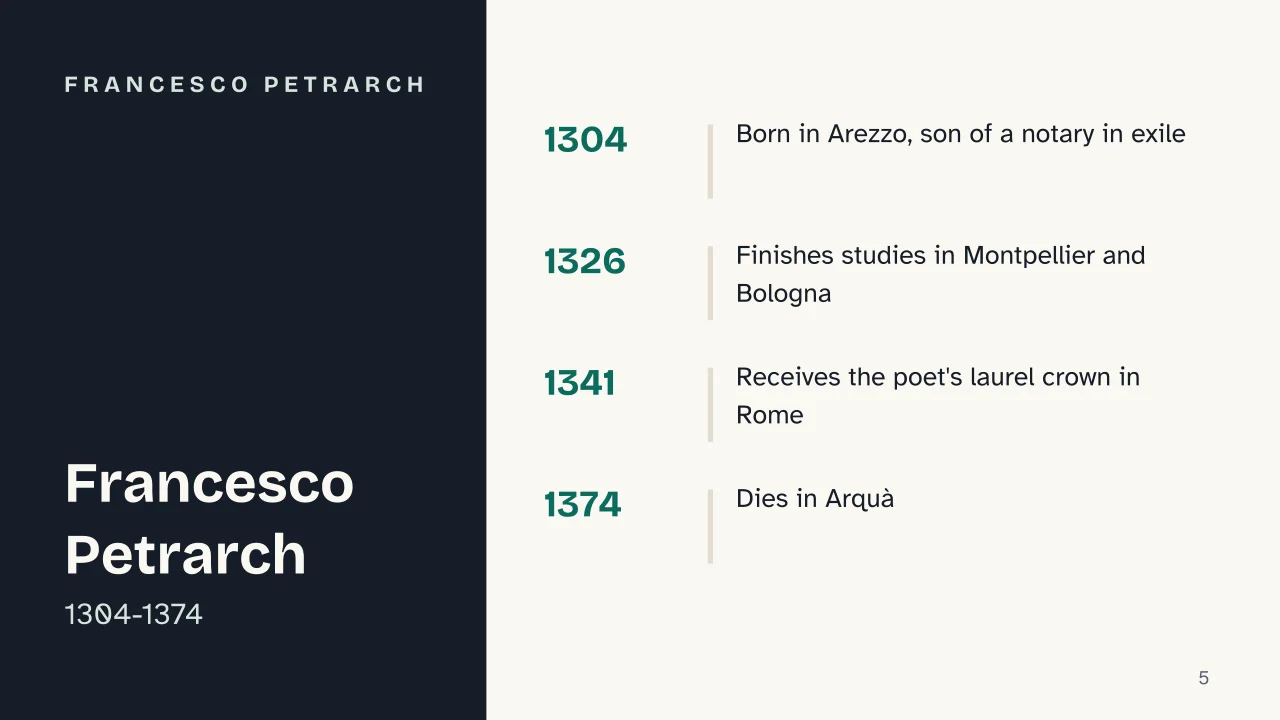
    According to the entry in Treccani’s Biographical Dictionary, Francesco Petrarch was born in Arezzo during the night of July 19-20, 1304, in a house in the Orto district. He was the son of ser Petracco, a notary, and Eletta Cangiani. His father was in exile with the “white” Guelph faction and in 1311 moved the family to Avignon, then the seat of the papacy.

    Petrarch studied in Montpellier and Bologna between 1316 and 1326, focusing on Latin classics and law; in Provence his early teacher was Convenevole da Prato. In early April 1341 he received the poet’s laurel crown in Rome, in the Senatorial Palace on the Capitoline Hill, a ceremony that proclaimed him “master” and a citizen of Rome. In the years that followed he lived in Avignon, Vaucluse, and Rome, then Milan from 1353 to 1361, Venice from 1362 to 1368, and finally Padua and Arquà, where he died during the night of July 18-19, 1374, on the eve of his seventieth birthday.

    The Canzoniere: what it is and how it’s structured

    The title Petrarch chose for his poetry collection was in Latin: Rerum vulgarium fragmenta, meaning fragments in the vernacular. According to Treccani, only from the 16th century onward did the work begin to circulate under the title Rime or Canzoniere, the name by which it’s known in schools. It wasn’t a name the author picked, but a label added later.

    The collection contains 366 poems: 317 sonnets, 29 canzoni, 9 sestinas, 7 ballads, and 4 madrigals, written from around 1330 to the last years of the poet’s life. They’re divided into two parts, traditionally titled “During the Life of Madonna Laura” (263 poems) and “After the Death of Madonna Laura” (103 poems). Love dominates, but Treccani also notes political, moral, and religious poems among them.

    Encyclopedia.com describes the collection’s throughline as an unrequited passion, running through the conflict between earthly desire for Laura and spiritual longing for God. Among the conventions Petrarch established for love poetry are praise of a woman’s beauty in the loftiest terms, paired with a constant focus on the poet’s own inner experience.

    Practical example: the collection’s second half, set after Laura’s death, handles loss and memory while staying inside the poet’s personal story. A related theme, though handled quite differently, resurfaces centuries later in Ugo Foscolo’s Of the Sepulchres, built around the value of remembering the dead.

    Petrarch wrote the Canzoniere in the Tuscan vernacular, the same linguistic base Dante had already used for the Divine Comedy, and the one from which, over the centuries, many of today’s Italian dialects branched off.

    Laura, the Canzoniere’s muse

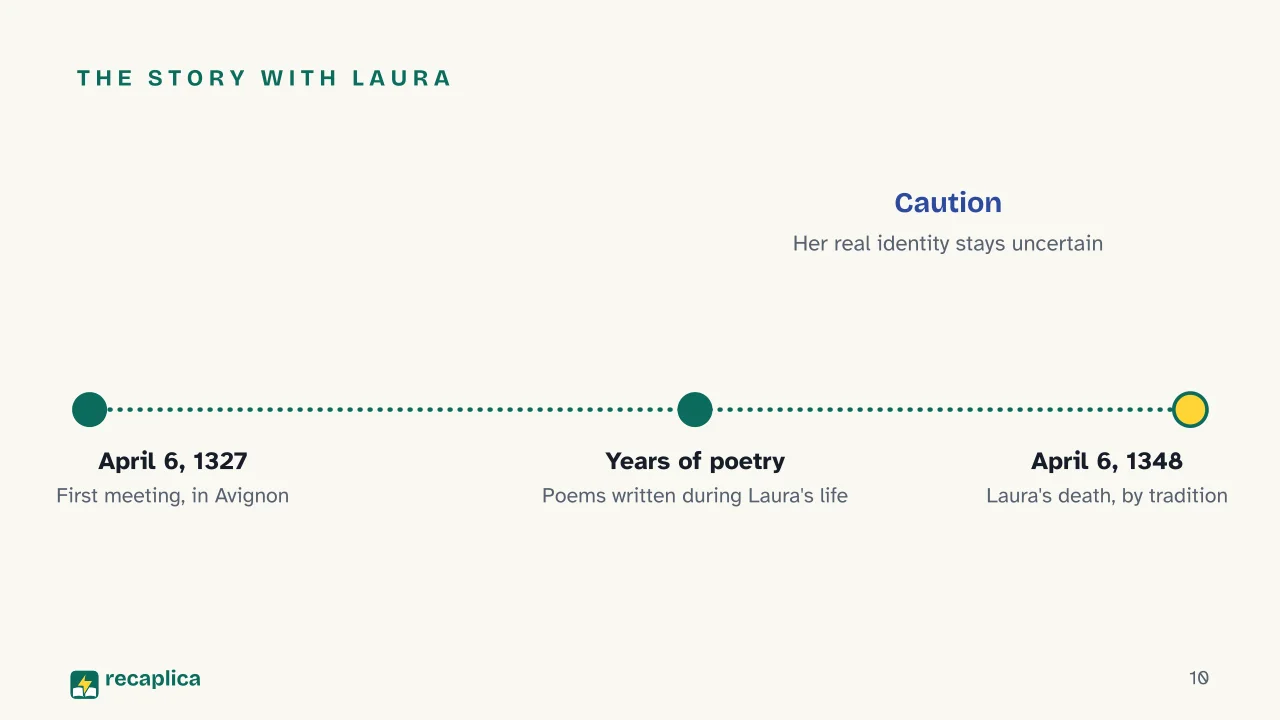
    According to a note Petrarch himself left, recorded in the so-called Virgil manuscript, he first met Laura on Friday, April 6, 1327, in the Church of St. Clare in Avignon. The same note places Laura’s death on April 6, 1348. These are traditional dates: they come from the poet’s own testimony, not from an independent outside record.

    Laura’s real identity remains uncertain. Encyclopedia.com reports that attempts to identify her with Laura de Noves, a woman from Avignon, proved unsuccessful, while noting that Petrarch himself insisted “Laura” was a real person. Encyclopaedia Britannica shows the same caution: tradition identifies her as Laura de Noves, a married mother, but since Petrarch left no clear clues about her identity, other candidates have been proposed, and some critics believe no real Laura ever existed.

    The minor works

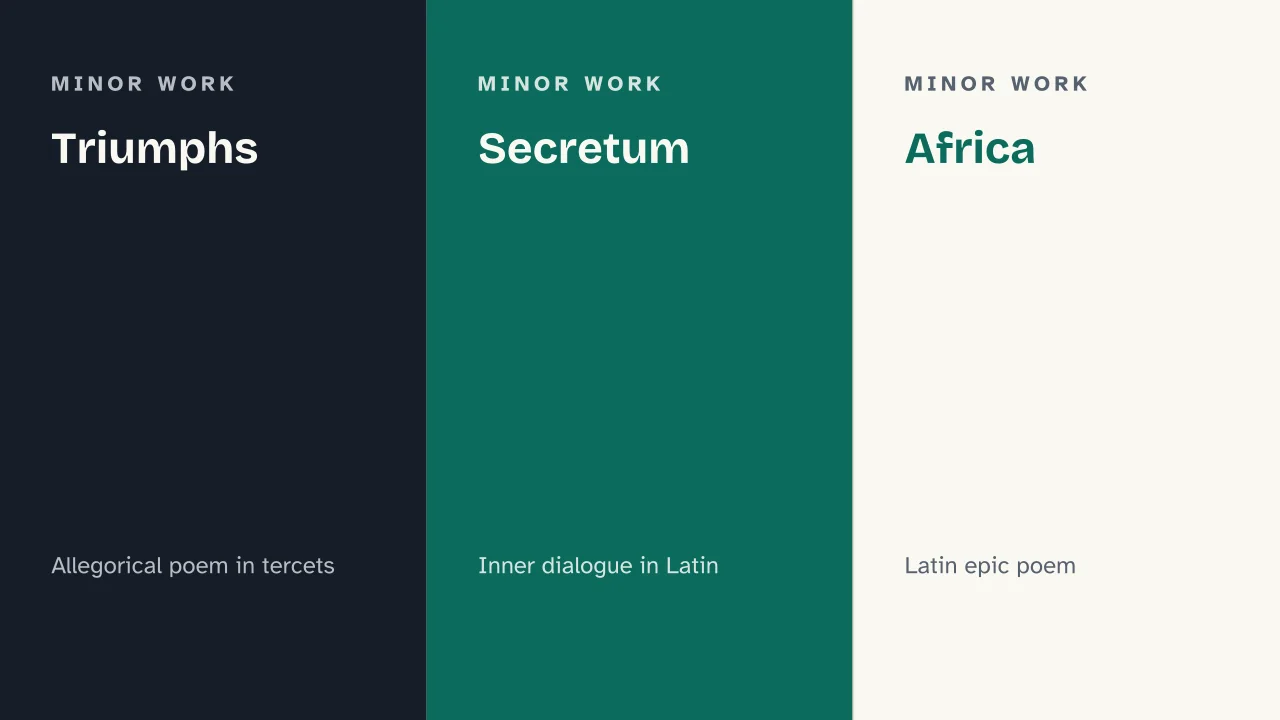
    Beyond the Canzoniere, Petrarch also wrote the Triumphs, the Secretum, and the Latin epic Africa. These works are less familiar to general readers than the Canzoniere, but they’re part of his broader output; this Recap focuses on the vernacular collection and doesn’t cover their contents in detail.

    Petrarchism: the Canzoniere’s legacy across Europe

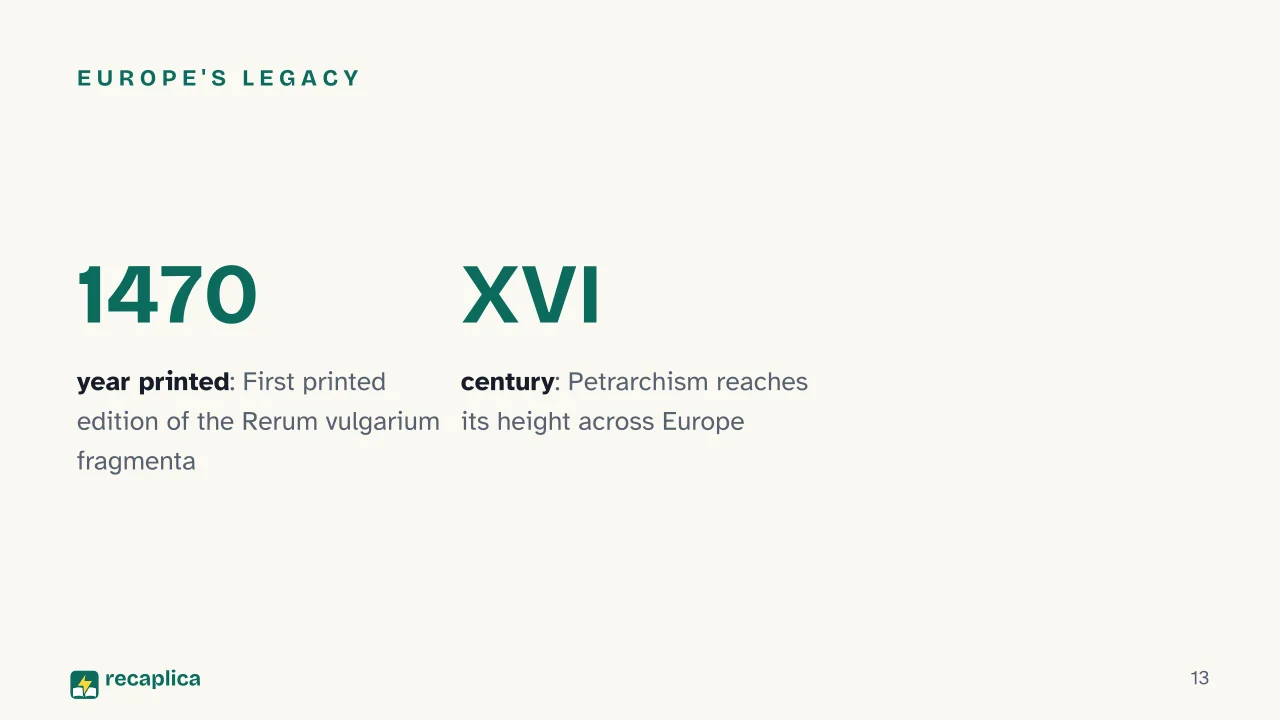
    The Rerum vulgarium fragmenta were first printed in 1470. According to Britannica, the Canzoniere established and perfected the sonnet as a poetic form, becoming one of the two principal sonnet models. Petrarch’s exploration of intense psychological reactions and spiritual conflict set a new standard for lyric poetry, and the work is considered a foundational text of the Renaissance.

    The widespread imitation of Petrarch’s love poetry across Europe is known as Petrarchism, and it reached its height in the 16th century. The Petrarchan sonnet became a recurring form in Spain, Portugal, and France, and reached as far as Poland, from where it spread to other Slavic literatures. In England, poets such as William Shakespeare and Sir Philip Sidney drew on Petrarchan themes and structures for their own sonnets.

    Slide deck

    Slides ready to download and make your own in PowerPoint or Google Slides, with speaker notes. Pick the Flash cut or the Full one.
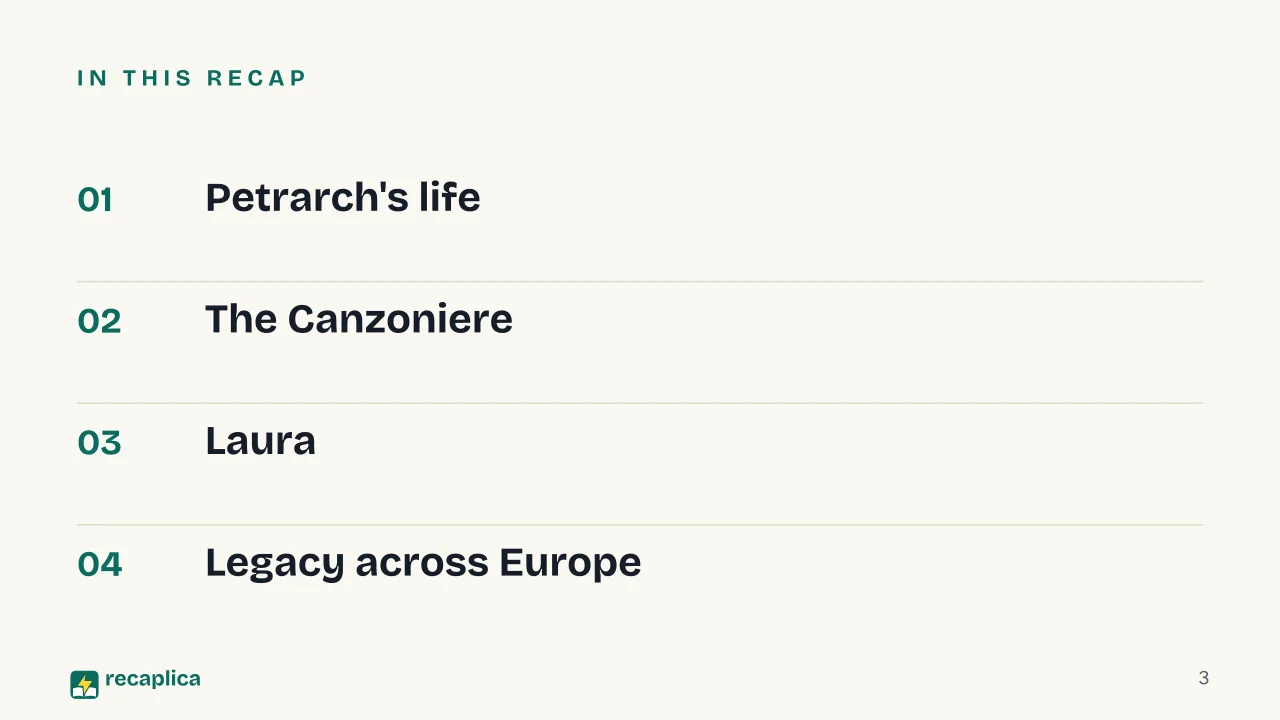
    Slide 1 of the presentation on Petrarch and the Canzoniere: Petrarch and the CanzoniereSlide 2 of the presentation on Petrarch and the Canzoniere: Who was the man behind Europe's most imitated love poems?Slide 3 of the presentation on Petrarch and the Canzoniere: In this RecapSlide 4 of the presentation on Petrarch and the Canzoniere: Chapter 01: LifeSlide 5 of the presentation on Petrarch and the Canzoniere: Francesco PetrarchSlide 6 of the presentation on Petrarch and the Canzoniere: Chapter 02: The CanzoniereSlide 7 of the presentation on Petrarch and the Canzoniere: The work in numbersSlide 8 of the presentation on Petrarch and the Canzoniere: The original title wasn't CanzoniereSlide 9 of the presentation on Petrarch and the Canzoniere: Chapter 03: LauraSlide 10 of the presentation on Petrarch and the Canzoniere: The story with LauraSlide 11 of the presentation on Petrarch and the Canzoniere: Chapter 04: Legacy and minor worksSlide 12 of the presentation on Petrarch and the Canzoniere: Triumphs · Secretum · AfricaSlide 13 of the presentation on Petrarch and the Canzoniere: Europe's legacySlide 14 of the presentation on Petrarch and the Canzoniere: What do the sources say about Laura's real identity?Slide 15 of the presentation on Petrarch and the Canzoniere: The Recap continues on the site
    Flash10 slidesThe essential thread, to present in classFull15 slidesEvery chapter and the deeper detail

    Common myths

    • ✗ Myth "Canzoniere" was the title Petrarch chose for his collection.

      ✓ Reality Petrarch did title the work himself, but in Latin: Rerum vulgarium fragmenta. The name "Canzoniere" (or "Rime") only arrived from the 16th century onward, once the collection also began circulating under that later label.

    • ✗ Myth Historians know for certain who Laura really was.

      ✓ Reality The traditional identification with Laura de Noves, a woman from Avignon, never held up, and some scholars think no real Laura ever existed. Even the date of their first meeting comes only from a note Petrarch wrote himself, in the so-called Virgil manuscript: her identity stays an open question.

    • ✗ Myth The Canzoniere is only about Laura.

      ✓ Reality Love dominates the collection, but it also includes political, moral, and religious poems; the romantic theme is central, not exclusive.

    Mind map

    Drag the background to move around and the nodes to reposition them; use − and + to collapse and expand branches.
    Customize
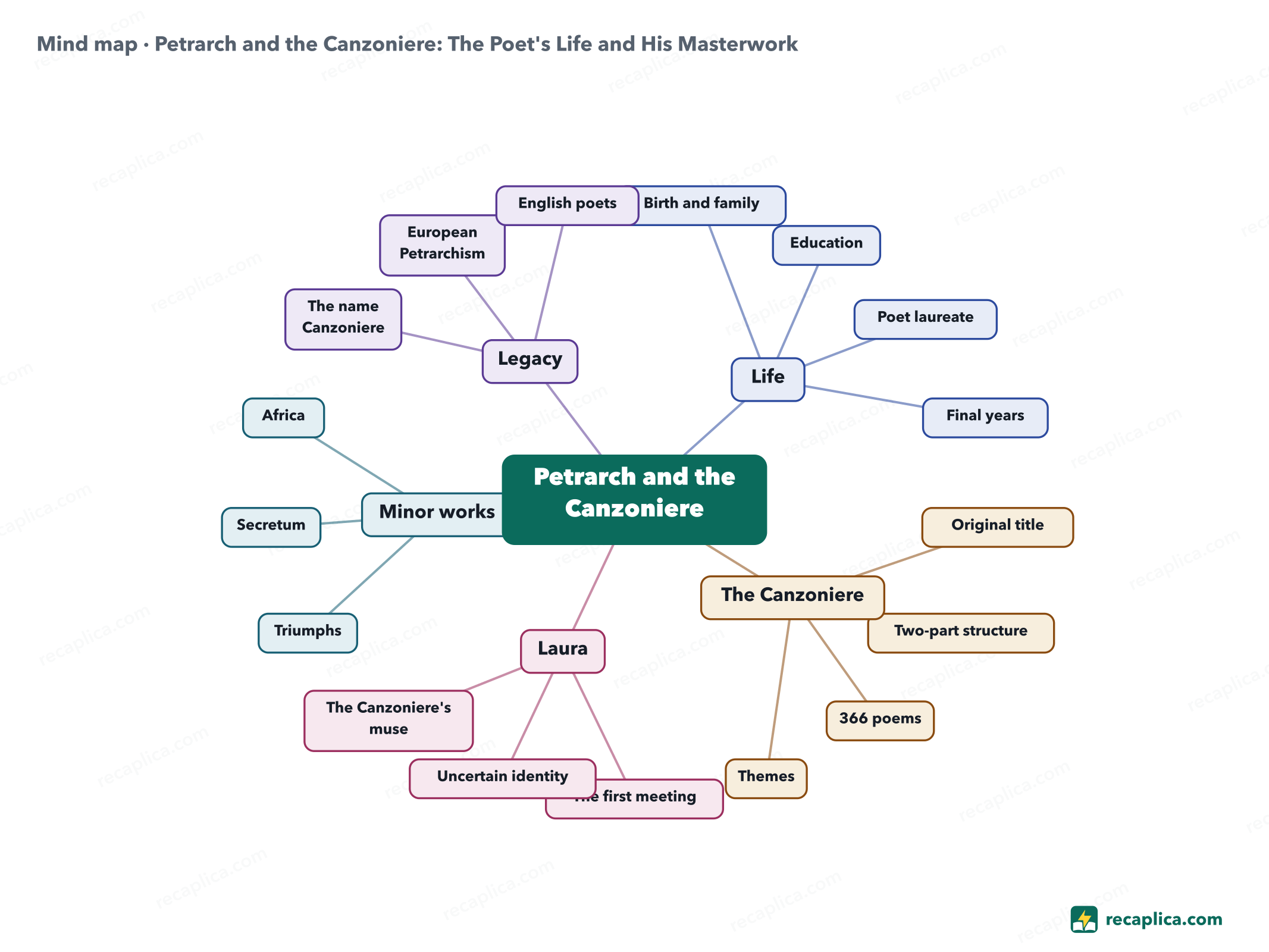
    Mind map: Petrarch and the Canzoniere: The Poet's Life and His Masterwork
    • Petrarch and the Canzoniere
      • Life
        • Birth and family Arezzo, 1304, son of a notary in exile with the whites
        • Education Montpellier and Bologna, between 1316 and 1326
        • Poet laureate Rome, 1341, on the Capitoline Hill
        • Final years Arquà, where he died in 1374
      • The Canzoniere
        • Original title Rerum vulgarium fragmenta, in Latin
        • Two-part structure 263 poems during Laura's life, 103 after her death
        • 366 poems 317 sonnets, 29 canzoni, 9 sestinas, 7 ballads, 4 madrigals
        • Themes love, but also politics, morals, and religion
      • Laura
        • The first meeting April 6, 1327, in Avignon, according to Petrarch's own note
        • Uncertain identity the identification with Laura de Noves rests on shaky ground
        • The Canzoniere's muse a constant presence throughout the poems
      • Minor works
        • Triumphs
        • Secretum
        • Africa
      • Legacy
        • The name Canzoniere spread from the 16th century onward
        • European Petrarchism imitation of the love poetry, peaking in the 16th century
        • English poets Wyatt, Surrey, Shakespeare, Sidney

    Quiz: test yourself

    Answer the questions to check what you have learned: you get instant feedback and a short explanation.

    Grade 0/10 0/5
    1 In what year was Francesco Petrarch born?

    Petrarch was born in Arezzo during the night of July 19-20, 1304; he died in 1374, met Laura in 1327, and received the poet's laurel crown in 1341.

    2 What was the original Latin title of the work now commonly called the Canzoniere?

    The Latin title Petrarch chose was Rerum vulgarium fragmenta; Africa and Secretum are two other works of his, while "Canzoniere" only came into use from the 16th century onward.

    3 How is the collection traditionally divided?

    Tradition splits the 366 poems into two sections, 263 "during the life" and 103 "after the death" of Madonna Laura.

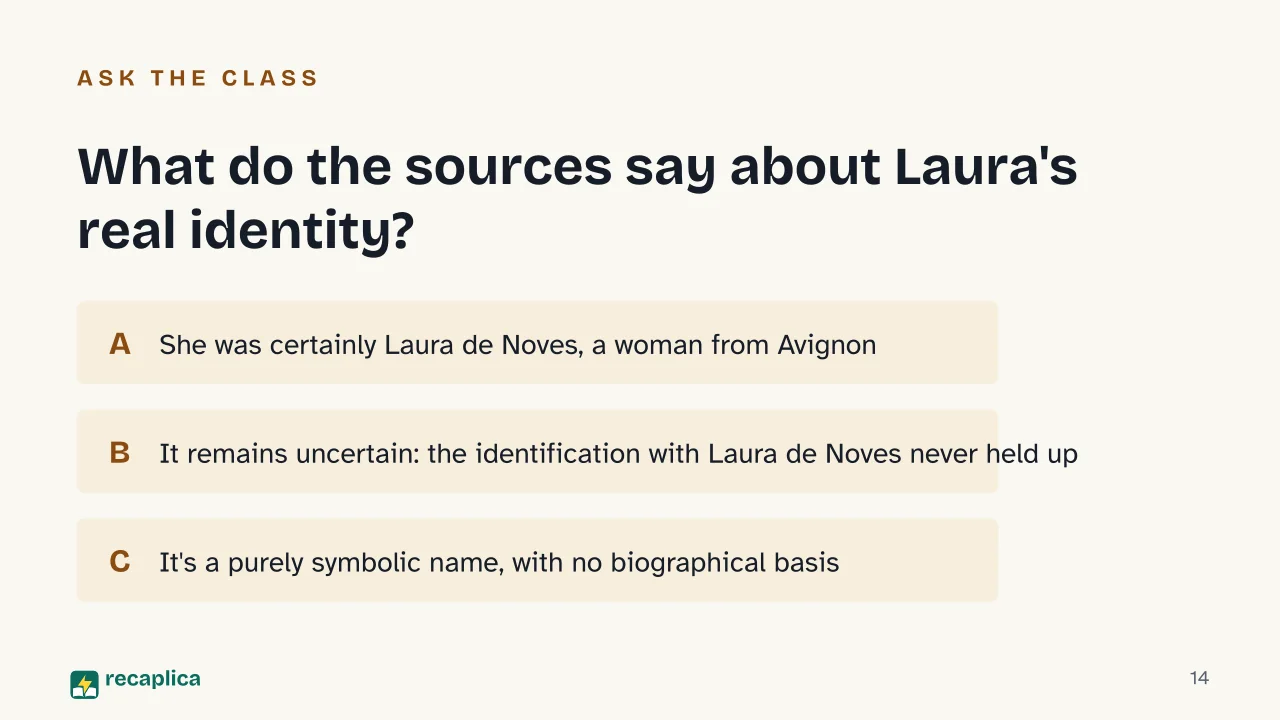
    4 What do the sources say about Laura's real identity?

    Both Encyclopedia.com and Encyclopaedia Britannica are cautious: attempts to identify Laura with Laura de Noves never held up, and some critics believe no real woman by that name ever existed.

    5 What is "Petrarchism"?

    Petrarchism is the imitation, widespread across Europe and peaking in the 16th century, of the themes and forms of Petrarch's love poetry; it also influenced English poets such as Wyatt, Surrey, Shakespeare, and Sidney.

    Answers: 1-A · 2-A · 3-A · 4-B · 5-A

    Flashcards

    Tap the card to flip it and check whether you remember the answer, then move to the next one.

    1 / 8

    Explain it in your own words

    The ultimate test: if you can explain it in simple words, you've truly understood it. Write your explanation, then compare it with the Recap.

    Your explanation is saved only on this device.

    Francesco Petrarch was born in Arezzo in 1304 and died in Arquà in 1374, after a life spent between Avignon, Milan, Venice, and Padua. He wrote the Canzoniere, a collection of 366 poems that he titled in Latin Rerum vulgarium fragmenta and that only began circulating under its better-known name from the 16th century onward. At the center of the work is his love for Laura, whom, according to a note Petrarch left, he first met on April 6, 1327, in Avignon; her real identity, however, remains uncertain, as several sources point out. The Canzoniere established the sonnet as a major poetic form and inspired centuries of love poetry across Europe, from 16th-century Italy to Shakespeare's English sonnets.

    Frequently asked questions

    Why is Petrarch's work called the Canzoniere if he gave it a different title?

    Petrarch called his collection Rerum vulgarium fragmenta, a Latin title. The name Canzoniere (along with Rime) only appeared from the 16th century onward, once the work started circulating under this simpler label too.

    Who was Laura to Petrarch?

    Laura is the woman most of the Canzoniere's poems are addressed to. According to a note Petrarch wrote himself, he met her on April 6, 1327, in the Church of St. Clare in Avignon. Her real historical identity, though, has never been confirmed with certainty: attempts to identify her with a specific woman from Avignon haven't succeeded.

    What other works did Petrarch write besides the Canzoniere?

    Among Petrarch's other works are the Triumphs, the Secretum, and the Latin epic Africa. They're less known to general readers than the Canzoniere, but they're part of the poet's wider body of work.

    What is Petrarchism?

    It's the name given to the imitation, widespread across Europe, of the themes and forms of Petrarch's love poetry. It peaked in the 16th century and influenced poetry in France, Spain, Portugal, and Poland, as well as English poets such as Wyatt, Surrey, Shakespeare, and Sidney.

    Where did Petrarch live as an adult?

    After his childhood in Avignon, Petrarch lived between Vaucluse, Rome, Milan (from 1353 to 1361), Venice (from 1362 to 1368), Padua, and finally Arquà, where he died in 1374.

    Sources

    • Canzoniere — Treccani Encyclopedia
    • Francesco Petrarca — Biographical Dictionary, Treccani Encyclopedia
    • The Canzoniere — Encyclopedia.com
    • Petrarch — Encyclopaedia Britannica
    • Canzoniere — Encyclopaedia Britannica
    • Laura (literary subject) — Encyclopaedia Britannica

    Every Recap goes through an independent review before publication.

    Every evening, the day's new Recaps on our Telegram channel. Join the channel →

    Keep learning

    • Literature Carlo Goldoni: The Playwright Who Rewrote Italian Comedy Carlo Goldoni was born in Venice in 1707 and died in Paris in 1793, after training as a lawyer in Padua and practicing law in Venice. Before him, Italian comic theater relied mostly on commedia dell'arte: unscripted scenarios and fixed stock characters such as Harlequin. Goldoni moved the genre toward fully written plays with characters drawn from real life instead of stereotypes, a shift that begins with "La donna di garbo" ("The Woman of Good Sense") and spreads through his work in the 1750s. The change happened gradually: some transitional plays kept only three or four fully scripted scenes per act, with the rest still improvised. Read the Recap →
    • Literature Torquato Tasso: The Poet Behind Jerusalem Delivered Torquato Tasso was born in Sorrento in 1544 and died in Rome in 1595, having spent most of his adult life at the Este court in Ferrara. His masterwork is Jerusalem Delivered, a twenty-canto poem about the First Crusade and the fall of Jerusalem, published in its final form in 1581 after more than two decades of work. The story follows Godfrey of Bouillon as he leads the Christian army, but it keeps breaking away into private tales of love and duty: the knight Tancred, the sorceress Armida, the paladin Rinaldo. In 1593 Tasso issued a stricter revision titled Jerusalem Conquered, which never won over readers the way the original did. Read the Recap →
    • Literature Gabriele D'Annunzio: Life, Works, and Italian Decadence Gabriele D'Annunzio was born in Pescara on March 12, 1863, and spent seven formative years at the Collegio Cicognini in Prato, graduating in 1881. In the 1880s he threw himself into a restless social life of newsrooms and fashionable salons while writing the novel The Child of Pleasure, published in 1889, and later the Laudi, four volumes (1903-1912) whose first three books mark the high point of his poetry, with Alcyone as the volume critics praised most. According to the Treccani encyclopedia, D'Annunzio was the first Italian writer to bring Italian literature into full contact with the decadent currents that had emerged in France around 1885-1886 in the wake of Baudelaire, which is why he is regarded as the leading figure of Italian Decadence. His life also included a long bond with the actress Eleonora Duse and, in the 1920s, a relationship with Benito Mussolini who, by his own reckoning, never granted the poet any real political weight. He died suddenly on March 1, 1938, at his residence, the Vittoriale. Read the Recap →

    recaplica

    Clear in 30 seconds, yours in 10 minutes.

    Recaps Mind maps Request a Recap Telegram channel Mind map maker Our method About Privacy & cookies Legal notes & terms of use

    © 2026 Recaplica · A project by Curi S.r.l. — VAT IT05472000750

    Statistics, only if you say so

    To learn which Recaps help most we would use Google Analytics, with aggregate, anonymous data. It starts only with your OK, and you can change your mind anytime. Privacy policy