|
recaplica
The Leopard Novel by Giuseppe Tomasi di Lampedusa: Summary | ||||||||||||
| © 2026 Recaplica · recaplica.com — All rights reserved | ||||||||||||
The Leopard Novel by Giuseppe Tomasi di Lampedusa: SummaryWhat to print Page numbers appear when printing with default margins. SlidesChoose a cut Flash10 slidesThe essential thread, to present in classFull15 slidesEvery chapter and the deeper detailBoth come with speaker notes. In 30 seconds quick readThe Leopard, by Giuseppe Tomasi di Lampedusa, follows the decline of the Sicilian aristocracy through the eyes of Prince Fabrizio Corbera of Salina, in a Sicily that moves from the Bourbon kingdom to a unified Italy between 1860 and the first decade of the twentieth century. The prince's nephew, Tancredi Falconeri, marries Angelica, daughter of the newly wealthy commoner Don Calogero Sedara: a union that marks the shift of power from the aristocracy to the rising middle class. Turned down by two publishers during the author's lifetime, the novel appeared posthumously in 1958 and won the Strega Prize the following year, becoming Italy's first great bestseller; in 1963 Luchino Visconti turned it into an award-winning film. Key Points
Key figures
Deep DiveA novel about the end of a worldThe Leopard tells of the Sicily that, between 1860 and the first decade of the twentieth century, moves from the Bourbon kingdom to a unified Italy, seen through the eyes of a man who belongs to that transition but no longer takes part in it: Fabrizio Corbera, Prince of Salina. The Treccani Dizionario Biografico describes Giuseppe Tomasi di Lampedusa’s construction of the novel as an exquisitely modern narrative device, built from the montage of largely self-contained parts that, chapter by chapter, mark the decline of the Sicilian aristocracy. It is not a historical novel in the strict sense, nor an autobiography: the author drew on episodes from his own family, in particular the life of his great-grandfather, Prince Giulio Fabrizio Tomasi. It is an acknowledged inspiration, not a point-by-point account of real events. The plotIn 1860 the landing of the Expedition of the Thousand at Marsala opens the season in Sicily that will lead to the island’s annexation to the new Kingdom of Italy, the event covered in the Recap on Italian unification. Prince Fabrizio of Salina watches that historic shift with a clear-eyed detachment: he understands that the aristocracy he belongs to is losing power, and that nothing will bring it back. The change under way is embodied above all by the prince’s nephew, Tancredi Falconeri: young and ambitious, he chooses to side with the new political order rather than defend the world he grew up in. The clearest sign of that choice is his marriage to Angelica, daughter of Don Calogero Sedara, a commoner who made his own fortune and stands for the new ruling class on the rise. The wedding joins the Salinas’ old name to the Sedaras’ new money, and marks, more than any political speech, the real shift of power from one social class to another. The Prince of Salina watches this happen without openly resisting, almost with resignation: he understands that his own historical role has run its course, and that the future belongs to those, like Tancredi, who know how to adapt. Gattopardismo, from Tancredi’s line to a conceptIt is Tancredi himself, in the novel, who speaks the book’s most famous line, addressed to his uncle: Tancredi tells his uncle that unless their own side gets involved in the change under way, the new republic will be built without them regardless, and that the only way to keep things as they are is to change first. From that argument comes the term “gattopardismo,” which has travelled well beyond literature: it describes going along with visible, even apparently radical change, precisely in order to keep, underneath, the existing balance of power intact. It is not a refusal of change but its apparent opposite: something changes so that everything else can stay as it is.
A novel rejected twiceThe road to publication was not straightforward. Giuseppe Tomasi di Lampedusa submitted the manuscript to Mondadori in May 1956, and the publisher rejected it. He then tried Einaudi, where the novel met a second rejection, this time on the unfavorable judgment of Elio Vittorini, who called it “a decent but conventional piece of work.”
The author died in Rome in 1957; the novel was still unpublished, and he never had the chance to give it a final polish. The Leopard appeared posthumously on 11 November 1958 through Feltrinelli, edited by Giorgio Bassani, the writer who worked on the manuscript after the other publishers had turned it down. It is not an isolated case in literature: writers tied to a rather different narrative world, such as Giovanni Verga before him, had also written about Sicily from the inside, with a critical eye on its social changes; twentieth-century Sicily would later find another major voice in Luigi Pirandello, even if his language and sensibility were very different from Tomasi di Lampedusa’s. A success that came after the author’s deathOnce it came, success arrived fast. In 1959 The Leopard won the Strega Prize, becoming Italy’s first bestseller with more than 100,000 copies sold: print runs reached 250,000 copies within eight months of publication. A novel rejected by two publishers in under three years became the best-selling Italian book of its time, read by an audience far wider than the one that usually picks up a novel set in nineteenth-century Sicily. Visconti’s filmIn 1963 the director Luchino Visconti made the film adaptation of the novel, bringing a landmark literary text to the screen, much as other directors had already done with other classics, as with Pasolini’s Decameron a few years later. In the cast, Burt Lancaster played Prince Fabrizio of Salina, Claudia Cardinale played Angelica Sedara and Alain Delon played Tancredi Falconeri. The film won the Palme d’Or. From a manuscript rejected twice to an award-winning film just five years after the novel’s first publication, The Leopard has crossed Italian culture in different forms, while staying tied to the same question the Prince of Salina asks himself as he faces a world that is changing. Slide deckSlides ready to download and make your own in PowerPoint or Google Slides, with speaker notes. Pick the Flash cut or the Full one.     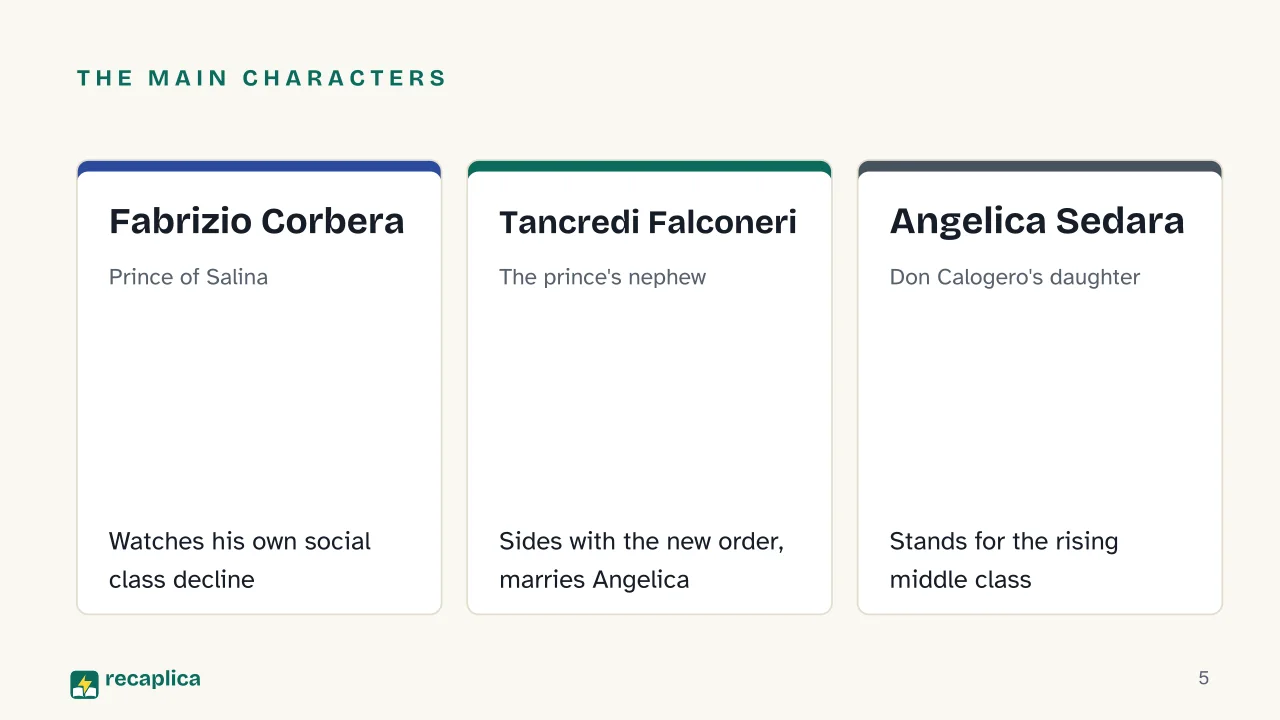 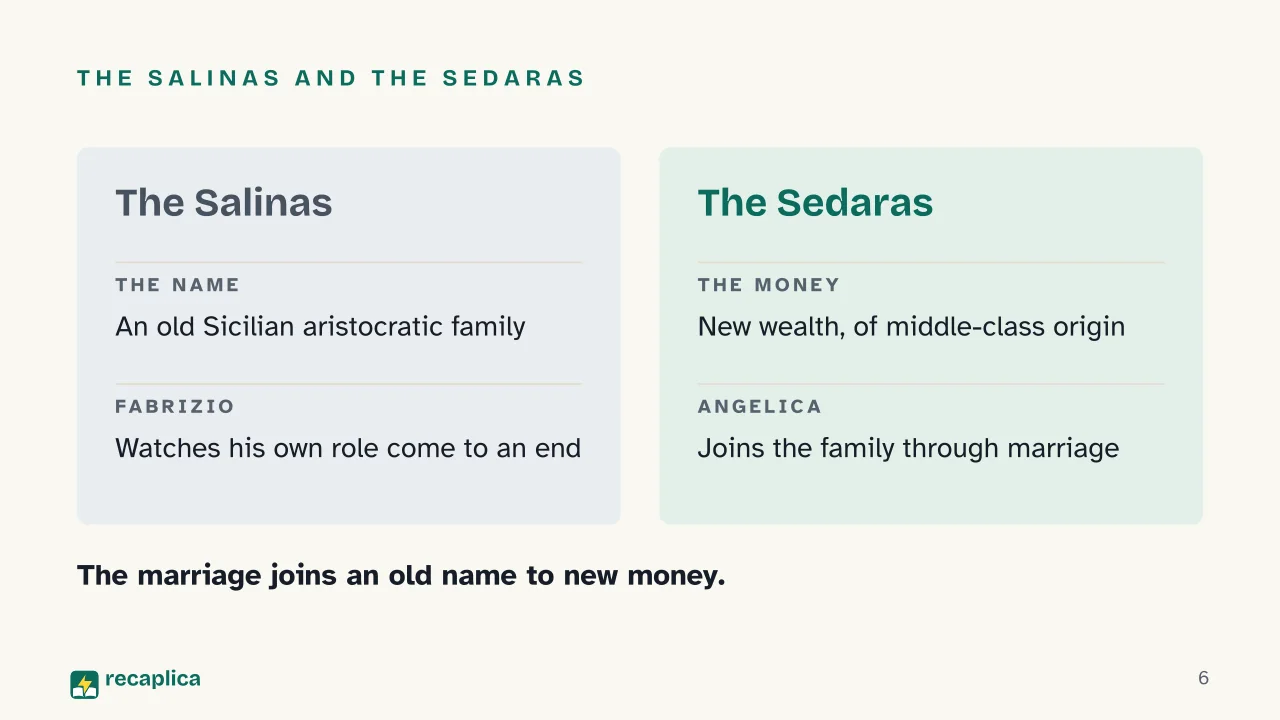  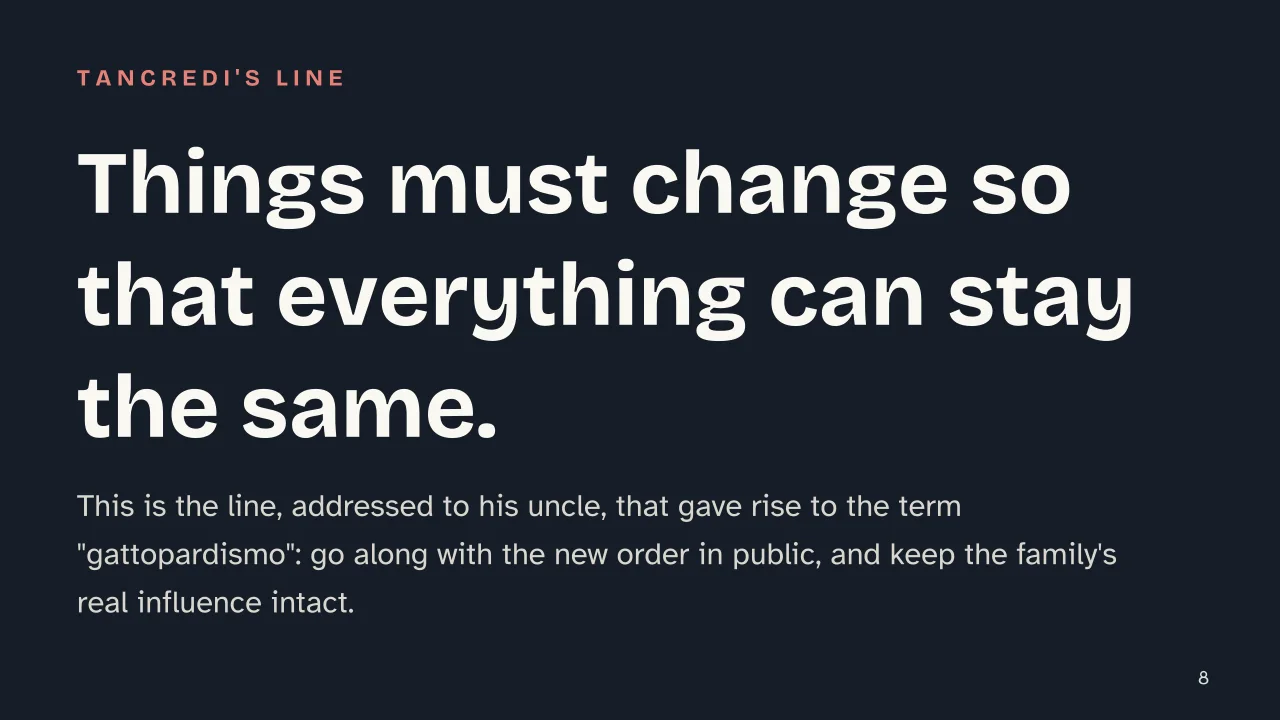  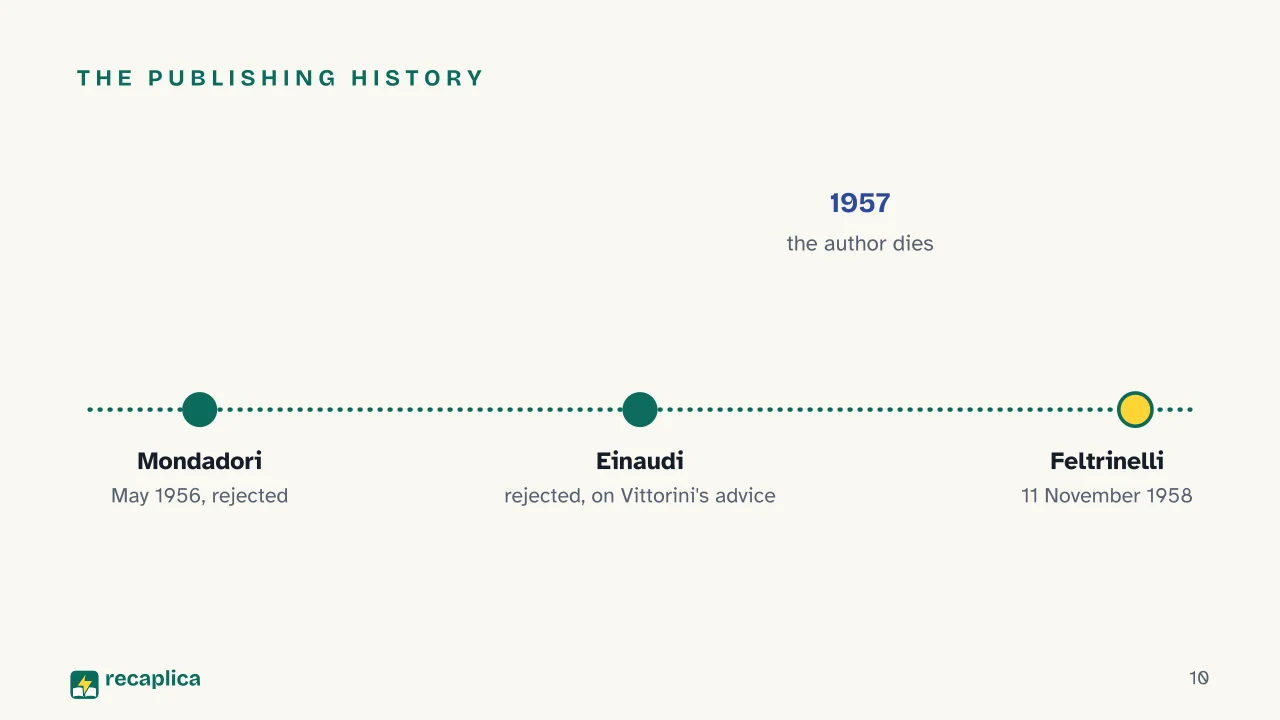 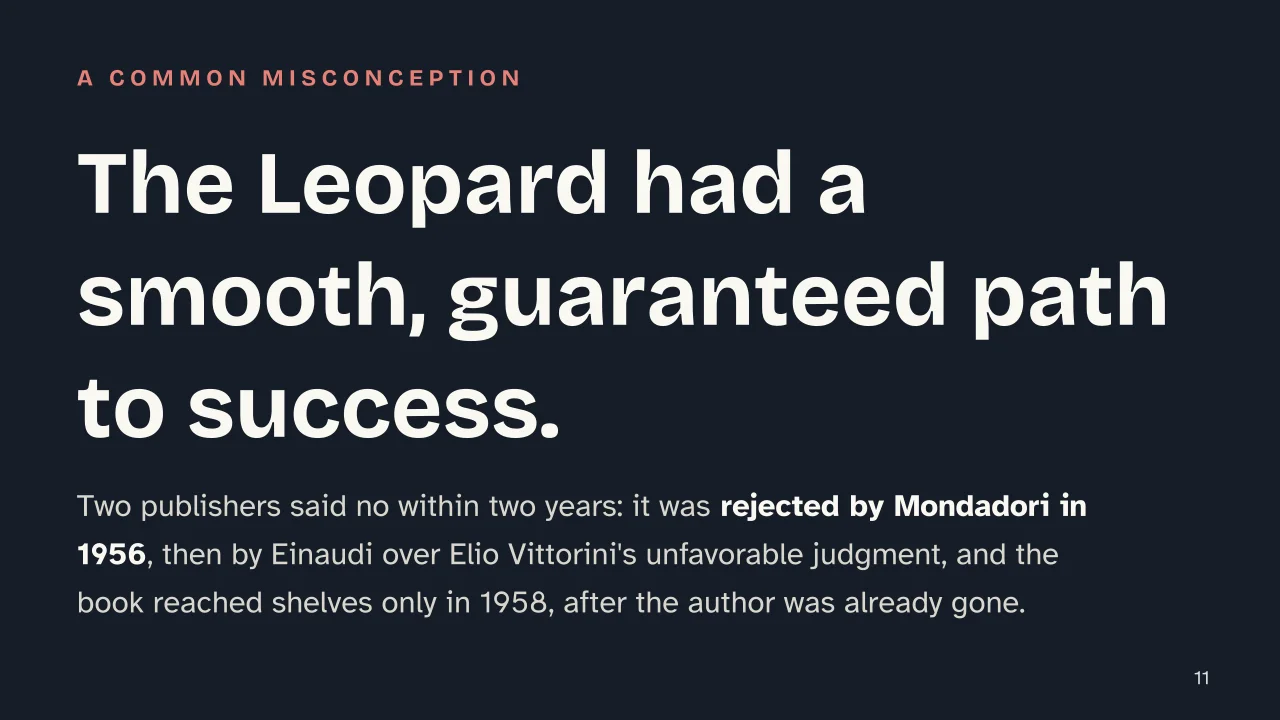  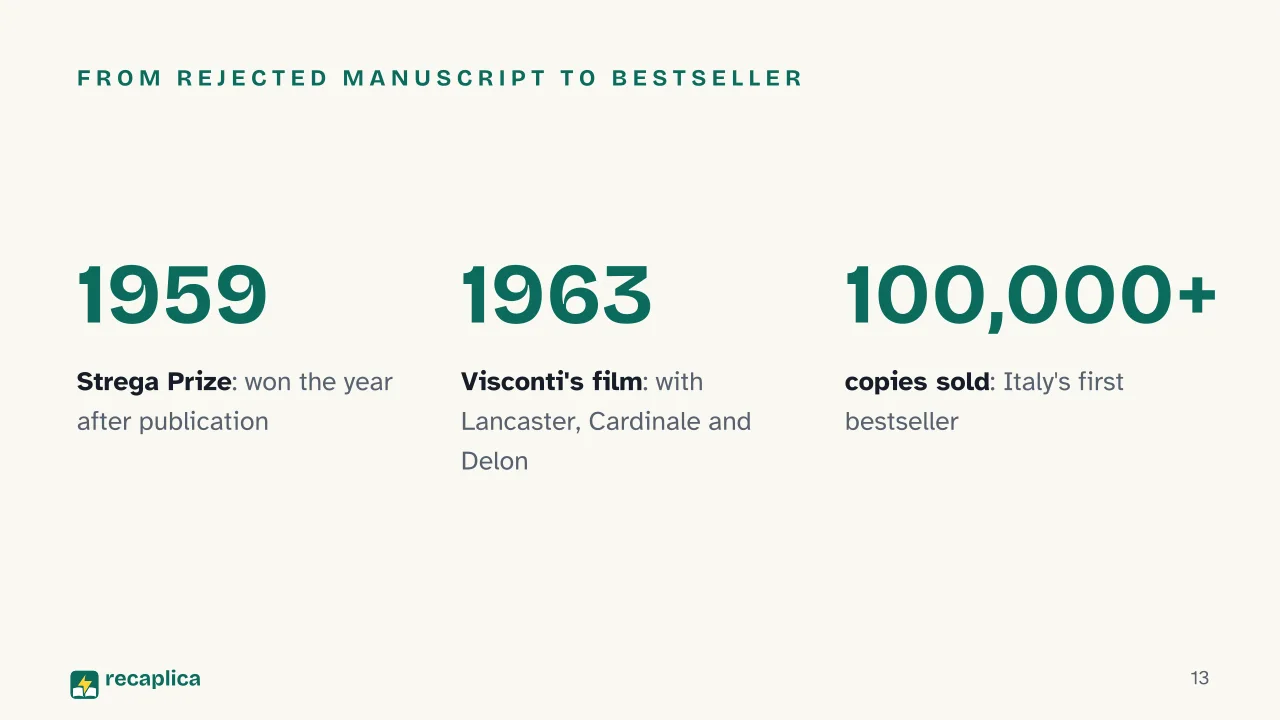 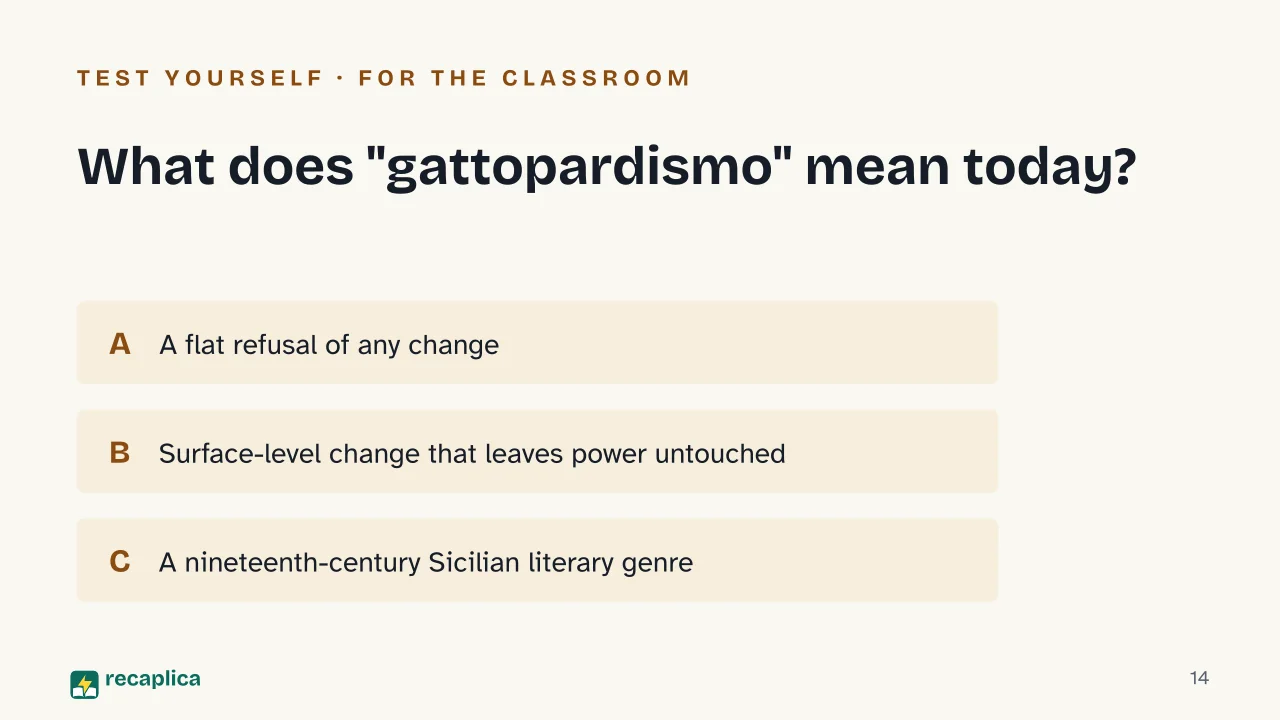  Common myths
Mind mapDrag the background to move around and the nodes to reposition them; use − and + to collapse and expand branches. 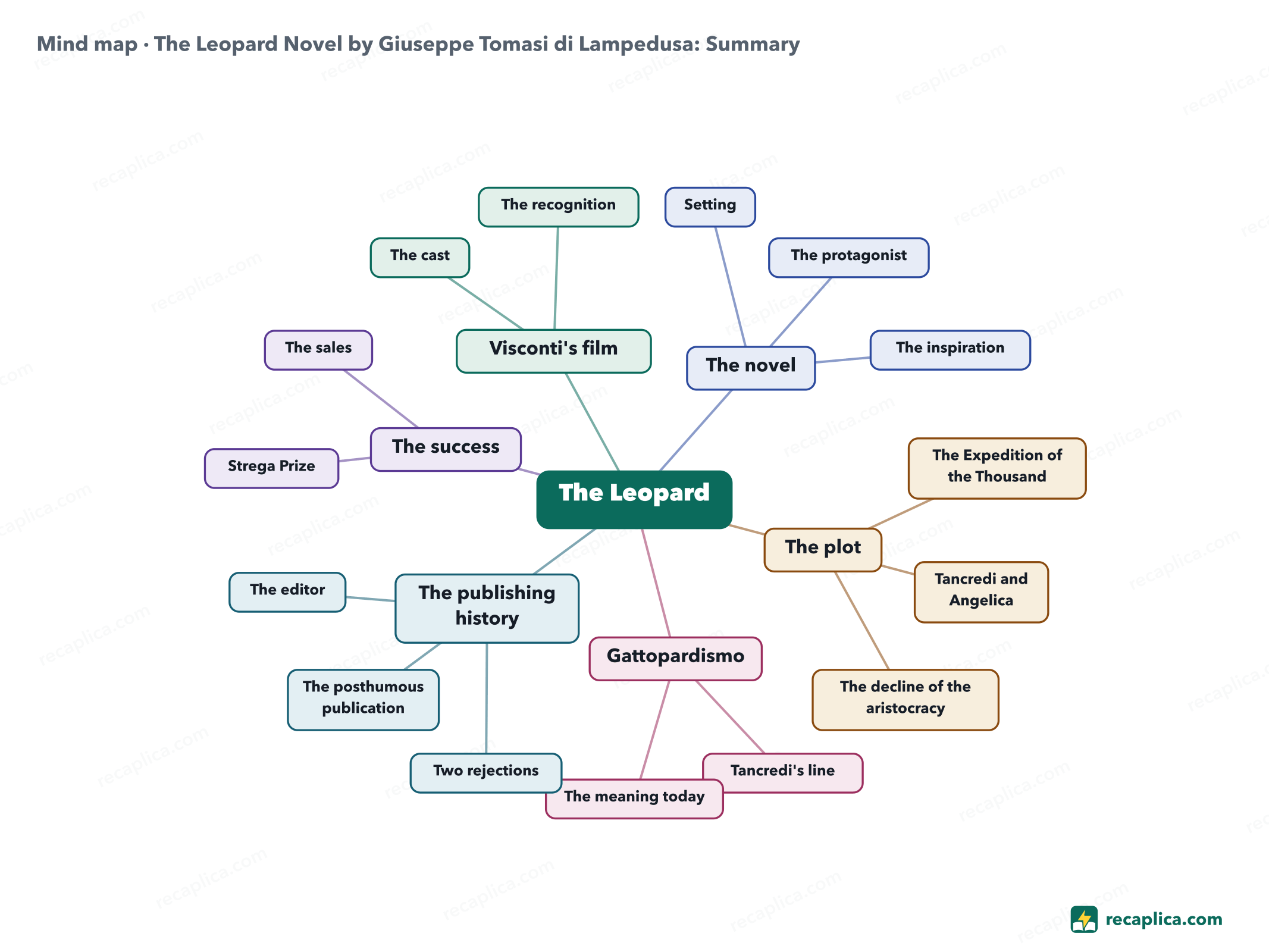
Quiz: test yourselfAnswer the questions to check what you have learned: you get instant feedback and a short explanation. Grade 0/10 0/5
FlashcardsTap the card to flip it and check whether you remember the answer, then move to the next one. 1 / 8 Explain it in your own wordsThe ultimate test: if you can explain it in simple words, you've truly understood it. Write your explanation, then compare it with the Recap. Your explanation is saved only on this device.
Frequently asked questionsWhat is The Leopard about?It follows the decline of the Sicilian aristocracy through Prince Fabrizio Corbera of Salina, between 1860 and the early 1900s, as Sicily passes from Bourbon rule to the unified Italian kingdom. His nephew Tancredi Falconeri marries Angelica Sedara, whose father Don Calogero is a commoner grown rich, and with that marriage power shifts toward the new ruling class. What does "gattopardismo" mean?It comes from the line Tancredi uses to talk his uncle into backing the new political order instead of staying loyal to the old regime, and it now describes going along with changes that look real while whoever actually holds power stays the same. Why was The Leopard published only after the author's death?The manuscript was submitted to Mondadori in May 1956 and rejected; a second attempt with Einaudi was turned down as well, after Elio Vittorini judged it "a decent but conventional piece of work." Giuseppe Tomasi di Lampedusa died in 1957 without seeing the novel published; it appeared posthumously on 11 November 1958 through Feltrinelli, edited by Giorgio Bassani. Is The Leopard a true story?No, it is fiction. Tomasi di Lampedusa took his cue from his family's past, above all from the life of his great-grandfather, Prince Giulio Fabrizio Tomasi; the inspiration is acknowledged, but the book is no historical or autobiographical account. Who directed the film based on the novel, and who starred in it?The 1963 film was directed by Luchino Visconti, with Burt Lancaster as the Prince of Salina, Claudia Cardinale as Angelica Sedara and Alain Delon as Tancredi Falconeri; it won the Palme d'Or. Every Recap goes through an independent review before publication. |