Skip to content
recaplica

    One moment: security check

    Cloudflare wants to make sure you're not a robot. Tick the box below and your search will continue on its own.

    IT
    recaplica The Decameron (1971): Pasolini's Boccaccio Adaptation in Naples
    © 2026 Recaplica · recaplica.com — All rights reserved
    Home › Literature

    The Decameron (1971): Pasolini's Boccaccio Adaptation in Naples

    By Recaplica Newsroom · Updated on September 22, 2026

    What to print

    Page numbers appear when printing with default margins.

    Slides

    Choose a cut

    Flash10 slidesThe essential thread, to present in classFull16 slidesEvery chapter and the deeper detail

    Both come with speaker notes.

    Telegram channel
    recaplica Clear in 30 seconds, yours in 10 minutes.
    In 30 seconds Key points Figures Deep dive Slides Myths Mind map Quiz Flashcards FAQ

    In 30 seconds quick read

    The Decameron is the film Pier Paolo Pasolini released in 1971, adapting a group of Giovanni Boccaccio's medieval stories and opening what he called the Trilogy of Life. Presented at the Berlin Film Festival, where it won the Silver Bear, it moves Boccaccio's tales from Florence to Angevin-era Naples. Pasolini selected nine or ten stories for the film, including Ser Ciappelletto and Andreuccio da Perugia, and cast himself as a pupil of Giotto alongside actors such as Franco Citti, Ninetto Davoli and Silvana Mangano. In June 1975, Pasolini wrote a harsh self-critique known as the Abiura, published posthumously in Corriere della Sera a week after his death, publicly disowning the project that had made him famous only a few years earlier.

    Key Points

    • The Decameron came out in 1971 and premiered at the Berlin Film Festival, where it won the Silver Bear; it is the first film in Pasolini's Trilogy of Life.
    • Pasolini relocated Boccaccio's stories from Florence to Angevin-era Naples, narrowing an original plan that had also considered Sicily, North Africa and France.
    • Sources from the Centro Studi Pier Paolo Pasolini disagree on the exact number of stories chosen, nine in one count and ten in another; titles appearing on both lists include Ser Ciappelletto, Andreuccio da Perugia and Masetto da Lamporecchio.
    • The cast includes Franco Citti as Ser Ciappelletto, Ninetto Davoli as Andreuccio da Perugia, and Pasolini himself as a pupil of Giotto.
    • The Trilogy of Life also includes The Canterbury Tales (1972) and Arabian Nights (1974); according to Senses of Cinema, the three films share a celebration of the body's physicality and carnal life.
    • Pasolini wrote the Abiura della trilogia della vita in June 1975, a self-critique of the trilogy's three films published posthumously in Corriere della Sera a week after his death.

    Key figures

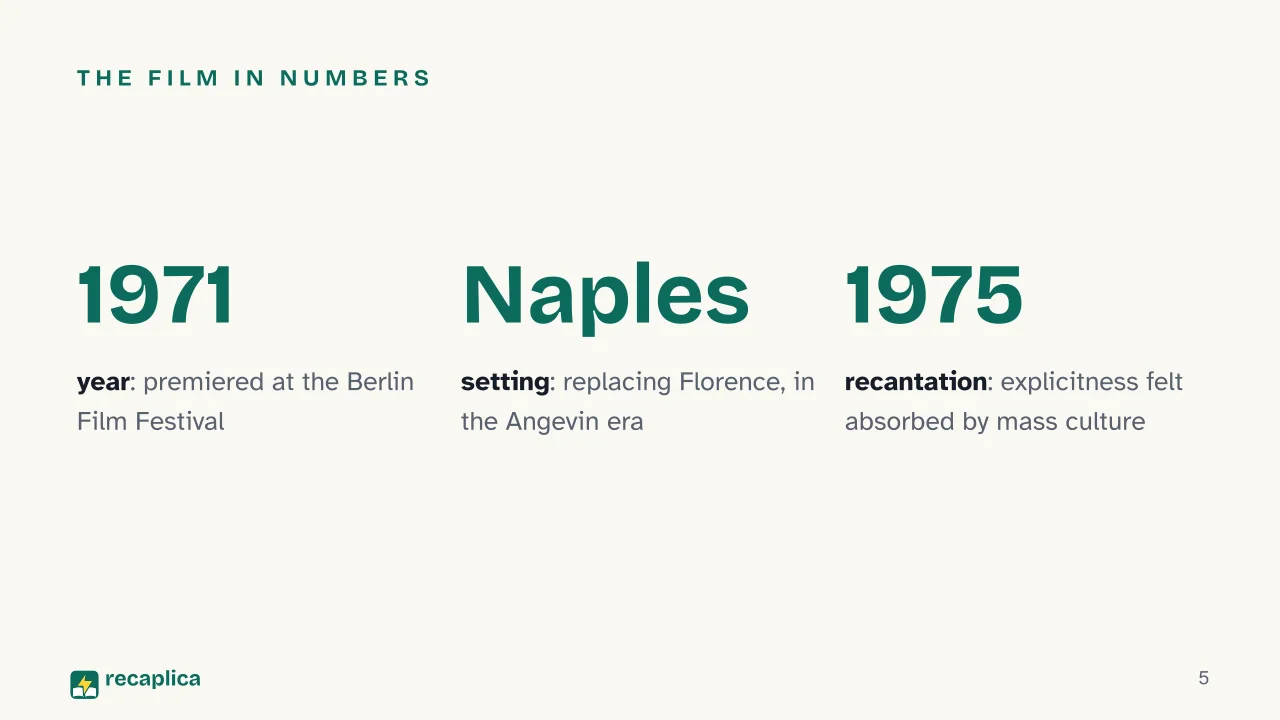
    • 1971 year of the Berlin Film Festival premiere, where the film won the Silver Bear Source: Centro Studi Pier Paolo Pasolini Casarsa della Delizia
    • 9 November 1975 date the Abiura della trilogia della vita appeared in Corriere della Sera, published posthumously; Pasolini had written it on 15 June that year Source: Centro Studi Pier Paolo Pasolini Casarsa della Delizia

    Deep Dive

    From Florence to Naples: a scaled-down project

    The Decameron came out in 1971 and won the Silver Bear at the Berlin Film Festival, where it was presented on 29 June of that year. It is the first chapter of Pier Paolo Pasolini’s Trilogy of Life.

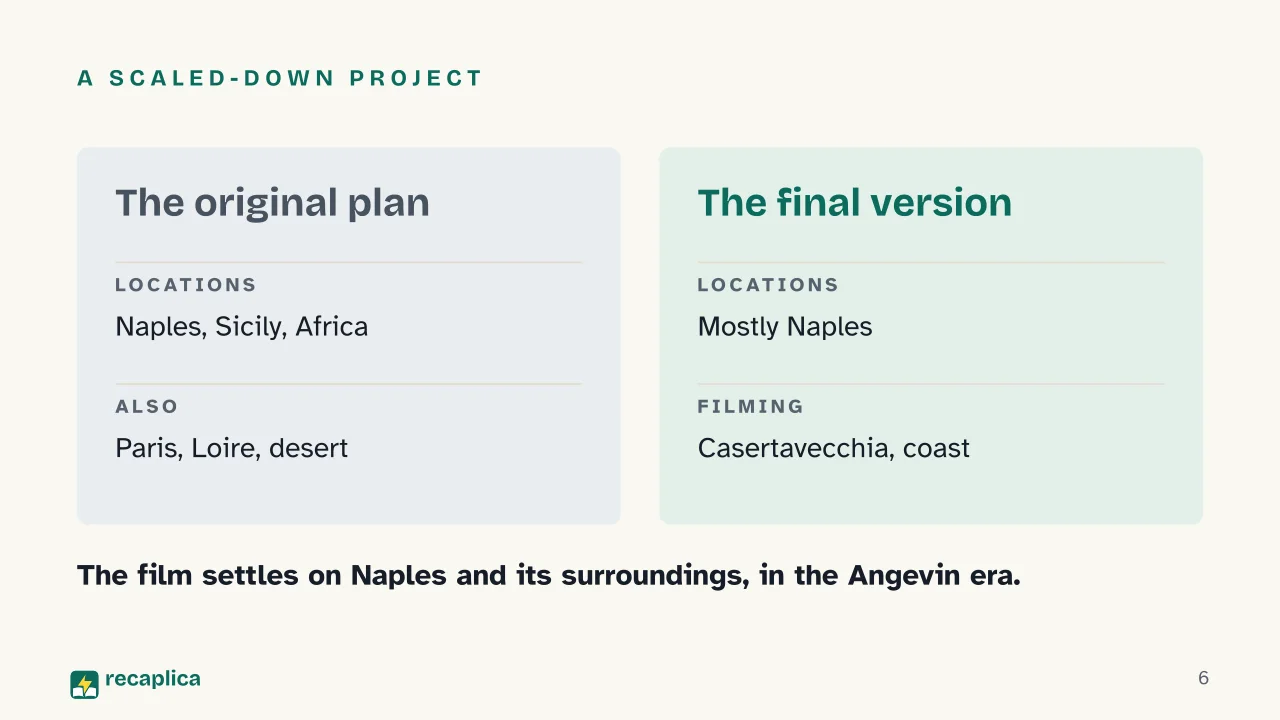
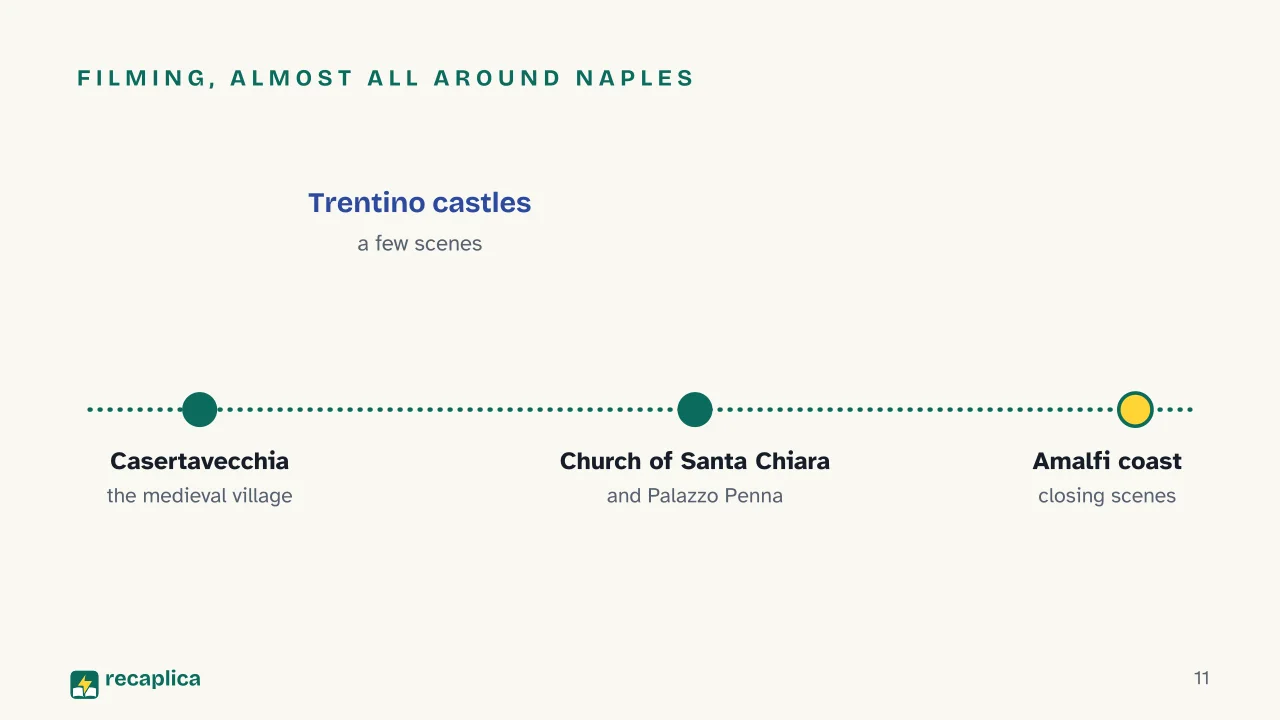
    The Centro Studi Pier Paolo Pasolini in Casarsa della Delizia describes a wider original plan than the one that reached the screen: in Pasolini’s own account, beyond Naples the film was meant to include Sicily, North Africa, Paris, the Norman castles of southern Italy, the Loire castles, and even a desert with casbahs. In the final version, that geographic ambition narrows almost entirely to Naples, in the Angevin era, with filming split between Casertavecchia, the Church of Santa Chiara, Palazzo Penna and the Amalfi coast, plus a few scenes in castles in Trentino.

    Critic Alberto Moravia, reviewing the finished film, observed that in place of the tidy order of the book’s Florence, the film gives us the crowded working-class alleys of Naples, and in place of the Tuscan countryside, the countryside of Campania. It is one of the sharpest departures from Boccaccio’s Decameron, which stays set in fourteenth-century Florence.

    The stories chosen, between Boccaccio and the screen

    Of the roughly one hundred stories that make up Boccaccio’s book, the film stages a group of around ten. Here the sources don’t fully agree on the exact number: two articles from the Centro Studi Pier Paolo Pasolini reach different totals, nine in one case and ten in the other. This Recap leaves the discrepancy open and lists the stories on which the two lists overlap.

    StoryReferenceKnown performer
    Ser CiappellettoI, 1Franco Citti
    Andreuccio da PerugiaII, 5Ninetto Davoli
    Masetto da LamporecchioIII, 1—
    Lisabetta da MessinaIV, 5—
    Caterina di ValbonaV, 4—
    Giotto’s pupilVI, 5Pier Paolo Pasolini
    PeronellaVII, 2—
    Tingoccio and MeuccioVII, 10—
    GemmataIX, 10—

    A tenth story, that of Isabetta and the abbess Usimbalda (IX, 2), appears in one of the two Centro Studi lists but not the other: it is probably the source of the nine-versus-ten discrepancy noted above.

    Cast and locations

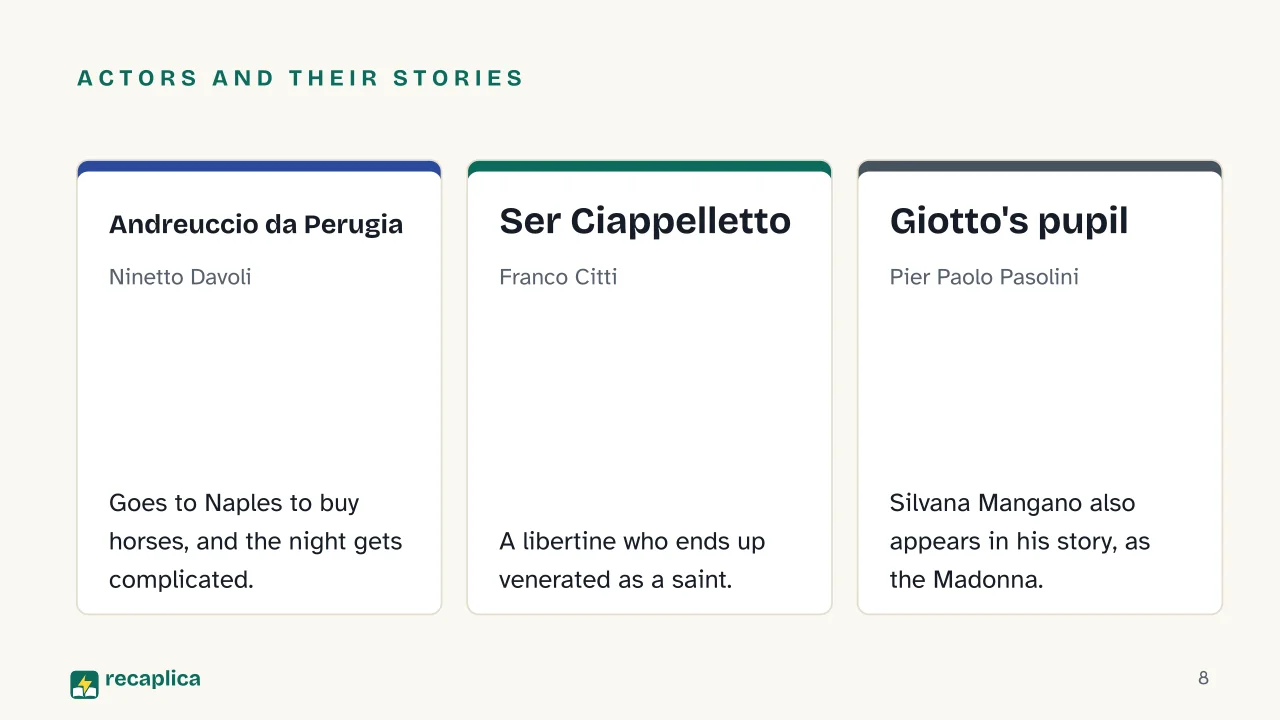
    Among the actors Pasolini chose, two names recur often in his cinema of those years: Franco Citti, who plays Ser Ciappelletto, and Ninetto Davoli, in the role of Andreuccio da Perugia.

    Real-world example: in the Andreuccio story, the protagonist arrives in Naples to buy horses and, in a single night, loses his money, comes close to ending up in a tomb in place of a corpse, and gets pulled into a jewel theft at a church. It’s the kind of picaresque tale, packed with reversals inside just a few hours, that several of the film’s stories are built on.

    Pasolini reserves a part for himself, that of Giotto’s pupil, and a dream sequence in that story also features Silvana Mangano, in the role of the Madonna. Filming centers on Casertavecchia, the Church of Santa Chiara and Palazzo Penna, with a few scenes on the Amalfi coast and in castles in Trentino: an Angevin-era Naples rebuilt for the film, far removed from the book’s Florence.

    One chapter of the Trilogy of Life

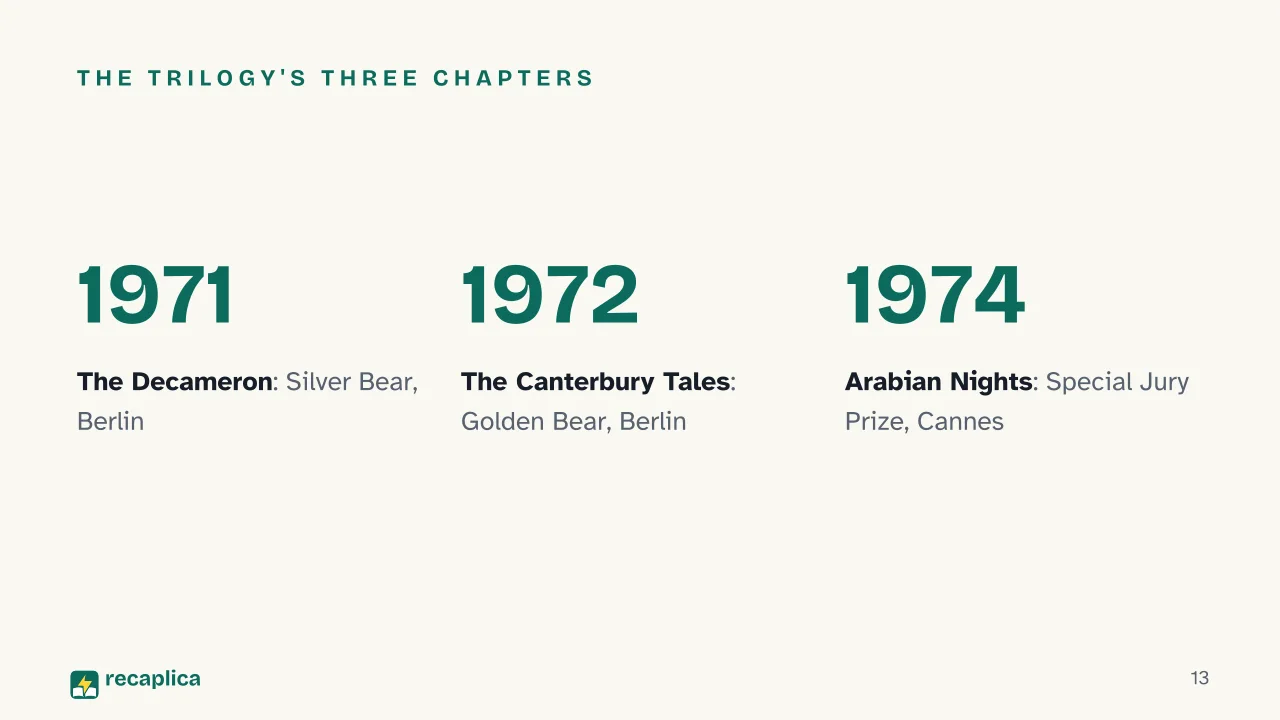
    The Decameron is the first film in what Pasolini called the Trilogy of Life, completed by The Canterbury Tales (1972, from Chaucer, Golden Bear in Berlin) and Arabian Nights (1974, from the Arabian tales, Special Jury Prize at Cannes). According to Senses of Cinema, what holds the three films together is a declared thematic thread: the celebration of life’s physicality and carnal nature.

    Boccaccio never met Dante in person: his connection to him ran only through texts, including the Divine Comedy, written in those same decades. His direct relationship, built on real meetings, was instead with Francesco Petrarch: in March 1351, Boccaccio travelled to see him in Padua.

    From success to recantation: the 1975 Abiura

    On 15 June 1975, Pasolini wrote the Abiura della trilogia della vita, a harsh self-critique of the three films that Corriere della Sera published posthumously on 9 November, a week after his death. According to Senses of Cinema, what drove him was his disillusionment at the impossibility of resisting what he called cultural massification: even the sexual explicitness with which he had once defended the films now struck him as absorbed by mass consumer culture, to the point of forcing him to retract his earlier position.

    Slide deck

    Slides ready to download and make your own in PowerPoint or Google Slides, with speaker notes. Pick the Flash cut or the Full one.
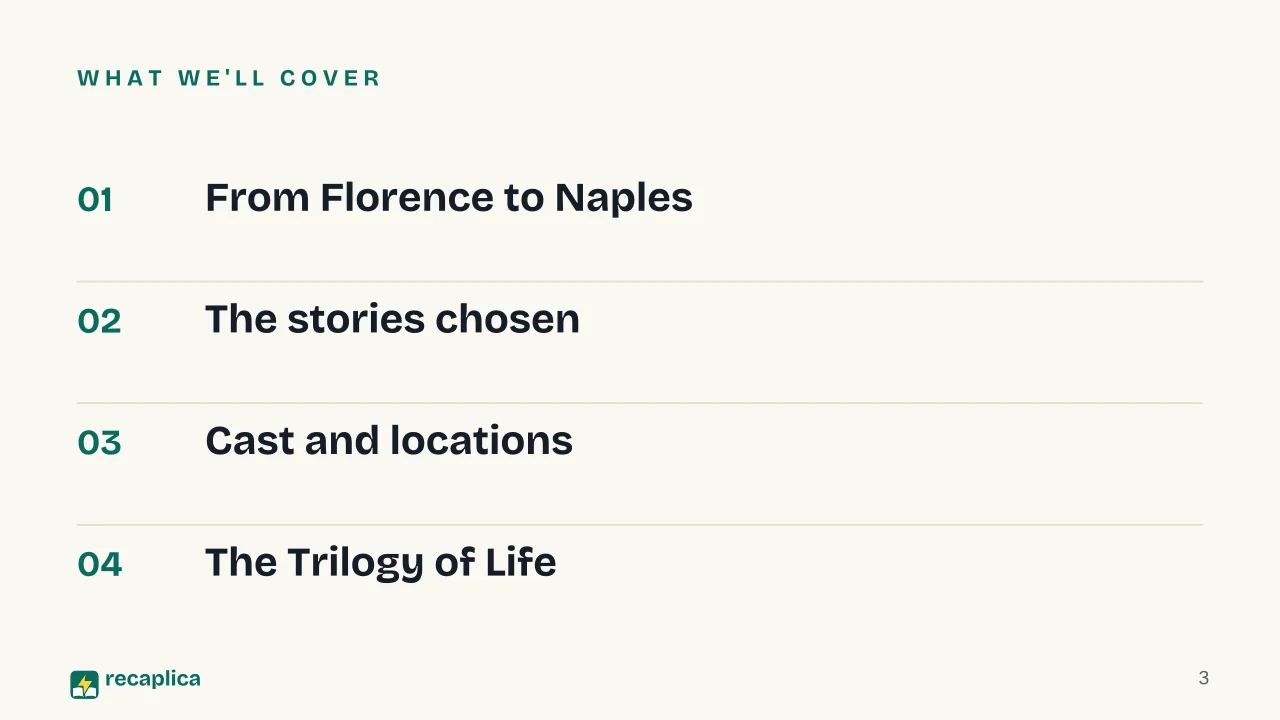
    Slide 1 of the presentation on The Decameron (1971): The Decameron (1971)Slide 2 of the presentation on The Decameron (1971): Why did Pasolini move Boccaccio's stories to Naples?Slide 3 of the presentation on The Decameron (1971): What we'll coverSlide 4 of the presentation on The Decameron (1971): Chapter 01: From Florence to NaplesSlide 5 of the presentation on The Decameron (1971): The film in numbersSlide 6 of the presentation on The Decameron (1971): A scaled-down projectSlide 7 of the presentation on The Decameron (1971): Chapter 02: The stories chosenSlide 8 of the presentation on The Decameron (1971): Actors and their stories: Andreuccio da Perugia, Ser Ciappelletto, Giotto's pupilSlide 9 of the presentation on The Decameron (1971): The exact number of chosen stories remains unclear.Slide 10 of the presentation on The Decameron (1971): Chapter 03: Cast and locationsSlide 11 of the presentation on The Decameron (1971): Filming, almost all around NaplesSlide 12 of the presentation on The Decameron (1971): Chapter 04: The Trilogy of LifeSlide 13 of the presentation on The Decameron (1971): The trilogy's three chaptersSlide 14 of the presentation on The Decameron (1971): Why did Pasolini disown his own trilogy in 1975?Slide 15 of the presentation on The Decameron (1971): In which city does Pasolini set the film?Slide 16 of the presentation on The Decameron (1971): Now, time to review
    Flash10 slidesThe essential thread, to present in classFull16 slidesEvery chapter and the deeper detail

    Common myths

    • ✗ Myth The film stages the whole of Boccaccio's Decameron, in its original setting.

      ✓ Reality Of the roughly one hundred stories in Boccaccio's book, the film selects a group of around ten, and moves the whole affair from Florence to Angevin-era Naples; it is not a full transposition of the text but a selection reworked for the screen.

    • ✗ Myth Being an adaptation of a literary classic, the film met with no controversy.

      ✓ Reality It was precisely the sexual explicitness of the three Trilogy of Life films that pushed Pasolini, in 1975, to publish a harsh self-critique, the Abiura della trilogia della vita, retracting the position he had once defended.

    • ✗ Myth The three Trilogy of Life films are simply three unrelated literary adaptations.

      ✓ Reality According to Senses of Cinema, a declared thematic thread ties them together, the celebration of life's physicality and carnal nature; they also share a structure, one narrative classic per chapter, from Boccaccio to Chaucer to the Arabian tales of the Thousand and One Nights.

    Mind map

    Drag the background to move around and the nodes to reposition them; use − and + to collapse and expand branches.
    Customize
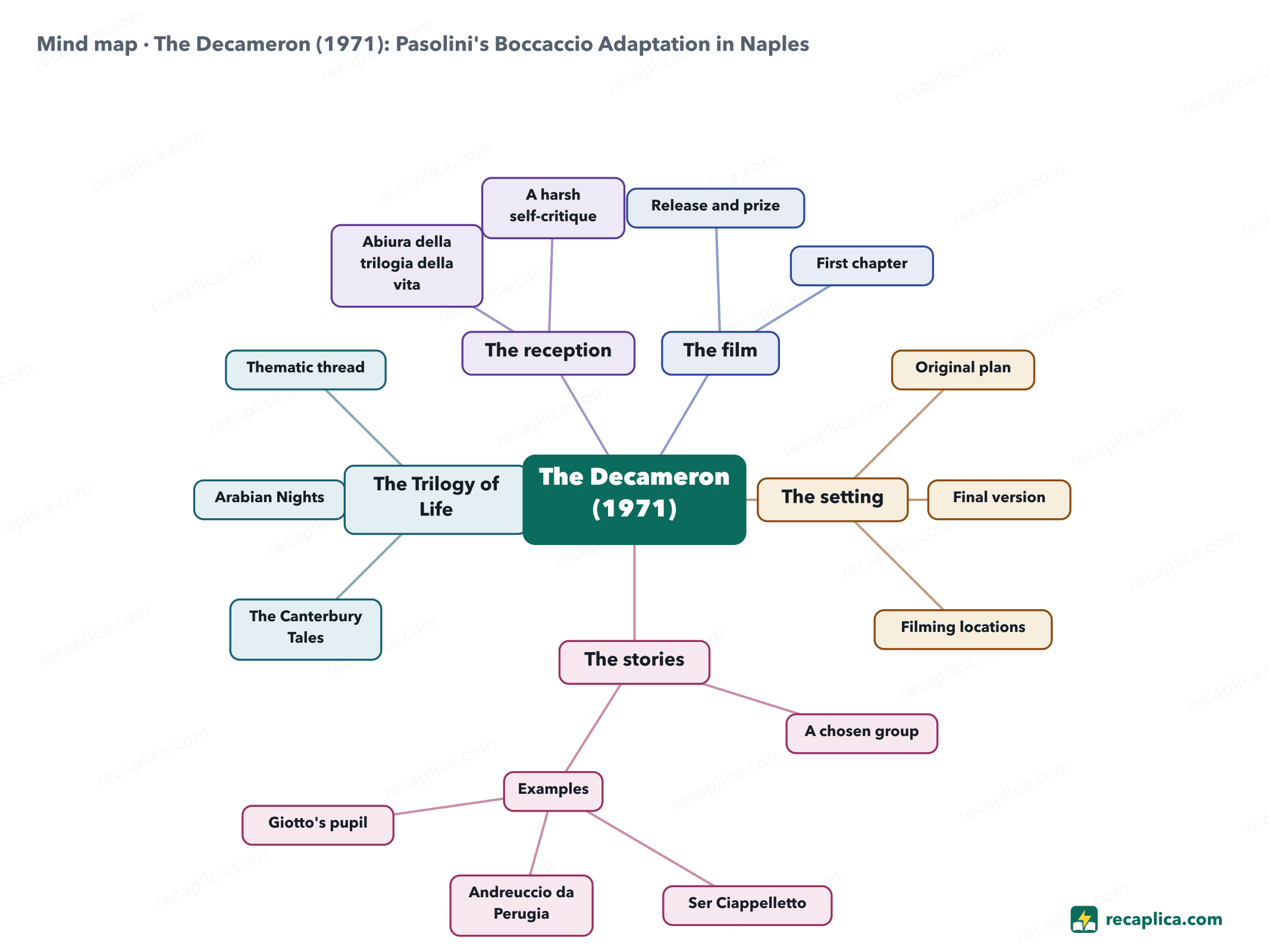
    Mind map: The Decameron (1971): Pasolini's Boccaccio Adaptation in Naples
    • The Decameron (1971)
      • The film
        • Release and prize 1971, Silver Bear at the Berlin Film Festival
        • First chapter Opens the Trilogy of Life
      • The setting
        • Original plan Naples, Sicily, North Africa, Paris, Loire castles
        • Final version Mostly Naples, in the Angevin era
        • Filming locations Casertavecchia, Church of Santa Chiara, Palazzo Penna, Amalfi coast
      • The stories
        • A chosen group About ten stories, the exact count is uncertain in the sources
        • Examples
          • Ser Ciappelletto Franco Citti
          • Andreuccio da Perugia Ninetto Davoli
          • Giotto's pupil Pier Paolo Pasolini
      • The Trilogy of Life
        • The Canterbury Tales 1972, Golden Bear in Berlin
        • Arabian Nights 1974, Special Jury Prize at Cannes
        • Thematic thread The celebration of physicality and carnal life
      • The reception
        • Abiura della trilogia della vita written 15 June 1975, published posthumously 9 November in Corriere della Sera
        • A harsh self-critique Pasolini publicly disowns the project

    Quiz: test yourself

    Answer the questions to check what you have learned: you get instant feedback and a short explanation.

    Grade 0/10 0/5
    1 In what year was The Decameron presented, and with what prize?

    The Decameron premiered at the Berlin Film Festival on 29 June 1971 and won the Silver Bear. The other prizes listed went to the other two films in the Trilogy of Life, not to The Decameron.

    2 From which city does Pasolini move the setting of Boccaccio's stories?

    The film moves the stories from Florence to Naples, in the Angevin era, with filming split between Casertavecchia, the Church of Santa Chiara, Palazzo Penna and the Amalfi coast.

    3 Which two other films complete the Trilogy of Life alongside The Decameron?

    The Canterbury Tales (1972, from Chaucer) and Arabian Nights (1974, from the Arabian tales) complete the trilogy; the other titles are also Pasolini films, but they are not part of this group.

    4 True or false: Pasolini plays a character in the film himself, a pupil of Giotto.

    True. Pasolini takes on the role of Giotto's pupil; a dream sequence in that story also features Silvana Mangano as the Madonna.

    5 Why did the Abiura della trilogia della vita, written by Pasolini, appear in 1975?

    According to Senses of Cinema, Pasolini came to believe that even the sexual explicitness of the films had been reabsorbed by mass consumer culture, defeating their intended act of cultural resistance; that conviction led him to publicly retract his position.

    Answers: 1-A · 2-A · 3-A · 4-A · 5-A

    Flashcards

    Tap the card to flip it and check whether you remember the answer, then move to the next one.

    1 / 8

    Explain it in your own words

    The ultimate test: if you can explain it in simple words, you've truly understood it. Write your explanation, then compare it with the Recap.

    Your explanation is saved only on this device.

    The Decameron is the film Pier Paolo Pasolini released in 1971, adapting a group of Giovanni Boccaccio's medieval stories and opening what he called the Trilogy of Life. Presented at the Berlin Film Festival, where it won the Silver Bear, it moves Boccaccio's tales from Florence to Angevin-era Naples. Pasolini selected nine or ten stories for the film, including Ser Ciappelletto and Andreuccio da Perugia, and cast himself as a pupil of Giotto alongside actors such as Franco Citti, Ninetto Davoli and Silvana Mangano. In June 1975, Pasolini wrote a harsh self-critique known as the Abiura, published posthumously in Corriere della Sera a week after his death, publicly disowning the project that had made him famous only a few years earlier.

    Frequently asked questions

    What is Pasolini's The Decameron?

    It is the film Pier Paolo Pasolini shot in 1971, adapting a group of Giovanni Boccaccio's stories and moving them from Florence to Angevin-era Naples. Presented at the Berlin Film Festival, it won the Silver Bear and opens the Trilogy of Life.

    How many of Boccaccio's stories does Pasolini choose for the film?

    Sources disagree. Two articles from the Centro Studi Pier Paolo Pasolini in Casarsa della Delizia give different counts, nine in one case and ten in the other; stories named on both lists include Ser Ciappelletto, Andreuccio da Perugia, Masetto da Lamporecchio, Peronella and Lisabetta da Messina.

    What is Pasolini's Trilogy of Life?

    It is the group of three films Pasolini made between 1971 and 1974, freely adapting three narrative classics, The Decameron (1971, from Boccaccio), The Canterbury Tales (1972, from Chaucer) and Arabian Nights (1974, from the Arabian tales). According to Senses of Cinema, what holds them together is a celebration of life's physicality and carnal nature.

    Why did Pasolini disown the Trilogy of Life?

    In June 1975 he wrote the Abiura della trilogia della vita, published posthumously in Corriere della Sera on 9 November. According to Senses of Cinema, he had come to believe that even the films' sexual explicitness had by then been absorbed by mass consumer culture, defeating their intended act of cultural resistance.

    Where was Pasolini's The Decameron filmed?

    Mostly in and around Naples, between Casertavecchia, the Church of Santa Chiara and Palazzo Penna, with some scenes on the Amalfi coast and in castles in Trentino. Pasolini's original plan had called for a far wider setting, spanning Sicily, North Africa, Paris and the Loire castles.

    Sources

    • Treccani, Enciclopedia del Cinema — Pier Paolo Pasolini
    • Centro Studi Pier Paolo Pasolini Casarsa della Delizia — "The Decameron According to Pasolini", by Giampiero Monetti
    • Centro Studi Pier Paolo Pasolini Casarsa della Delizia — Pasolini's Neapolitan Decameron (1971), discussed by Alberto Moravia
    • Senses of Cinema — The Canterbury Tales (an analysis of the Trilogy of Life)

    Every Recap goes through an independent review before publication.

    Every evening, the day's new Recaps on our Telegram channel. Join the channel →

    Keep learning

    • Literature Carlo Goldoni: The Playwright Who Rewrote Italian Comedy Carlo Goldoni was born in Venice in 1707 and died in Paris in 1793, after training as a lawyer in Padua and practicing law in Venice. Before him, Italian comic theater relied mostly on commedia dell'arte: unscripted scenarios and fixed stock characters such as Harlequin. Goldoni moved the genre toward fully written plays with characters drawn from real life instead of stereotypes, a shift that begins with "La donna di garbo" ("The Woman of Good Sense") and spreads through his work in the 1750s. The change happened gradually: some transitional plays kept only three or four fully scripted scenes per act, with the rest still improvised. Read the Recap →
    • Literature Torquato Tasso: The Poet Behind Jerusalem Delivered Torquato Tasso was born in Sorrento in 1544 and died in Rome in 1595, having spent most of his adult life at the Este court in Ferrara. His masterwork is Jerusalem Delivered, a twenty-canto poem about the First Crusade and the fall of Jerusalem, published in its final form in 1581 after more than two decades of work. The story follows Godfrey of Bouillon as he leads the Christian army, but it keeps breaking away into private tales of love and duty: the knight Tancred, the sorceress Armida, the paladin Rinaldo. In 1593 Tasso issued a stricter revision titled Jerusalem Conquered, which never won over readers the way the original did. Read the Recap →
    • Literature Orlando Furioso: Plot, Characters and Summary Orlando Furioso is the chivalric romance that Ludovico Ariosto first publishes in 1516 and brings to its final shape in 1532, in forty-six cantos. It follows knights and ladies at the court of Charlemagne, and centers on the paladin Orlando, who loses his mind for love of Angelica — the source of the poem's title. Ariosto writes in ottava rima, the eight-line stanza typical of Italian narrative poetry, and takes as his starting point the unfinished Orlando Innamorato by Matteo Maria Boiardo. Read the Recap →

    recaplica

    Clear in 30 seconds, yours in 10 minutes.

    Recaps Mind maps Request a Recap Telegram channel Mind map maker Our method About Privacy & cookies Legal notes & terms of use

    © 2026 Recaplica · A project by Curi S.r.l. — VAT IT05472000750

    Statistics, only if you say so

    To learn which Recaps help most we would use Google Analytics, with aggregate, anonymous data. It starts only with your OK, and you can change your mind anytime. Privacy policy