Skip to content
recaplica

    One moment: security check

    Cloudflare wants to make sure you're not a robot. Tick the box below and your search will continue on its own.

    IT
    recaplica Giovanni Verga and Verismo: Life, Works and Key Traits
    © 2026 Recaplica · recaplica.com — All rights reserved
    Home › Literature

    Giovanni Verga and Verismo: Life, Works and Key Traits

    By Recaplica Newsroom · Updated on September 16, 2026

    What to print

    Page numbers appear when printing with default margins.

    Slides

    Choose a cut

    Flash10 slidesThe essential thread, to present in classFull16 slidesEvery chapter and the deeper detail

    Both come with speaker notes.

    Telegram channel
    recaplica Clear in 30 seconds, yours in 10 minutes.
    In 30 seconds Key points Figures Deep dive Slides Myths Mind map Quiz Flashcards FAQ

    In 30 seconds quick read

    Giovanni Verga was born in Catania on 2 September 1840, the son of landowner Giovanni Battista Verga, and died in the same city on 27 January 1922. He is the central figure of Verismo, the Italian literary movement that between 1875 and the early 1900s depicted rural Sicily and the working poor through a method that erases the author's voice from the page. His best-known novel, I Malavoglia (1881), met a cold reception from critics at the time, while Mastro-don Gesualdo (1889) fared far better; both were meant to belong to a larger project, the Cycle of the Vanquished, announced in 1878 and never finished. Verga developed these techniques alongside his friend Luigi Capuana, whom he met in Milan after being struck by Émile Zola's novel L'Assommoir.

    Key Points

    • Born in Catania on 2 September 1840, died in the same city on 27 January 1922 of a cerebral thrombosis; appointed senator of the Kingdom in 1920.
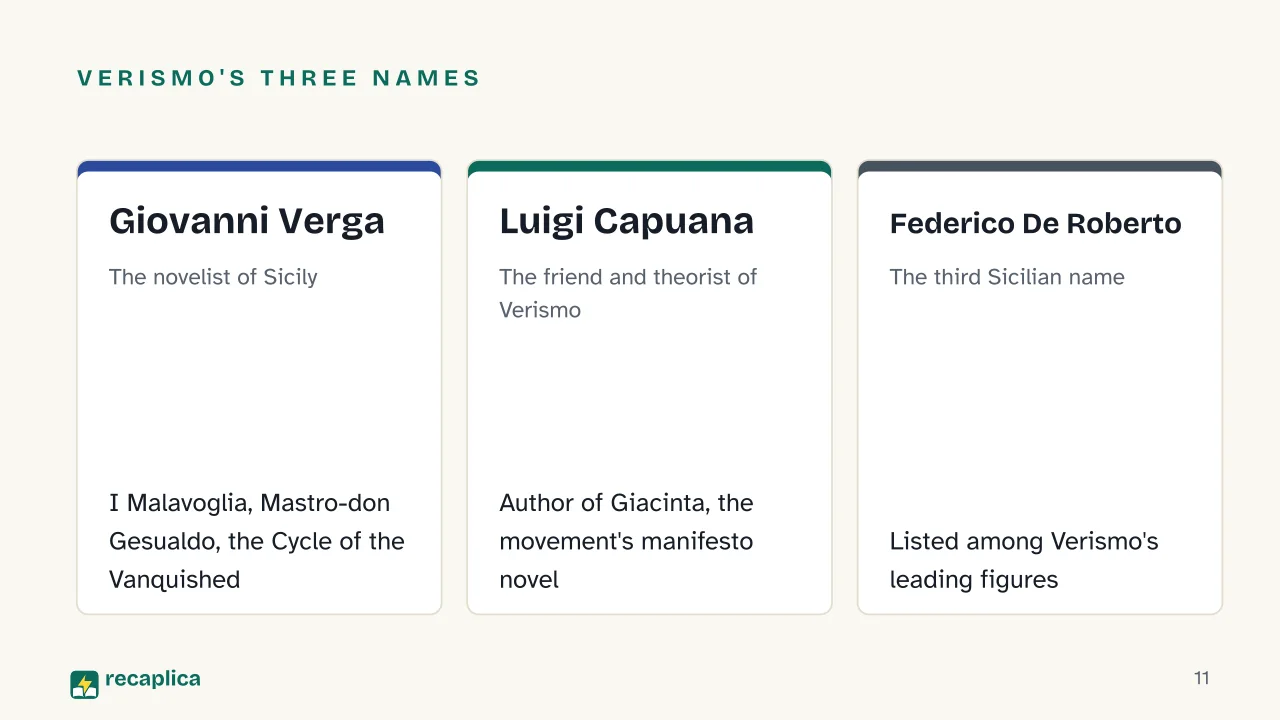
    • Verismo is the Italian literary movement that, between 1875 and the early 1900s, portrayed Sicily and the working poor through an impersonal method: three Sicilian writers led it, Verga, Luigi Capuana (author of Giacinta, the movement's manifesto novel) and Federico De Roberto.
    • I Malavoglia (1881) met a cold critical reception, while Mastro-don Gesualdo (1889) was received far more warmly; both were meant to belong to the Cycle of the Vanquished, announced in 1878 as a five-novel series and left unfinished.
    • Impersonality and free indirect discourse dissolve the author's voice into the point of view of Sicilian fishermen and peasants, using syntax that mimics the irregular rhythms of dialect speech.
    • Verga and Capuana took Émile Zola's L'Assommoir (1877) as a model, yet Verismo departs from French Naturalism by rejecting its scientific claims and by favouring rural, provincial life over the urban working-class settings Zola preferred.
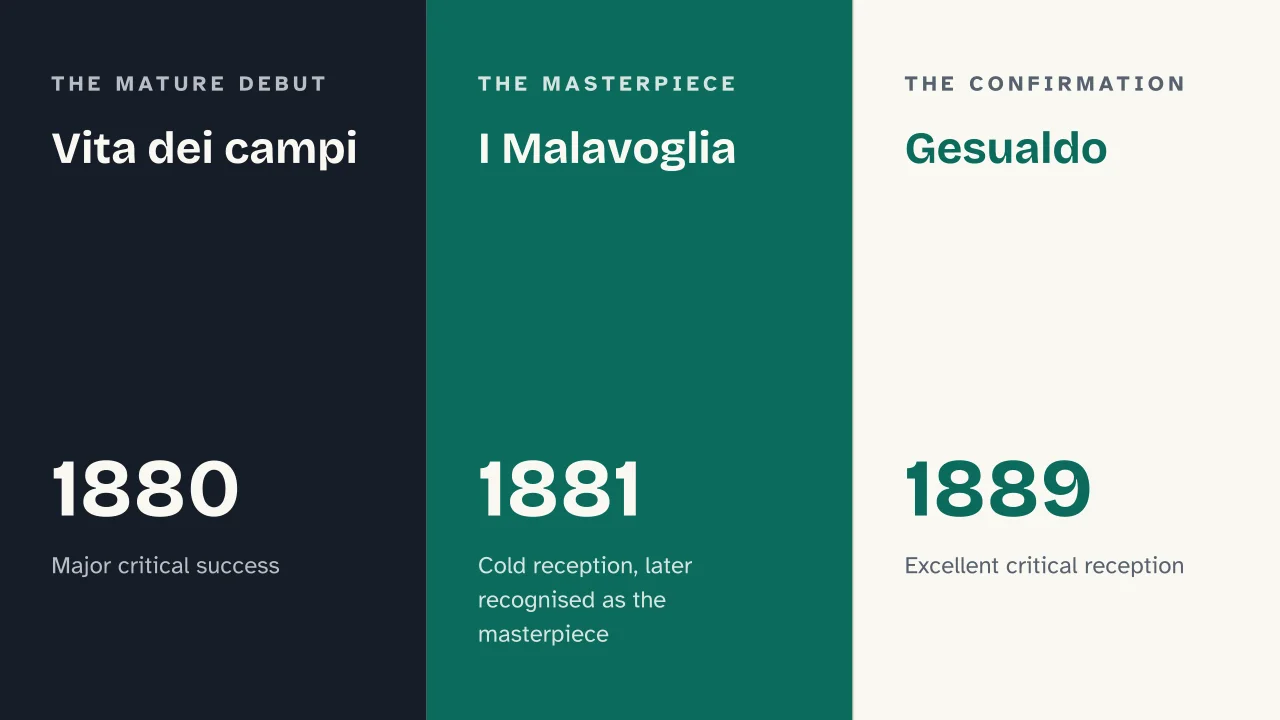
    • Vita dei campi (1880), which contains Rosso Malpelo, Cavalleria rusticana and La lupa, was a major critical success; Novelle rusticane (1883) instead portrays the "cult of property" and the unresolved tensions of Sicily after Italian unification.

    Key figures

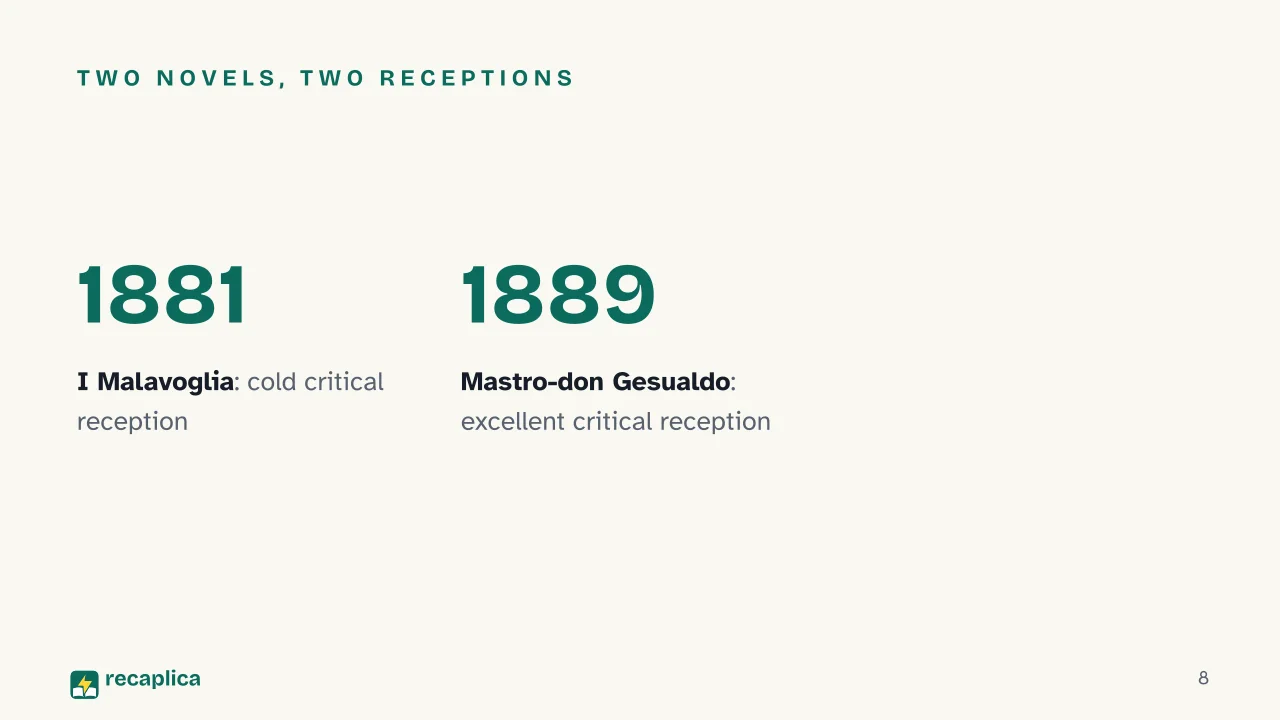
    • 1881 the year I Malavoglia was published, met with a cold critical reception at the time, with the exception of Luigi Capuana Source: Treccani, Dizionario Biografico degli Italiani
    • 1889 the year of Mastro-don Gesualdo, the Cycle of the Vanquished novel that instead received an excellent critical reception Source: Treccani, Dizionario Biografico degli Italiani
    • 1877 the year Verga and Capuana, both then settled in Milan, were struck by Émile Zola's L'Assommoir and adopted it as a model Source: Wikipedia (EN), Giovanni Verga entry

    Deep Dive

    A life between Sicily and the mainland

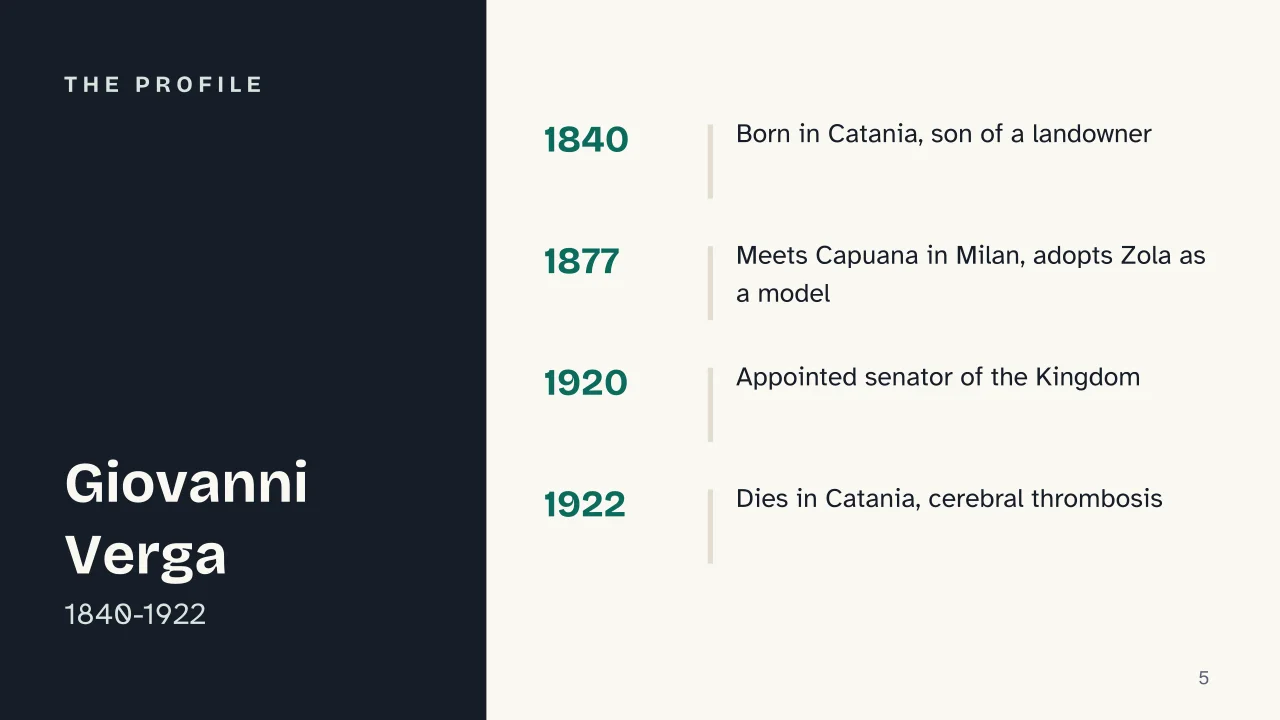
    Giovanni Verga was born in Catania on 2 September 1840, the son of landowner Giovanni Battista Verga. He studied law at the University of Catania between 1860 and 1865, after a private education in the years before. He then moved to Florence, where he lived from 1865 to 1870, and finally to Milan, where he stayed until 1885: these were the years in which he matured as a writer and formed the most important friendship of his life, with Luigi Capuana.

    Back in Sicily, Verga was appointed senator of the Kingdom in 1920. He died in Catania on 27 January 1922, in the house where he was born, on Via Sant’Anna, of a cerebral thrombosis.

    The early years and the Milan period

    Verga’s first novels, written when he was very young, remain minor works: Amore e patria (1856-57), identified by the Treccani Dizionario Biografico as his first novel, and I carbonari della montagna (1861-62), published at the author’s own expense. Una peccatrice followed in 1866, written in Florence, along with the epistolary novel Storia di una capinera (1870-71). Eva (1873) marks, according to Treccani, the real turning point toward Verga’s mature fiction. That same year, 1875, produced Tigre reale and Eros, works tied to the Milanese Scapigliatura movement, which, per the English Wikipedia, set the false, cynical life of the urban upper classes against the virtues of family life.

    At the end of 1877, the Sicilian writer and critic Luigi Capuana settled in Milan and became, from that point on, Verga’s closest friend. Both men were struck by L’Assommoir, the novel Émile Zola published that same year, and decided to take it as a model for their own narrative project.

    What Verismo is

    Verismo is the Italian literary movement that, between 1875 and the early 1900s, portrayed post-unification Italy through a method rooted in the era’s positivist climate, a broad faith in science, empirical observation and research. Its name comes from the Italian word for “true.” Three Sicilian writers are credited as its leading figures: Giovanni Verga, Luigi Capuana (author of Giacinta, considered the movement’s manifesto novel) and Federico De Roberto; other names linked to the movement include Matilde Serao, Grazia Deledda and, in one phase of his career, Gabriele D’Annunzio.

    The movement rests on four core principles: an impersonal form of narration; language and style suited to the subject at hand; a study of modern Italy across all its social classes; and a method built on environmental analysis, modelled on scientific inquiry. The Recap on the industrial revolution covers the economic and social upheaval that forms the backdrop to Verismo’s stories of rural poverty. Treccani’s biography describes Verga’s project as a search for “the new prose of a unified Italy,” pursued through a realistic study of Sicily, a world the source describes as worse off, if anything, after unification.

    Verismo versus French Naturalism

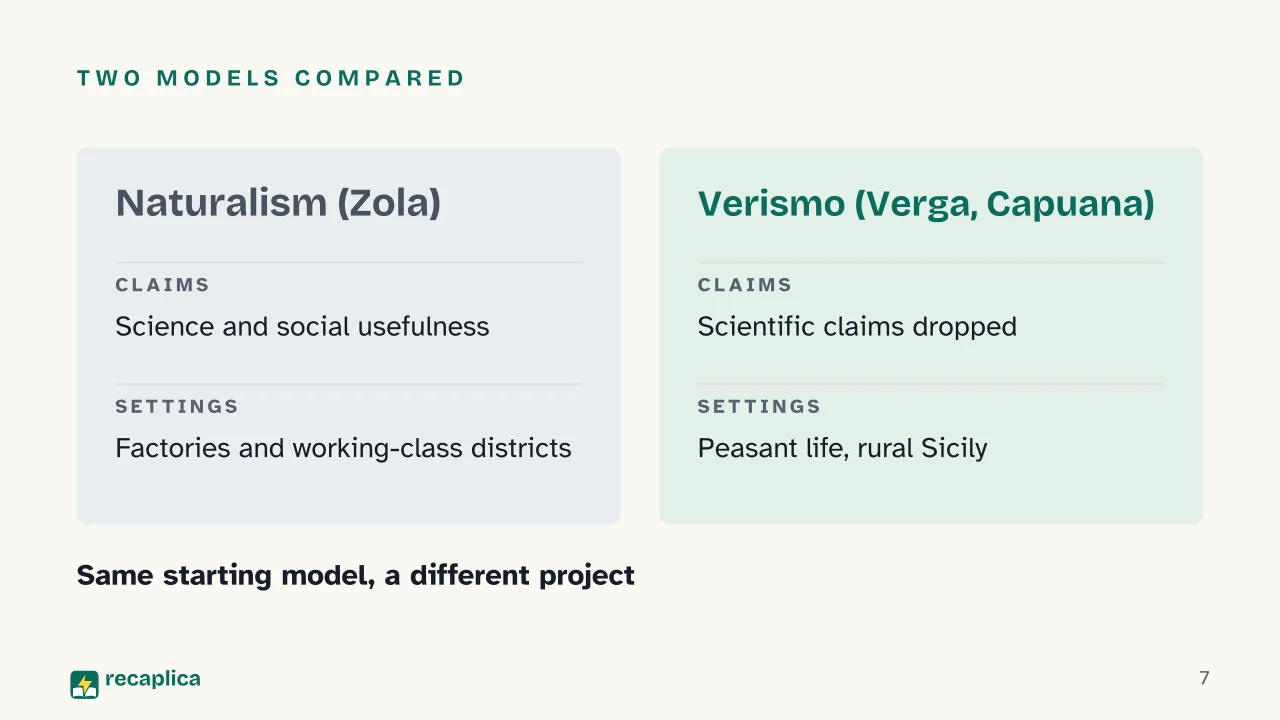
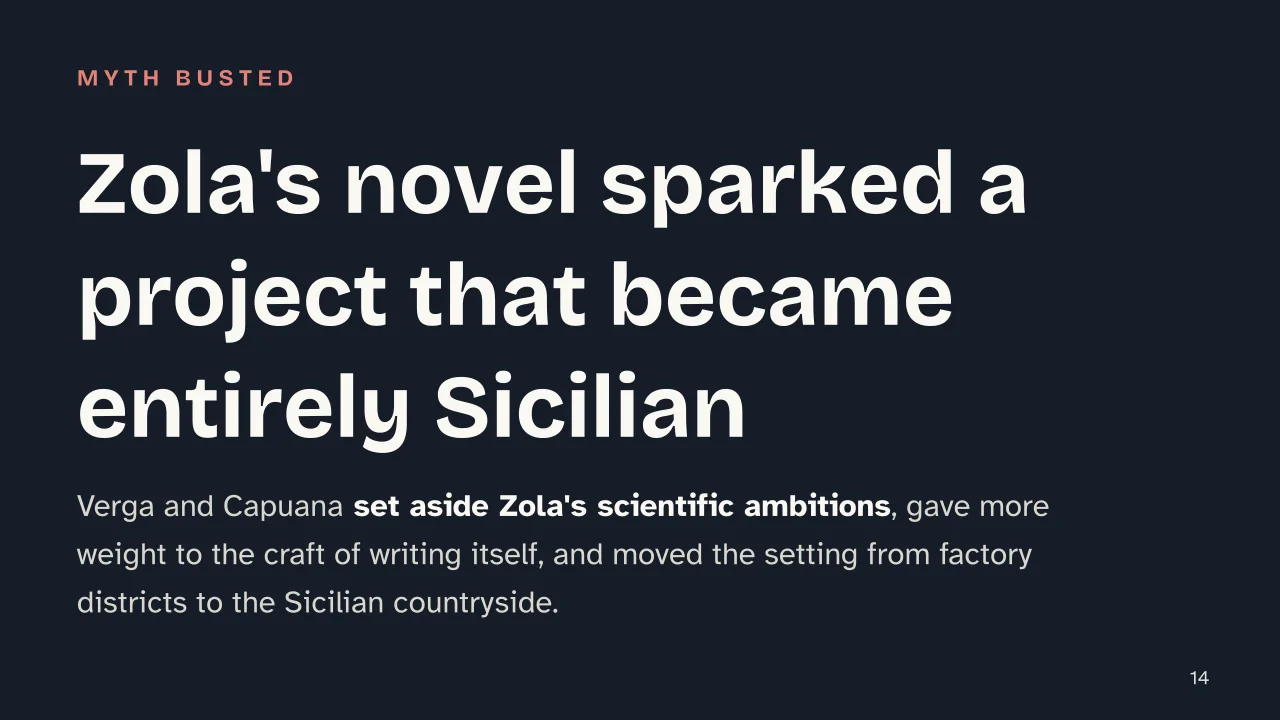
    Verga’s debt to Zola is well documented: L’Assommoir was adopted as a model in 1877. But what grew out of it took a different direction from French Naturalism. Verga and Capuana rejected the scientific claims and the social purpose that Zola’s movement asserted for itself, put more weight on the craft of the writing, and chose rural, provincial life over the big-city working-class settings of Naturalism.

    AspectFrench Naturalism (Zola)Italian Verismo (Verga, Capuana)
    Claims madeScientific method and social usefulness assertedScientific claims rejected
    SettingUrban working-class districtsRural, provincial life, above all Sicily
    Main emphasisOn the objectivity of the methodOn the style of the writing
    Declared model—Zola’s L’Assommoir (1877), adopted by Verga and Capuana

    A closer look: the preface letter to L’amante di Gramigna is, according to the Treccani Dizionario Biografico, the text of central importance for Verga’s theory of impersonality: it is where he explains why the narrator’s voice has to stay out of the story.

    Impersonality and free indirect discourse

    Impersonality is the technique underpinning Verga’s mature fiction: the author vanishes, and the story appears to tell itself through the characters’ own point of view. To achieve it, Verga worked the language on two levels. On one, he adopted free indirect discourse, built from long, winding sentences, sparse and irregular punctuation, and coordination that Treccani calls “alogical,” detached from the logic of formal written prose. On the other, he made the syntax itself dialectal, borrowing the loose, irrational connectives of spoken language, the famous run-on “che” clauses that mark his best-known pages: the goal, according to Encyclopedia.com, was an “invisible author,” achieved by blending written language with spoken dialect.

    The result is a choral narration, one that adopts the point of view of the community of fishermen and peasants whose stories it tells, instead of that of an outside, all-knowing narrator. This same attention to spoken syntax is the thread picked up in the Recap on Italian dialects, on how oral language finds its way onto the page. A reader following two fishermen talking in I Malavoglia, or watching a peasant family fall apart, never finds a moral aside steering the interpretation: whatever judgement exists rises out of the facts themselves.

    The Cycle of the Vanquished, a project left unfinished

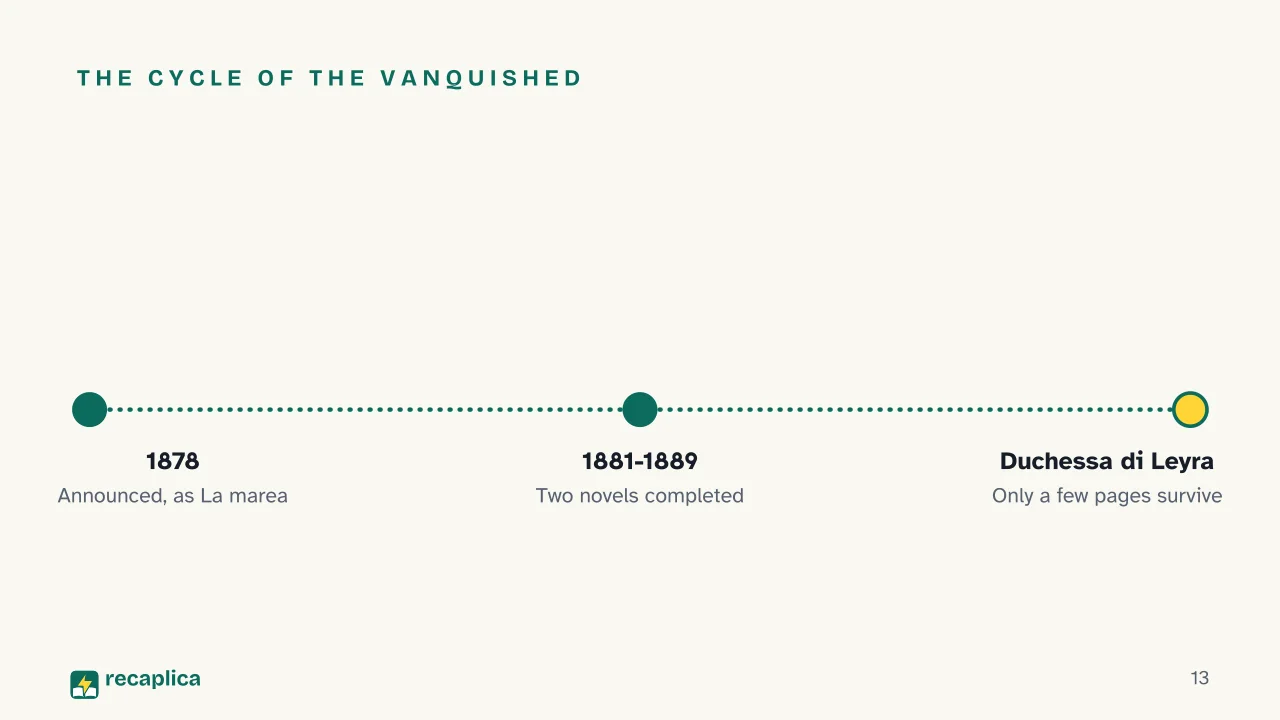
    On 21 April 1878, Verga announced a narrative project he called La marea, later renamed the Cycle of the Vanquished. The planned series comprised five novels: I Malavoglia, Mastro-don Gesualdo, La duchessa delle Gargantas, L’onorevole Scipioni and L’uomo di lusso. Of these, Verga completed only two, I Malavoglia (1881) and Mastro-don Gesualdo (1889); of La duchessa di Leyra, according to Treccani, only a few opening pages survive.

    I Malavoglia met a cold reception from critics on publication, with the exception of Luigi Capuana. It was translated into English as The House by the Medlar Tree in 1890, and later again by D.H. Lawrence. Mastro-don Gesualdo, published eight years later, received an excellent reception from the start.

    The other major works

    Before and after the two Cycle of the Vanquished novels, Verga published some of the works still most read in Italian schools. Vita dei campi (1880) was a major success and gathers stories including Rosso Malpelo, Cavalleria rusticana and La lupa. This same ground, of a newly unified Italy struggling to become a shared nation, is also covered in the Recap on Alessandro Manzoni and The Betrothed, the novel that had first sought a common language and prose for the country. Novelle rusticane (1883, published in Turin by Casanova) portrays what Treccani calls the “cult of property,” an obsession with land and ownership that, in Sicily after Italian unification, was bound up with a marginalisation still unresolved: the same source describes these stories as clarifying “the misunderstanding of the Risorgimento,” showing how religion, justice, politics and the economy remained open problems in post-unification Sicily.

    Verga’s legacy

    The English Wikipedia calls Verga the greatest Italian novelist after Manzoni, a critical judgement rather than a settled fact, but one that conveys the weight of his work. Verismo’s techniques shaped Luigi Pirandello in particular, as well as the writer Federigo Tozzi, and later, more markedly, Italian Neorealism, the film and literary movement that between 1943 and 1955 returned to depicting ordinary Italian life with an unmediated look at the facts.

    Slide deck

    Slides ready to download and make your own in PowerPoint or Google Slides, with speaker notes. Pick the Flash cut or the Full one.
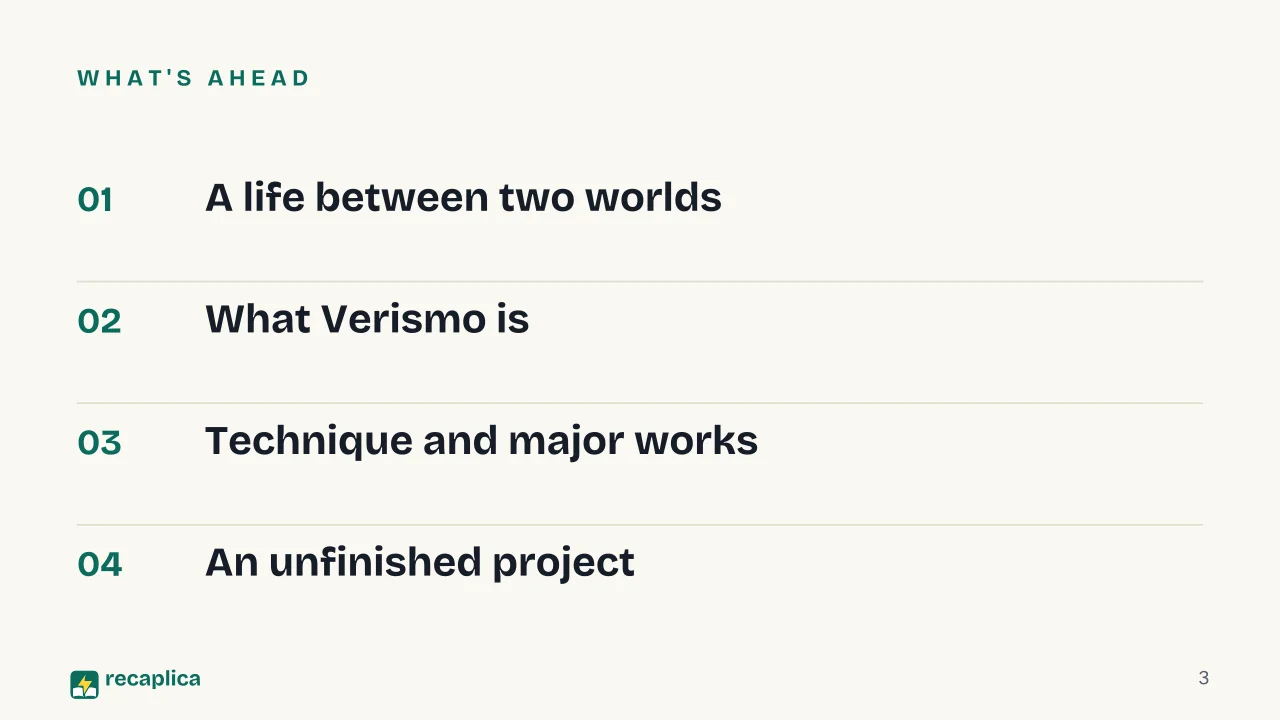
    Slide 1 of the presentation on Giovanni Verga and Verismo: Giovanni Verga and VerismoSlide 2 of the presentation on Giovanni Verga and Verismo: Take the author out. Who is left telling the story?Slide 3 of the presentation on Giovanni Verga and Verismo: What's aheadSlide 4 of the presentation on Giovanni Verga and Verismo: Chapter 01: A life between two worldsSlide 5 of the presentation on Giovanni Verga and Verismo: The profileSlide 6 of the presentation on Giovanni Verga and Verismo: Chapter 02: What Verismo isSlide 7 of the presentation on Giovanni Verga and Verismo: Two models comparedSlide 8 of the presentation on Giovanni Verga and Verismo: Two novels, two receptionsSlide 9 of the presentation on Giovanni Verga and Verismo: Chapter 03: Technique and major worksSlide 10 of the presentation on Giovanni Verga and Verismo: Vita dei campi · I Malavoglia · GesualdoSlide 11 of the presentation on Giovanni Verga and Verismo: Verismo's three names: Giovanni Verga, Luigi Capuana, Federico De RobertoSlide 12 of the presentation on Giovanni Verga and Verismo: Chapter 04: An unfinished projectSlide 13 of the presentation on Giovanni Verga and Verismo: The Cycle of the VanquishedSlide 14 of the presentation on Giovanni Verga and Verismo: Zola's novel sparked a project that became entirely SicilianSlide 15 of the presentation on Giovanni Verga and Verismo: In what year was Giovanni Verga born?Slide 16 of the presentation on Giovanni Verga and Verismo: Read more
    Flash10 slidesThe essential thread, to present in classFull16 slidesEvery chapter and the deeper detail

    Common myths

    • ✗ Myth Verga's Verismo is just the Italian name for Zola's French Naturalism, the same thing under a different label.

      ✓ Reality The debt to Zola is real; Verga and Capuana took his L'Assommoir as a model in 1877. But what they built was a different project. The two Sicilian writers dropped Naturalism's scientific claims and social ambitions, put more weight on the style of the writing itself, and shifted the setting from urban factory workers to peasants and fishermen in the provinces.

    • ✗ Myth A Verista author disappears from the text, so Verga simply photographs reality without shaping it.

      ✓ Reality Impersonality is a constructed technique, not an absence. Verga worked the syntax deliberately, long sentences, irregular coordination, the loose connectives of dialect speech, and free indirect discourse, to make the story seem to tell itself; the preface letter to L'amante di Gramigna sets out exactly this method. Behind the "absent" narrator sits a precise stylistic choice.

    • ✗ Myth I Malavoglia was an instant success, as you would expect from Verga's masterpiece.

      ✓ Reality According to the Treccani Dizionario Biografico, the novel met a cold reception from critics in 1881, with the exception of Capuana. Wider recognition came only later, while Mastro-don Gesualdo, eight years on, was received far more warmly from the start.

    Mind map

    Drag the background to move around and the nodes to reposition them; use − and + to collapse and expand branches.
    Customize
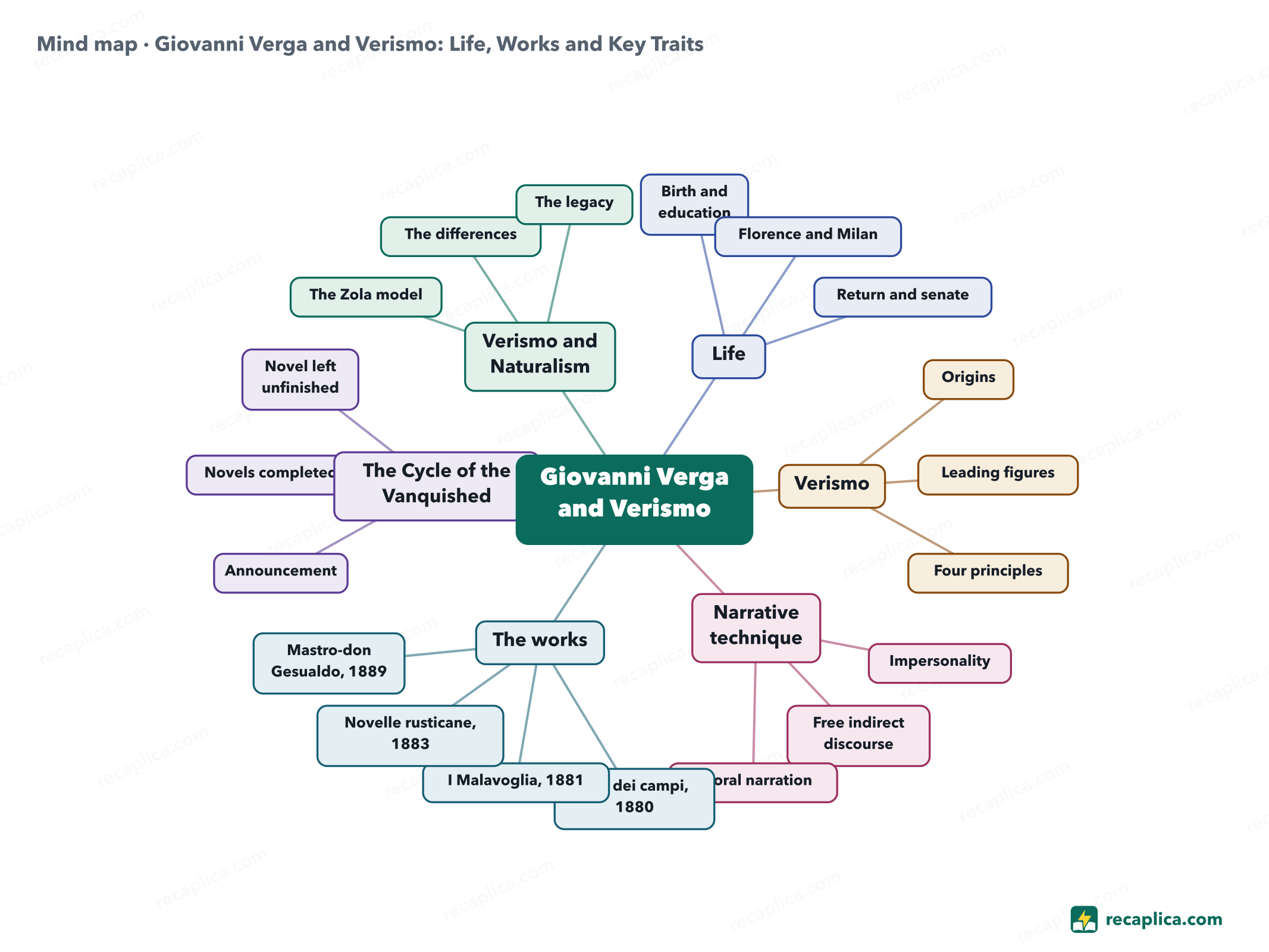
    Mind map: Giovanni Verga and Verismo: Life, Works and Key Traits
    • Giovanni Verga and Verismo
      • Life From Catania to Milan and back
        • Birth and education Catania 1840, law studies
        • Florence and Milan 1865-1885, meeting Capuana
        • Return and senate Senator in 1920, died 1922
      • Verismo Literary movement, 1875 to the early 1900s
        • Origins Out of positivism, the word "vero"
        • Leading figures Verga, Capuana, De Roberto
        • Four principles Impersonal form, style, all classes, scientific method
      • Narrative technique How the author disappears
        • Impersonality Set out in L'amante di Gramigna
        • Free indirect discourse Long sentences, dialect syntax
        • Choral narration Fishermen and peasants' point of view
      • The works From success to coldness, and back
        • Vita dei campi, 1880 Major critical success
        • I Malavoglia, 1881 Cold reception
        • Novelle rusticane, 1883 The cult of property
        • Mastro-don Gesualdo, 1889 Excellent reception
      • The Cycle of the Vanquished Five novels announced in 1878
        • Announcement 21 April 1878, La marea
        • Novels completed I Malavoglia, Mastro-don Gesualdo
        • Novel left unfinished La duchessa di Leyra, a few pages
      • Verismo and Naturalism Same model, different projects
        • The Zola model L'Assommoir, 1877
        • The differences No scientific claims, more style
        • The legacy Pirandello, Tozzi, Neorealism

    Quiz: test yourself

    Answer the questions to check what you have learned: you get instant feedback and a short explanation.

    Grade 0/10 0/5
    1 In what year was Giovanni Verga born?

    Verga was born in Catania on 2 September 1840, the son of landowner Giovanni Battista Verga; he died in the same city on 27 January 1922.

    2 Which 1877 novel did Verga and Capuana take as a model for their narrative project?

    Verga and Capuana, both then settled in Milan, were struck by Zola's L'Assommoir, published in 1877, and decided to take it as a model for their own project.

    3 True or false: Verismo shared French Naturalism's scientific and social claims about literature.

    Verga and Capuana set those claims aside, focusing on style rather than the presumed scientific objectivity of Zola's method, and turned to rural, provincial life rather than the urban working-class settings typical of Naturalism.

    4 Which Cycle of the Vanquished novel, according to the Treccani Dizionario Biografico, received an excellent critical reception?

    Mastro-don Gesualdo, published in 1889, received an excellent critical reception; I Malavoglia, eight years earlier, had instead been met with coldness.

    5 What is the "free indirect discourse" Verga used?

    It blends written language with the rhythms of dialect speech, using long sentences and irregular coordination, so the story appears to unfold straight from the viewpoint of fishermen and peasants.

    Answers: 1-B · 2-B · 3-B · 4-B · 5-B

    Flashcards

    Tap the card to flip it and check whether you remember the answer, then move to the next one.

    1 / 8

    Explain it in your own words

    The ultimate test: if you can explain it in simple words, you've truly understood it. Write your explanation, then compare it with the Recap.

    Your explanation is saved only on this device.

    Giovanni Verga was born in Catania on 2 September 1840, the son of landowner Giovanni Battista Verga, and died in the same city on 27 January 1922. He is the central figure of Verismo, the Italian literary movement that between 1875 and the early 1900s depicted rural Sicily and the working poor through a method that erases the author's voice from the page. His best-known novel, I Malavoglia (1881), met a cold reception from critics at the time, while Mastro-don Gesualdo (1889) fared far better; both were meant to belong to a larger project, the Cycle of the Vanquished, announced in 1878 and never finished. Verga developed these techniques alongside his friend Luigi Capuana, whom he met in Milan after being struck by Émile Zola's novel L'Assommoir.

    Frequently asked questions

    Why is Verga considered the leading figure of Verismo?

    Because he was, alongside Luigi Capuana, one of the two most influential figures behind the movement, and because his novels, especially I Malavoglia (1881) and Mastro-don Gesualdo (1889), put the techniques of impersonality and free indirect discourse into full practice.

    What is the difference between Verismo and French Naturalism?

    Zola's Naturalism claimed a scientific method and a social purpose for literature, and focused mainly on urban working-class settings; Verga and Capuana set those scientific claims aside, leaned more heavily on style, and set their stories in rural, provincial life, above all in Sicily.

    What was the Cycle of the Vanquished, and why was it left unfinished?

    It was the five-novel series Verga announced in 1878 (I Malavoglia, Mastro-don Gesualdo, La duchessa delle Gargantas, L'onorevole Scipioni, L'uomo di lusso); Verga completed only the first two, while just a few opening pages survive of La duchessa di Leyra.

    What are Giovanni Verga's major works?

    Among the most important are Vita dei campi (1880, containing Rosso Malpelo, Cavalleria rusticana and La lupa), I Malavoglia (1881), Novelle rusticane (1883) and Mastro-don Gesualdo (1889), alongside earlier works such as Storia di una capinera (1870-71) and Eva (1873), which Treccani identifies as the turning point toward his mature fiction.

    What is impersonality in a Verga novel?

    It is the choice to remove the author's voice and judgement from the story, so events seem to narrate themselves through the characters' own point of view, using syntax that mirrors dialect speech, as Verga explains in the preface letter to L'amante di Gramigna.

    Sources

    • VERGA, Giovanni - Dizionario Biografico degli Italiani, Treccani
    • Verga, Giovanni - Encyclopedia.com
    • Giovanni Verga - Wikipedia (EN)
    • Verismo (literature) - Wikipedia (EN)

    Every Recap goes through an independent review before publication.

    Every evening, the day's new Recaps on our Telegram channel. Join the channel →

    Keep learning

    • Literature Carlo Goldoni: The Playwright Who Rewrote Italian Comedy Carlo Goldoni was born in Venice in 1707 and died in Paris in 1793, after training as a lawyer in Padua and practicing law in Venice. Before him, Italian comic theater relied mostly on commedia dell'arte: unscripted scenarios and fixed stock characters such as Harlequin. Goldoni moved the genre toward fully written plays with characters drawn from real life instead of stereotypes, a shift that begins with "La donna di garbo" ("The Woman of Good Sense") and spreads through his work in the 1750s. The change happened gradually: some transitional plays kept only three or four fully scripted scenes per act, with the rest still improvised. Read the Recap →
    • Literature Torquato Tasso: The Poet Behind Jerusalem Delivered Torquato Tasso was born in Sorrento in 1544 and died in Rome in 1595, having spent most of his adult life at the Este court in Ferrara. His masterwork is Jerusalem Delivered, a twenty-canto poem about the First Crusade and the fall of Jerusalem, published in its final form in 1581 after more than two decades of work. The story follows Godfrey of Bouillon as he leads the Christian army, but it keeps breaking away into private tales of love and duty: the knight Tancred, the sorceress Armida, the paladin Rinaldo. In 1593 Tasso issued a stricter revision titled Jerusalem Conquered, which never won over readers the way the original did. Read the Recap →
    • Literature Gabriele D'Annunzio: Life, Works, and Italian Decadence Gabriele D'Annunzio was born in Pescara on March 12, 1863, and spent seven formative years at the Collegio Cicognini in Prato, graduating in 1881. In the 1880s he threw himself into a restless social life of newsrooms and fashionable salons while writing the novel The Child of Pleasure, published in 1889, and later the Laudi, four volumes (1903-1912) whose first three books mark the high point of his poetry, with Alcyone as the volume critics praised most. According to the Treccani encyclopedia, D'Annunzio was the first Italian writer to bring Italian literature into full contact with the decadent currents that had emerged in France around 1885-1886 in the wake of Baudelaire, which is why he is regarded as the leading figure of Italian Decadence. His life also included a long bond with the actress Eleonora Duse and, in the 1920s, a relationship with Benito Mussolini who, by his own reckoning, never granted the poet any real political weight. He died suddenly on March 1, 1938, at his residence, the Vittoriale. Read the Recap →

    recaplica

    Clear in 30 seconds, yours in 10 minutes.

    Recaps Mind maps Request a Recap Telegram channel Mind map maker Our method About Privacy & cookies Legal notes & terms of use

    © 2026 Recaplica · A project by Curi S.r.l. — VAT IT05472000750

    Statistics, only if you say so

    To learn which Recaps help most we would use Google Analytics, with aggregate, anonymous data. It starts only with your OK, and you can change your mind anytime. Privacy policy