Skip to content
recaplica

    One moment: security check

    Cloudflare wants to make sure you're not a robot. Tick the box below and your search will continue on its own.

    IT
    recaplica Shakespearean Sonnet Structure and Rhyme Scheme
    © 2026 Recaplica · recaplica.com — All rights reserved
    Home › Literature

    Shakespearean Sonnet Structure and Rhyme Scheme

    By Recaplica Newsroom · Updated on September 17, 2026

    What to print

    Page numbers appear when printing with default margins.

    Telegram channel
    recaplica Clear in 30 seconds, yours in 10 minutes.
    In 30 seconds Key points Deep dive Myths Mind map Quiz Flashcards FAQ

    In 30 seconds quick read

    The Shakespearean sonnet is the English take on the sonnet form, the version William Shakespeare made famous in his 154 poems published in 1609. It runs on three quatrains and a closing couplet, rhymed ABAB CDCD EFEF GG — a different shape from the Petrarchan sonnet, which splits into an octave and a sestet. That final couplet carries the poem's turn, often wrapping up, amplifying, or even undercutting what came before. The form itself predates Shakespeare: Thomas Wyatt and Henry Howard, Earl of Surrey, reworked the Petrarchan sonnet into this English structure before Shakespeare ever picked up a pen.

    Key Points

    • The Shakespearean sonnet's rhyme scheme is ABAB CDCD EFEF GG: three quatrains followed by a rhyming couplet.
    • It runs 14 lines in iambic pentameter, the same line count as the Italian sonnet but built on a different meter.
    • The turn, where the poem's argument shifts, lands in the closing couplet rather than between the octave and sestet as in the Petrarchan form.
    • Thomas Wyatt brought the Petrarchan sonnet to England; Henry Howard, Earl of Surrey, later locked in the three-quatrains-plus-couplet structure.
    • Shakespeare's 154 sonnets appeared in print in 1609, carrying a cryptic dedication most likely written by the publisher, Thomas Thorpe.
    • Sonnets 18, 116, and 130 are among the most read and put the closing couplet to three different jobs: immortalizing, defining, and overturning.

    Deep Dive

    A sonnet is a fixed 14-line form that has taken different shapes depending on the language and the poet handling it. Petrarchan sonnet rhyme scheme covers the form’s general blueprint; this Recap zooms in on the variant William Shakespeare pushed to its peak in England, a variant with a rhyme scheme all its own, distinct from the one Petrarch had shaped in Italy.

    The Shakespearean sonnet form runs on three quatrains and a closing couplet, 14 lines total, in iambic pentameter. The rhyme scheme is ABAB CDCD EFEF GG: each quatrain alternates two rhymes, and then the couplet closes on a rhyming pair, GG, that stands out against everything before it. It builds in stages — three blocks stacked one after another, each with its own rhyme pair, before the couplet lands the final blow.

    That closing couplet does more than tie off the meter. Per the Academy of American Poets’ glossary, those two lines are where the poet often reaches a conclusion, an amplification, or even a reversal of what the three quatrains just argued — this is where the sonnet’s turn concentrates.

    The sonnet Petrarch and the Canzoniere made famous works differently: an octave with crossed rhymes, ABBA ABBA, followed by a sestet that tradition closes either CDECDE or CDCDCD. Petrarch himself, per Treccani, mixed in variants like ABAB BABA or ABAB BAAB within the octave, favoring the CDE CDE pattern in the sestet; the ABBA ABBA scheme commonly treated as “the” Petrarchan form only settled into place toward the end of the 13th century, not the shape the Italian tradition started with. The turning point moves too: the Italian sonnet’s turn falls between lines eight and nine, between octave and sestet, while the Shakespearean sonnet pushes it further out, into the closing couplet.

    Shakespeare didn’t invent the shift from the Italian form to the English one. Thomas Wyatt brought the Petrarchan sonnet to England in the early 16th century; according to Treccani, Wyatt is the one who turned the Italian sestet’s two tercets into a quatrain plus a couplet, the first step toward the structure that came to be called Shakespearean. Henry Howard, Earl of Surrey, then reworked the Petrarchan form further, locking in the sequence of three quatrains and a couplet rhymed ABAB CDCD EFEF GG — a structure that carries Shakespeare’s name not because he invented it, but because his 154 sonnets, published in 1609 with a cryptic dedication most likely written by the publisher, Thomas Thorpe, made it famous.

    Three of those sonnets remain among the most read and, between them, show exactly how the closing couplet does its work. Sonnet 18 overturns the promise of the sonnets before it, which had urged the young man it addresses to marry and have children so his beauty would live on; here, it’s the poem itself that guarantees that immortality, and the couplet states it flatly. Sonnet 116 uses its couplet to seal an absolute definition of true love, described as unalterable and eternal, a fixed point that doesn’t bend to storms or bow to time. Sonnet 130 works differently: it strips away, one by one, the stock images of Elizabethan love poetry — eyes like the sun, lips like coral — only to flip the whole thing in the couplet, calling the poet’s love rare precisely because it skips those false comparisons.

    Worked example: in the couplet of Sonnet 18, the poet writes that so long as people can breathe or eyes can see, his lines will live on and keep their subject alive — the GG rhyme closes the argument with a flat statement, after three quatrains of build-up.

    The 154 sonnets aren’t a loose pile of separate poems. Per the Folger Shakespeare Library, the collection opens with 17 sonnets urging a young man to marry, moves through a long stretch — up to sonnet 126 — that declares the poet’s love for that same young man, and closes with 28 sonnets to or about a woman cast as dark and unfaithful. The rhyme scheme stays the same across all 154 sonnets, no matter the theme or the addressee.

    Common myths

    • ✗ Myth "Shakespearean sonnet" is often treated as just another name for the Petrarchan sonnet, same structure and all.

      ✓ Reality Both forms run 14 lines in a strict meter — iambic pentameter in English, hendecasyllables in Italian — but they're built differently: the Petrarchan sonnet splits into an octave and a sestet with its turn falling between lines eight and nine, while the Shakespearean sonnet stacks three quatrains and closes with a couplet, pushing that turn all the way to the final two lines.

    • ✗ Myth ABBA ABBA is assumed to be the rhyme scheme Petrarch started out with.

      ✓ Reality According to Treccani, the crossed rhyme ABBA ABBA only became the dominant octave pattern toward the end of the 13th century; Petrarch himself also used patterns such as ABAB BABA or ABAB BAAB, favoring CDE CDE in the closing six lines.

    • ✗ Myth All 154 of Shakespeare's sonnets are addressed to the same woman.

      ✓ Reality Only the final 28 concern a woman cast as dark and unfaithful; the first 126 are addressed to or about a young man, and the opening 17 of those specifically urge him to marry and have children.

    Mind map

    Drag the background to move around and the nodes to reposition them; use − and + to collapse and expand branches.
    Customize
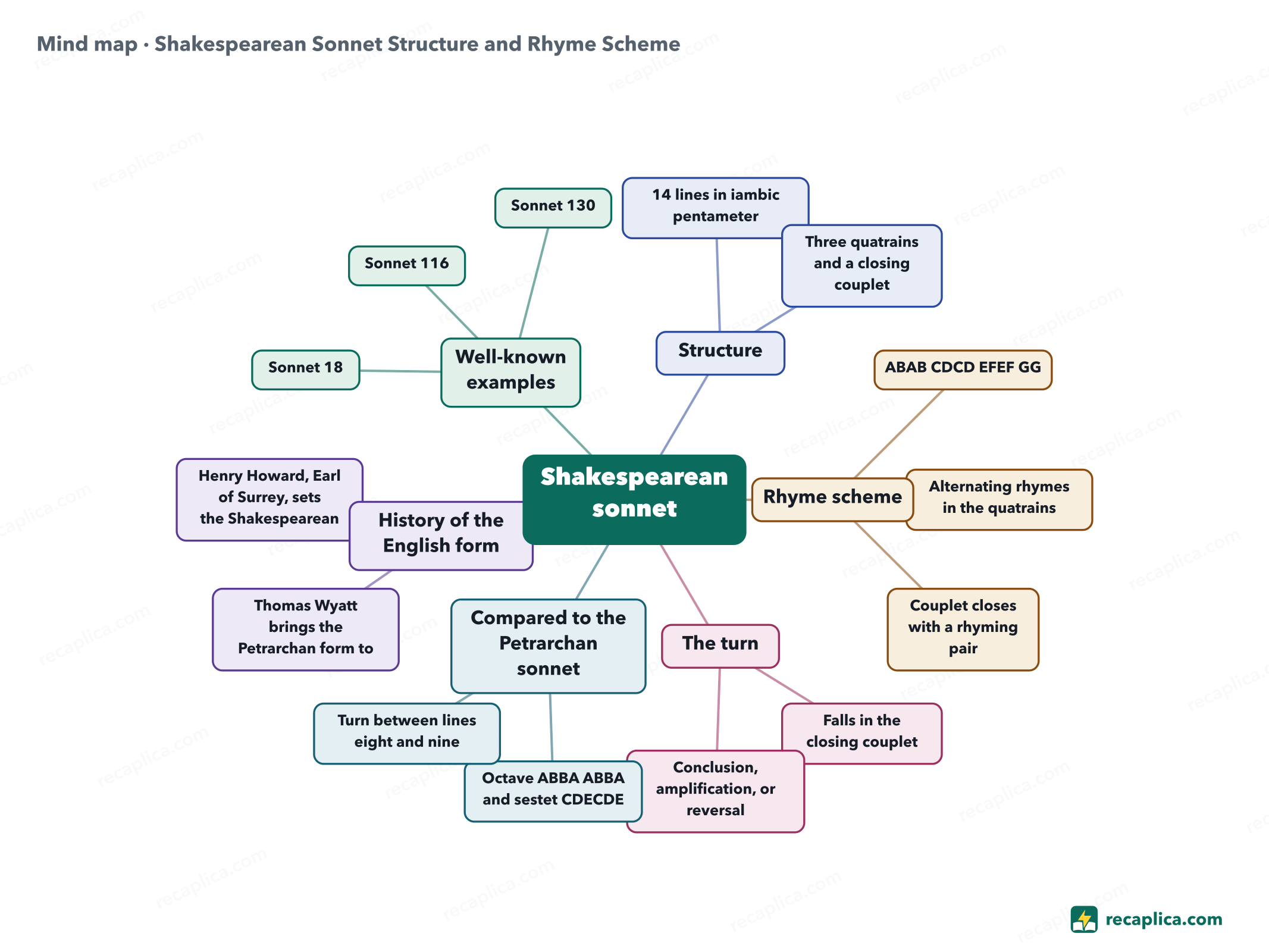
    Mind map: Shakespearean Sonnet Structure and Rhyme Scheme
    • Shakespearean sonnet
      • Structure
        • 14 lines in iambic pentameter
        • Three quatrains and a closing couplet
      • Rhyme scheme
        • ABAB CDCD EFEF GG
        • Alternating rhymes in the quatrains
        • Couplet closes with a rhyming pair
      • The turn Where the sonnet's meaning shifts
        • Falls in the closing couplet
        • Conclusion, amplification, or reversal
      • Compared to the Petrarchan sonnet
        • Octave ABBA ABBA and sestet CDECDE
        • Turn between lines eight and nine
      • History of the English form
        • Thomas Wyatt brings the Petrarchan form to England
        • Henry Howard, Earl of Surrey, sets the Shakespearean structure
      • Well-known examples
        • Sonnet 18
        • Sonnet 116
        • Sonnet 130

    Quiz: test yourself

    Answer the questions to check what you have learned: you get instant feedback and a short explanation.

    Grade 0/10 0/5
    1 Which rhyme scheme defines the Shakespearean sonnet?

    Three quatrains with alternating rhymes (ABAB, CDCD, EFEF) followed by a rhyming couplet (GG) — this is what sets the Shakespearean sonnet apart from the Petrarchan one.

    2 How is the Shakespearean sonnet structured?

    Three quatrains plus a couplet is what separates the English sonnet from the Italian one, which instead splits into an octave and a sestet.

    3 According to the Poets.org glossary, where does the turn fall in a Petrarchan sonnet?

    The Italian turn falls between the octave and the sestet, meaning between lines eight and nine; in the Shakespearean sonnet it shifts instead to the final couplet.

    4 True or false: in a Shakespearean sonnet, the closing couplet often concludes, amplifies, or even undercuts what the three preceding quatrains just said.

    That's exactly how the Poets.org glossary describes it: the couplet isn't just a metrical wrap-up, it's where the sonnet stakes its claim.

    5 Who, according to the sources, first brought the Petrarchan sonnet to England?

    Thomas Wyatt carried the Petrarchan sonnet into England in the early 16th century; Surrey later reshaped it into the structure that would become known as Shakespearean.

    Answers: 1-A · 2-A · 3-A · 4-A · 5-A

    Flashcards

    Tap the card to flip it and check whether you remember the answer, then move to the next one.

    1 / 8

    Explain it in your own words

    The ultimate test: if you can explain it in simple words, you've truly understood it. Write your explanation, then compare it with the Recap.

    Your explanation is saved only on this device.

    The Shakespearean sonnet is the English take on the sonnet form, the version William Shakespeare made famous in his 154 poems published in 1609. It runs on three quatrains and a closing couplet, rhymed ABAB CDCD EFEF GG — a different shape from the Petrarchan sonnet, which splits into an octave and a sestet. That final couplet carries the poem's turn, often wrapping up, amplifying, or even undercutting what came before. The form itself predates Shakespeare: Thomas Wyatt and Henry Howard, Earl of Surrey, reworked the Petrarchan sonnet into this English structure before Shakespeare ever picked up a pen.

    Frequently asked questions

    What's the difference between a Shakespearean sonnet and a Petrarchan sonnet?

    It comes down to how the lines are grouped and how they rhyme. The Petrarchan sonnet form splits into an octave rhymed ABBA ABBA and a sestet rhymed CDECDE (or CDCDCD); the Shakespearean sonnet form runs three quatrains rhymed ABAB CDCD EFEF and closes with a GG couplet. The turn moves too: in the Petrarchan sonnet it sits between the octave and the sestet, while in the Shakespearean sonnet it's packed into those final two lines.

    What is the turn in a sonnet?

    It's the moment the poem changes direction, shifting its argument or its point of view from what came before. In the Petrarchan sonnet it falls between lines eight and nine; in the Shakespearean sonnet it concentrates in the closing couplet, where the poet often wraps up, amplifies, or flips the three preceding quatrains entirely.

    What is the Shakespearean sonnet rhyme scheme?

    ABAB CDCD EFEF GG: three quatrains with alternating rhymes followed by a rhyming couplet, across 14 lines of iambic pentameter.

    What are Shakespeare's sonnets about?

    There are 154 of them, published in 1609: the first 17 urge a young man to marry and have children, the next stretch (up to sonnet 126) declares the poet's love for that same young man, and the final 28 concern a woman described as dark and unfaithful.

    Why is Shakespeare's Sonnet 130 so famous?

    Because it systematically overturns the stock imagery of Elizabethan love poetry — eyes like the sun, lips like coral — with blunt, realistic denials, then closes by calling the poet's love rare precisely because it skips those false comparisons.

    Sources

    • Folger Shakespeare Library, "About Shakespeare's Sonnets"
    • Poets.org (Academy of American Poets), "Sonnet"
    • Treccani, Enciclopedia online, voce "Sonetto"
    • Folger Shakespeare Library, Sonnet 18
    • Folger Shakespeare Library, Sonnet 116
    • Folger Shakespeare Library, Sonnet 130

    Every Recap goes through an independent review before publication.

    Every evening, the day's new Recaps on our Telegram channel. Join the channel →

    Keep learning

    • Literature Carlo Goldoni: The Playwright Who Rewrote Italian Comedy Carlo Goldoni was born in Venice in 1707 and died in Paris in 1793, after training as a lawyer in Padua and practicing law in Venice. Before him, Italian comic theater relied mostly on commedia dell'arte: unscripted scenarios and fixed stock characters such as Harlequin. Goldoni moved the genre toward fully written plays with characters drawn from real life instead of stereotypes, a shift that begins with "La donna di garbo" ("The Woman of Good Sense") and spreads through his work in the 1750s. The change happened gradually: some transitional plays kept only three or four fully scripted scenes per act, with the rest still improvised. Read the Recap →
    • Literature Torquato Tasso: The Poet Behind Jerusalem Delivered Torquato Tasso was born in Sorrento in 1544 and died in Rome in 1595, having spent most of his adult life at the Este court in Ferrara. His masterwork is Jerusalem Delivered, a twenty-canto poem about the First Crusade and the fall of Jerusalem, published in its final form in 1581 after more than two decades of work. The story follows Godfrey of Bouillon as he leads the Christian army, but it keeps breaking away into private tales of love and duty: the knight Tancred, the sorceress Armida, the paladin Rinaldo. In 1593 Tasso issued a stricter revision titled Jerusalem Conquered, which never won over readers the way the original did. Read the Recap →
    • Literature Gabriele D'Annunzio: Life, Works, and Italian Decadence Gabriele D'Annunzio was born in Pescara on March 12, 1863, and spent seven formative years at the Collegio Cicognini in Prato, graduating in 1881. In the 1880s he threw himself into a restless social life of newsrooms and fashionable salons while writing the novel The Child of Pleasure, published in 1889, and later the Laudi, four volumes (1903-1912) whose first three books mark the high point of his poetry, with Alcyone as the volume critics praised most. According to the Treccani encyclopedia, D'Annunzio was the first Italian writer to bring Italian literature into full contact with the decadent currents that had emerged in France around 1885-1886 in the wake of Baudelaire, which is why he is regarded as the leading figure of Italian Decadence. His life also included a long bond with the actress Eleonora Duse and, in the 1920s, a relationship with Benito Mussolini who, by his own reckoning, never granted the poet any real political weight. He died suddenly on March 1, 1938, at his residence, the Vittoriale. Read the Recap →

    recaplica

    Clear in 30 seconds, yours in 10 minutes.

    Recaps Mind maps Request a Recap Telegram channel Mind map maker Our method About Privacy & cookies Legal notes & terms of use

    © 2026 Recaplica · A project by Curi S.r.l. — VAT IT05472000750

    Statistics, only if you say so

    To learn which Recaps help most we would use Google Analytics, with aggregate, anonymous data. It starts only with your OK, and you can change your mind anytime. Privacy policy