|
recaplica
Italian Dialects: How Many There Are, Where They're Spoken and Why They're Fading | ||||||||||||||||||
| © 2026 Recaplica · recaplica.com — All rights reserved | ||||||||||||||||||
Italian Dialects: How Many There Are, Where They're Spoken and Why They're FadingWhat to print Page numbers appear when printing with default margins. SlidesChoose a cut Flash10 slidesThe essential thread, to present in classFull14 slidesEvery chapter and the deeper detailBoth come with speaker notes. In 30 seconds quick readItaly has no official count of its dialects. The classification scholars cite most often, put together by Giovan Battista Pellegrini in 1975, sorts them into five major systems, all descended from the Latin once spoken across the peninsula rather than from a "broken" form of standard Italian. The La Spezia-Rimini line has marked the boundary between northern and central-southern dialects for centuries. In the Middle Ages, regional vernaculars held the same standing as Florentine; only after the 1500s did Florentine become the base of standard Italian, pushing the rest down to the rank of dialects. Istat data show the share of the population speaking dialect at home dropped from 32% in 1988 to 9.6% in 2024. Key Points
Key figures
Deep DiveFrom Latin to vernacularsWhen the Roman Empire spread Latin across most of the peninsula, the language didn’t stay uniform everywhere. Over the following centuries, spoken Latin evolved differently in each area, blending with the local speech that came before it: this is how vernaculars emerged, the original name for what we now call regional languages and dialects. In the Middle Ages, according to the Accademia della Crusca, every local language went by the name vernacular, Florentine included. At that stage, Florentine was competing on close to equal footing with the rest: none of them had yet earned the status of a national language. It was only after the 1500s that Florentine settled in as the reference for educated speech, and the other vernaculars slid, in name and in function, into the rank of dialects — languages that no longer cover every communicative need of an entire community. How many, according to those who study themAsking how many dialects Italy has doesn’t lead to one answer. As Treccani points out, popular perception treats dialects the way it treats village bell towers: there’s one for every town, every valley has its own shade of difference. Scholars have looked for steadier criteria to sort those differences into broader systems. The first attempt came from Graziadio Isaia Ascoli, who between 1882 and 1885 proposed measuring how far each area’s speech had drifted from Tuscan, treated as the dialect closest to the shared Latin base. In 1924 Clemente Merlo took a different angle: he argued the deciding factor was substrate, meaning the imprint left by the languages spoken in Italy before Latin arrived. In 1937 Gerhard Rohlfs introduced a geographic criterion, drawing two boundary lines: the La Spezia-Rimini line and the Roma-Ancona line. The classification most scholars accept today is the one Giovan Battista Pellegrini put forward in 1975, which sorts Italo-Romance dialects into five major systems.
Alongside these five, scholars often carve out a sixth area: the extreme southern dialects of Salento, southern Calabria and Sicily, which share a five-vowel stressed sound system (/i/, /ɛ/, /a/, /ɔ/, /u/), unlike the seven stressed vowels of Tuscan and standard Italian.
The line that divides ItalyThe most cited boundary between the two big dialect macro-areas is the La Spezia-Rimini line, drawn by Rohlfs in 1937: it separates the northern dialects from the combined Tuscan and central-southern block. A little further south, the Roma-Ancona line marks a second boundary, between the Tuscan area and the central-southern area proper. The dialects of the northwest, Piedmontese, Lombard, Ligurian and Emilian, have been called Gallo-Italic since the 1800s, for the substrate left behind by the Celtic populations of the area before Roman times. Those of the northeast, Venetan and Istrian, form another recognizable group. The language questionHow Italian became the shared language while regional vernaculars stayed dialects isn’t a story that closed in the Middle Ages: it’s a debate, known as the question of the language, that runs through centuries of Italian literature. Alessandro Manzoni is among the writers most associated with tackling it head-on, rewriting his own novel to bring it closer to the educated spoken Florentine of his day. With Italian unification, spreading a common language stopped being only a literary concern and became a practical one too: a newly unified country needed a shared language for administration, schools and the press, even as most of the population still relied mainly on dialect at home. What today’s data showsAccording to Istat, the share of the population speaking dialect at home, exclusively or mostly, dropped from 32% in 1988 to 9.6% in 2024. The same report finds that 53.6% of the population says it speaks mostly Italian at home in 2024. The decline touches the whole peninsula, though the Istat report still points to relatively higher dialect use in parts of southern Italy compared with the national average. Factors commonly cited for a shift this large include schooling that reached every corner of the country, national broadcast media, and the movement of people between regions over the twentieth century; none of these alone accounts for a change of this scale. The Accademia della Crusca, in a 2025 survey on how dialects are perceived, finds that their use is linked mainly to older speakers, while judgment on the cultural level of those who use them stays neutral. That same year, seventy-four percent of respondents said dialects carry a cultural and identity value that institutions should protect. Slide deckSlides ready to download and make your own in PowerPoint or Google Slides, with speaker notes. Pick the Flash cut or the Full one.     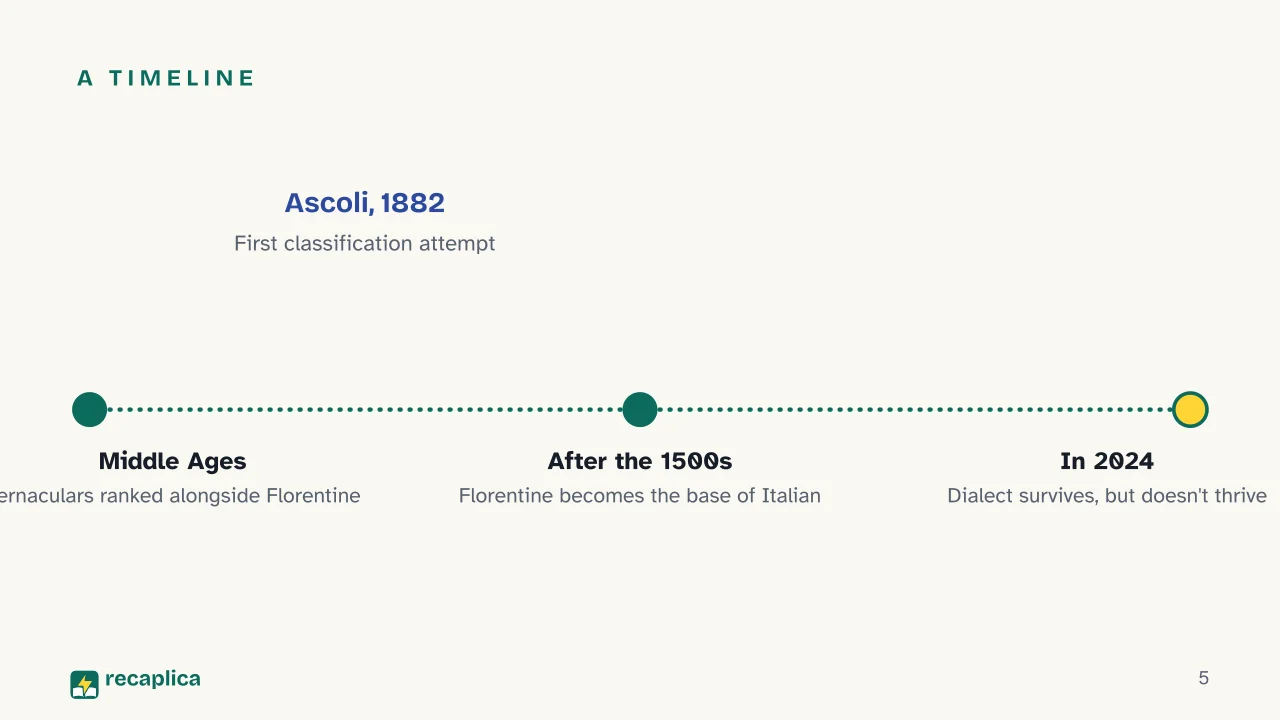  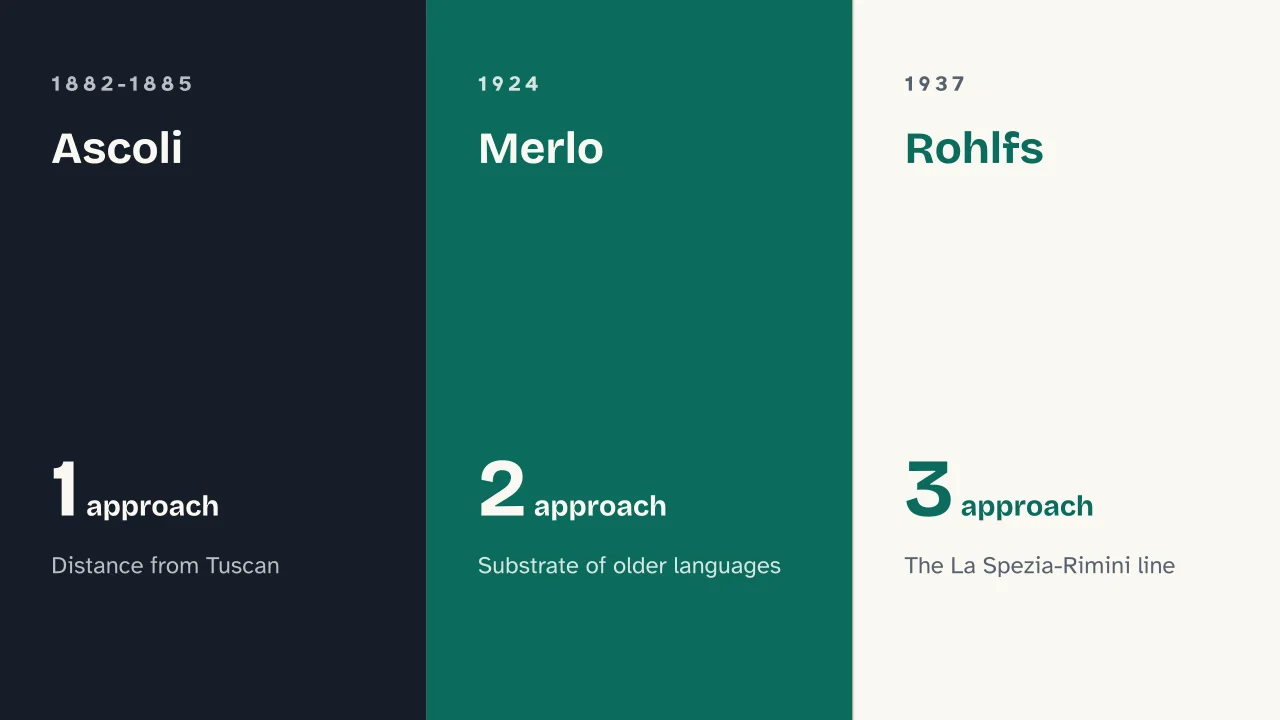 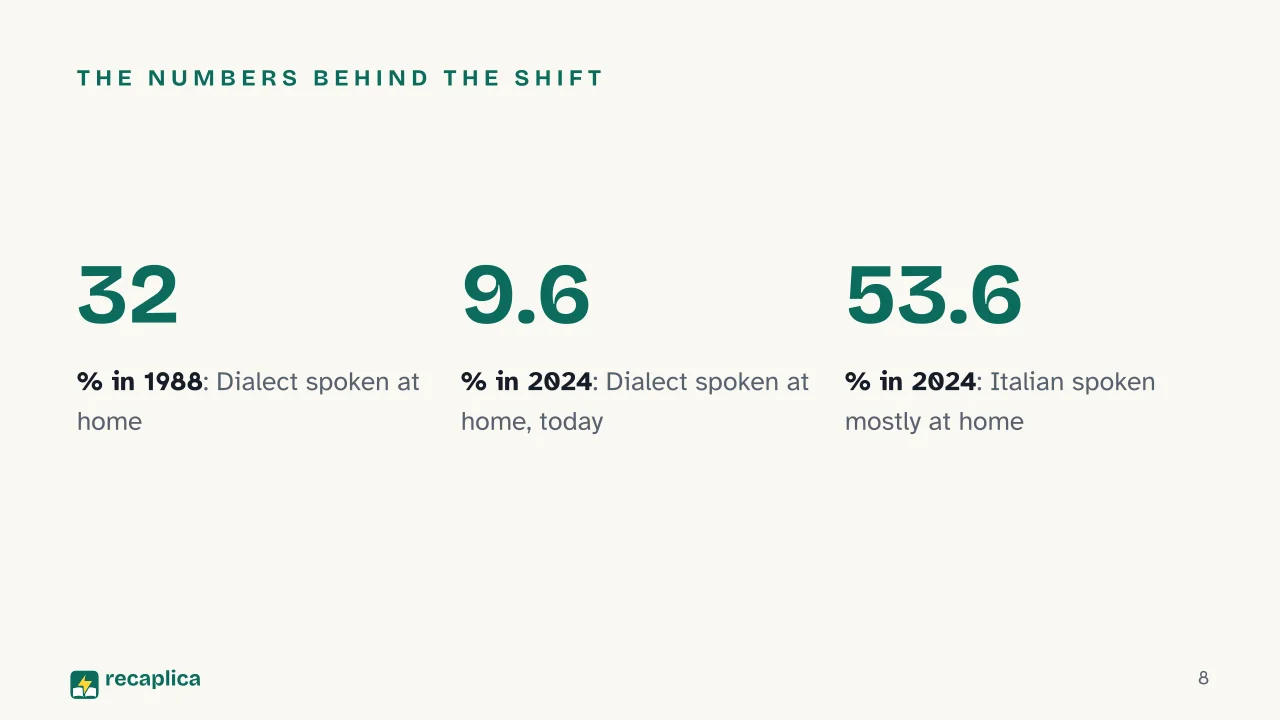  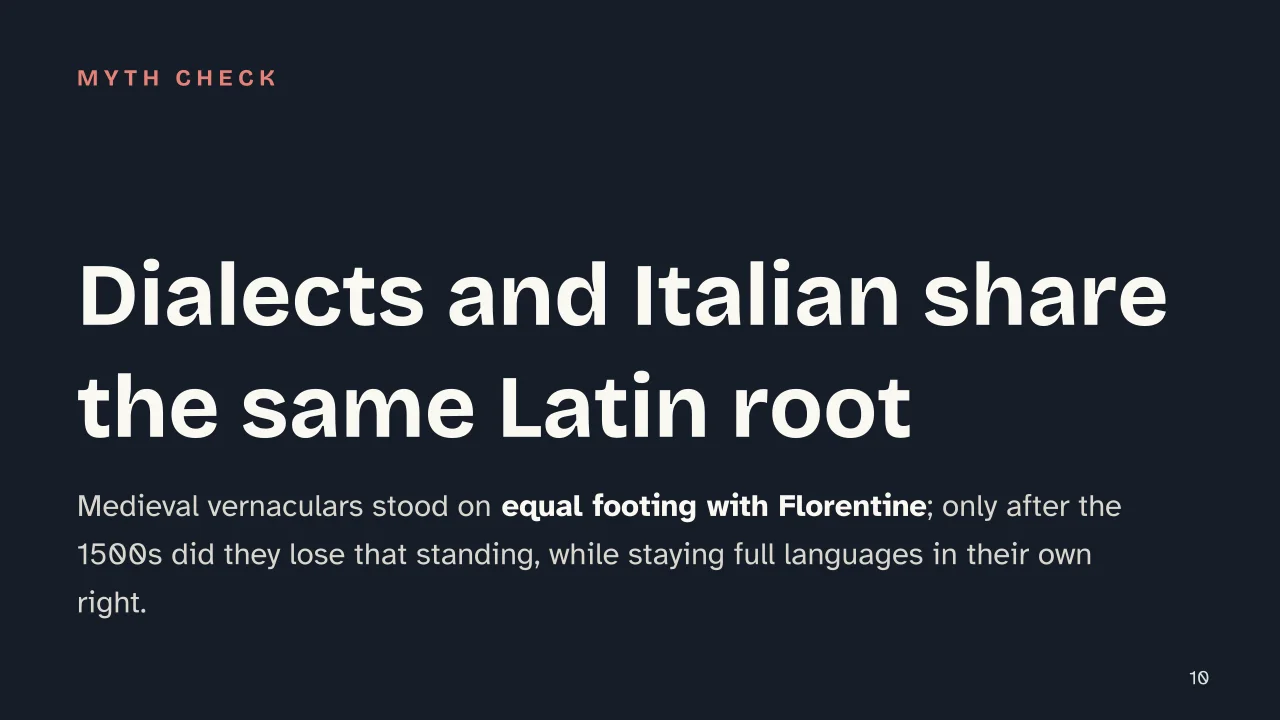  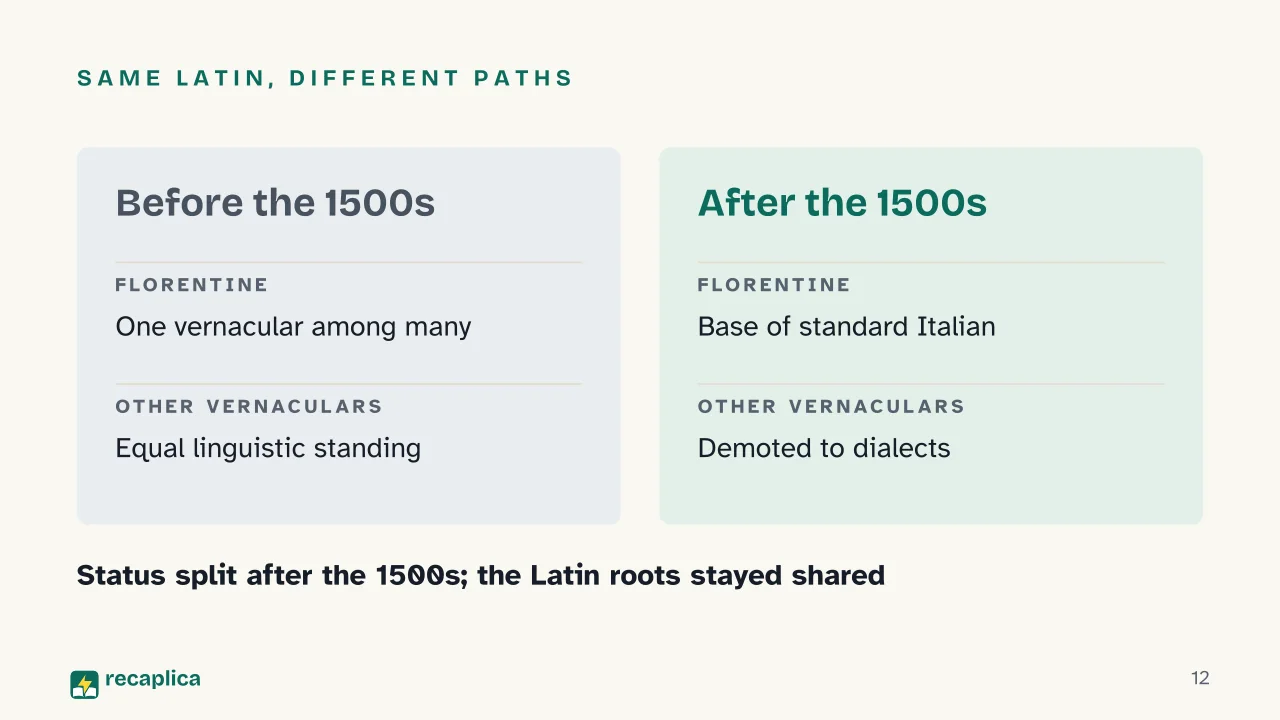 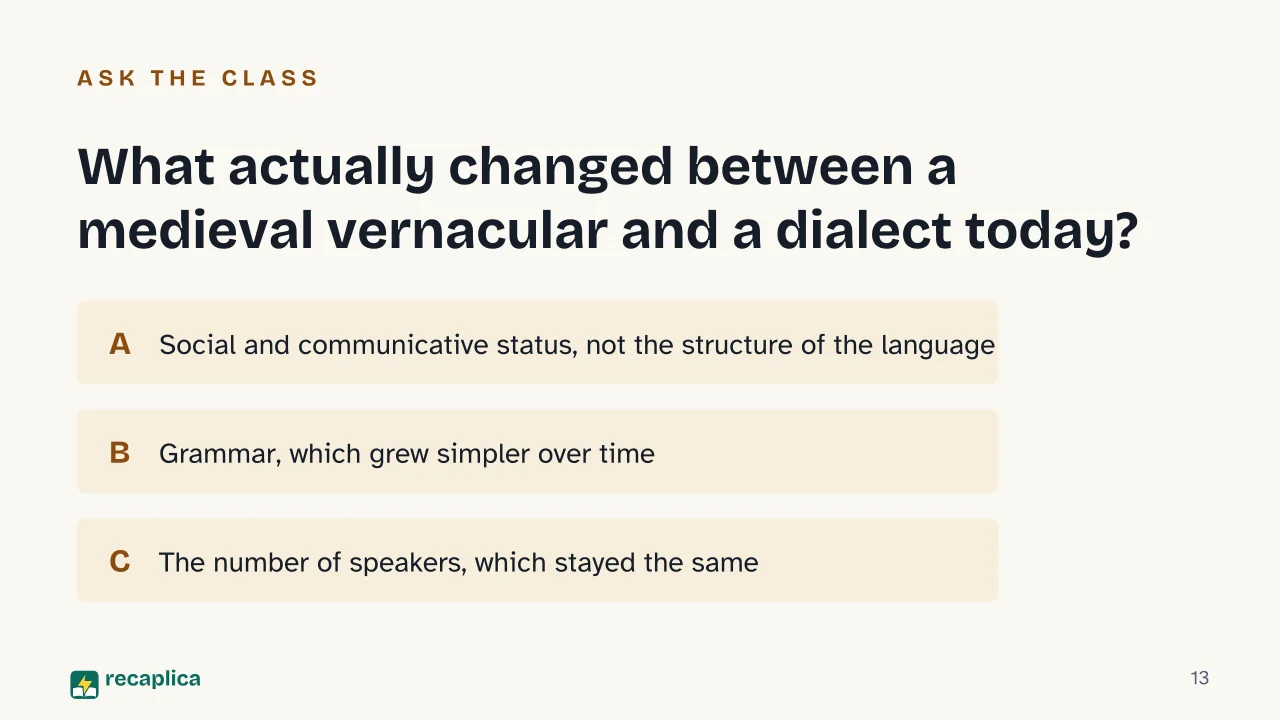  Common myths
Mind mapDrag the background to move around and the nodes to reposition them; use − and + to collapse and expand branches. 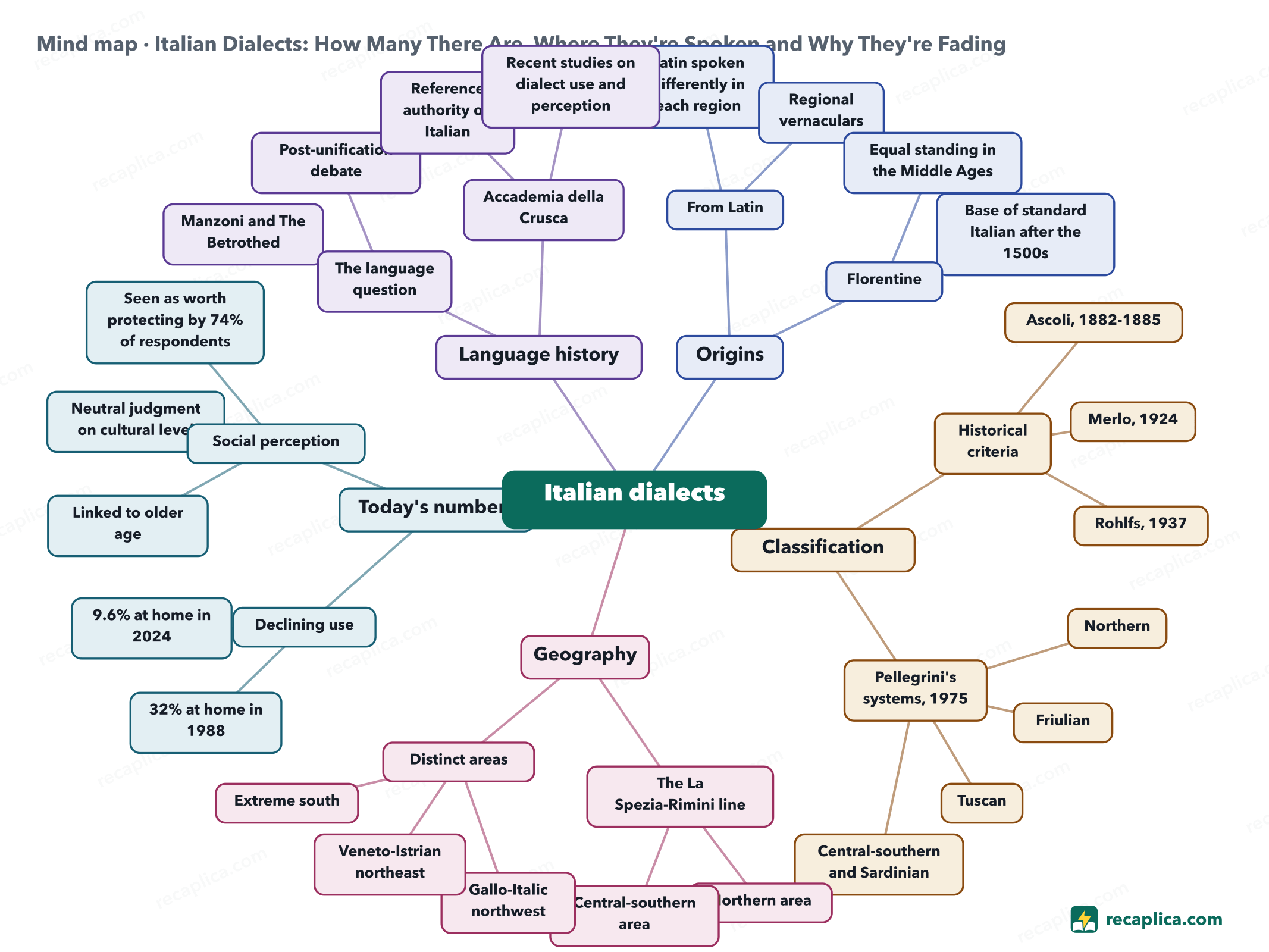
Quiz: test yourselfAnswer the questions to check what you have learned: you get instant feedback and a short explanation. Grade 0/10 0/5
FlashcardsTap the card to flip it and check whether you remember the answer, then move to the next one. 1 / 8 Explain it in your own wordsThe ultimate test: if you can explain it in simple words, you've truly understood it. Write your explanation, then compare it with the Recap. Your explanation is saved only on this device.
Frequently asked questionsHow many dialects are spoken in Italy?There's no official count: in everyday perception dialects are as numerous as village bell towers, changing from one town to the next. Scholars group those differences into broader systems; the most widely accepted classification, Pellegrini's from 1975, counts five: northern, Friulian, Tuscan, central-southern and Sardinian, often with the extreme southern dialects added as a sixth area. What's the difference between a dialect and a language?According to the Accademia della Crusca, the difference is historical: in the Middle Ages every regional variety, Florentine included, was called a vernacular and carried equal standing. Only after the 1500s did Florentine become the national language, while the other vernaculars were demoted to the rank of dialects. Where in Italy is dialect still spoken the most?The decline runs across the whole peninsula, but the most recent Istat report still points to relatively higher dialect use in parts of southern Italy compared with the national average. Why has dialect use fallen so sharply in recent decades?There's no single cause: factors commonly cited include schooling that reached every part of the country, national broadcast media, and the movement of people between regions over the twentieth century. None of these alone explains a shift as large as the one Istat recorded between 1988 and 2024. Is Sardinian considered a dialect or a language of its own?In Pellegrini's classification, Sardinian is one of the five major Italo-Romance systems, set apart from the other four — a placement that reflects how linguistically distant it is from the rest of the peninsula, rather than a final answer to whether it counts as a language or a dialect. Every Recap goes through an independent review before publication. |