|
recaplica
Gabriele D'Annunzio: Life, Works, and Italian Decadence |
| © 2026 Recaplica · recaplica.com — All rights reserved |
Gabriele D'Annunzio: Life, Works, and Italian DecadenceWhat to print Page numbers appear when printing with default margins. SlidesChoose a cut Flash10 slidesThe essential thread, to present in classFull16 slidesEvery chapter and the deeper detailBoth come with speaker notes. In 30 seconds quick readGabriele D'Annunzio was born in Pescara on March 12, 1863, and spent seven formative years at the Collegio Cicognini in Prato, graduating in 1881. In the 1880s he threw himself into a restless social life of newsrooms and fashionable salons while writing the novel The Child of Pleasure, published in 1889, and later the Laudi, four volumes (1903-1912) whose first three books mark the high point of his poetry, with Alcyone as the volume critics praised most. According to the Treccani encyclopedia, D'Annunzio was the first Italian writer to bring Italian literature into full contact with the decadent currents that had emerged in France around 1885-1886 in the wake of Baudelaire, which is why he is regarded as the leading figure of Italian Decadence. His life also included a long bond with the actress Eleonora Duse and, in the 1920s, a relationship with Benito Mussolini who, by his own reckoning, never granted the poet any real political weight. He died suddenly on March 1, 1938, at his residence, the Vittoriale. Key Points
Key figures
Deep DiveYouth and educationGabriele D’Annunzio was born in Pescara on March 12, 1863, the son of Francesco Paolo and Luisa de Benedictis. After his early schooling in his home city, his father sent him to the first year of the Reale Collegio Cicognini in Prato, where he stayed seven years, from 1874 to 1881, until earning his “honors diploma” on June 30 of that year. An unrepeatable life: the social yearsThe two years from 1882 to 1883 were, according to the Treccani biographical dictionary, a nonstop chase after adventures, romances, parties, and salon gatherings. In its Enciclopedia Italiana entry, Treccani describes what it calls his “joyful” hour, split between the newsroom of the paper Capitan Fracassa and the most fashionable salons, in an existence where writing a poem and living out a love affair followed one another without a break. It is this decades-long way of living that the Fondazione Il Vittoriale degli Italiani had in mind when it chose to preserve, as its mission, the memory of the poet-soldier’s unrepeatable life. The Child of Pleasure and the LaudiBetween July and December 1888, D’Annunzio wrote The Child of Pleasure (Il Piacere), published the following May by the Milan house Treves. Its protagonist, Andrea Sperelli, is a refined dilettante of an essentially formal spirit: Treccani calls it the author’s most accomplished and most sincere novel. In the first decade of the twentieth century, D’Annunzio turned to the Laudi, four volumes published between 1903 and 1912. The first three books mark, according to Treccani, the peak of his long poetic search; on the third, Alcyone, critics reached unanimous agreement, regarding it as the high point of the whole collection. These were also years when Italian literature was heading in other directions: Giovanni Pascoli stayed within lyric poetry but with a more intimate tone, while Giovanni Verga used Verismo to portray a rural Italy far removed from D’Annunzio’s salons and pageantry. From Notturno to the Fiume ventureThe path toward Notturno began with Contemplazione della morte in 1913 and reached completion only in November 1921. Between those two dates came the First World War, after which, less than a year later, D’Annunzio threw himself into the Fiume venture, which he left on December 26, 1920. Decadence, between France and ItalyAccording to Treccani, Decadence is an aesthetic-moral theory that arose in France around 1885-1886: it describes a taste for finding a kind of distinction in inner fatigue, a refinement built on surrender and self-denial that, over time, drains the spirit’s energy. The movement’s true spiritual father, for Treccani, is Charles Baudelaire, the first to give decadence a clear theoretical shape: he is also credited with a famous idea of correspondence among scents, colors, and sounds. In Italy, Treccani goes on, it was only with D’Annunzio that literature made full, direct contact with the currents running through contemporary European poetry: that is why the encyclopedia calls him “the sole great master of Italian Decadence.” Compared with a poet of the previous generation such as Ugo Foscolo, active between Neoclassicism and pre-Romanticism, D’Annunzio moved within an entirely different literary climate, the one running through Europe at the close of the nineteenth century. Aestheticism: the sensuality of formIn Treccani’s account of Decadence, aestheticism is where a mystical streak meets an openly sensual one, where a taste for refined form meets a certain surrender to the senses: the spirit’s creative energy dissolves there into an enjoyment more undergone than pursued. In The Child of Pleasure, this disposition takes shape in Andrea Sperelli’s refined, dilettante games; in D’Annunzio’s writing, according to Treccani, a new sensuality also emerges in the language itself, not only in what it describes. Eleonora Duse: an inextricable partnershipD’Annunzio’s partnership with the actress Eleonora Duse began in Venice, a bond in which, the Treccani biographical dictionary writes, “love, personal attraction, practical interest, and intellectual curiosity became inextricably mixed.” The publication of the Laudi came a few months before the staging of The Daughter of Iorio (La figlia di Iorio), which the same source says marked the end of the two writers’ partnership. Eleonora Duse died on April 21, 1924, in Pittsburgh, according to the Fondazione Il Vittoriale’s chronology. D’Annunzio and Mussolini: a relationship of mutual convenienceIn the 1920s, D’Annunzio received Mussolini at his new residence on April 5, 1921; on May 25, 1925, Mussolini paid him a visit at Gardone, where the two rode together on a MAS torpedo boat across the lake, according to the Fondazione Il Vittoriale’s chronology. Their relationship, however, never amounted to full political allegiance: according to the Treccani biographical dictionary, Mussolini did not see the poet as politically significant, and preferred that the national bard remain tied to the new establishment only as “the harmless symbol of an ideal entirely detached from actual politics.” D’Annunzio died suddenly on March 1, 1938, at 8 pm, from a cerebral hemorrhage, at his Vittoriale museum: death caught him seated at the table in the Zambracca room. Slide deckSlides ready to download and make your own in PowerPoint or Google Slides, with speaker notes. Pick the Flash cut or the Full one.     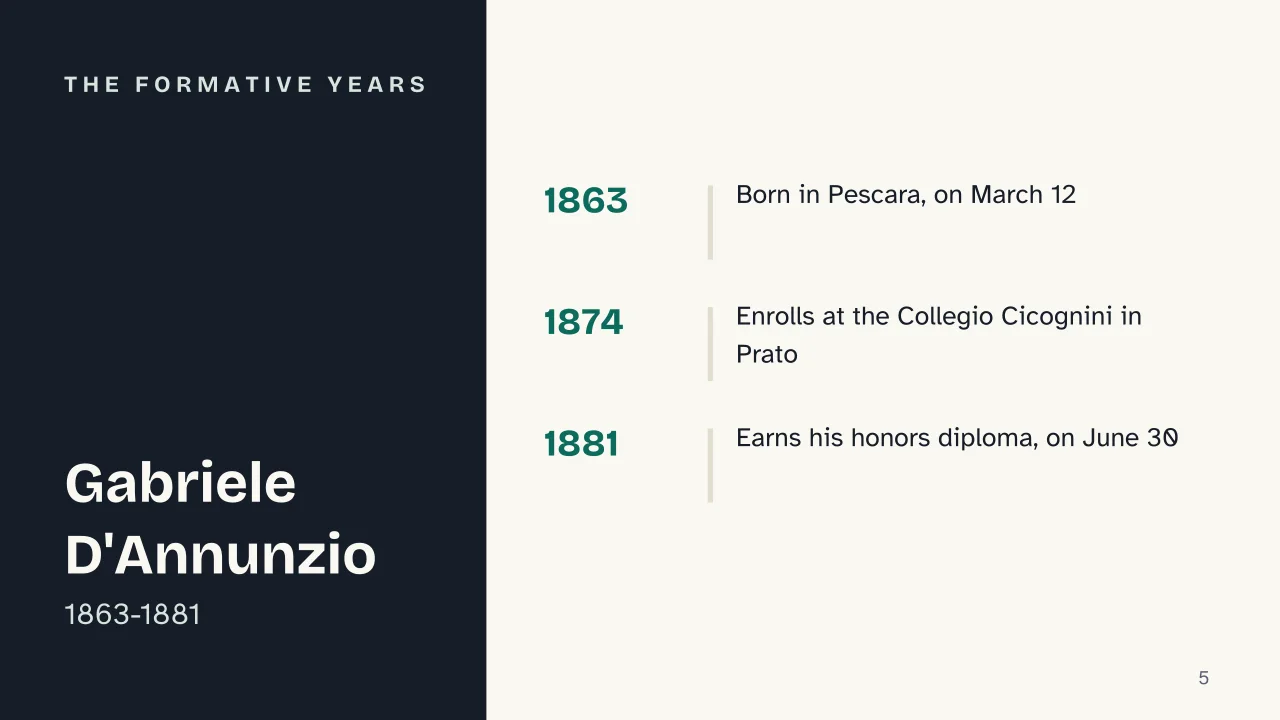  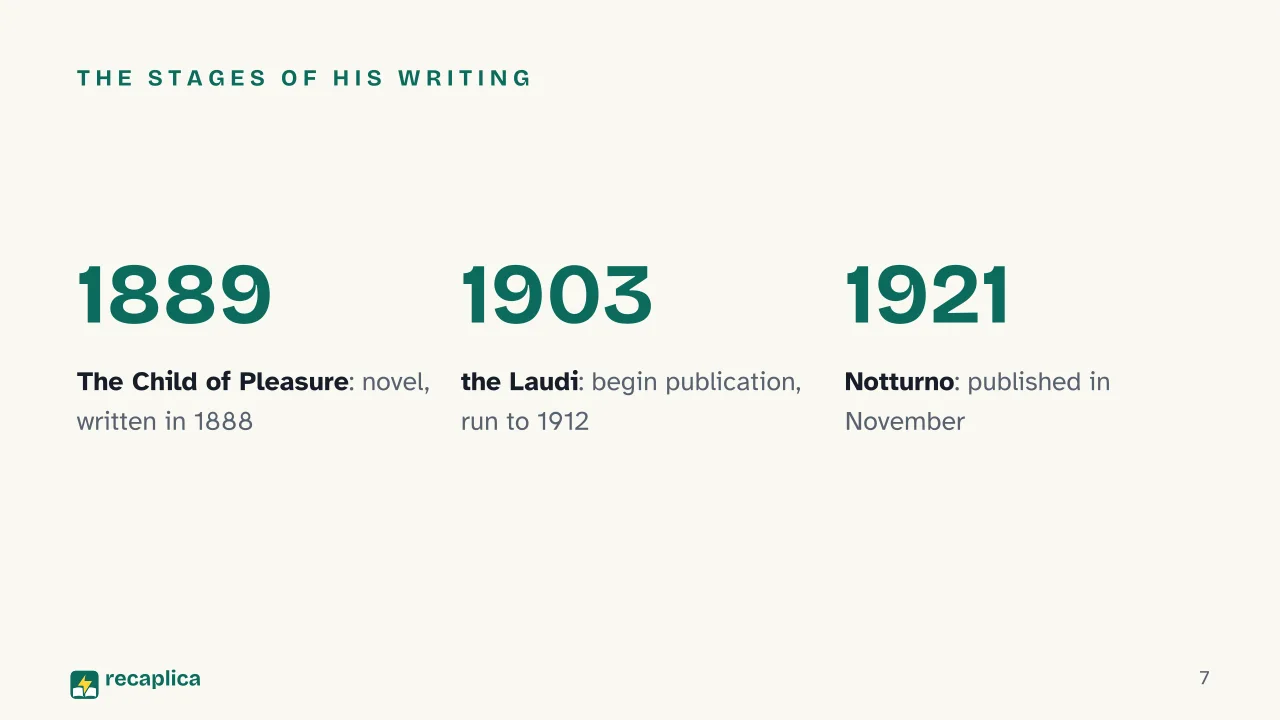 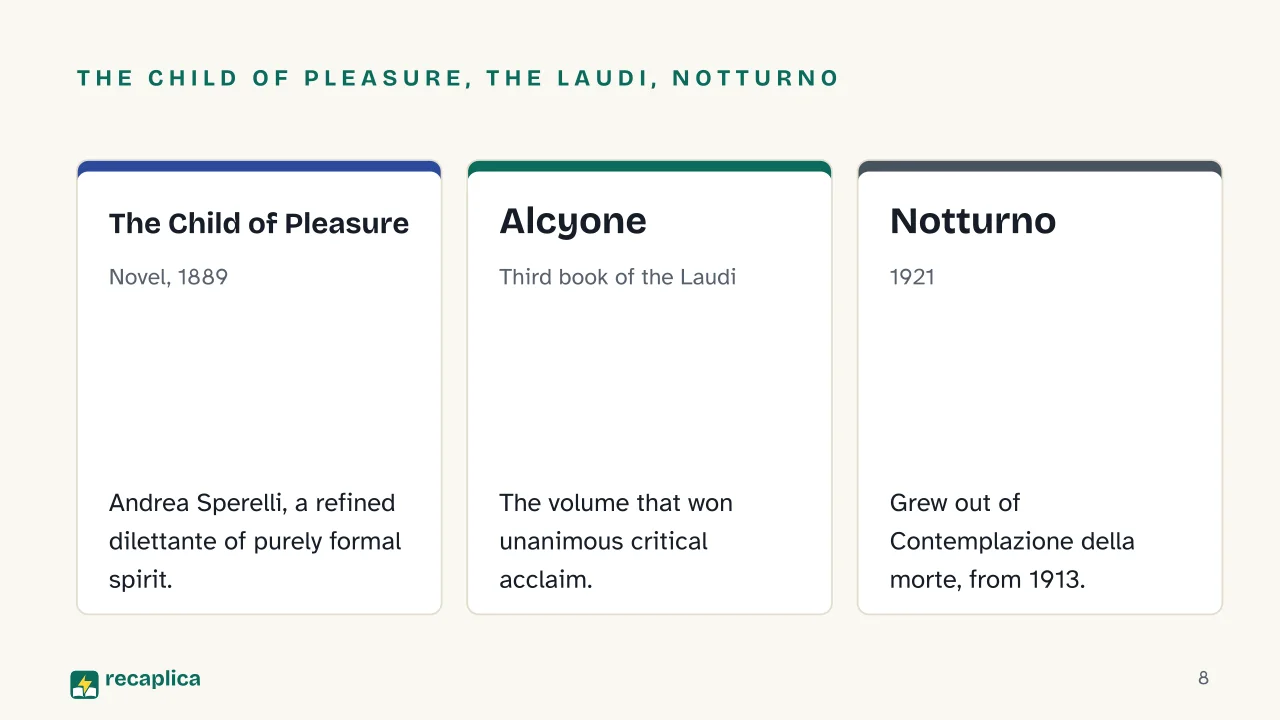  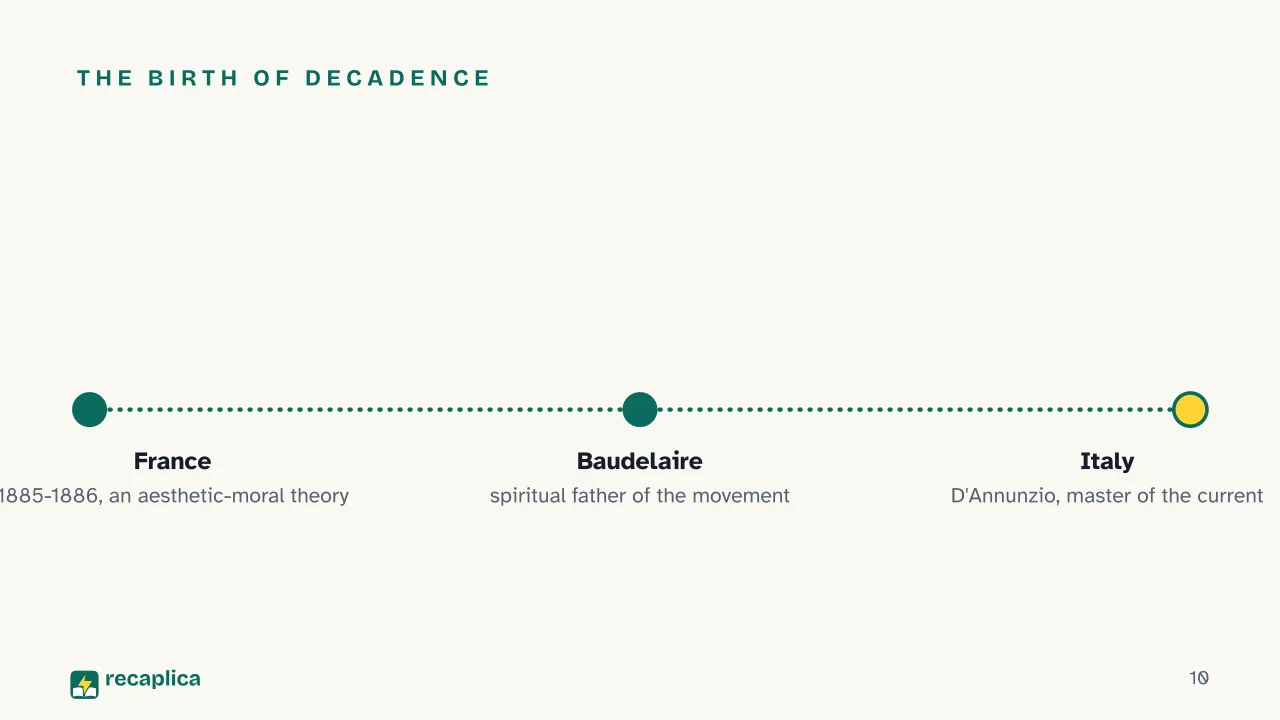 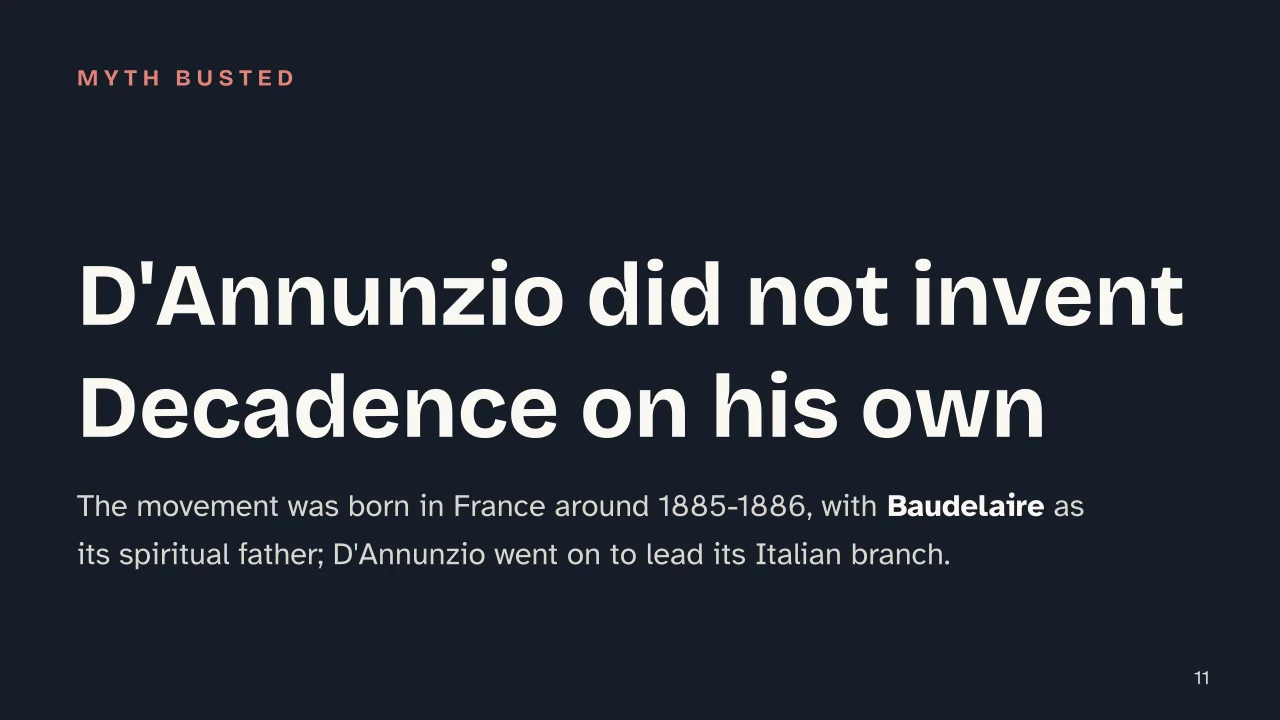  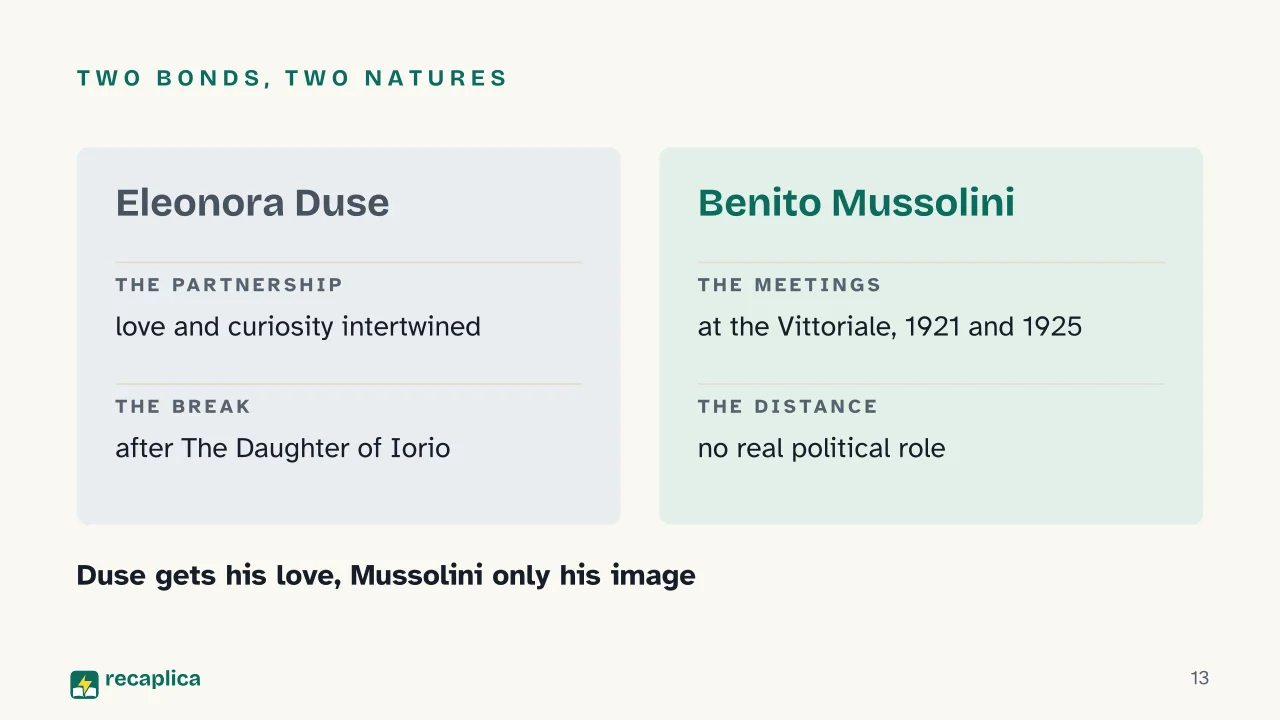 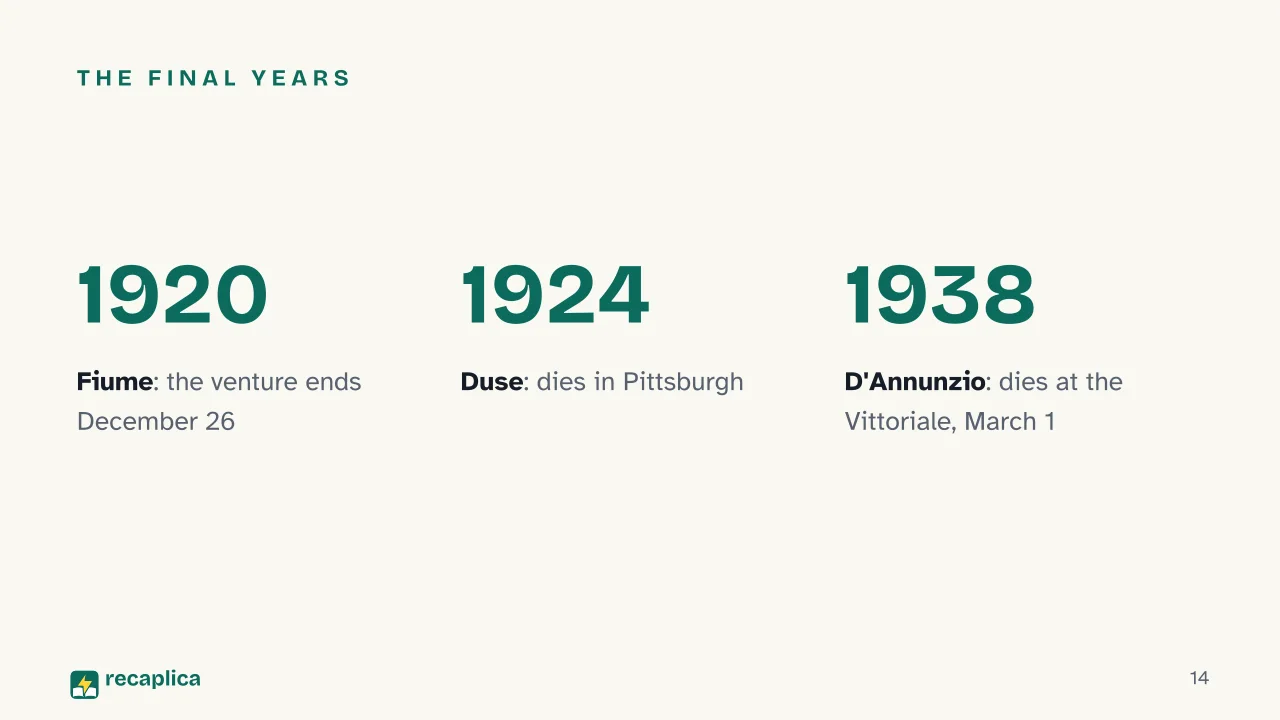 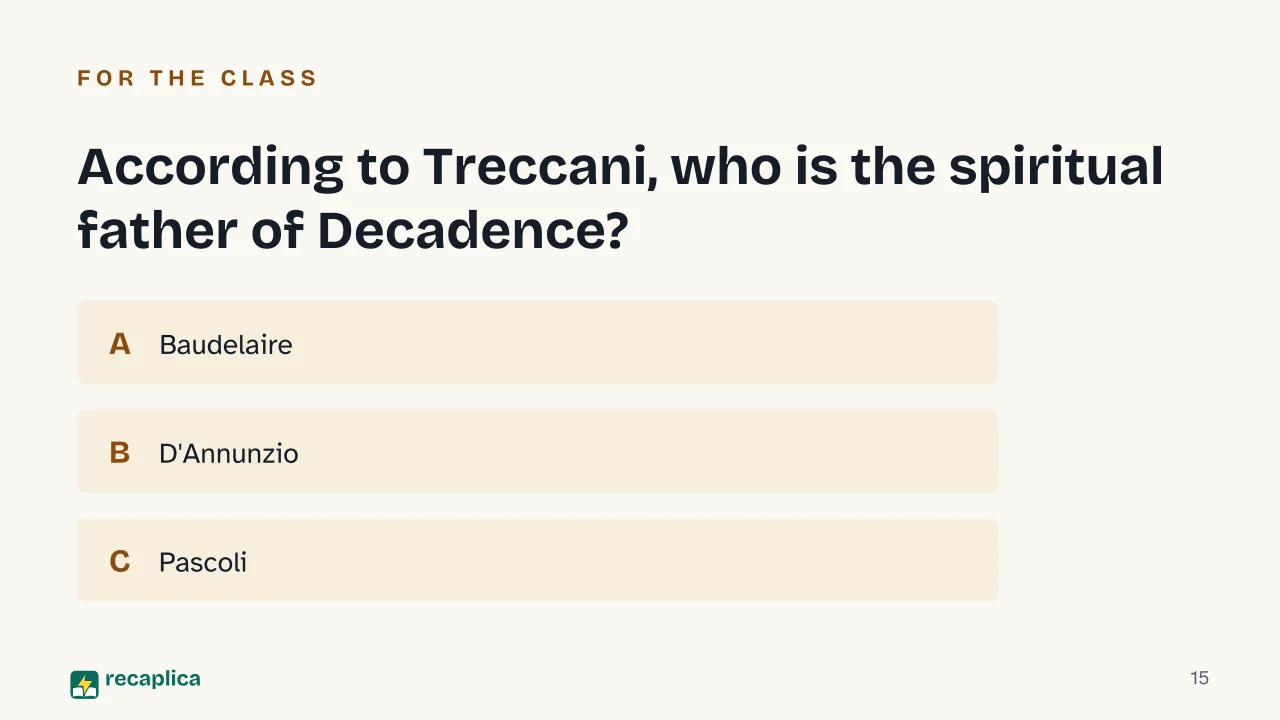  Common myths
Mind mapDrag the background to move around and the nodes to reposition them; use − and + to collapse and expand branches. 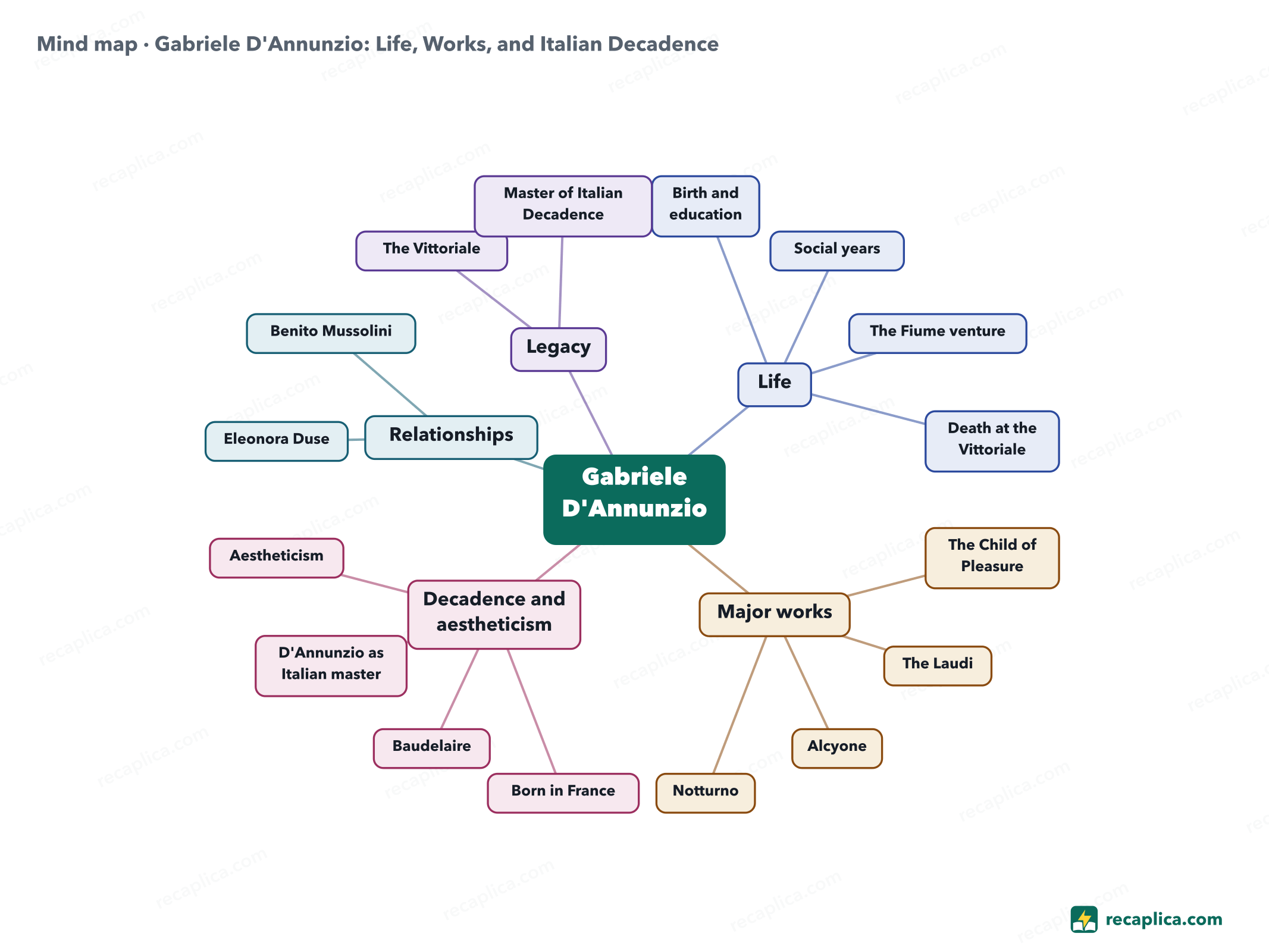
Quiz: test yourselfAnswer the questions to check what you have learned: you get instant feedback and a short explanation. Grade 0/10 0/5
FlashcardsTap the card to flip it and check whether you remember the answer, then move to the next one. 1 / 8 Explain it in your own wordsThe ultimate test: if you can explain it in simple words, you've truly understood it. Write your explanation, then compare it with the Recap. Your explanation is saved only on this device.
Frequently asked questionsWho was Gabriele D'Annunzio?A writer and poet born in Pescara in 1863, author of the novel The Child of Pleasure (1889) and the Laudi (1903-1912), regarded by Treccani as Italy's leading figure of Decadence. What is Italian Decadence?An aesthetic-moral theory that emerged in France around 1885-1886, with Baudelaire as its spiritual father; in Italy, according to Treccani, D'Annunzio became its sole great master. What was D'Annunzio's relationship with Eleonora Duse?A romantic and artistic partnership that began in Venice, in which, according to Treccani, love, personal attraction, practical interest, and intellectual curiosity became inextricably mixed; it ended after the staging of The Daughter of Iorio, shortly after the Laudi came out. Was D'Annunzio a fascist?His relationship with Mussolini, documented by meetings at the Vittoriale in 1921 and 1925, remained more a personal acquaintance than a political allegiance: according to the Treccani biographical dictionary, Mussolini did not see the poet as politically significant. Which of the Laudi is most highly regarded?Alcyone, the third of the four volumes (1903-1912), which won unanimous critical acclaim. Every Recap goes through an independent review before publication. |