Skip to content
recaplica

    One moment: security check

    Cloudflare wants to make sure you're not a robot. Tick the box below and your search will continue on its own.

    IT
    recaplica Italo Svevo: life, works and thought
    © 2026 Recaplica · recaplica.com — All rights reserved
    Home › Literature

    Italo Svevo: life, works and thought

    By Recaplica Newsroom · Updated on September 28, 2026

    What to print

    Page numbers appear when printing with default margins.

    Slides

    Choose a cut

    Flash10 slidesThe essential thread, to present in classFull17 slidesEvery chapter and the deeper detail

    Both come with speaker notes.

    Telegram channel
    recaplica Clear in 30 seconds, yours in 10 minutes.
    In 30 seconds Key points Deep dive Slides Myths Mind map Quiz Flashcards FAQ

    In 30 seconds quick read

    Italo Svevo was the pen name of the Trieste-born writer Ettore Schmitz, born on 19 December 1861 and died on 13 September 1928. He spent eighteen years working as a bank clerk while writing novels that stayed on the margins of success for a long time. His three main works, A Life, As a Man Grows Older and Zeno's Conscience, follow protagonists unable to keep up with the rules of ordinary life, a figure critics call the inetto (the inept man). His contact with Sigmund Freud's theories and his friendship with the Irish writer James Joyce, whom he met in Trieste as an English teacher, shaped his writing decisively, above all in the third novel.

    Key Points

    • Italo Svevo was born in Trieste on 19 December 1861 under the name Ettore Schmitz and died on 13 September 1928.
    • He worked for eighteen years as a bank clerk, starting on 27 September 1880, before turning more steadily to writing.
    • His three main works are the novels A Life (1892, though dated 1893), As a Man Grows Older (1898) and Zeno's Conscience (1923).
    • His protagonists are often described as "inetti" (inept), ordinary men unable to accept the rules of the life around them.
    • He met the writer James Joyce in Trieste as a private English teacher, and deepened his knowledge of Sigmund Freud's psychoanalytic theories starting around 1908-1910.
    • Only with Zeno's Conscience, after a very difficult start, did Svevo finally win recognition for his literary merits.

    Deep Dive

    Who was Italo Svevo

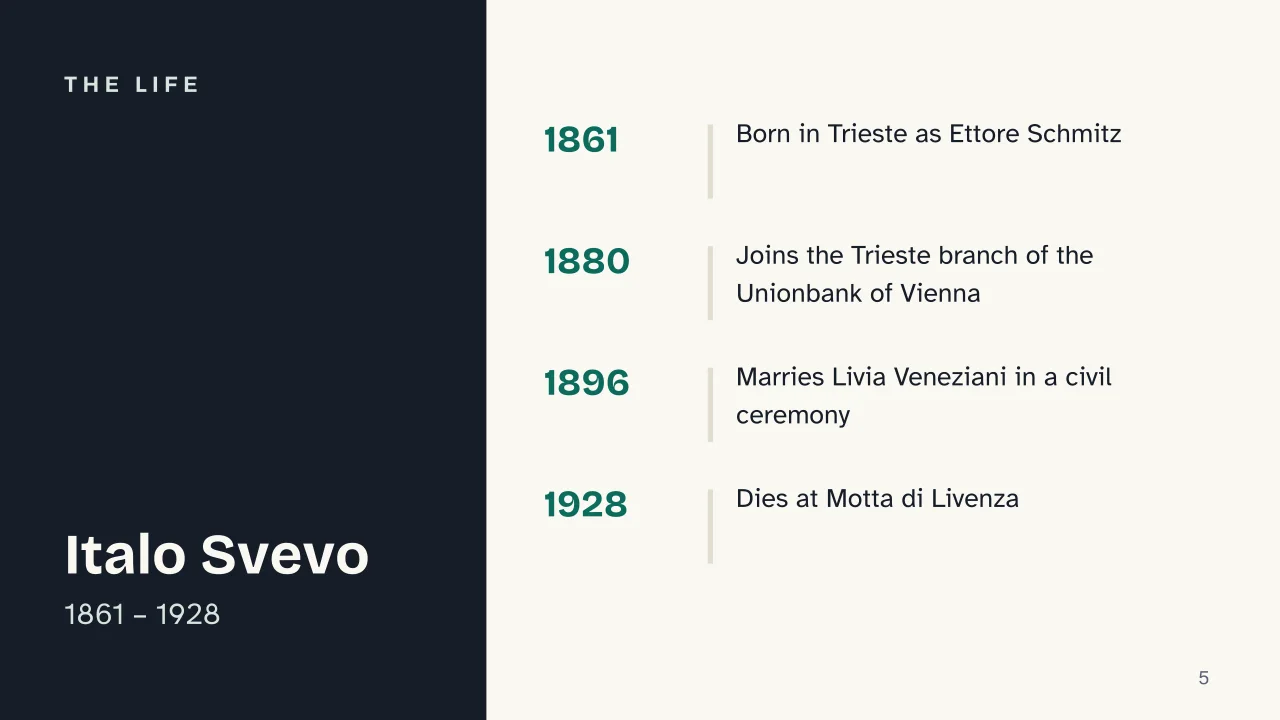
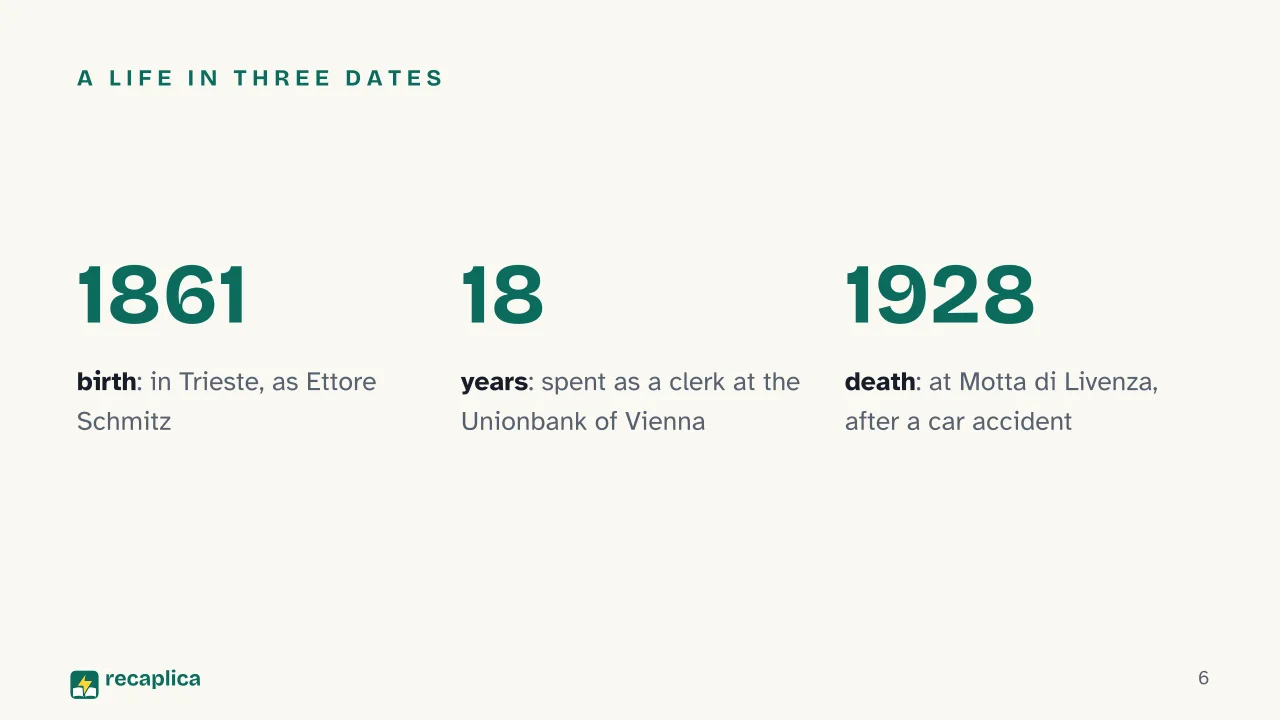
    Italo Svevo was the pen name of the writer Ettore Schmitz, born in Trieste on 19 December 1861 and who died on 13 September 1928 at Motta di Livenza, from the consequences of a car accident; he was buried in the Sant’Anna cemetery in Trieste. The pen name joins the two identities of his family: “Italo” for his Italian cultural belonging, “Svevo” for the German origins of his father, Francesco Schmitz.

    Before becoming a writer, Svevo spent eighteen years as a clerk: on 27 September 1880 he joined the Trieste branch of the Unionbank of Vienna, a job he kept for years alongside writing his first novels, read by very few people. In 1896 he married Livia Veneziani in a civil ceremony; the marriage was also celebrated in a religious ceremony in August of the following year.

    Three novels and the thread of the inetto

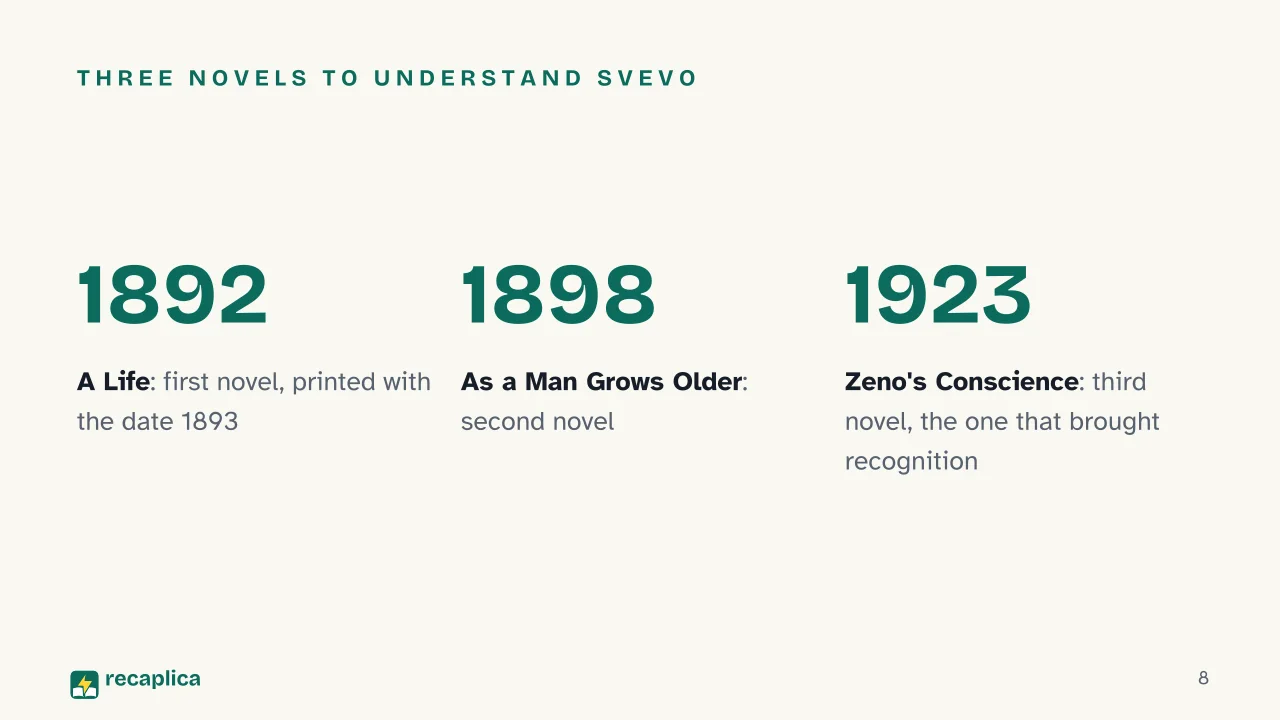
    Svevo’s three main works are the novels A Life, As a Man Grows Older and Zeno’s Conscience, published years apart from one another, with success growing only with the last one.

    WorkYear of publication
    A Life1892 (printed with the date 1893)
    As a Man Grows Older1898
    Zeno’s Conscience1923

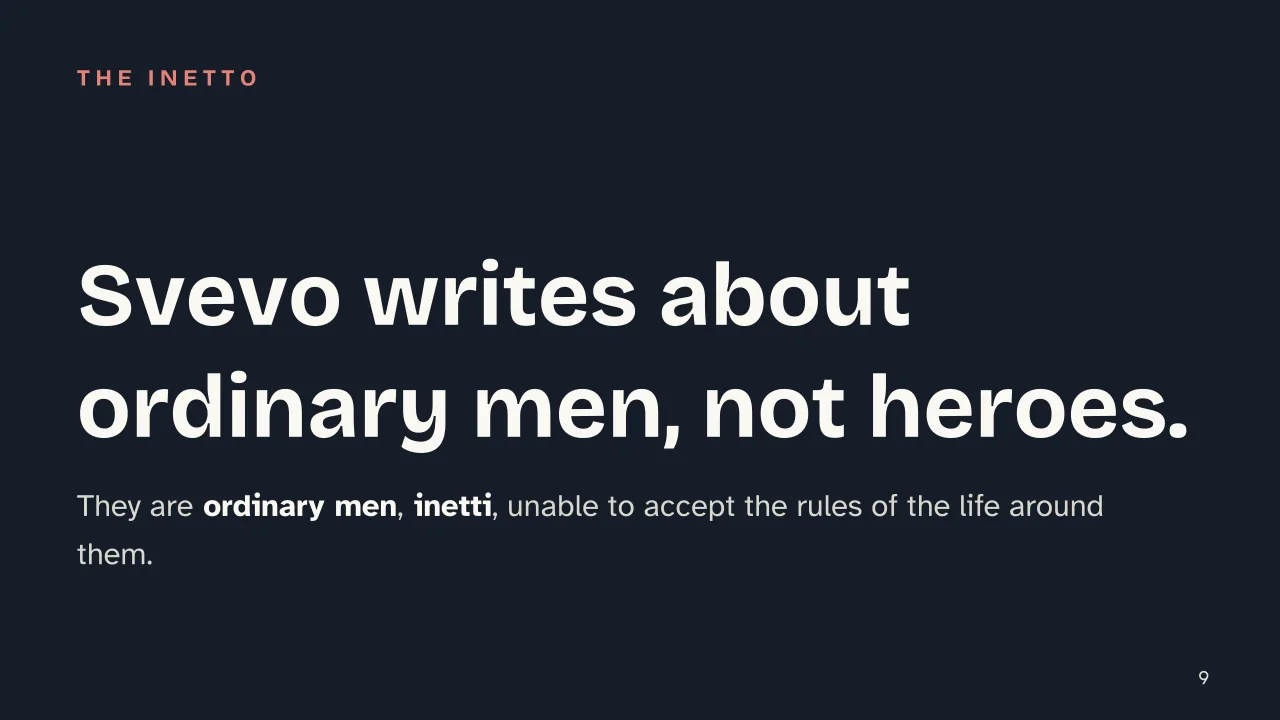
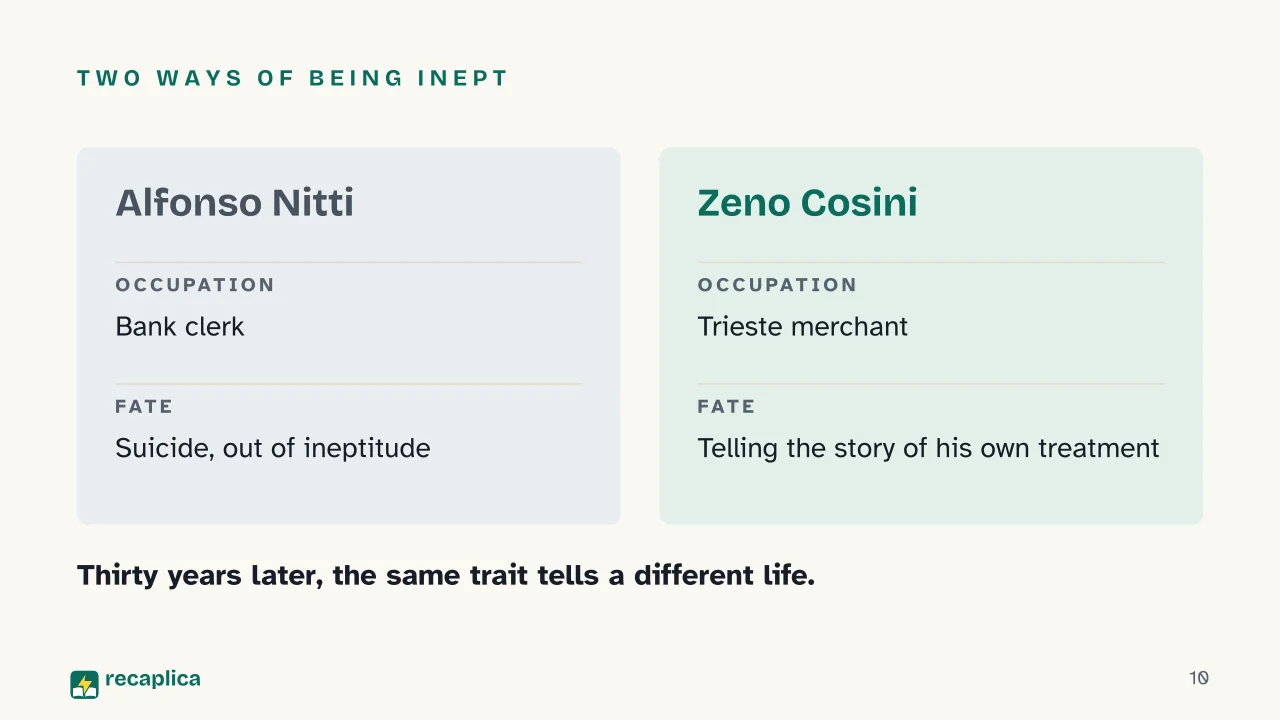
    A Life came out in Trieste in 1892, published by Vram, printed with the date 1893 on the cover. Its protagonist, Alfonso Nitti, is a clerk who never stops turning over his own every move and thought, and who ends up taking his own life, driven by his own inability to understand and accept the rules of the life around him. It is the first portrait of what critics call the “inetto”: a trait Treccani’s Enciclopedia dei ragazzi sums up by describing the protagonists of Svevo’s novels as anti-heroes “of an incoherent, inept and listless nature,” “the ordinary man, without qualities.” As a Man Grows Older, published in 1898, is the second novel in the same vein.

    A practical example: to spot an “inetto” in Svevo’s sense, there is no need to look for a villain or an exceptional character. An ordinary man will do, like Alfonso Nitti, who spends more time watching and judging his own actions than actually living them, and who for that reason always ends up one step behind the unwritten rules of the people around him: at work, in love, in everyday life.

    The third novel, Zeno’s Conscience, took shape after Trieste became part of Italy, and came out in 1923 after a very difficult start: it is the book that finally brought Svevo recognition for his literary merits, after the first two had gone almost unnoticed. Its protagonist, the Trieste merchant Zeno Cosini, tells in the first person the story of the psychoanalytic treatment he undertook with a doctor who signs the preface as “Doctor S.” and explains that he is publishing his patient’s memoir “out of revenge.” It is a different narrative structure from the first two novels, and it is also the book in which Svevo’s relationship with psychoanalysis shows most clearly.

    Freud and the discovery of psychoanalysis

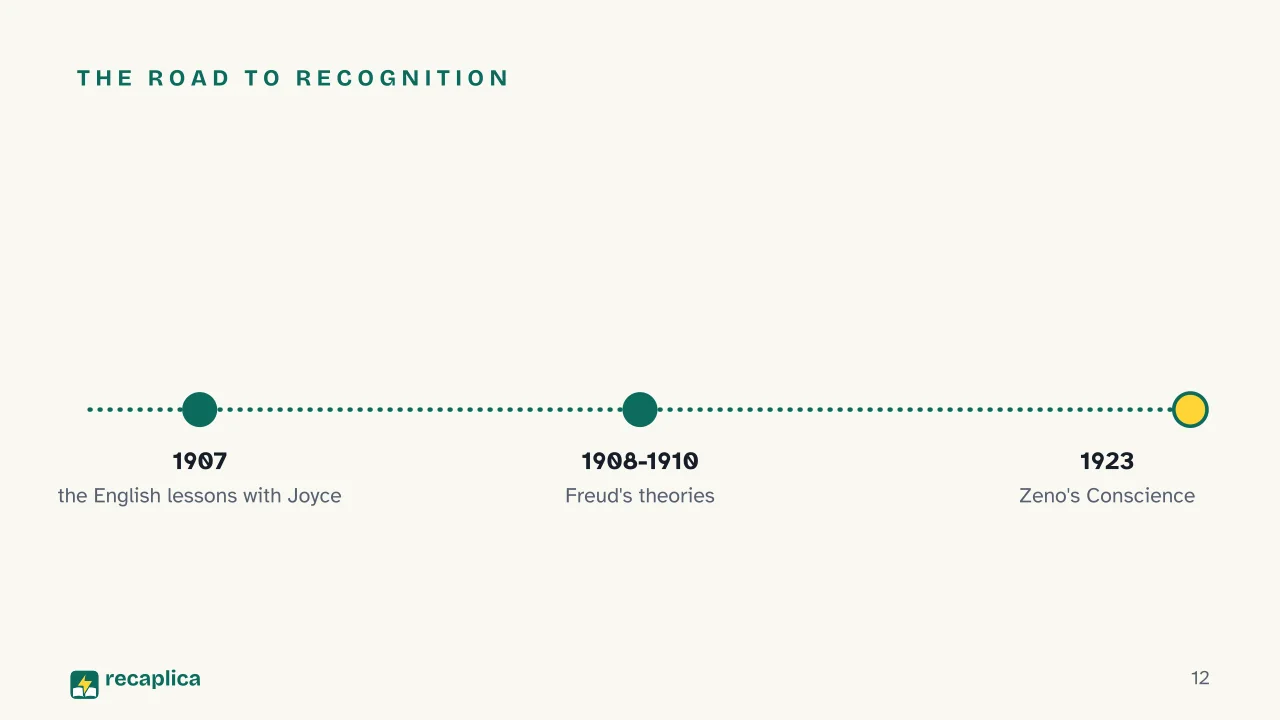
    Svevo came into contact with Sigmund Freud’s theories, and he himself traced this knowledge back to the years between 1908 and 1910. It was an encounter that matured slowly alongside other influences before flowing into his writing: it is above all Zeno’s Conscience that shows how much that reading had changed the way Svevo built a novel, based as it is on his protagonist’s psychoanalytic treatment.

    Meeting James Joyce

    It was the demands of his work as a merchant that led Svevo, in Trieste in 1907, to start taking private English lessons from a twenty-five- year-old Irishman who had reached the city in October 1904: his name was James Joyce, a complete unknown there at the time. The relationship began for practical reasons, but it did not stay that way: over the years it grew into a lasting friendship, and only later, according to Treccani’s Enciclopedia dei ragazzi, did the friendship with the Irish writer “manage to become a spur” for Svevo’s writing.

    Recognition that came late

    For nearly all his productive life, Svevo remained an almost unknown author, far from official literary circles: he worked at the bank, wrote in the evening, and his first two novels never found a wide readership. The Museo Sveviano in Trieste describes the start of Zeno’s Conscience as “painfully slow” — a way of saying that even the third novel did not immediately change things.

    In the story of early twentieth-century Italian literature, Svevo’s career sits alongside that of Luigi Pirandello, another major novelist who, in nearby years, staged the uncertainty of identity and the crisis of the ordinary self, though with different tools. His fiction, by contrast, stays fairly distant from the Verismo of Giovanni Verga, focused on a rural, regional world, and from the Decadentism of Gabriele D’Annunzio, which glorifies the exceptional individual in the figure of the superuomo: Svevo’s inetti are, on the contrary, ordinary men whom life seems always to push one step back.

    Slide deck

    Slides ready to download and make your own in PowerPoint or Google Slides, with speaker notes. Pick the Flash cut or the Full one.
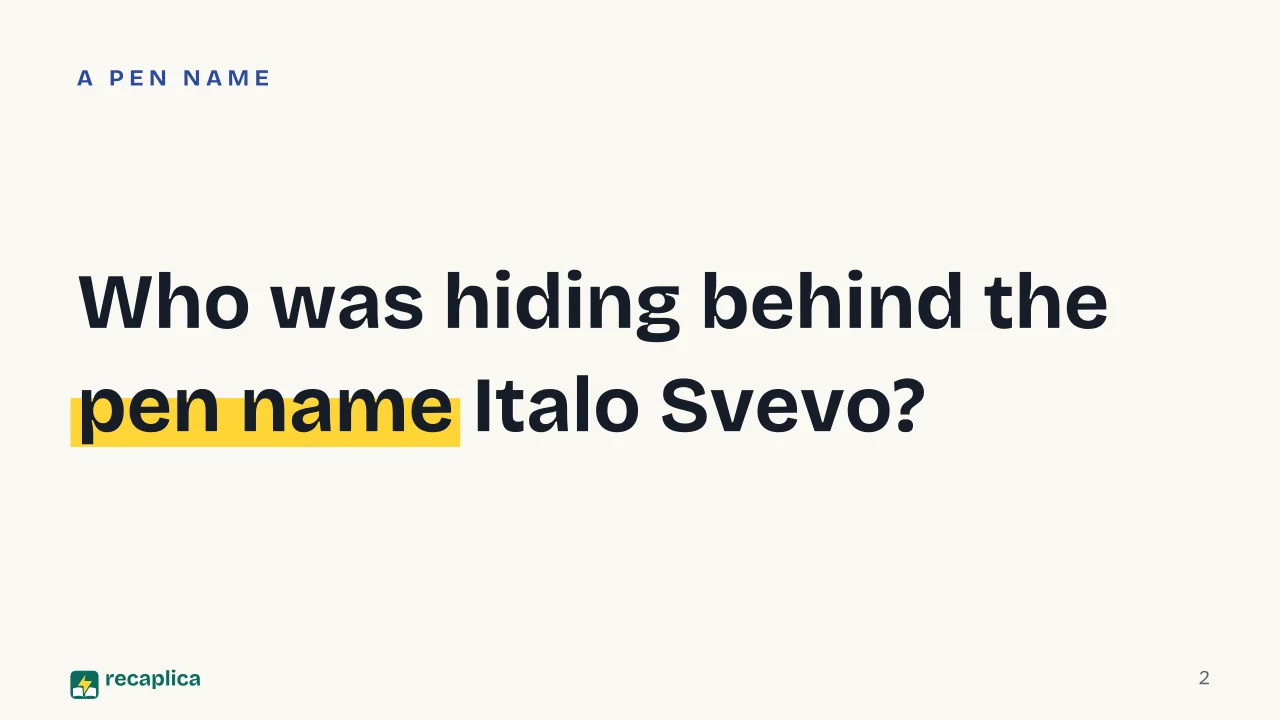
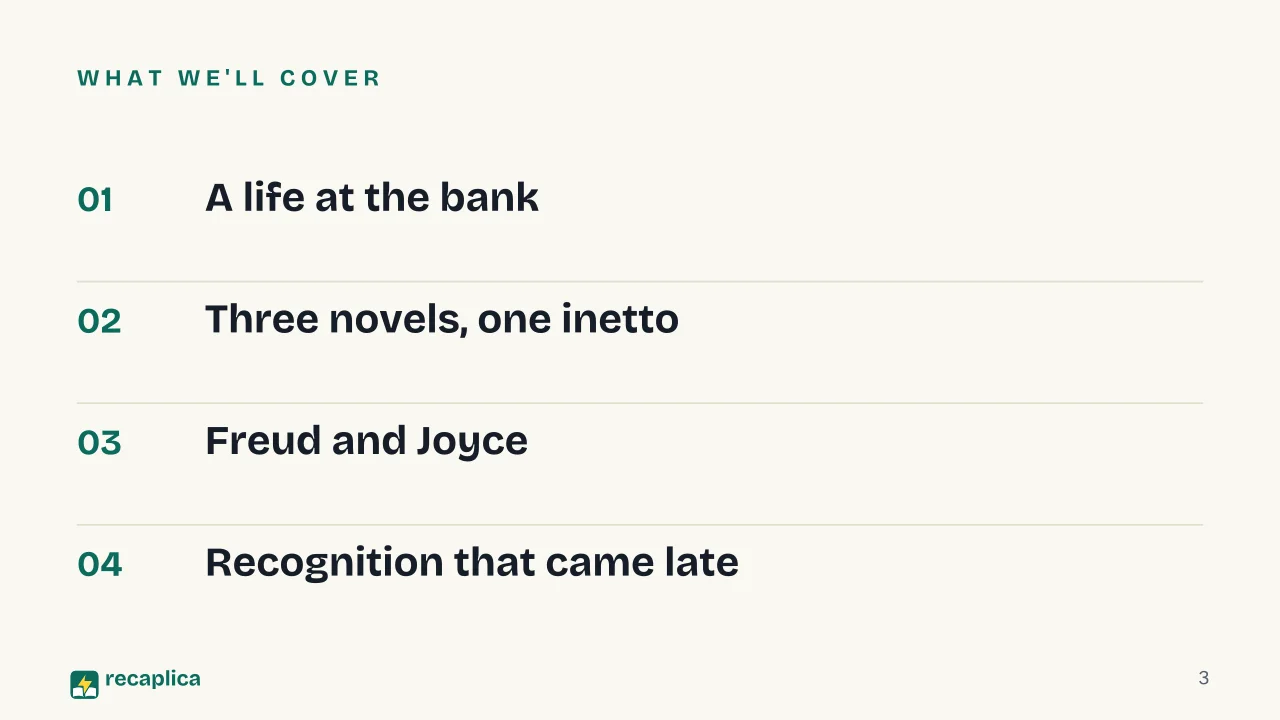
    Slide 1 of the presentation on Italo Svevo: Italo SvevoSlide 2 of the presentation on Italo Svevo: Who was hiding behind the pen name Italo Svevo?Slide 3 of the presentation on Italo Svevo: What we'll coverSlide 4 of the presentation on Italo Svevo: Chapter 01: A life at the bankSlide 5 of the presentation on Italo Svevo: The lifeSlide 6 of the presentation on Italo Svevo: A life in three datesSlide 7 of the presentation on Italo Svevo: Chapter 02: Three novels, one inettoSlide 8 of the presentation on Italo Svevo: Three novels to understand SvevoSlide 9 of the presentation on Italo Svevo: Svevo writes about ordinary men, not heroes.Slide 10 of the presentation on Italo Svevo: Two ways of being ineptSlide 11 of the presentation on Italo Svevo: Chapter 03: Freud and JoyceSlide 12 of the presentation on Italo Svevo: The road to recognitionSlide 13 of the presentation on Italo Svevo: Zeno's Conscience was not an immediate success.Slide 14 of the presentation on Italo Svevo: Chapter 04: Recognition that came lateSlide 15 of the presentation on Italo Svevo: Why did Svevo have to wait so long for recognition?Slide 16 of the presentation on Italo Svevo: Which novel finally brought Svevo widespread recognition?Slide 17 of the presentation on Italo Svevo: Now, time to review
    Flash10 slidesThe essential thread, to present in classFull17 slidesEvery chapter and the deeper detail

    Common myths

    • ✗ Myth Italo Svevo was a full-time professional novelist from a young age.

      ✓ Reality For eighteen years, from 1880, he worked as a clerk at the Trieste branch of the Unionbank of Vienna; he wrote his first novels while remaining, for a long time, an almost unknown author, far from official literary circles.

    • ✗ Myth Zeno's Conscience was an immediate success, as Svevo himself expected after his first two novels.

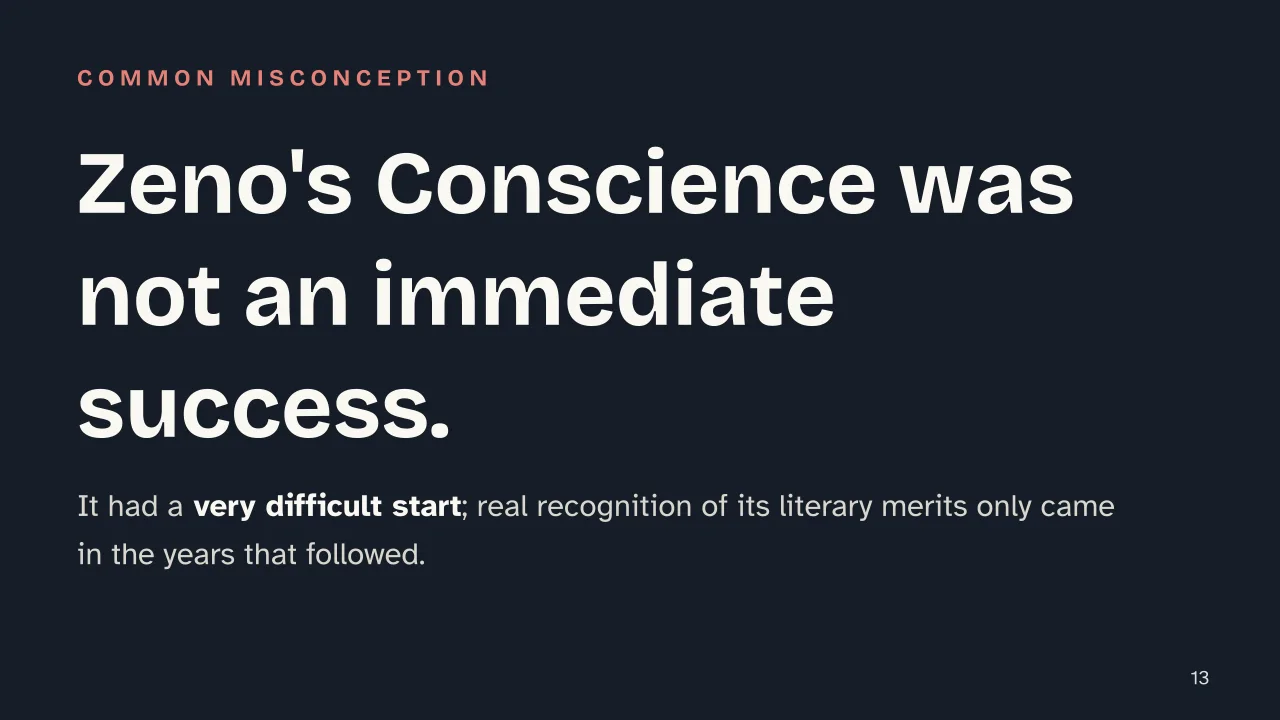
      ✓ Reality According to the Museo Sveviano in Trieste, the novel had a very difficult start; real recognition of its literary merits only came in the years following its 1923 publication.

    • ✗ Myth James Joyce was a literary mentor to Svevo from their very first meeting.

      ✓ Reality Their relationship began for practical reasons, the private English lessons Joyce gave Svevo from 1907 for his work needs; only later, according to Treccani's Enciclopedia dei ragazzi, did the friendship with the Irish writer "manage to become a spur" for his writing.

    Mind map

    Drag the background to move around and the nodes to reposition them; use − and + to collapse and expand branches.
    Customize
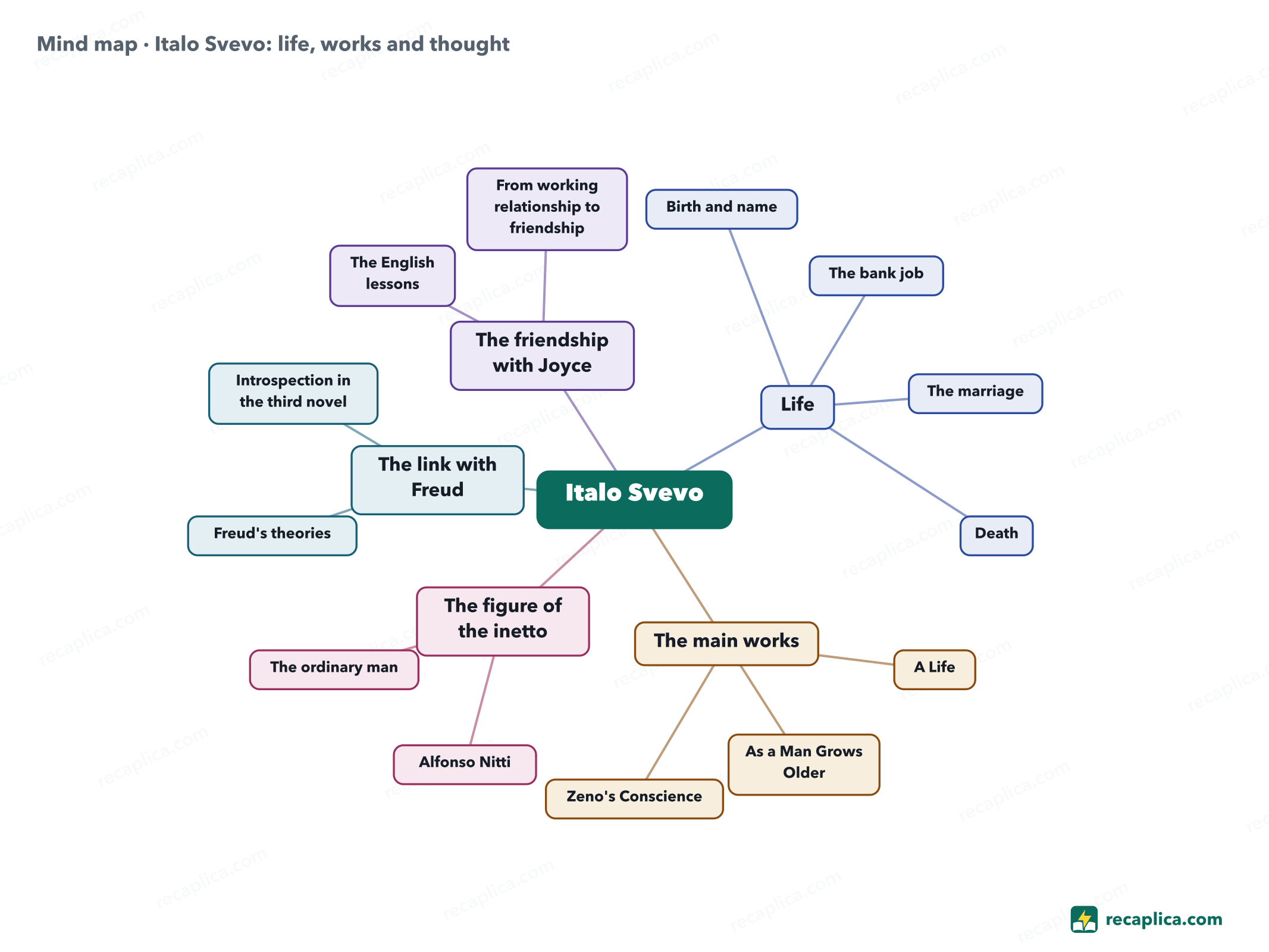
    Mind map: Italo Svevo: life, works and thought
    • Italo Svevo
      • Life
        • Birth and name Trieste, 19 December 1861, real name Ettore Schmitz
        • The bank job eighteen years at the Unionbank of Vienna, from 1880
        • The marriage to Livia Veneziani, civil ceremony in 1896
        • Death 13 September 1928, at Motta di Livenza
      • The main works
        • A Life 1892, though dated 1893
        • As a Man Grows Older 1898
        • Zeno's Conscience 1923
      • The figure of the inetto
        • Alfonso Nitti protagonist of A Life, driven to suicide
        • The ordinary man without qualities, incoherent and listless
      • The link with Freud
        • Freud's theories encountered between 1908 and 1910
        • Introspection in the third novel Zeno Cosini's psychoanalytic treatment
      • The friendship with Joyce
        • The English lessons in Trieste, from 1907
        • From working relationship to friendship a spur for Svevo's writing

    Quiz: test yourself

    Answer the questions to check what you have learned: you get instant feedback and a short explanation.

    Grade 0/10 0/5
    1 In which city was Italo Svevo born, and under what real name?

    Italo Svevo was the pen name of the writer Ettore Schmitz, born in Trieste on 19 December 1861 and who died on 13 September 1928.

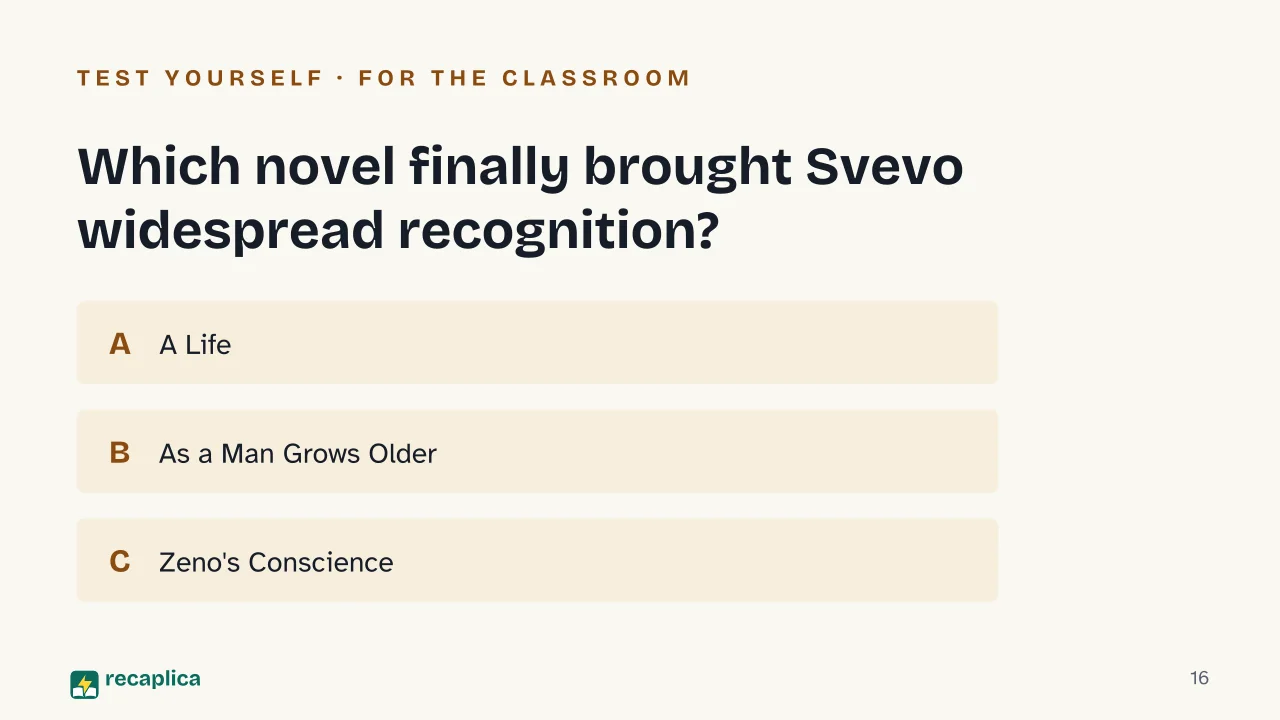
    2 Which novel finally brought Svevo widespread recognition for his literary merits?

    According to the Museo Sveviano in Trieste, Zeno's Conscience, published in 1923, gave Svevo the recognition his first two novels had not achieved, after a very difficult start.

    3 Who gave Italo Svevo private English lessons in Trieste, later becoming his friend?

    In 1907 Svevo began taking private English lessons from a twenty-five-year-old Irishman who had arrived in Trieste in October 1904, James Joyce; the working relationship grew into a lasting friendship.

    4 True or false: Italo Svevo worked for eighteen years as a clerk at a Trieste bank before turning more steadily to writing.

    True: on 27 September 1880 Svevo joined the Trieste branch of the Unionbank of Vienna, where he stayed eighteen years.

    5 What does the figure of the "inetto" mean in Svevo's novels?

    Treccani's Enciclopedia dei ragazzi describes the protagonists of Svevo's novels as anti-heroes "of an incoherent, inept and listless nature," "the ordinary man, without qualities."

    Answers: 1-A · 2-C · 3-A · 4-A · 5-B

    Flashcards

    Tap the card to flip it and check whether you remember the answer, then move to the next one.

    1 / 8

    Explain it in your own words

    The ultimate test: if you can explain it in simple words, you've truly understood it. Write your explanation, then compare it with the Recap.

    Your explanation is saved only on this device.

    Italo Svevo was the pen name of the Trieste-born writer Ettore Schmitz, born on 19 December 1861 and died on 13 September 1928. He spent eighteen years working as a bank clerk while writing novels that stayed on the margins of success for a long time. His three main works, A Life, As a Man Grows Older and Zeno's Conscience, follow protagonists unable to keep up with the rules of ordinary life, a figure critics call the inetto (the inept man). His contact with Sigmund Freud's theories and his friendship with the Irish writer James Joyce, whom he met in Trieste as an English teacher, shaped his writing decisively, above all in the third novel.

    Frequently asked questions

    Who was Italo Svevo?

    A writer from Trieste, born in 1861 and who died in 1928, writing under the pen name Italo Svevo (real name Ettore Schmitz). He worked for eighteen years as a bank clerk and wrote three main novels, A Life, As a Man Grows Older and Zeno's Conscience, about ordinary men unable to keep up with the life around them.

    What was Italo Svevo's real name?

    Ettore Schmitz. "Italo Svevo" is the pen name under which he published his work, a choice that joins his Italian identity ("Italo") with his father's family, of German origin ("Svevo", meaning Swabian).

    What are Italo Svevo's main works?

    The three novels A Life (1892, though dated 1893), As a Man Grows Older (1898) and Zeno's Conscience (1923). It was the last one that, after a very difficult start, finally brought him the recognition the first two had not achieved.

    What is the "inetto" in Svevo's novels?

    The trait shared by the protagonists of his novels, described as ordinary anti-heroes, incoherent and unable to accept the rules of the life around them. The first example is Alfonso Nitti, the protagonist of A Life, driven to suicide by his own inability to understand and accept those rules.

    What was Svevo's relationship with James Joyce?

    He met Joyce in Trieste, where in 1907 he began taking private English lessons from him; Joyce had arrived in the city in October 1904. Their relationship, at first purely professional, later grew into a lasting friendship and a spur for Svevo's writing.

    Sources

    • Treccani, Enciclopedia online — entry "Svèvo, Italo"
    • Museo LETS (Museo Sveviano, Trieste) — "Vita di Italo Svevo"
    • Treccani, Dizionario Biografico degli Italiani — entry "SCHMITZ, Aron Hector"
    • Treccani, Enciclopedia dei ragazzi — entry "Svevo, Italo"

    Every Recap goes through an independent review before publication.

    Every evening, the day's new Recaps on our Telegram channel. Join the channel →

    Keep learning

    • Literature Zeno's Conscience (Confessions of Zeno): Summary and Analysis Zeno's Conscience is the novel Italo Svevo published in 1923, the third and last of his major novels after A Life (1892) and As a Man Grows Older (1898). The book takes the shape of a memoir that Zeno Cosini writes at his psychoanalyst's urging, working through his life not in chronological order but chapter by chapter, each one built around a separate theme: smoking, his father's death, his marriage to Augusta, an affair with his lover Carla, and a business partnership with his brother-in-law Guido Speier. Zeno's account can't be taken at face value, since it passes through his own subjective memory and self-deceptions he never intended. Svevo paid to publish the book himself, and it barely sold in Italy at first; it found an audience only years later, after his friend James Joyce brought it to the attention of two French critics. Read the Recap →
    • Literature Cesare Beccaria: Life and Ideas in On Crimes and Punishments Cesare Beccaria was born in Milan in 1738 and died in the same city in 1794. In 1764 he anonymously published On Crimes and Punishments, a short treatise written within the Academy of Fists, the Milanese circle led by the Verri brothers. The book argues that punishment should be proportionate to the harm a crime does to the public good, that its purpose is to prevent further offenses, and it condemns judicial torture and the death penalty. Within a few years it was translated into French and English, and it found readers such as Catherine II of Russia, John Adams and Thomas Jefferson. Read the Recap →
    • Literature Giuseppe Parini: Life, The Day, and the Satire of the Nobility Giuseppe Parini was born in Bosisio in 1729, became a priest without a real calling in 1754, and taught eloquence in Milan at the Scuole Palatine. His major work, The Day, tells in unrhymed verse the story of one day in the life of a Milanese nobleman, the «giovin signore», from waking to sleep, using the solemn style of epic poetry to expose how empty that day really is. Alongside the poem he wrote the Odes, developed over nearly forty years, and the Dialogue on Nobility, a direct attack on the privileges of birth. Close to, but never fully aligned with, Pietro Verri's Enlightenment circle at the Caffè, he left behind a model of committed poetry that Foscolo and Manzoni would each take up in their own way. Read the Recap →

    recaplica

    Clear in 30 seconds, yours in 10 minutes.

    Recaps Mind maps Request a Recap Telegram channel Mind map maker Our method About Privacy & cookies Legal notes & terms of use

    © 2026 Recaplica · A project by Curi S.r.l. — VAT IT05472000750

    Statistics, only if you say so

    To learn which Recaps help most we would use Google Analytics, with aggregate, anonymous data. It starts only with your OK, and you can change your mind anytime. Privacy policy