Skip to content
recaplica

    One moment: security check

    Cloudflare wants to make sure you're not a robot. Tick the box below and your search will continue on its own.

    IT
    recaplica The Path to the Spider's Nests by Italo Calvino
    © 2026 Recaplica · recaplica.com — All rights reserved
    Home › Literature

    The Path to the Spider's Nests by Italo Calvino

    By Recaplica Newsroom · Updated on September 29, 2026

    What to print

    Page numbers appear when printing with default margins.

    Slides

    Choose a cut

    Flash10 slidesThe essential thread, to present in classFull16 slidesEvery chapter and the deeper detail

    Both come with speaker notes.

    Telegram channel
    recaplica Clear in 30 seconds, yours in 10 minutes.
    In 30 seconds Key points Deep dive Slides Myths Mind map Quiz Flashcards FAQ

    In 30 seconds quick read

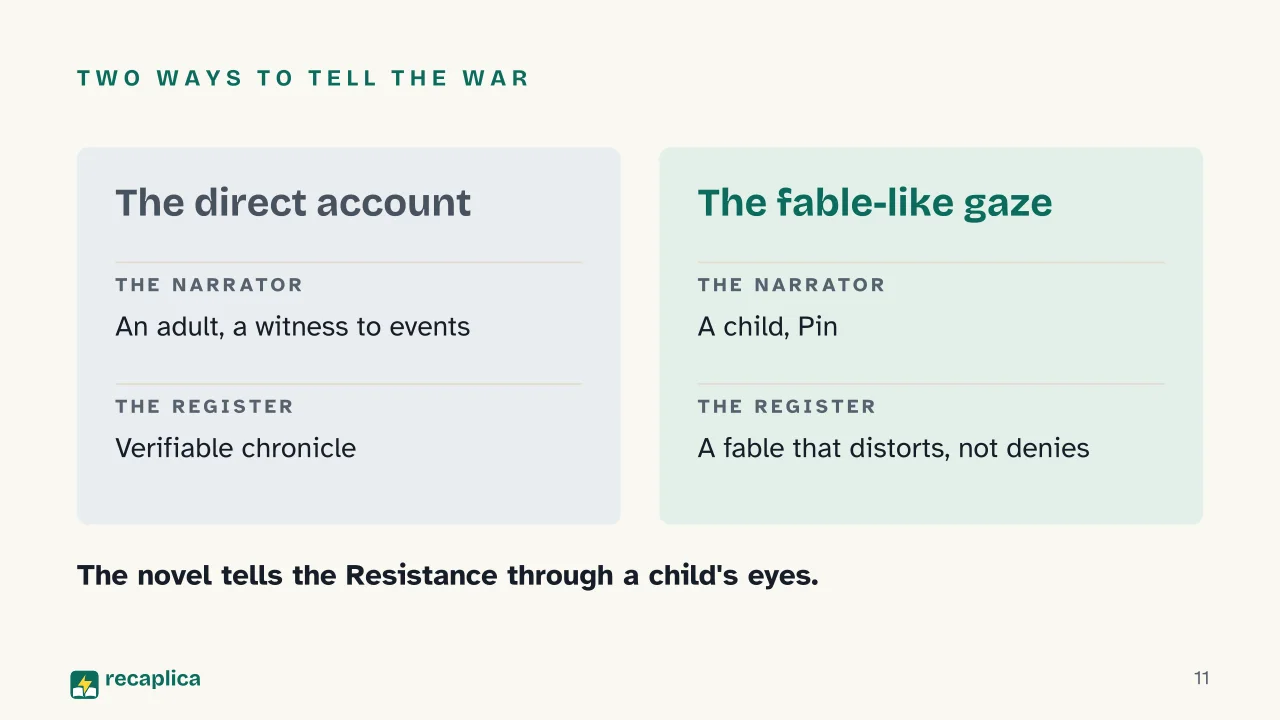
    The Path to the Spider's Nests is Italo Calvino's debut novel, published by Einaudi in the autumn of 1947. It tells the story of the Italian Resistance through Pin, a boy who steals a pistol from a sailor and hides it in a place only he knows. Calvino wrote it in about twenty days, at 23, to meet a literary prize deadline of December 31, 1946 — the same young man who had joined the partisans in 1944 under the nom de guerre Santiago. The novel is the book critics point to when they introduce Calvino's early phase, known as fantastic neorealism: a war told through a child's fable-like gaze rather than a direct, adult account.

    Key Points

    • Published by Einaudi in autumn 1947, it is Italo Calvino's debut novel.
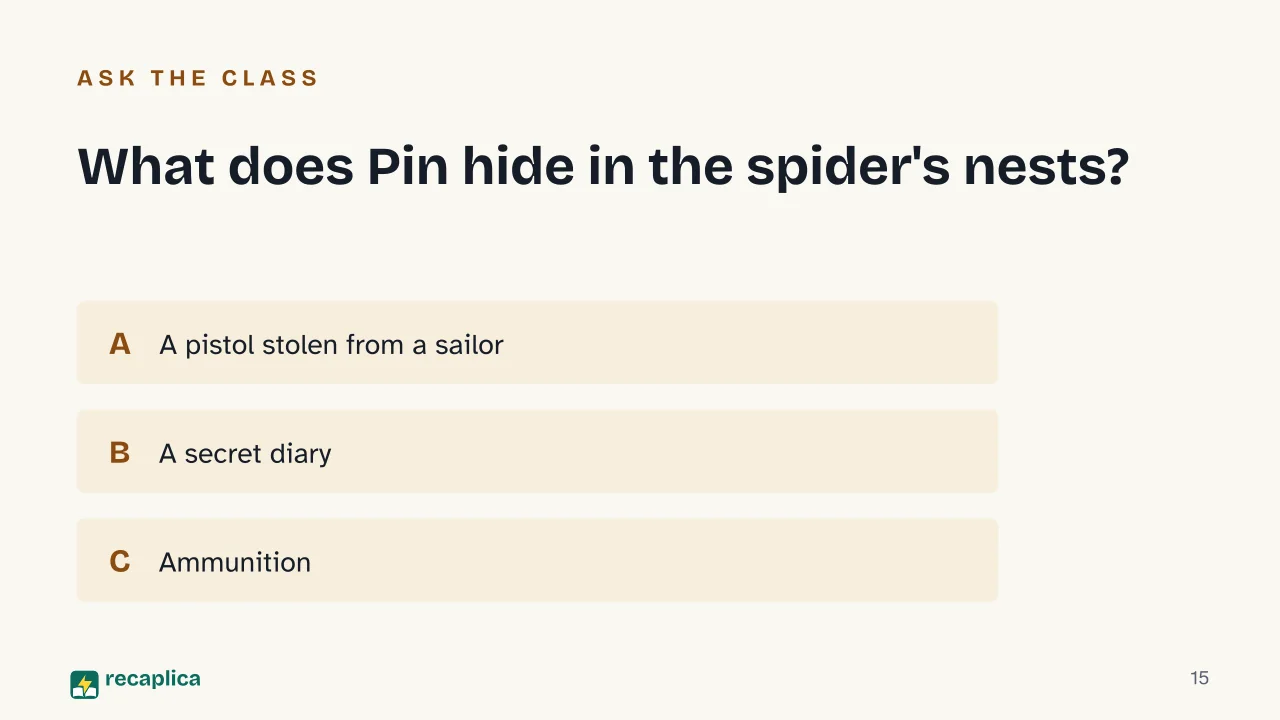
    • The protagonist Pin steals a pistol from a sailor and hides it where spiders nest, giving the book its title.
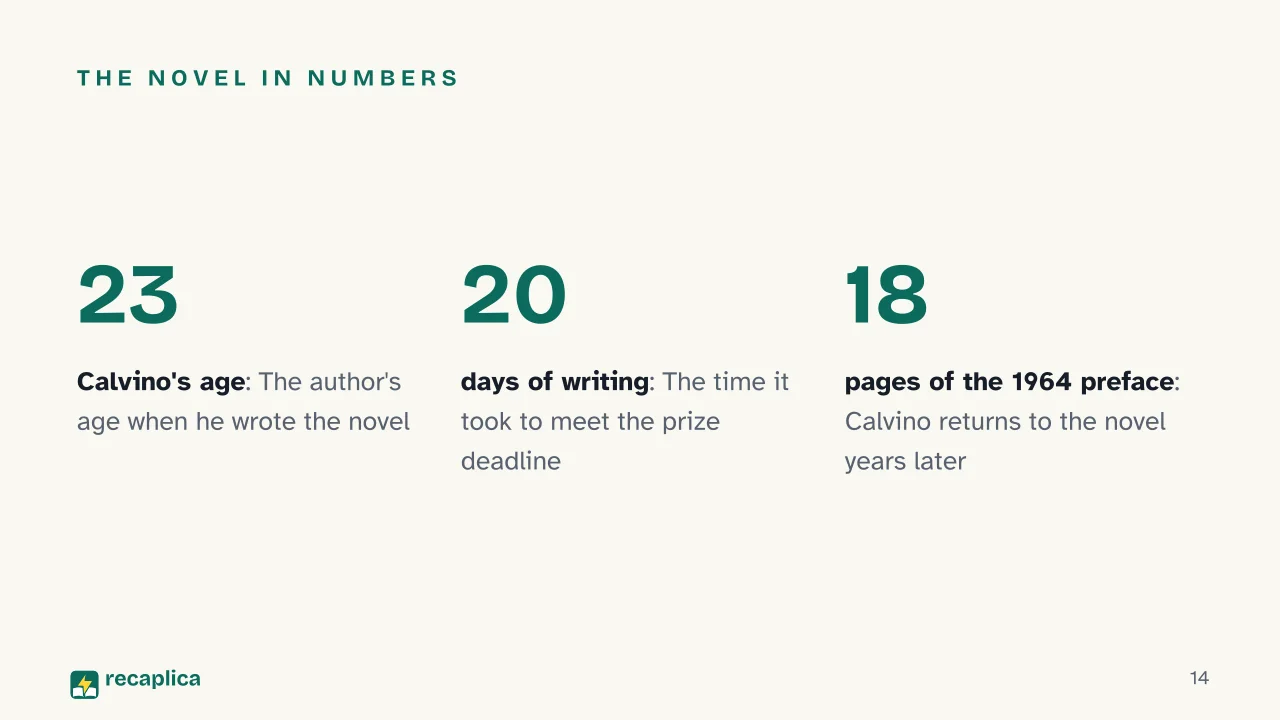
    • Calvino wrote it in about twenty days, at 23, to meet a literary prize deadline of December 31, 1946.
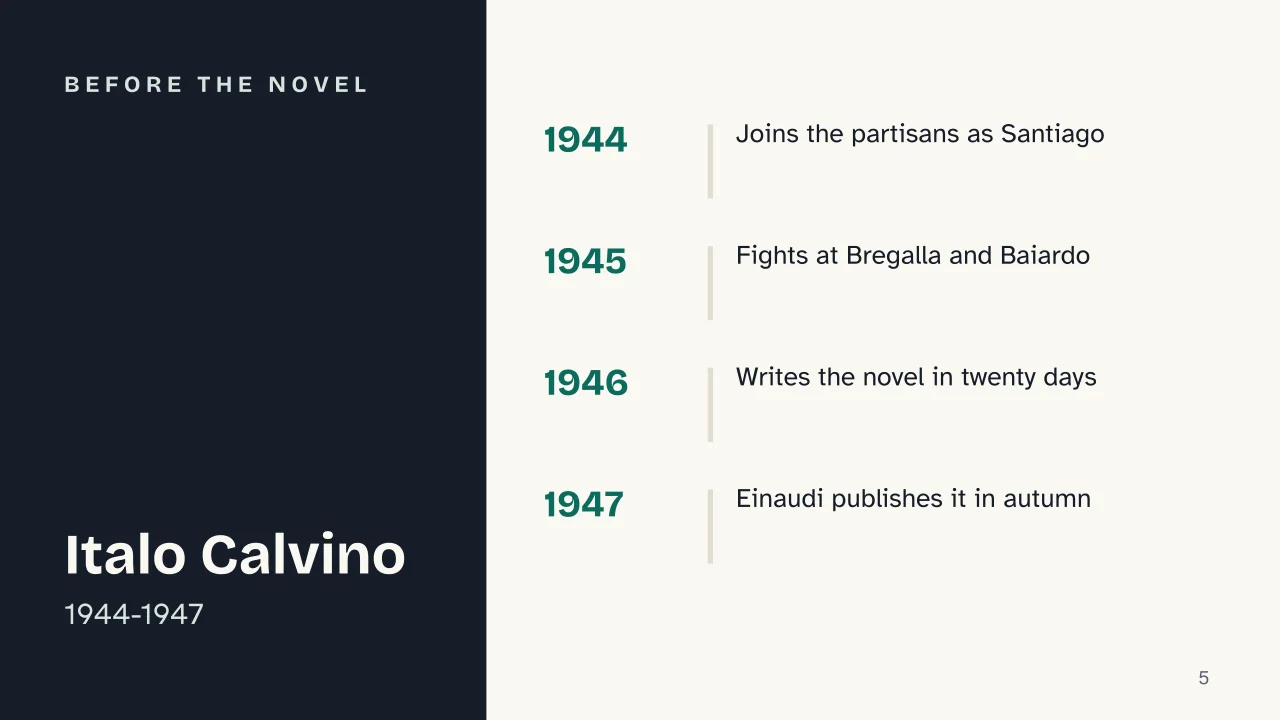
    • Before becoming a writer, Calvino had joined the partisans in June 1944 under the nom de guerre Santiago.
    • The novel shared a prize, but also met early reservations from Elio Vittorini and Cesare Pavese.
    • In 1964 Calvino returned to the novel with an eighteen-page author's preface.

    Deep Dive

    When Italo Calvino submitted The Path to the Spider’s Nests for a literary prize at the end of 1946, he was 23 and carried an experience he never narrates in the first person in the book: fighting with the partisans. The novel appeared the following year, in the autumn of 1947, published by Einaudi, and became the text through which textbooks and anthologies introduce the first phase of his writing, the one critics call fantastic neorealism.

    Who Calvino was before the novel

    In June 1944 Calvino joined the partisans under the nom de guerre Santiago, taken from his birthplace, Santiago de Las Vegas, in Cuba. He served in the 16th detachment of the 9th Communist Garibaldi brigade “Felice Cascione”; between February and April 1945 he moved to the 2nd Garibaldi assault division “Felice Cascione” and took part in fighting along the border between Liguria and Piedmont, including at Bregalla and Baiardo, in the final months of World War 2 in Italy.

    Less than two years after that experience, Calvino wrote a novel that does not recount it directly: the war is told by a boy standing on the margins of the Resistance, not by one of its protagonists. For a literary prize with a deadline of December 31, 1946, he wrote The Path to the Spider’s Nests in about twenty days.

    The plot of The Path to the Spider’s Nests

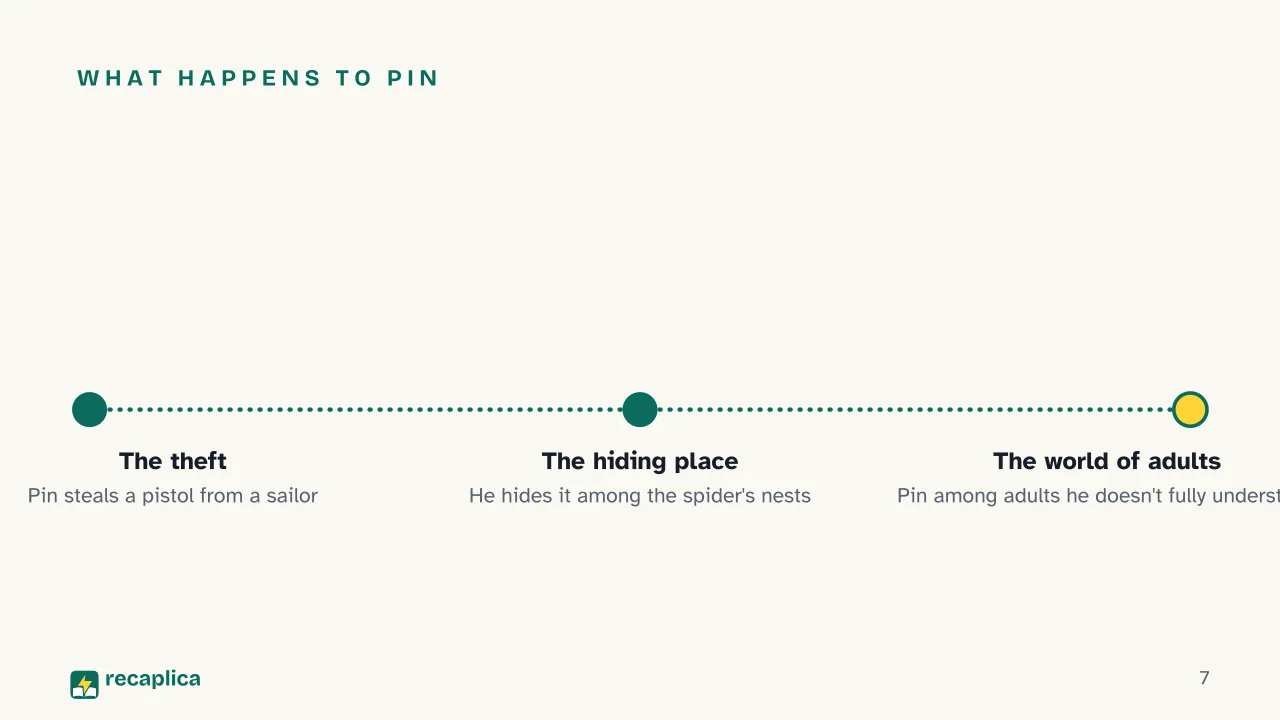
    The novel’s protagonist is Pin, a boy who lives on the edge of the old town, brother of a woman who works as a prostitute and an unwilling companion to the men who pass through her house. The story begins when Pin steals a pistol from a sailor and hides it somewhere only he knows: a path where spiders build their nests among the grass, the “spider’s nests” of the title.

    From there the boy brushes against the world of adults, men and women caught up in the Resistance in different ways, without fully grasping what is at stake: for Pin, the war remains, in part, a dangerous game among grown-ups.

    Example: the theft of the pistol could be told as an act of wartime sabotage, a political gesture. Calvino instead tells it as the way a boy gets hold of a treasure to hide away: the same event changes register depending on who is looking at it, and that shift is exactly how fantastic neorealism works.

    Fantastic neorealism

    The term describes how Calvino, in this novel, holds together two things that seem opposed: the historical substance of the Resistance and a fable-like gaze, almost like a story for children. Treccani describes the novel’s style as a harsh, distorted fable, close to the perception of a boy raised in the alleys of old Sanremo — a description that keeps both poles in view: the fable, which is the form, and the harshness and distortion, which are the historical content filtered through it.

    It is neither a direct account of the partisan war nor a comforting fairy tale: it is a reading of the Resistance built on a partial, childlike point of view, one that can distort events without making them false. It remains one possible reading of the book, not the only one: the novel also lends itself to a more political or more linguistic analysis, depending on what a reader chooses to focus on.

    Compared with the nineteenth-century verismo of Giovanni Verga, which portrayed the poor with an almost documentary eye, Calvino shifts the filter from objective observation to the viewpoint of a single child, gaps and all. The fascism the novel leaves in the background had, in the years before, built an image of itself very different from the one Calvino’s fellow partisans knew firsthand, as the Recap on the Mussolini myth recounts.

    The 1947 reception and the 1964 return

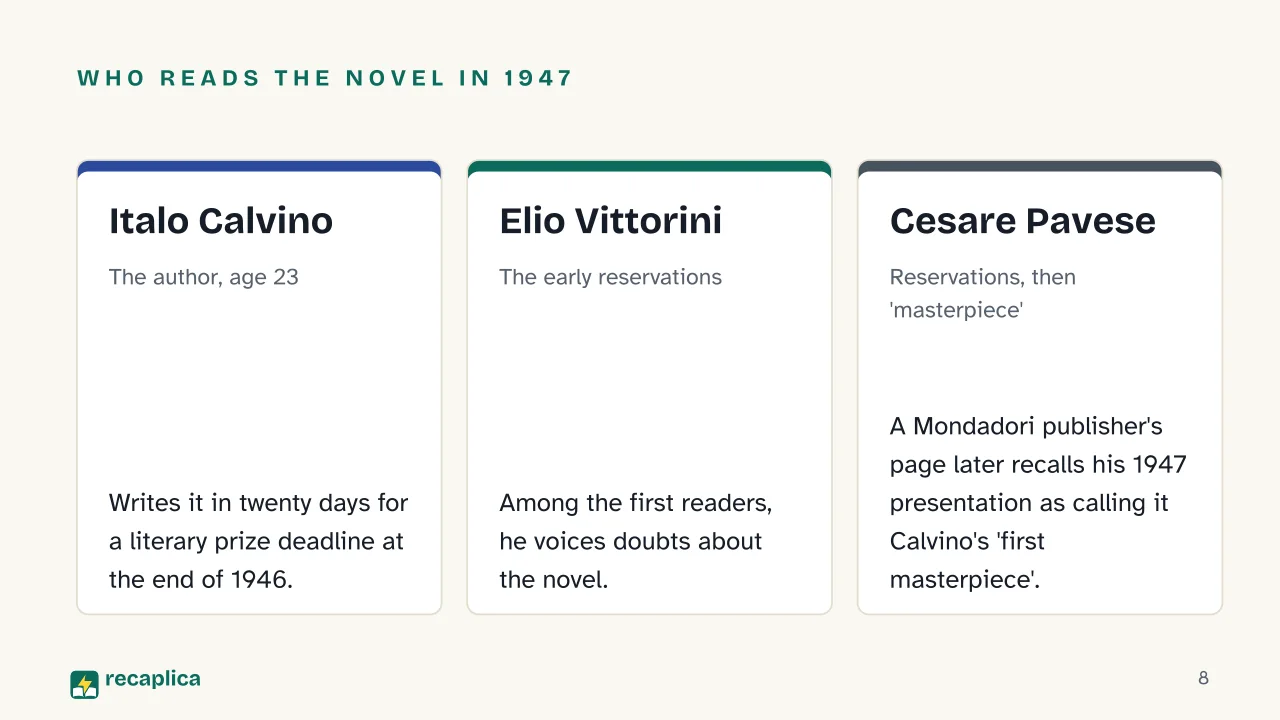
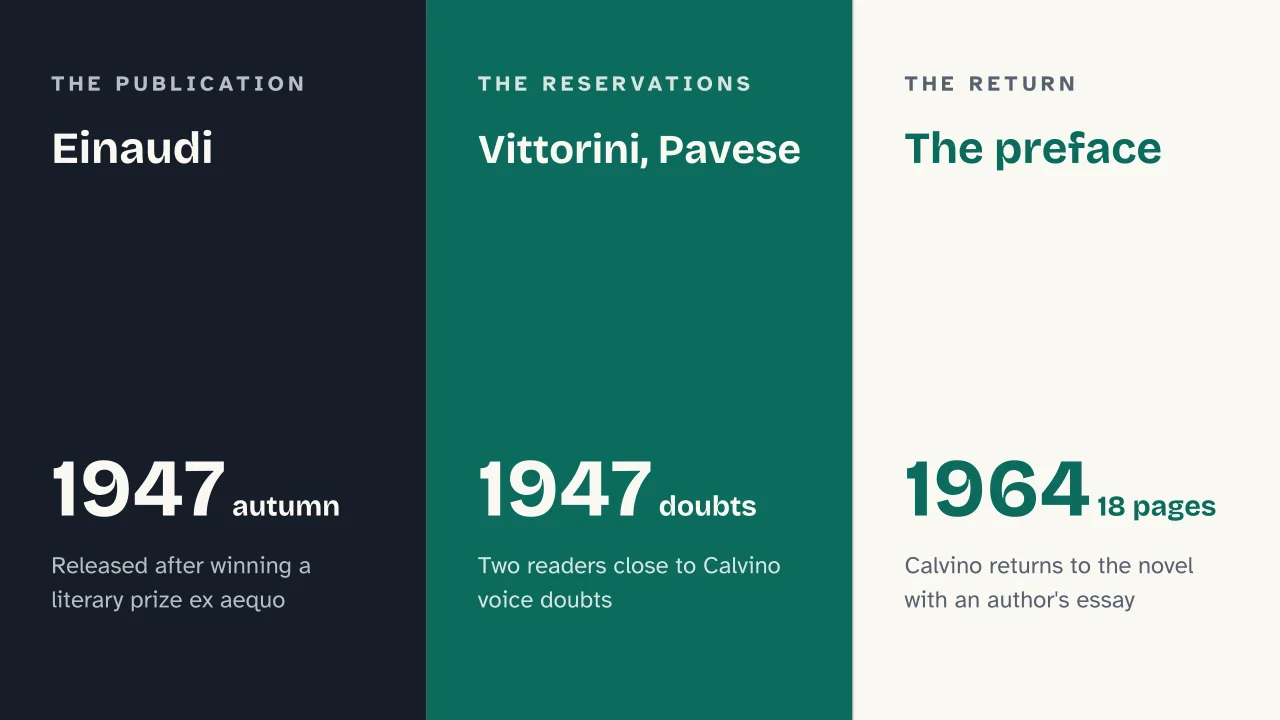
    On its release, the novel shared a literary prize, but also drew reservations from Giansiro Ferrata, Elio Vittorini and Cesare Pavese. A Mondadori publisher’s page, recalling Pavese’s 1947 presentation, remembers that text as calling the novel Calvino’s “first masterpiece” — a judgment the page attributes to Pavese, though it does not appear to have been verified against the original text of the presentation.

    Seventeen years later, for a new Einaudi edition dated June 20, 1964, in the “I coralli” series, Calvino returned to his debut novel with an eighteen-page author’s preface. Calvino made his debut in an Italian literary twentieth century that had already made room for writers like Luigi Pirandello, even if working from very different premises.

    Slide deck

    Slides ready to download and make your own in PowerPoint or Google Slides, with speaker notes. Pick the Flash cut or the Full one.
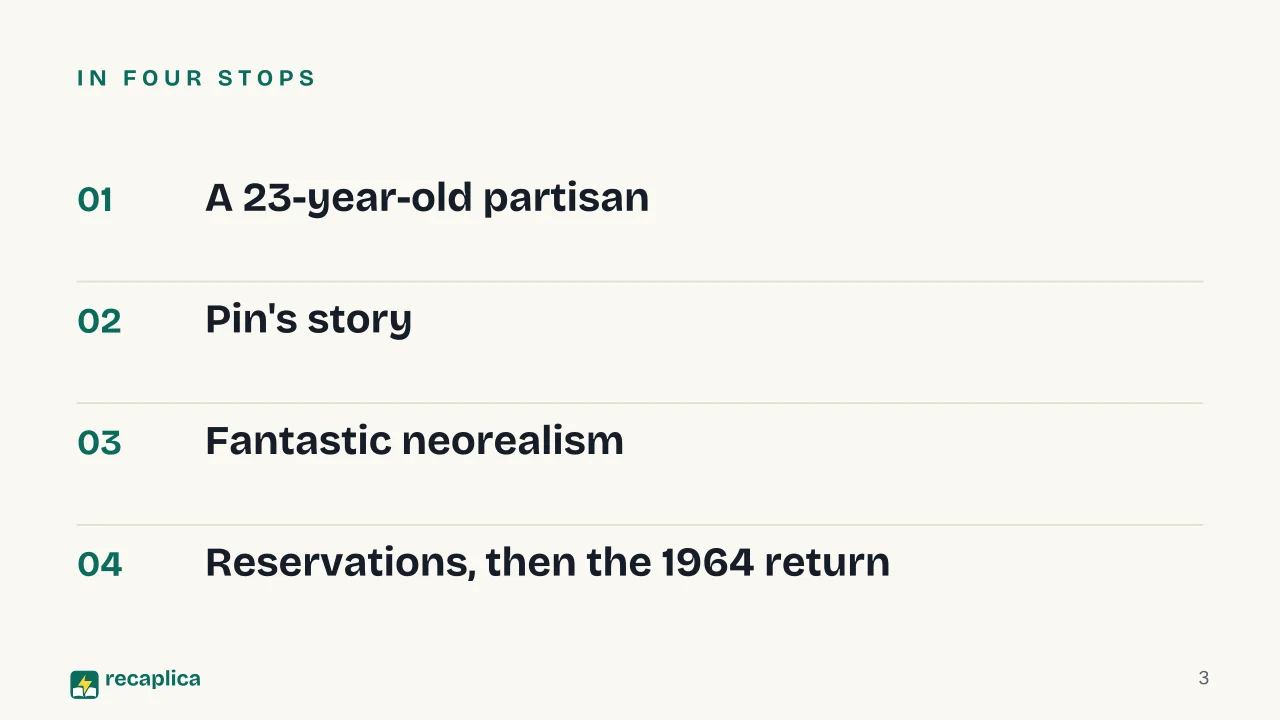
    Slide 1 of the presentation on The Path to the Spider's Nests by Italo Calvino: The Path to the Spider's NestsSlide 2 of the presentation on The Path to the Spider's Nests by Italo Calvino: Why does a novel about the Resistance talk about spiders?Slide 3 of the presentation on The Path to the Spider's Nests by Italo Calvino: In four stopsSlide 4 of the presentation on The Path to the Spider's Nests by Italo Calvino: Chapter 01: A 23-year-old partisanSlide 5 of the presentation on The Path to the Spider's Nests by Italo Calvino: Before the novelSlide 6 of the presentation on The Path to the Spider's Nests by Italo Calvino: Chapter 02: Pin's storySlide 7 of the presentation on The Path to the Spider's Nests by Italo Calvino: What happens to PinSlide 8 of the presentation on The Path to the Spider's Nests by Italo Calvino: Who reads the novel in 1947: Italo Calvino, Elio Vittorini, Cesare PaveseSlide 9 of the presentation on The Path to the Spider's Nests by Italo Calvino: Chapter 03: Fantastic neorealismSlide 10 of the presentation on The Path to the Spider's Nests by Italo Calvino: Fantastic neorealism looks at the war through a child's eyes.Slide 11 of the presentation on The Path to the Spider's Nests by Italo Calvino: Two ways to tell the warSlide 12 of the presentation on The Path to the Spider's Nests by Italo Calvino: Chapter 04: Reservations, then the 1964 returnSlide 13 of the presentation on The Path to the Spider's Nests by Italo Calvino: Einaudi · Vittorini, Pavese · The prefaceSlide 14 of the presentation on The Path to the Spider's Nests by Italo Calvino: The novel in numbersSlide 15 of the presentation on The Path to the Spider's Nests by Italo Calvino: What does Pin hide in the spider's nests?Slide 16 of the presentation on The Path to the Spider's Nests by Italo Calvino: The full Recap
    Flash10 slidesThe essential thread, to present in classFull16 slidesEvery chapter and the deeper detail

    Common myths

    • ✗ Myth The Path to the Spider's Nests is a realistic war novel, a direct account of the Resistance seen through an adult's eyes.

      ✓ Reality The story is told by Pin, a boy on the margins of the Resistance: the novel filters events through a childlike, fable-like gaze, not through the direct testimony of an adult combatant.

    • ✗ Myth Calvino wrote the novel as a memoir of his own experience as a partisan.

      ✓ Reality Calvino had fought with the Garibaldi brigades under the nom de guerre Santiago, but the novel is not told in the first person: he chose a boy-narrator standing at the edges of the Resistance, not an alter ego of himself as a fighter.

    • ✗ Myth The novel was hailed as an undisputed masterpiece from the moment it appeared.

      ✓ Reality On its release in 1947 it shared a literary prize, but also met early reservations from Elio Vittorini and Cesare Pavese; it is a later publisher's blurb, not a unanimous 1947 verdict, that remembers it as Calvino's 'first masterpiece'.

    Mind map

    Drag the background to move around and the nodes to reposition them; use − and + to collapse and expand branches.
    Customize
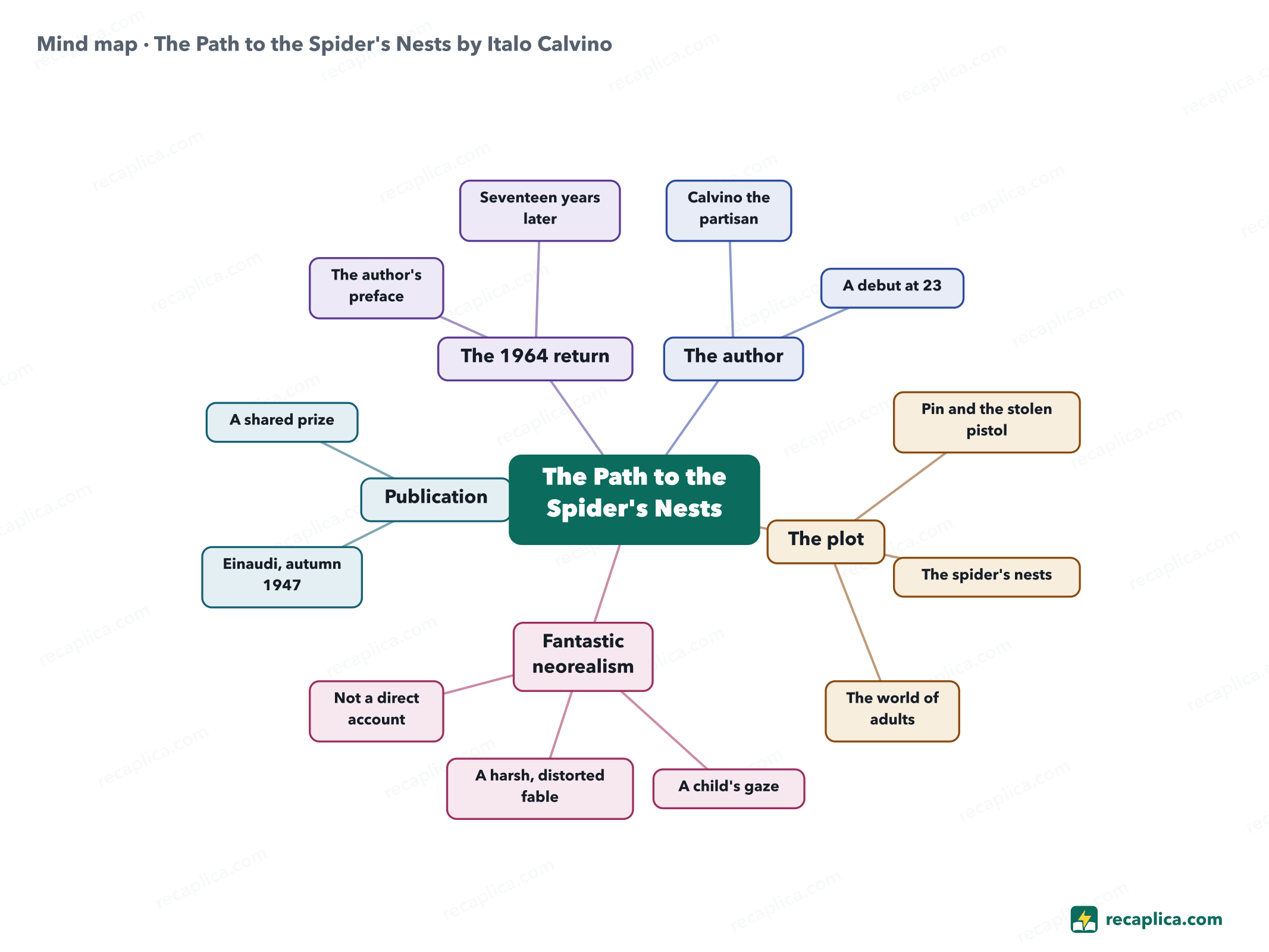
    Mind map: The Path to the Spider's Nests by Italo Calvino
    • The Path to the Spider's Nests
      • The author
        • Calvino the partisan Nom de guerre Santiago, Garibaldi brigades, 1944-1945
        • A debut at 23 Written in twenty days for a literary prize
      • The plot
        • Pin and the stolen pistol The theft from a sailor
        • The spider's nests The secret hiding spot that gives the novel its title
        • The world of adults Pin among adults caught up in the Resistance
      • Fantastic neorealism
        • A child's gaze The war filtered through a boy's eyes
        • A harsh, distorted fable Treccani's description of the novel's style
        • Not a direct account One possible reading among others
      • Publication
        • Einaudi, autumn 1947
        • A shared prize And the early reservations of Vittorini and Pavese
      • The 1964 return
        • The author's preface Eighteen pages, for the 1964 Einaudi edition
        • Seventeen years later Calvino reopens his debut novel

    Quiz: test yourself

    Answer the questions to check what you have learned: you get instant feedback and a short explanation.

    Grade 0/10 0/5
    1 In what year was The Path to the Spider's Nests published?

    Einaudi published the novel in autumn 1947, a year after Calvino wrote it.

    2 What was Italo Calvino's nom de guerre during the Resistance?

    Calvino joined the partisans in June 1944 under the name Santiago, taken from his birthplace, Santiago de Las Vegas, in Cuba.

    3 What does Pin hide in the titular spider's nests?

    Pin steals a pistol from a sailor and hides it in that secret spot, which gives the novel its title.

    4 According to Treccani, how long did it take Calvino to write the novel?

    Calvino wrote it in about twenty days to meet a literary prize deadline of December 31, 1946.

    5 According to Treccani, how was the novel received when it came out?

    The novel shared a literary prize, but also received early reservations from Giansiro Ferrata, Elio Vittorini and Cesare Pavese.

    Answers: 1-B · 2-B · 3-A · 4-A · 5-B

    Flashcards

    Tap the card to flip it and check whether you remember the answer, then move to the next one.

    1 / 7

    Explain it in your own words

    The ultimate test: if you can explain it in simple words, you've truly understood it. Write your explanation, then compare it with the Recap.

    Your explanation is saved only on this device.

    The Path to the Spider's Nests is Italo Calvino's debut novel, published by Einaudi in the autumn of 1947. It tells the story of the Italian Resistance through Pin, a boy who steals a pistol from a sailor and hides it in a place only he knows. Calvino wrote it in about twenty days, at 23, to meet a literary prize deadline of December 31, 1946 — the same young man who had joined the partisans in 1944 under the nom de guerre Santiago. The novel is the book critics point to when they introduce Calvino's early phase, known as fantastic neorealism: a war told through a child's fable-like gaze rather than a direct, adult account.

    Frequently asked questions

    What is The Path to the Spider's Nests about?

    It tells the story of the Italian Resistance through Pin, a boy who lives on the fringes of the partisan struggle: the war reaches him filtered through his own limited understanding, not as a direct adult account.

    What happens in the novel?

    Pin steals a pistol from a sailor and hides it in a secret spot only he knows, a path where spiders build their nests in the grass, the title's 'spider's nests'. From there he brushes against the adult world of the Resistance without fully grasping what is at stake.

    What is Calvino's fantastic neorealism?

    It is the term used to describe Calvino's first narrative phase: the historical substance of the Resistance told through a childlike, fable-like gaze.

    Who is Pin, the novel's protagonist?

    A boy who lives on the edge of the old town, brother of a woman who works as a prostitute; he steals a pistol from a sailor and hides it in his secret refuge, the spider's nests.

    How was The Path to the Spider's Nests received when it came out?

    In 1947 it shared a literary prize, but also met early reservations from Elio Vittorini and Cesare Pavese, two readers close to Calvino; in 1964 Calvino himself returned to the novel with an eighteen-page preface.

    Sources

    • Treccani, Dizionario Biografico degli Italiani – Italo Calvino
    • Mondadori – Il sentiero dei nidi di ragno, publisher's page
    • Laboratorio Calvino – bibliographic record, Einaudi 1964 edition

    Every Recap goes through an independent review before publication.

    Every evening, the day's new Recaps on our Telegram channel. Join the channel →

    Keep learning

    • Literature Zeno's Conscience (Confessions of Zeno): Summary and Analysis Zeno's Conscience is the novel Italo Svevo published in 1923, the third and last of his major novels after A Life (1892) and As a Man Grows Older (1898). The book takes the shape of a memoir that Zeno Cosini writes at his psychoanalyst's urging, working through his life not in chronological order but chapter by chapter, each one built around a separate theme: smoking, his father's death, his marriage to Augusta, an affair with his lover Carla, and a business partnership with his brother-in-law Guido Speier. Zeno's account can't be taken at face value, since it passes through his own subjective memory and self-deceptions he never intended. Svevo paid to publish the book himself, and it barely sold in Italy at first; it found an audience only years later, after his friend James Joyce brought it to the attention of two French critics. Read the Recap →
    • Literature Cesare Beccaria: Life and Ideas in On Crimes and Punishments Cesare Beccaria was born in Milan in 1738 and died in the same city in 1794. In 1764 he anonymously published On Crimes and Punishments, a short treatise written within the Academy of Fists, the Milanese circle led by the Verri brothers. The book argues that punishment should be proportionate to the harm a crime does to the public good, that its purpose is to prevent further offenses, and it condemns judicial torture and the death penalty. Within a few years it was translated into French and English, and it found readers such as Catherine II of Russia, John Adams and Thomas Jefferson. Read the Recap →
    • Literature Giuseppe Parini: Life, The Day, and the Satire of the Nobility Giuseppe Parini was born in Bosisio in 1729, became a priest without a real calling in 1754, and taught eloquence in Milan at the Scuole Palatine. His major work, The Day, tells in unrhymed verse the story of one day in the life of a Milanese nobleman, the «giovin signore», from waking to sleep, using the solemn style of epic poetry to expose how empty that day really is. Alongside the poem he wrote the Odes, developed over nearly forty years, and the Dialogue on Nobility, a direct attack on the privileges of birth. Close to, but never fully aligned with, Pietro Verri's Enlightenment circle at the Caffè, he left behind a model of committed poetry that Foscolo and Manzoni would each take up in their own way. Read the Recap →

    recaplica

    Clear in 30 seconds, yours in 10 minutes.

    Recaps Mind maps Request a Recap Telegram channel Mind map maker Our method About Privacy & cookies Legal notes & terms of use

    © 2026 Recaplica · A project by Curi S.r.l. — VAT IT05472000750

    Statistics, only if you say so

    To learn which Recaps help most we would use Google Analytics, with aggregate, anonymous data. It starts only with your OK, and you can change your mind anytime. Privacy policy