|
recaplica
Giovanni Pascoli: Life, the Fanciullino and Major Poems | ||||||||||||||||||||||||||||||||||||
| © 2026 Recaplica · recaplica.com — All rights reserved | ||||||||||||||||||||||||||||||||||||
Giovanni Pascoli: Life, the Fanciullino and Major PoemsWhat to print Page numbers appear when printing with default margins. SlidesChoose a cut Flash10 slidesThe essential thread, to present in classFull18 slidesEvery chapter and the deeper detailBoth come with speaker notes. In 30 seconds quick readGiovanni Pascoli (1855-1912) was one of the leading Italian poets between the 19th and 20th centuries, best known for the poetics of the fanciullino: the idea that a childlike way of seeing survives inside every adult, able to marvel at ordinary things as though seeing them for the first time. His childhood was marked by his father's murder in 1867 and by a string of family deaths in the years that followed, events that resurface often in his poetry alongside other themes. He taught Latin and Greek at several schools and universities, eventually succeeding his mentor Giosuè Carducci in the chair of Italian literature in Bologna. His best-known works are the poetry collections Myricae and Canti di Castelvecchio, along with the essay Il fanciullino, where he lays out his idea of poetry. Key Points
Key figures
Deep DiveA childhood broken by grief without justiceGiovanni Pascoli was born on 31 December 1855 in San Mauro di Romagna, near Forlì, the fourth of ten children of Ruggero Pascoli and Caterina Alloccatelli Vincenzi. His father managed the “la Torre” estate on behalf of the Torlonia family, Roman princes, a position that gave the family a solid economic standing, but also drew some local envy. That stability shattered on 10 August 1867: Ruggero was shot dead on the Via Emilia while riding back by carriage from the train station in Cesena. The man believed to be behind the killing was a local landowner who coveted Ruggero’s job as estate manager, but the crime was never solved: the Pascoli family never got justice. Giovanni was twelve. In the years that followed, the family was struck by a string of further deaths: his sister Margherita died of typhus in November 1868, his mother Caterina a month later, his brother Luigi of meningitis in 1871, and his brother Giacomo, who had taken on responsibility for the family in the meantime and was remembered as “the little father,” of typhus in 1876. Two sisters stayed close to Giovanni: Ida, who married Salvatore Berti in 1895, and Maria, known as Mariù, who never left his side for the rest of his life.
From studies in Bologna to jail over a heckle in courtFrom 1862 to 1871 Pascoli studied at the Collegio Raffaello in Urbino, run by the Piarist fathers, where he built a solid grounding in Latin alongside Italian. After a year in Florence to finish secondary school, in the autumn of 1873 he enrolled to study literature at the University of Bologna on a scholarship. There he met Giosuè Carducci, who became his mentor and opened his reading to English, French and German poets alongside the classics: a decisive influence, even if the relationship between the two men always stayed uneasy, made up of admiration but also some unspoken resentment over Carducci’s silence about his student’s Italian poetry. In 1876 Pascoli lost his scholarship for heckling the government minister Ruggero Bonghi, and carried on his studies as an unofficial student. In those years he drifted toward the Bakuninist wing of the International Workingmen’s Association, introduced by Andrea Costa, and took part in meetings and gatherings of the movement. In September 1879, during the trial of a group of International protesters, he shouted out in a Bologna courtroom and was arrested: he spent three months in the San Giovanni in Monte prison, until well into December, before being tried and fully acquitted. After the episode his active political involvement slowed down, partly because the anarchist movement itself went into crisis in the years that followed. He graduated on 17 June 1882, with full marks and honors, with a thesis on Alcaeus. From provincial schools to the chair once held by CarducciBefore reaching university level, Pascoli taught Greek and Latin at several secondary schools: in Matera from 1882, in Massa from 1884, in Livorno from 1887. Only at the end of October 1895 did he land his first university chair, as associate professor of Latin and Greek grammar in Bologna, a period he found unsatisfying. In 1897 he moved to Messina as full professor of Latin literature, “for special merit”; in 1903 he moved on to Pisa. Between 1905 and 1906 came his most significant milestone: the faculty of letters in Bologna awarded him the chair of Italian literature that had belonged to Carducci, and on 9 January 1906 Pascoli delivered his inaugural lecture as his mentor’s direct successor. From May 1885 he lived at the villa of Castelvecchio di Barga, on the Caprona hill, together with his sister Mariù: a place of poetic inspiration where the poet is now buried. It’s here, more than in any university hall, that most of his work took shape. The poetics of the fanciullinoIn 1897, in the Florentine magazine Il Marzocco, Pascoli published a series of essays that would become the book Il fanciullino, the text in which he lays out his idea of poetry. He sums it up directly: poetry, he writes, lies in “the sight of some overlooked detail, outside us and within us.” According to Pascoli, a child survives inside every adult, able to look at the world without the habits that make us take everything for granted, and the poet’s task is to let that child speak. This poetics rests on recovering memory and a deep subjectivity, read through a visionary rather than a rational lens. From here comes one of the most recurring symbols in his work: the “nest,” the family shelter and lost childhood that Pascoli tries to rebuild inside his own consciousness, and inside his verse.
Myricae and Pascoli’s other major worksThe title Myricae appeared for the first time on 10 August 1890, the exact anniversary of his father’s murder, in the magazine Vita nuova: a coincidence of dates that ties Pascoli’s most famous work, from the start, to the loss that had marked his childhood. The collection came out as a book in 1891, with 22 poems, and grew through later editions up to the fifth and final one in 1900. In the same years Pascoli also published three essays on Dante, Minerva oscura (1898), Sotto il velame (1900) and La mirabile visione (1902).
A style built from sound and detailPascoli’s style applies careful craftsmanship to common, everyday subjects, with a looser meter than usual, full of internal echoes. His language is often described as sound-symbolic: onomatopoeia, alliteration and repetition that imitate the sound of what they describe, within a syntax that favors association by analogy over the logical thread of argument. A clear example is found in two poems from Myricae about a summer storm. In Il Lampo (“The Lightning”): “E cielo e terra si mostrò qual era: / la terra ansante, livida, in sussulto” (sky and earth showed themselves as they truly were: the earth gasping, livid, shuddering); the lightning itself is compared to “an eye that, wide, terror-struck, / opened and shut, in the black night.” In Il Tuono (“The Thunder”), the sound of thunder is built from verbs piling on top of one another: “rimbombò, rimbalzò, rotolò cupo” (it boomed, bounced, rolled darkly), before the tension dissolves into a domestic image, “the rocking of a cradle.” The same technique carries X Agosto, the poem that links the memory of his father to the death of a swallow: “Anche un uomo tornava al suo nido: / l’uccisero: disse: Perdono” (a man, too, was returning to his nest: they killed him: he said, forgive them). In Pascoli’s verse, death keeps returning as a mystery that stirs dread, pushing the poet to narrow his gaze onto the small, concrete things around him: animals, humble plants, the peasants of Romagna and Tuscany. Anyone curious about how a family loss can run through an entire body of literary work, even in very different forms, may also enjoy our piece on the Aeneid, where the theme of loss and memory sits just as centrally at the heart of Virgil’s poem. Pascoli and D’Annunzio, two answers to DecadentismTextbooks often compare Pascoli’s poetics with that of his contemporary, Gabriele D’Annunzio. It wasn’t a direct rivalry: D’Annunzio admired Myricae from the moment it appeared, reviewing it enthusiastically in Naples’s Il Mattino on 30-31 December 1892. Still, the two poetics stayed far apart, and the comparison remains a recurring one in Italian literature textbooks.
In Il fanciullino itself, Pascoli seems to mark his distance from that other idea of poetry: “for poetry, youth isn’t enough: it takes childhood.” In textbooks, D’Annunzio’s cult of the superuomo is often described as owing something to a not entirely rigorous reading of Nietzsche: that’s a common line in current teaching materials, more than a settled critical verdict, but it helps explain why the two poetics are so often read as mirror opposites of the same period. From youthful socialism to “the great proletariat”Pascoli’s political path didn’t stay fixed on the internationalist sympathies of his youth. On 26 November 1911, at the Teatro dei Differenti in Barga, he delivered the speech known as “La grande proletaria s’è mossa” (“The great proletariat has moved”), in support of the Italian-Turkish war in Libya. It marks a turning point: from the libertarian socialism of his university years to what scholars call a patriotic socialism, carrying notes of national pride tied to the mythology of the Risorgimento. It’s a speech that marks a sharp nationalist turn in Pascoli’s final years, a long way from the libertarian socialism of his university days. The final years and his legacyPascoli died in Bologna on 6 April 1912, of liver cirrhosis, a few years after finally reaching the chair that had belonged to his mentor Carducci. His sister Mariù, who had stayed by his side since 1885, outlived him until 1953 and in 1961 published her own memoir of her brother’s life. In 1932 his birthplace, San Mauro di Romagna, was renamed San Mauro Pascoli by royal decree, in his honor. Alongside his Italian output, Pascoli also kept writing Latin poetry for years, entering the international Certamen poeticum Hoeufftianum in Amsterdam almost every year, a sign of how much his classical training stayed alive alongside his writing in Italian. His legacy weighs on the Italian poetry that followed through the 20th century, both for his attention to the smallest detail and for a language that moved away from the single lyric register inherited from Petrarch. Readers who want to keep exploring the voices of Italian literature that marked the turn of that century can also read our piece on Luigi Pirandello, another author who, in the years just after, carried a similar unease into the language and forms of Italian literature. Slide deckSlides ready to download and make your own in PowerPoint or Google Slides, with speaker notes. Pick the Flash cut or the Full one.     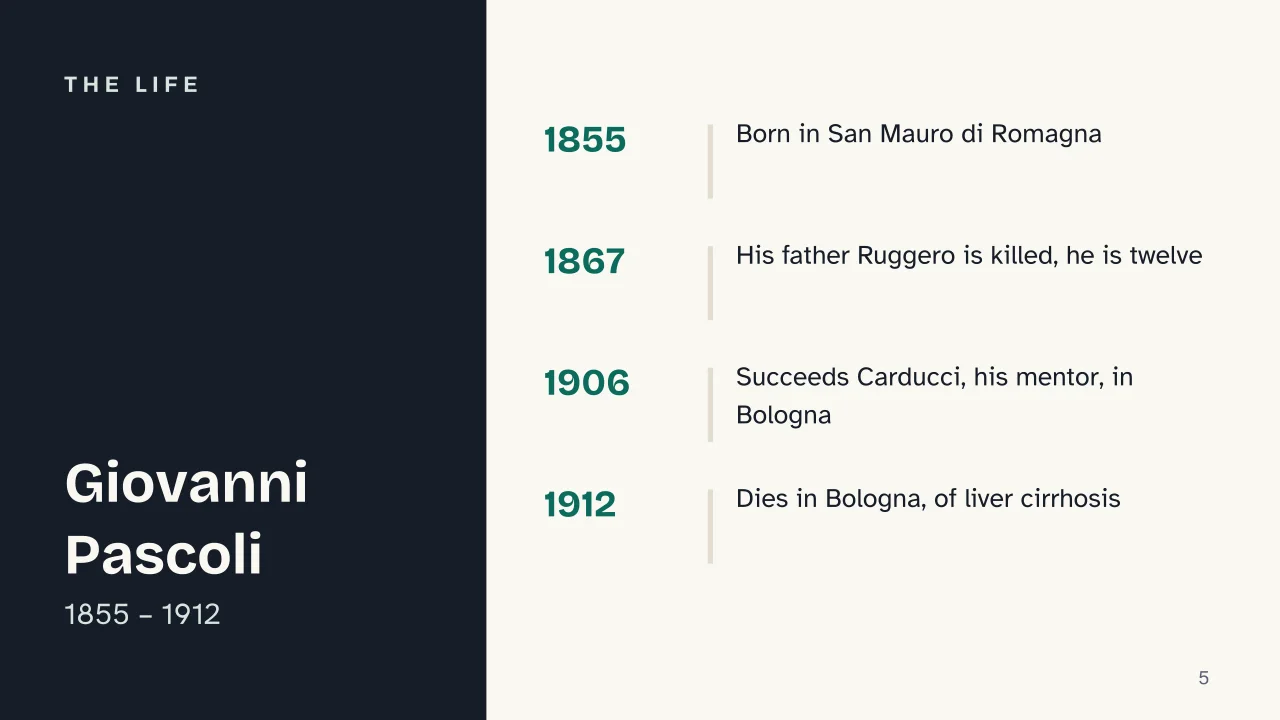 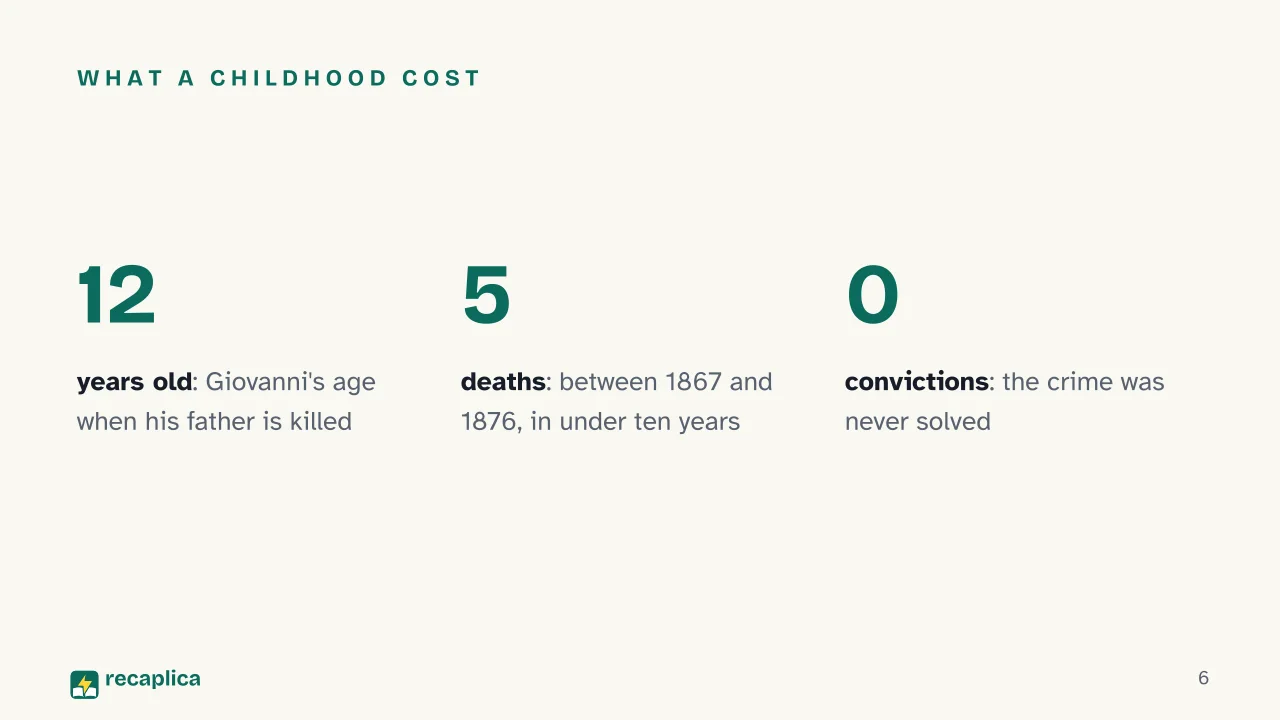  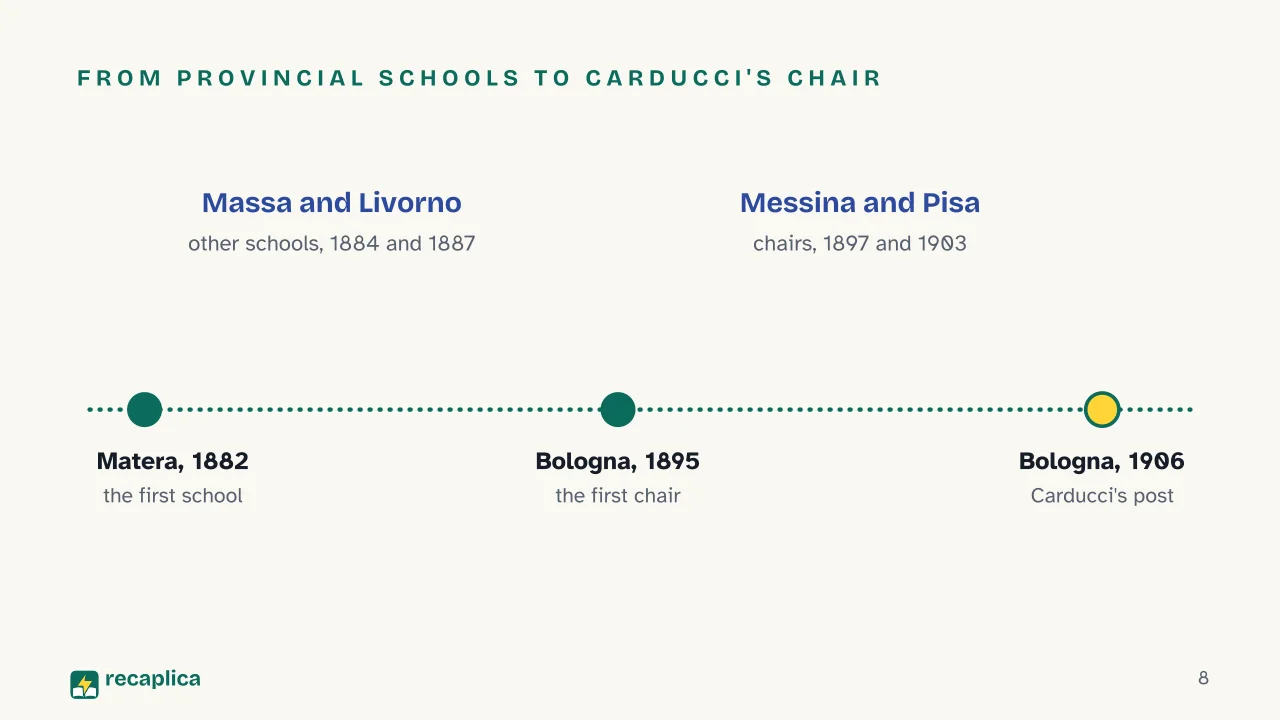 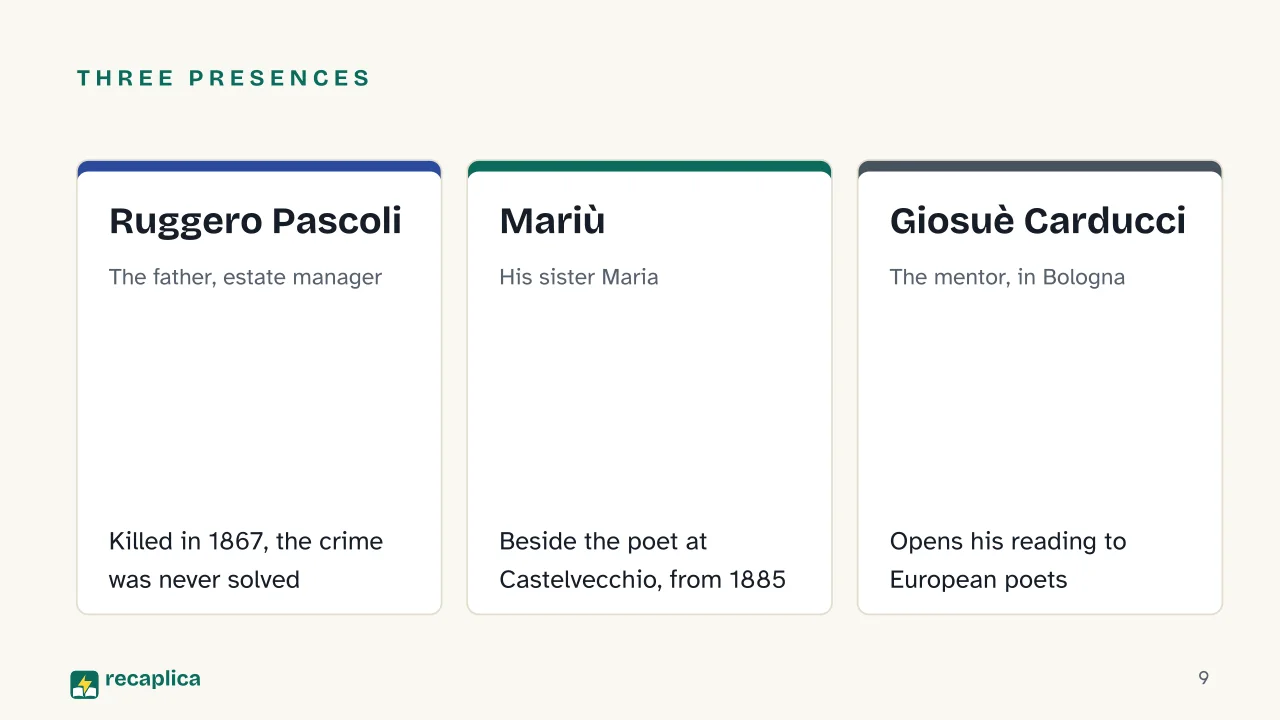  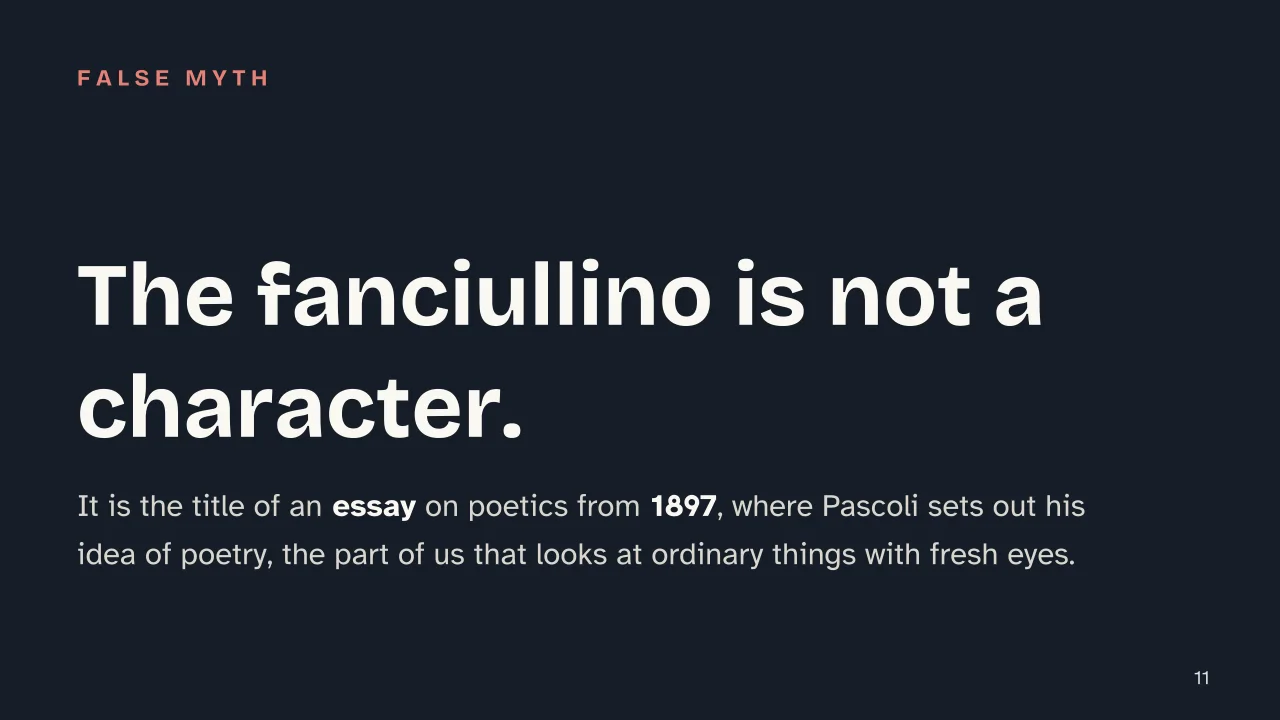   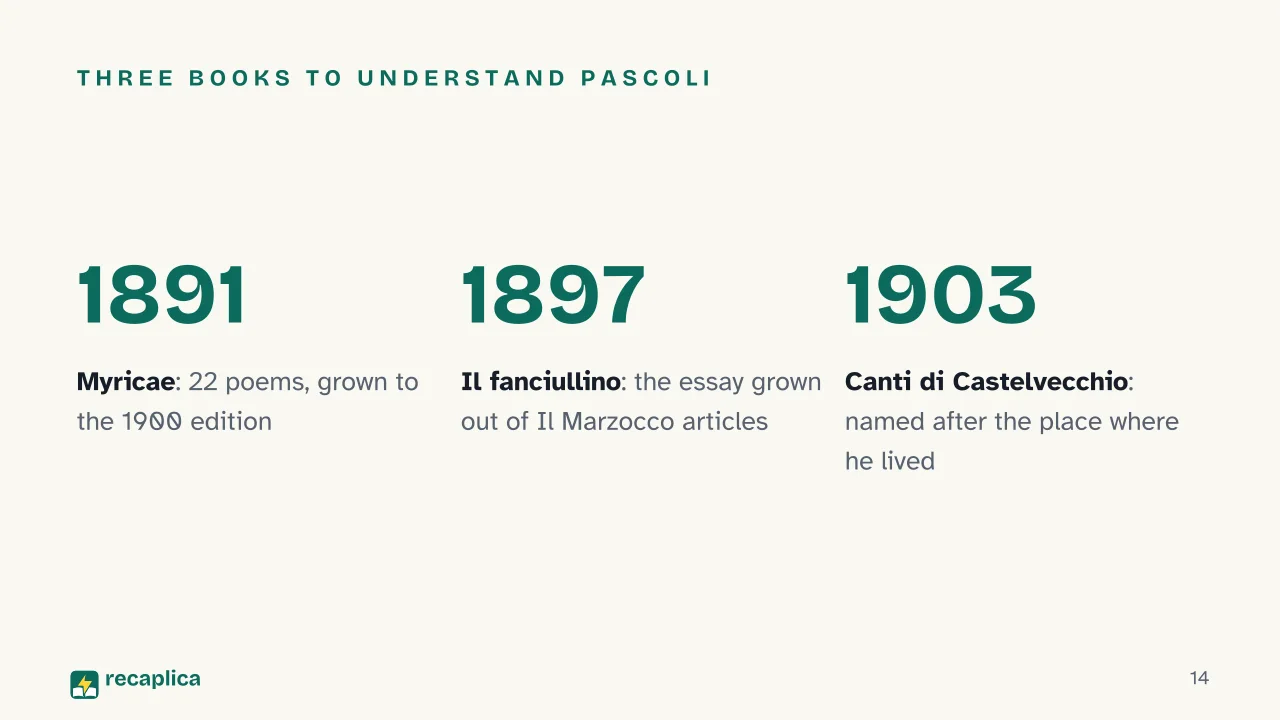 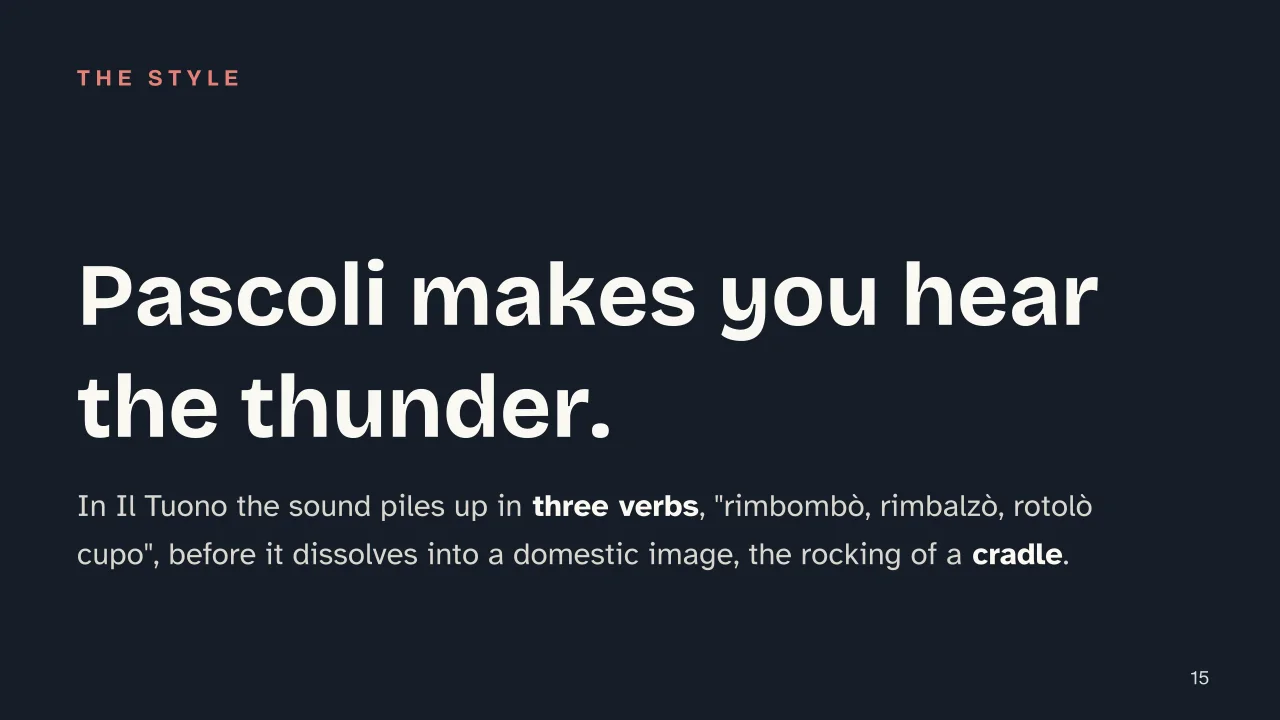 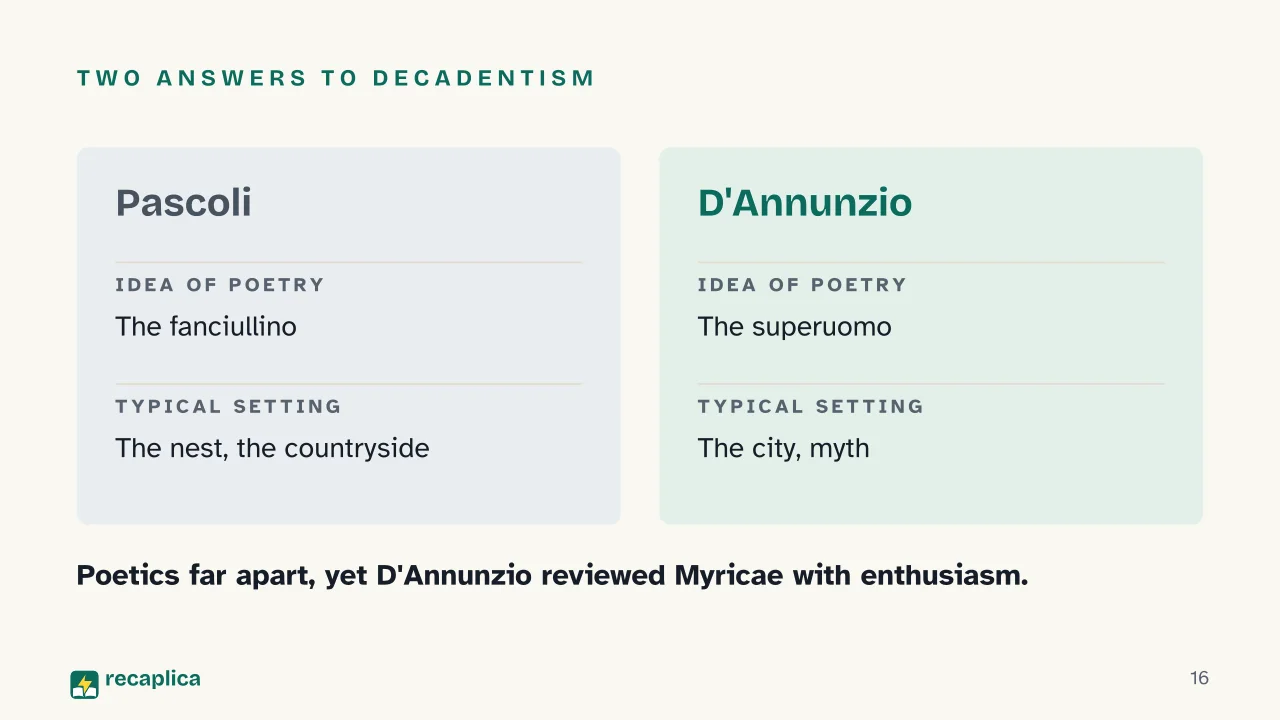   Common myths
Mind mapDrag the background to move around and the nodes to reposition them; use − and + to collapse and expand branches. 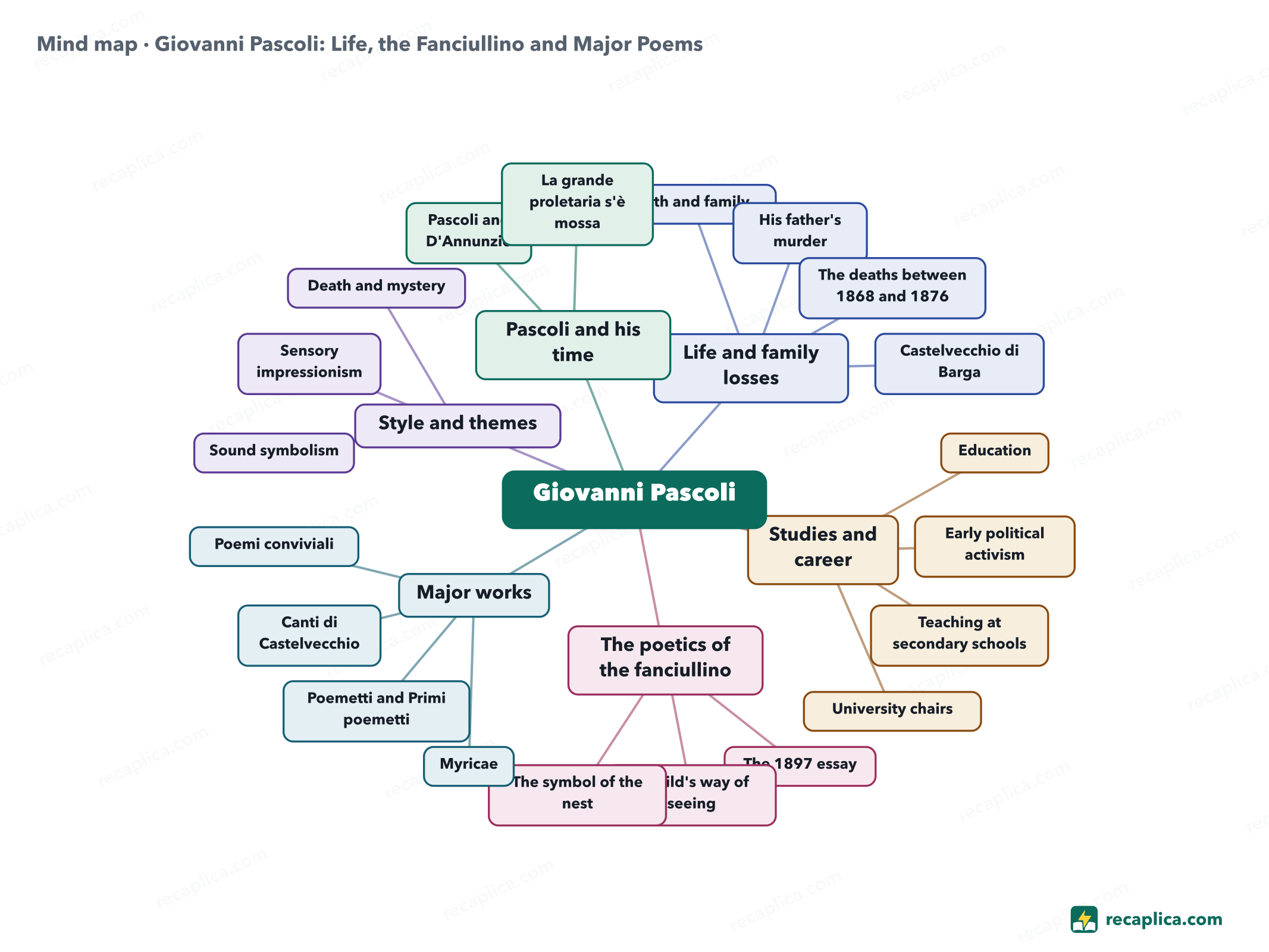
Quiz: test yourselfAnswer the questions to check what you have learned: you get instant feedback and a short explanation. Grade 0/10 0/5
FlashcardsTap the card to flip it and check whether you remember the answer, then move to the next one. 1 / 8 Explain it in your own wordsThe ultimate test: if you can explain it in simple words, you've truly understood it. Write your explanation, then compare it with the Recap. Your explanation is saved only on this device.
Frequently asked questionsWho was Giovanni Pascoli?An Italian poet, one of the leading voices between the 19th and 20th centuries, born in 1855 and died in 1912. He taught Latin and Greek at several schools and universities and succeeded Giosuè Carducci in the chair of Italian literature in Bologna. He's best known for the poetics of the fanciullino and for collections such as Myricae and Canti di Castelvecchio. What is Pascoli's fanciullino?It's the title of an 1897 essay on poetics: Pascoli argues that a 'fanciullino,' a little child, survives inside every person, able to look at ordinary things with wonder, as though seeing them for the first time. It isn't a character in his poems, but an idea about the nature of poetry itself. Why does Pascoli write so often about death and family loss?Between 1867 and 1876 Pascoli lost his father, murdered, and then a sister, his mother and two brothers: five deaths in under ten years. These events, among other factors, shaped his poetics and resurface in poems such as X Agosto and La cavalla storna. What's the difference between Pascoli and D'Annunzio?Textbooks present them as the two Italian answers to Decadentism: Pascoli focuses on childhood and on the shelter of the family 'nest,' while D'Annunzio exalts the individual through the figure of the superuomo. D'Annunzio, in any case, admired Pascoli's poetry from Myricae onward, reviewing it in 1892. What are Giovanni Pascoli's main works?Among the most important: Myricae (from 1891, with expanded editions up to 1900), the essay Il fanciullino (1897), the Poemetti (1897, then Primi poemetti in 1904), the Canti di Castelvecchio (1903) and the Poemi conviviali (1904). Every Recap goes through an independent review before publication. |