|
recaplica
Was Alan Turing Gay? The 1952 Conviction, Chemical Castration and Pardon |
| © 2026 Recaplica · recaplica.com — All rights reserved |
Was Alan Turing Gay? The 1952 Conviction, Chemical Castration and PardonWhat to print Page numbers appear when printing with default margins. SlidesChoose a cut Flash10 slidesThe essential thread, to present in classFull16 slidesEvery chapter and the deeper detailBoth come with speaker notes. In 30 seconds quick readYes, Alan Turing was gay. In 1952 a court in Manchester convicted him after police charged him over a same-sex relationship, an act British law classified as 'gross indecency.' The judge gave him a choice: prison, or probation on condition of hormone injections that sources call 'chemical castration.' Turing chose the treatment, lost the security clearance that let him do classified cryptologic work for the British state, and died at his home in Wilmslow on 7 June 1954. In 2013 Queen Elizabeth II granted him an individual royal pardon, and in 2017 a law known as Turing's Law extended a posthumous pardon to thousands of other men convicted under sexual offences long since struck from the law books. Key Points
Key figures
Deep DiveThe arrest and the 1952 trialManchester police arrested Alan Turing in February 1952 over his relationship with another man, according to the Stanford Encyclopedia of Philosophy’s entry on him. Only a few years had passed since his cryptanalysis work at Bletchley Park during the war, told in the Recap on Alan Turing and the Enigma Machine. The episode belongs to the same postwar Britain that sits behind the Recap on World War 2: a country emerging from the conflict while still enforcing laws that criminalised consensual homosexual acts. The charge was “gross indecency,” as the UK Ministry of Justice’s own announcement on GOV.UK also records. Turing was tried and convicted in 1952, the same year as the arrest: the Education Hub of the UK Department for Education confirms this too, in a page devoted to his legacy. The sentence: prison or hormone treatmentThe court set Turing a choice, not a single penalty. According to the Education Hub, Turing could choose between prison and probation, the latter conditional on a hormone treatment: injections of the female sex hormone oestrogen, which both the Education Hub and the Science Museum’s own blog in London call “chemical castration,” meant to switch off his sex drive. Turing chose the treatment, staying out of prison but undergoing the injections for the length of his probation.
Clearance revoked, and state surveillanceThe conviction had a direct effect on Turing’s work. Following the sentence, the Stanford Encyclopedia of Philosophy reports, he lost the ability to continue his classified cryptologic work for the British state: his security clearance, which had allowed it, was revoked. Historian Andrew Hodges, cited by the Science Museum, puts three things side by side: the revoked clearance, how little the state trusted Turing by then, and the watch it kept on him. Together they may have weighed on the two years before his death, in 1954, though Hodges stops short of calling any one of them the cause. The Recap on mass surveillance and human rights frames that same tension between the state and the individual in broader terms. Death in 1954Turing died on 7 June 1954 at his home in Wilmslow, Cheshire, as both the Science Museum and the Stanford Encyclopedia of Philosophy report. The coroner, after an inquest, concluded it was suicide; according to the Science Museum, Turing himself had spoken of it before. The Stanford Encyclopedia of Philosophy notes, however, that his death was generally a surprise: people close to him did not see him as someone on the verge of taking his own life. The 2013 royal pardon and the 2017 lawIn 2013 Queen Elizabeth II put her signature on a pardon covering Turing’s conviction, which took effect right away, according to the Education Hub. The Science Museum notes that a royal pardon is normally granted only to someone found innocent of a crime: Turing’s was an exception to that practice, secured through the Royal Prerogative of Mercy after a public campaign that drew support from tens of thousands of signatories. The law known as Turing’s Law, part of the Policing and Crime Bill, received Royal Assent on 31 January 2017, according to the UK Ministry of Justice’s announcement on GOV.UK. That same day, a blanket posthumous pardon reached thousands of gay and bisexual men who had been convicted under sexual offences now abolished; the convictions concerned consensual homosexual acts. The same announcement gives no precise number of people involved; the UK Education Hub cites a figure of 75,000 elsewhere, but no primary source among those consulted confirms it. The principle behind those posthumous pardons touches a broader subject, the rights set out in the Universal Declaration of Human Rights. Turing is remembered today also as one of the founding figures of computing: the Recap on the history of computers traces that other strand of his legacy, distinct from the legal case told here. Slide deckSlides ready to download and make your own in PowerPoint or Google Slides, with speaker notes. Pick the Flash cut or the Full one.     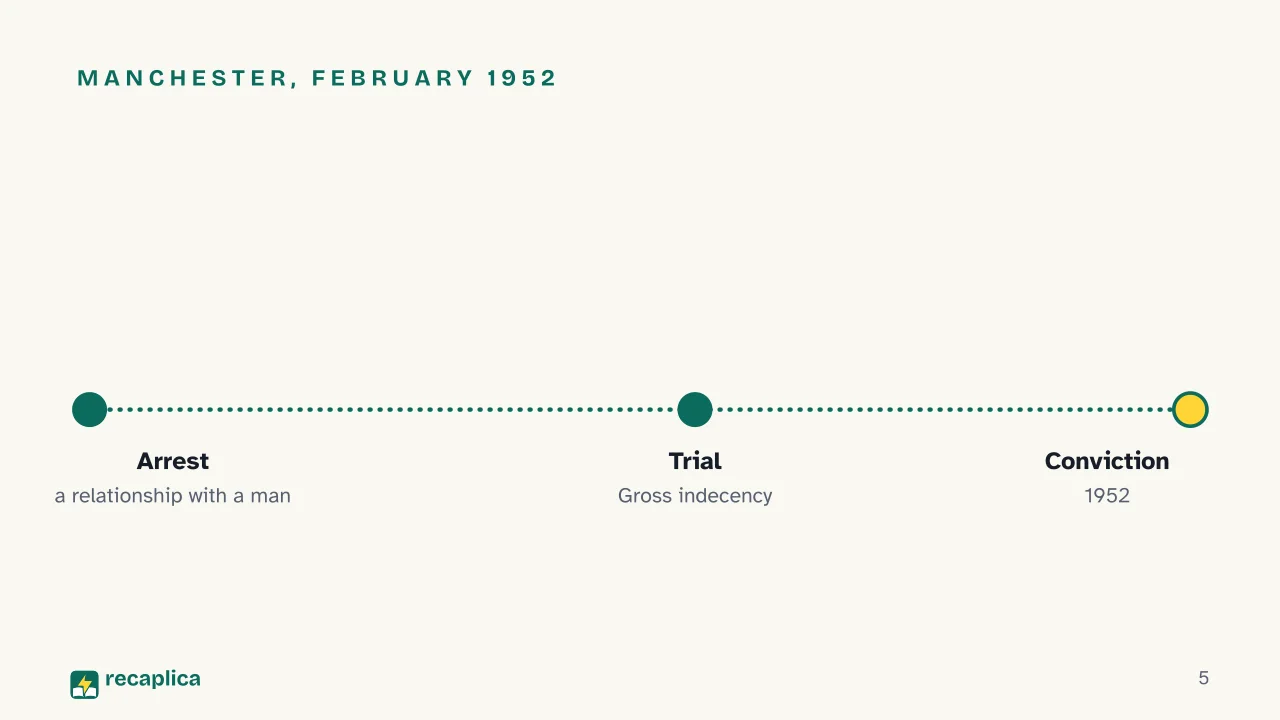  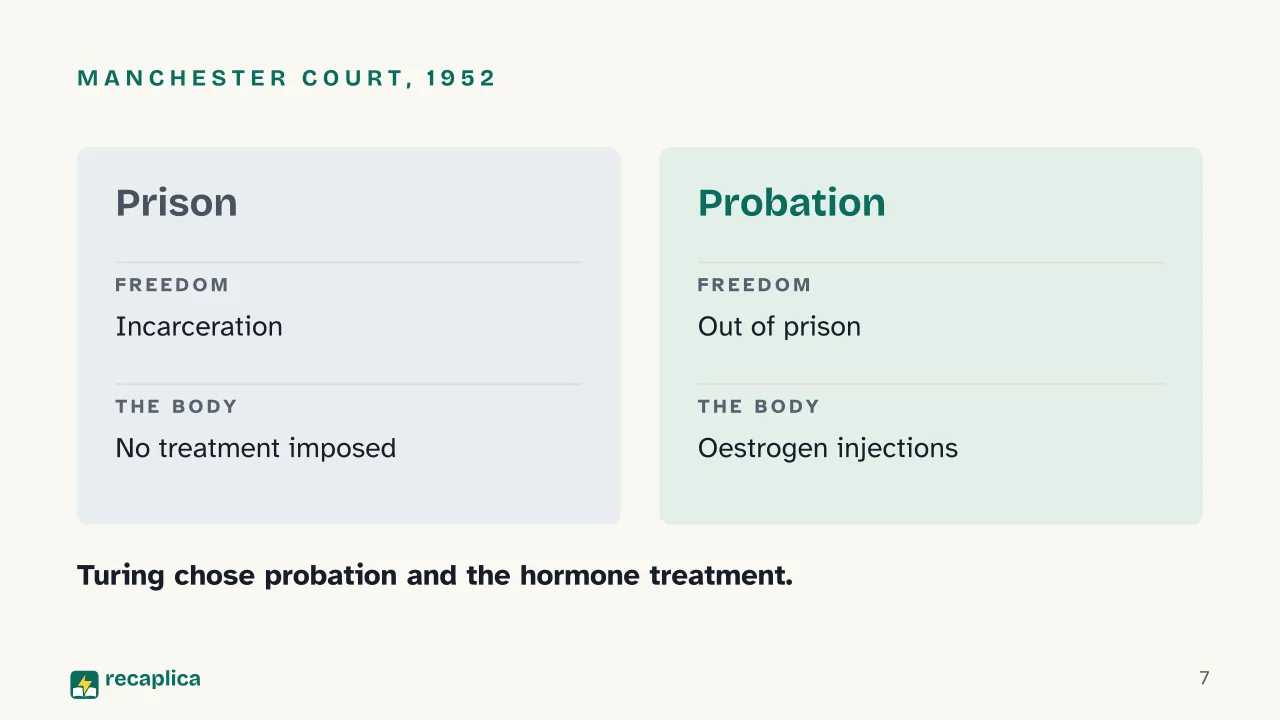 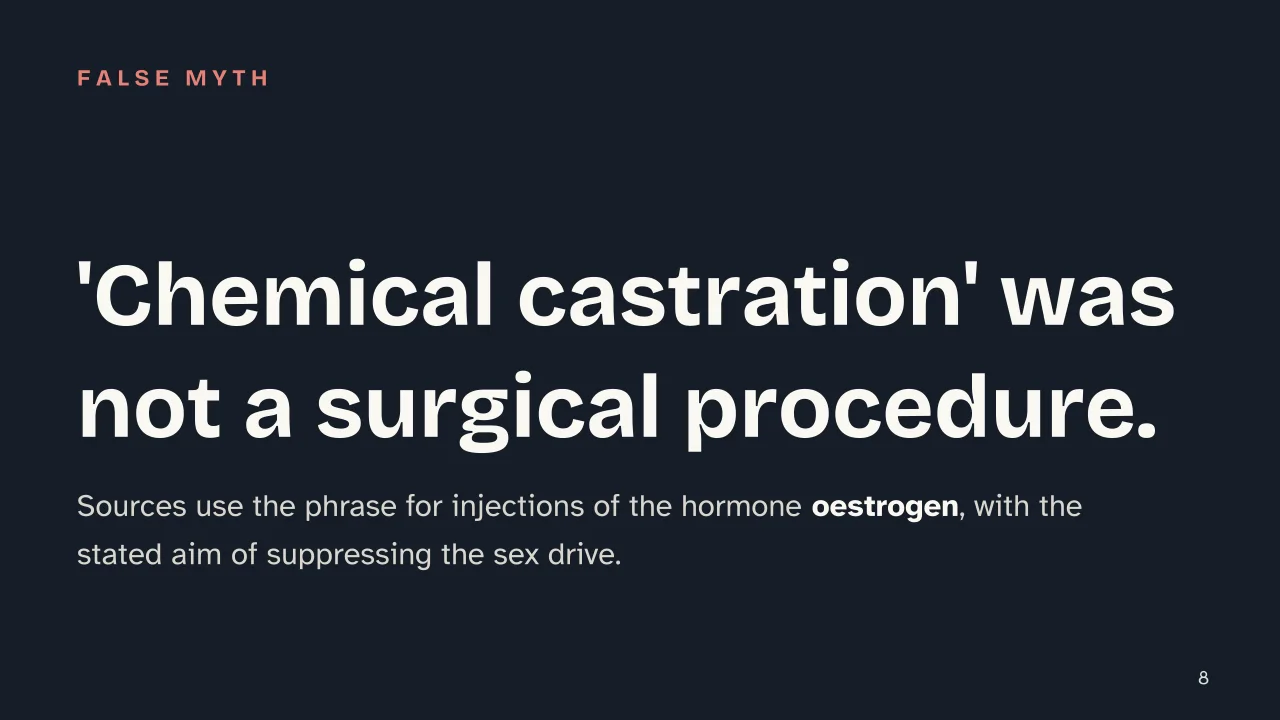  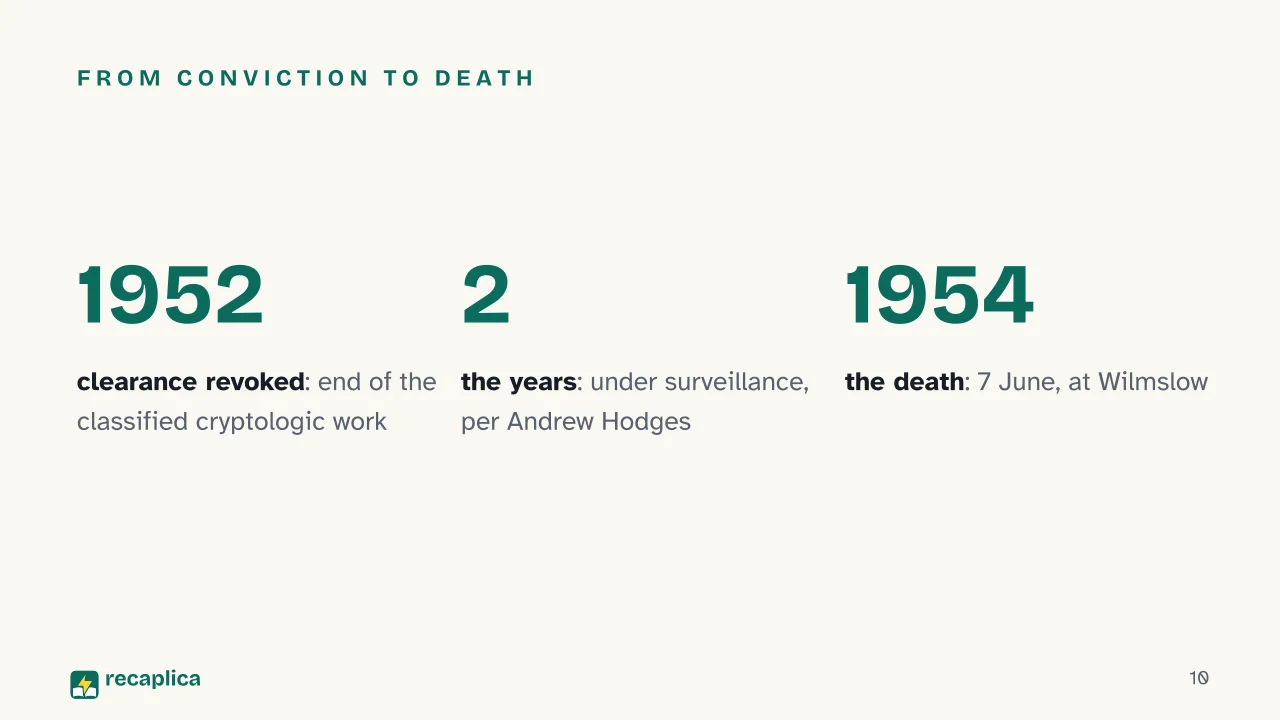   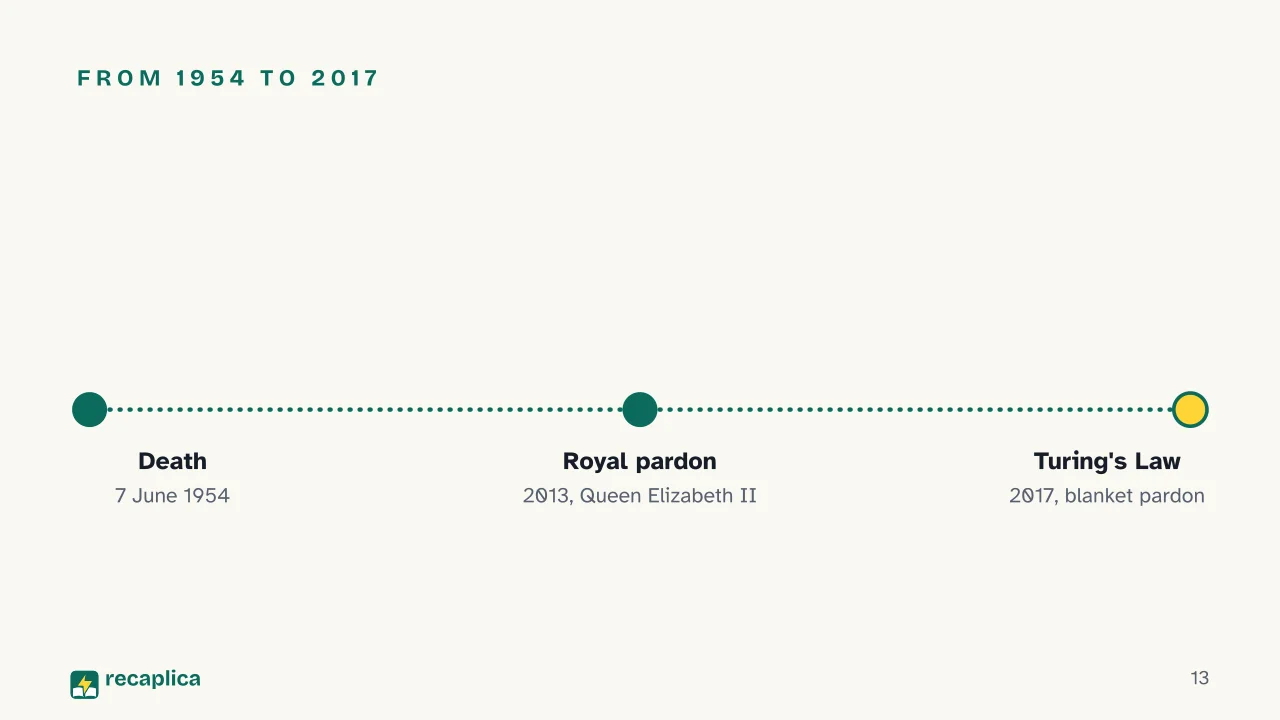 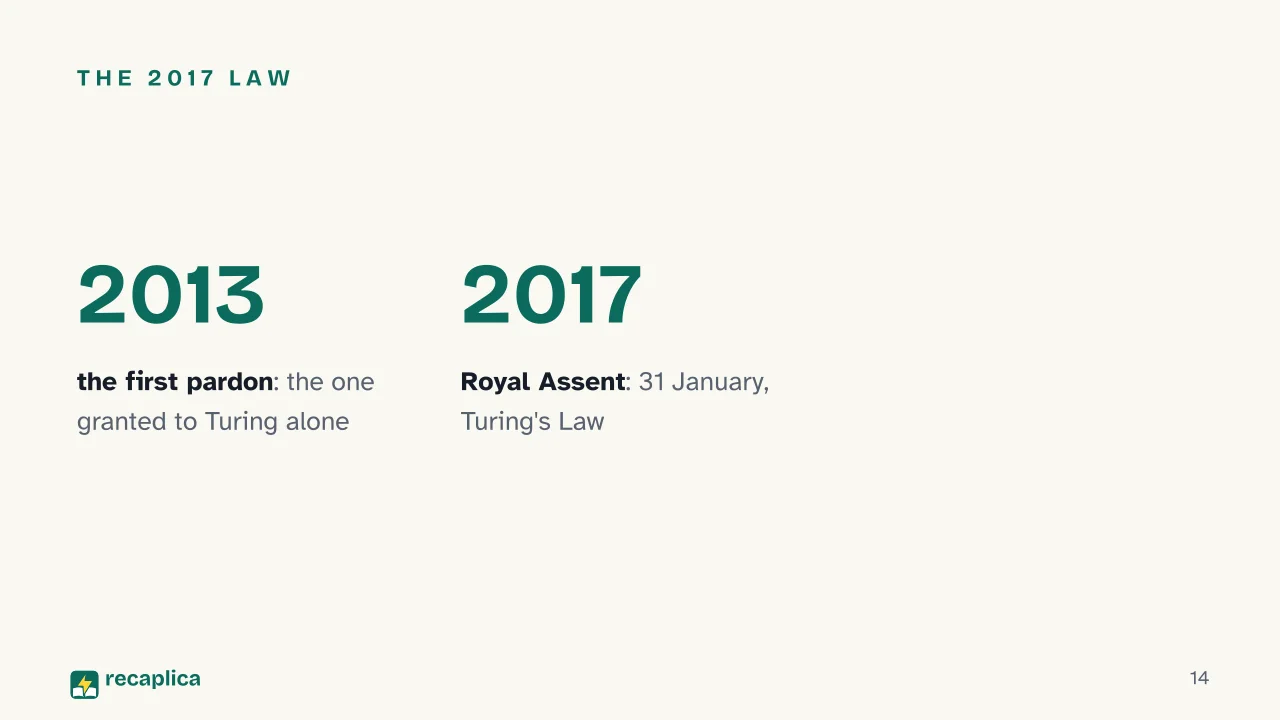 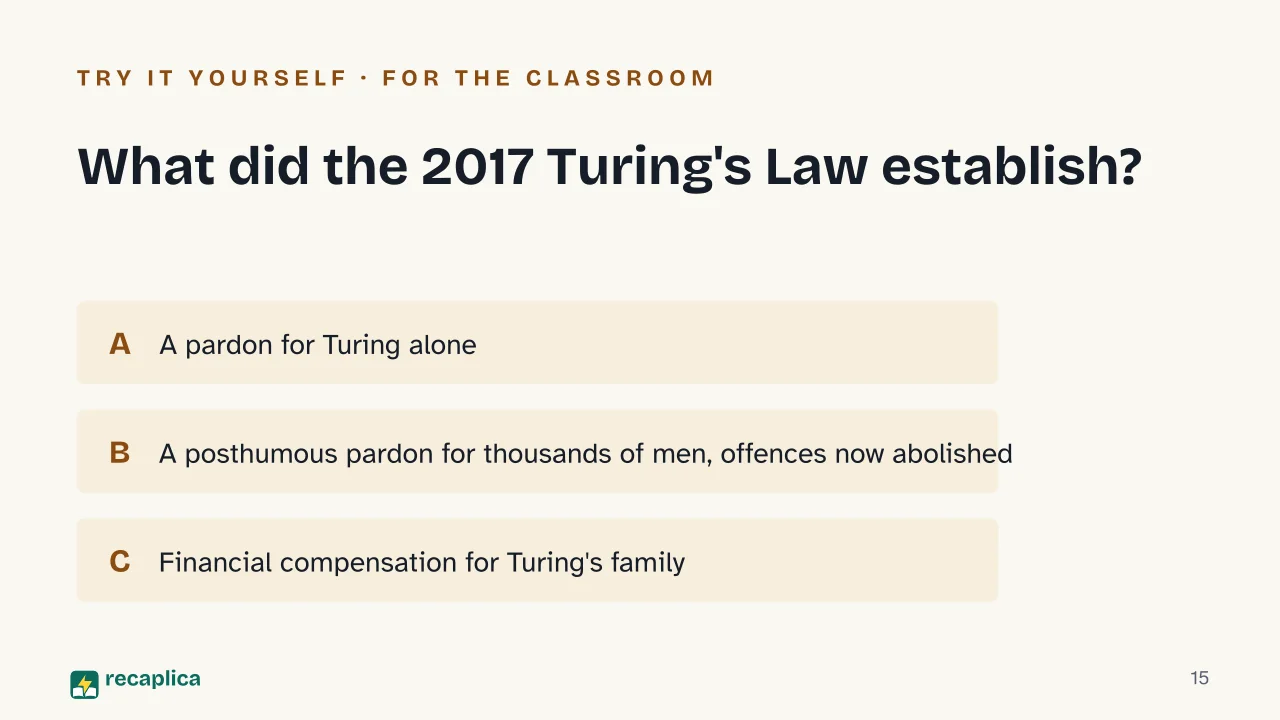  Common myths
Mind mapDrag the background to move around and the nodes to reposition them; use − and + to collapse and expand branches. 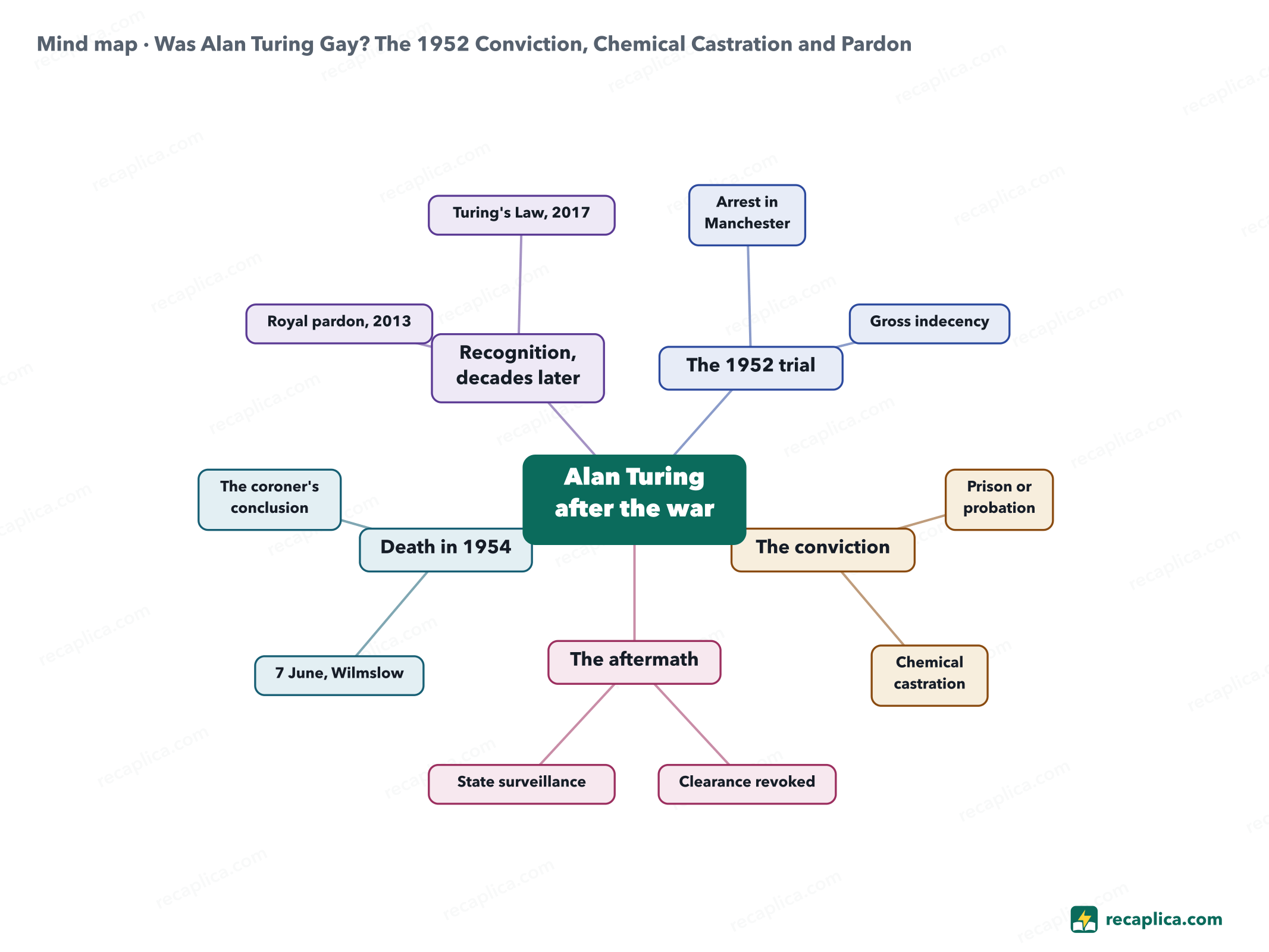
Quiz: test yourselfAnswer the questions to check what you have learned: you get instant feedback and a short explanation. Grade 0/10 0/5
FlashcardsTap the card to flip it and check whether you remember the answer, then move to the next one. 1 / 8 Explain it in your own wordsThe ultimate test: if you can explain it in simple words, you've truly understood it. Write your explanation, then compare it with the Recap. Your explanation is saved only on this device.
Frequently asked questionsWas Alan Turing gay?Yes. In February 1952 Turing was arrested in Manchester over a sexual relationship with a man, and the following trial for "gross indecency" — the offence British law at the time used to criminalise consensual homosexual acts — is the central fact of his post-war life, alongside his wartime work at Bletchley Park. What was the "chemical castration" Turing was sentenced to?Sources use that term for the oestrogen injections Turing underwent, intended to suppress his sex drive. It was the condition the court set for staying out of prison, on probation. How did Alan Turing die?Turing died on 7 June 1954, at his home in Wilmslow, Cheshire. After an inquest, the coroner attributed the death to suicide; the Stanford Encyclopedia of Philosophy adds that, for people close to him, it was nonetheless unexpected. When was Alan Turing pardoned?In 2013, with an individual royal pardon signed by Queen Elizabeth II through the Royal Prerogative of Mercy, following a campaign backed by tens of thousands of people. It was an exception, since a royal pardon is normally reserved for people found innocent of a crime. What is Turing's Law?The law, part of the Policing and Crime Bill, received Royal Assent on 31 January 2017. Since then it has posthumously pardoned convictions for sexual offences no longer on the books, covering thousands of gay and bisexual men. Every Recap goes through an independent review before publication. |