|
recaplica
Wittgenstein on Certainty and the Hinge Propositions |
| © 2026 Recaplica · recaplica.com — All rights reserved |
Wittgenstein on Certainty and the Hinge PropositionsWhat to print Page numbers appear when printing with default margins. SlidesChoose a cut Flash10 slidesThe essential thread, to present in classFull15 slidesEvery chapter and the deeper detailBoth come with speaker notes. In 30 seconds quick read«On Certainty» gathers the last notes Ludwig Wittgenstein wrote, from late 1949 to 27 April 1951, printed in 1969. A plain question runs underneath them: why does nobody set about checking certain beliefs, such as having two hands? Wittgenstein calls them hinge propositions, after the hinges that keep still while the door swings. Anyone who tries to doubt the whole lot in one go, he argues, discovers that doubt needs something steady to lean on. That is where his quarrel with G.E. Moore begins, since Moore offered such certainties as things he knew. Key Points
Key figures
Deep DiveIn 1949 Norman Malcolm, an American friend and former student of Ludwig Wittgenstein, was putting to him his own criticism of the way G.E. Moore uses «I know» in two essays about common sense, from 1925 and 1939; the Wittgenstein Archives at the University of Bergen report that it became the central theme of their talks. Out of that exchange came the notes published in 1969 under the title «On Certainty», where Wittgenstein brings into focus a peculiar class of beliefs: the ones nobody in ordinary life thinks of verifying, and which for that very reason hold up everything else. For the wider story of the philosopher there is the Recap on Wittgenstein and analytic philosophy, of which these pages form a closing chapter. A book Ludwig Wittgenstein never assembledThe Wittgenstein Archives at the University of Bergen describe «On Certainty» as an editorial assembly. The notes sit in four separate notebooks, alongside a bundle of loose slips. The first section, paragraphs 1 to 65, comes from MS 172, twenty-four loose pages that Anscombe places, as a conjecture, between December 1949 and March 1950, the pages themselves carrying no date: it is the oldest material in the group. Manuscript MS 174, a forty-page notebook, carries a single date, 24 April 1950. MS 175, which the Bergen archives identify as the source of the whole third section of the work, holds entries dated from 23 September 1950 to 21 March 1951. The closing paragraphs, 638 to 676, come from a small notebook, MS 177, whose first notes go back to 25 April 1951. The last lines carry the date 27 April 1951: Wittgenstein died two days later, on 29 April. The printed edition was edited by G.E.M. Anscombe and G.H. von Wright in 1969, and the archives report that the two editors believed the philosopher, in his final months, treated those pages as a block of thought standing on its own. «I know that I have two hands»Moore defended common sense by listing things he said he knew: that he had two hands, for instance, or that objects exist outside him. Wittgenstein challenges the list, though his target is the words Moore picks to present it. The entry «Wittgenstein: Epistemology» in the Internet Encyclopedia of Philosophy sums up the objection this way: saying «I know» makes sense where doubting also makes sense, and on those certainties doubt gets no grip, so the verb spins freely. A second remark follows. The evidence Moore offers, holding up his own hand for example, turns out on that reading to be no more secure than what it should establish, and only adds a gesture to a conviction that was already firm. It helps to watch what the verb «to know» usually does in conversation. If I say I know when the train leaves, whoever hears me can ask how I know, and I answer that I checked the timetable; I might also have got it wrong, and then someone corrects me. Behind an «I know», in Wittgenstein’s reasoning, there sit a way of checking and some room for error. With «I have two hands» that machinery jams, because I could neither name the check that would settle it nor picture the discovery that proves me wrong, and Wittgenstein’s remark points right there. There is a question about words too. For Wittgenstein a sentence such as «I know the earth has existed for many years», taken as an ordinary claim to knowledge, has no recognisable use in everyday speech; and a sentence whose use we cannot find, he adds, is one we do not really understand. On one practical point he agrees with Malcolm: repeating «I know that is a tree» at a sceptical philosopher supplies no argument. What hinge propositions areA door panel swings only if its hinges stay where they are. The image is Wittgenstein’s, and the Internet Encyclopedia of Philosophy takes it up to say that certain propositions do the same job in the way we reason: while they hold still, questions and checks can open up around them. The Stanford Encyclopedia of Philosophy entry «Certainty» puts the matter from the opposite side, saying that in practice such propositions are left alone precisely because everything a person asks, or fears having got wrong, moves on them.
In practical life the difference barely shows, since the hinges are in place and nobody looks at them. They catch the eye when someone tries to touch them. A person who called having a body into question, or the existence of the floor underfoot, would be hard to follow at all: the surface an argument rests on would be missing. Hence the most debated move in the work. The Internet Encyclopedia of Philosophy describes it like this: for Wittgenstein the obvious truths on Moore’s list are to be treated neither as things one knows nor as things one can doubt; they sit in a class of their own, whose function is unlike that of ordinary empirical beliefs. It amounts to a third place, alongside the two into which modern philosophy had learned to sort propositions. What if we doubted everything?According to the Stanford Encyclopedia of Philosophy entry «Certainty», Wittgenstein answers that a doubt on that scale never manages to form: whoever doubts rests the question on something held firm in the meantime. Doubt pushed to the extreme has a famous precedent, told in the Recap on Descartes and the problem of method, and here the target is exactly its claim to cover everything at once. Language comes into it too: the Internet Encyclopedia of Philosophy reports that for Wittgenstein certainty about some basic facts and certainty about what words mean go together, because if the shared ground is missing it stops being clear what the doubt falls on. Readers who met the question of how far experience can be trusted in the Recap on David Hume’s empiricism, or the question of what makes knowledge possible in the Critique of Pure Reason, find the question turned around here: what happens to a doubt that tries to do away with every certainty. What came of itThe notion has had a second life. The Internet Encyclopedia of Philosophy documents a strand of epistemology rooted in those pages, gathering readings quite unlike one another, and cites Duncan Pritchard, Annalisa Coliva and Danièle Moyal-Sharrock among its authors, along with Wright, Williams and McGinn. In the scholarly literature that strand goes under the name hinge epistemology, after Wittgenstein’s hinges. An article in the Nordic Wittgenstein Review urges caution on one point. Wittgenstein’s criticism of Moore is often misread, its author writes, partly because Wittgenstein himself portrays Moore somewhat unfaithfully, partly because readers credit him with a position on the justification of knowledge that is not really his. For that article the knot, seen through Wittgenstein’s eyes, is that Moore lumps three things together that belong apart: knowing something, being certain of it, and having evidence for it. Slide deckSlides ready to download and make your own in PowerPoint or Google Slides, with speaker notes. Pick the Flash cut or the Full one.     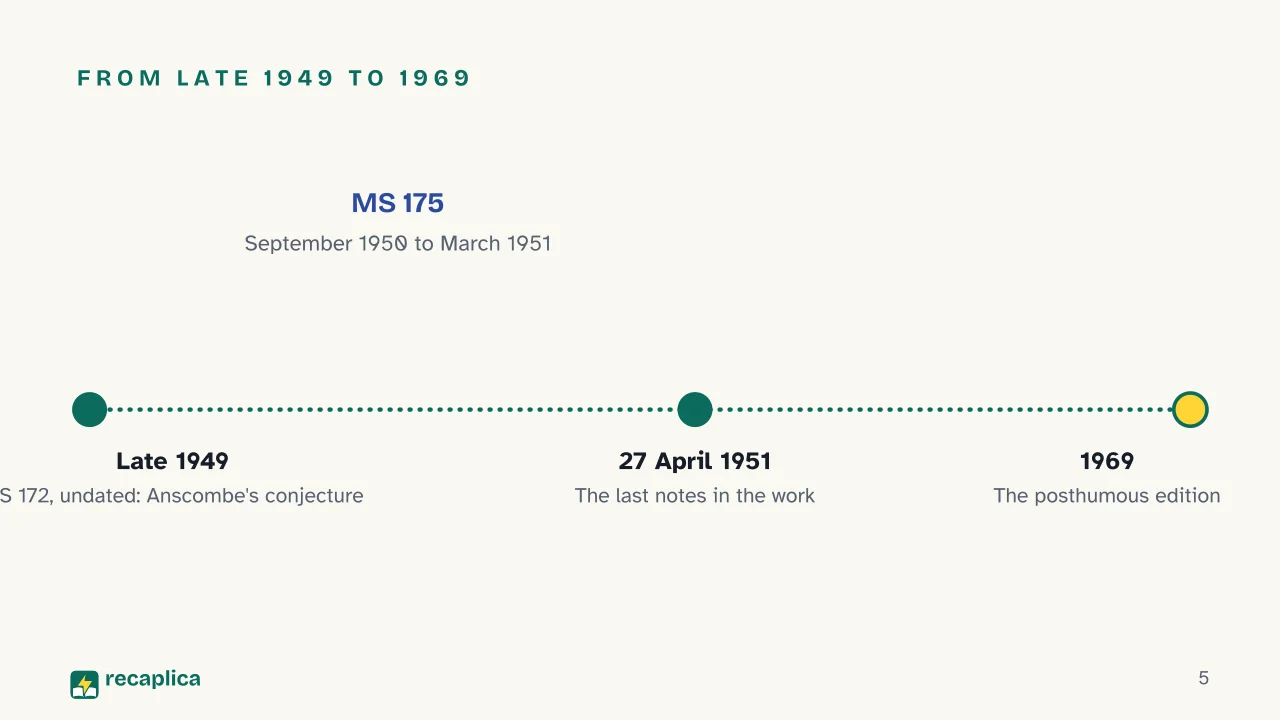 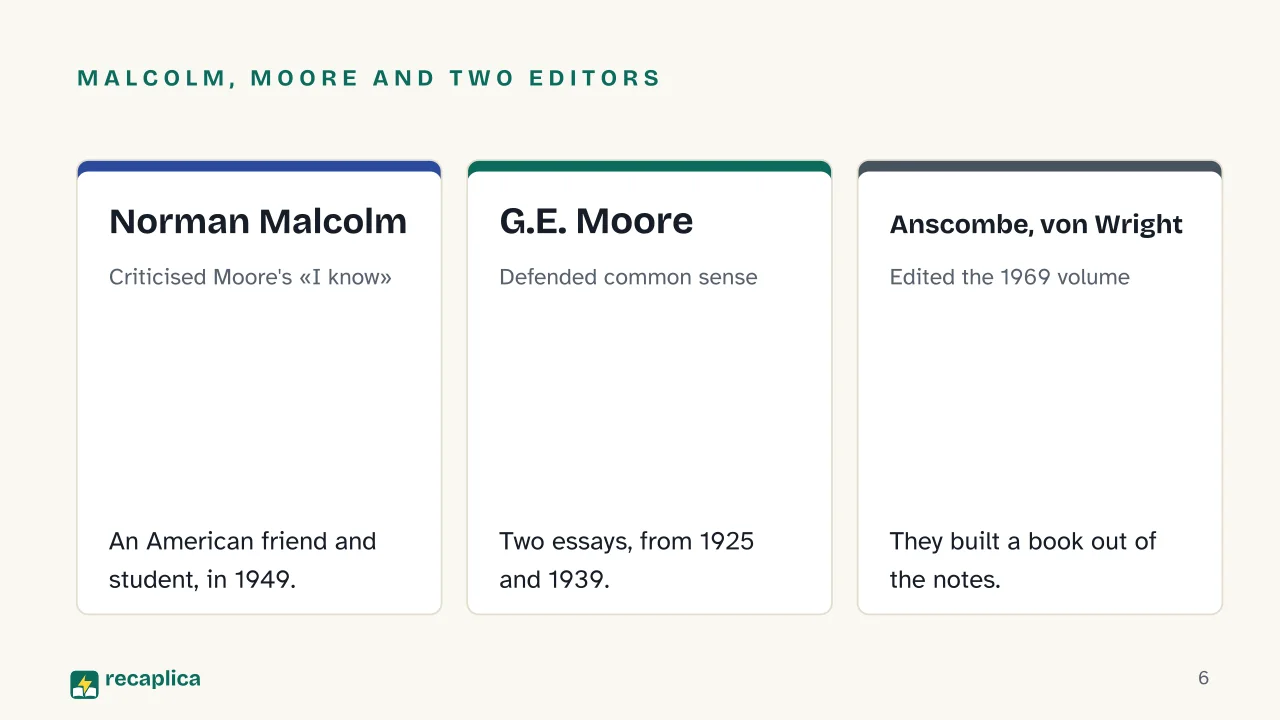  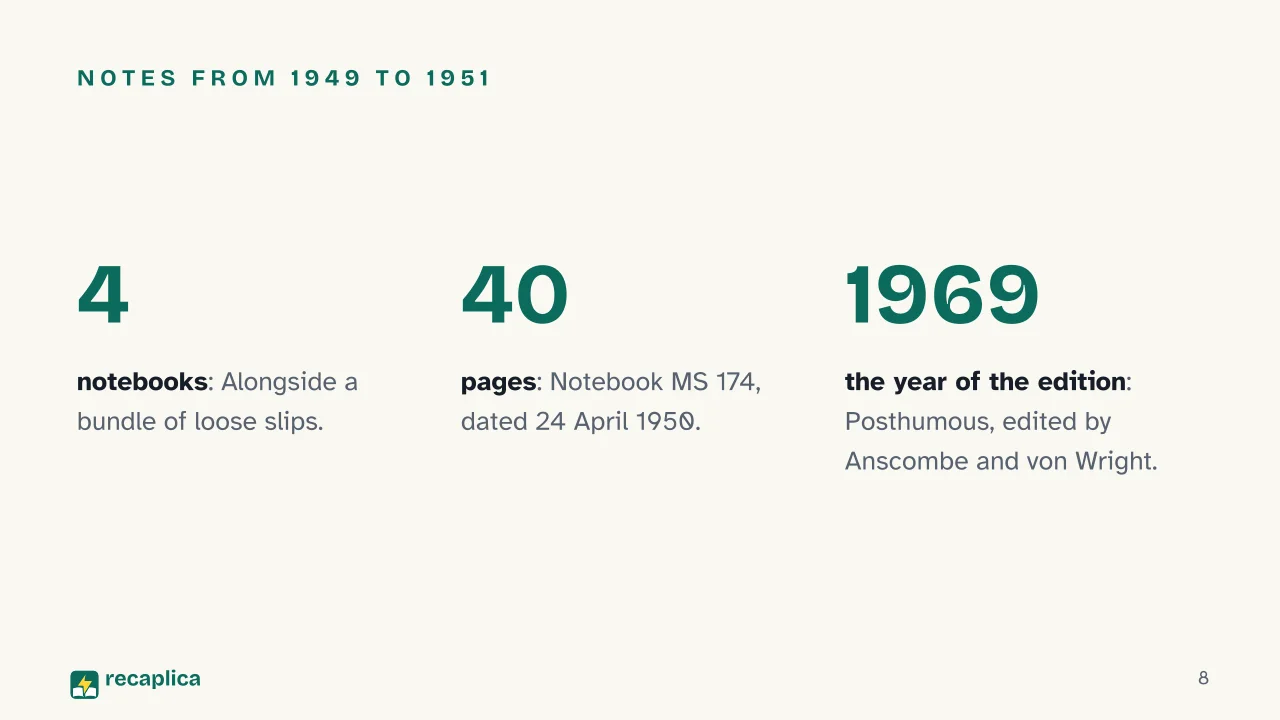 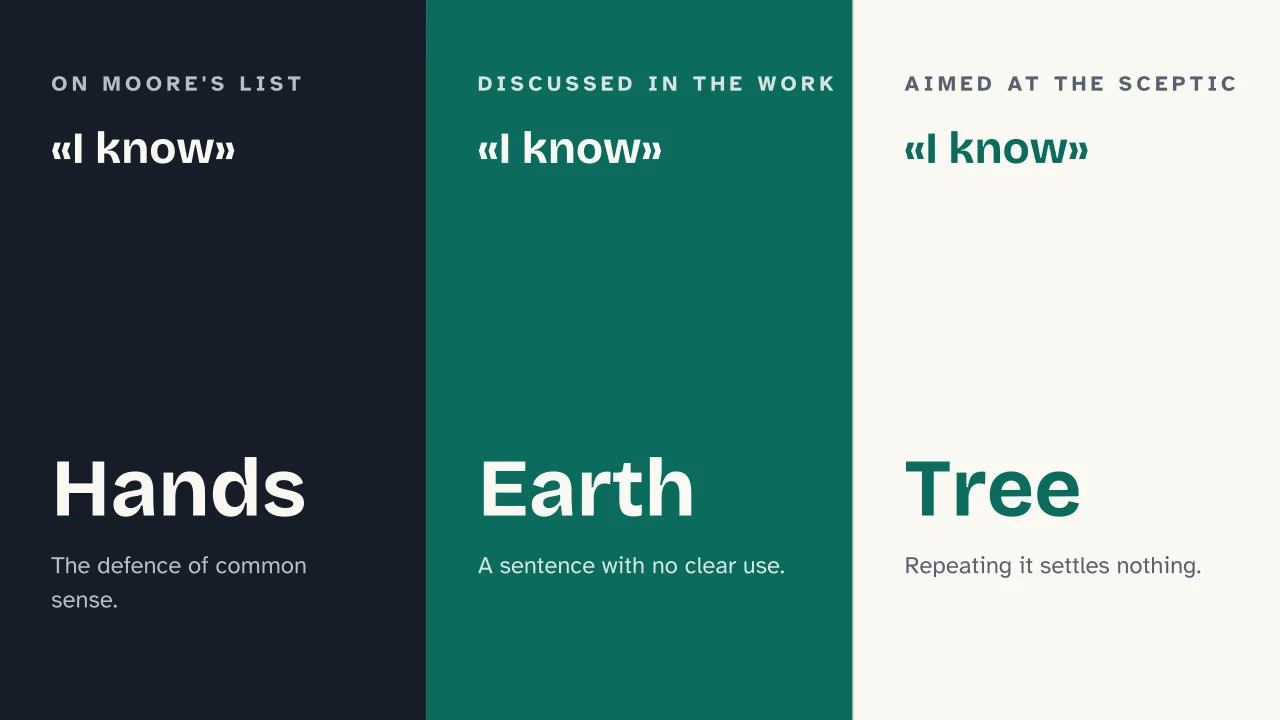 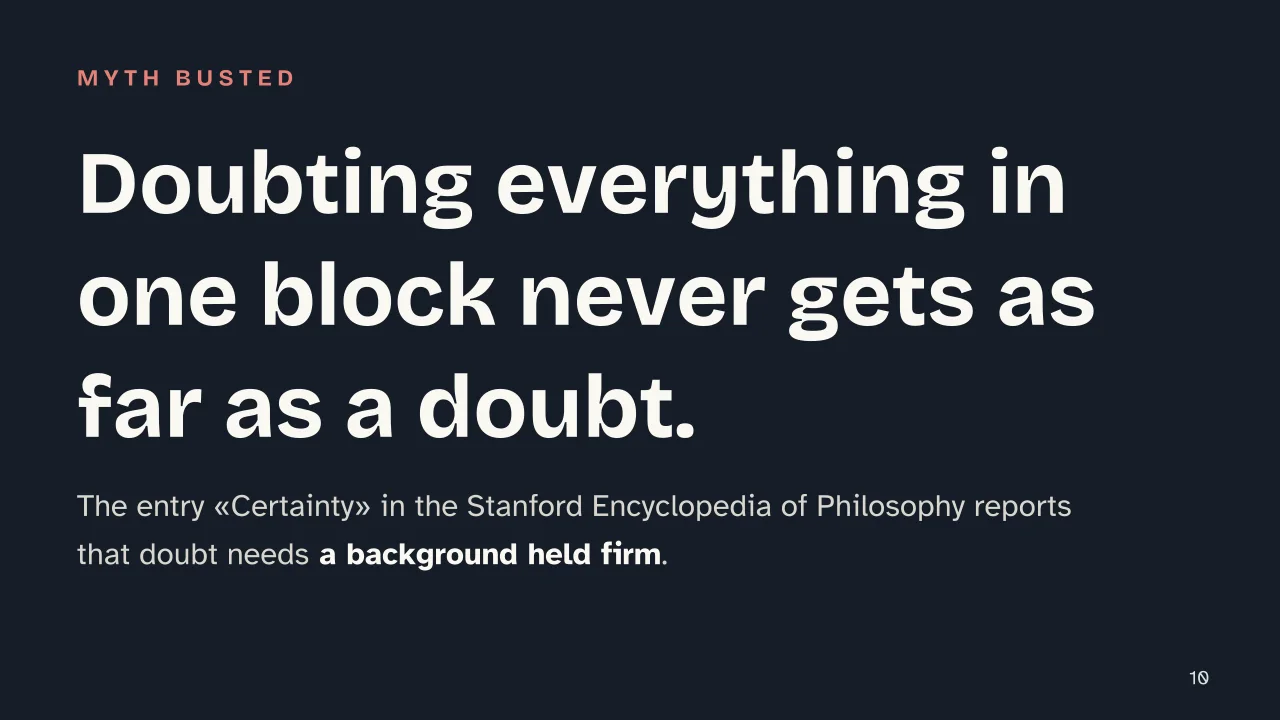  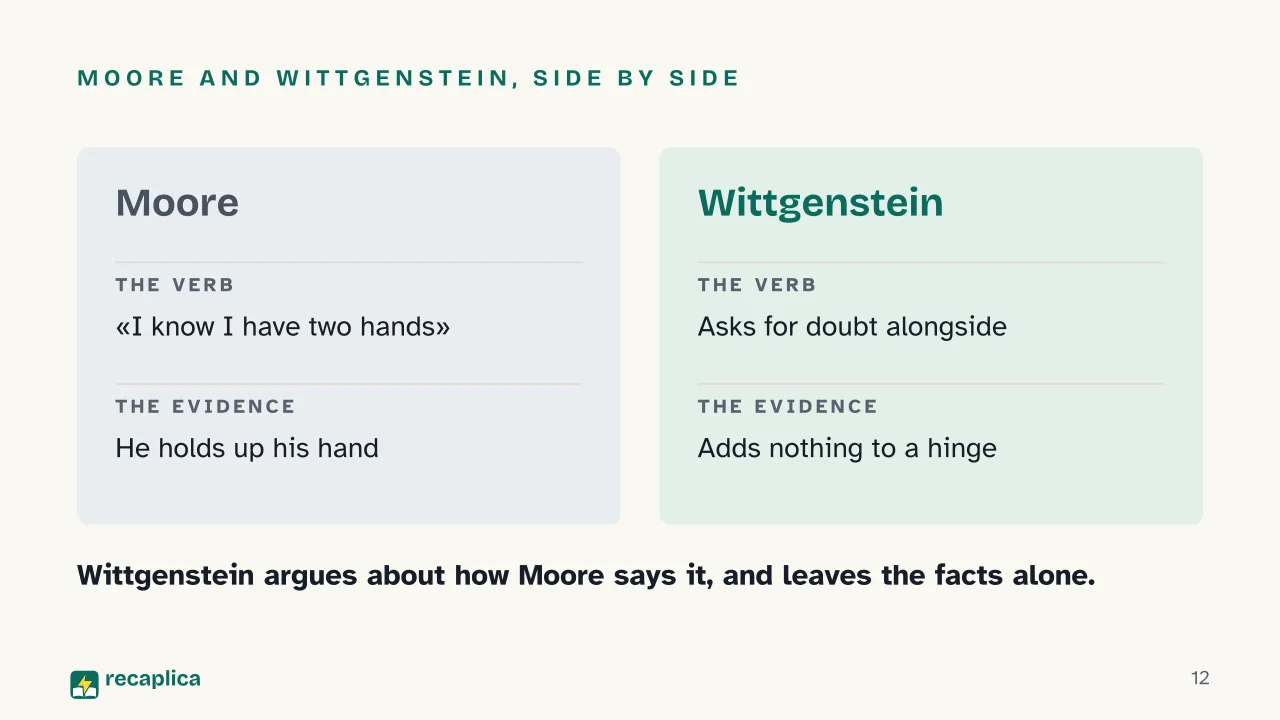  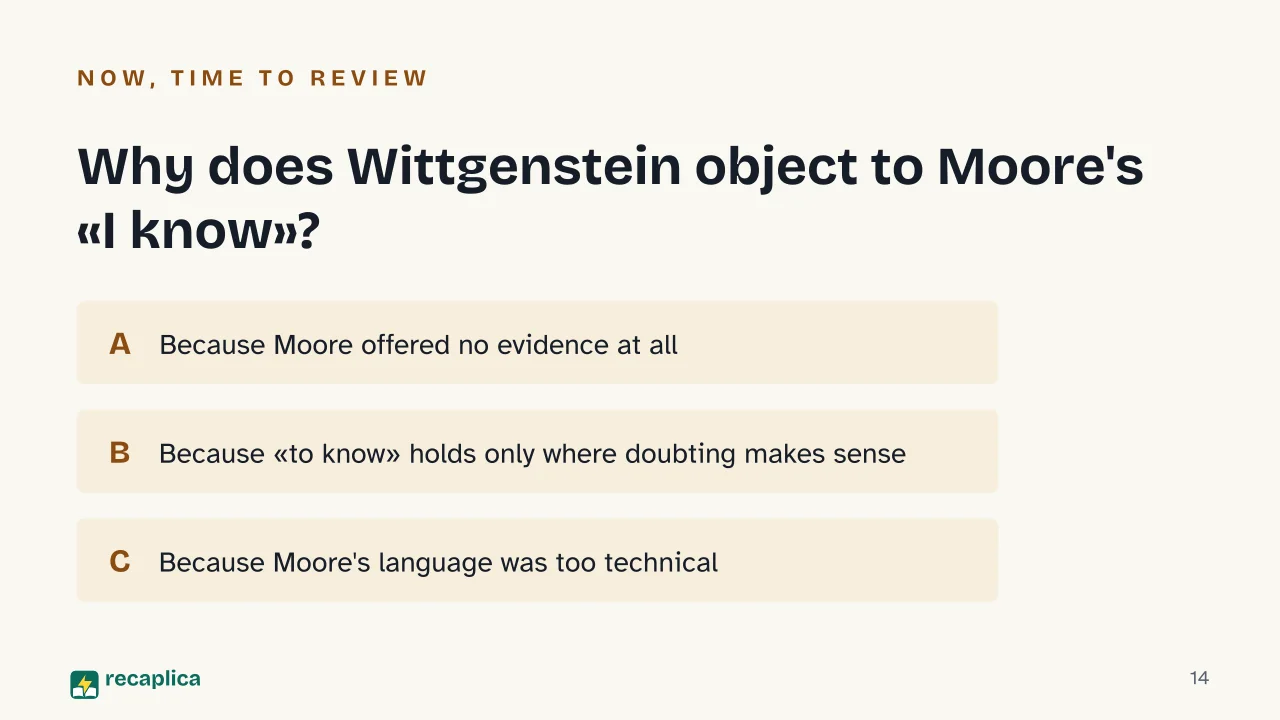  Common myths
Mind mapDrag the background to move around and the nodes to reposition them; use − and + to collapse and expand branches. 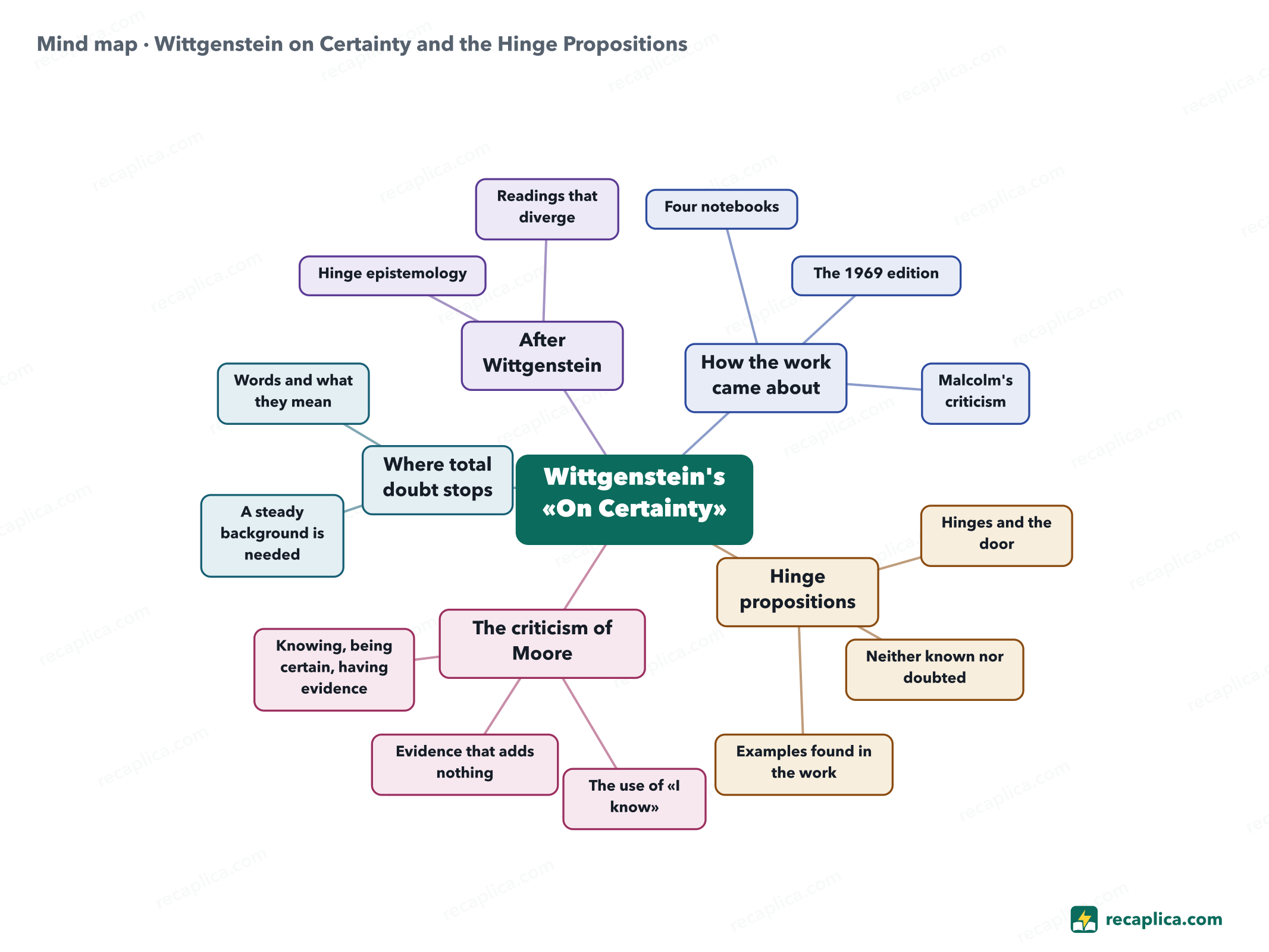
Quiz: test yourselfAnswer the questions to check what you have learned: you get instant feedback and a short explanation. Grade 0/10 0/5
FlashcardsTap the card to flip it and check whether you remember the answer, then move to the next one. 1 / 7 Explain it in your own wordsThe ultimate test: if you can explain it in simple words, you've truly understood it. Write your explanation, then compare it with the Recap. Your explanation is saved only on this device.
Frequently asked questionsWhat is Wittgenstein's «On Certainty»?It collects the last notes Ludwig Wittgenstein wrote about knowledge and doubt. The Wittgenstein Archives at the University of Bergen place the material in four notebooks and a bundle of loose slips, dated from late 1949 to 27 April 1951; the volume came out posthumously in 1969, edited by G.E.M. Anscombe and G.H. von Wright, who built it from those pages. What are hinge propositions?They are the background beliefs nobody sets about verifying in daily life, such as having two hands. The Stanford Encyclopedia of Philosophy credits Wittgenstein with the thought that a person's questions and doubts move on them: like the hinges of a door, they stay put so that something else can turn. Why does Wittgenstein criticise G.E. Moore?Moore defended common sense by listing obvious truths he claimed to know. For the Internet Encyclopedia of Philosophy, Wittgenstein answers that the verb «to know» asks for the possibility of doubt alongside it, and that Moore's evidence, holding up a hand for example, supplies no extra firmness to a conviction that was already settled. Was Wittgenstein a sceptic?No, and his argument pushes against total scepticism. For the Stanford Encyclopedia of Philosophy, Wittgenstein holds that a doubt widened to every subject fails to become a doubt, because whoever doubts has to grant something already, starting with the meaning of the words in use. What is hinge epistemology?It is a strand of the philosophy of knowledge that takes its name from the hinges of «On Certainty». The Internet Encyclopedia of Philosophy describes it as a set of readings that differ among themselves while remaining rooted in the work, and names Duncan Pritchard, Annalisa Coliva and Danièle Moyal-Sharrock among its authors. Every Recap goes through an independent review before publication. |