|
recaplica
Wittgenstein's Philosophical Investigations: Language-Games and Meaning as Use |
| © 2026 Recaplica · recaplica.com — All rights reserved |
Wittgenstein's Philosophical Investigations: Language-Games and Meaning as UseWhat to print Page numbers appear when printing with default margins. SlidesChoose a cut Flash10 slidesThe essential thread, to present in classFull15 slidesEvery chapter and the deeper detailBoth come with speaker notes. In 30 seconds quick readPhilosophical Investigations, published in 1953 after Wittgenstein's death, breaks with his earlier book, the 1921 Tractatus Logico-Philosophicus. Instead of a systematic treatise, the text moves through short remarks, close to aphorisms. Its starting point is the claim that a word's meaning often comes down to how it gets used in everyday speech. From there come language-games, family resemblance and the private language argument, which denies that a language built only from private sensations known to a single speaker could work at all. Key Points
Key figures
Deep DiveWho Wittgenstein was, and the break from his first bookLudwig Wittgenstein died of cancer in Cambridge in 1951, where he had returned for his final years. Philosophical Investigations came out two years later, in 1953. Part I of the book, 693 numbered sections, had already been ready for print in 1946: it would not reach print for another seven years. The Internet Encyclopedia of Philosophy traces a direct debt from Wittgenstein’s close attention to the grammar of use to Oxford’s postwar school of ordinary language, a central strand of analytic philosophy. From the Tractatus to Philosophical Investigations: the picture that cracksThe Tractatus was published in German in 1921. It argued that a proposition is a logical picture of the reality it describes: the picture theory, as the Internet Encyclopedia of Philosophy explains it, makes a proposition’s sense depend on representing some empirical state of affairs. Taken literally, that rule turns against the book itself: the Tractatus’s own propositions about language in general represent no particular fact, so by its own rule they should come out meaningless. According to the same source, this was one of the pressures that pushed Wittgenstein to rework his position. Philosophical Investigations opens by attacking the very idea, held in the Tractatus, that words work by naming objects and that sentences are combinations of names. In place of that old naming theory, Wittgenstein proposes watching language-games, the real practices in which language gets used. Language-games and meaning as useA language-game, in Wittgenstein’s sense, is a practice where words and actions weave together under their own rules, tied to a purpose shared by the speakers.
In that example «slab» points to the gesture required at that exact moment in the job: the meaning is the role the word plays in the activity the two men share. For Wittgenstein, in many cases, a word’s sense is measured by looking at how it is put to work in everyday speech. Wittgenstein and language: family resemblanceOne question is left open: why does «game» cover chess, solitaire and catch without any trait shared by all of them? Wittgenstein answers with family resemblance: a web of similarities that cross from one case to the next, different each time, never the same across the whole series. It is a different kind of answer from one that hunts for an essence common to every case, the way Plato’s theory of Forms does: here the threads cross without ever running through the same single point. The private language argumentThe private language argument occupies sections 244 to 271 of Philosophical Investigations. It concerns an imagined language whose words would name only inner sensations known solely to the speaker: for Wittgenstein, a language like that lacks rules, and so lacks meaning. The crux, as the Private Language entry in the Stanford Encyclopedia of Philosophy explains, is that for a private sensation there is no objective standard able to settle whether it matches the one before, beyond how it strikes the person feeling it in that moment. Privately christening a sign for a sensation is not enough: giving something meaning requires a shareable technique of use, and a lone gesture cannot create one. If the link between sign and sensation was not already correct from the start, leaning on memory alone cannot make it correct afterward. Both the Ludwig Wittgenstein entry and the Private Language entry in the Stanford Encyclopedia of Philosophy close on the same point: a language intelligible in principle only to its own speaker fails the test of being a real language. Slide deckSlides ready to download and make your own in PowerPoint or Google Slides, with speaker notes. Pick the Flash cut or the Full one.     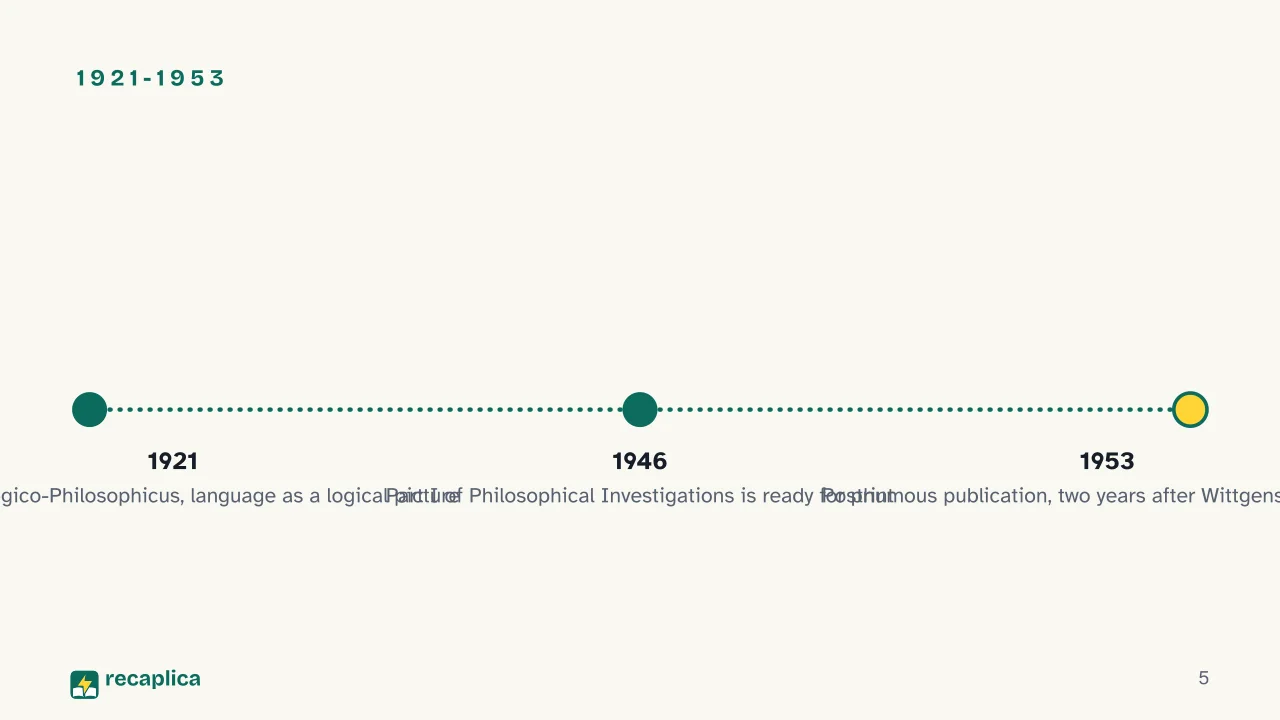 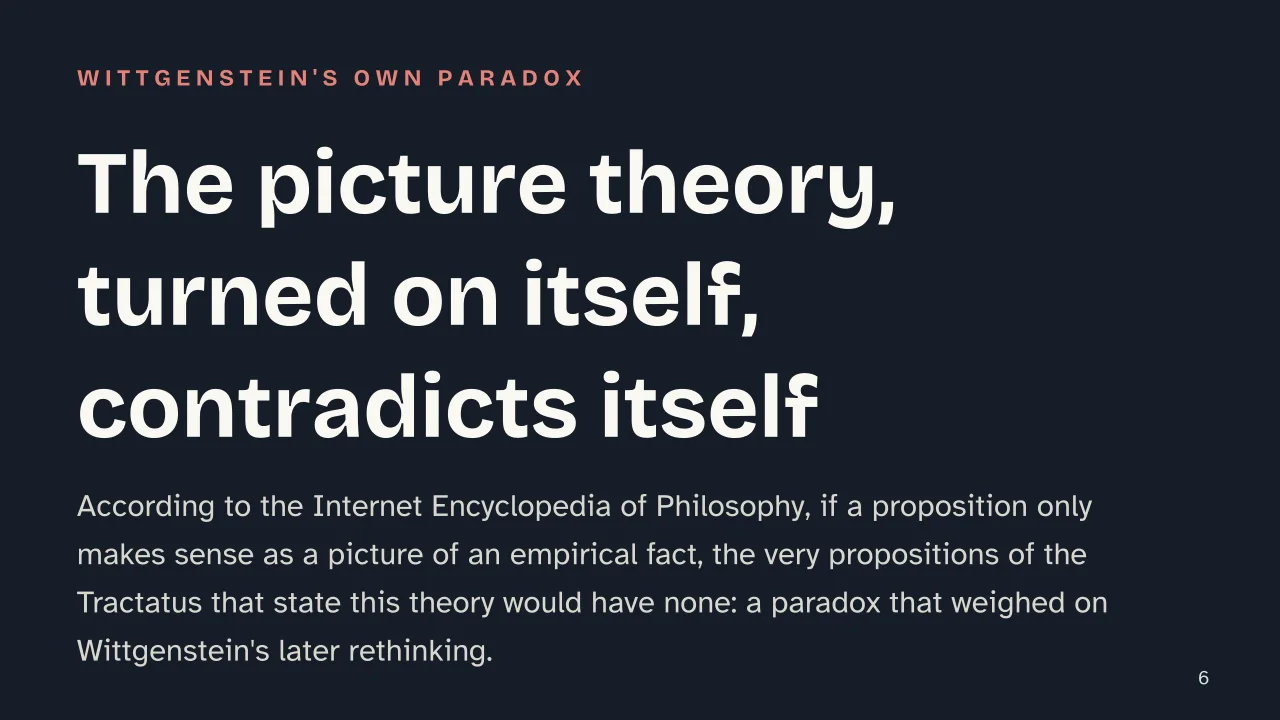  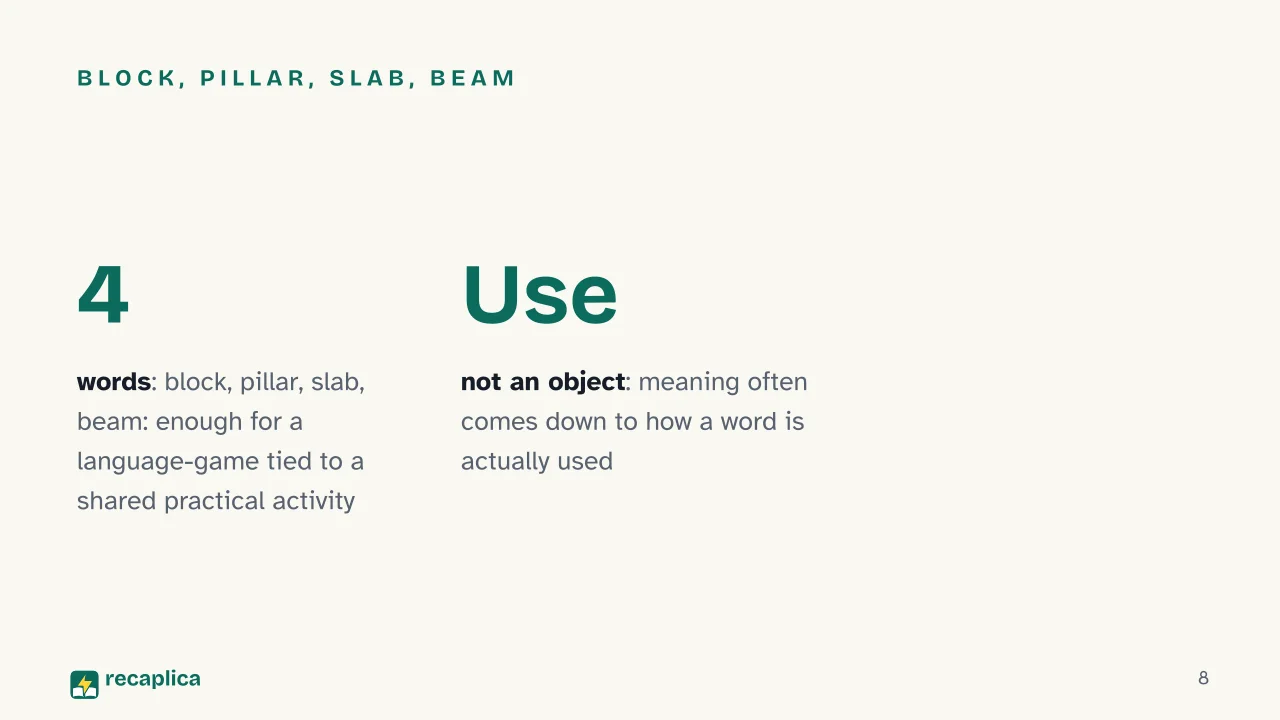    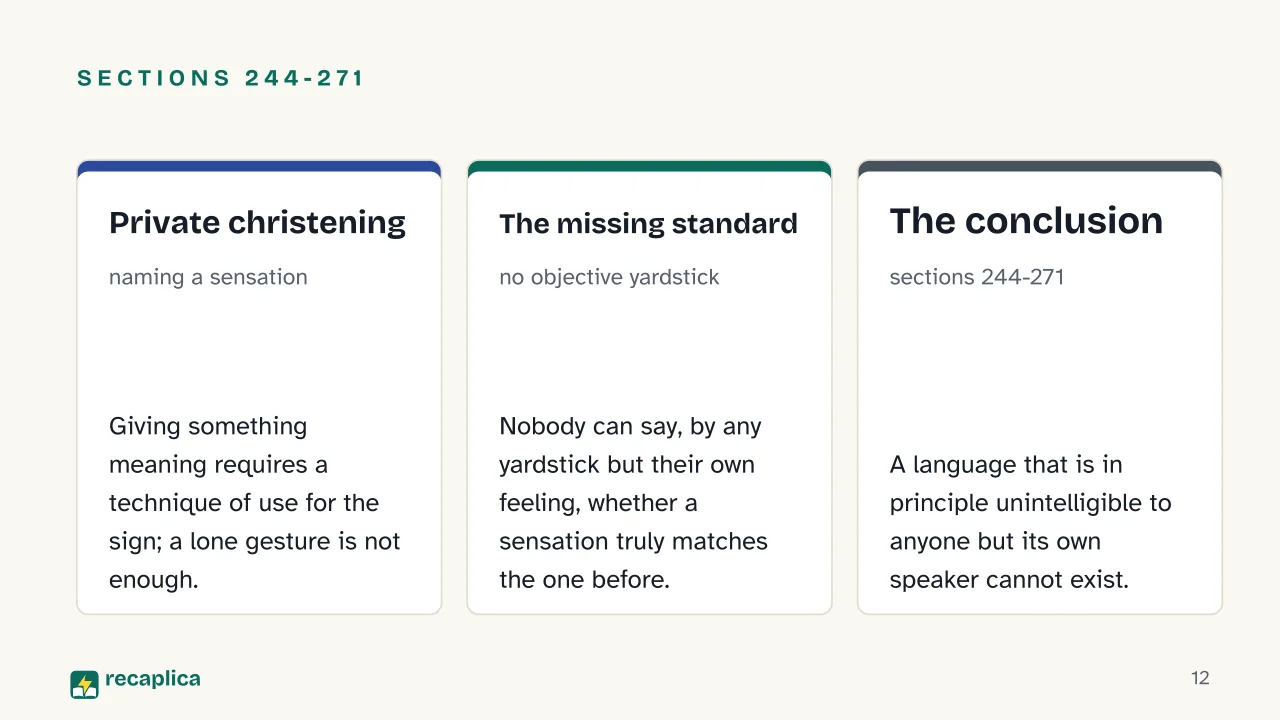 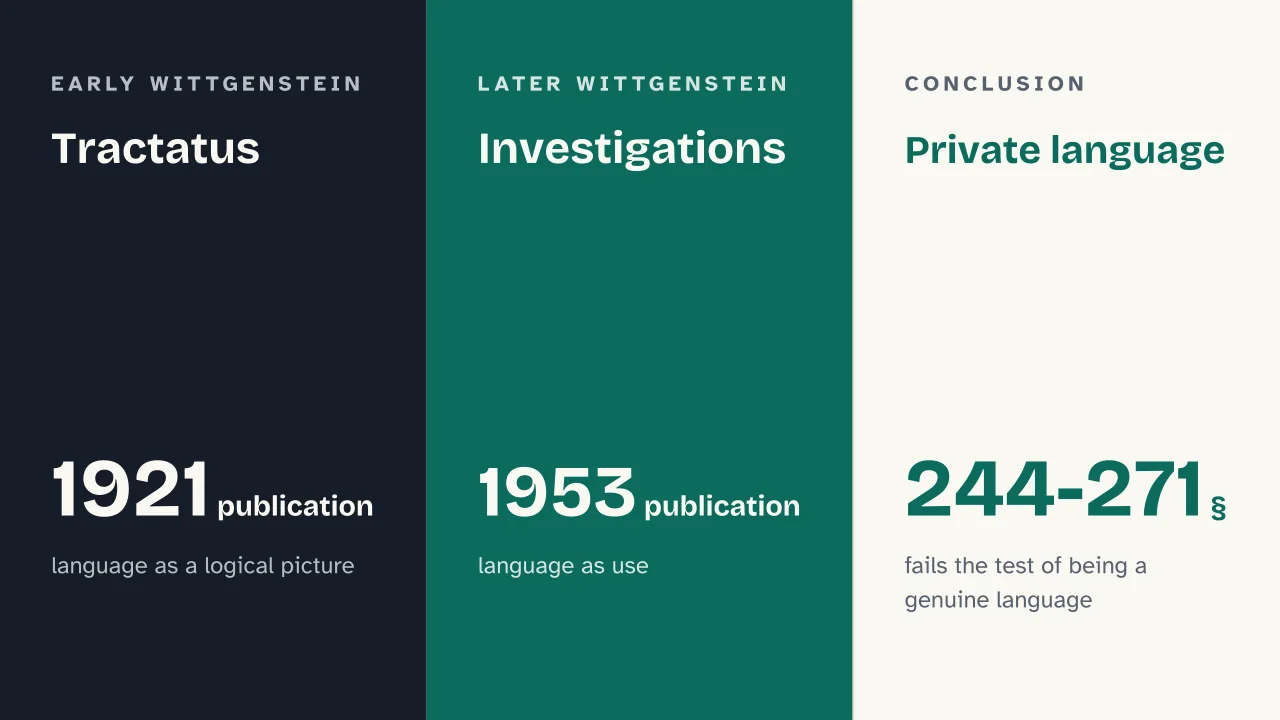 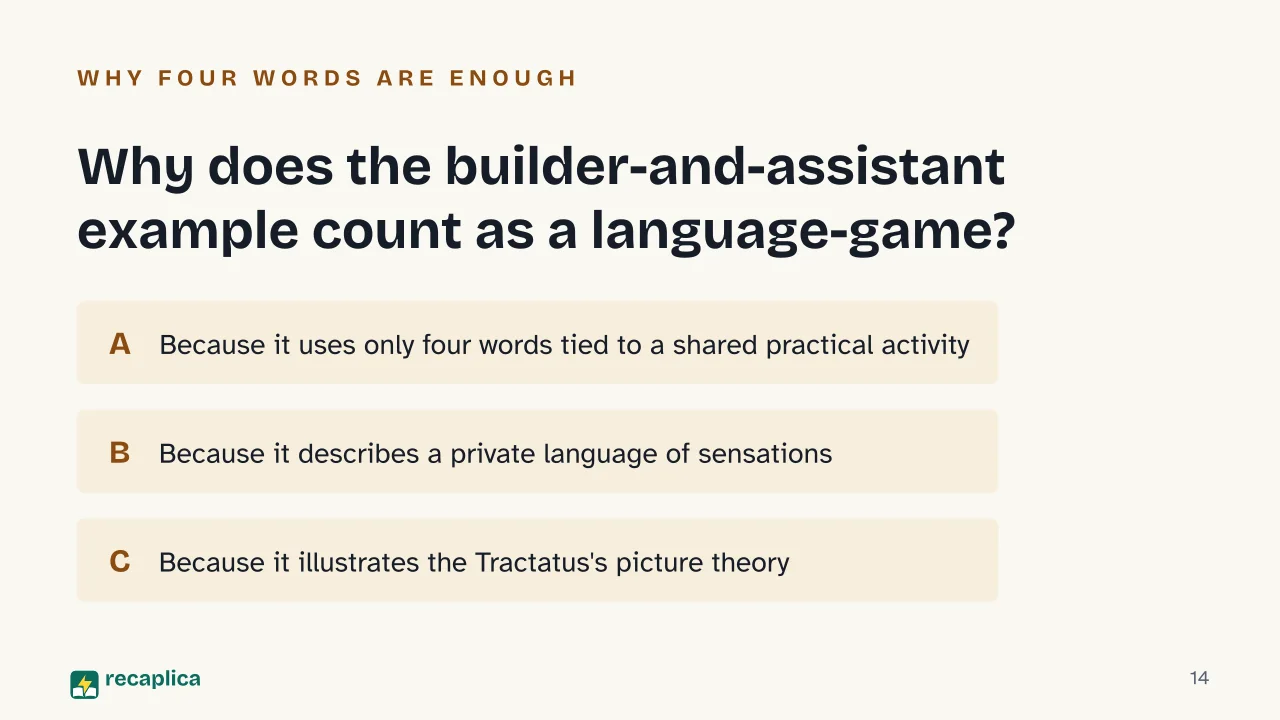  Common myths
Mind mapDrag the background to move around and the nodes to reposition them; use − and + to collapse and expand branches. 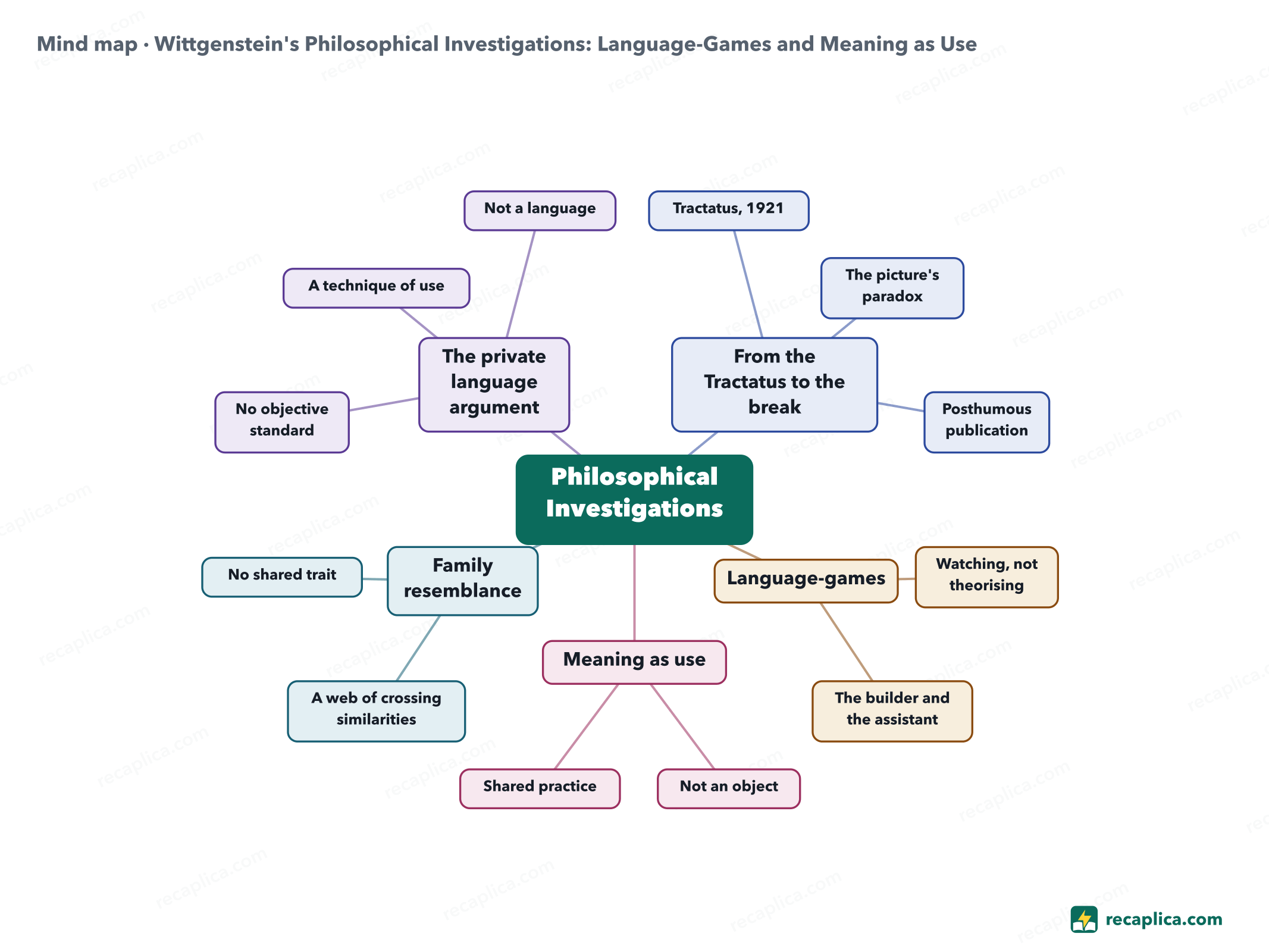
Quiz: test yourselfAnswer the questions to check what you have learned: you get instant feedback and a short explanation. Grade 0/10 0/5
FlashcardsTap the card to flip it and check whether you remember the answer, then move to the next one. 1 / 8 Explain it in your own wordsThe ultimate test: if you can explain it in simple words, you've truly understood it. Write your explanation, then compare it with the Recap. Your explanation is saved only on this device.
Frequently asked questionsWhat does Philosophical Investigations say about Wittgenstein and language?In the second phase of his thinking, Wittgenstein stops looking for a single logical structure behind every sentence and asks readers to look instead at how language works in everyday practices. For him, a word's sense is judged by the shared practices where it gets used. This is the ground on which language-games and family resemblance grow. What is Wittgenstein's private language argument?It is the argument, worked out in sections 244-271 of Philosophical Investigations, that a language whose words would name only inner experiences known solely to the speaker does not earn the status of a genuine language. Without an external, shareable standard, asking whether a sign is used «the same way» as before stops making sense. What are language-games in Philosophical Investigations?They are the concrete practices in which language gets used, observed case by case. The most-cited example is a builder and an assistant who communicate with just four words (block, pillar, slab, beam) tied to their shared activity. How does Philosophical Investigations differ from the Tractatus?The Tractatus (1921) describes language as a logical picture of reality, inside a systematically organised treatise. Philosophical Investigations, published posthumously in 1953, drops that theory and proceeds through fragmentary remarks on the concrete use of words, part of the later Wittgenstein's turn toward everyday language. What is family resemblance in Wittgenstein?Wittgenstein uses it for how the different senses of «game» hang together: a web of partial, overlapping similarities. Every Recap goes through an independent review before publication. |