Skip to content
recaplica

    One moment: security check

    Cloudflare wants to make sure you're not a robot. Tick the box below and your search will continue on its own.

    IT
    recaplica Why Korea Is Divided: North Korea's History and How It's Ruled
    © 2026 Recaplica · recaplica.com — All rights reserved
    Home › History

    Why Korea Is Divided: North Korea's History and How It's Ruled

    By Recaplica Newsroom · Updated on September 5, 2026

    What to print

    Page numbers appear when printing with default margins.

    Slides

    Choose a cut

    Flash10 slidesThe essential thread, to present in classFull18 slidesEvery chapter and the deeper detail

    Both come with speaker notes.

    Telegram channel
    recaplica Clear in 30 seconds, yours in 10 minutes.
    In 30 seconds Key points Figures Deep dive Slides Myths Mind map Quiz Flashcards FAQ

    In 30 seconds quick read

    North and South Korea have been separate states since 1948, the outcome of several factors layered on top of each other, the legacy of Japanese occupation, the division the Allies drew along the 38th parallel in August 1945, and the Korean War of 1950-53, which ended only in an armistice never followed by a peace treaty. In the north, the Democratic People's Republic of Korea has been led since 1948 by the Kim dynasty, by Kim Jong Un since 2011, through a single ruling party and a state ideology of self-reliance called Juche. North Korea publishes no reliable official statistics and its economy depends almost entirely on trade with China; since 2006 the country has been under a series of UN Security Council sanctions tied to its nuclear and missile programs. Technically, the two Koreas remain in a suspended conflict more than seventy years on.

    Key Points

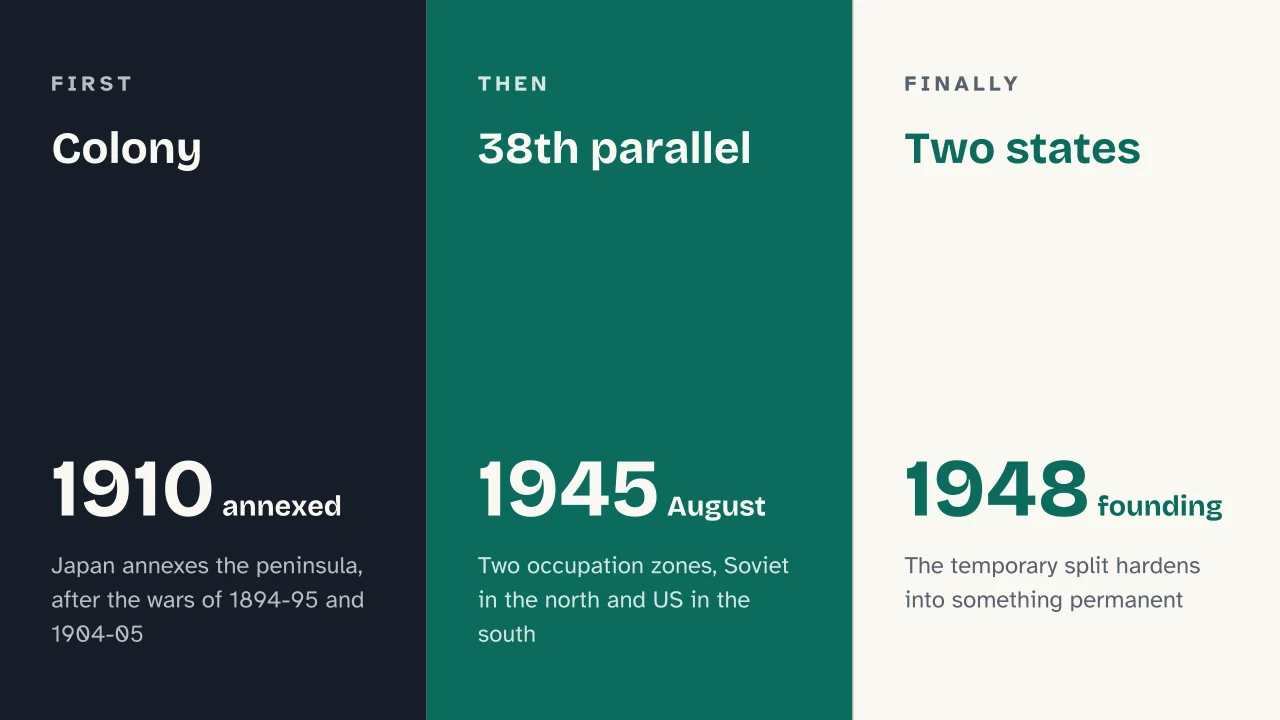
    • The division has several intertwined roots: Japanese occupation (1910-1945), the 1945 split along the 38th parallel between a Soviet and a US occupation zone, and the founding of two separate states in 1948.
    • The Korean War (25 June 1950 - 27 July 1953) ended with an armistice, not a peace treaty: the two Koreas are technically still in a suspended conflict.
    • Power in North Korea has passed since 1948 through the Kim dynasty (Kim Il Sung, then Kim Jong Il, then Kim Jong Un since 17 December 2011) and a single party, the Workers' Party of Korea.
    • The state ideology is Juche (self-reliance); in the 1990s it was joined by the Songun doctrine ("military first"), later scaled back under Kim Jong Un in favor of tighter party control over the army.
    • North Korea publishes no reliable official economic statistics: the external estimate of its GDP, at purchasing power parity (2023), should not be mistaken for a figure the regime itself has declared; its trade depends almost entirely on China.
    • Since 2006 the UN Security Council has adopted nine major resolutions against North Korea, all tied to nuclear and missile tests.

    Key figures

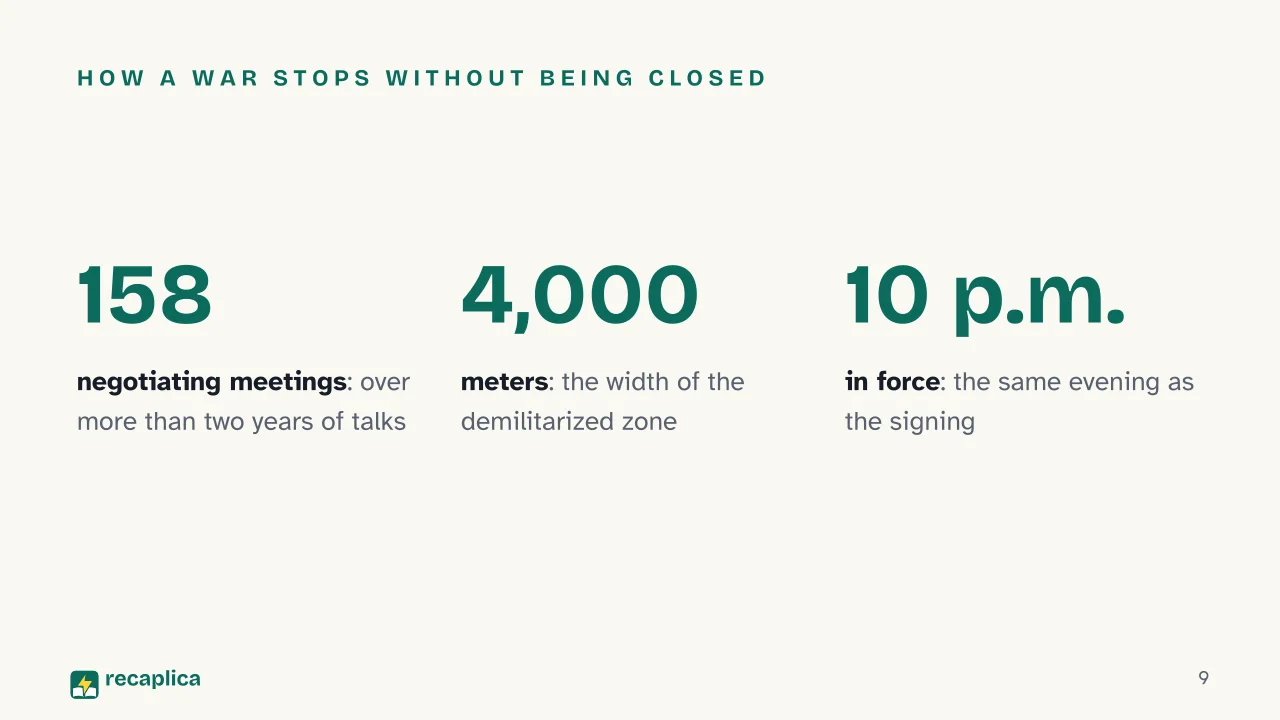
    • 158 negotiating meetings over more than two years that led to the Korean War armistice, signed on 27 July 1953 Source: National Archives (NARA), United States
    • 9 the major UN Security Council resolutions adopted against North Korea between 2006 and 2017, all tied to its nuclear and missile program Source: Arms Control Association
    • 26.4 million North Korea's estimated population in 2025 Source: The World Factbook (mirror theworldfactbook.org)

    Deep Dive

    From a colonial empire to two occupation zones

    Korea’s division does not begin in 1950, with the first shots fired, but decades earlier. After the First Sino-Japanese War of 1894-95 and the Russo-Japanese War of 1904-05, Japan occupied the Korean peninsula; in 1910 it formally annexed it, ending centuries of Korean sovereignty over its own territory.

    Japanese occupation ended with the Second World War: in August 1945, defeated, Japan laid down its arms and surrendered unconditionally to the Allied powers. That is where one of the century’s most debated decisions enters the picture. The task of figuring out how to handle the Japanese surrender on the Korean peninsula landed on two young officials at the US State Department, who picked the 38th parallel as the dividing line: north of it, Japanese troops would surrender to the Soviets, south of it, to the Americans. It was meant to be a temporary administrative and military split, not a permanent political border. Things turned out otherwise.

    1948: two states are born

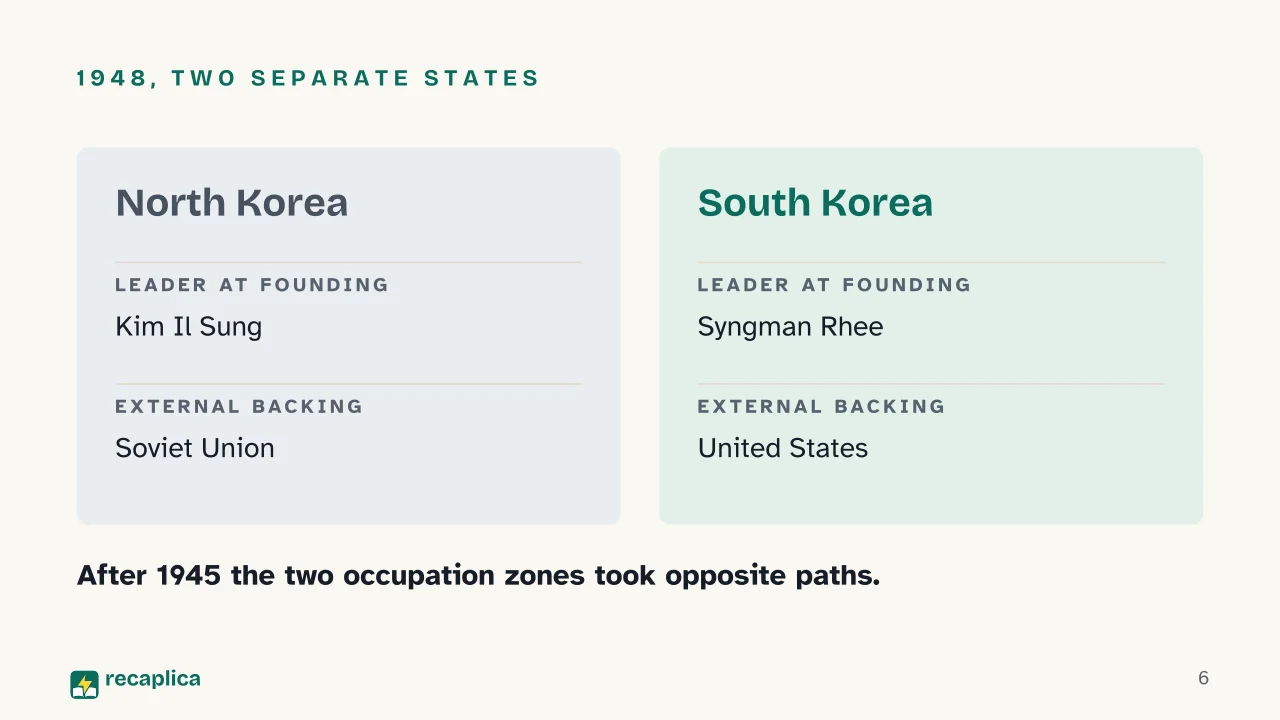
    Over the following three years, the two occupation zones took opposite paths. In the north, the Soviets backed the rise of Kim Il Sung; in the south, the United States supported Syngman Rhee. In 1948 the temporary split hardened into something permanent: two separate states came into being.

    North Korea (1948)South Korea (1948)
    Official nameDemocratic People’s Republic of KoreaRepublic of Korea
    Leader at foundingKim Il SungSyngman Rhee
    External backingSoviet UnionUnited States

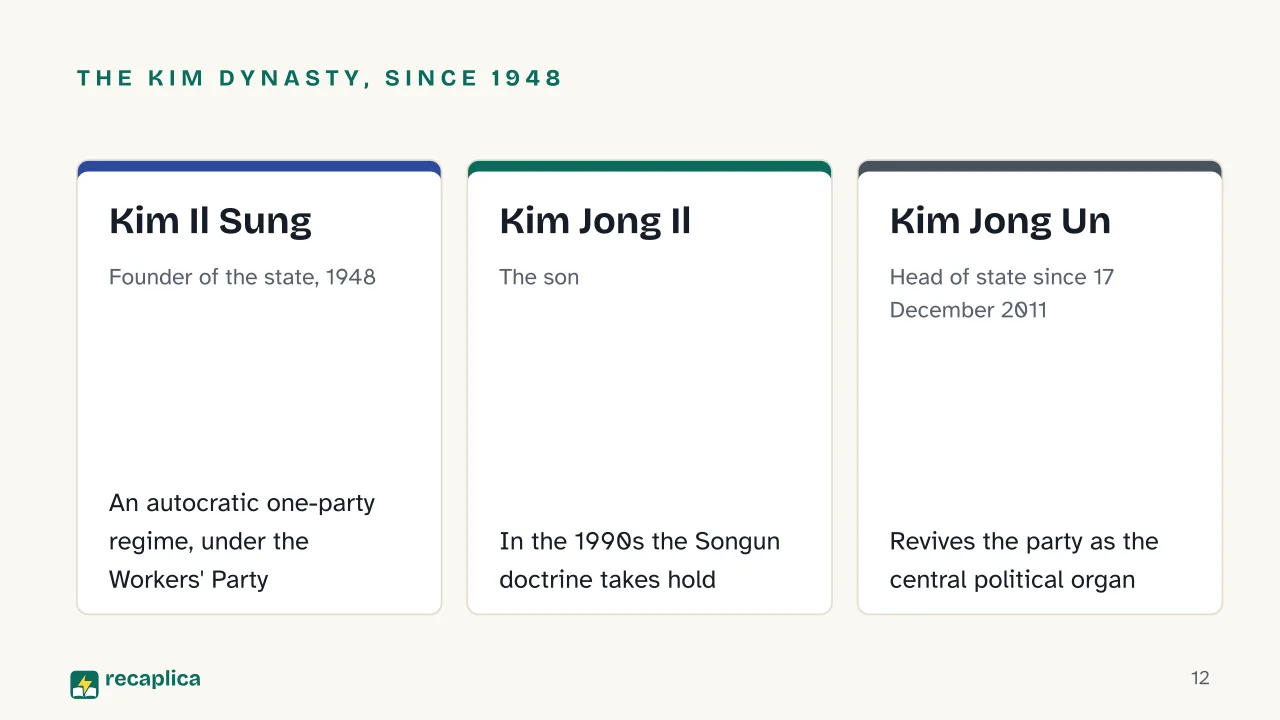
    In the north, Kim Il Sung quickly consolidated power and built an autocratic one-party regime under the Workers’ Party of Korea. It was the start of a system of government that, with internal changes, has lasted nearly eighty years.

    The Korean War, and an armistice that never became peace

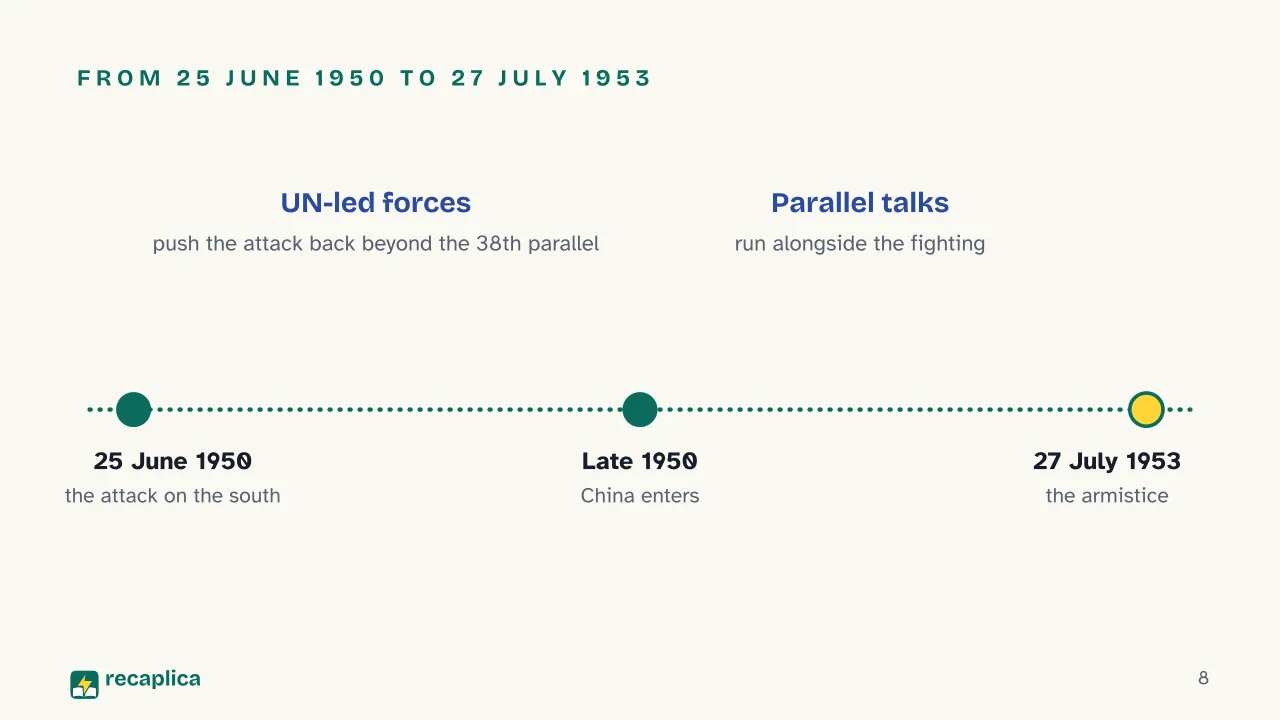
    On 25 June 1950 Kim Il Sung’s army attacked South Korea, coming close to conquering the entire peninsula. US forces then led a UN-authorized operation to push the North Korean army back beyond the 38th parallel; by the end of 1950, after UN troops advanced toward the Chinese border, the People’s Republic of China entered the conflict as well.

    A little over three years of fighting and parallel negotiations followed. After 158 negotiating meetings, on 27 July 1953 General William K. Harrison Jr., the delegate for the UN Command, and General Nam Il, the delegate for the North Korean army and Chinese People’s Volunteers, spent ten minutes signing eighteen official copies of the armistice agreement, drafted in three languages. The agreement took effect that same evening, at 10 p.m.

    Practical example: the Korean armistice is like a match stopped by the referee’s whistle at halftime, never resumed and never closed with a final score. The players are still on the field, lined up in nearly the same positions as almost seventy years ago, waiting for a final whistle that has never come.

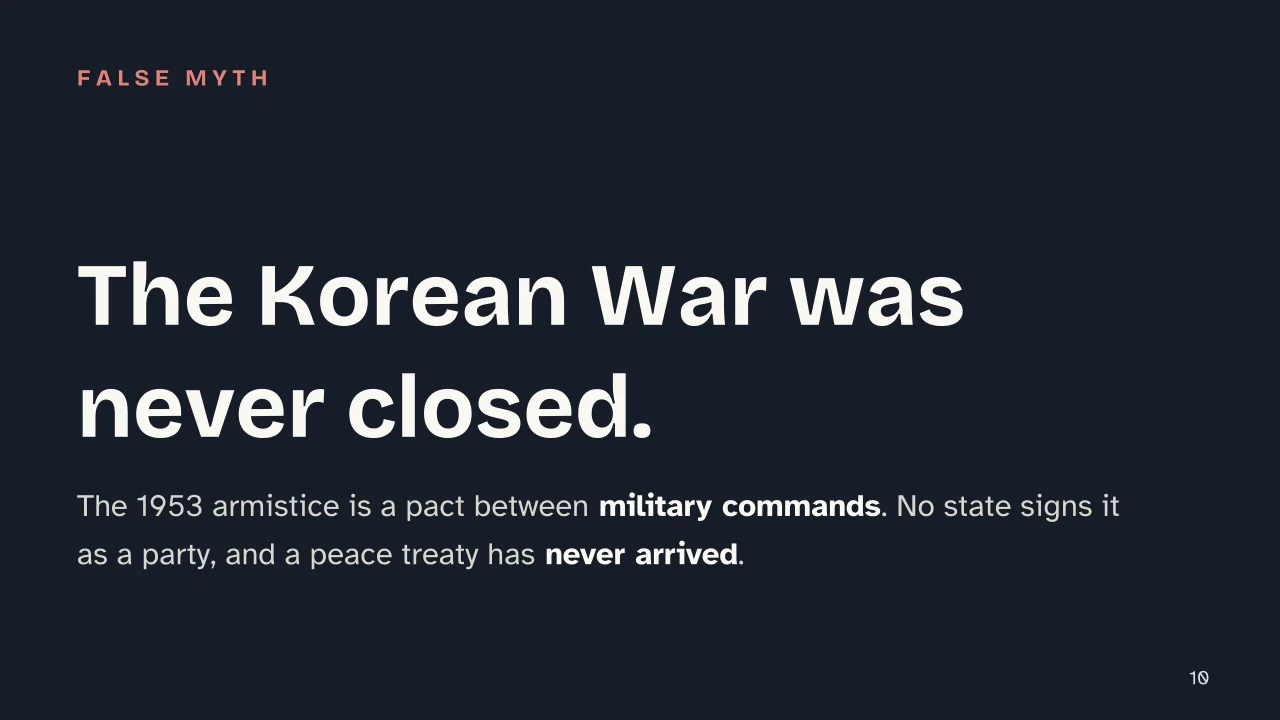
    The agreement suspended hostilities and withdrew military forces from a strip about 4,000 meters wide, the demilitarized zone (DMZ); it established the Military Armistice Commission to oversee the truce; and it committed both sides to release and repatriate prisoners of war and displaced people. But the agreement’s text leaves no doubt that it was signed by military commanders, not governments, with no state signing it as a party. That is why North and South Korea remain, technically, in a suspended conflict more than seventy years on, with no treaty ever having closed it. That same year, the United States and South Korea also signed a mutual defense treaty, the legal basis, in effect since 1953, for the American military presence on the peninsula. After three years of war, the de facto borders ended up almost exactly where they had started, near the 38th parallel.

    Who runs North Korea: party, dynasty, ideology

    Since 1948, power in North Korea has passed, without interruption, through three generations of the same family: Kim Il Sung, then his son Kim Jong Il, then his grandson Kim Jong Un, head of state as president of the State Affairs Commission since 17 December 2011. Since 11 April 2019, the head of government has instead been Choe Ryong Hae, president of the Supreme People’s Assembly.

    The decision-making center remains the Workers’ Party of Korea (WPK), whose Central Committee relies on three subordinate bodies: the Politburo, the Control Commission and the Executive Policy Bureau. Among its branches, the Organization Guidance Department and the Propaganda Department are considered among the most influential party agencies.

    The relative weight of party and military, though, has not stayed constant. Under Kim Jong Il, the Songun doctrine, “military first,” took hold in the 1990s, raising the armed forces’ role in political life and in the allocation of resources. Kim Jong Un reversed that trend: he revived the Workers’ Party as the central political organ and pushed for tighter, more formal institutional control over the military, replacing three senior generals in 2018 to strengthen the party’s grip on the armed forces.

    The guiding ideology, though, remains Juche, usually translated as “self-reliance”: a notion of independence and sovereignty that has dominated North Korean politics since the years after the Second World War. Three generations of the Kim family have ruled, since 1948, with near-absolute authority and heavy repression of dissent.

    An isolated economy, hard to measure

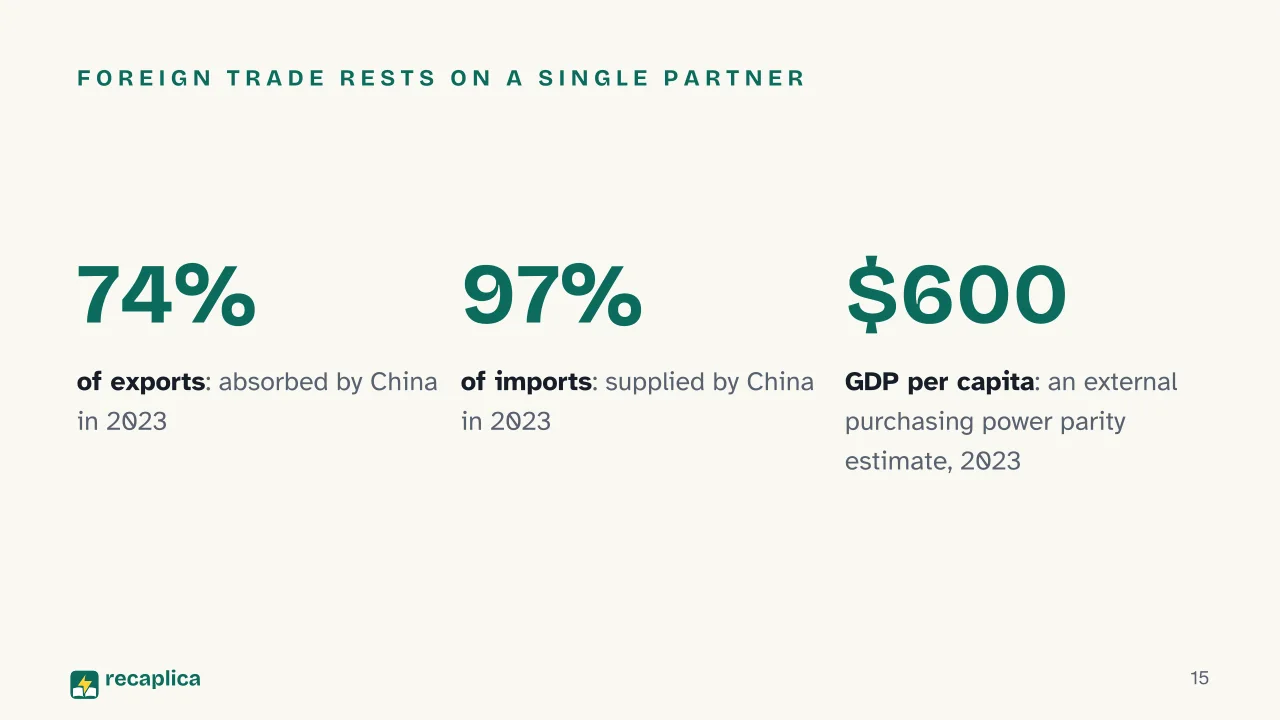
    North Korea publishes no reliable official economic statistics, so there is no nominal GDP figure declared by the state. The number most often cited by outside sources is a purchasing-power-parity estimate for 2023: about 15.416 billion dollars, or a GDP per capita of about 600 dollars. It should be treated for what it is, an external estimate, not an official figure from the regime.

    The main productive sectors named by outside sources are military products, heavy machinery, electric power, chemicals, mining (coal, iron ore, limestone, magnesite, graphite, copper, zinc, lead and precious metals), metallurgy, textiles, food processing and tourism. Foreign trade, though, depends on almost a single partner: in 2023 China absorbed about 74% of North Korean exports and supplied about 97% of its imports, while every other trading partner remained marginal.

    The estimated population in 2025 is about 26.4 million people, with a median age of 36.2 years and a life expectancy of 73.5 years, across a territory of 120,538 square kilometers. The armed forces count up to 1.3 million active-duty personnel, with compulsory service for men (ages 17-30) and women (ages 17-23), an obligation that sources put at up to ten years for men and seven for women. Between 2010 and 2020, military spending is estimated at 20% to 30% of North Korea’s GDP each year, an enormous share for any economy.

    UN sanctions and relations with the outside world

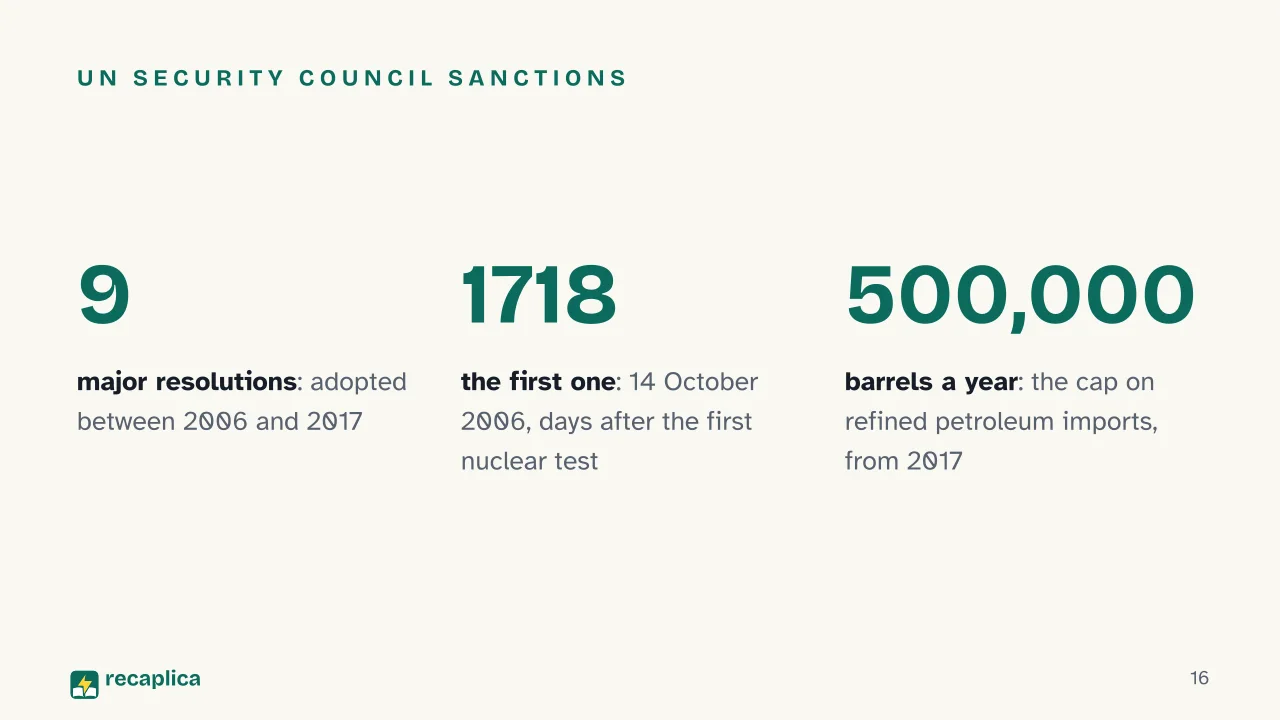
    Since 2006, North Korea’s nuclear and missile program has led the UN Security Council to adopt nine major resolutions, through 2017, nearly always in direct response to a test. Resolution 1718, from 14 October 2006, came just days after North Korea’s first nuclear test and banned transfers of heavy weapons and weapons-of-mass-destruction technology. Later resolutions followed each new test or missile launch, gradually widening the embargo: from a ban on exporting copper, nickel, silver and zinc (2016) to a full ban on textile exports (2017), to a cap on refined petroleum imports, limited to 500,000 barrels a year under resolution 2397 in December 2017.

    The roots of this isolation reach back into the wider ideological standoff of the Cold War, which turned Korea into one of the grounds where the two superpowers fought each other by proxy, without ever clashing directly. That bloc logic, of opposing alliances and isolated economic systems, never fully lifted from the Korean peninsula: it has stayed frozen, together with the 1953 armistice, along a border that, as of 2026, no treaty has yet made permanent.

    Slide deck

    Slides ready to download and make your own in PowerPoint or Google Slides, with speaker notes. Pick the Flash cut or the Full one.
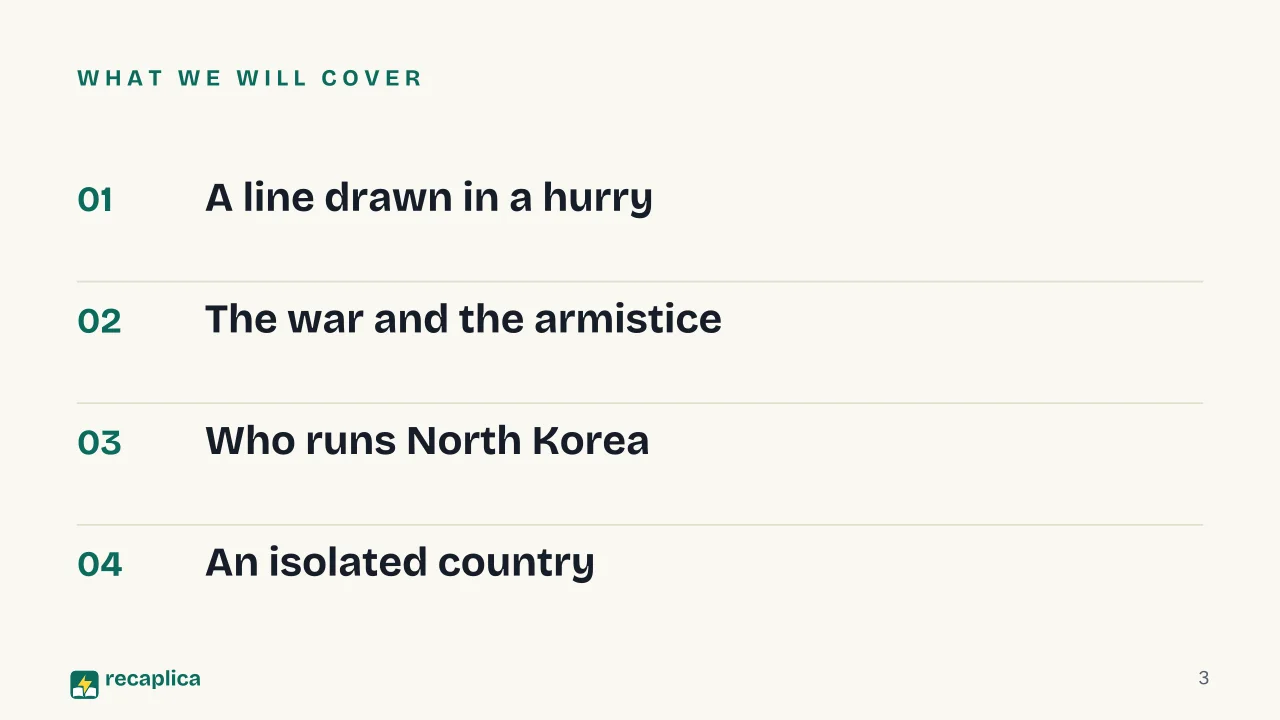
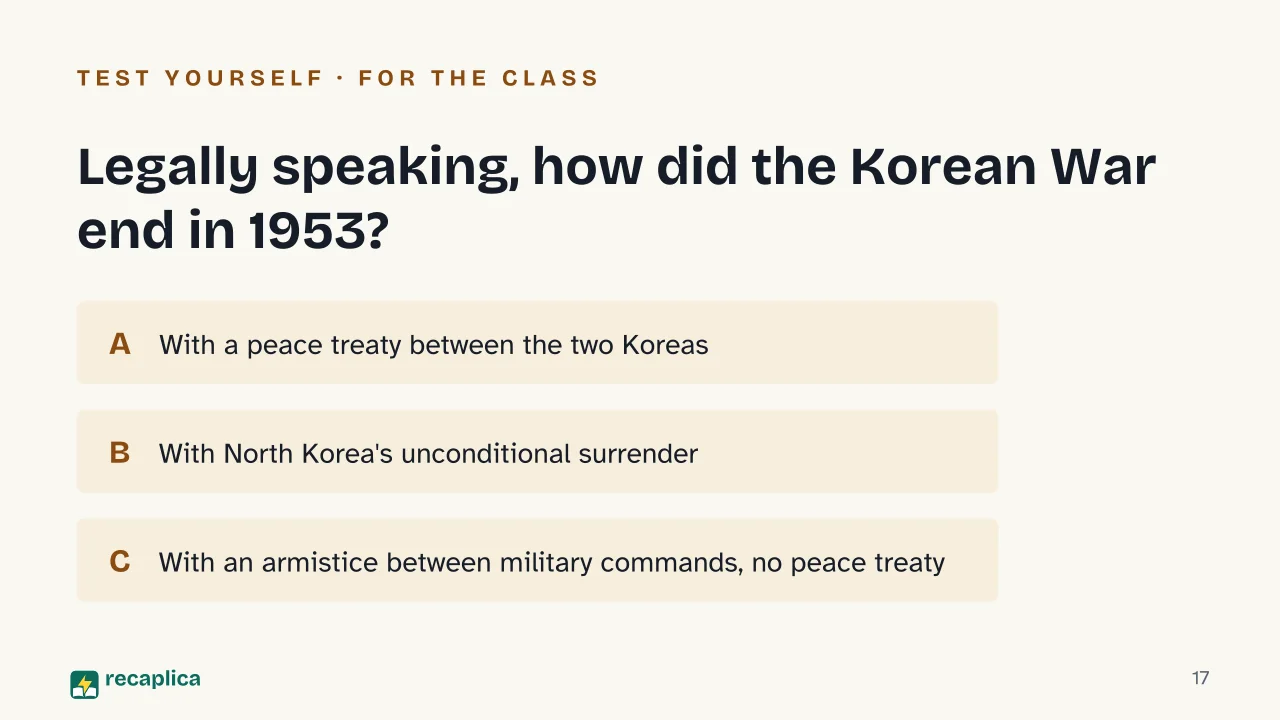
    Slide 1 of the presentation on Why Korea Is Divided: Why Korea Is DividedSlide 2 of the presentation on Why Korea Is Divided: Who drew the border between the two Koreas?Slide 3 of the presentation on Why Korea Is Divided: What we will coverSlide 4 of the presentation on Why Korea Is Divided: Chapter 01: A line drawn in a hurrySlide 5 of the presentation on Why Korea Is Divided: Colony · 38th parallel · Two statesSlide 6 of the presentation on Why Korea Is Divided: 1948, two separate statesSlide 7 of the presentation on Why Korea Is Divided: Chapter 02: The war and the armisticeSlide 8 of the presentation on Why Korea Is Divided: From 25 June 1950 to 27 July 1953Slide 9 of the presentation on Why Korea Is Divided: How a war stops without being closedSlide 10 of the presentation on Why Korea Is Divided: The Korean War was never closed.Slide 11 of the presentation on Why Korea Is Divided: Chapter 03: Who runs North KoreaSlide 12 of the presentation on Why Korea Is Divided: The Kim dynasty, since 1948: Kim Il Sung, Kim Jong Il, Kim Jong UnSlide 13 of the presentation on Why Korea Is Divided: What does Juche mean?Slide 14 of the presentation on Why Korea Is Divided: Chapter 04: An isolated countrySlide 15 of the presentation on Why Korea Is Divided: Foreign trade rests on a single partnerSlide 16 of the presentation on Why Korea Is Divided: UN Security Council sanctionsSlide 17 of the presentation on Why Korea Is Divided: Legally speaking, how did the Korean War end in 1953?Slide 18 of the presentation on Why Korea Is Divided: And now, the review
    Flash10 slidesThe essential thread, to present in classFull18 slidesEvery chapter and the deeper detail

    Common myths

    • ✗ Myth Koreans themselves chose the border between the two Koreas.

      ✓ Reality The 38th parallel line was drawn in August 1945 by US State Department officials, in a matter of hours, as a temporary administrative boundary to manage the Japanese surrender, not as a political choice made by Koreans or a border meant to last for decades.

    • ✗ Myth The Korean War ended with a peace treaty, like other twentieth century wars.

      ✓ Reality It ended only in an armistice signed on 27 July 1953, a pact between military commands that no government signs as a party. No peace treaty has ever followed it, so technically the two Koreas remain in a suspended conflict more than seventy years on.

    • ✗ Myth The North Korean military has always held the same weight in the country's government.

      ✓ Reality Its role has shifted over time. Under the Songun doctrine, rooted in the 1990s under Kim Jong Il, the army gained more decision- making autonomy; Kim Jong Un later reversed that trend, tightening party control over the armed forces and replacing three senior generals in 2018.

    Mind map

    Drag the background to move around and the nodes to reposition them; use − and + to collapse and expand branches.
    Customize
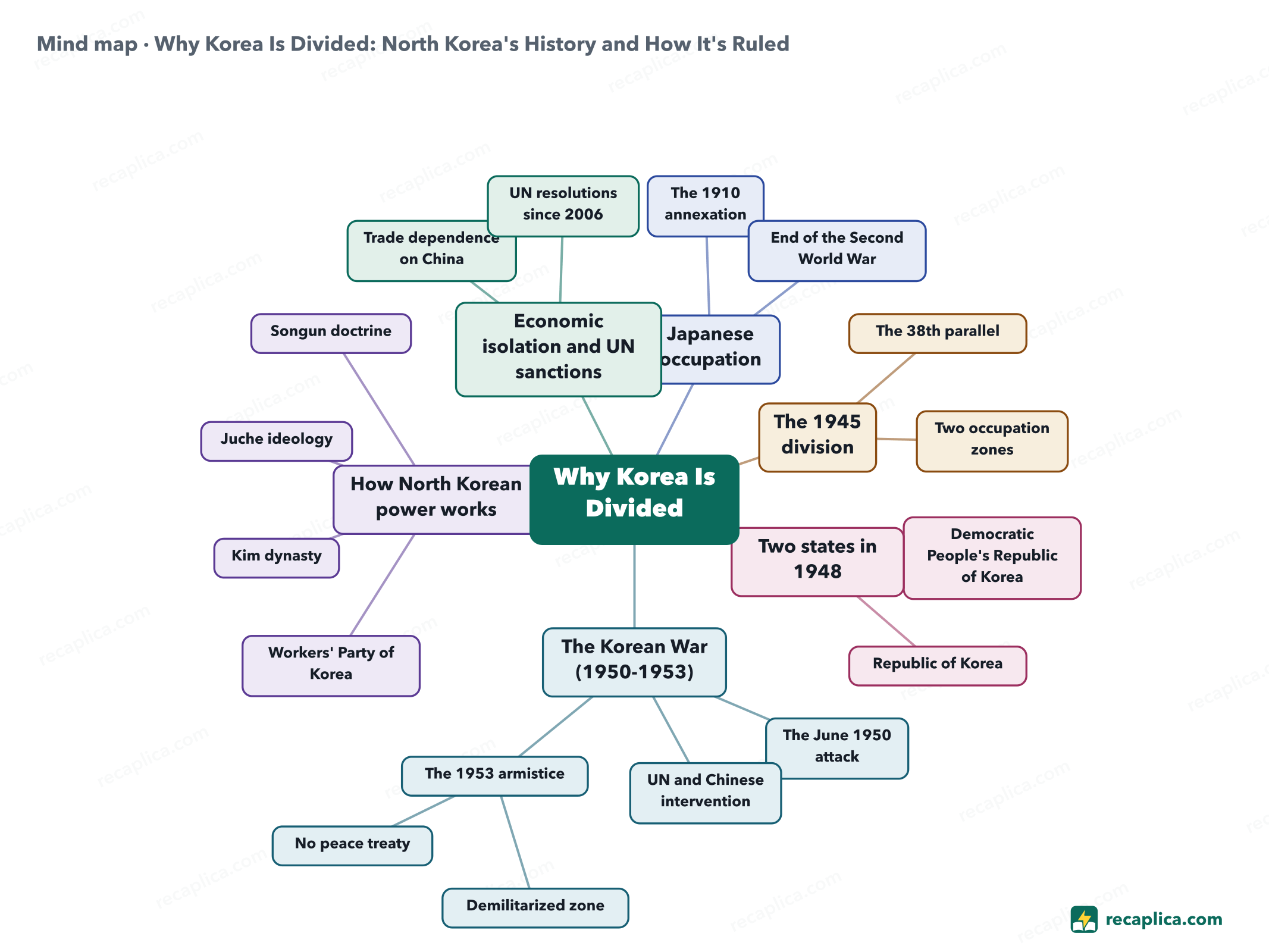
    Mind map: Why Korea Is Divided: North Korea's History and How It's Ruled
    • Why Korea Is Divided
      • Japanese occupation
        • The 1910 annexation Japan formally annexes the whole Korean peninsula.
        • End of the Second World War Japan surrenders in August 1945.
      • The 1945 division
        • The 38th parallel Line drawn by US officials as a temporary administrative border.
        • Two occupation zones Soviet in the north, US in the south.
      • Two states in 1948
        • Democratic People's Republic of Korea North, Kim Il Sung, Soviet backing.
        • Republic of Korea South, Syngman Rhee, US backing.
      • The Korean War (1950-1953)
        • The June 1950 attack The North Korean army invades the south.
        • UN and Chinese intervention UN-led forces push back the attack; China enters the war in late 1950.
        • The 1953 armistice
          • Demilitarized zone A strip about 4,000 meters wide.
          • No peace treaty A purely military document, with no state as a signatory.
      • How North Korean power works
        • Workers' Party of Korea The central organ of state politics.
        • Kim dynasty Kim Il Sung, Kim Jong Il, Kim Jong Un since 2011.
        • Juche ideology Self-reliance, independence, sovereignty.
        • Songun doctrine Military first: rooted in the 1990s, later scaled back.
      • Economic isolation and UN sanctions
        • Trade dependence on China 2023 data, about 74% of exports, about 97% of imports.
        • UN resolutions since 2006 Nine major resolutions through 2017, tied to nuclear tests.

    Quiz: test yourself

    Answer the questions to check what you have learned: you get instant feedback and a short explanation.

    Grade 0/10 0/5
    1 Why was Korea divided along the 38th parallel in 1945?

    In August 1945, as Japan surrendered, US State Department officials drew the line as a temporary military boundary between Soviet occupation in the north and US occupation in the south, not as a choice made by Koreans or a border meant to last.

    2 What happened in Korea in 1948?

    In 1948, two separate states emerged, the Democratic People's Republic of Korea in the north, founded under Kim Il Sung with Soviet backing, and the Republic of Korea in the south, led by Syngman Rhee with US backing.

    3 Legally speaking, how did the Korean War end in 1953?

    The armistice signed on 27 July 1953 stopped the fighting, but it was signed by military commands, not by the two countries' governments as contracting parties. That is why, technically, the two Koreas remain in a suspended conflict.

    4 Which North Korean state ideology is associated with self-reliance?

    Juche, usually translated as "self-reliance," stresses independence and sovereignty and has dominated North Korean politics since the years after the Second World War. Songun ("military first") is a separate doctrine, rooted instead in the 1990s.

    5 Why should North Korea's GDP figure be treated with caution?

    North Korea does not publish reliable official economic statistics. The figure that circulates (15.416 billion dollars in 2023) is a purchasing-power-parity estimate produced by outside sources, not a number declared by the regime.

    Answers: 1-A · 2-B · 3-C · 4-B · 5-B

    Flashcards

    Tap the card to flip it and check whether you remember the answer, then move to the next one.

    1 / 8

    Explain it in your own words

    The ultimate test: if you can explain it in simple words, you've truly understood it. Write your explanation, then compare it with the Recap.

    Your explanation is saved only on this device.

    North and South Korea have been separate states since 1948, the outcome of several factors layered on top of each other, the legacy of Japanese occupation, the division the Allies drew along the 38th parallel in August 1945, and the Korean War of 1950-53, which ended only in an armistice never followed by a peace treaty. In the north, the Democratic People's Republic of Korea has been led since 1948 by the Kim dynasty, by Kim Jong Un since 2011, through a single ruling party and a state ideology of self-reliance called Juche. North Korea publishes no reliable official statistics and its economy depends almost entirely on trade with China; since 2006 the country has been under a series of UN Security Council sanctions tied to its nuclear and missile programs. Technically, the two Koreas remain in a suspended conflict more than seventy years on.

    Frequently asked questions

    Why is Korea divided in two?

    The division has several intertwined roots, the legacy of Japanese occupation (1910-1945), the split along the 38th parallel decided in August 1945 between a Soviet and a US occupation zone, the founding of two separate states in 1948, and finally the Korean War (1950-53), which ended only in an armistice never followed by a peace treaty. No single one of these causes explains the whole story.

    What is the difference between an armistice and a peace treaty in Korea's case?

    The armistice of 27 July 1953 stopped the fighting and set up the demilitarized zone, but it remains an agreement between military commands, and neither government signs it as a contracting party. An actual peace treaty, which would formally end the conflict between the two Koreas, has never arrived, so technically the two Koreas remain in a suspended conflict more than seventy years on.

    Who leads North Korea?

    Since 17 December 2011, the head of state has been Kim Jong Un, president of the State Affairs Commission, the third generation of the Kim dynasty after his grandfather Kim Il Sung, who founded the state in 1948, and his father Kim Jong Il. Since 11 April 2019 the head of government has been Choe Ryong Hae, president of the Supreme People's Assembly.

    Why is North Korea so economically isolated?

    The state depends almost entirely on China for foreign trade, which in 2023 absorbed around 74% of North Korean exports and supplied around 97% of its imports, and it publishes no reliable official economic statistics. On top of that, the UN Security Council adopted nine resolutions between 2006 and 2017 that progressively ban exports and imports in response to the country's nuclear and missile tests.

    What is the demilitarized zone (DMZ) between the two Koreas?

    It is a strip about 4,000 meters wide, set up by the 1953 armistice, from which all military forces and equipment were withdrawn. Despite its name, it remains one of the most heavily guarded borders in the world, running along a de facto line that has stayed almost unchanged since the start of the war, near the 38th parallel.

    Sources

    • The World Factbook — North Korea
    • Office of the Historian, U.S. Department of State — The Korean War, 1950-1953
    • National Archives (Prologue Magazine) — Korean War Armistice Agreement, 1953
    • Council on Foreign Relations — North Korea's Power Structure
    • Arms Control Association — UN Security Council Resolutions on North Korea

    Every Recap goes through an independent review before publication.

    Every evening, the day's new Recaps on our Telegram channel. Join the channel →

    Keep learning

    • History The Atomic Bomb: How Nuclear Fission Works, and the History of Hiroshima and Nagasaki The atomic bomb is a weapon that releases an enormous amount of energy by splitting the nuclei of heavy atoms such as uranium or plutonium, a process called nuclear fission. The Manhattan Project, the secret program that built the first American atomic bombs, cost $2.2 billion at the time and employed 130,000 people at its peak. On 6 August 1945 the United States dropped Little Boy on Hiroshima, and three days later, on 9 August, Fat Man on Nagasaki: the only two atomic bombs ever used in a war. Deaths ran into the tens of thousands in the months that followed, and Japan surrendered on 14 August 1945, a decision whose relative weight of causes historians still debate. Since 1970 the Treaty on the Non-Proliferation of Nuclear Weapons has tried to limit the spread of these weapons around the world. Read the Recap →
    • History The Mussolini Myth: How Fascist Propaganda Built the Duce The "myth of Mussolini" was the public persona built to order by Fascist propaganda: an infallible, tireless, ever-young Duce single-handedly lifting Italy back on its feet. The regime built it through systematic press censorship, control of radio and cinema, and a purpose-built ministry, the Minculpop, that told newspapers what to print and what to leave out. Some legends born in those years, like the claim that trains always ran on time, were later dismantled by historians. The myth peaked with the proclamation of the Empire in 1936 and collapsed quickly between 1943 and 1945, when military defeat swept away the leader's image along with the regime. Read the Recap →
    • History The Cold War: What It Was, Why It Started and How It Ended The Cold War was the confrontation between the United States and the Soviet Union that ran from the end of the Second World War to 1991. It is called "cold" because the two superpowers never fought each other directly: both had nuclear weapons, and an open clash would have been too destructive for either side to survive intact. Instead they competed through rival military alliances, economic aid used as political leverage, espionage, propaganda and wars fought elsewhere — in Korea and in Vietnam. Europe was split along a line Churchill called an "iron curtain" in 1946, and Berlin became the sharpest point of contact. The confrontation ended between 1989, when the Berlin Wall came down, and 25 December 1991, when Gorbachev resigned and the Soviet Union ceased to exist. Read the Recap →

    recaplica

    Clear in 30 seconds, yours in 10 minutes.

    Recaps Mind maps Request a Recap Telegram channel Mind map maker Our method About Privacy & cookies Legal notes & terms of use

    © 2026 Recaplica · A project by Curi S.r.l. — VAT IT05472000750

    Statistics, only if you say so

    To learn which Recaps help most we would use Google Analytics, with aggregate, anonymous data. It starts only with your OK, and you can change your mind anytime. Privacy policy