|
recaplica
Giovanni Gentile: Actual Idealism and Fascism | ||||||||||||||||||||||||
| © 2026 Recaplica · recaplica.com — All rights reserved | ||||||||||||||||||||||||
Giovanni Gentile: Actual Idealism and FascismWhat to print Page numbers appear when printing with default margins. SlidesChoose a cut Flash10 slidesThe essential thread, to present in classFull15 slidesEvery chapter and the deeper detailBoth come with speaker notes. In 30 seconds quick readGiovanni Gentile was a Sicilian philosopher, born in 1875 and killed in Florence in 1944. His doctrine, actual idealism or actualism, holds that reality exists only as it is being made, in the act of thinking. In 1923, while Minister of Education, he joined the National Fascist Party, and Treccani ties the choice to the consistency of his philosophy. In 1925 he drafted the Manifesto of the Fascist Intellectuals, which Croce answered with a counter-manifesto. In 1932 he wrote the first part of the Italian Encyclopedia entry on Fascism. Key Points
Key figures
Deep DiveGiovanni Gentile: who he wasGiovanni Gentile was born in Castelvetrano, in the province of Trapani, on 29 May 1875, the eighth of ten children, according to Treccani’s Dizionario Biografico. He was a philosopher and Minister of Education. The school reform that bears his name has a Recap of its own: the 1923 Gentile reform and what it changed in Italian schools. Actual idealism: Gentile’s philosophy of the pure actAccording to Treccani, actualism and actual idealism are the same doctrine, and the name comes from the way all reality is traced back to spirit. The reference work is the Teoria generale dello spirito come atto puro, published in 1916. Treccani explains that “act” means something being done, unlike Aristotle’s completed act. In actualism, reality exists only as it is being made. The pure act coincides with self-consciousness, which thinks and acts at once and so grounds itself. According to the English Wikipedia entry, the pure act is the only true reality for Gentile: thinking as it thinks. Subject and object are not distinguished in it. That is where his opposition to dualism comes from.
Gentile’s philosophy against Hegel and CroceAccording to Wikipedia, actualism sets out to reform the dialectic of Hegel and German idealism: in Gentile the dialectic lives entirely inside the act of thinking. He also rejects Hegel’s triad of Idea, Nature and Spirit, because for him everything is Spirit. Gentile shared a long partnership with Benedetto Croce. According to Treccani it lasted almost thirty years and ended in the break of October 1924. Wikipedia describes Croce as an absolute historicist and sets the two philosophies side by side.
Gentile and fascism: from 1923 to the ManifestoIn May 1923, when he was Minister of Education, Gentile joined the National Fascist Party. He announced it in a letter to Mussolini. Christian Raimo, in Il Post, also dates the membership to 1923. Treccani’s Dizionario Biografico calls it a decision that was sudden only in appearance and ties it to the consistency of his philosophy: for the pure act, all reality lives inside the act of thought. That is Treccani’s reading. In March 1925, at the Bologna conference, Gentile drafted the Manifesto of the Fascist Intellectuals, which Mussolini revised. Treccani Magazine recalls the two publications, ten days apart.
Croce refused to put culture at the service of party politics. Raimo credits Gentile with one more decision: the idea and the wording of the loyalty oath for university professors in 1931. Between 1925 and 1943 Gentile gave his best energies to the Italian Encyclopedia, according to Treccani. Wikipedia names him as its first editor. Ethical state and the Doctrine of FascismIn Treccani’s Croce e Gentile portal, the ethical state is one where the individual cannot be separated from the community and every action carries public moral value. The author of the entry writes that, for Gentile, the ethical state par excellence is the Fascist state. The corporative state is ethical, in Gentile’s view, because it subordinates the economy to the moral ends of the State. Mussolini also claimed an ethical character for the Fascist state, in his 1929 speech to the Chamber on the Lateran Pacts. The public image of the Duce has a Recap of its own: the Mussolini myth and Fascist propaganda. The 1932 Doctrine of Fascism sits in the entry “Fascismo” of the Italian Encyclopedia, volume 14. It has two parts: the first, “Le idee fondamentali”, is Gentile’s, and the second, “La dottrina politica e sociale”, is Mussolini’s. Raimo writes that Gentile composed the entry for Mussolini; Wikipedia specifies that it was the first part of the essay credited to Mussolini. Gentile’s death in 1944In 1943, in the middle of World War II and in the phase of the Italian Social Republic, Gentile was president of the Academy of Italy, which was moved from Rome to Florence. He was killed in Florence on 15 April 1944, near the Villa Montalto at Salviatino, by a Communist partisan group, according to Treccani. Wikipedia gives the killers as Bruno Fanciullacci and Antonio Ignesti of the Communist GAP, and reports that the PCI approved the killing and claimed it. On who ordered it and why, Treccani names no established responsibility and awaits new documents. Slide deckSlides ready to download and make your own in PowerPoint or Google Slides, with speaker notes. Pick the Flash cut or the Full one.   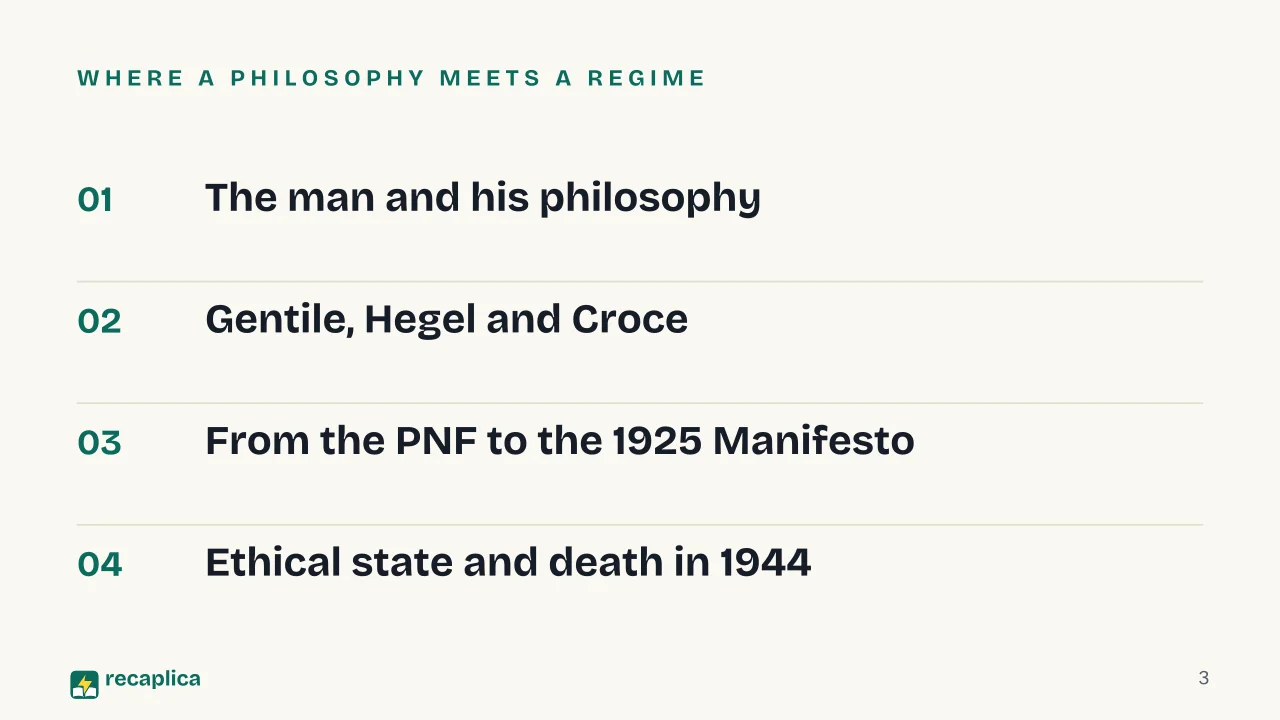  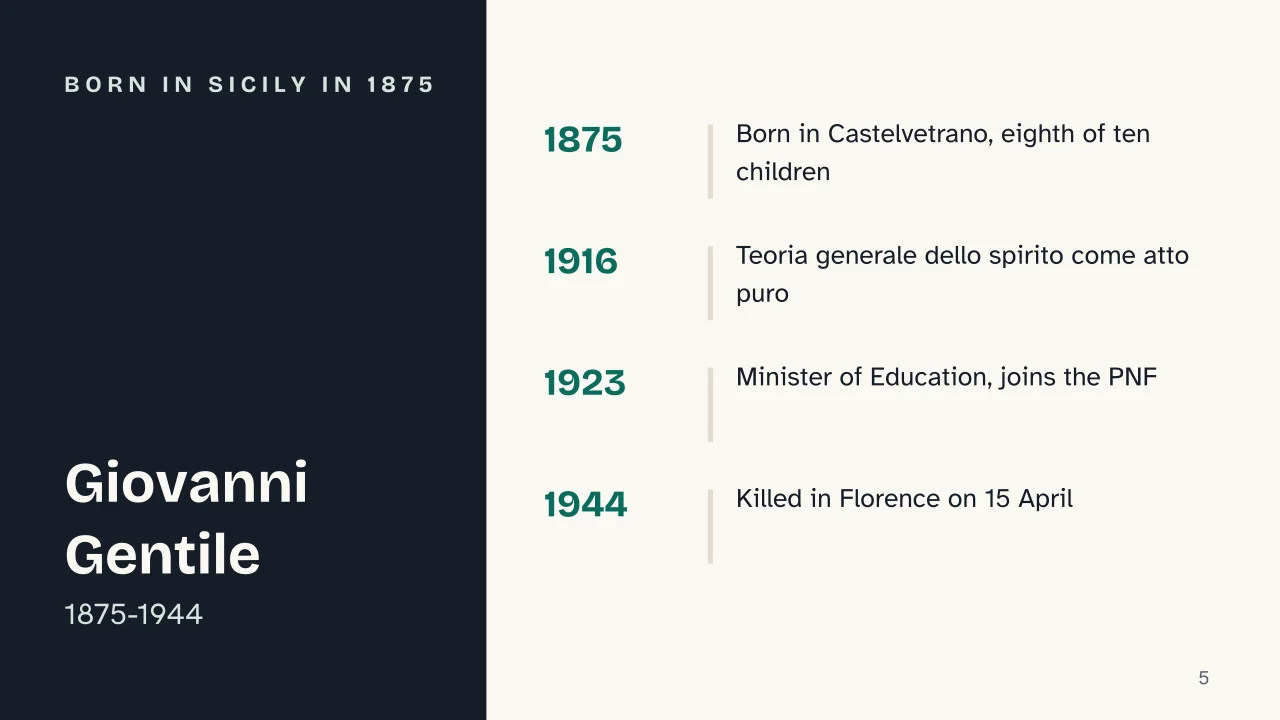  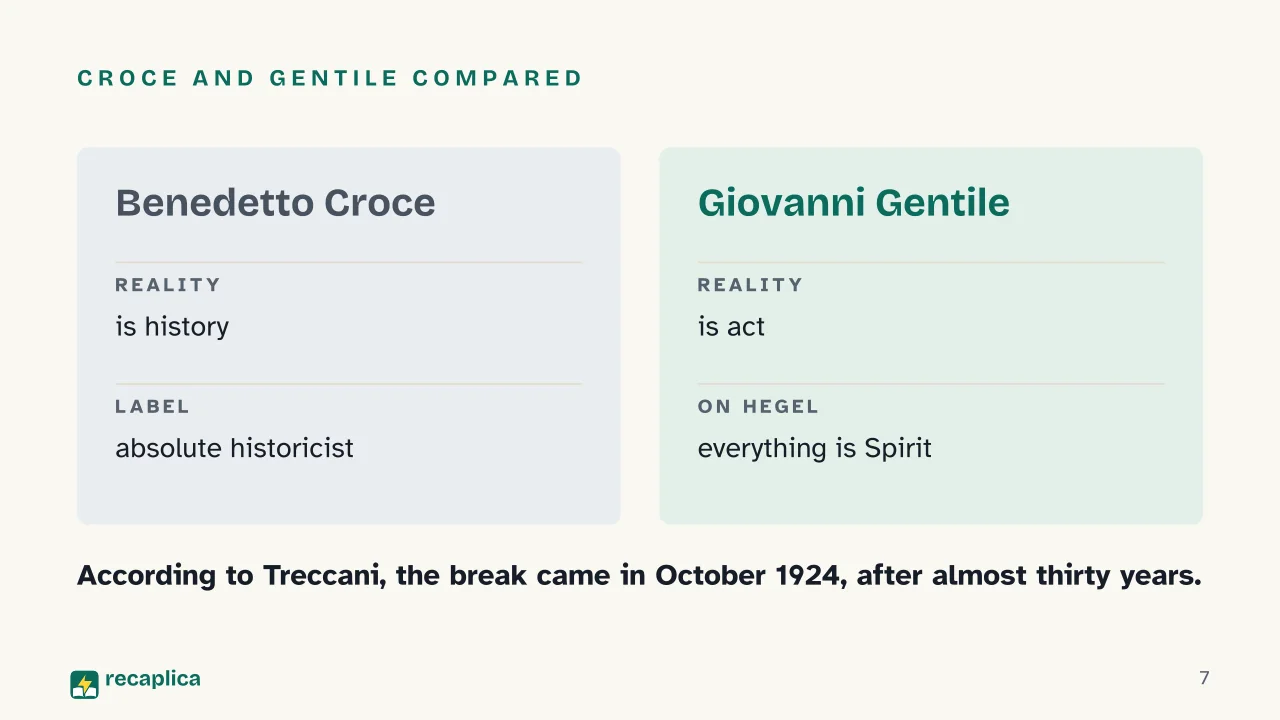  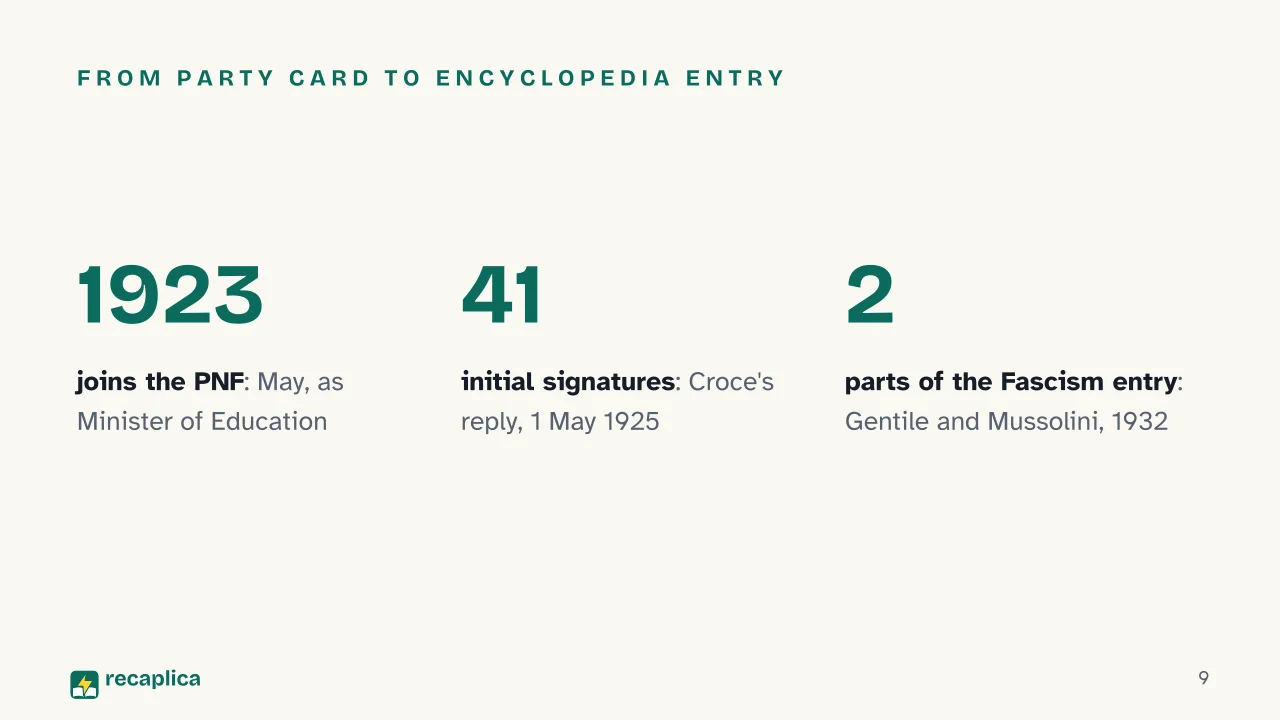 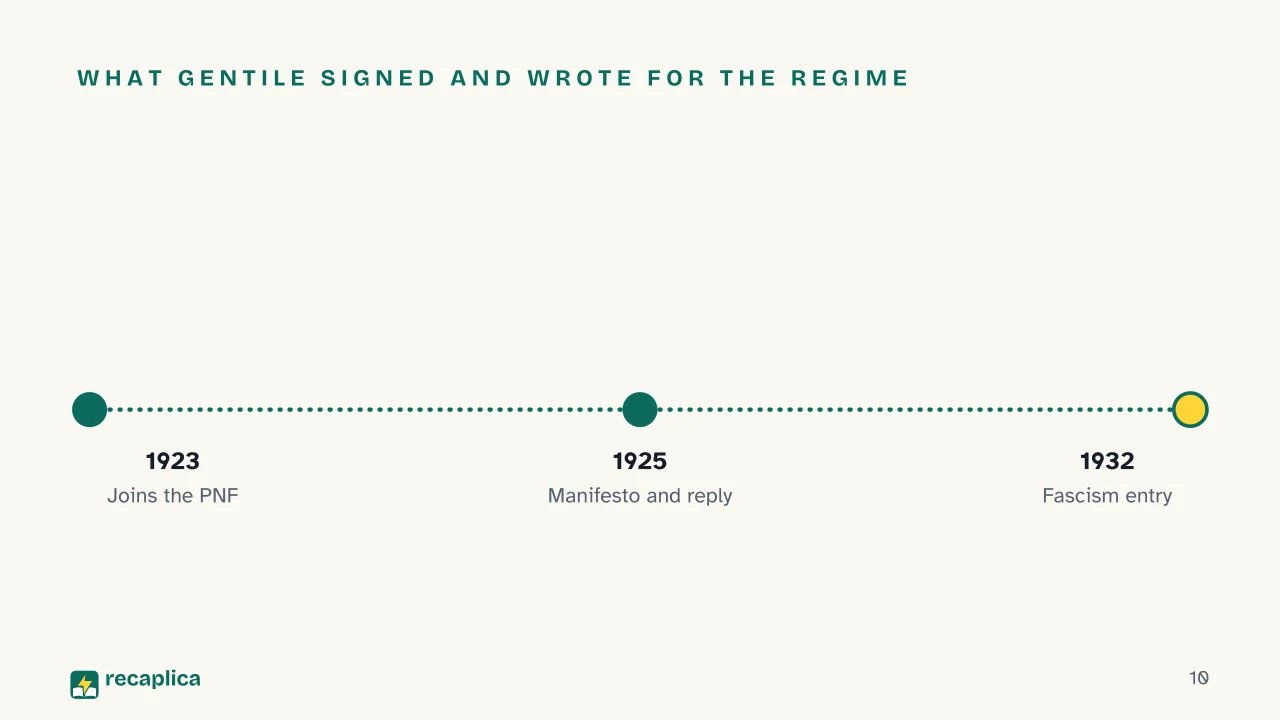  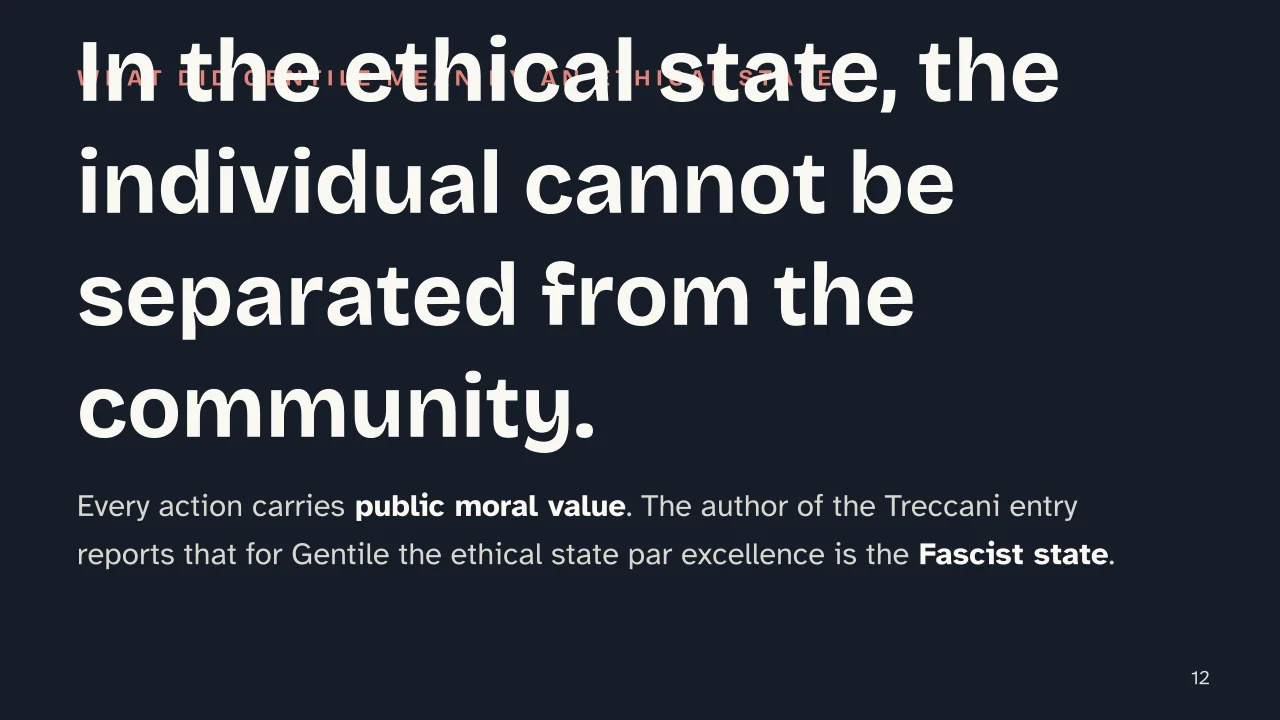 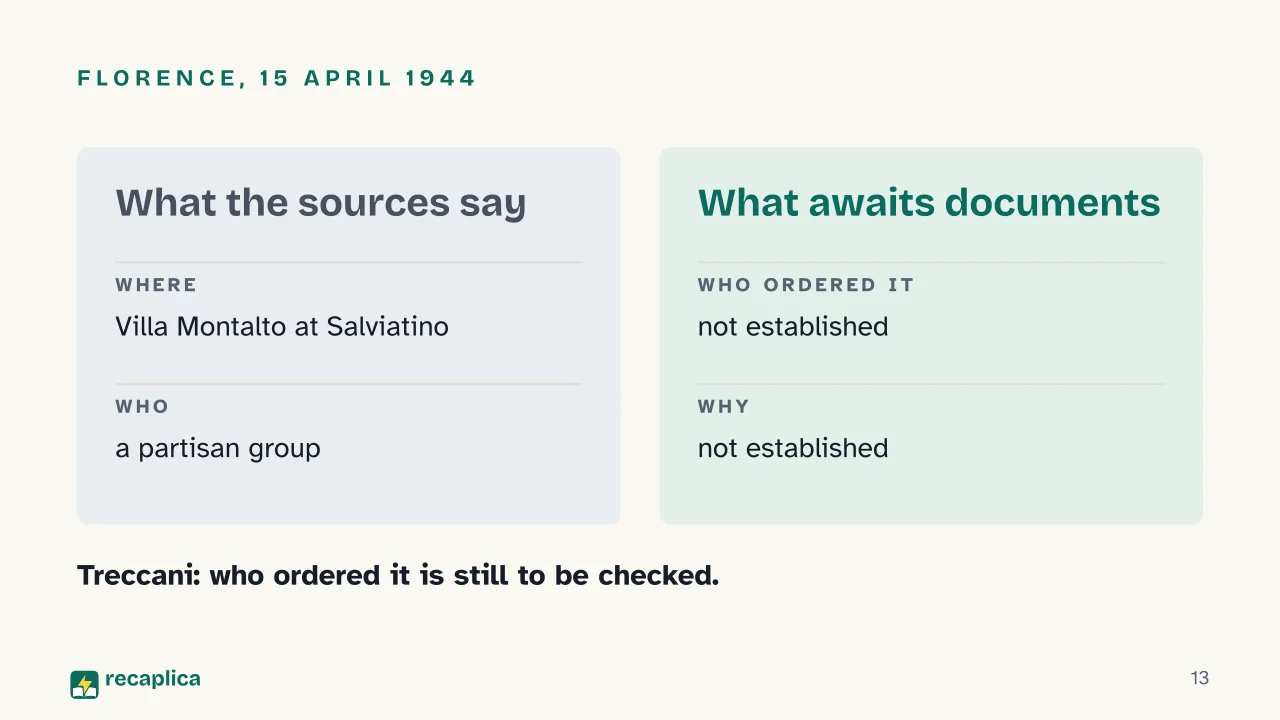 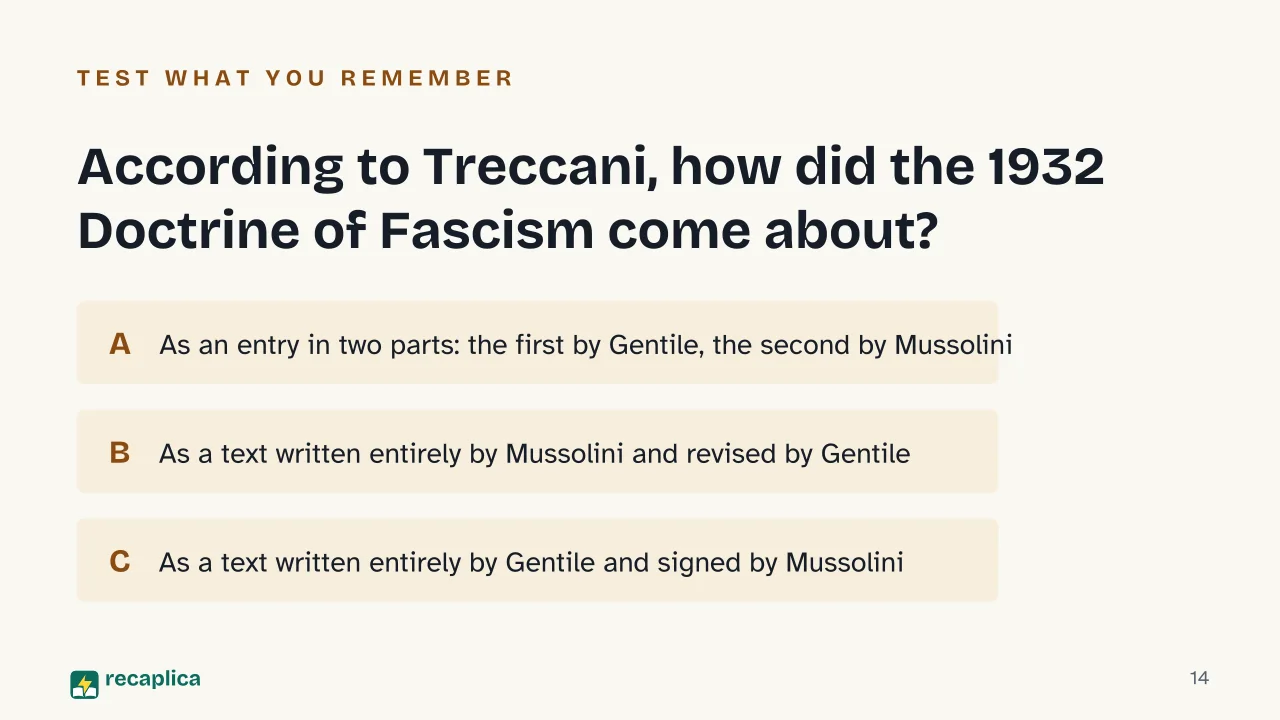  Common myths
Mind mapDrag the background to move around and the nodes to reposition them; use − and + to collapse and expand branches. 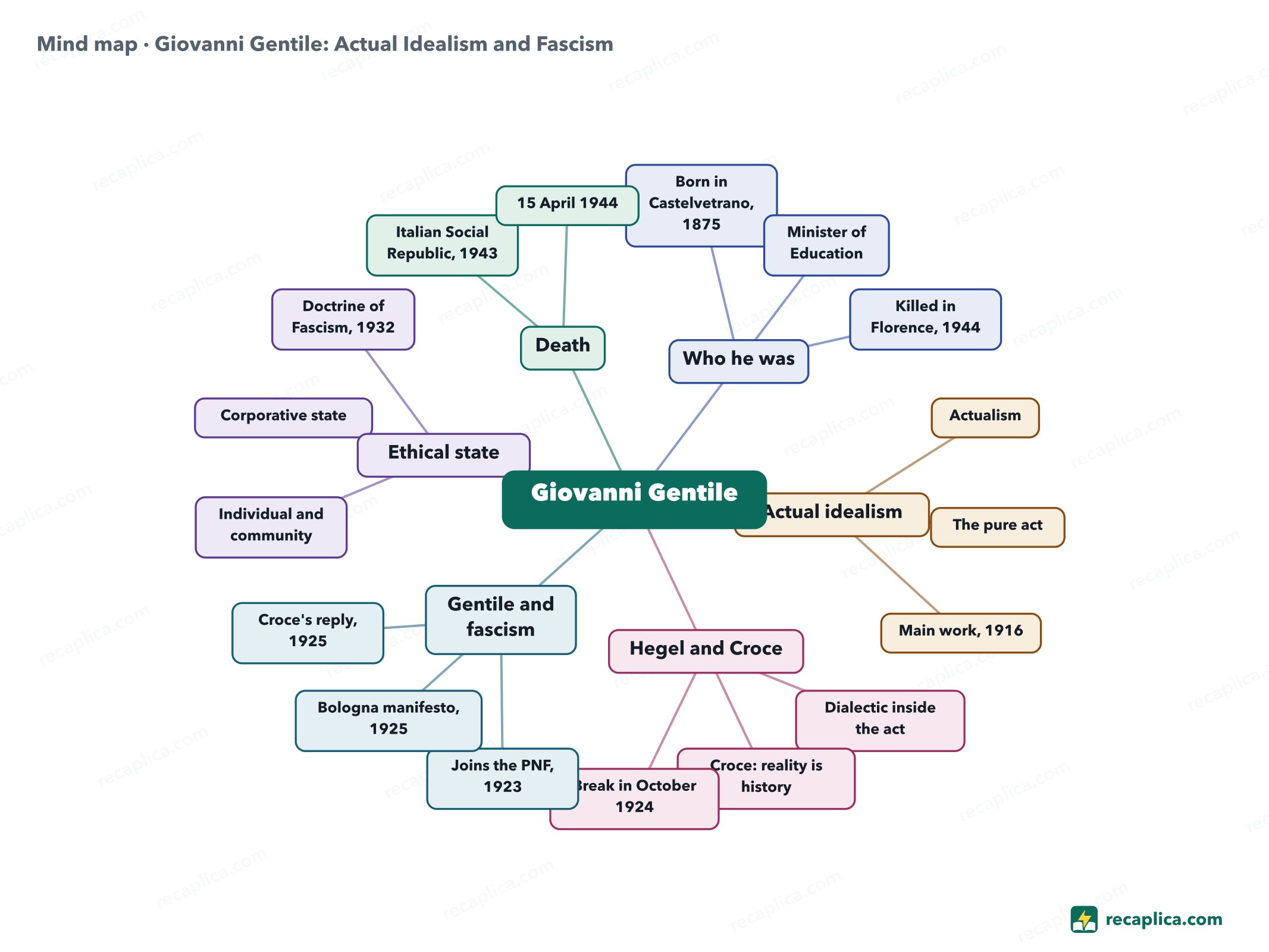
Quiz: test yourselfAnswer the questions to check what you have learned: you get instant feedback and a short explanation. Grade 0/10 0/5
FlashcardsTap the card to flip it and check whether you remember the answer, then move to the next one. 1 / 8 Explain it in your own wordsThe ultimate test: if you can explain it in simple words, you've truly understood it. Write your explanation, then compare it with the Recap. Your explanation is saved only on this device.
Frequently asked questionsWho was Giovanni Gentile?A philosopher born in Castelvetrano, in the province of Trapani, on 29 May 1875. He devised actual idealism, served as Minister of Education, was the first editor of the Italian Encyclopedia and died in Florence on 15 April 1944. What is actual idealism in simple terms?It is Gentile's doctrine that reality is all spirit and lives in the act of thinking, that is, in thinking as one thinks. According to Treccani the act is something being done, and reality exists only as it is being made. Was Giovanni Gentile a fascist?He joined the National Fascist Party in May 1923, as Treccani and Christian Raimo in Il Post report. He drafted the 1925 Manifesto of the Fascist Intellectuals and wrote the first part of the 1932 entry on Fascism. How fascist he was is a matter of interpretation: Treccani, for instance, ties his choice to the consistency of his philosophy. What is the difference between Croce and Gentile?They were bound by a partnership of almost thirty years, until the break of October 1924. Wikipedia places Croce in absolute historicism and Gentile in actual idealism. In 1925 Croce answered Gentile's Manifesto with a text of his own. Who killed Giovanni Gentile?Treccani's Dizionario Biografico speaks of a Communist partisan group and names no established responsibility for who ordered the killing or why. Wikipedia names Bruno Fanciullacci and Antonio Ignesti of the GAP as the killers. The same entry adds that the PCI approved the action and claimed it. Every Recap goes through an independent review before publication. |