|
recaplica
Italian City-State: What It Was, How It Began, and How It Changed | ||||||||||||
| © 2026 Recaplica · recaplica.com — All rights reserved | ||||||||||||
Italian City-State: What It Was, How It Began, and How It ChangedWhat to print Page numbers appear when printing with default margins. SlidesChoose a cut Flash10 slidesThe essential thread, to present in classFull14 slidesEvery chapter and the deeper detailBoth come with speaker notes. In 30 seconds quick readThe Italian city-state was the form of self-government with which, starting in the late 11th century, many cities in northern and central Italy ran their own affairs, pulling free of direct control by bishops and feudal lords. It began as a government of consuls elected by an assembly of heads of household, then shifted to a foreign official called the podestà, and from the mid-13th century saw the institutions of the popolo take shape alongside it, organized by guild and led by the captain of the people. Through the 13th and 14th centuries, conflict between leading families and the popolo wore this balance down and opened the way to city lordships, the signorie. Venice followed a different path from the start, with an elected doge and its own system of councils. Key Points
Key figures
Deep DiveIn the late 11th century, in a number of cities across northern and central Italy, citizens began governing themselves, cutting back the direct authority of the bishop-count or the imperial official who had until then run the city on behalf of a higher power. According to the “Comune” entry in Treccani’s Dizionario di Storia, this was a form of autonomous urban government, born in Europe after the year 1000 and typical of medieval Western European cities from the late 11th century onward. In Italy, this autonomy grew into de facto independence before that independence was later confirmed in law by kings and emperors. There was no single cause. The “Comune medievale” entry in the Treccani Enciclopedia points to population growth, economic change and the fragmentation of feudal power as factors behind it: more people, more trade, a feudal system less able on its own to control increasingly complex territories. On this basis, cities set up their own government, with assemblies and elected offices standing in place of authority imposed from above. The consular phaseIn the commune’s first phase, the consular phase, city government turned on two bodies. On one side, an assembly open to every head of household; on the other, a smaller governing council, the consuls, who often held judicial powers too. The number of consuls was not fixed: Treccani puts it at roughly two to twelve, elected by assemblies of varying size depending on the city. It was not, it should be said, a form of universal participation: the assembly gathered heads of household, not the whole population, and actual government stayed in the hands of the small consular group. To understand the social dynamics of an era still largely rural outside the cities, it helps to compare this with manorialism in the early Middle Ages, the economic system that came before and, for a while, ran alongside the birth of the communes. A turning point for the consular communes came in 1183, with the Peace of Constance. In that agreement, Emperor Frederick I recognized the commune’s right to run its own justice system, in exchange for tribute and a pledge of loyalty. The Empire remained a recognized higher authority; what changed was that an autonomy many cities already exercised in practice now had a written basis. From consulate to podestàBetween the late 12th century and the early 13th, consular government began giving way to a different magistracy: the podestà, a single official replacing the collective council of consuls. Enrico Artifoni, a historian specializing in the Italian communes, dates the rise of this office to the 1190s, with a settled form taking shape within two decades; the mature podestà system, according to the same source, was not complete until the second or third decade of the 13th century. That is a finer timeline than a generic “early 1200s”: the shift from consulate to podestà was a process spanning several decades, not a sudden change. What defines the podestà is precisely his standing as an outsider to the city that elected him. Artifoni describes the podestà’s government as elective, temporary and, in theory, subject to no other power: a foreigner, called into the city each year to carry out the task of governing.
A 13th-century source on the election of the podestà, Brunetto Latini, writing between 1260 and 1266, describes citizens and city communities as the ones who elected their own podestà — indirect confirmation that, decades after the office began, its elective nature was by then a recognized practice, described even by outside observers. The popular communeBy the mid-13th century, the institutions of the popolo had taken shape alongside the commune’s structure in many cities. This was a different kind of organization, built around the guilds, the trade associations, and led by its own magistrate, the captain of the people, distinct from the podestà. The “commune of the guilds” did not immediately replace the existing communal institutions but sat alongside them, creating for a time a double layer of city government.
Crisis and the shift to signoriaThrough the 13th and 14th centuries, amid the structures of the popolo and the older institutions of the commune, individual figures began to emerge who could impose themselves as lords of the city. Treccani’s entry on the medieval commune links this outcome to an ongoing political conflict between magnates and the popolo, a struggle that, among other causes, wore down communal freedoms and helped bring about the signoria. The pace differed from city to city: some kept the outward form of a republic for decades after power had already settled with a single family, as in Florence after 1434 under the growing influence of the Medici. Anyone looking to place this arc in a wider frame can go back to the Middle Ages as a whole, the thousand years between feudalism and the crusades in which the communal phenomenon sits, or look ahead to the period that follows, when the Renaissance inherited, in many Italian cities, institutions and ruling classes shaped in the age of the commune. Venice, a path of its ownVenice reached self-government by a different route than the mainland cities did. The islands of the Venetian lagoon saw a substantial rise in population from the 5th century, as people from the mainland sought refuge there from barbarian invasions. From that settlement grew a political order that did not pass through autonomy from a bishop-count or an imperial official, as in the mainland communes, but from a magistracy of Byzantine origin: the doge, nothing other than the dux, the Roman-Byzantine “general.” From the late 9th century, the office of doge became elective. Over time, a system of the city’s own councils formed alongside the doge. In 1143 the Great Council was established, with legislative powers; in 1187 it was joined by the Minor Council; from 1223 the council of Forty, or Quarantia, is also recorded. Some cities, according to the general framing offered by English-language sources on the phenomenon of the Italian city-states, traced their own origins back to Roman times — Milan, Verona, Siena and Florence among them — an ancient legacy quite different from Venice’s own settlement story, born instead of flight into the lagoon. Readers who want to revisit that earlier era can turn to the Recap on the Roman Empire. Between the 11th and 13th centuries, the rivalry between the Empire and the papacy left cities in northern and central Italy room to maneuver, and many made the most of it to develop as self-governing city-states. Venice lived through this era with its own institutions; the other communes lived through it via the consulate, the podestà and the popular commune, within the same historical period. Slide deckSlides ready to download and make your own in PowerPoint or Google Slides, with speaker notes. Pick the Flash cut or the Full one.     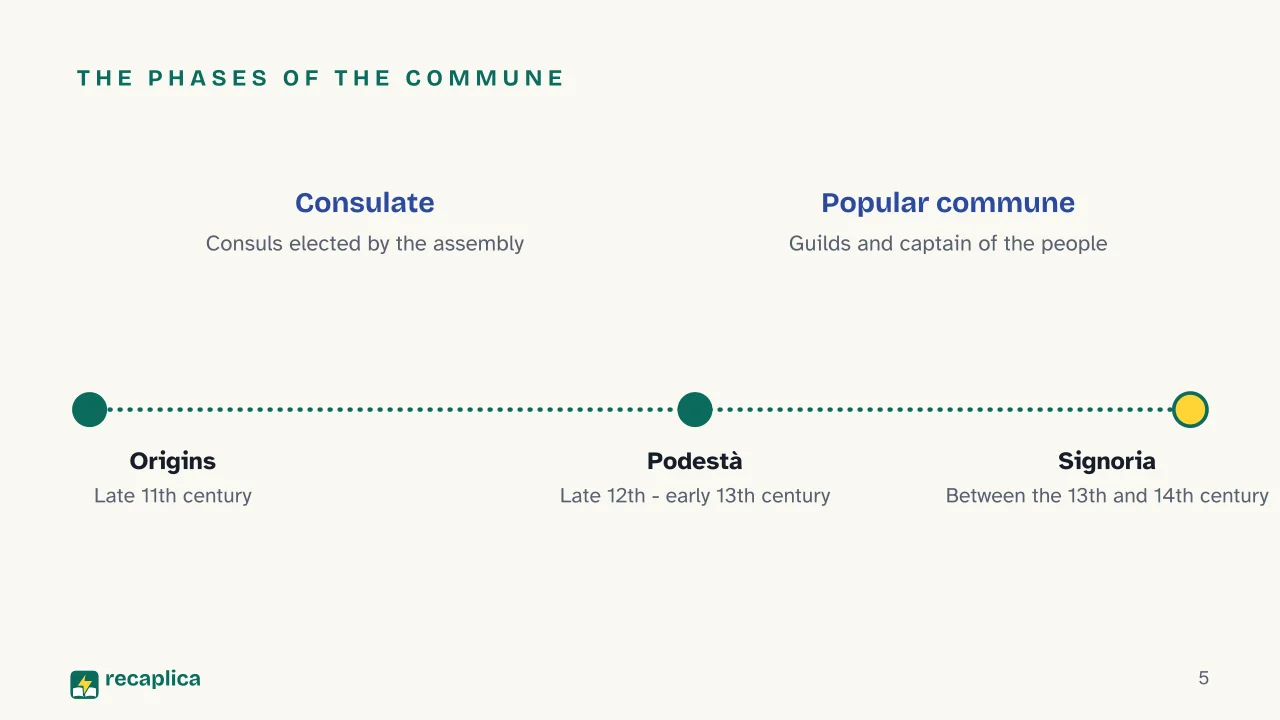  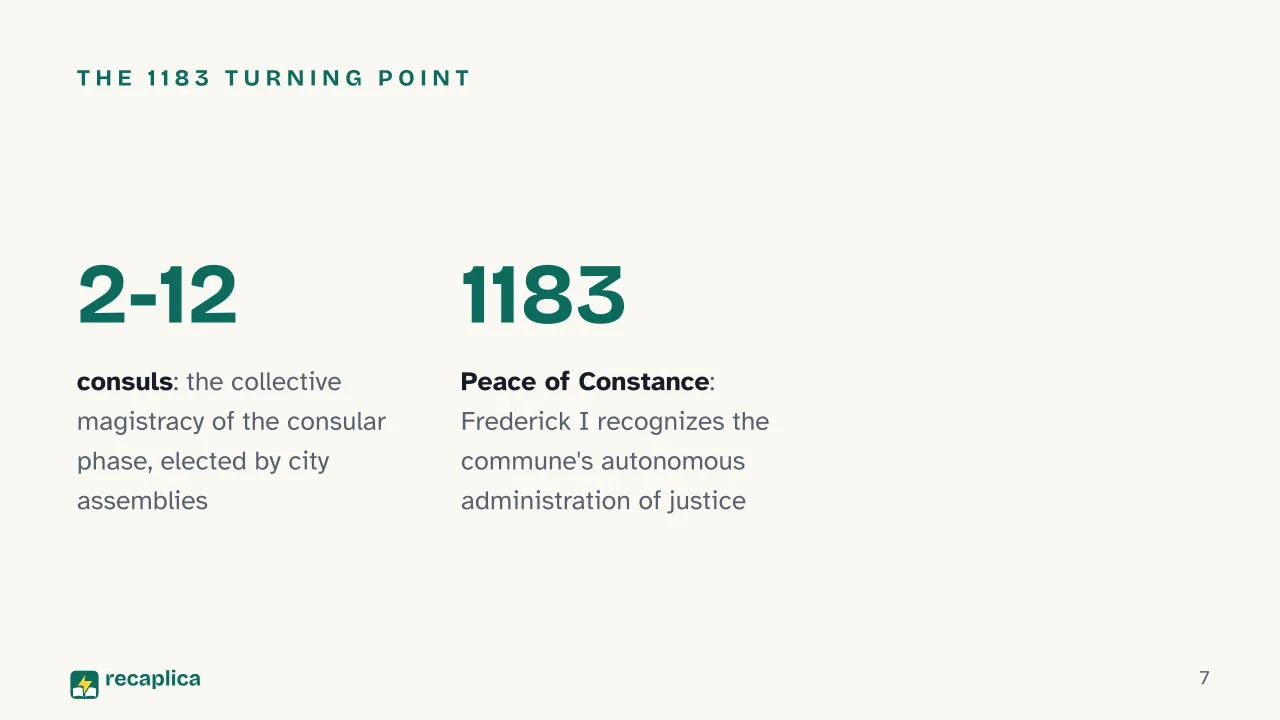 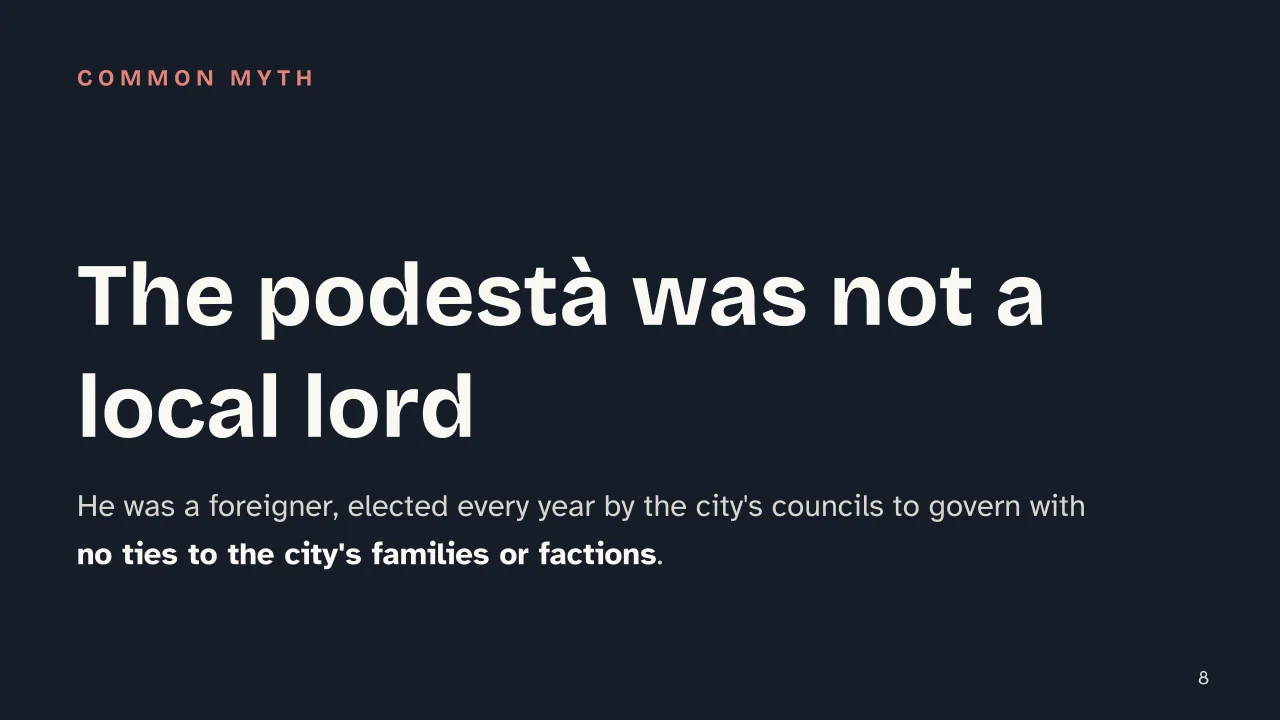  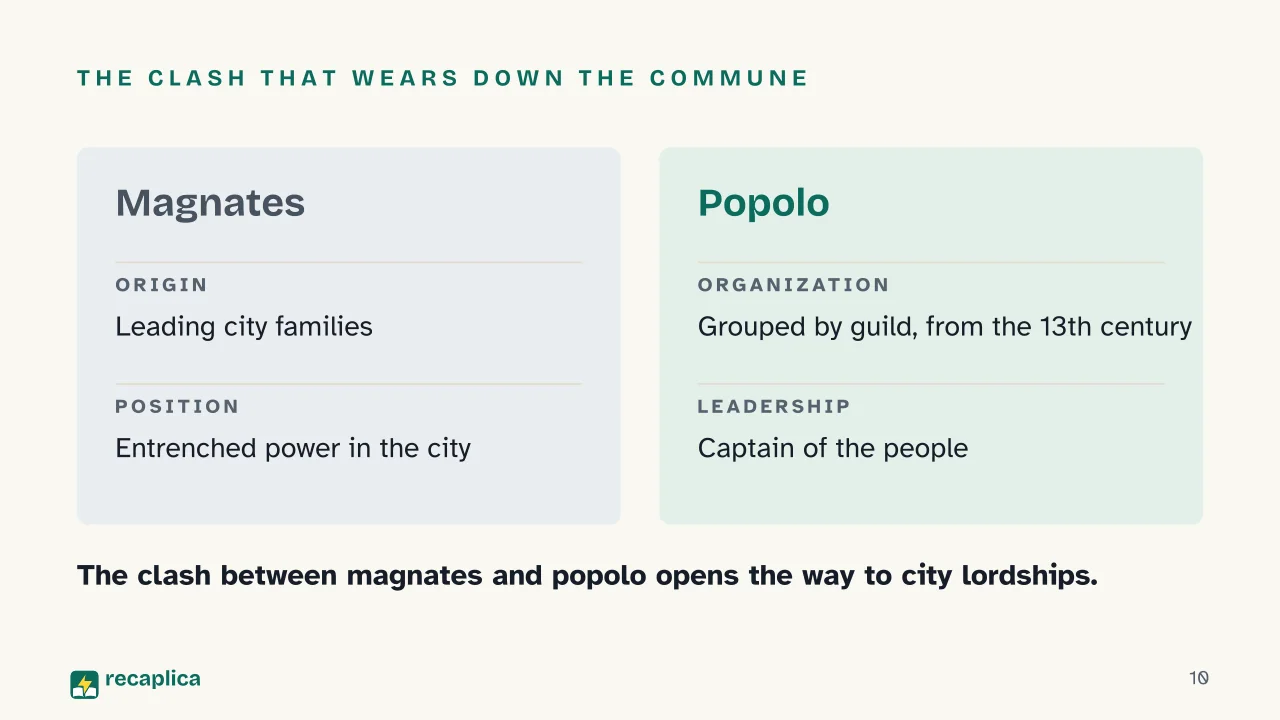  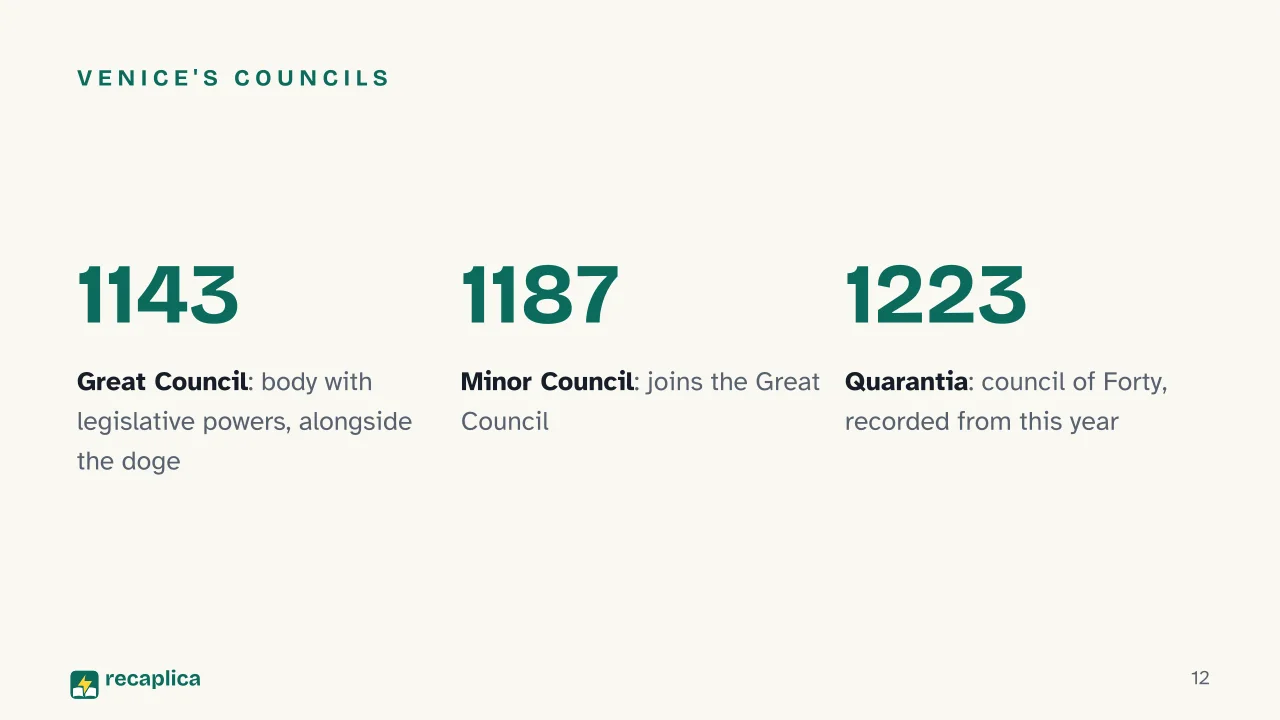 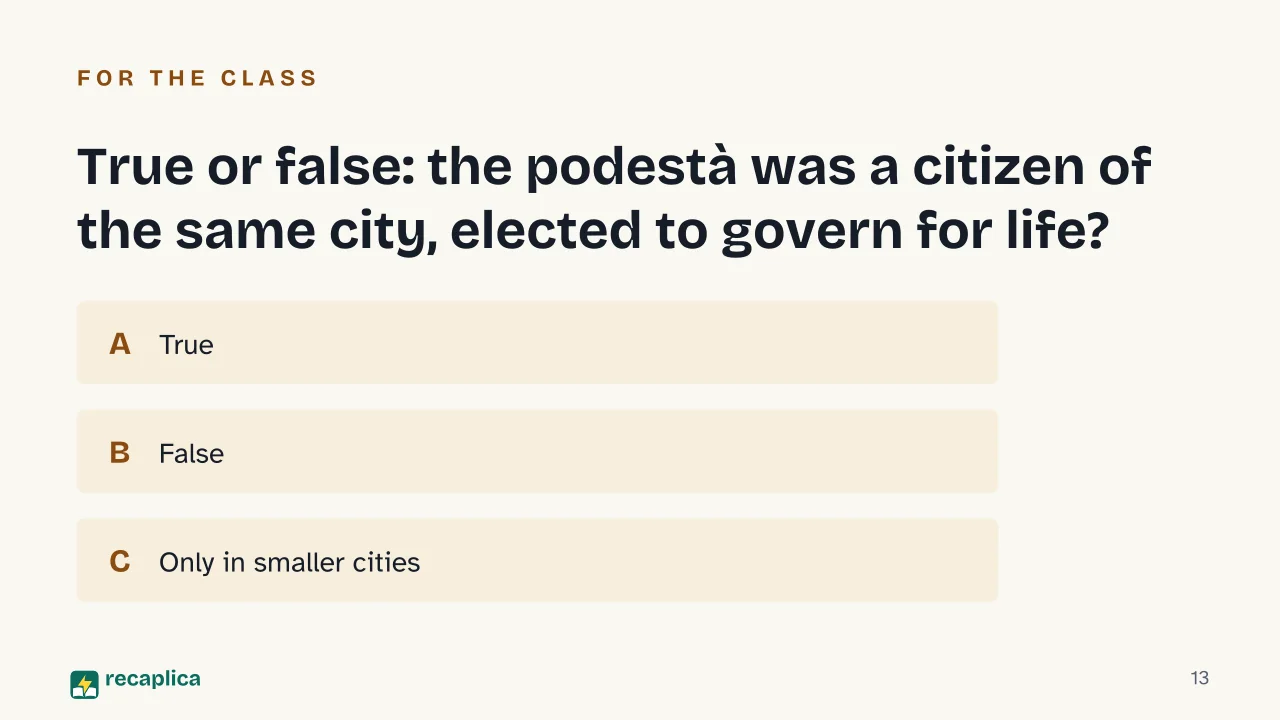  Common myths
Mind mapDrag the background to move around and the nodes to reposition them; use − and + to collapse and expand branches. 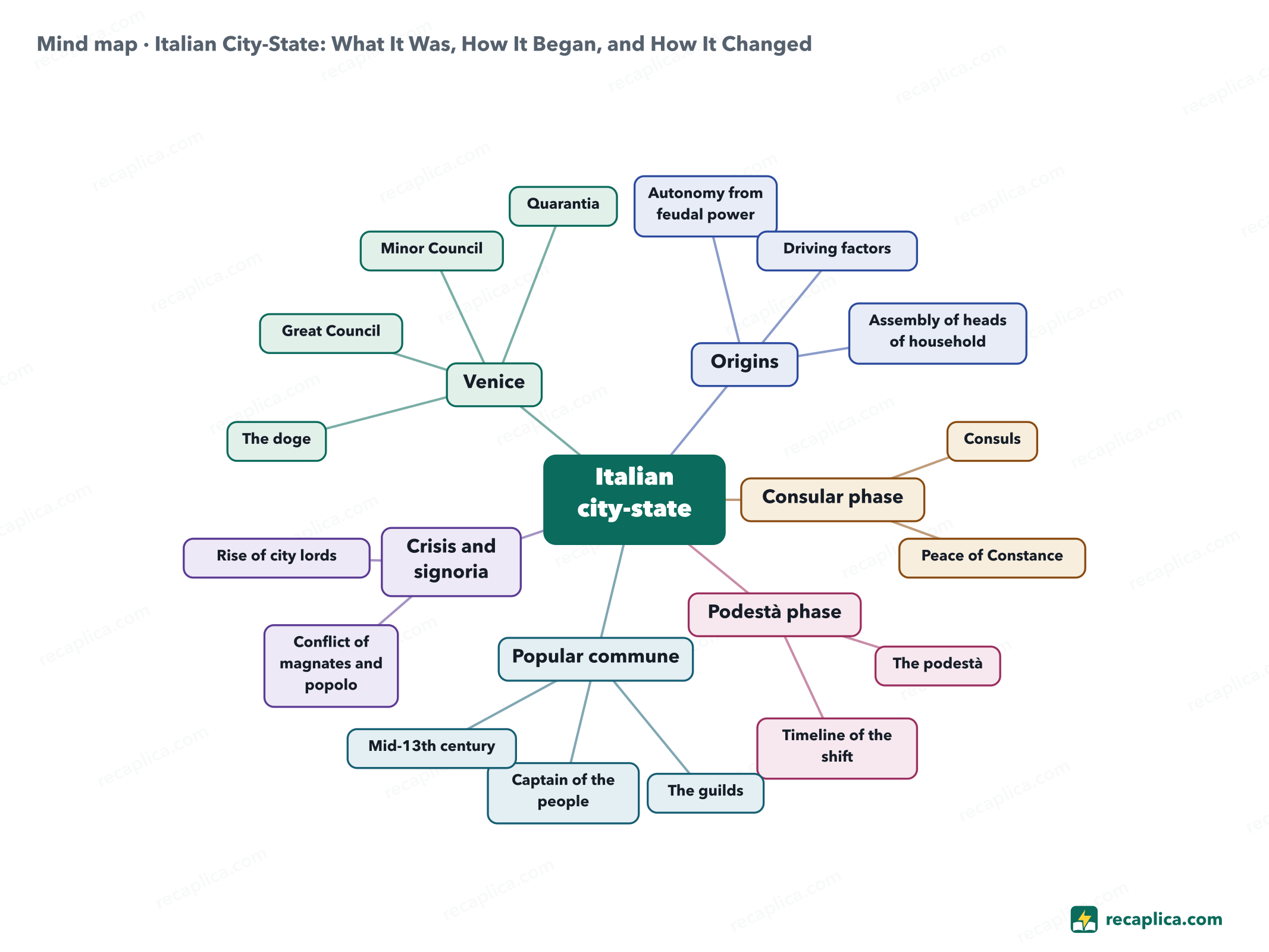
Quiz: test yourselfAnswer the questions to check what you have learned: you get instant feedback and a short explanation. Grade 0/10 0/5
FlashcardsTap the card to flip it and check whether you remember the answer, then move to the next one. 1 / 7 Explain it in your own wordsThe ultimate test: if you can explain it in simple words, you've truly understood it. Write your explanation, then compare it with the Recap. Your explanation is saved only on this device.
Frequently asked questionsWhat was a medieval Italian city-state?It was the form of self-government with which, starting in the late 11th century, many Italian cities ran their own affairs, pulling free of direct control by bishop-counts and feudal or imperial powers. Who was the podestà of the medieval commune?A single magistrate, a foreigner to the city that elected him, brought in to govern for a limited term, usually a year. He replaced the collective government of the consuls between the late 12th and early 13th century. What was the Peace of Constance?The 1183 agreement in which Emperor Frederick I recognized the commune's right to run its own justice, in exchange for tribute and loyalty. What was the popular commune?The phase, starting in the mid-13th century, in which the organization of the popolo took shape alongside the commune's traditional institutions, structured by guild and led by the captain of the people. Why did Italian city-states eventually turn into signorie?Among the causes, sources point to the ongoing political conflict between the great families, the magnates, and the popolo, a struggle that wore down communal institutions and favored the rise of lords in individual cities. Every Recap goes through an independent review before publication. |