|
recaplica
Monasticism: What It Is and How Christian Monastic Life Began | |||||||||||||||
| © 2026 Recaplica · recaplica.com — All rights reserved | |||||||||||||||
Monasticism: What It Is and How Christian Monastic Life BeganWhat to print Page numbers appear when printing with default margins. SlidesChoose a cut Flash10 slidesThe essential thread, to present in classFull16 slidesEvery chapter and the deeper detailBoth come with speaker notes. In 30 seconds quick readMonasticism is the choice some Christians make to devote daily life to prayer, manual work and asceticism, alone or in community. It took shape over the early centuries as an outgrowth of Christian asceticism: the World History Encyclopedia points to the new imperial favor that came with the Edict of Milan in 313 as one of its causes, which some historians say also brought worldliness into the Church and pushed many Christians to seek a poorer setting for their faith. In Egypt, Anthony starts the eremitic tradition, and Pachomius and Basil later organize monks into true communities, a model known as cenobitic monasticism. In the West, Benedict of Nursia becomes the reference figure: his Rule, written probably around 530, governs prayer, manual work and obedience inside the monastery. Key Points
Key figures
Deep DiveChristian monasticism does not begin with a single decision or in a single year. According to the Catholic Encyclopedia, Christian asceticism already exists in the very earliest centuries, but it is not yet monastic in the proper sense: early believers cannot withdraw from the community, and giving up material comforts is practiced within the ordinary life of the Church. From asceticism to the School of AlexandriaIn Alexandria, Egypt, a source on Coptic patrology traces the Catechetical School, whose founding tradition credits to the evangelist Mark — a city the history of philosophy already remembers for blending Greek thought with the Bible, as the Recap on Ancient Greek Education describes for the wider Hellenistic world. The school prepares candidates for baptism in the Christian faith and in biblical studies; Origen, a third-century theologian who taught there, describes this preparation as a path of correcting vices and learning humility, alongside the Word of God. It is run by “deans,” catechists tasked both with teaching doctrine and with giving practical guidance on Christian life. Admission, the source says, is open to anyone, with no distinction of background, age or origin — a different kind of openness from the more selective educational paths of the ancient world described in the Recap on Ancient Education. The source does not give a certain founding year for the school. In 313 Constantine’s Edict of Milan ends the persecutions and places the Christian Church under imperial protection, a turning point for the entire Roman Empire. The World History Encyclopedia argues that this new imperial favor is itself among the reasons behind the rise of the monastic movement, since some historians cited in the source say it also brought corruption and worldliness into the Church: many Christians then start looking for a less worldly, purer setting in which to live out their faith. Egyptian eremitism: Anthony of the DesertAnthony of the Desert, who lived according to the World History Encyclopedia roughly from 251 to 356, is an Egyptian who first lives as a solitary hermit along the Nile. Later he organizes his disciples into a community of hermits under a rule. The Catholic Encyclopedia reports that the first Christian monks settle as hermits around the mountain of Saint Anthony, at Pispir, in northern Egypt, where Anthony organizes and guides them; the strictest among them live in isolation and meet only for the Saturday and Sunday services. For this reason the Catholic Encyclopedia considers him the founder of the eremitic monastic tradition.
The World History Encyclopedia notes that the first monks lived out the Christian faith in a totalizing way, giving up every material comfort to devote themselves entirely to the spiritual life. Cenobitic monasticism: Pachomius and BasilPachomius, who lived according to the World History Encyclopedia roughly from 290 to 346, shifts the model from eremitism to community life. He founds a monastery at Tabennisi, on an island of the Nile in Upper Egypt: the Catholic Encyclopedia dates the founding to around 318, when he is still young, making it the first cenobitic, community-life monastery of Christian history. By his death — dated to 345 by the Catholic Encyclopedia and to 346 by the World History Encyclopedia — the institute counts eight monasteries with several hundred monks, under a centralized governance that, the Catholic Encyclopedia notes, would not be matched again until the Cistercians and the mendicant orders, eight or nine centuries later. Basil of Caesarea, in the fourth century, substantially reshapes the cenobitic model built by Pachomius by turning the monastery into a true community: monks eat, work and pray together, gathering for prayer seven times every day, according to the Catholic Encyclopedia.
Benedict of Nursia and the Western RuleBenedict is born at Nursia around the year 480 and dies at Monte Cassino in 543, according to the Catholic Encyclopedia; other reference works, such as the New World Encyclopedia, date his death to 547, since the only ancient source on Benedict — Pope Gregory the Great’s Dialogues — gives no absolute dates. Tradition, as the Catholic Encyclopedia reports, has him withdraw to Subiaco, where he lives as a hermit in a cave for three years before founding twelve monasteries in the valley. He later builds his own monastery on the hilltop of Monte Cassino, on the site of a pagan temple, and sets up its governance by appointing a prior and deans. The source calls Benedict the founder of Western monasticism. His Rule is written, according to the Catholic Encyclopedia, probably around 530, more likely at Monte Cassino than at Subiaco. Chapters 9 through 19 govern the Divine Office, the communal prayer called “opus Dei,” the work of God, to which, in the words of the Rule as quoted by the source, “nothing is to be preferred.” Chapter 48 sets aside time for manual labor each day, a span that varies with the season but never drops below about five hours. Chapter 5 requires immediate, calm and total obedience to the superior, in everything that is lawful: it is called the first degree of humility. The source describes Benedict’s Rule as the most important monastic legislative code and the decisive factor in organizing and spreading monasticism across the West. The World History Encyclopedia credits Benedict as the author of the Western monastic rule, while noting that most scholars see the Rule of the Master, an earlier text, as the source behind much of its content. In 581, when the Lombards destroy Monte Cassino, an ancient chronicler cited by the Catholic Encyclopedia recounts that the monks flee to Rome carrying, among other things, a copy of Benedict’s Rule — a period of crisis that the Recap on the Middle Ages tells for the whole Latin West. Alongside the Benedictine Rule, other Western communities, in later centuries, would also look to the figure of Saint Augustine: that is the case of the Augustinians. A monk’s daily lifeBenedict’s Rule fixes three elements of a monk’s day: communal prayer, manual work and obedience to the superior. The Divine Office punctuates the day several times over, and the Rule allows nothing to take its place. Manual work fills at least about five hours a day, a span that shifts with the season. The Rule calls obedience to the superior the first degree of humility.
The World History Encyclopedia notes that monks in the early centuries combined prayer with teaching, spreading the faith and offering practical support to the surrounding population. Eastern monasticism and the spread across EuropeBasil of Caesarea’s model, with its community of shared meals, work and prayer seven times a day, remains the reference point of Greek Eastern monasticism, distinct from the Rule Benedict would write later in the West. In the fourth century, according to the World History Encyclopedia, the monastic movement also spreads into Western Europe when John Cassian, a Desert Father and friend of John Chrysostom, carries the Egyptian-style monastic model already described for Pachomius into Gaul, present-day France. Slide deckSlides ready to download and make your own in PowerPoint or Google Slides, with speaker notes. Pick the Flash cut or the Full one.     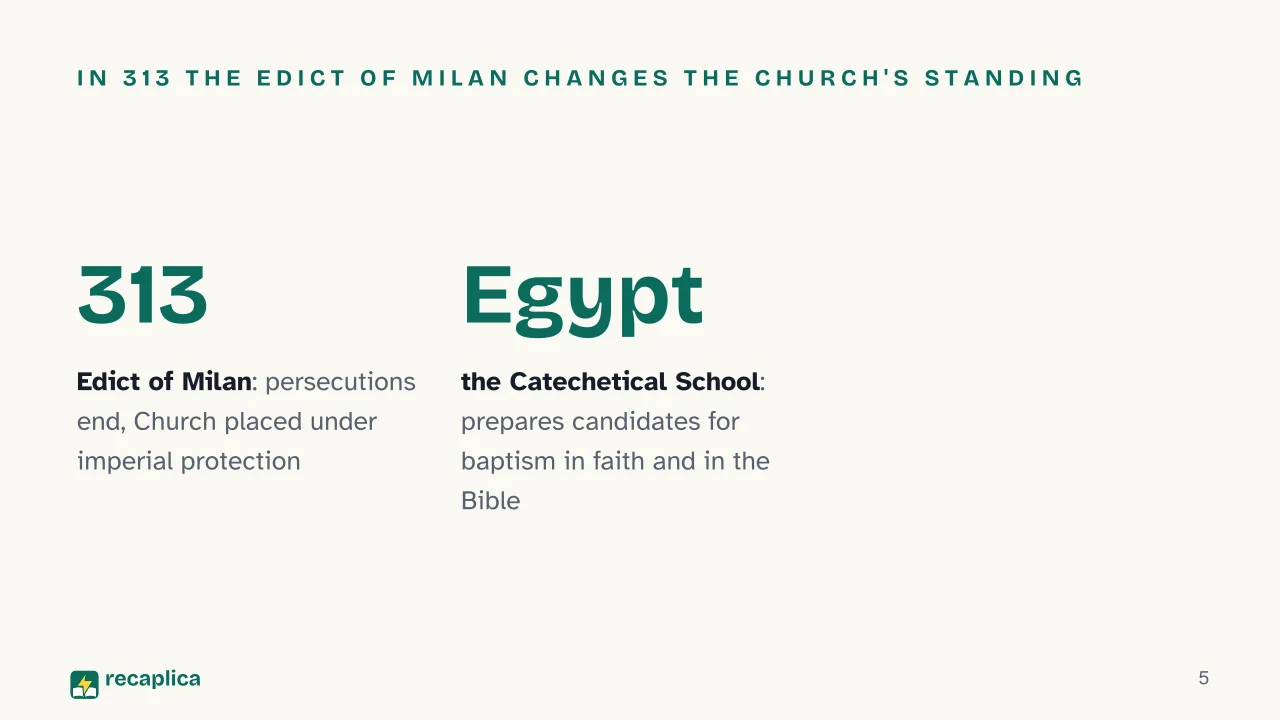  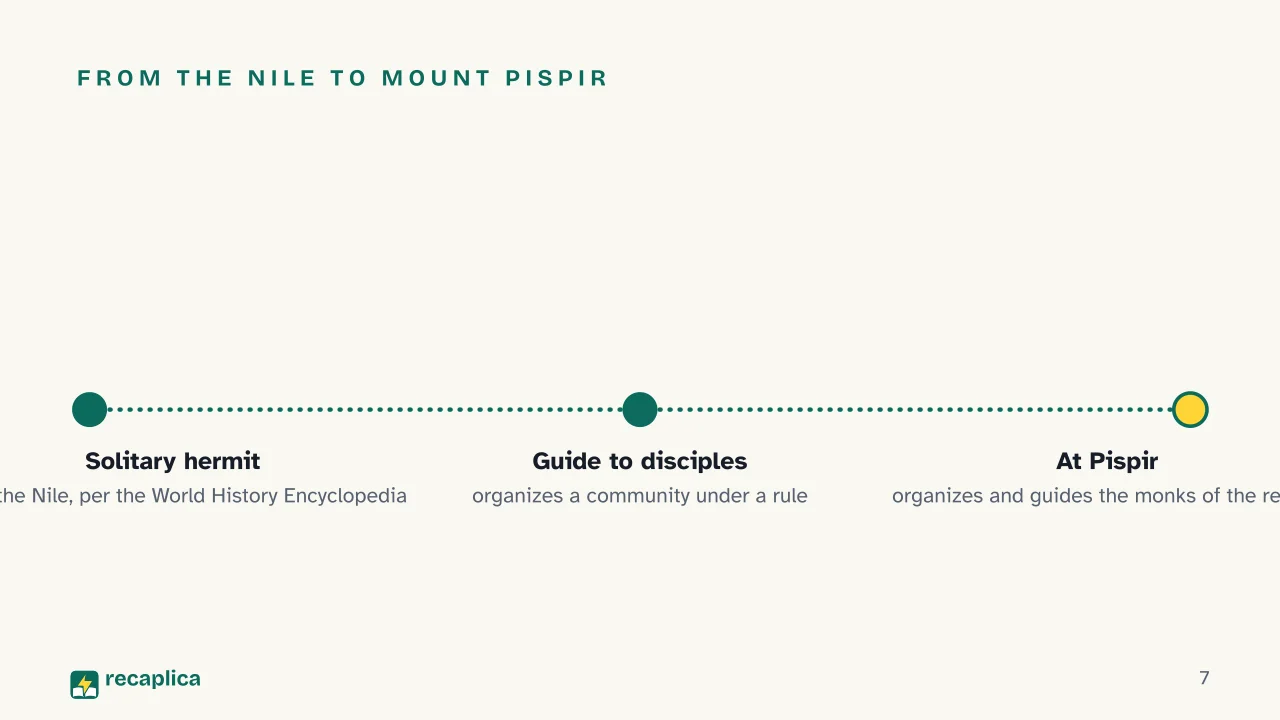 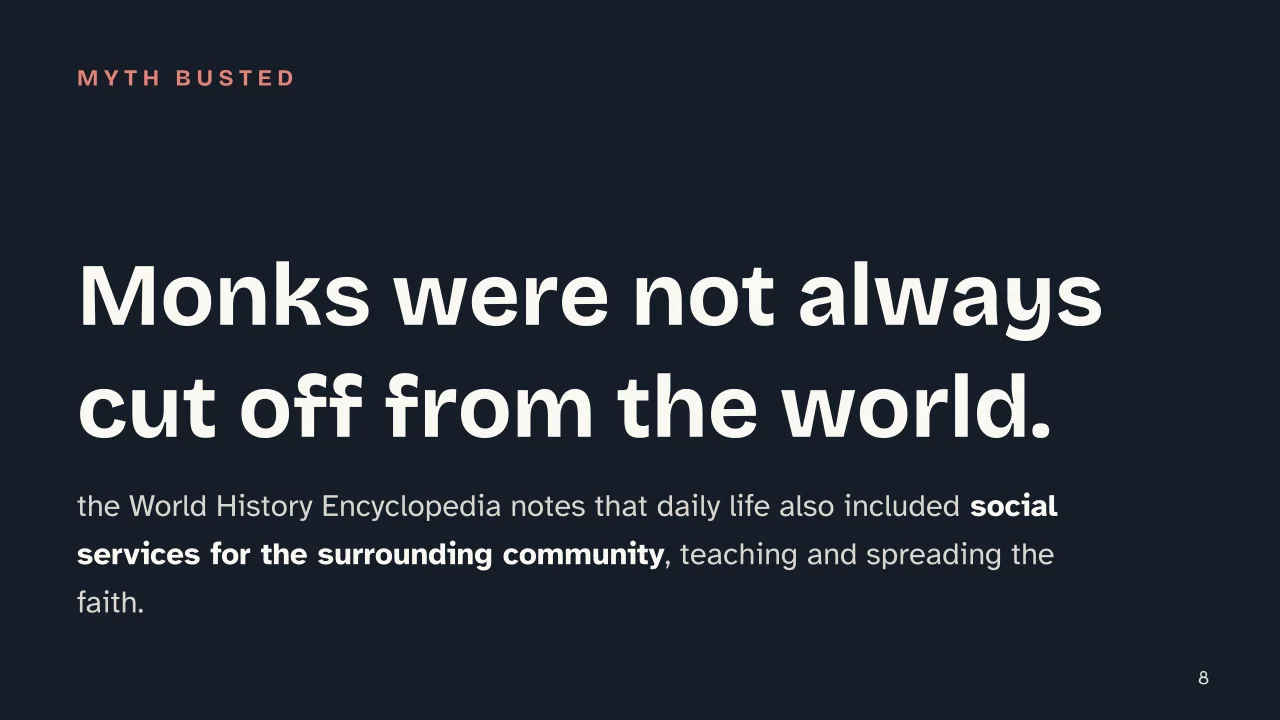  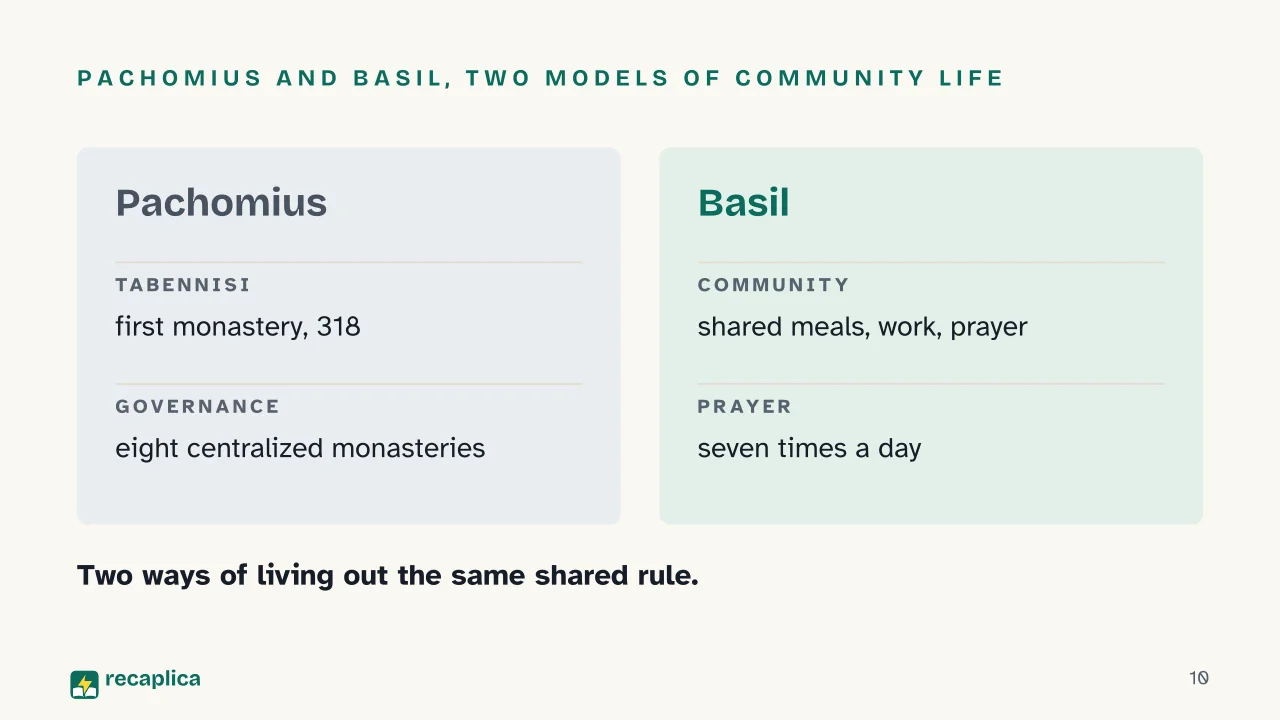  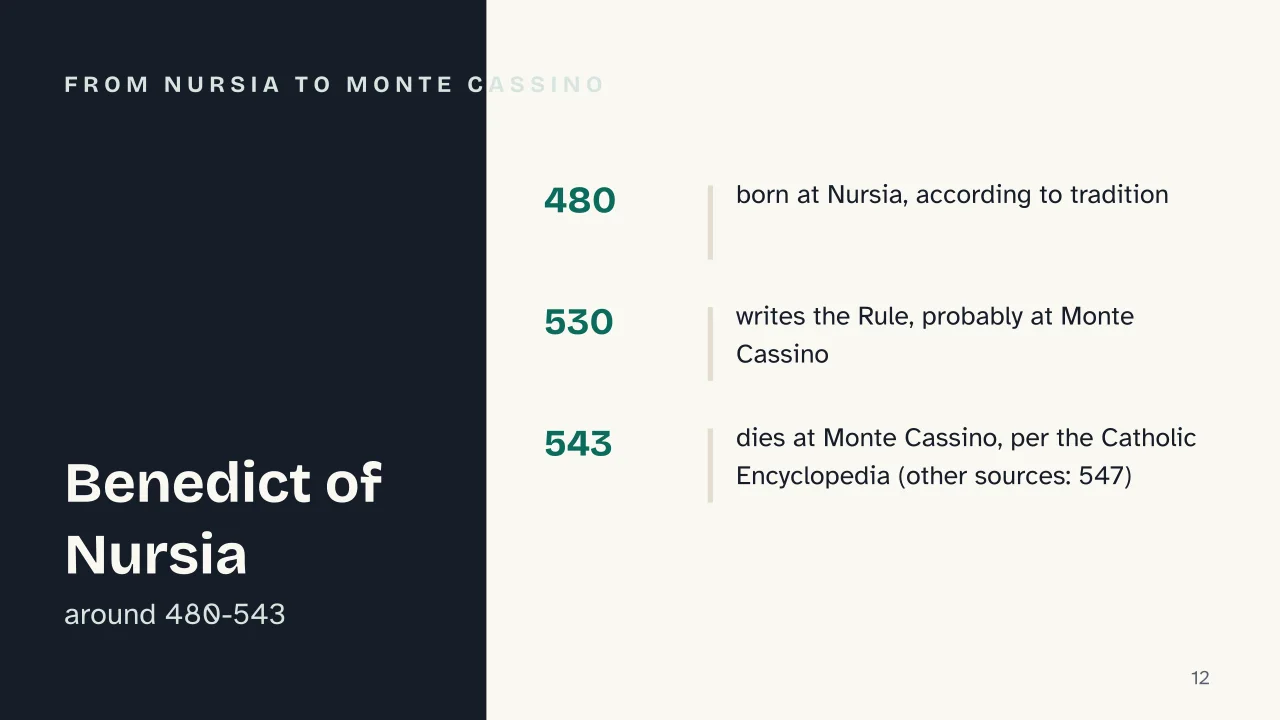 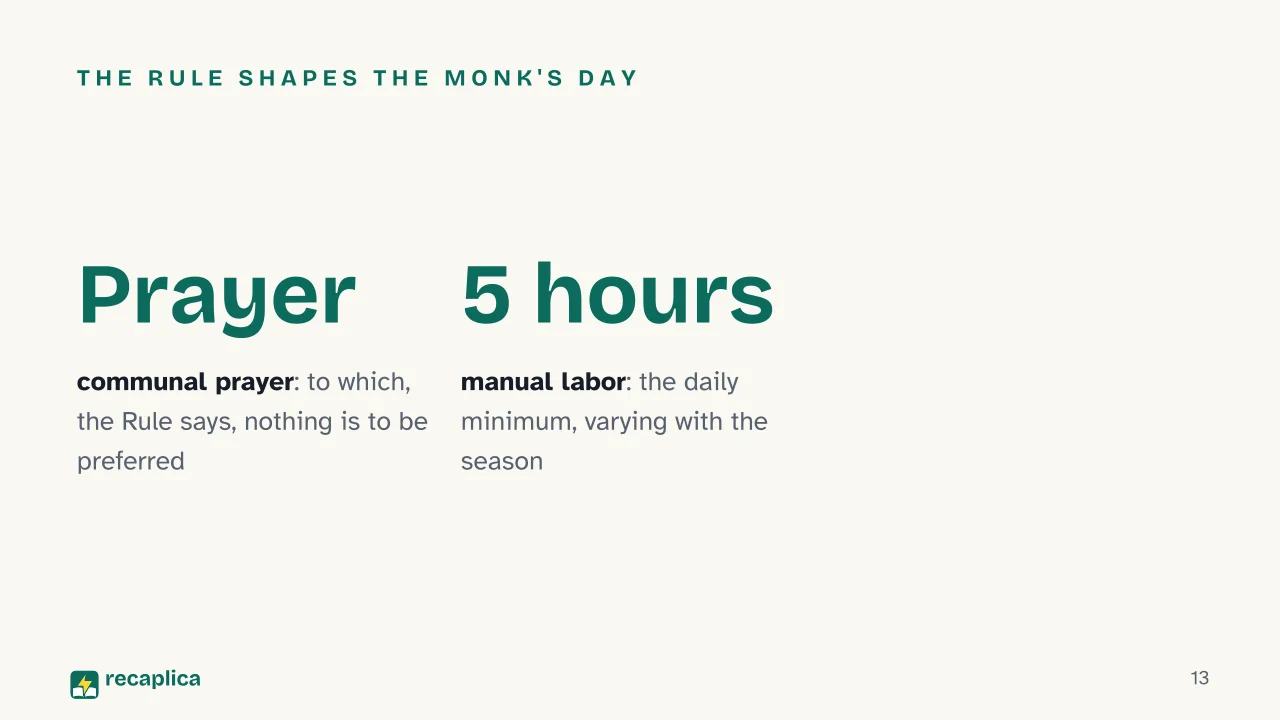 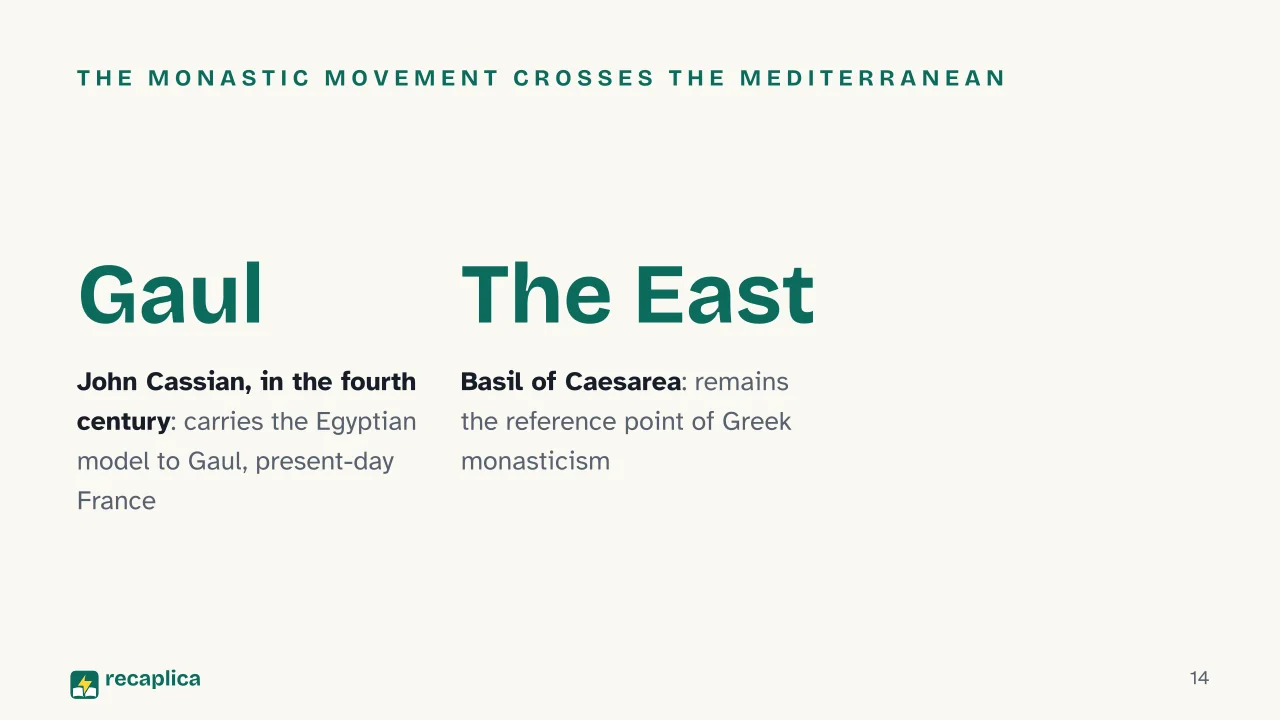 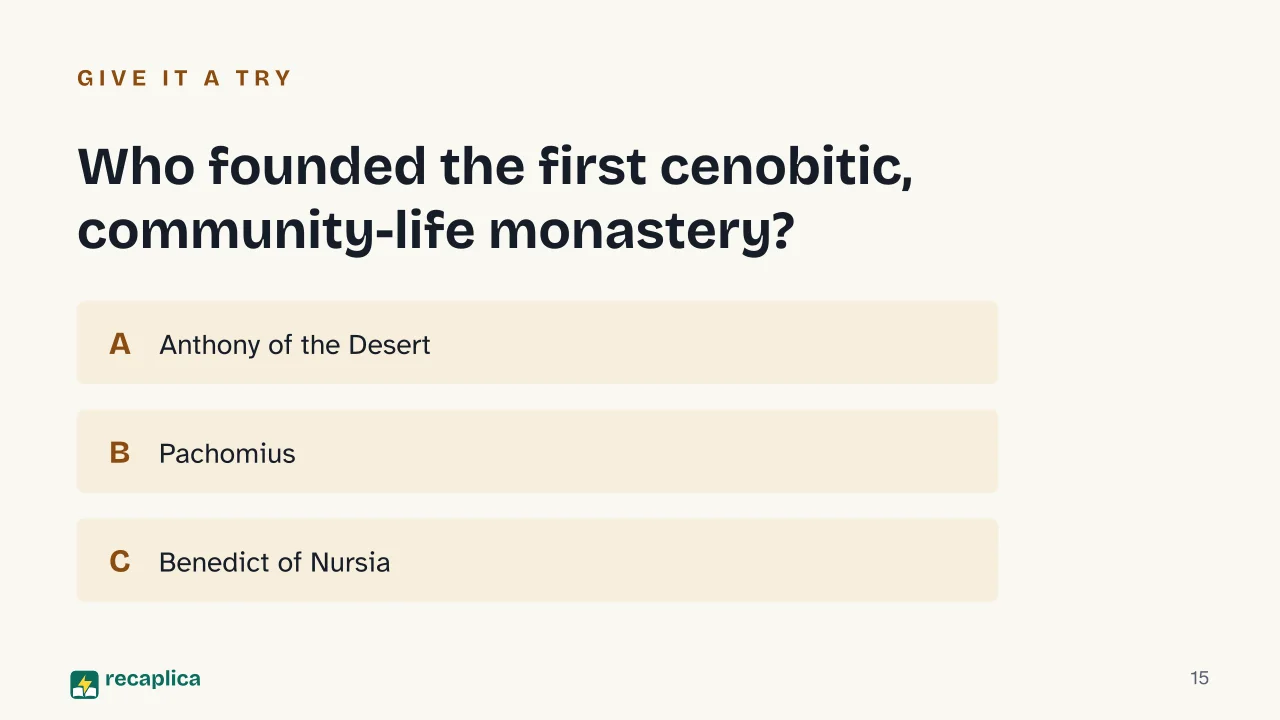  Common myths
Mind mapDrag the background to move around and the nodes to reposition them; use − and + to collapse and expand branches. 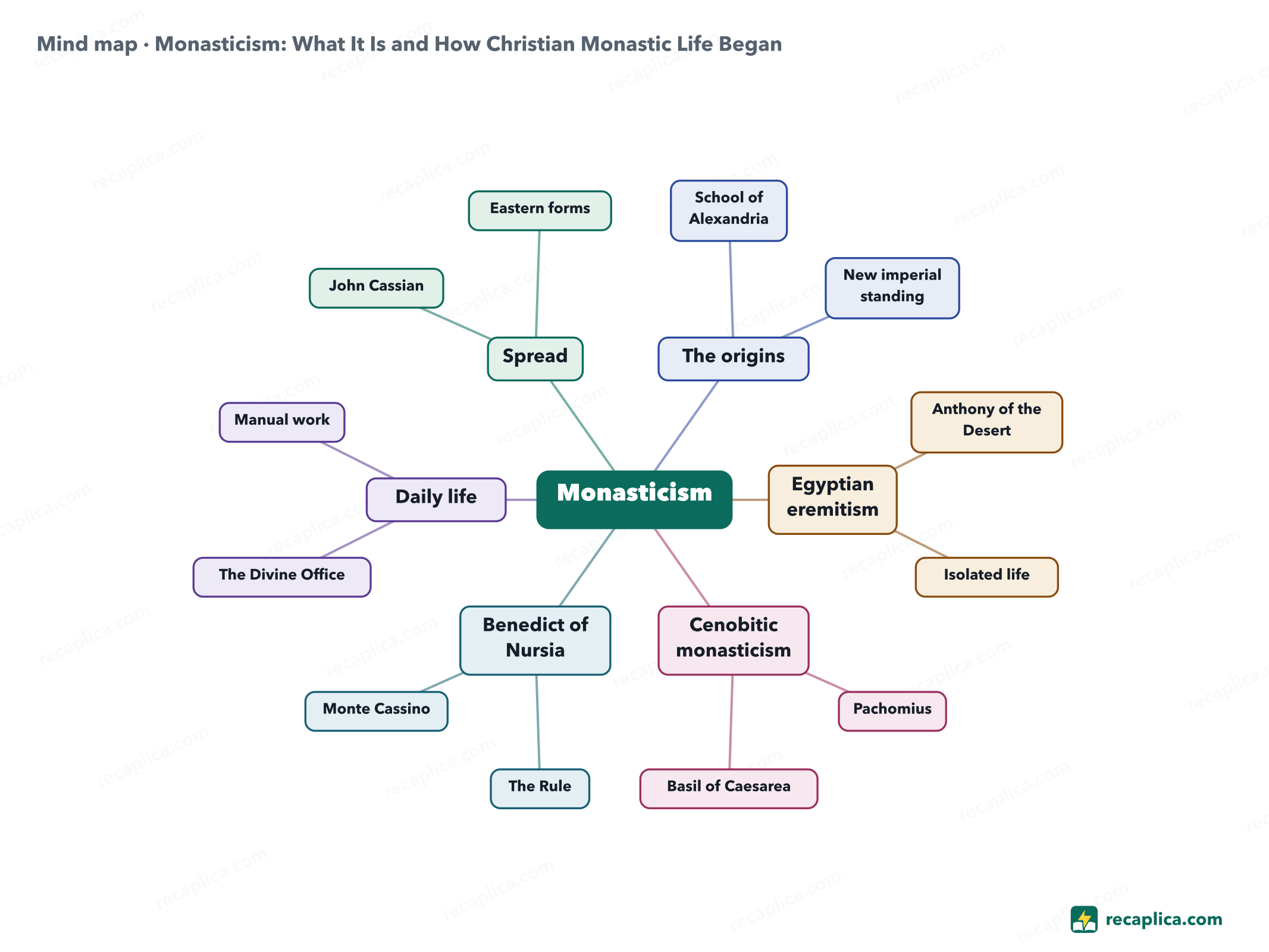
Quiz: test yourselfAnswer the questions to check what you have learned: you get instant feedback and a short explanation. Grade 0/10 0/5
FlashcardsTap the card to flip it and check whether you remember the answer, then move to the next one. 1 / 8 Explain it in your own wordsThe ultimate test: if you can explain it in simple words, you've truly understood it. Write your explanation, then compare it with the Recap. Your explanation is saved only on this device.
Frequently asked questionsWhat is Christian monasticism?A form of religious life centered on prayer, manual work and asceticism: some Christians live it in isolation (eremitic monasticism), others in community (cenobitic monasticism). Its roots lie in the ascetic practices Christians already followed before the movement took a shape of its own. Who is the founder of Western monasticism?According to the Catholic Encyclopedia it is Benedict of Nursia, who lived roughly from 480 to 543 and wrote the Rule that organizes prayer, work and obedience in Western monasteries. What is the difference between eremitic and cenobitic monasticism?A hermit lives in isolation, like the first monks guided by Anthony in Egypt; a cenobite lives in community, as in the monasteries founded by Pachomius and later reorganized by Basil of Caesarea. How was a Benedictine monk's day organized?According to Benedict's Rule, around communal prayer (the Divine Office, to which nothing is to be preferred), manual labor for at least about five hours a day, and immediate obedience to the superior. Did Christian monasticism exist only in the West?No. Basil of Caesarea, in the fourth century, organized a form of community life that remains the reference point of Greek Eastern monasticism, distinct from the model Benedict would later codify in the West. Every Recap goes through an independent review before publication. |