Skip to content
recaplica

    One moment: security check

    Cloudflare wants to make sure you're not a robot. Tick the box below and your search will continue on its own.

    IT
    recaplica Ancient Education: Scribes in Egypt, Citizens in Greece, the Law in Israel
    © 2026 Recaplica · recaplica.com — All rights reserved
    Home › History

    Ancient Education: Scribes in Egypt, Citizens in Greece, the Law in Israel

    By Recaplica Newsroom · Updated on October 18, 2026

    What to print

    Page numbers appear when printing with default margins.

    Slides

    Choose a cut

    Flash10 slidesThe essential thread, to present in classFull18 slidesEvery chapter and the deeper detail

    Both come with speaker notes.

    Telegram channel
    recaplica Clear in 30 seconds, yours in 10 minutes.
    In 30 seconds Key points Figures Deep dive Slides Myths Mind map Quiz Flashcards FAQ

    In 30 seconds quick read

    In ancient Egypt, becoming a scribe opened the door to a prestigious career, built around institutions called Houses of Life and texts like the Papyrus Lansing, which ranked that profession above manual trades. Greek education prepared the citizen: Athens leaned on letters, music, and gymnastics, while Sparta ran a collective military program known as the agoge. In ancient Israel, education began at home, where the father was responsible for teaching the Law to his children, and later grew around the synagogue, a place for reading the Torah and, by the Second Temple period, for organized schooling as well. Each system grew out of a different need in its own society.

    Key Points

    • In Egypt, training as a scribe ran through the Houses of Life, institutions tied to major religious centers that also trained astronomers, physicians, and architects.
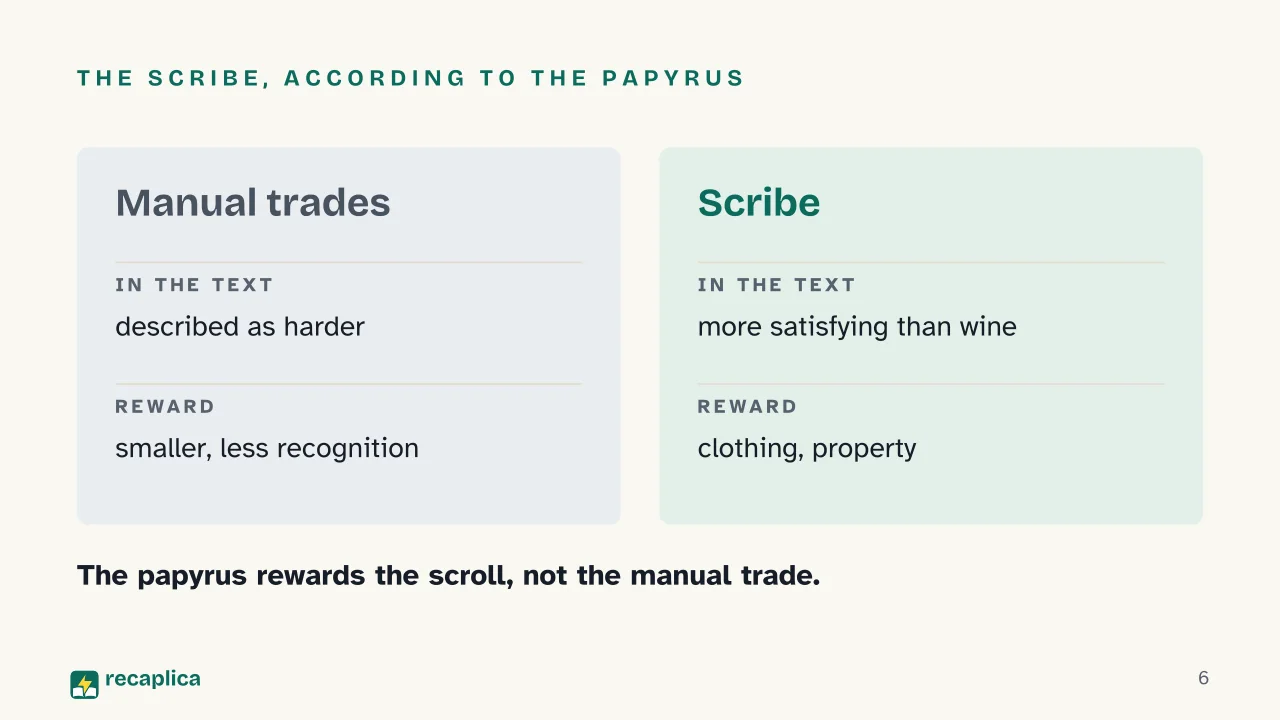
    • The Papyrus Lansing, from the reign of Senusret III, ranked the scribal profession above manual trades, promising fine clothing, property, and servants as rewards.
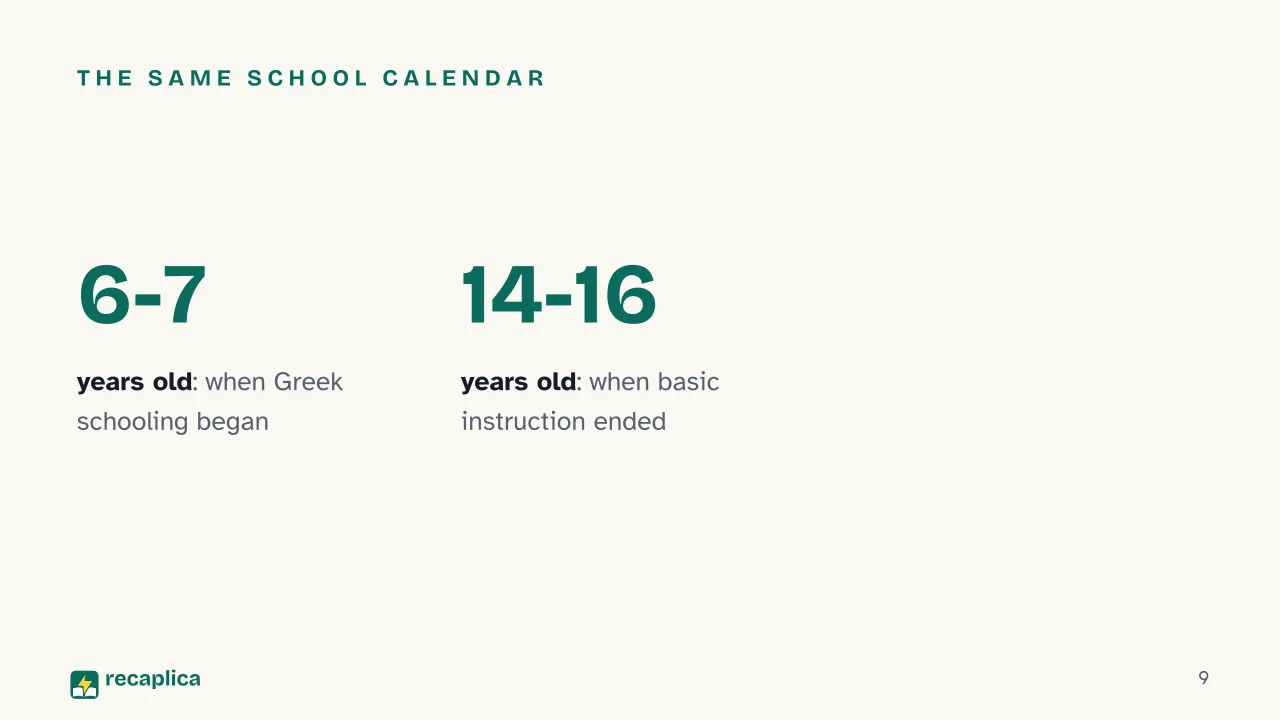
    • Greek schooling began around age six or seven; Athens focused on letters and music, Sparta on the physical and military training of the agoge.
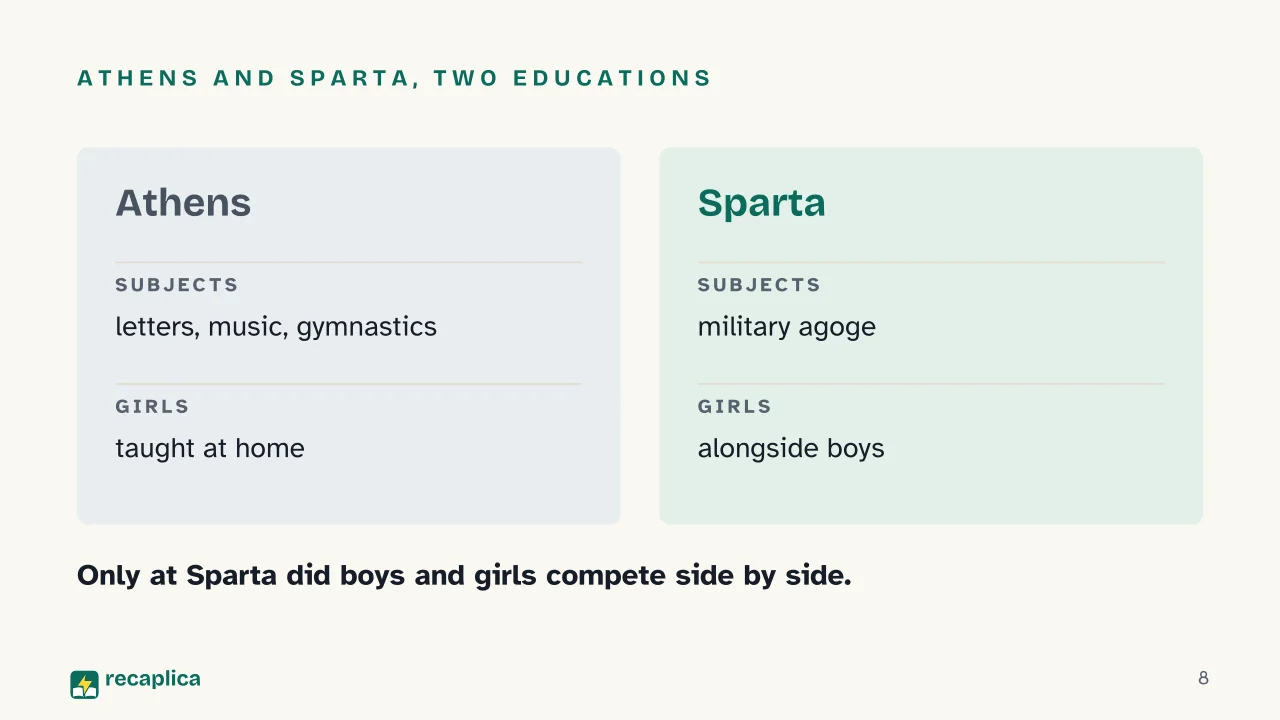
    • At Sparta, athletic contests put boys and girls on the same field, while in Athens girls' education stayed informal and domestic.
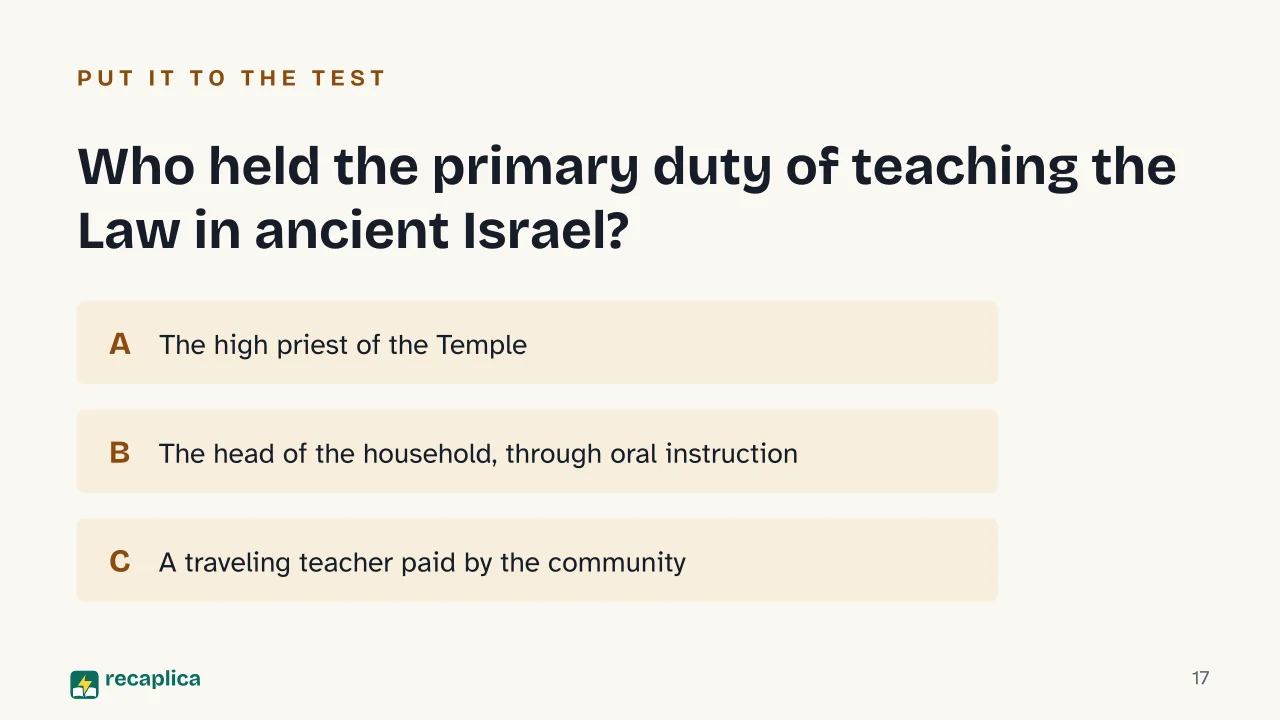
    • In ancient Israel, teaching the Law was first and foremost a father's duty, passed on orally.
    • The ancient synagogue combined teaching, public reading of the Torah, and the role of community center for meals, lodging, and legal matters.

    Key figures

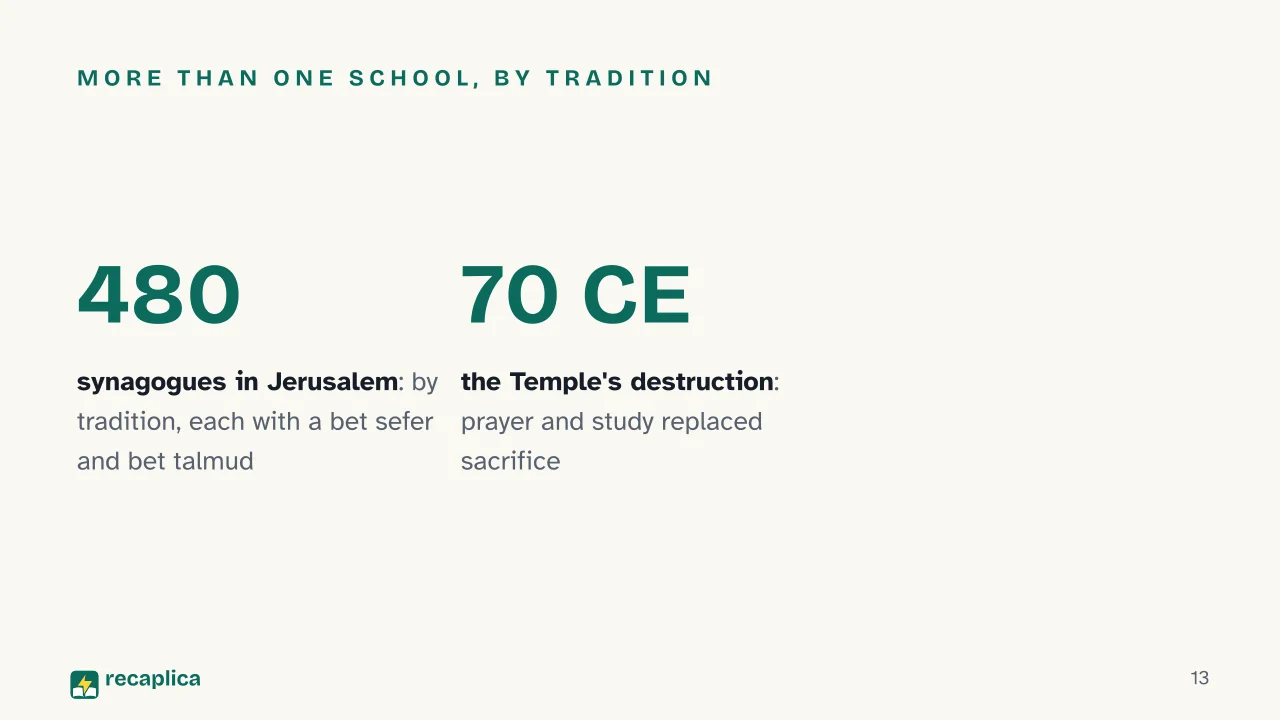
    • 480 synagogues in Jerusalem, according to tradition, each with its own Bible school and Talmud school. Source: Encyclopaedia Judaica (via Encyclopedia.com)

    Deep Dive

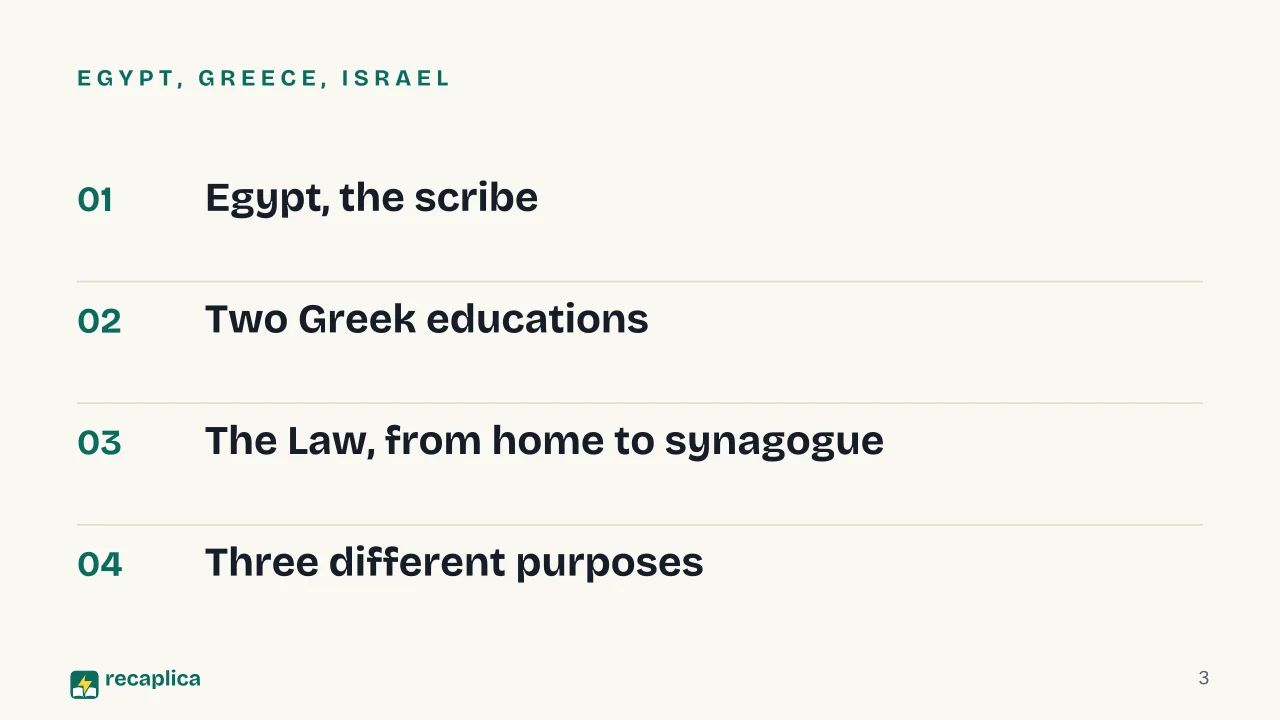
    Three educational traditions tell three different stories about preparing a young person for their place in society. In Egypt, the goal was to become a scribe; in Greece, a citizen of the polis; in ancient Israel, a keeper and transmitter of the Law.

    Egypt: the House of Life and the scribe

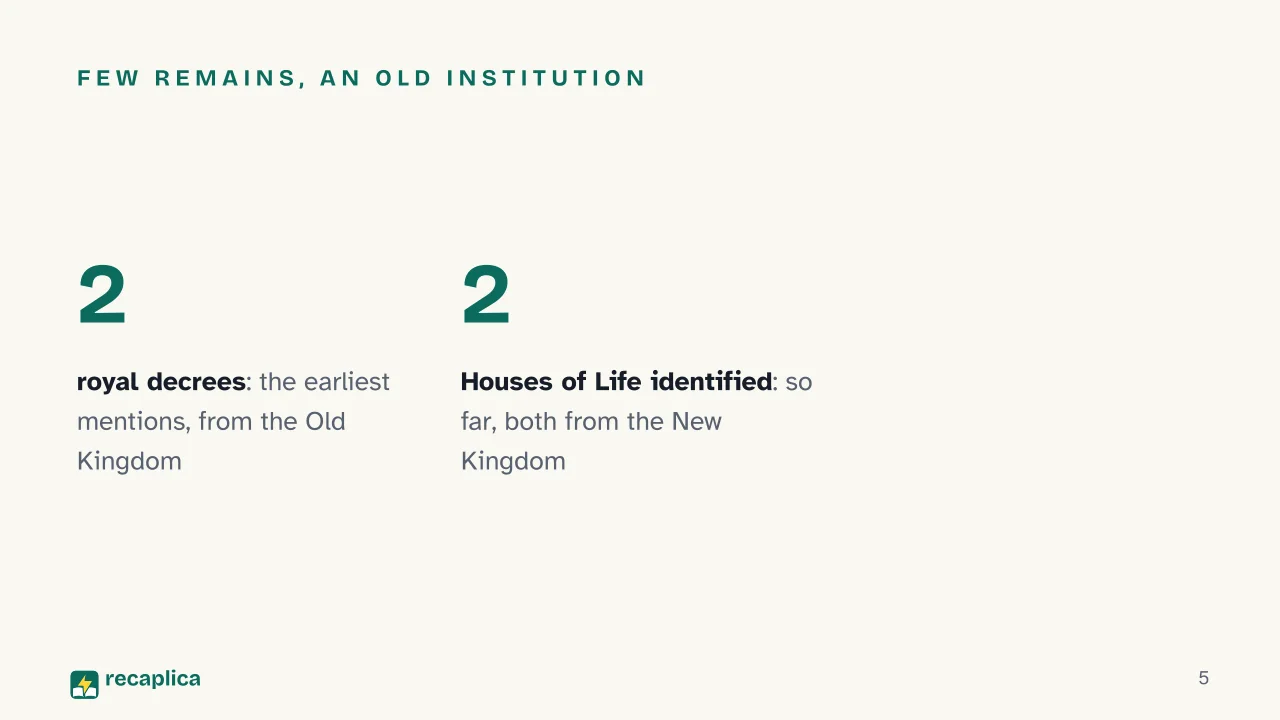
    According to the Wikipedia entry on the House of Life, the Per Ânkh was both an institution and a physical place of formal instruction in ancient Egypt. The earliest references appear in two royal decrees from the Old Kingdom, which places the idea of an organized teaching institution quite early in Egyptian history. Archaeologically, though, only two Houses of Life have been identified so far, both dated to the New Kingdom: one at Tell el-Amarna, the other at the Ramesseum. Houses of Life tied to major religious centers did more than teach writing: they trained an elite destined for specific intellectual professions. Astronomers, physicians, veterinarians, diplomats, architects, translators, and theologians all came out of this track. It was a channel toward specialized roles, not a system of mass schooling.

    The Papyrus Lansing, according to World History Encyclopedia, dates to the reign of Senusret III. Senusret III ruled in the 12th Dynasty, a period Egyptologists place around 1878-1839 BCE. The text opens with an exhortation to commit to the scribal profession, framed as superior to other trades. The apprentice is pushed to dedicate himself to the scroll and the writing board, described as more satisfying than wine.

    Practical example: a boy in his first writing lessons would have found the Papyrus Lansing promising fine clothing, property, and servants once his training was done, set sharply against the manual trades the same text describes as harder and less rewarded.

    Readers who want the broader picture of the civilization behind this training system can start from /en/history/ancient-egypt/.

    Greece: a quick look at paideia

    The Greek model gets only a brief comparison here against the other two. According to National Geographic History, boys in ancient Greece started school around age six or seven, and basic instruction wrapped up between fourteen and sixteen. Music, played on lyre and reed pipes, wasn’t purely an artistic skill: it also carried lessons in history and ethics.

    Athens and Sparta pulled in different directions. In Athens, girls received an informal education, confined to the home. Sparta ran a centralized system, the agoge, that gave boys a military education geared toward survival, built on deliberate hardship and physical deprivation; and within that system, girls trained and competed alongside boys in athletics, a sharp contrast with Athens. Readers curious about the political setting behind this training model can read /en/history/ancient-greece/, and those wanting one figure that school eventually produced can turn to /en/history/aristotle/.

    Israel: from family to synagogue

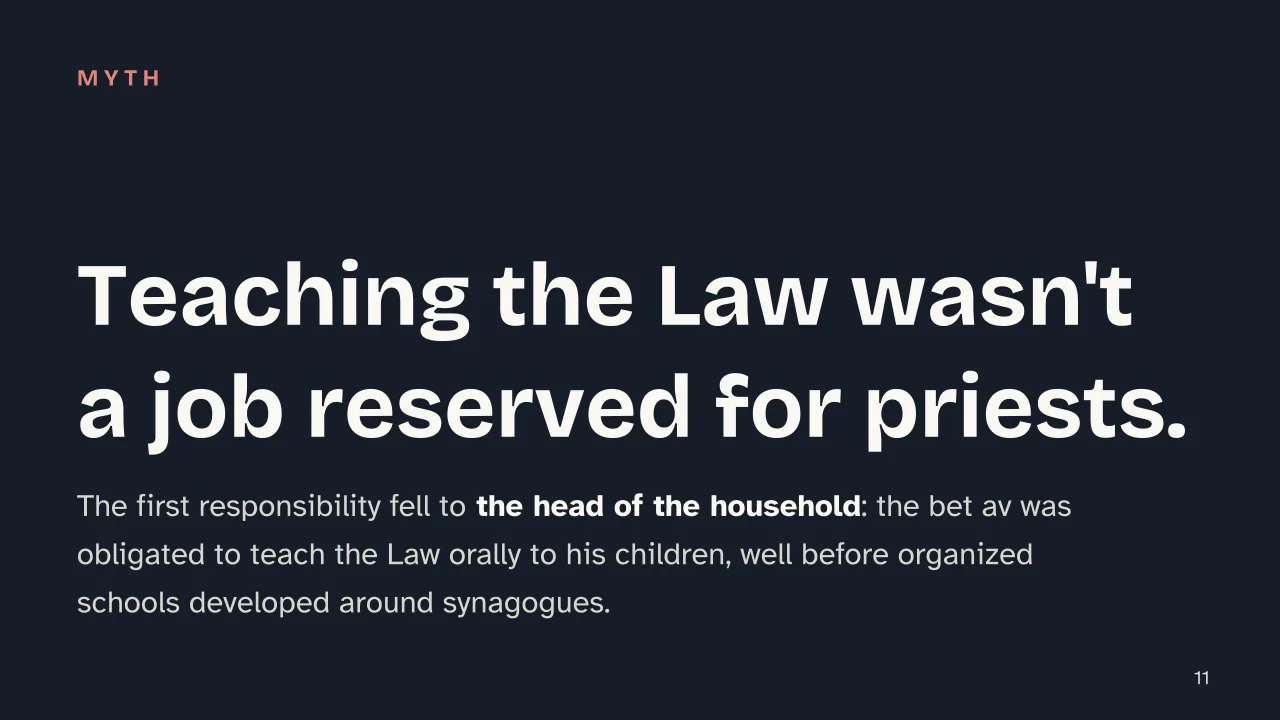
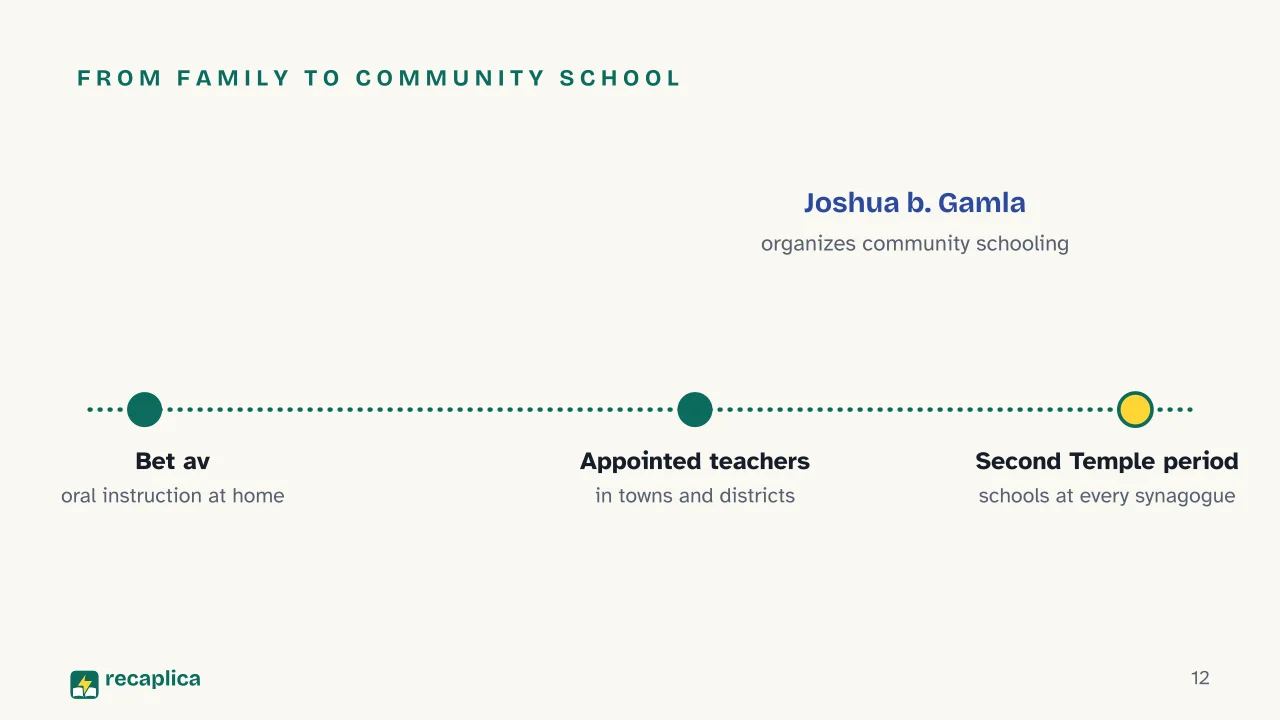
    According to Encyclopaedia Judaica, as reproduced by Encyclopedia.com, the family unit in ancient Israel, the bet av, was the basic unit of education for the young as well. It fell to the head of the household to pass the Law on orally, father to son: not a task handed off to specialists, but a duty of the home.

    A later regulation changed that picture. It required towns and districts to appoint teachers for young children, with schooling starting around age six or seven. Tradition holds that Jerusalem had 480 synagogues, each with its own Bible school (bet sefer) and Talmud school (bet talmud). This growth of systematic community education sits within the Second Temple period, and the source credits its structure to Joshua b. Gamla, around the turn of the era.

    World History Encyclopedia also describes the synagogue as a physical space. Reading and publicly teaching the Torah took priority over everything else held there. The ancient synagogue wasn’t only a classroom: it worked as a multipurpose center for lodging, communal meals, public fasts, and legal proceedings. After the Temple’s destruction in 70 CE, prayer and study replaced sacrifice as the main form of religious practice.

    Three models, three functions

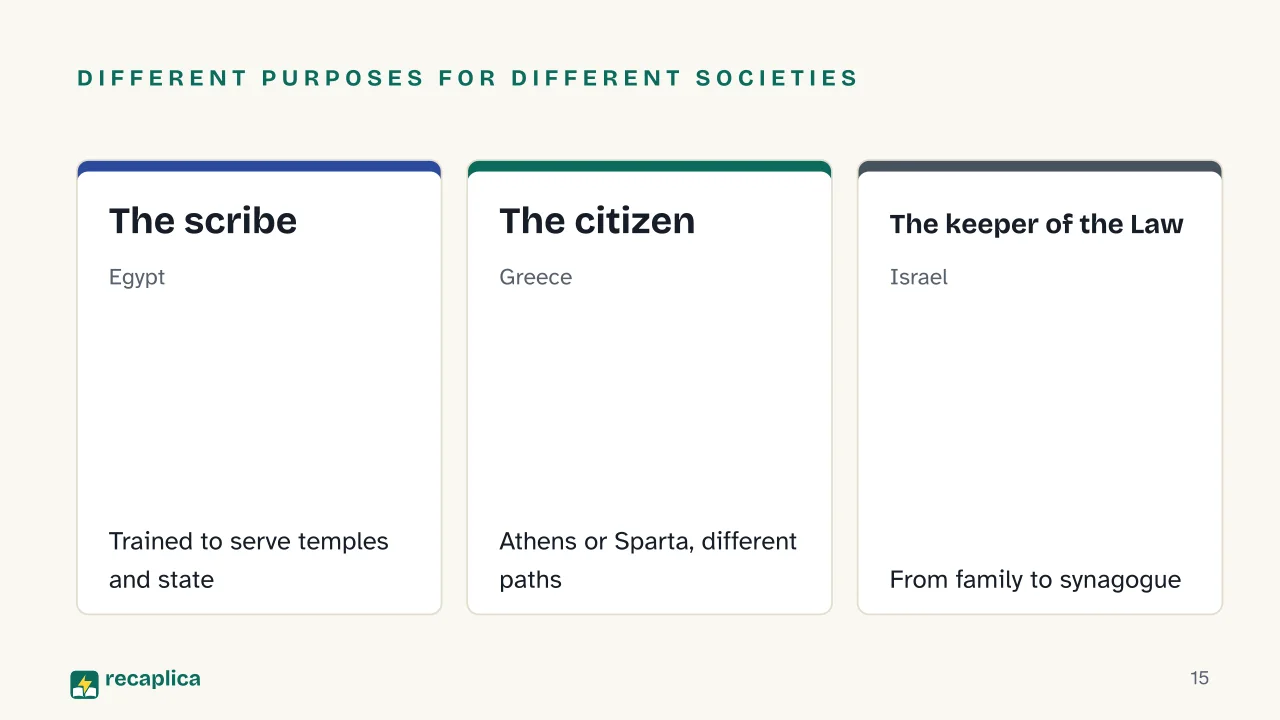
    Egypt trained officials and specialists through a selective channel tied to the temples. Greece prepared the citizen of the polis, with Athens and Sparta taking different paths. Ancient Israel passed down knowledge of the Law, first within the family and later around the synagogue. Readers interested in how these educational models connect to the first philosophical questions about the natural world can also read /en/history/pre-socratic-philosophers/.

    Slide deck

    Slides ready to download and make your own in PowerPoint or Google Slides, with speaker notes. Pick the Flash cut or the Full one.
    Slide 1 of the presentation on Ancient Education: Ancient EducationSlide 2 of the presentation on Ancient Education: What was an ancient education actually trying to produce?Slide 3 of the presentation on Ancient Education: Egypt, Greece, IsraelSlide 4 of the presentation on Ancient Education: Chapter 01: Egypt, the scribeSlide 5 of the presentation on Ancient Education: Few remains, an old institutionSlide 6 of the presentation on Ancient Education: The scribe, according to the papyrusSlide 7 of the presentation on Ancient Education: Chapter 02: Two Greek educationsSlide 8 of the presentation on Ancient Education: Athens and Sparta, two educationsSlide 9 of the presentation on Ancient Education: The same school calendarSlide 10 of the presentation on Ancient Education: Chapter 03: The Law, from home to synagogueSlide 11 of the presentation on Ancient Education: Teaching the Law wasn't a job reserved for priests.Slide 12 of the presentation on Ancient Education: From family to community schoolSlide 13 of the presentation on Ancient Education: More than one school, by traditionSlide 14 of the presentation on Ancient Education: Chapter 04: Three different purposesSlide 15 of the presentation on Ancient Education: Different purposes for different societies: The scribe, The citizen, The keeper of the LawSlide 16 of the presentation on Ancient Education: Why isn't this a ranking of the three systems?Slide 17 of the presentation on Ancient Education: Who held the primary duty of teaching the Law in ancient Israel?Slide 18 of the presentation on Ancient Education: Time to review
    Flash10 slidesThe essential thread, to present in classFull18 slidesEvery chapter and the deeper detail

    Common myths

    • ✗ Myth Many assume that in ancient Israel only priests were allowed to teach the Law.

      ✓ Reality The first responsibility fell to the head of the household: the bet av was obligated to teach the Law orally to his children, well before organized schools developed around synagogues.

    • ✗ Myth Some picture the Egyptian House of Life as a school open to anyone who wanted to learn to write.

      ✓ Reality Houses of Life tied to major religious centers trained a select group headed for specific professions, such as astronomers, physicians, architects, and translators, not the whole literate population.

    • ✗ Myth It's easy to assume that in ancient Greece only boys received organized physical training.

      ✓ Reality At Sparta the system applied to girls too, who trained and competed in athletics alongside their male peers; in Athens, by contrast, girls' education remained informal and home-based.

    Mind map

    Drag the background to move around and the nodes to reposition them; use − and + to collapse and expand branches.
    Customize
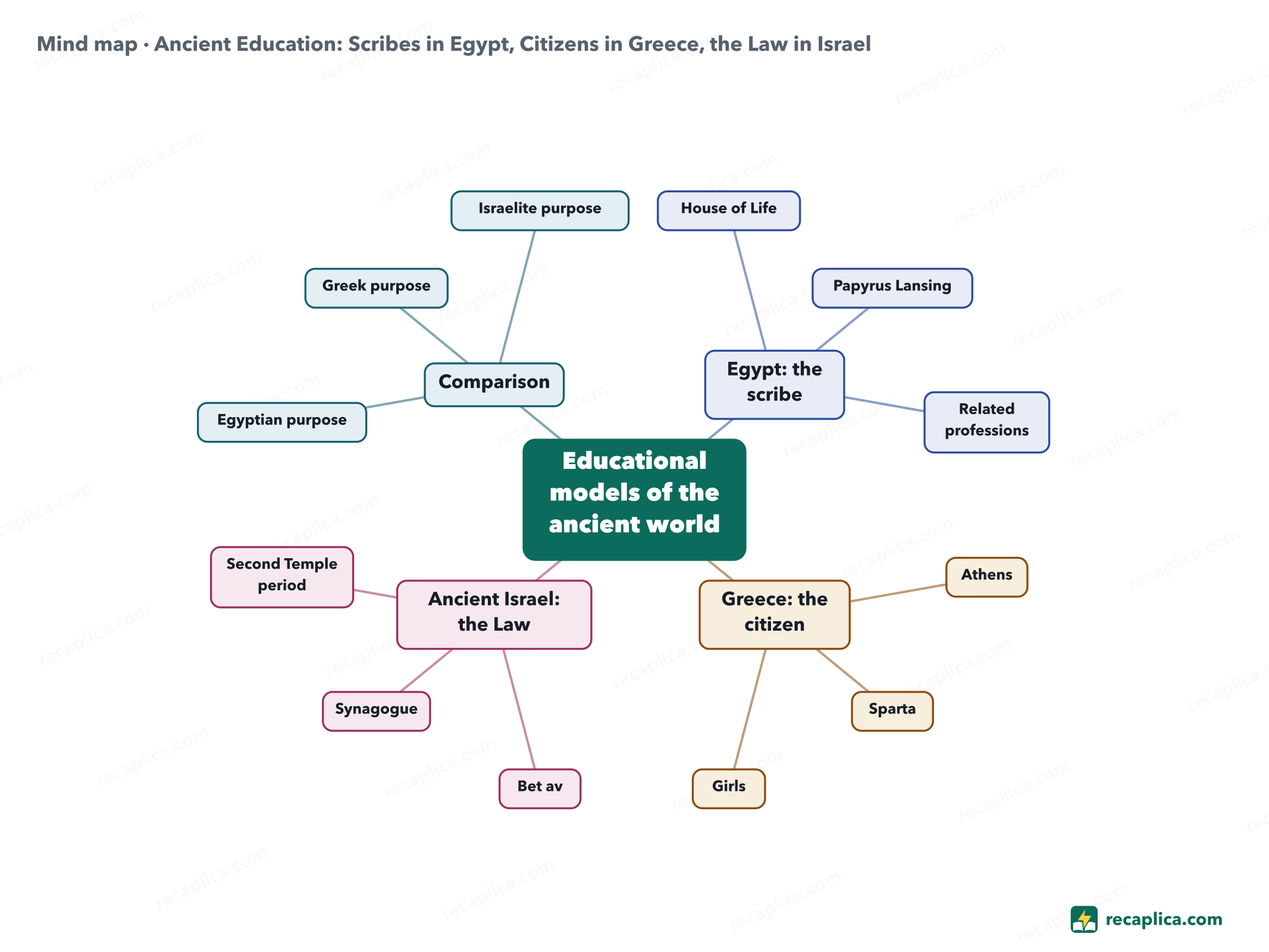
    Mind map: Ancient Education: Scribes in Egypt, Citizens in Greece, the Law in Israel
    • Educational models of the ancient world
      • Egypt: the scribe Training tied to the Houses of Life
        • House of Life institution and physical place of instruction
        • Papyrus Lansing praises the scribal profession
        • Related professions astronomers, physicians, architects, translators
      • Greece: the citizen Quick comparison of two models
        • Athens letters, music, gymnastics
        • Sparta agoge, military training
        • Girls informal in Athens, shared in Sparta
      • Ancient Israel: the Law From family to synagogue
        • Bet av the family, the first educational authority
        • Synagogue Torah reading, bet sefer and bet talmud
        • Second Temple period era of growth for community schooling
      • Comparison Three different purposes
        • Egyptian purpose training officials and specialists
        • Greek purpose training the citizen of the polis
        • Israelite purpose passing on knowledge of the Law

    Quiz: test yourself

    Answer the questions to check what you have learned: you get instant feedback and a short explanation.

    Grade 0/10 0/5
    1 What was the House of Life in ancient Egypt?

    The House of Life (Per Ânkh) combined an institutional role with a physical place of instruction; those tied to major religious centers trained the intellectual elite.

    2 According to the Papyrus Lansing, how was the scribal profession presented compared to manual trades?

    The papyrus urged the apprentice scribe to devote himself to the scroll and the writing board, promising fine clothing, property, and servants, unlike the manual trades it described.

    3 At what age did schooling typically begin in ancient Greece?

    Schooling typically started around age six or seven, and basic instruction ended between fourteen and sixteen.

    4 True or false: at Sparta, boys and girls trained and competed together in athletics.

    Unlike Athens, where girls' education remained informal and home-based, at Sparta boys and girls trained and competed together.

    5 Who held the primary duty of teaching the Law to children in ancient Israel, before synagogue-based schools developed?

    The head of the household (bet av) was obligated to teach his children the Law through oral instruction; later regulation introduced appointed teachers by town and district.

    Answers: 1-A · 2-C · 3-B · 4-A · 5-B

    Flashcards

    Tap the card to flip it and check whether you remember the answer, then move to the next one.

    1 / 8

    Explain it in your own words

    The ultimate test: if you can explain it in simple words, you've truly understood it. Write your explanation, then compare it with the Recap.

    Your explanation is saved only on this device.

    In ancient Egypt, becoming a scribe opened the door to a prestigious career, built around institutions called Houses of Life and texts like the Papyrus Lansing, which ranked that profession above manual trades. Greek education prepared the citizen: Athens leaned on letters, music, and gymnastics, while Sparta ran a collective military program known as the agoge. In ancient Israel, education began at home, where the father was responsible for teaching the Law to his children, and later grew around the synagogue, a place for reading the Torah and, by the Second Temple period, for organized schooling as well. Each system grew out of a different need in its own society.

    Frequently asked questions

    Who could become a scribe in ancient Egypt?

    The path ran through Houses of Life tied to major religious centers, which trained a select group headed for roles such as astronomer, physician, veterinarian, diplomat, architect, translator, or theologian.

    What was the main difference between education in Athens and in Sparta?

    Athens focused on letters, music, and gymnastics, with girls taught informally at home; Sparta's agoge was centralized and military, and included girls alongside boys in athletics.

    Where was the Law taught in ancient Israel?

    First at home, where the head of the household was obligated to teach his children orally; later, as community schooling grew during the Second Temple period, also in synagogue schools such as the bet sefer and the bet talmud.

    What is the Papyrus Lansing?

    An Egyptian text from the reign of Senusret III (12th Dynasty, roughly 1878-1839 BCE) that urges an apprentice scribe to commit to the profession, presented as more rewarding than manual trades.

    What other functions did the synagogue serve besides teaching the Torah?

    It worked as a multipurpose community center for lodging, shared meals, public fasts, and legal proceedings, especially after the Temple's destruction in 70 CE.

    Sources

    • House of life in Ancient Egypt
    • The Papyrus Lansing: Be a Scribe...or Else
    • Education in Ancient Greece
    • Education: Jewish Education
    • The Ancient Synagogue in Israel & the Diaspora

    Every Recap goes through an independent review before publication.

    Every evening, the day's new Recaps on our Telegram channel. Join the channel →

    Keep learning

    • History Clifford Geertz: who he was and what interpretive anthropology is Clifford Geertz (1926-2006) is the anthropologist who proposed studying a culture the way one studies a text. In 1973 he described culture as a body of meanings handed down through history and carried in symbols: to understand it you interpret those symbols, rather than hunt for general laws. His working tool is thick description, an account detailed enough to show which meanings hold the observed facts together. “The Interpretation of Cultures”, regarded as his most influential book, appeared in 1973. Read the Recap →
    • History What Is Epistemology? How Philosophy Looks at Science Epistemology is the branch of philosophy that studies knowledge, especially scientific knowledge: what makes it count as knowledge, how it gets justified, when a belief earns the name. The word comes from the Greek episteme (knowledge) and logos (account), and the Scottish philosopher James Frederick Ferrier was the first to propose it. In Italian usage the term names the critical study of how the sciences are logically built and how they work; in English-speaking countries epistemology covers the theory of knowledge in general. One of its classic problems is the line Karl Popper drew between science and pseudoscience. Read the Recap →
    • History Hermeneutics: What Is It? Philosophical hermeneutics asks what interpretation itself is, rather than treating it as a shortcut to some other goal. Schleiermacher proposed it as a universal discipline, valid for every kind of text, from scripture to literary and legal writing. Heidegger moved the question from method to existence: understanding becomes a way of being, shaped by the situation a person is already in. Gadamer pulled these threads together in "Truth and Method" and argued that understanding a text means letting its horizon meet the reader's own. Read the Recap →

    recaplica

    Clear in 30 seconds, yours in 10 minutes.

    Recaps Mind maps Request a Recap Telegram channel Mind map maker Our method About Privacy & cookies Legal notes & terms of use

    © 2026 Recaplica · A project by Curi S.r.l. — VAT IT05472000750

    Statistics, only if you say so

    To learn which Recaps help most we would use Google Analytics, with aggregate, anonymous data. It starts only with your OK, and you can change your mind anytime. Privacy policy