Skip to content
recaplica

    One moment: security check

    Cloudflare wants to make sure you're not a robot. Tick the box below and your search will continue on its own.

    IT
    recaplica Quintilian: Who He Was and His Model for the Complete Orator
    © 2026 Recaplica · recaplica.com — All rights reserved
    Home › History

    Quintilian: Who He Was and His Model for the Complete Orator

    By Recaplica Newsroom · Updated on October 18, 2026

    What to print

    Page numbers appear when printing with default margins.

    Slides

    Choose a cut

    Flash10 slidesThe essential thread, to present in classFull10 slidesEvery chapter and the deeper detail

    Both come with speaker notes.

    Telegram channel
    recaplica Clear in 30 seconds, yours in 10 minutes.
    In 30 seconds Key points Figures Deep dive Slides Myths Mind map Quiz Flashcards FAQ

    In 30 seconds quick read

    Marcus Fabius Quintilian was a Roman rhetorician born in Spain, at Calagurris, between 35 and 40 CE, who became the first teacher of rhetoric in Rome to receive a salary paid by the state, granted by the emperor Vespasian. In his main work, the Institutio Oratoria, twelve books long, he traces a path that starts with the child's nurse and ends, in the last book, with the moral qualities of the complete orator. For Quintilian, the ideal orator is Cato's vir bonus dicendi peritus, an honest man skilled in speaking, in which technical skill alone is not enough without a solid character. The complete manuscript of the work, lost for centuries, was rediscovered in 1416 by the humanist Poggio Bracciolini and returned to the center of European culture.

    Key Points

    • Marcus Fabius Quintilian was born in Spain, at Calagurris, between 35 and 40 CE, and was brought to Rome as a child by his father, also a rhetorician.
    • He returned to Rome in 68 CE at the order of Emperor Galba, and opened a school of oratory that became public in 74 CE.
    • Vespasian granted him the first state-paid salary ever given to a teacher of rhetoric in Rome.
    • In the Institutio Oratoria, twelve books long, he describes the orator's education from infancy (Book I) to moral character (Book XII).
    • He borrows from Cato the definition of the orator as vir bonus dicendi peritus, an honest man skilled in speaking: for him, a true orator needs an honest character before anything else.
    • The complete manuscript of the work, lost during the Middle Ages, was rediscovered by the humanist Poggio Bracciolini in 1416.

    Key figures

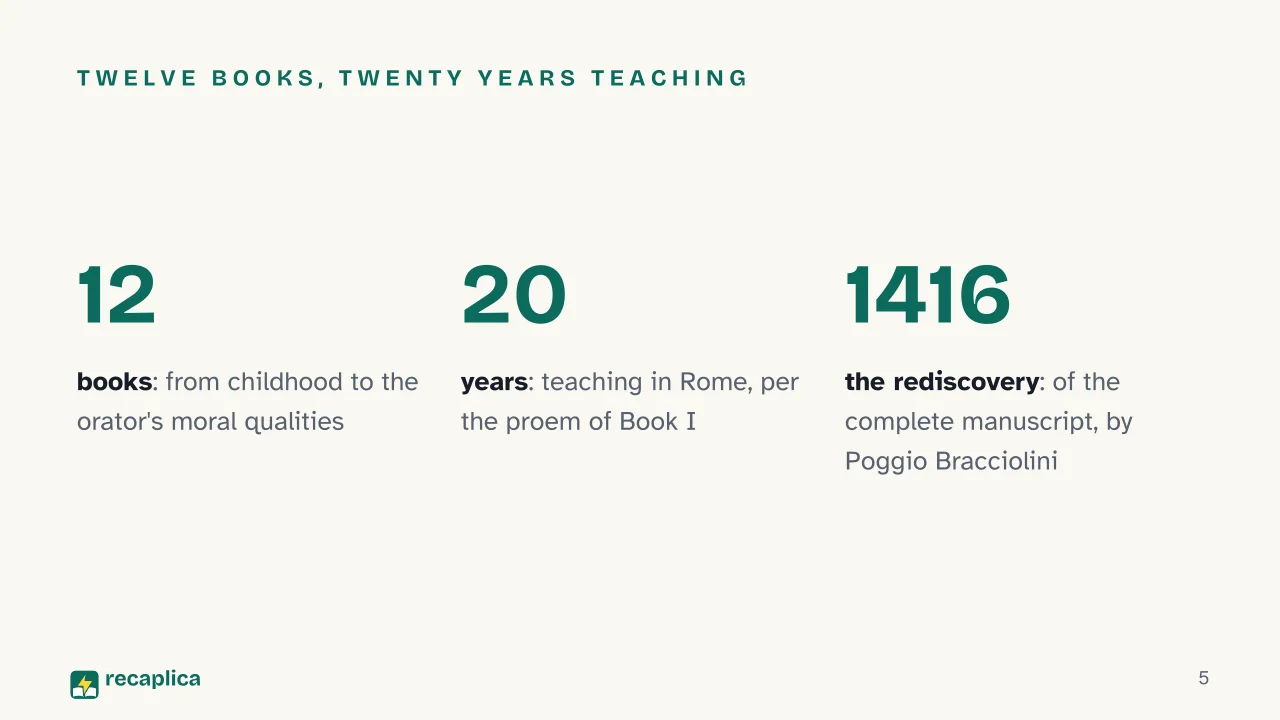
    • 12 books make up the Institutio Oratoria, from a child's education in Book I to the orator's moral qualities in Book XII. Source: Treccani
    • 20 years Quintilian spent teaching rhetoric in Rome, a figure he gives himself, according to Treccani, in the proem of Book I of the Institutio Oratoria. Source: Treccani
    • 1416 the year the humanist Poggio Bracciolini rediscovered the complete manuscript of the Institutio Oratoria at St. Gall, until then known only in incomplete form. Source: Treccani

    Deep Dive

    Who Was Quintilian

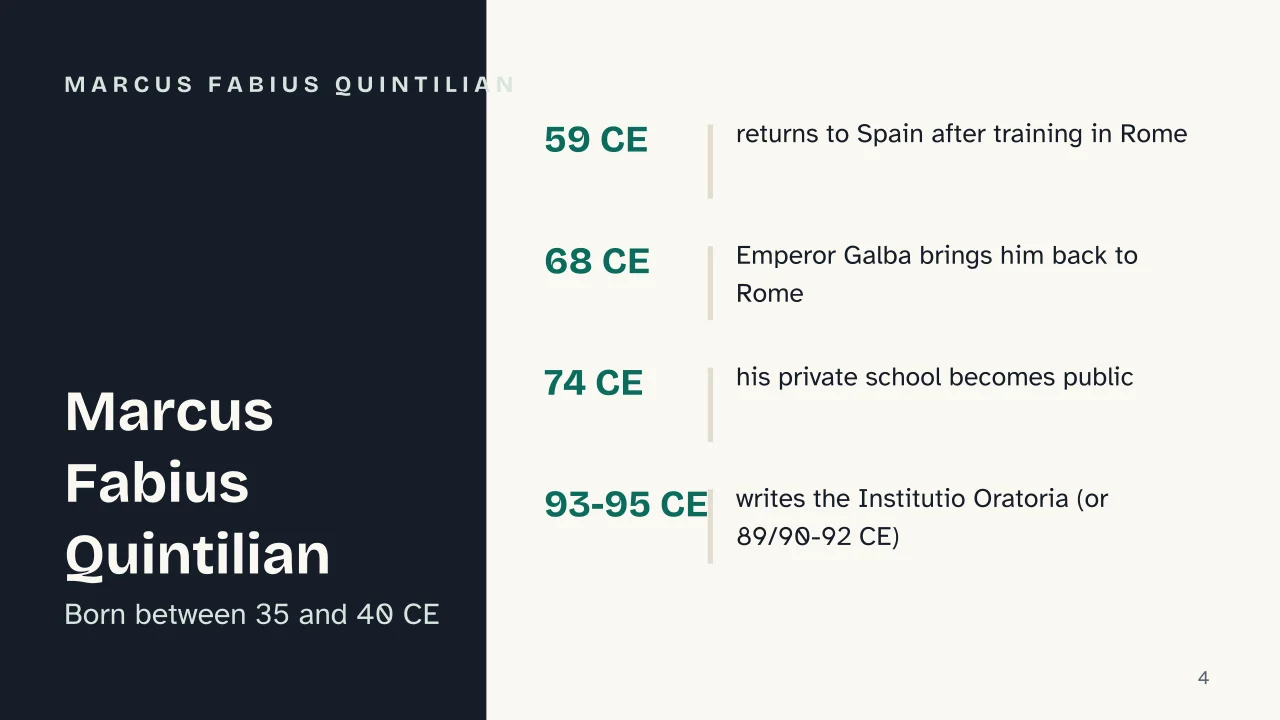
    Marcus Fabius Quintilian was born at Calagurris, present-day Calahorra, in Spain, between 35 and 40 CE: the sources give no single year, only this span. He was brought to Rome still young, perhaps still a child, by his father, himself a rhetorician. In Rome he completed his training under two teachers, the grammarian Remmius Palaemon and the advocate-rhetorician Domitius Afer, before returning to Spain in 59 CE.

    He came back to Rome in 68 CE, at the order of Emperor Galba. There he practiced law and opened a private school of oratory, which became a public school in 74 CE. It was Vespasian who granted him an unprecedented recognition for the time, the first salary the Roman state ever paid to a teacher of rhetoric. Later he was also given the honor of consular rank, a high-ranking title rather than the actual office of consul. He was also entrusted with educating two boys, grandsons of Domitilla, sister of an emperor, who were destined to become emperors themselves: an assignment that shows how far he had risen in Flavian Rome, the same century that saw the Roman Empire at its height.

    Quintilian taught rhetoric for twenty years, a figure that, according to Treccani, he reports himself in the proem of the first book of his major work.

    The Institutio Oratoria, Quintilian’s Treatise for the Orator

    Writing the Institutio Oratoria took Quintilian just over two years. The sources disagree on when: Treccani places the work, alternatively, between 89 (or 90) and 92 CE, or between 93 and the autumn of 95 CE.

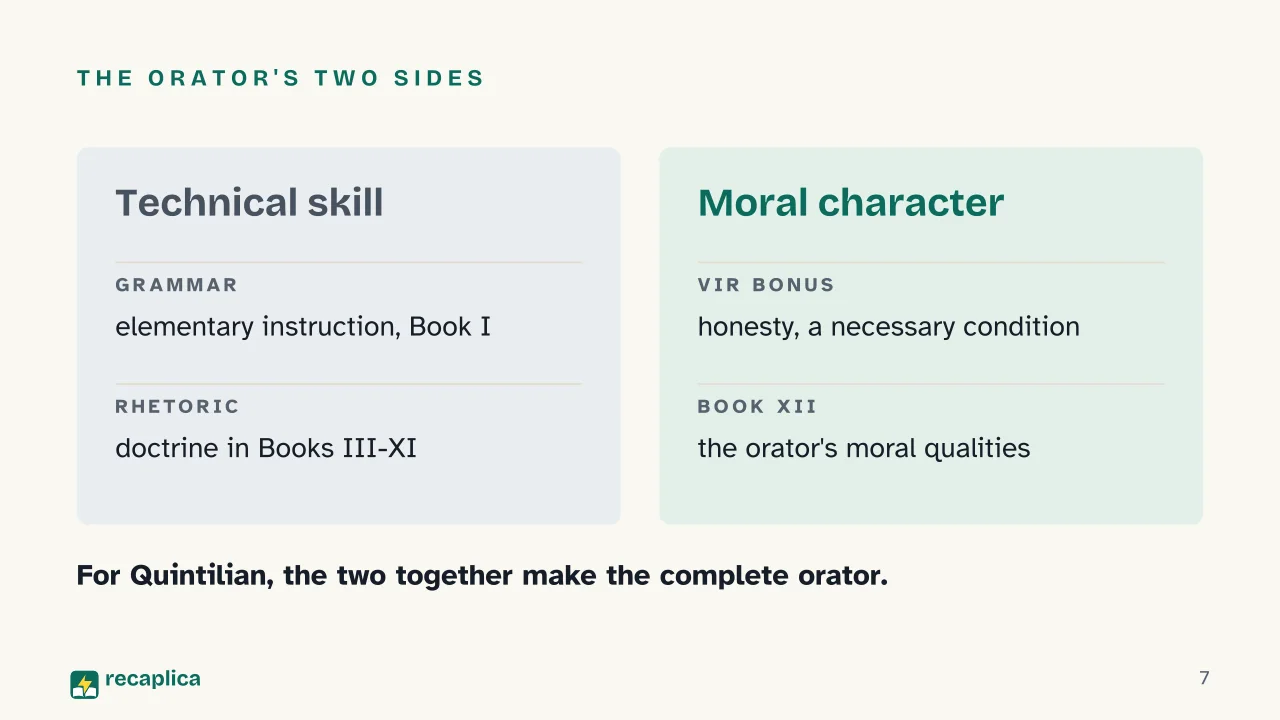
    The work is divided into twelve books, grouped into four blocks. The first covers a child’s education from an early age and elementary instruction, grammar, before any rhetorical training proper, ground that Roman schooling shared with the Roman ideal of humanitas. The second book deals with choosing a tutor and the teaching method itself; it also introduces the first rhetorical exercises, the progymnasmata. From the third book onward comes the more technical part, on rhetorical doctrine proper, after a historical survey of Greek and Roman teachers. The last book, the twelfth, changes subject: technique is already settled in the books before it, so here Quintilian turns to the personal and moral qualities a complete orator needs.

    According to Treccani, among surviving ancient works, the Institutio Oratoria is the only complete, systematic treatise on ancient pedagogy to come down to us.

    Vir Bonus Dicendi Peritus, Skill and Character Together

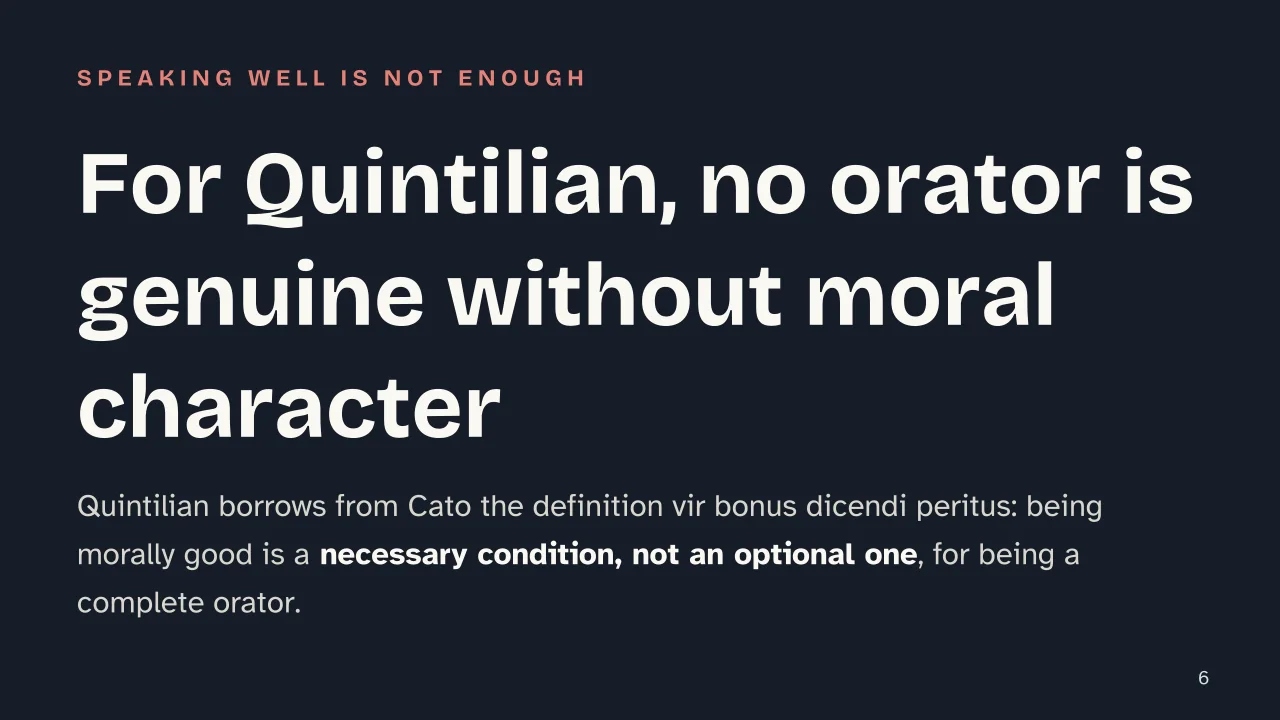
    At the opening of Book XII, Quintilian borrows a definition of the orator coined centuries earlier by Cato: vir bonus dicendi peritus, an honest man who speaks well. Quintilian puts moral character first: he treats it as the foundation an orator needs before any technique, rating rhetorical mastery on its own as insufficient. In his system, moral goodness is a necessary condition, not an optional one, for being a genuinely complete orator.

    The Teaching Method, From the Nurse to Play

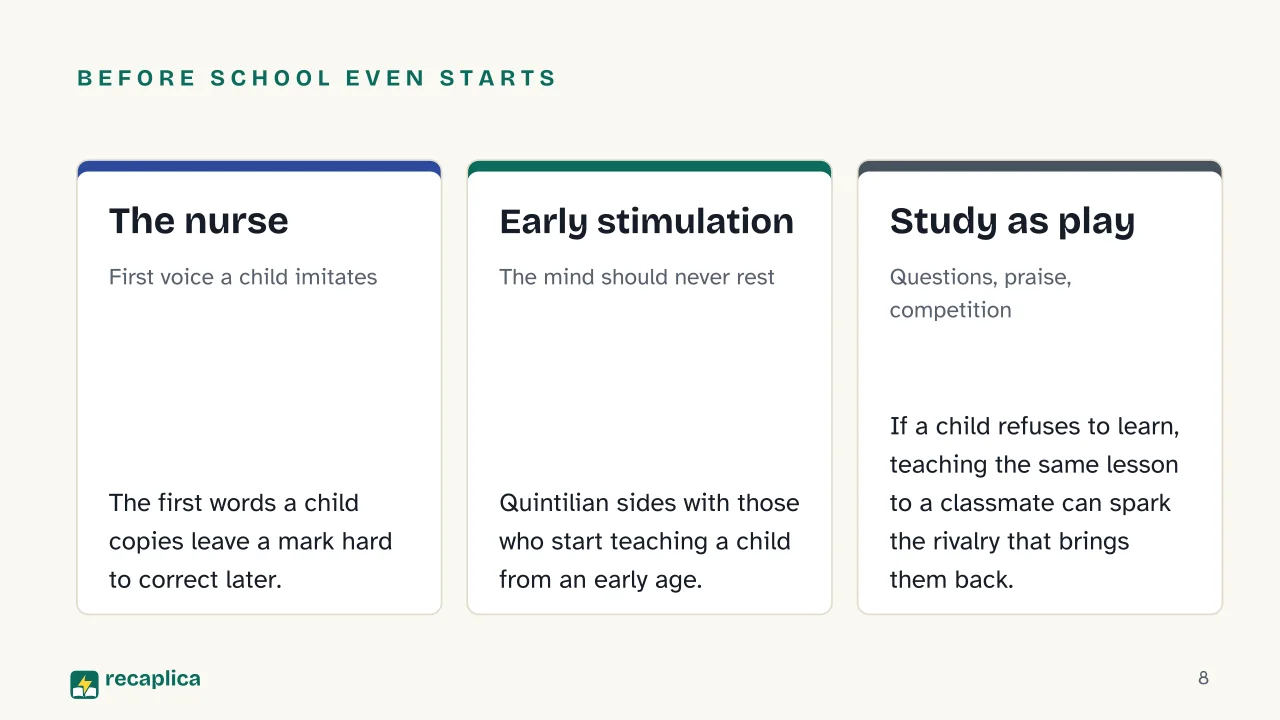
    For Quintilian, language learning starts long before school, with the choice of a nurse: she is the first person a child hears speak, and the first words a child tries to copy are hers. Quintilian sides with those who think a young child’s mind should never be left idle: he wants stimulation to begin early, well before the conventional age for starting instruction. In ancient Greek education, training a future citizen also began early, though with a different emphasis.

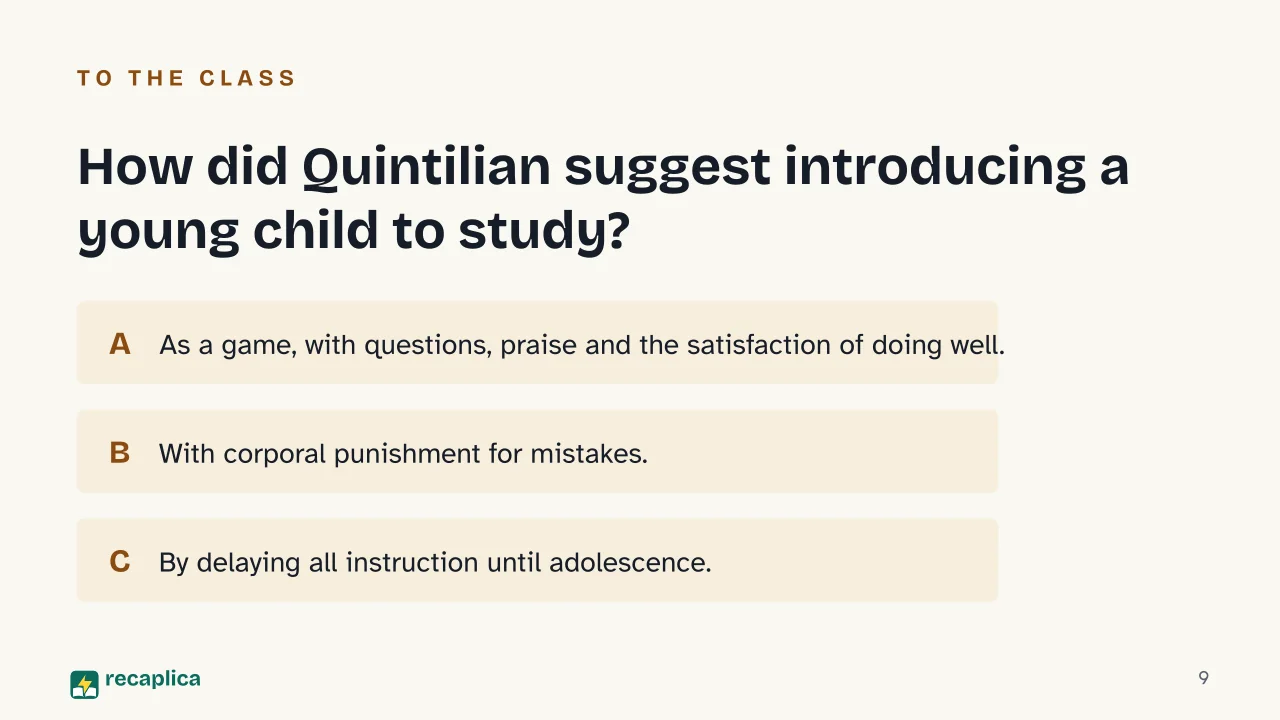
    Practical example: Quintilian suggests turning study into play for a young child, with questions, praise and the satisfaction of getting something right. If the child refuses to learn, he also recommends teaching the same lesson to another child: competition, in his view, can be enough to bring back the will to learn.

    The Legacy of the Institutio Oratoria

    During the Middle Ages, the complete text of the Institutio Oratoria was thought lost and circulated only in incomplete form. It was the humanist Poggio Bracciolini who, in 1416, found a complete copy at the monastery of St. Gall: a discovery that returned Quintilian to the center of European culture.

    Centuries later, according to the Stanford Encyclopedia of Philosophy, Desiderius Erasmus also built his own idea of rhetorical imitation from classical manuals, including Quintilian’s Institutio Oratoria, before giving it a Christian stamp of his own.

    Slide deck

    Slides ready to download and make your own in PowerPoint or Google Slides, with speaker notes. Pick the Flash cut or the Full one.
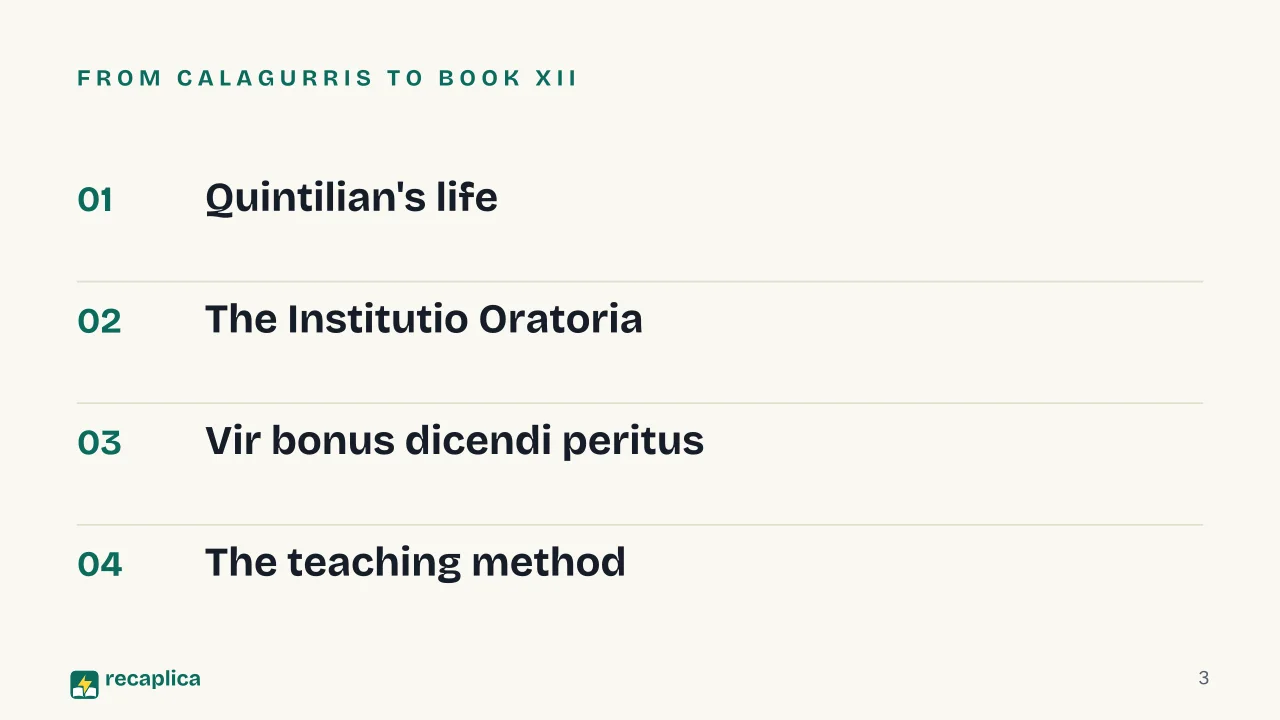
    Slide 1 of the presentation on Quintilian: QuintilianSlide 2 of the presentation on Quintilian: Is a complete orator just someone who speaks well?Slide 3 of the presentation on Quintilian: From Calagurris to Book XIISlide 4 of the presentation on Quintilian: Marcus Fabius QuintilianSlide 5 of the presentation on Quintilian: Twelve books, twenty years teachingSlide 6 of the presentation on Quintilian: For Quintilian, no orator is genuine without moral characterSlide 7 of the presentation on Quintilian: The orator's two sidesSlide 8 of the presentation on Quintilian: Before school even starts: The nurse, Early stimulation, Study as playSlide 9 of the presentation on Quintilian: How did Quintilian suggest introducing a young child to study?Slide 10 of the presentation on Quintilian: Now for review
    Flash10 slidesThe essential thread, to present in classFull10 slidesEvery chapter and the deeper detail

    Common myths

    • ✗ Myth Quintilian invented the phrase vir bonus dicendi peritus.

      ✓ Reality The definition goes back to Cato, who coined it centuries earlier. Quintilian borrows it at the start of Book XII of the Institutio Oratoria and turns it into an organizing principle that ties technical skill to moral character.

    • ✗ Myth The Institutio Oratoria is a manual of rhetorical technique and nothing else.

      ✓ Reality Book I covers a child's early education and elementary instruction, before any rhetoric proper; Book XII, the last, drops technique entirely, already covered in the books before it, and turns to the orator's moral qualities.

    • ✗ Myth Roman schooling, as Quintilian describes it, meant strict discipline and corporal punishment.

      ✓ Reality Quintilian wants a young child's studies to feel like play, with questions, praise and the satisfaction of getting something right; if a child refuses to learn, his advice is to teach the same lesson to another child, to spark competition rather than punishment.

    Mind map

    Drag the background to move around and the nodes to reposition them; use − and + to collapse and expand branches.
    Customize
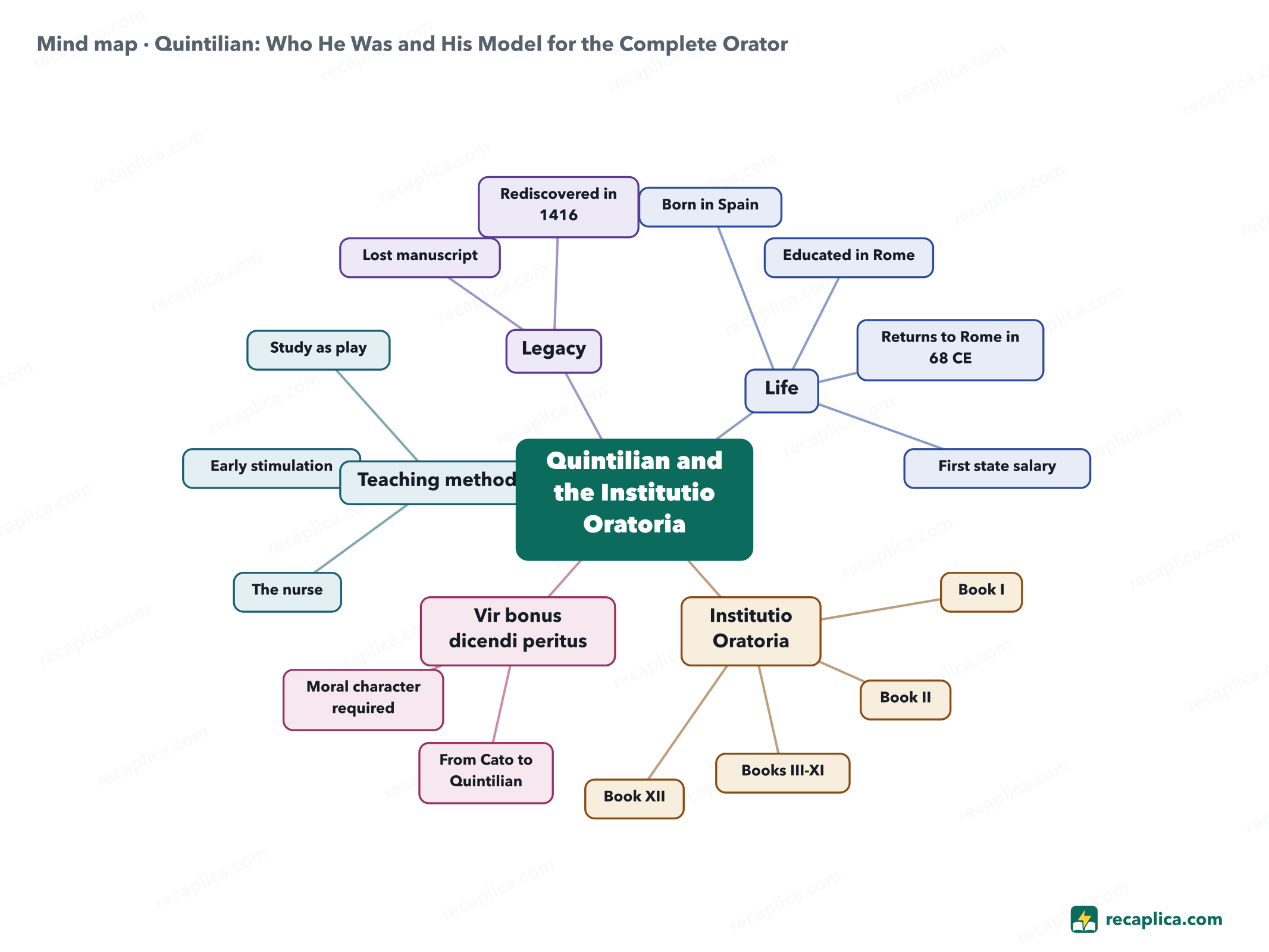
    Mind map: Quintilian: Who He Was and His Model for the Complete Orator
    • Quintilian and the Institutio Oratoria
      • Life
        • Born in Spain Calagurris, between 35 and 40 CE
        • Educated in Rome under Remmius Palaemon and Domitius Afer
        • Returns to Rome in 68 CE at the order of Emperor Galba
        • First state salary granted by Vespasian as a teacher of rhetoric
      • Institutio Oratoria
        • Book I childhood and elementary instruction
        • Book II choosing a teacher, first exercises
        • Books III-XI rhetorical doctrine proper
        • Book XII the orator's moral qualities
      • Vir bonus dicendi peritus
        • From Cato to Quintilian the definition reused at the start of Book XII
        • Moral character required honesty before technique
      • Teaching method
        • The nurse a child's first words are imitated from her
        • Early stimulation a child's mind should never rest
        • Study as play questions, praise, competition among children
      • Legacy
        • Lost manuscript circulated incomplete through the Middle Ages
        • Rediscovered in 1416 Poggio Bracciolini, the monastery of St. Gall

    Quiz: test yourself

    Answer the questions to check what you have learned: you get instant feedback and a short explanation.

    Grade 0/10 0/5
    1 In what span of years was Quintilian born, according to Treccani?

    The source gives no single year, only a span: between 35 and 40 CE, at Calagurris, in Spain.

    2 What first did Quintilian achieve thanks to Emperor Vespasian?

    Vespasian granted him the first state salary ever paid to a teacher of rhetoric in Rome, an unprecedented recognition for the time.

    3 What does the last book, Book XII, of the Institutio Oratoria cover?

    After exhausting rhetorical technique in the previous books, Book XII turns to the orator's moral character.

    4 Who gave Quintilian the definition of the orator as vir bonus dicendi peritus?

    The phrase goes back to Cato; Quintilian reuses it at the start of Book XII to tie technical skill to moral character.

    5 How did Quintilian suggest introducing a young child to study?

    Quintilian suggested making study feel like play; if a child refused to learn, his advice was to teach the same lesson to another child, to spark competition.

    Answers: 1-A · 2-A · 3-A · 4-A · 5-A

    Flashcards

    Tap the card to flip it and check whether you remember the answer, then move to the next one.

    1 / 8

    Explain it in your own words

    The ultimate test: if you can explain it in simple words, you've truly understood it. Write your explanation, then compare it with the Recap.

    Your explanation is saved only on this device.

    Marcus Fabius Quintilian was a Roman rhetorician born in Spain, at Calagurris, between 35 and 40 CE, who became the first teacher of rhetoric in Rome to receive a salary paid by the state, granted by the emperor Vespasian. In his main work, the Institutio Oratoria, twelve books long, he traces a path that starts with the child's nurse and ends, in the last book, with the moral qualities of the complete orator. For Quintilian, the ideal orator is Cato's vir bonus dicendi peritus, an honest man skilled in speaking, in which technical skill alone is not enough without a solid character. The complete manuscript of the work, lost for centuries, was rediscovered in 1416 by the humanist Poggio Bracciolini and returned to the center of European culture.

    Frequently asked questions

    Who was Quintilian?

    Marcus Fabius Quintilian was a Roman rhetorician born in Spain, at Calagurris, between 35 and 40 CE. He taught rhetoric in Rome and wrote the Institutio Oratoria, the ancient treatise on education that survives complete.

    What is Quintilian's Institutio Oratoria?

    It is a twelve-book work on training the complete orator, from early childhood education to the moral qualities a public speaker needs; according to Treccani, it is the only systematic treatise on ancient pedagogy to survive intact.

    What does the phrase vir bonus dicendi peritus mean?

    It is Cato's phrase for the ideal orator, which Quintilian adopts as his own: an honest man who speaks well. In his system, character comes before technical skill, so speaking well alone does not make a true orator.

    Why is the Institutio Oratoria considered so important?

    Because, according to Treccani, it is the only complete and systematic treatise on ancient pedagogy to survive to the present; its complete manuscript, lost through the Middle Ages, was rediscovered by the humanist Poggio Bracciolini in 1416.

    When was the Institutio Oratoria written?

    Writing it took Quintilian just over two years, in a period the sources place, alternatively, between 89/90 and 92 CE, or between 93 and the autumn of 95 CE.

    Sources

    • Treccani, QUINTILIANO, Marco Fabio (Enciclopedia Italiana)
    • Perseus Digital Library, Quintilian, Institutio Oratoria, trans. H. E. Butler
    • Stanford Encyclopedia of Philosophy, Desiderius Erasmus

    Every Recap goes through an independent review before publication.

    Every evening, the day's new Recaps on our Telegram channel. Join the channel →

    Keep learning

    • History Ancient Greek Education: How Paideia Shaped a Citizen Paideia was the Greek idea that the city itself was a community built to educate, across a person's entire life: its goal was to make a free person useful to friends, family and the city. In Athens, boys first learned to read, write and count, then moved on to literature, music and physical training, before entering civic service between eighteen and twenty. In Sparta, physical training outweighed every other subject from early childhood. From age six, Athenian boys had a pedagogue, almost always a slave, who guarded them without teaching them, while girls followed a path with more room for dance and music. The sophists, Protagoras among the first, were the earliest to charge a fee for education, and centuries later the scholar Werner Jaeger put the word paideia back at the center of classical studies. Read the Recap →
    • History Monasticism: What It Is and How Christian Monastic Life Began Monasticism is the choice some Christians make to devote daily life to prayer, manual work and asceticism, alone or in community. It took shape over the early centuries as an outgrowth of Christian asceticism: the World History Encyclopedia points to the new imperial favor that came with the Edict of Milan in 313 as one of its causes, which some historians say also brought worldliness into the Church and pushed many Christians to seek a poorer setting for their faith. In Egypt, Anthony starts the eremitic tradition, and Pachomius and Basil later organize monks into true communities, a model known as cenobitic monasticism. In the West, Benedict of Nursia becomes the reference figure: his Rule, written probably around 530, governs prayer, manual work and obedience inside the monastery. Read the Recap →
    • History Roman Education: How Rome's Three-Tier School System Worked Roman education grew out of an idea the Romans called humanitas: the belief that a full human being is shaped by learning, not born complete. The word humanus originally meant simply being kind to others, but by the 1st century BC Cicero had stretched it to cover liberal education too, what the Greeks called paideia. That idea took a very concrete shape in Roman schools, split into three stages: the litterator taught children to read and write, the grammaticus added Greek and the natural sciences, and the rhetor trained young men in public speaking and law. Very few girls went past the first stage, since most married while still in their teens. Read the Recap →

    recaplica

    Clear in 30 seconds, yours in 10 minutes.

    Recaps Mind maps Request a Recap Telegram channel Mind map maker Our method About Privacy & cookies Legal notes & terms of use

    © 2026 Recaplica · A project by Curi S.r.l. — VAT IT05472000750

    Statistics, only if you say so

    To learn which Recaps help most we would use Google Analytics, with aggregate, anonymous data. It starts only with your OK, and you can change your mind anytime. Privacy policy