recaplica
Clear in 30 seconds, yours in 10 minutes.
In 30 seconds quick read
Max Weber was born in Erfurt in 1864 and died in Munich in 1920. He trained in law, and Treccani calls him a sociologist and historian. He studied social action through interpretive sociology, used ideal types to put empirical data in order and described three kinds of legitimate domination: traditional, charismatic and rational-legal. He also analyzed bureaucracy and rationalization, which can trap people in what is known as the iron cage. These ideas appear in The Protestant Ethic and the Spirit of Capitalism (1904-1905), in the Munich lectures on science and politics as vocations and in Economy and Society, published after his death.
Key Points
Max Weber (1864-1920) trained in law; the Italian encyclopedia Treccani calls him a sociologist and historian.
Interpretive sociology tries to grasp the meaning that people give to their own actions, which Weber called Verstehen.
Ideal types are models against which real cases are compared; according to Treccani they help put empirical data in order.
Legitimate domination comes in three types: traditional, charismatic and rational-legal.
In Frank Elwell's account, bureaucratic coordination is what marks modern social structures for Weber.
The Protestant Ethic dates from 1904-1905, while Economy and Society appeared after his death.
Deep Dive
Who was Max Weber
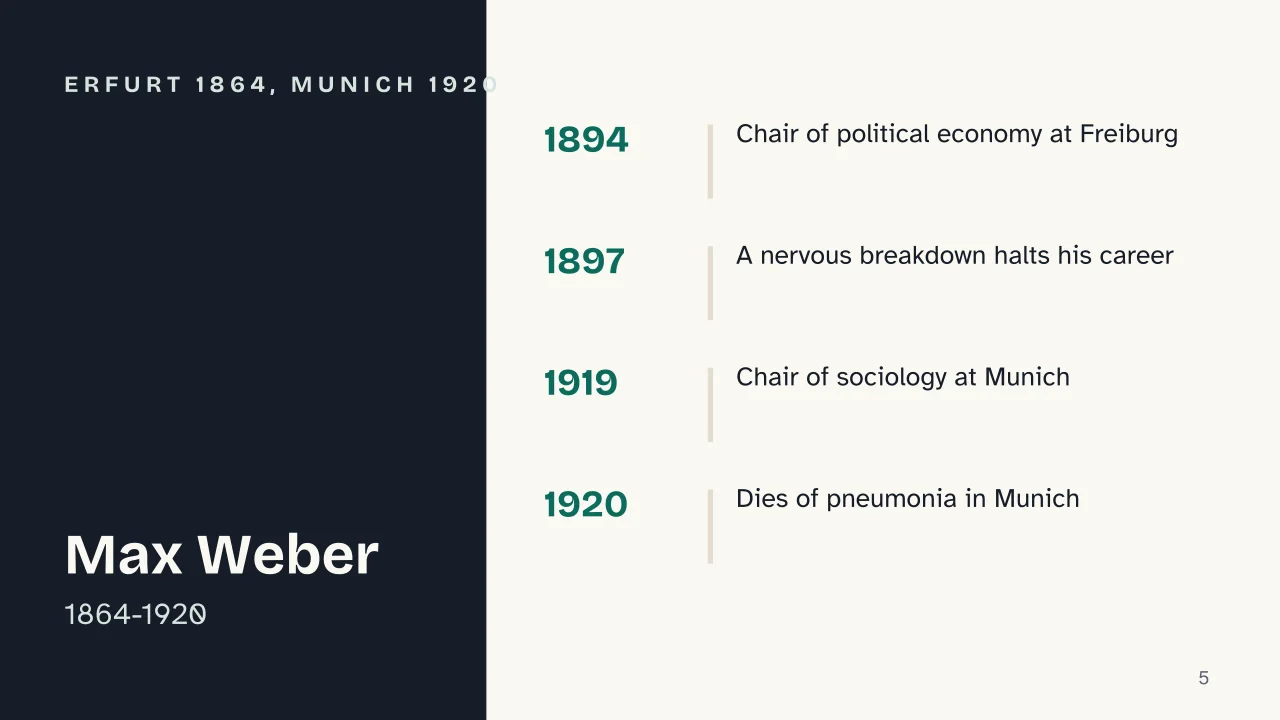
Max Weber was born in Erfurt, a Prussian city, in 1864. He took his degree in Berlin under Goldschmidt and, influenced by Mommsen, turned to Roman agrarian history, as Treccani tells it. The Stanford Encyclopedia of Philosophy recalls his legal training and his first university post, at Freiburg in 1894, where, per Treccani, he taught political economy. He later won the chair of political economy at Heidelberg. In 1897 a nervous breakdown, which came shortly after his father’s sudden death, abruptly cut into the productive years of his career. According to Wikipedia he withdrew from teaching altogether in 1903 and returned only in 1918. That year, Treccani says, he accepted a chair of sociology at Vienna; the lost war brought him back to Germany, and in 1919 he got the chair of sociology at Munich.
He died there the following year, suddenly, of pneumonia.
Max Weber and sociology: interpretive sociology and Verstehen
Students of sociology meet Weber for one method in particular. Treccani calls him a sociologist and historian and says the individual action that carries meaning sits at the center of his analysis. Treccani adds that Weber argues for an interpretive sociology, in German verstehende Soziologie.
Verstehen means understanding, grasping nature and meaning. According to Frank Elwell of Rogers State University, Weber used the word for the effort to understand the intention behind an action and the context around it. The Stanford Encyclopedia of Philosophy describes the same task for the social scientist: to understand the subjective side of human conduct as it is directed at others.
Esempio pratico: a person raises an arm in the middle of a crowd. Describing the movement is not enough, because it could be a wave to a friend, a signal to a taxi or a request to speak at a meeting. Interpretive sociology starts from what the gesture means to the person making it and to those who see it.
Wikipedia sums up the distance from Émile Durkheim this way: Durkheim focused on society, Weber on individuals and their actions.
Social action and its four types
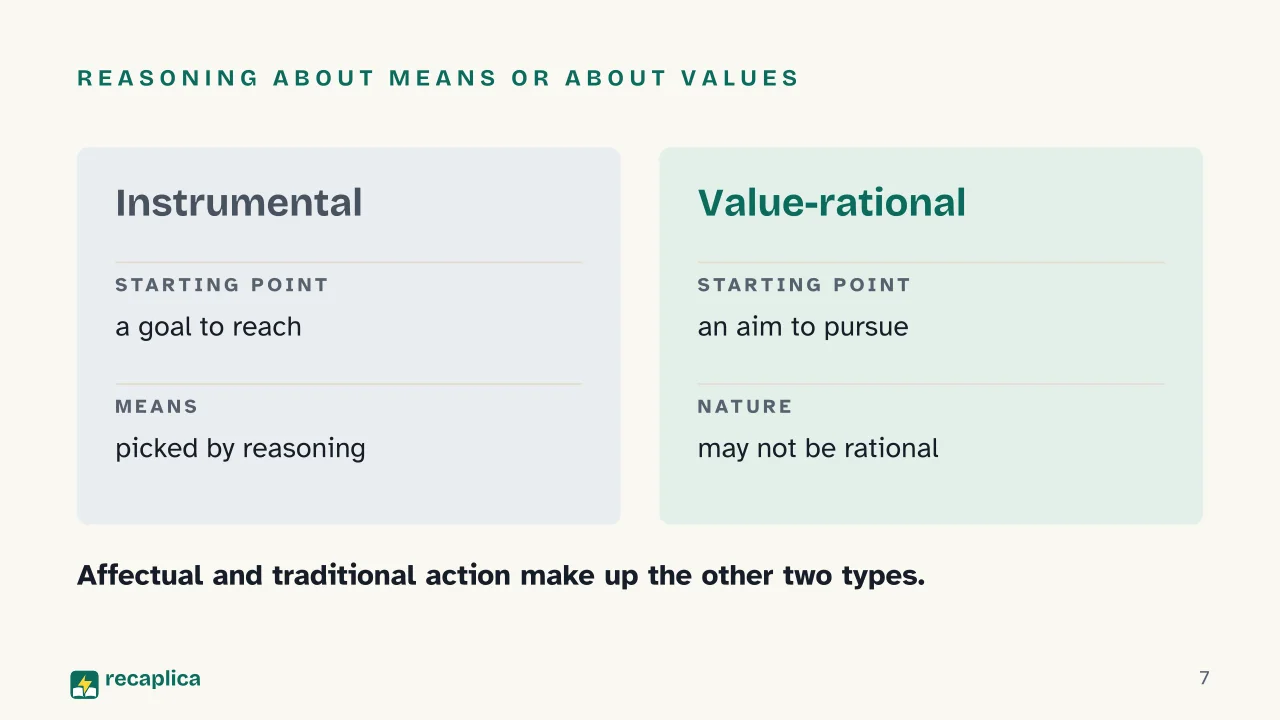
Frank Elwell reports that Weber distinguishes four main types of social action.
Type of action
How it is oriented
Instrumentally rational
picks the means to an end by reasoning
Value-rational
pursues an aim that may not be rational in itself
Affectual
arises from the emotional state of the actor
Traditional
is steered by custom or habit
Esempio pratico: four people stand during an anthem. The first has read the ceremony rules and wants to avoid trouble, the second sees it as a duty to their country. The third is moved, and the fourth has always done it, like the rest of the family.
Ideal types and value-freedom
An ideal type, Treccani writes, is a limiting concept used to order empirical data. The Stanford Encyclopedia of Philosophy explains that it is built by one-sidedly stressing one or more points of view. It never matches concrete reality; Elwell calls it a description that reality is compared with.
Esempio pratico: a buyer who chooses every product on price alone does not exist. Describing one is useful for measuring how far real buyers drift from that model, and for what reasons.
Value-freedom (Wertfreiheit, «freedom from values» in Treccani’s rendering) is, for the Stanford Encyclopedia, a principle of method. It asks the researcher to tell empirical knowledge from value judgments. Treccani specifies that it is legitimate to look for the links between means and ends while leaving the worth of the ends unjudged.
Max Weber’s theory of legitimate authority
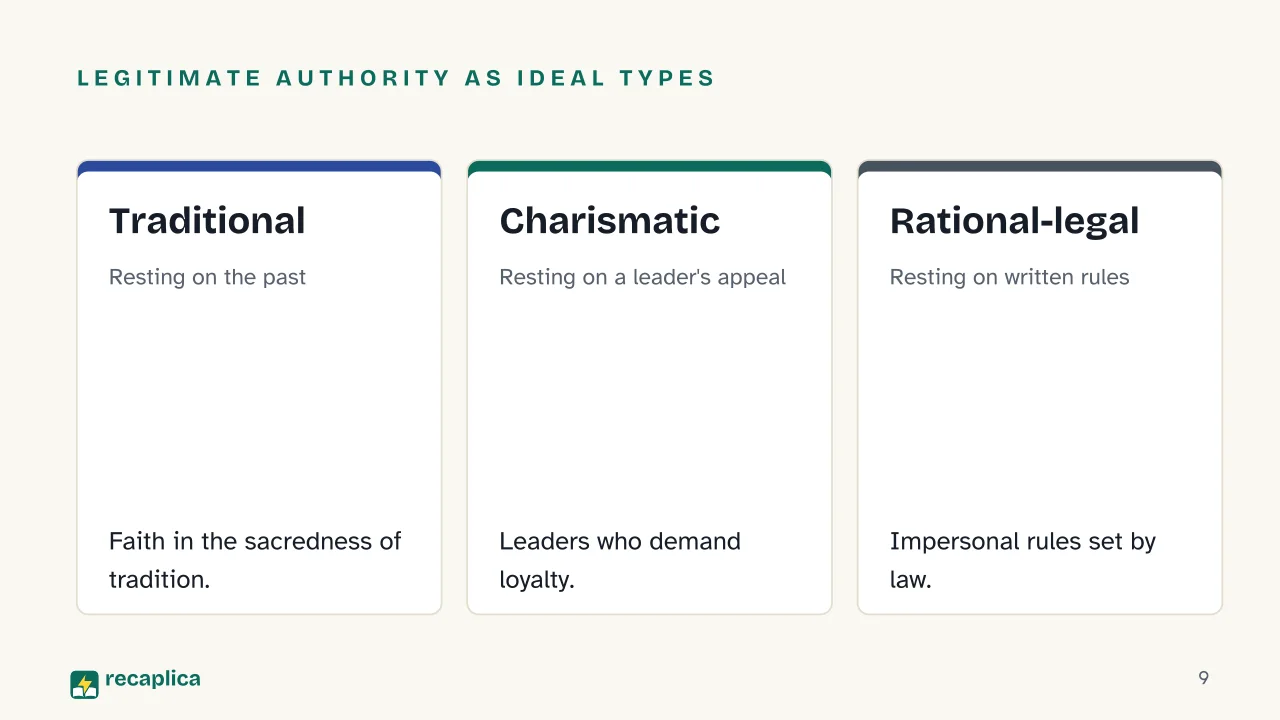
Treccani says Weber distinguishes forms of authority and power. The Stanford Encyclopedia describes three ideal types of legitimate domination, resting on charisma, tradition and legal rationality. Elwell’s account gives each one its foundation.
Type of authority
What it rests on
Traditional
faith in the sacredness of tradition, «the eternal yesterday»
Charismatic
the appeal of leaders who demand loyalty
Rational-legal
impersonal rules laid down by law
Esempio pratico: a traffic officer stops a car parked where it is not allowed. Whoever stops is following an impersonal rule that applies to everyone: this is rational-legal authority.
The theme returns in «Politics as a Vocation», the lecture Weber gave in Munich on 28 January 1919 to a free student union of Bavaria. According to Wikipedia, three principles justify the legitimacy of the state’s political rule: tradition, charisma and legality. The Stanford Encyclopedia recalls his definition of the state as the body that successfully holds the exclusive claim to legitimate physical force over a territory.
In the same lecture, again per Wikipedia, the politician has to balance the ethic of conviction with the ethic of responsibility.
Bureaucracy and the iron cage
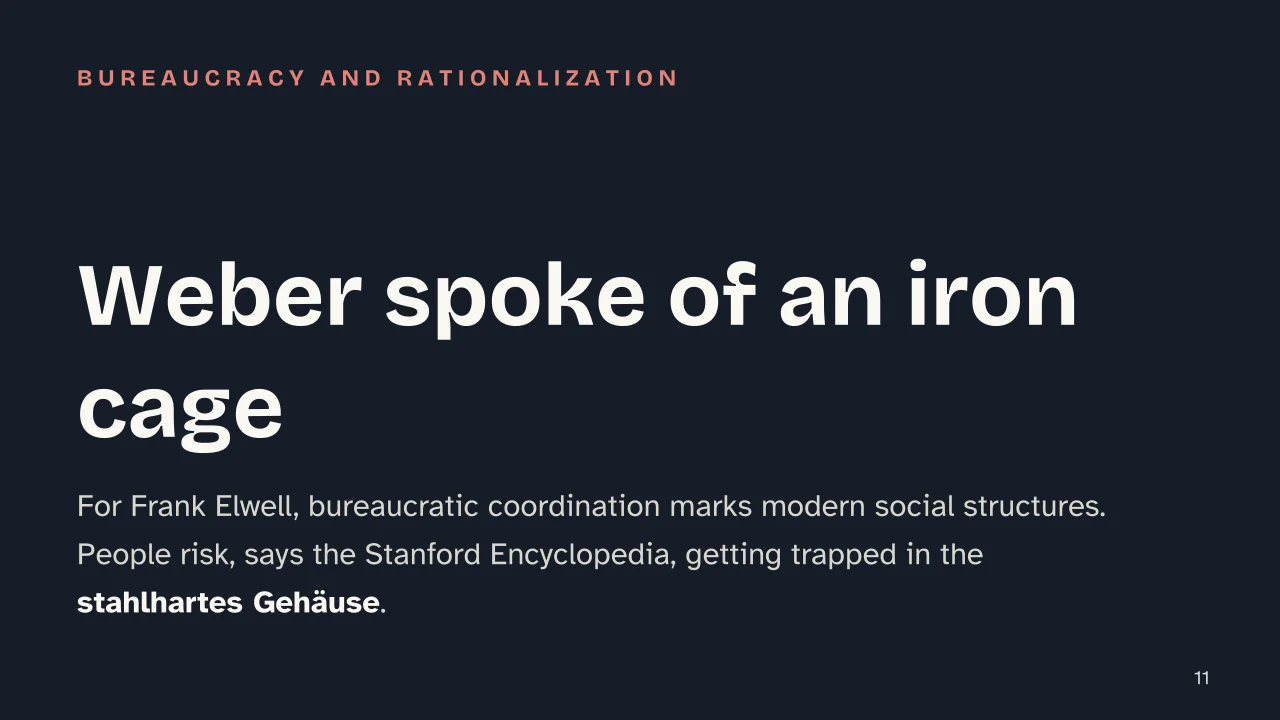
For Elwell, Weber treats bureaucratic coordination as the distinguishing mark of modern social structures. Offices are arranged in a hierarchy: information goes up and directives come down. Impersonal rules fix each person’s duties and responsibilities.
Esempio pratico: an application filed at an office goes through the desks laid out in the regulations. Whoever examines it applies the same rule to every applicant, whoever they are, and the answer travels back down the same ladder of offices.
Rationalization, in this picture, is the practical application of knowledge to reach a desired end. For the Stanford Encyclopedia, the Western version tends toward a formal and procedural rationality tied to instrumental rationality.
«Iron cage» is the English rendering of the German stahlhartes Gehäuse, and people risk getting trapped in it, writes the Stanford Encyclopedia. Wikipedia attributes the risk to rationalization and bureaucracy; Elwell describes a society that is technically ordered, rigid and dehumanized.
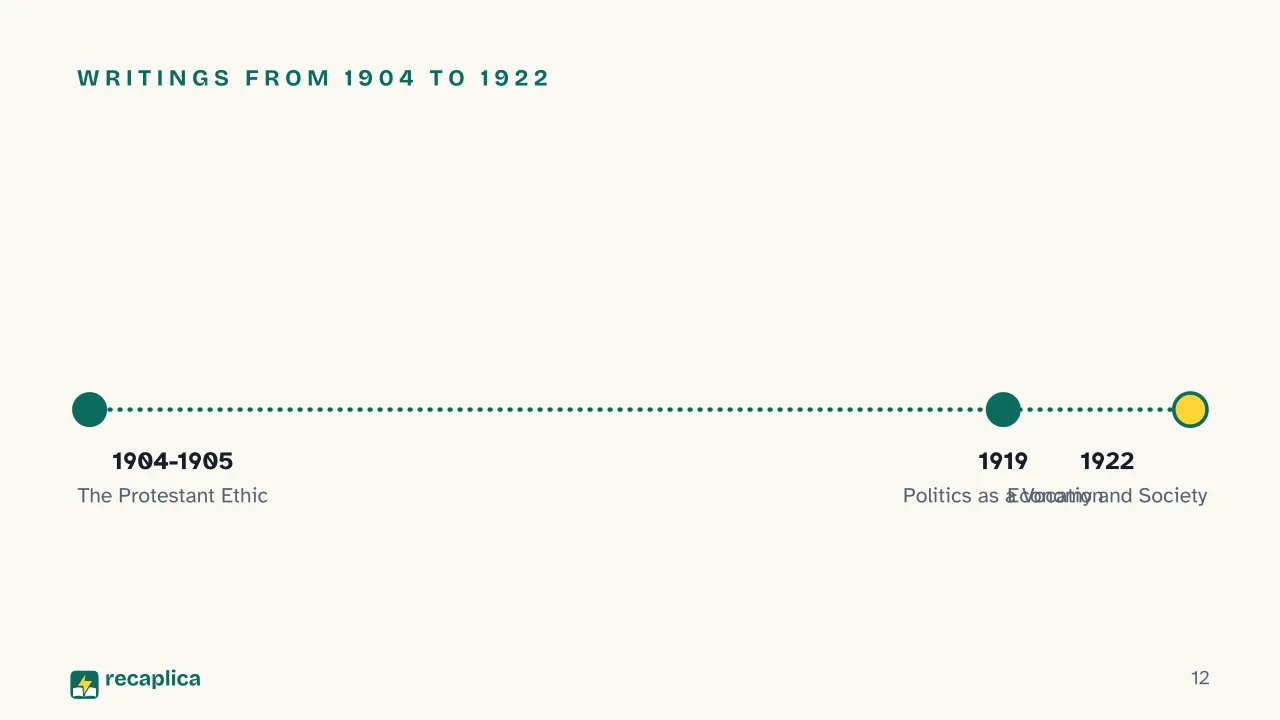
Max Weber’s writings, from the Protestant Ethic to Economy and Society
The Recap covers these writings, of different kinds: one work published in his lifetime, two lectures, and collections and essays published after his death.
per the Stanford Encyclopedia, a non-Marxist genealogy of modern capitalism
Lectures on science and politics as vocations
1919 (politics)
given in Munich, the one on politics on 28 January; the Stanford Encyclopedia calls them highly praised
Political Writings
1921
collected and published posthumously, according to Treccani
Economy and Society
1922 (Treccani)
posthumous; 1921-1922 for Wikipedia
Economy and Society (Wirtschaft und Gesellschaft) is a collection of essays Weber was working on when he died, in 1920. The Stanford Encyclopedia presents it as his presumed major work, published thanks to the editing of his widow Marianne.
According to the Stanford Encyclopedia, the thesis of the 1904-1905 book is a genealogy of modern capitalism that is non-Marxist.
Slide deck
Slides ready to download and make your own in PowerPoint or Google Slides, with speaker notes. Pick the Flash cut or the Full one.
✗ Myth For Weber, the ethic of conviction and the ethic of responsibility are two roads that never meet.
✓ Reality The Stanford Encyclopedia of Philosophy reads the two ethics as something other than absolute opposites. In the lecture «Politics as a Vocation», given in Munich on 28 January 1919, the politician has to balance both, as Wikipedia summarizes it.
✗ Myth Value-freedom means a sociologist is not allowed to hold opinions.
✓ Reality The Stanford Encyclopedia presents it as a principle of method: the researcher keeps empirical knowledge apart from value judgments. Treccani adds that studying how means connect to ends is legitimate; the judgment on the worth of the ends stays outside it.
✗ Myth Weber was only a sociologist.
✓ Reality Treccani calls him a sociologist and historian, and his training was in law. He took his degree in Berlin under Goldschmidt, worked on Roman agrarian history and held chairs of political economy before the chair of sociology at Munich, in 1919.
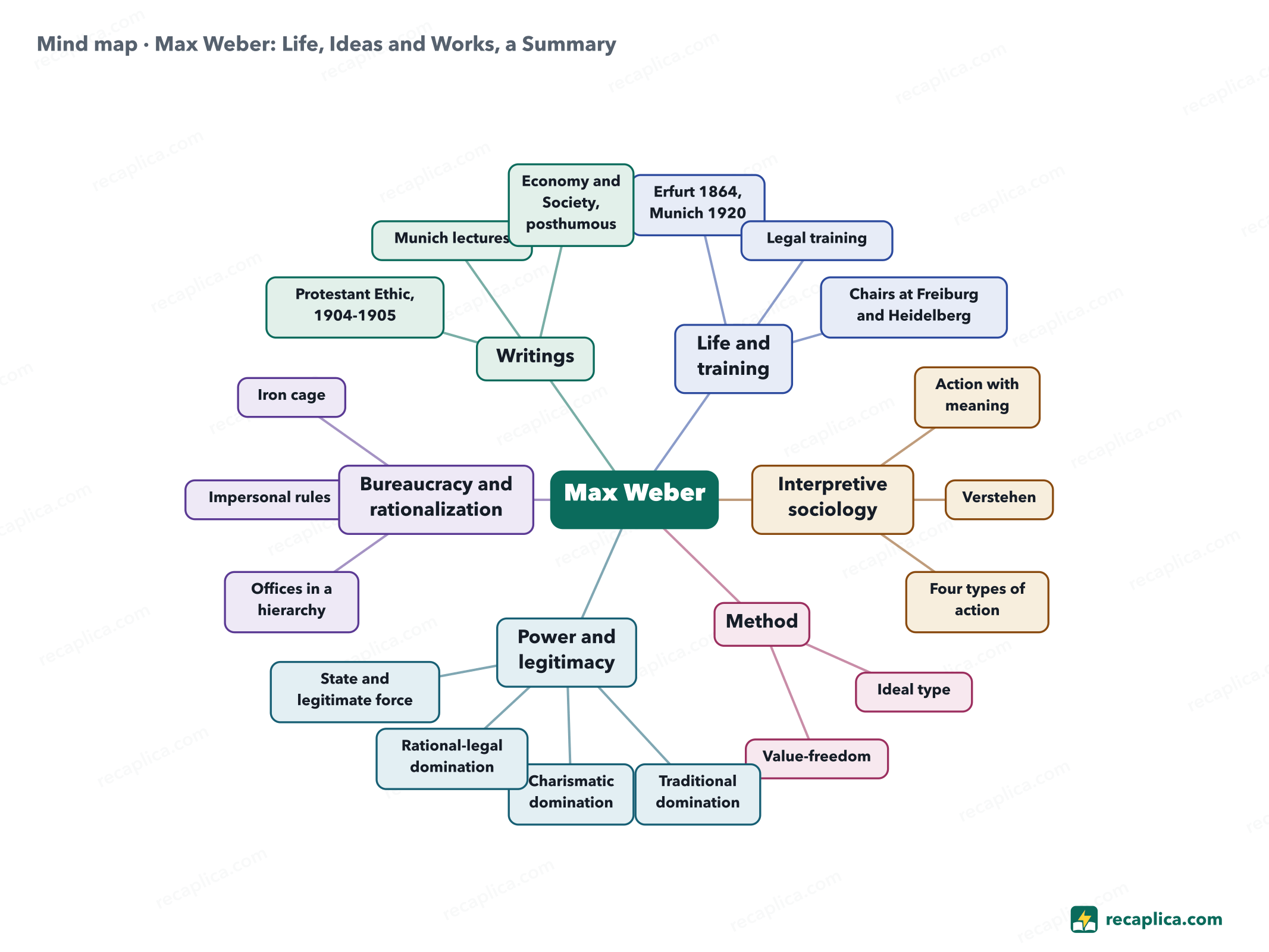
Mind map
Drag the background to move around and the nodes to reposition them; use − and + to collapse and expand branches.
Verstehengrasping the nature and meaning of an action
Four types of action
Method
Ideal typelimiting concept that orders data
Value-freedomWertfreiheit, freedom from values
Power and legitimacy
Traditional domination
Charismatic domination
Rational-legal domination
State and legitimate force
Bureaucracy and rationalization
Offices in a hierarchy
Impersonal rules
Iron cage
Writings
Protestant Ethic, 1904-1905
Munich lectures
Economy and Society, posthumous
Quiz: test yourself
Answer the questions to check what you have learned: you get instant feedback and a short explanation.
Grade0/100/5
Answers: 1-C · 2-D · 3-A · 4-B · 5-B
Flashcards
Tap the card to flip it and check whether you remember the answer, then move to the next one.
1 / 8
Explain it in your own words
The ultimate test: if you can explain it in simple words, you've truly understood it. Write your explanation, then compare it with the Recap.
Your explanation is saved only on this device.
Max Weber was born in Erfurt in 1864 and died in Munich in 1920. He trained in law, and Treccani calls him a sociologist and historian. He studied social action through interpretive sociology, used ideal types to put empirical data in order and described three kinds of legitimate domination: traditional, charismatic and rational-legal. He also analyzed bureaucracy and rationalization, which can trap people in what is known as the iron cage. These ideas appear in The Protestant Ethic and the Spirit of Capitalism (1904-1905), in the Munich lectures on science and politics as vocations and in Economy and Society, published after his death.
Frequently asked questions
Who was Max Weber?
Max Weber was born in Erfurt, Prussia, in 1864 and died in Munich in 1920. Treccani calls him a sociologist and historian. He trained in law, taught political economy at Freiburg and Heidelberg, and in 1919 took the chair of sociology at Munich.
What is Max Weber's theory of sociology?
Weber's sociology is interpretive: it studies social action by trying to understand the subjective meaning behind it. Treccani puts the individual action that carries meaning at the center of his analysis, and Verstehen is the German word for grasping the nature and meaning of what people do.
What are Max Weber's most important writings?
The Protestant Ethic and the Spirit of Capitalism dates from 1904-1905. He gave the Munich lectures on science and on politics as a vocation; the one on politics dates from 28 January 1919. The Political Writings and Economy and Society were published after his death, the first in 1921 and the second in 1922 according to Treccani.
What are Weber's ideal types?
They are limiting concepts used to order empirical data. An ideal type is built by stressing one or more points of view, and it never matches a real case: it is the description that real cases get compared with.
What does the iron cage mean in Weber?
The Stanford Encyclopedia says the phrase renders the German stahlhartes Gehäuse and that people risk getting trapped in it. Wikipedia ties it to rationalization and bureaucracy.
Every Recap goes through an independent review before publication.
Statistics, only if you say so
To learn which Recaps help most we would use Google Analytics, with aggregate, anonymous data. It starts only with your OK, and you can change your mind anytime. Privacy policy