|
recaplica
The Protestant Ethic and the Spirit of Capitalism: Summary | |||||||||||||||||||||||||||||||||||||||||||||
| © 2026 Recaplica · recaplica.com — All rights reserved | |||||||||||||||||||||||||||||||||||||||||||||
The Protestant Ethic and the Spirit of Capitalism: SummaryWhat to print Page numbers appear when printing with default margins. SlidesChoose a cut Flash10 slidesThe essential thread, to present in classFull16 slidesEvery chapter and the deeper detailBoth come with speaker notes. In 30 seconds quick readIn his essay of 1904-05, Max Weber asks whether religious ideas helped form the mentality of modern capitalism. He looks above all at ascetic Protestantism of the Calvinist kind: in his view the idea of work as a calling and anxiety about salvation pushed believers toward a methodical life, with plenty of work and little spending. Weber himself rejects the claim that capitalism was a creation of the Reformation. In the final pages that discipline outlives the faith that produced it and turns into an "iron cage". The thesis has been disputed since 1907, and in 2007 and 2010 two economic studies measured it against Germany's historical data. Key Points
Key figures
Deep DiveWhat Weber’s essay is aboutThe Protestant Ethic and the Spirit of Capitalism began life as two articles in the journal Archiv für Sozialwissenschaft und Sozialpolitik. The first, “The Problem”, came out in 1904; the second, on the idea of the calling in ascetic Protestantism, followed in 1905. In 1920 Weber reissued them as the opening study of his Collected Essays in the Sociology of Religion, reworking much of the text and adding replies to his critics in the notes. The collection was never finished, because Weber died in Munich that same year. These were unusual years in the life of Max Weber, the German sociologist born in Erfurt in 1864. After a nervous breakdown he had left regular teaching in 1903, and he only went back to it in 1919, so he wrote the essay as a private scholar. In 1904 he made a long trip to America, which the Stanford Encyclopedia of Philosophy says left a deep mark on his idea of modernity. He also edited the Archiv himself, together with Edgar Jaffé and Werner Sombart. Weber states his question openly: whether, and how far, religious forces helped shape and spread a particular economic mentality. The Stanford Encyclopedia describes the result as a non-Marxist genealogy of modern capitalism. Treccani, the Italian encyclopedia, notes that Weber wanted to show, against readings derived from Marx, that social behaviour cannot be reduced to economic causes alone. Where Weber starts: the Protestants of BadenWeber opens with a statistic. In countries of mixed religion, he observes, business owners, holders of capital and the most highly trained technical staff were overwhelmingly Protestant. His figures come from a 1901 study of Baden by his student Martin Offenbacher. In 1895 Protestants made up 37.0% of the population and Catholics 61.3%, yet taxable capital stood at 954,000 marks per 1,000 Protestants against 589,000 per 1,000 Catholics. The spirit of capitalism and the urge to make moneyThe title puts side by side two words that Weber wants kept apart. The drive to make money, even as much money as possible, is not capitalism in his eyes, and unlimited greed has even less to do with its spirit. Capitalism, for Weber, is the pursuit of profit that renews itself, through a continuous enterprise organised along rational lines. He grants that forms of capitalism existed in China, India and Babylon, in the ancient world and in the Middle Ages. What those cases lacked was a particular ethical outlook, and that outlook is what he calls the spirit of modern capitalism.
The first document of this spirit that Weber quotes comes from Benjamin Franklin: time is money, followed by the reminder that credit is money too. Most of the lines come from “Advice to a Young Tradesman”, written in 1748. Weber picked Franklin precisely because the text has no direct tie to religion. In Weber’s reading, this ethic puts earning ever more money at the top of its values and pairs it with a hard refusal of enjoyment. Money ends up as the goal, cut loose from the needs it once served.
Weber handles the spirit of capitalism as a “historical individual”: a set of real elements that the scholar groups into one concept according to what they mean for a culture. He presents religious ideas as ideal types too, deliberately simplified, and history rarely shows them in pure form. The Stanford Encyclopedia reports Weber’s definition of the ideal type as a concept built by deliberately accentuating one or more points of view, which is never found identical in reality. Beruf: work as a callingThe German word Beruf, like the English calling, carries the religious idea of a task set by God. Weber argues that its modern meaning first appears in Martin Luther’s translation of the Bible, in a passage of Sirach (11:20-21). Through the idea of the calling, a person pleases God by fulfilling the duties of their station in the world, instead of retreating into a monastery. The Stanford Encyclopedia suggests the book could just as well have been titled “Work as a Vocation”. It links the essay to a human type that Weber calls the Berufsmensch, the person of vocation. Capitalism and Protestantism: Calvinism and the capitalist spiritWeber did not place the causal weight on Lutheranism. Klaus Lichtblau, a scholar at Goethe University Frankfurt, points out that he gave it to the ascetic currents shaped by Calvinism. Weber distinguishes four of them: Calvinism, above all in its seventeenth-century Western European form, Pietism, Methodism and the sects that grew out of the Baptist movement. To explain predestination he quotes the Westminster Confession of 1647, in which God decrees that some people are bound for eternal life and others for eternal death. Weber holds that this doctrine left the believer with a sense of inner loneliness never felt before. Wherever it was held, the same question came up: how can I tell whether I am one of the elect? Good works could not buy a salvation that had already been settled. They served to free the believer from the fear of damnation, as a sign of election, and Weber specifies that in this way the Calvinist builds up his conviction of being saved. In Catholicism good works could be added up one at a time; for the Calvinist the conviction came from methodical self-control at every moment of life.
In the Puritan ethic that Weber reconstructs from the writings of Richard Baxter, wasting time is the first and gravest of all sins. Seeking wealth for its own sake was condemned, while gaining it as the fruit of work in one’s calling was a sign of God’s blessing. Weber also quotes John Wesley, the founder of Methodism, who urged Christians to earn and save all they could. Put tireless work and limited consumption together, and the practical outcome was the build-up of capital through ascetic saving. Treccani sums up the thesis, which it calls “much debated”, like this: for Weber a Calvinist ethic that made work a calling, a form of asceticism lived inside the world, helped bring about rational entrepreneurship, the capitalist “spirit”. The Stanford Encyclopedia adds that nobody set out to produce the calculable, disciplined control over people typical of modern life: it came, unintended, from this Puritan self-discipline. On money there was also a doctrinal gap, which Davide Cantoni points out. Calvin accepted lending at interest in business with his Letter on Usury of 1545, while the Catholic Church reaffirmed its ban on usury as late as 1745, in the bull Vix pervenit. Key terms of the essay
On disenchantment, Weber describes a long historical process in religion, which in Parsons’s translation is the elimination of magic from the world. Its roots go back to the ancient Hebrew prophets, with Greek scientific thought adding to it, and Puritan Calvinism carries it all the way: any recourse to magic for salvation is now dismissed as superstition and sin. The iron cageIn the last pages Weber goes back to Franklin, whose maxims hold the same elements as Puritan asceticism, with the religious basis already gone by his day. The best-known sentence of the conclusion sets two figures side by side: the Puritan worked in his calling because he chose to, while modern man is forced to. Baxter wanted worldly goods to rest on the saint’s shoulders like a light cloak; for Weber that cloak has become a stahlhartes Gehäuse, a casing as hard as steel. Talcott Parsons rendered it as “iron cage” in his 1930 English translation. Once capitalism had won and could run on mechanical foundations, Weber writes, it no longer needed religion to hold it up. Weber closes by picturing the last stage of this development as a world of specialists without spirit and sensualists without heart, convinced they have reached a level of civilisation never seen before. According to the Stanford Encyclopedia, the image is usually read as a sign of Weber’s fatalism about modernity. What Weber does not claimThe most common misreading, Lichtblau writes, takes the essay as a causal account of how modern capitalism arose from the spirit of the Reformation. Weber states that he has no intention of arguing that the spirit of capitalism could only have come from the Reformation, or that capitalism as an economic system is its creation, and he calls that thesis foolish and doctrinaire. He points out that some important forms of capitalist enterprise are far older than the Reformation. And in his closing pages he warns that he does not want to swap a one-sided materialist explanation for an equally one-sided spiritualist one. Already in the 1904-05 text Weber asked whether, and at which points, “elective affinities” can be traced between certain forms of religious belief and the ethics of work. He knew where the term came from, Goethe’s novel, and used it as a metaphor for complex historical relationships. On Lichtblau’s reading, Weber saw ascetic rationalism as one causal factor among many, and the forces that led to modern capitalism emerged at different times, each independent of the others. In the economic history lectures he gave in Munich in the winter semester of 1919/20, shortly before his death, he gave ascetic Protestantism only a marginal place beside many other factors of equal weight, according to the scholar Heinz Steinert as reported by Lichtblau. Lichtblau remarks that the title “The Puritan Ethic and the Spirit of Modern Capitalism” would have spared readers many misunderstandings. The critics: from the 1907 polemic to the economistsThe debate began at once. Between 1907 and 1910 came a run of critiques and “anti-critiques”. In the Archiv, Weber’s first replies, in 1907 and 1908, answered H. Karl Fischer; in 1909 the historian Felix Rachfahl attacked the thesis in “Kalvinismus und Kapitalismus”, published in the Internationale Wochenschrift, and Weber answered him in 1910 with two anti-critiques. R. H. Tawney gathered the strongest objections in his introduction to Parsons’s 1930 translation. A capitalist spirit already existed in fourteenth-century Venice and Florence and in fifteenth-century Antwerp, before the Reformation. He also took seriously an objection from the economist Lujo Brentano, who credited Renaissance political thought with breaking down traditional restraints just as effectively as Calvin’s teaching. He noted that almost all of Weber’s examples come from English Puritan writers of the later seventeenth century, whose Calvinism had already moved away from Calvin’s own. And he read the link another way: Calvinism and the capitalist spirit could be two parallel results of economic and social change, each influencing the other. Parsons himself, in his preface, observed that many critics had misjudged what the essay set out to do and where its limits lay. The economists came later, with Germany’s historical data: Becker and Wößmann in 2007, Cantoni in 2010. Davide Cantoni lists among the many earlier refutations those by Brentano (1916), Tawney (1926), Robertson (1933) and Samuelsson (1961).
Sascha O. Becker and Ludger Wößmann start from the reading in which Weber credited the prosperity of Protestant regions to a work ethic. They chose late nineteenth-century Prussia because it was the setting Weber had before his eyes. On his starting observation they side with him: the Protestant regions were richer. By their estimates, an all-Protestant county scored 6.4% higher than an all-Catholic one on an income proxy, the average pay of male elementary school teachers in the 1886 education census. In 1871 it also had a literacy rate 10 points higher, against an average of 87.5%. Their explanation lies elsewhere. Luther wanted every Christian to be able to read the Gospel for themselves, and the literacy that followed turned out to be useful in the economy as well. In the 2007 working paper the higher literacy of Protestants accounts for roughly the whole gap, which leaves little room for working or saving more. The version published in the Quarterly Journal of Economics in 2009 is more cautious: there, literacy accounts for most of the gap. The authors themselves warn that the question “Was Weber wrong?” has no simple answer, partly because what his main hypothesis actually is remains widely disputed.
Davide Cantoni draws on the Peace of Augsburg of 1555, after which the prince chose the confession and his subjects had to follow (cuius regio, eius religio). He measures development by city size and finds that, over the long run, Catholic and Protestant cities grew at practically the same pace; the result holds up with instrumental variables too. He acknowledges two limits: the territories he studies are mostly Lutheran (though the Calvinist ones show no substantial difference either), and he cannot rule out that small groups such as the Puritan sects held an ideology favourable to growth. His conclusion is that, as economic actors, Protestants and Catholics may have behaved in fairly similar ways. What is the Protestant work ethic?Weber’s title speaks of a Protestant ethic (die protestantische Ethik); “Protestant work ethic” is the phrase Becker and Wößmann use in 2007 to sum up his thesis. In psychology it names a belief system that gives hard work moral value, sees diligence as a basis of personal worth and treats laziness as a flaw. A study published in Frontiers in Psychology in 2026 measures it with the scale proposed by Mirels and Garrett in 1971, which also gauges how far people believe that success and failure depend on individual effort. Slide deckSlides ready to download and make your own in PowerPoint or Google Slides, with speaker notes. Pick the Flash cut or the Full one.     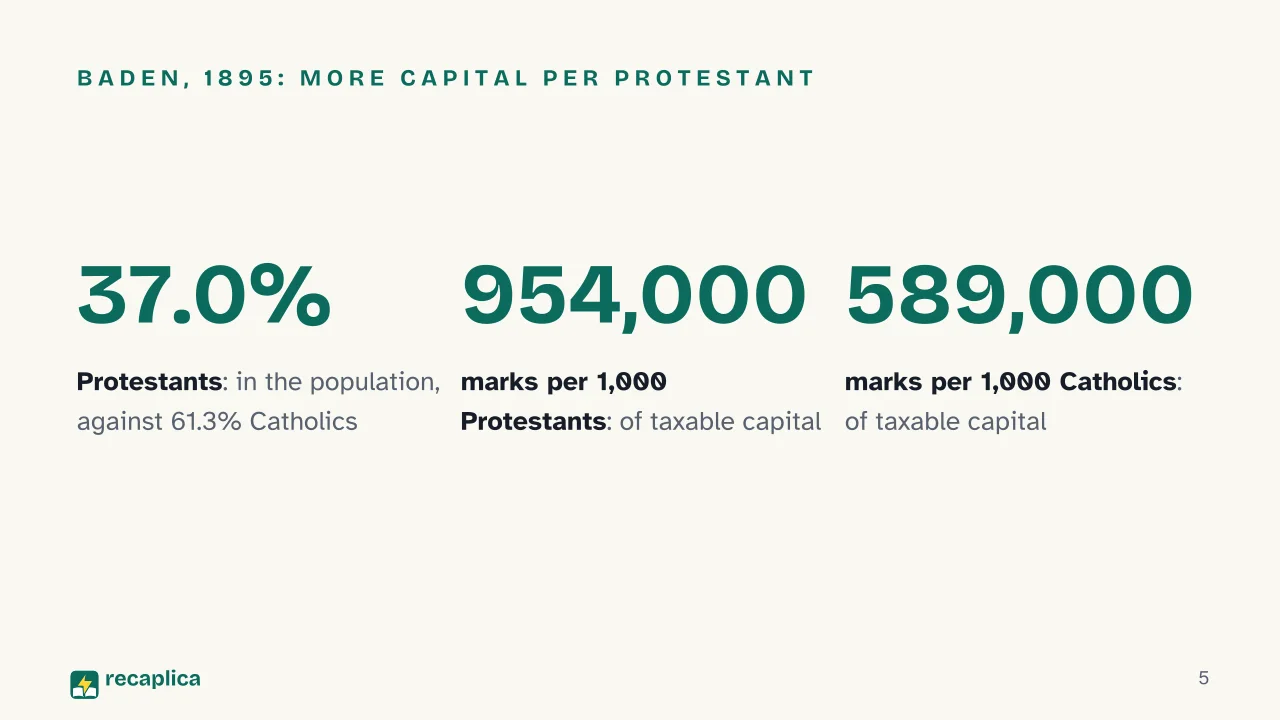 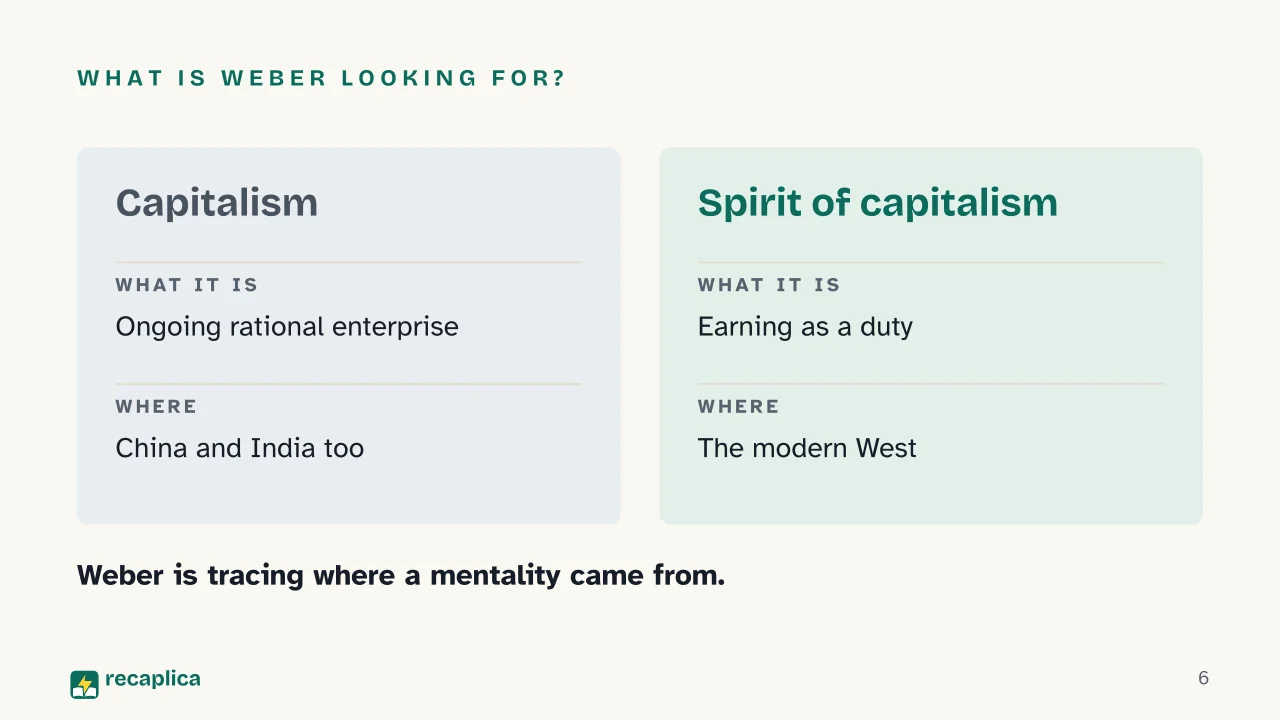  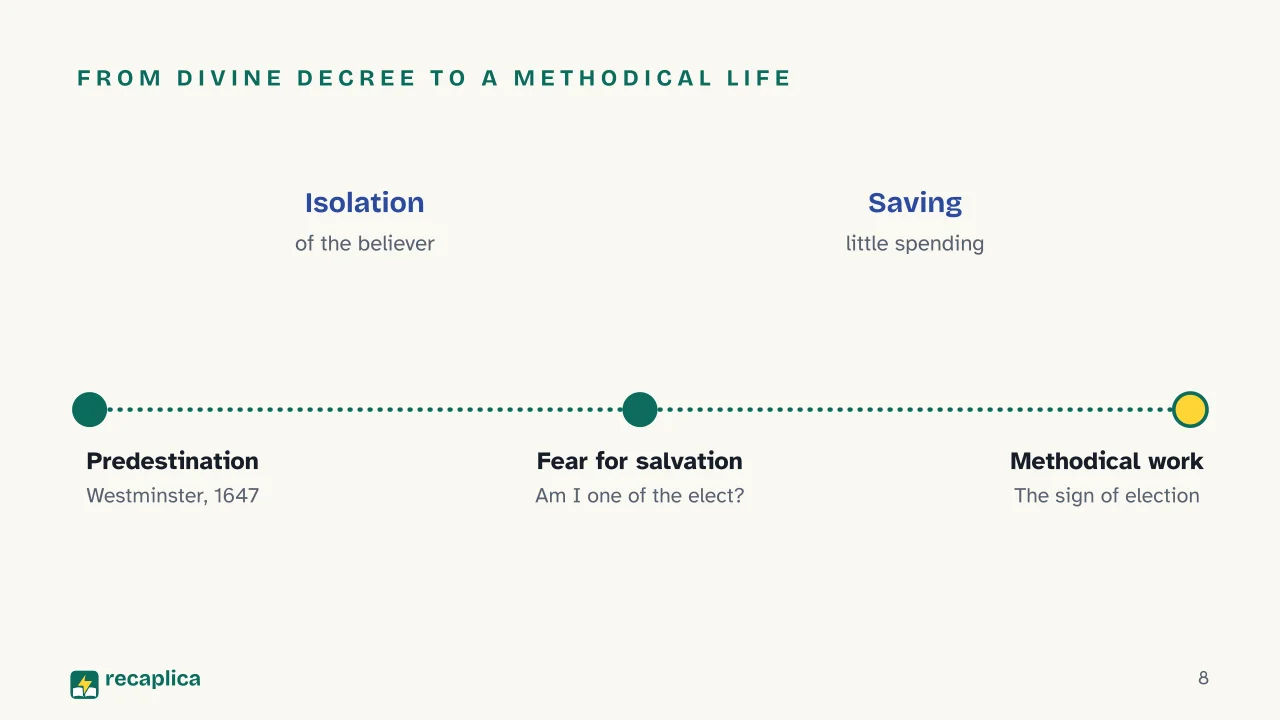 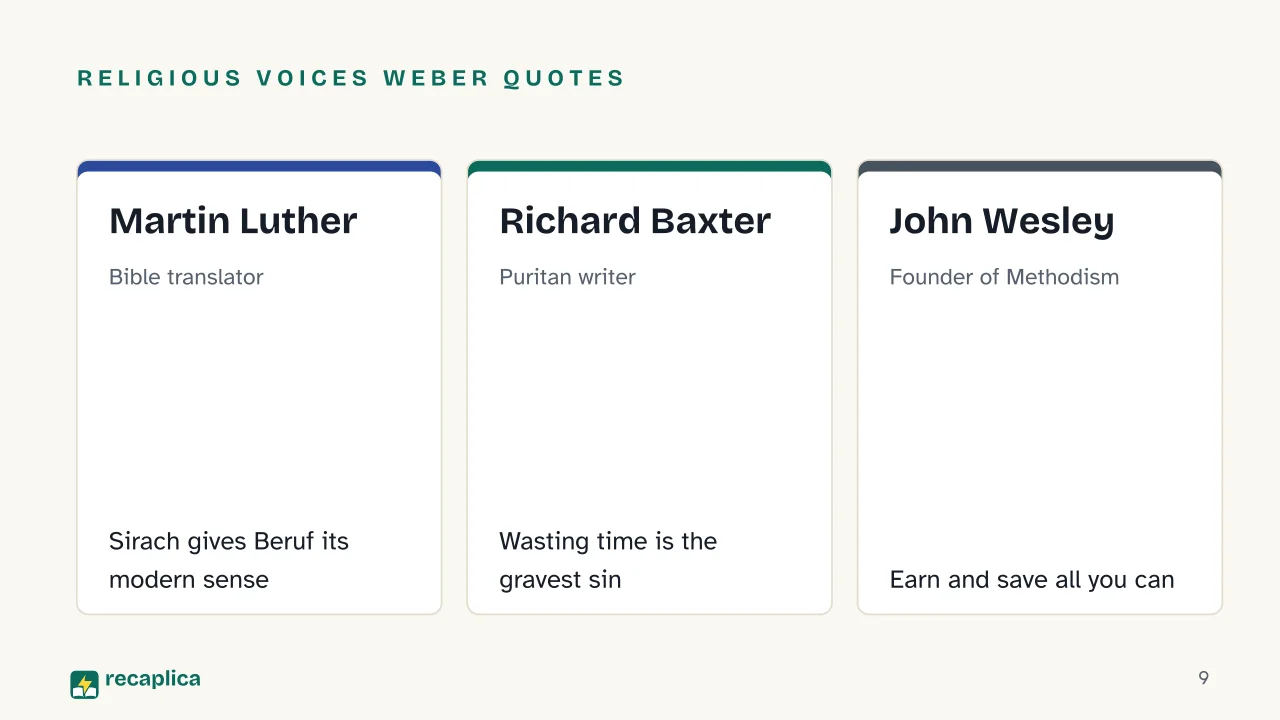   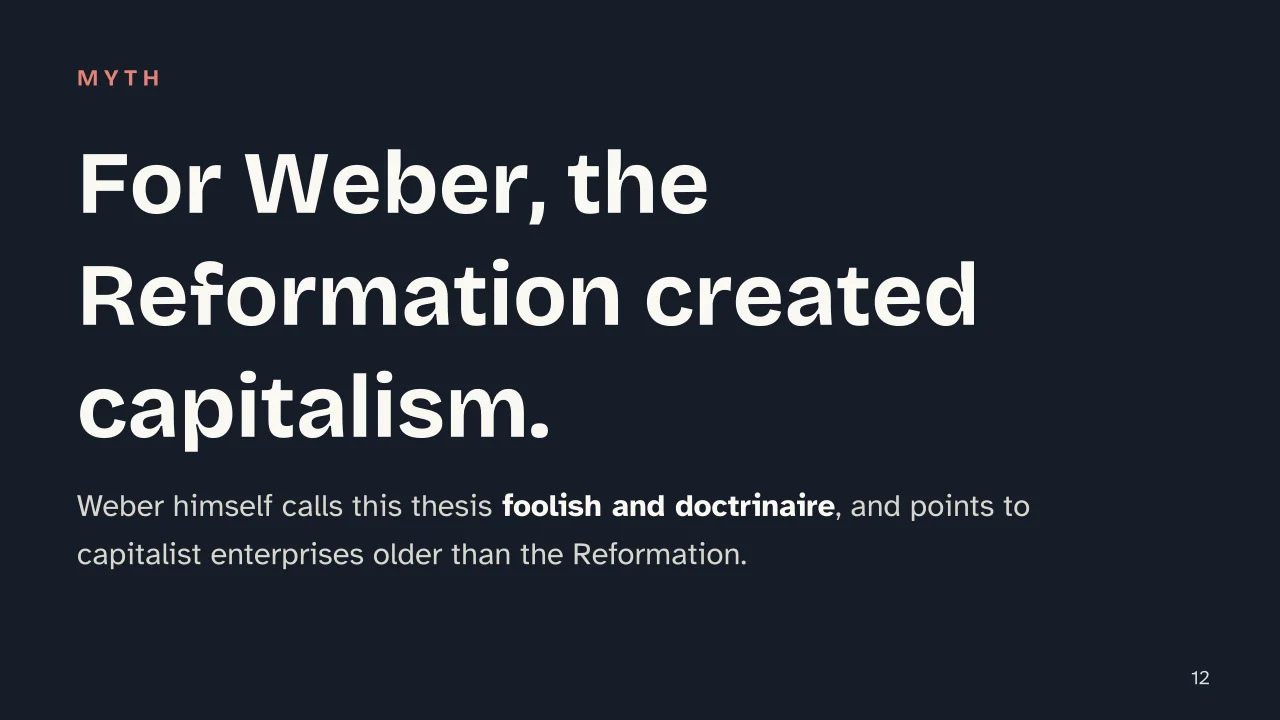  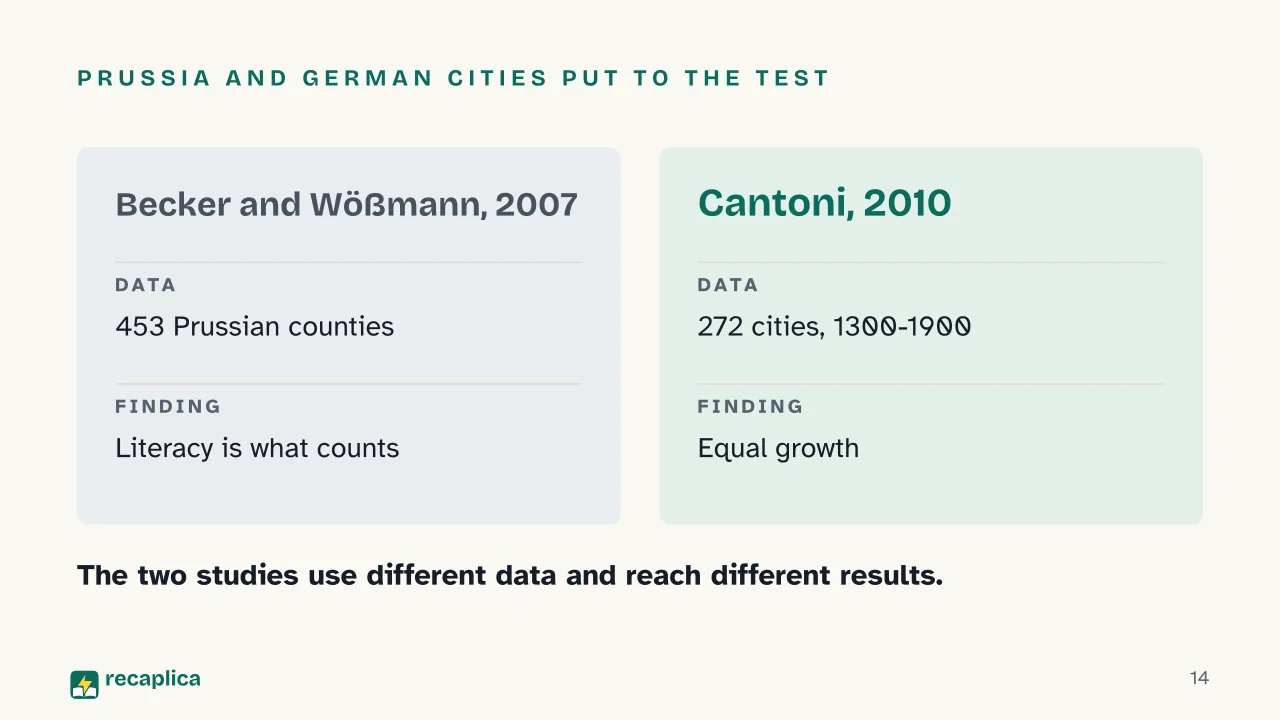 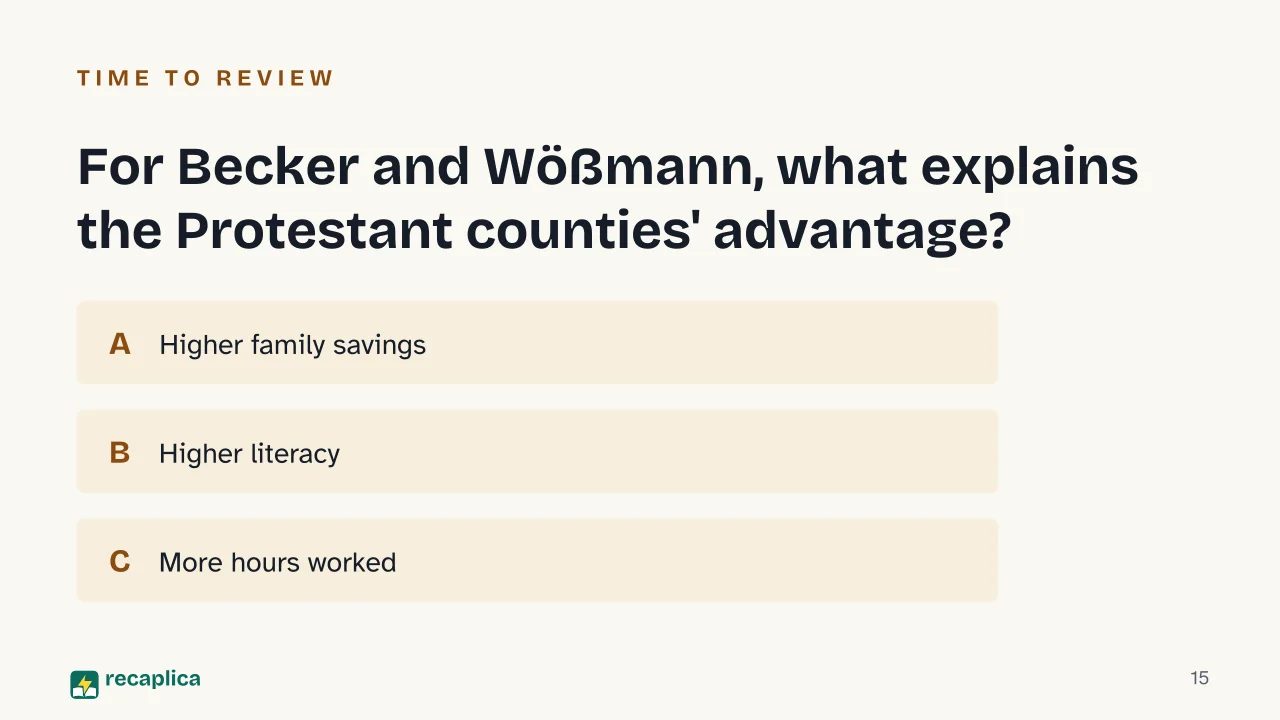  Common myths
Mind mapDrag the background to move around and the nodes to reposition them; use − and + to collapse and expand branches. 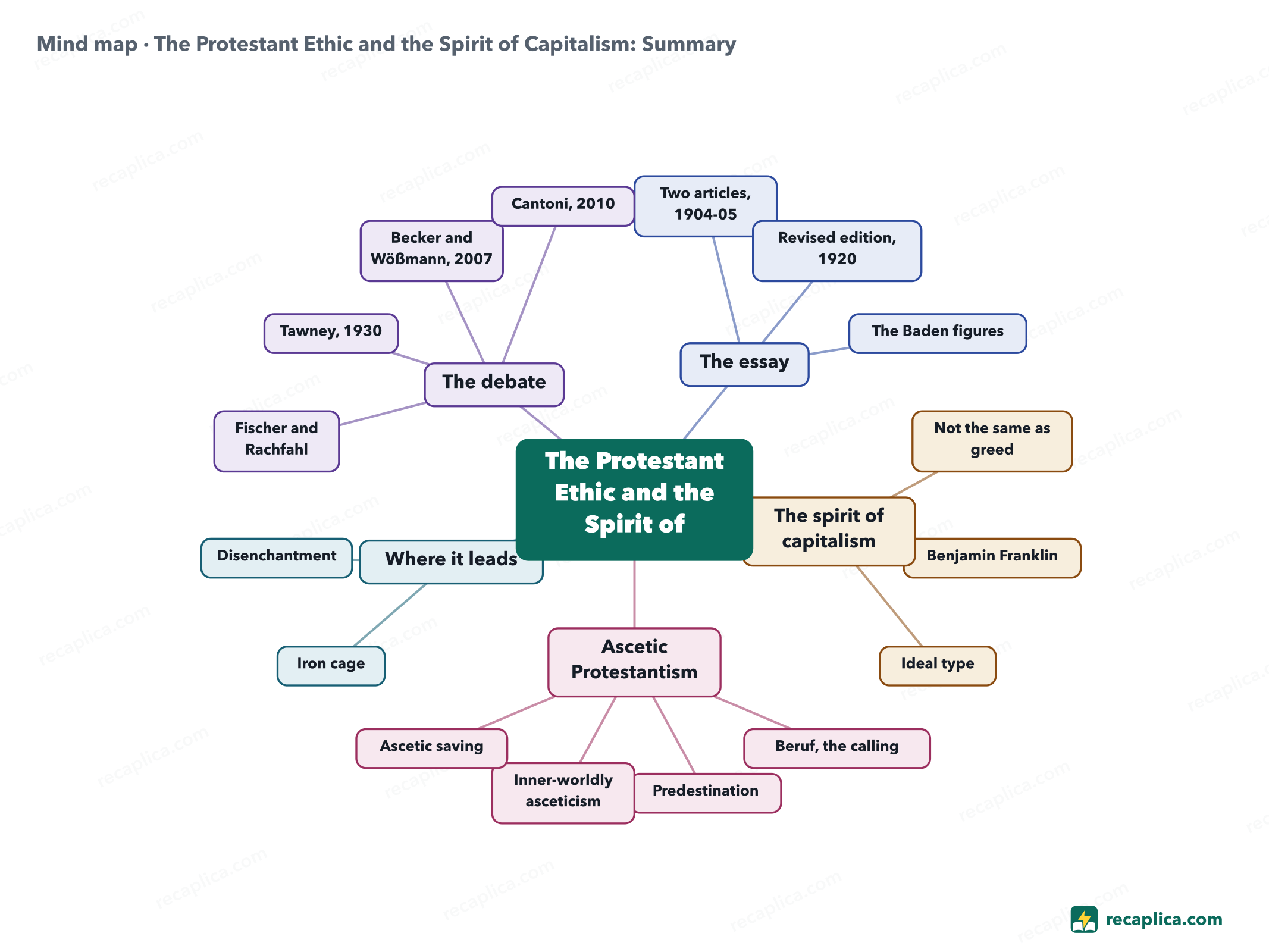
Quiz: test yourselfAnswer the questions to check what you have learned: you get instant feedback and a short explanation. Grade 0/10 0/5
FlashcardsTap the card to flip it and check whether you remember the answer, then move to the next one. 1 / 7 Explain it in your own wordsThe ultimate test: if you can explain it in simple words, you've truly understood it. Write your explanation, then compare it with the Recap. Your explanation is saved only on this device.
Frequently asked questionsWhat does Weber argue in The Protestant Ethic, in short?That some currents of ascetic Protestantism, especially seventeenth-century Calvinism, helped shape the mentality of modern capitalism. The idea of work as a calling and uncertainty about salvation pushed people toward a methodical life of unceasing work and limited consumption, and capital built up through saving as a result. The scholar Klaus Lichtblau stresses that Weber saw it as one factor among many. What is the link between Calvinism and capitalism according to Weber?A Calvinist had no way of knowing whether God had chosen him for salvation. Weber argues that this anxiety found an outlet in disciplined conduct: wasting time became a grave fault, and money earned by working in one's calling could be read as God's blessing, as long as it was not sought for its own sake. What is Max Weber's iron cage?It is the image that closes the essay. Richard Baxter, a Puritan writer, hoped possessions would sit on the believer as lightly as a cloak; in Weber's account they ended up as a casing hard as steel (stahlhartes Gehäuse, which Talcott Parsons translated as iron cage in 1930). Capitalism now runs on mechanical foundations and has no further need for religion. Was Weber right about Protestantism and wealth?Becker and Wößmann (2007 working paper) confirm that the Protestant regions of Prussia were richer but credit the advantage to literacy, and they warn that they did not test Weber's theory in the strict sense. Cantoni (2010), looking at German cities from 1300 to 1900, finds no difference in growth between Protestants and Catholics. When was The Protestant Ethic and the Spirit of Capitalism written?The first article, The Problem, came out in 1904; the second, which deals with how ascetic Protestantism understood the calling, appeared in 1905. In 1920 Weber republished them with many changes and with notes replying to his critics. Parsons's English translation of 1930 follows this revised version. Every Recap goes through an independent review before publication. |