|
recaplica
Francis Bacon's Inductive Method: The Philosopher Behind the Novum Organum | |||||||||||||||
| © 2026 Recaplica · recaplica.com — All rights reserved | |||||||||||||||
Francis Bacon's Inductive Method: The Philosopher Behind the Novum OrganumWhat to print Page numbers appear when printing with default margins. SlidesChoose a cut Flash10 slidesThe essential thread, to present in classFull14 slidesEvery chapter and the deeper detailBoth come with speaker notes. In 30 seconds quick readFrancis Bacon (1561-1626) was an English lawyer and statesman whom the Stanford Encyclopedia of Philosophy places in the first rank of early modern philosophy. In October 1620 he published the Instauratio magna, the volume that carried the two books of the Novum Organum, a title that points back to Aristotle's Organon, the logic Bacon meant to replace. Against the syllogism, which in his view starts from axioms already granted, he set out an induction that climbs one step at a time from the evidence of the senses toward the most general axioms, discarding every property that fails to turn up in each observed case. The same book describes the four idols of the mind (tribe, cave, marketplace, theatre) that bend our grasp of nature. The Stanford Encyclopedia of Philosophy credits his inductive theory with a significant contribution to the rise of empiricism and experimental philosophy in the late seventeenth century. Key Points
Key figures
Deep DiveWho Francis Bacon wasThe Stanford Encyclopedia of Philosophy dates Francis Bacon’s birth to 22 January 1561, at York House in the Strand in London, and ranks him among the leading philosophers of the early modern age. The Internet Encyclopedia of Philosophy notes that his family was prominent and well connected, and that he would later hold the titles of Lord Verulam and Viscount St. Albans. In 1573, aged just twelve, he entered Trinity College, Cambridge, where the traditional curriculum stirred the lifelong opposition to Aristotelianism that stayed with him, that is, to the philosophy of Aristotle and to the tradition built on it. His working life was that of a lawyer and a man of government. Bacon was admitted to Gray’s Inn in 1576 and called to the bar in June 1582; elected to Parliament in January 1581, he kept a seat in every session until 1621, lists the Stanford Encyclopedia of Philosophy. June 1607 brought him the post of solicitor-general, October 1613 that of attorney-general, March 1617 that of lord keeper, and January 1618 that of lord chancellor: by that point, the entry notes, no lawyer in England stood higher and his political career had reached its summit. The Internet Encyclopedia of Philosophy ties the climb to the arrival of James I, who succeeded Elizabeth I in 1603, and knighted Bacon; between 1604 and 1618 Bacon filled a run of high-profile institutional appointments. In May 1606, the Stanford Encyclopedia of Philosophy records, Bacon had married Alice Barnham: he was forty-five, she was barely fourteen. In the spring of 1621 Parliament tried him on a charge of taking bribes, and rather than mount a defence Bacon confessed. The Internet Encyclopedia of Philosophy reports that he was handed a heavy fine and a term of imprisonment in the Tower of London. The former lord chancellor died at Highgate on 9 April 1626. The tradition gathered by the Internet Encyclopedia of Philosophy puts his death down to a cold or a pneumonia caught while he was testing the preserving and insulating properties of snow. The Novum Organum of 1620October 1620 saw the publication of the book that secured Bacon a place in the history of philosophy, the Instauratio magna: it contained the general preface to the work, its “Plan”, and the two books of the Novum Organum, lists the Stanford Encyclopedia of Philosophy. The Novum Organum, or true directions concerning the interpretation of nature, is the second part of Bacon’s project to rebuild human knowledge from the ground up. The title deliberately echoes Aristotle’s Organon, the logic Bacon intended to replace; the Recap on Aristotle and Plato covers the Greek school that logic came out of. The Greek word organon means instrument, recalls the Internet Encyclopedia of Philosophy, which describes the book as a series of aphorisms rather than a systematic treatise. From the syllogism to inductionThe basic flaw Bacon finds in the Aristotelian syllogism, for the Stanford Encyclopedia of Philosophy, is that it departs from axioms already granted, racing from the senses and particular evidence to general axioms. The Internet Encyclopedia of Philosophy describes the same fault as a route that leaps straight from particulars to the most general propositions, then works back down by deduction to the middle ones. Should those general axioms prove false, the intermediate axioms drawn from them may be false as well: one contrary case is enough, in the image the Internet Encyclopedia of Philosophy uses, to bring the whole structure down. The alternative method of the Novum Organum moves in a steady, graded fashion from one axiom to the next, and it arrives at the most general axioms only last. Aphorism XIX calls this the true path, the one that draws axioms from the senses and from particular evidence by a gradual, unbroken climb, and Bacon states that nobody had attempted it in his day. Aphorism XIII had already made the point that the syllogism does not reach the first principles of the sciences and is applied in vain to the middle axioms, since it cannot catch the subtlety of nature. Bacon’s induction, the Stanford Encyclopedia of Philosophy reports, is often called “eliminative induction”. In book II, aphorism 16 of the Novum Organum, the first job of a genuine induction is to reject or rule out the individual properties that are not found constantly in the phenomenon under study.
Experiments, for Bacon, are to be built around a definite question: the Stanford Encyclopedia of Philosophy sums up his position by saying that the senses judge only the experiment, while the experiment judges the thing itself. In the opening aphorism of the Novum Organum, man appears as the servant and interpreter of nature, and what he can do and grasp stops at what he has observed of the natural order, in fact as in thought. Bacon himself points to three differences between his logic and the traditional kind: the end in view, the order of demonstration, and the starting point of the inquiry. The Recap on the scientific method follows the stages of inquiry as they are taught in schools. The four idols of the mindThe “idols” Bacon describes in book I of the Novum Organum, across aphorisms 39-68, are the habitual errors, natural leanings, and flaws that lay siege to the mind and stop it from understanding nature fully and correctly, writes the Internet Encyclopedia of Philosophy. Aphorism XXXIX sorts them into four classes.
The idols of the tribe are grounded in human nature itself, and Bacon treats it as an error to believe the senses mirror the world faithfully: aphorism XLI states that perceptions, of the senses and of the mind alike, stand in proportion to the measure of the individual and not to that of the universe. The Internet Encyclopedia of Philosophy observes that, being inborn weaknesses shared by all of humanity, these idols can only be recognised and compensated for. The cave idols, by contrast, vary from one individual to another, because they come out of personal culture and schooling: in aphorism XLII each person has a cave or den of his own that refracts and discolours the light of nature. The Stanford Encyclopedia of Philosophy counts the idols of the marketplace the most damaging of the four, since they grow out of the words people use to describe reality. The Internet Encyclopedia of Philosophy names language as the chief culprit behind the obstacles that arise from social dealings between people, and in aphorism XLIII Bacon writes that words are imposed according to the understanding of the crowd and end up forcing and ruling the intellect. The idols of the theatre consist in the dogmas of the philosophical schools and in faulty rules of demonstration taken on without question; like the cave idols, they are picked up by cultural route. New Atlantis and Salomon’s HouseNew Atlantis tells of the utopian society of Bensalem, whose happiness flows from Salomon’s House, a scientific institution devoted to the study of the works and creatures of God. That is how the Stanford Encyclopedia of Philosophy summarises it, describing the community more than once as happy and its inhabitants as full of piety and humanity. Thirty-six separate offices appear inside Salomon’s House, among them the “Merchants of Light”, who travelled through foreign countries to find out the inventions newly made there. For the Internet Encyclopedia of Philosophy the plot is little more than a narrative wrapper around the detailed description of that institution. Salomon’s House is imagined as a centrally organised research facility, where teams of specially trained investigators gather data, run experiments, and apply what they learn to produce things useful to human life. Both the Sylva sylvarum, a large collection of natural histories in English, and New Atlantis appeared posthumously in 1626, the year of Bacon’s death. The legacy, from the Royal Society to the EnlightenmentSoon after his philosophical works came out in Latin in the early 1620s, Bacon’s writings were read and discussed widely on the European continent, writes the Stanford Encyclopedia of Philosophy. The founding of the Royal Society in 1660 marked the high point of his fame, read as the triumph of his programme of collaboration, usefulness, and scientific progress. His admirers in the Royal Society, which traced its own inspiration to his writings, regarded him as the bold founder of a new intellectual era, reports the Internet Encyclopedia of Philosophy. Bacon’s inductive theory, along with his “natural histories” and his experimentalism, contributed significantly to the birth of experimental philosophy and of empiricism in the late seventeenth century, for the Stanford Encyclopedia of Philosophy. His standing held up through the Enlightenment as well: Voltaire, Rousseau, Condorcet, and d’Alembert all praised him. The central idea the Internet Encyclopedia of Philosophy credits to him is that knowledge is power and that, converted into new technical inventions and mechanical discoveries, it becomes the force that drives history. New Atlantis, too, proved a revolutionary text in terms of its historical impact, writes the Internet Encyclopedia of Philosophy: it inspired and supplied a model for the British Royal Society, and it stood as an early blueprint and foreshadowing of the modern research institute. Slide deckSlides ready to download and make your own in PowerPoint or Google Slides, with speaker notes. Pick the Flash cut or the Full one.     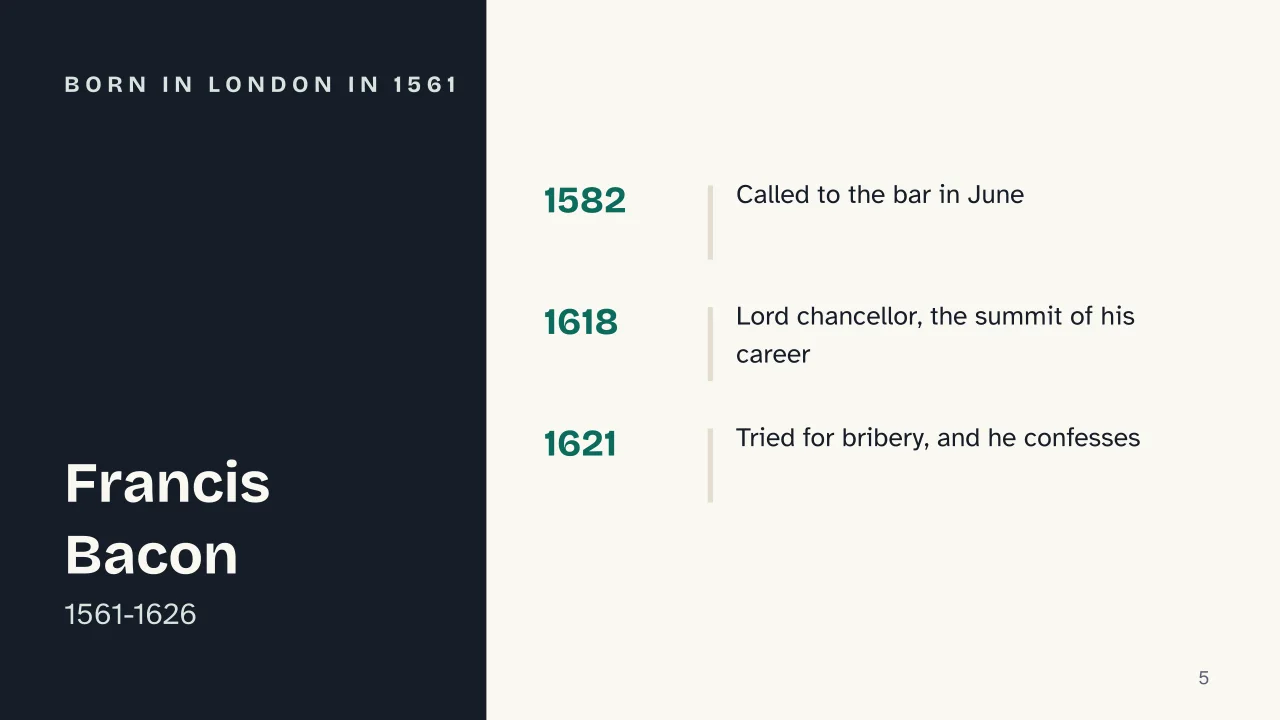  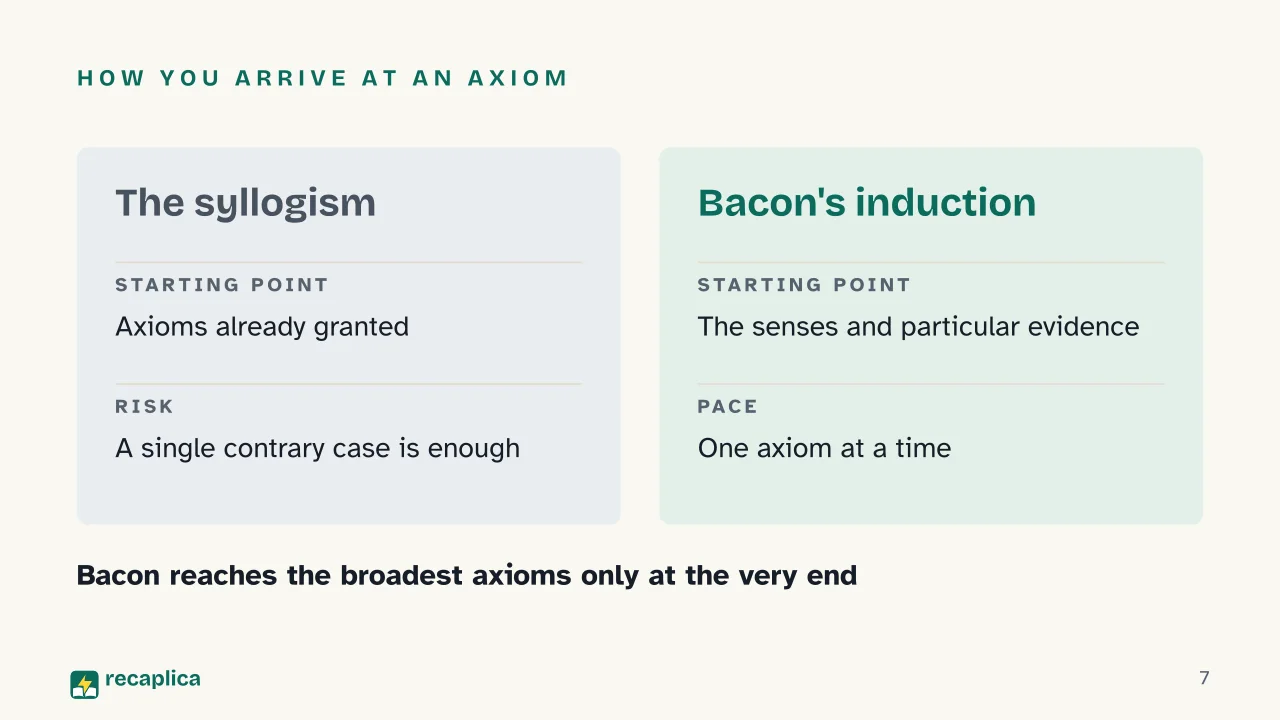 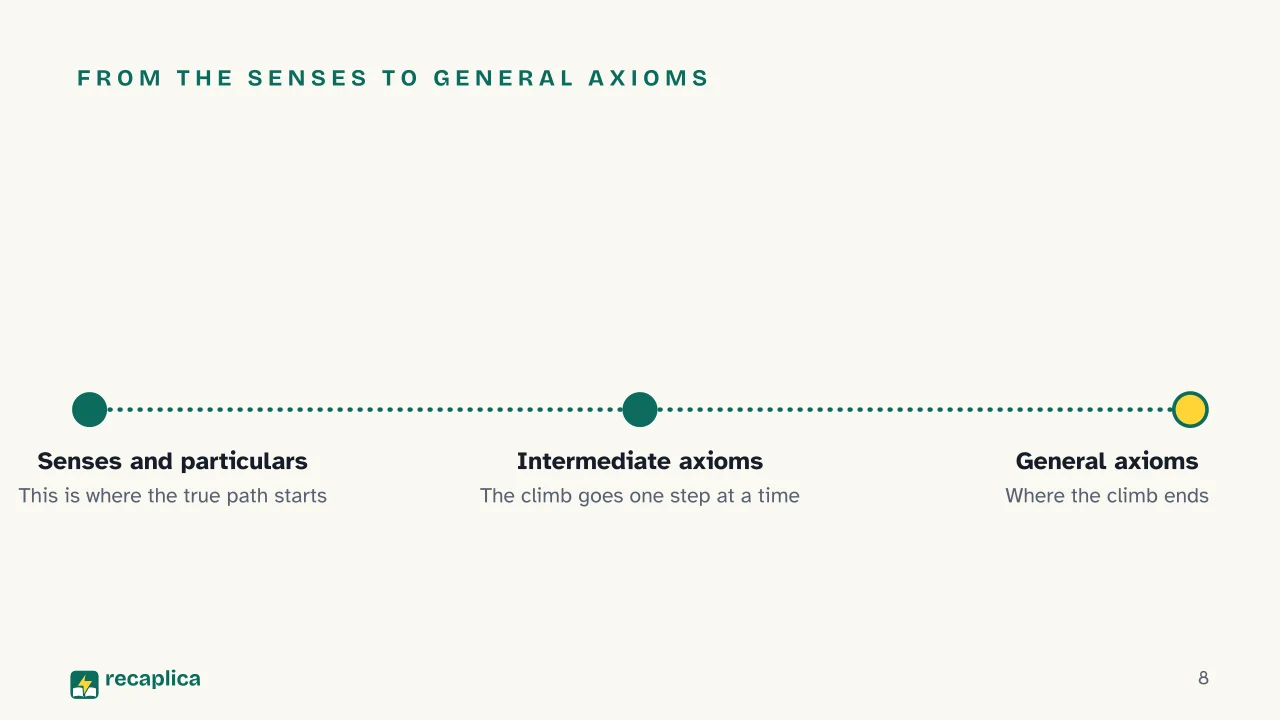    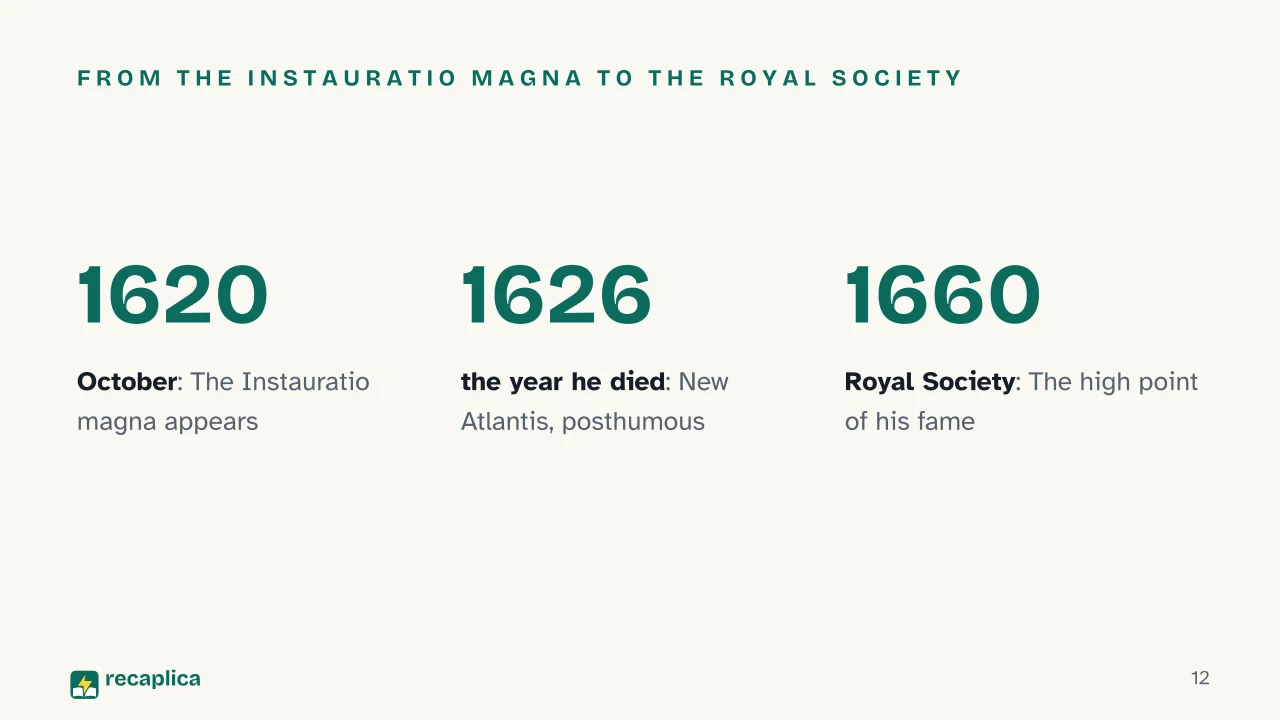 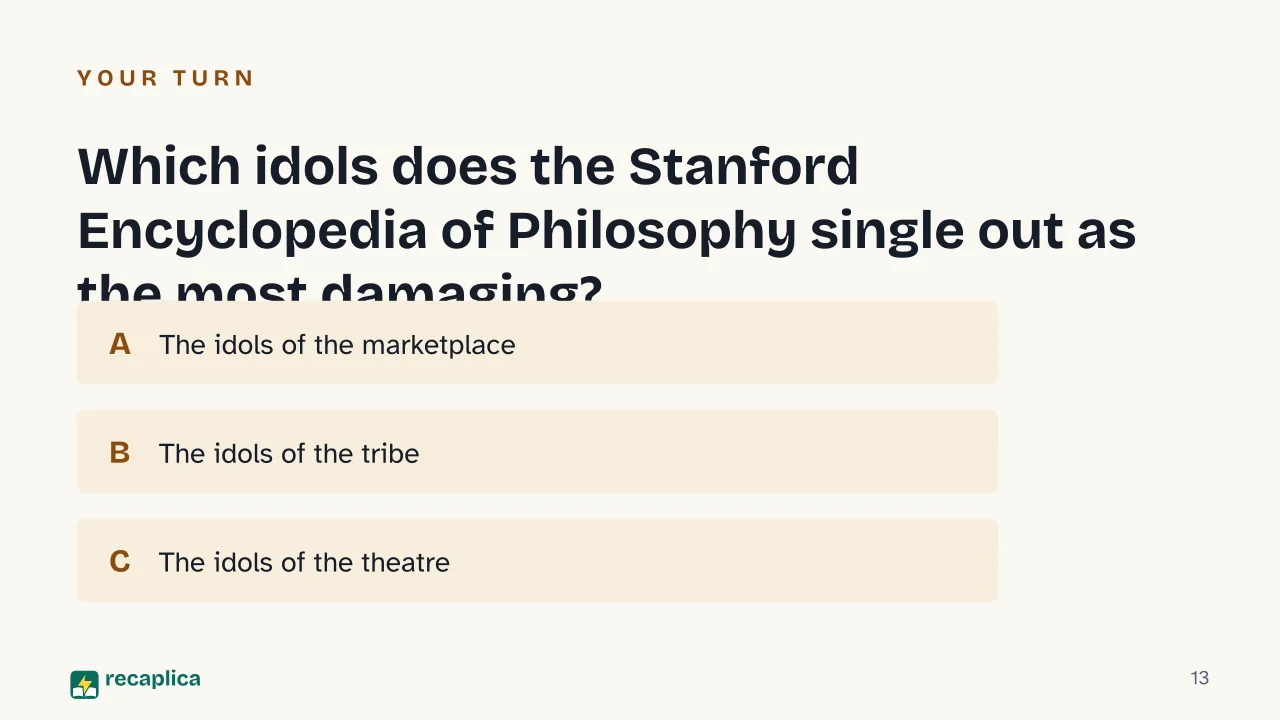  Common myths
Mind mapDrag the background to move around and the nodes to reposition them; use − and + to collapse and expand branches. 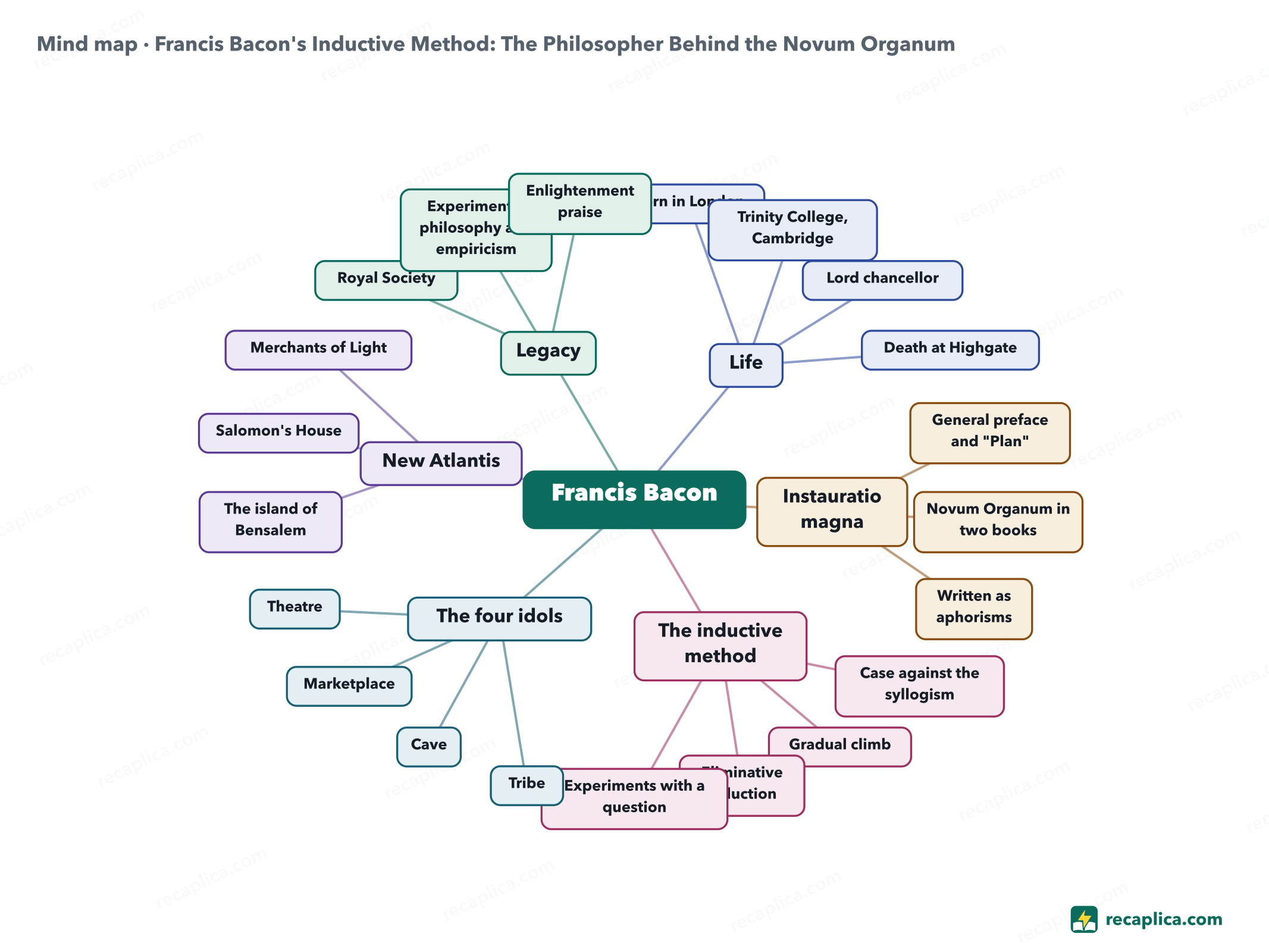
Quiz: test yourselfAnswer the questions to check what you have learned: you get instant feedback and a short explanation. Grade 0/10 0/5
FlashcardsTap the card to flip it and check whether you remember the answer, then move to the next one. 1 / 8 Explain it in your own wordsThe ultimate test: if you can explain it in simple words, you've truly understood it. Write your explanation, then compare it with the Recap. Your explanation is saved only on this device.
Frequently asked questionsWho was Francis Bacon the philosopher, in simple terms?An English philosopher and statesman, born in London in 1561 and dead in 1626, who built a career as a lawyer and reached the office of lord chancellor in January 1618. For the Stanford Encyclopedia of Philosophy he is a major figure of early modern thought, chiefly for the inductive method of the Novum Organum and for his argument that what people know and what they can do are bound together. What is Francis Bacon's inductive method?A procedure that sets out from the senses and from particular evidence, then rises by degrees, one axiom at a time, to the broadest axioms, which come last. According to the Stanford Encyclopedia of Philosophy its first job is to rule out the properties that do not recur in every observed case, which is why the method is known as "eliminative induction". What is the difference between Bacon's induction and Aristotle's syllogism?The syllogism begins from axioms already granted and deduces the middle propositions from them; the Internet Encyclopedia of Philosophy points out that if those general axioms turn out false, the middle ones drawn from them may be false as well. The induction of the Novum Organum reaches general axioms only at the finish, after working through the intermediate degrees. What are the four idols of Francis Bacon?The idols of the Tribe, which arise in human nature itself; those of the Cave, belonging to each separate individual; those of the Marketplace, which come from words; and those of the Theatre, meaning the dogmas of the philosophical schools and faulty rules of demonstration. Bacon lists them in aphorism XXXIX and describes them across aphorisms 39-68 of book I. What is Bacon's New Atlantis about?A story published after his death in 1626: it describes Bensalem, an island whose utopian society owes its happiness to Salomon's House, an institution devoted to studying nature. For the Internet Encyclopedia of Philosophy it supplied a model for the British Royal Society and anticipates the modern research institute. Every Recap goes through an independent review before publication. |