recaplica
Clear in 30 seconds, yours in 10 minutes.
In 30 seconds quick read
According to French historian Philippe Ariès, the idea that childhood is a stage of life with its own needs and sensibilities is a historical construction that emerged in early modern Europe. Ariès put forward this thesis in 1960, in a book published in English in 1962 as "Centuries of Childhood". The thesis opened up a new field of study and sparked a long-running debate among historians: some, like Nicholas Orme, reject it using medieval English sources; others, like Linda Pollock, question how Ariès read the sources on ordinary families. The history of childhood remains contested ground among historians.
Key Points
French historian Philippe Ariès argued, in his 1960 book, that childhood as a distinct stage of life is a historical construction of early modern Europe.
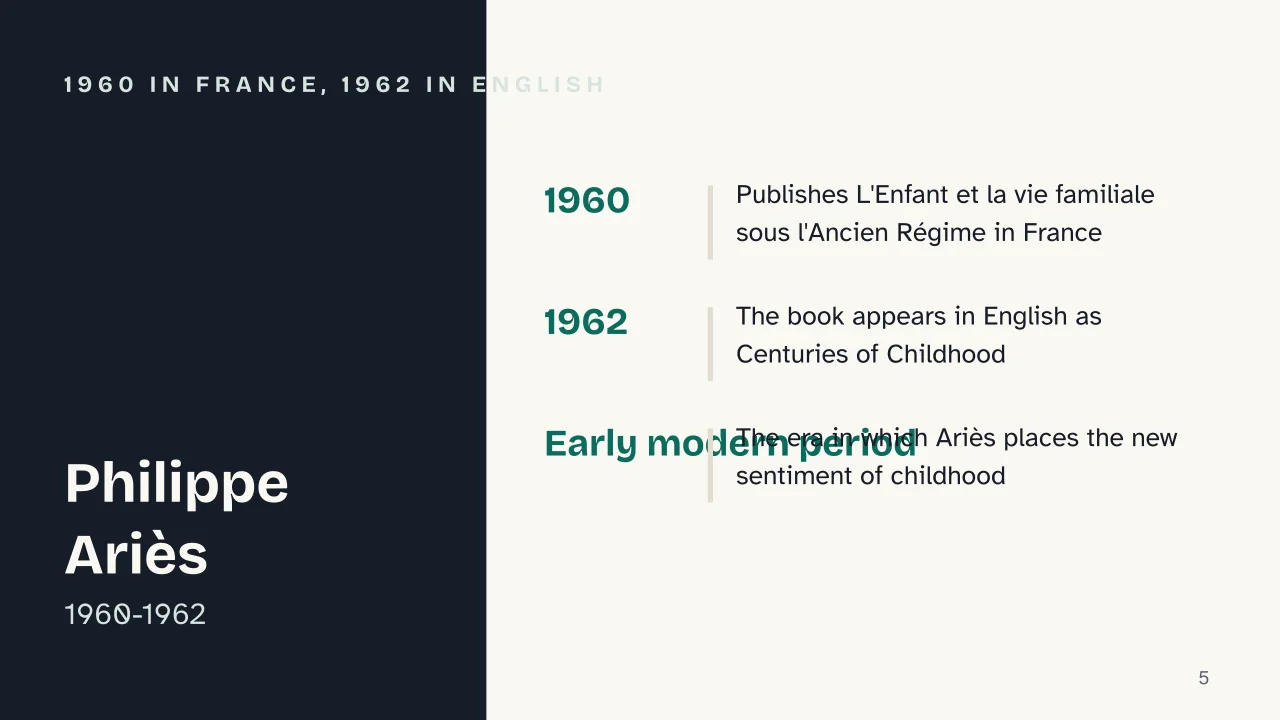
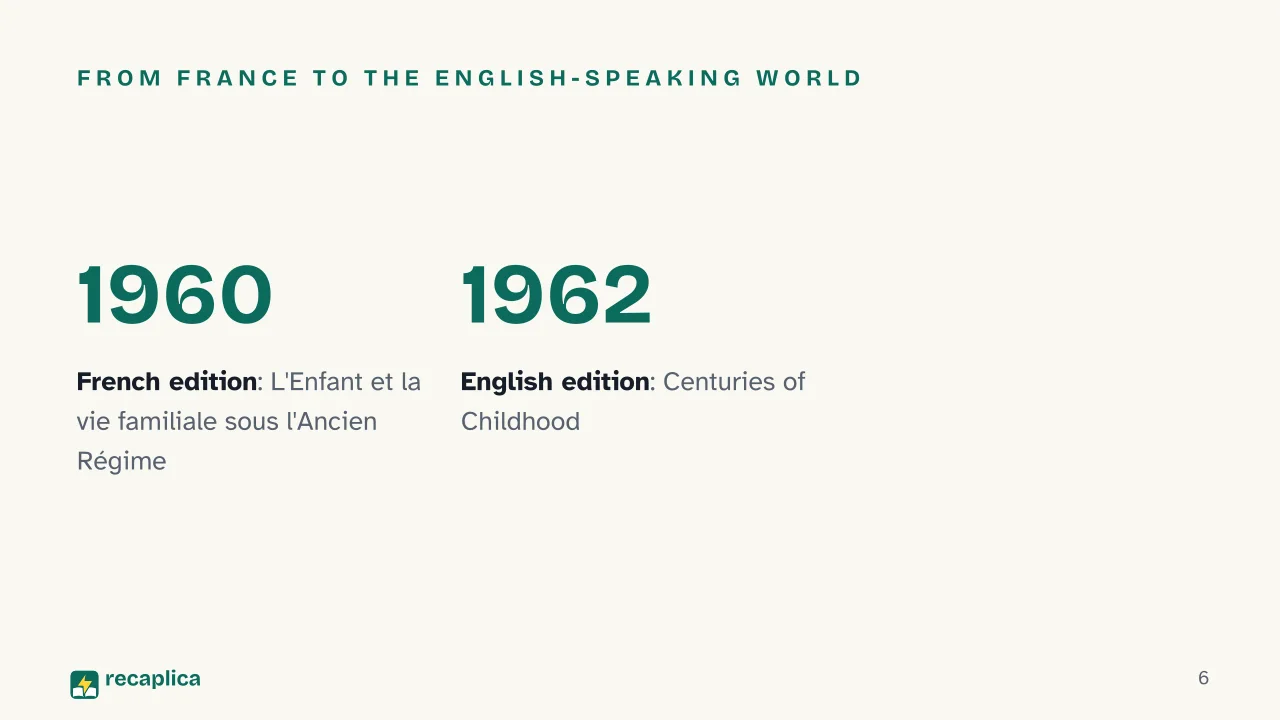
The book came out in France in 1960 as L'Enfant et la vie familiale sous l'Ancien Régime, and in English in 1962 as Centuries of Childhood.
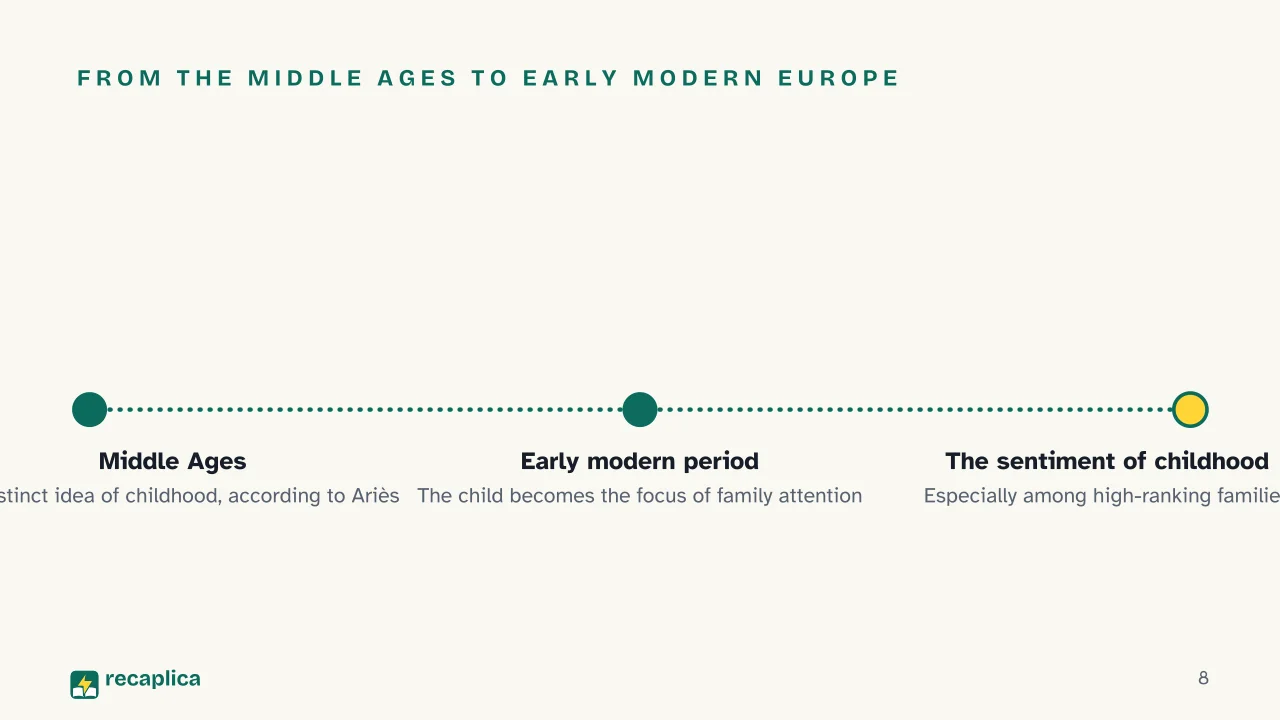
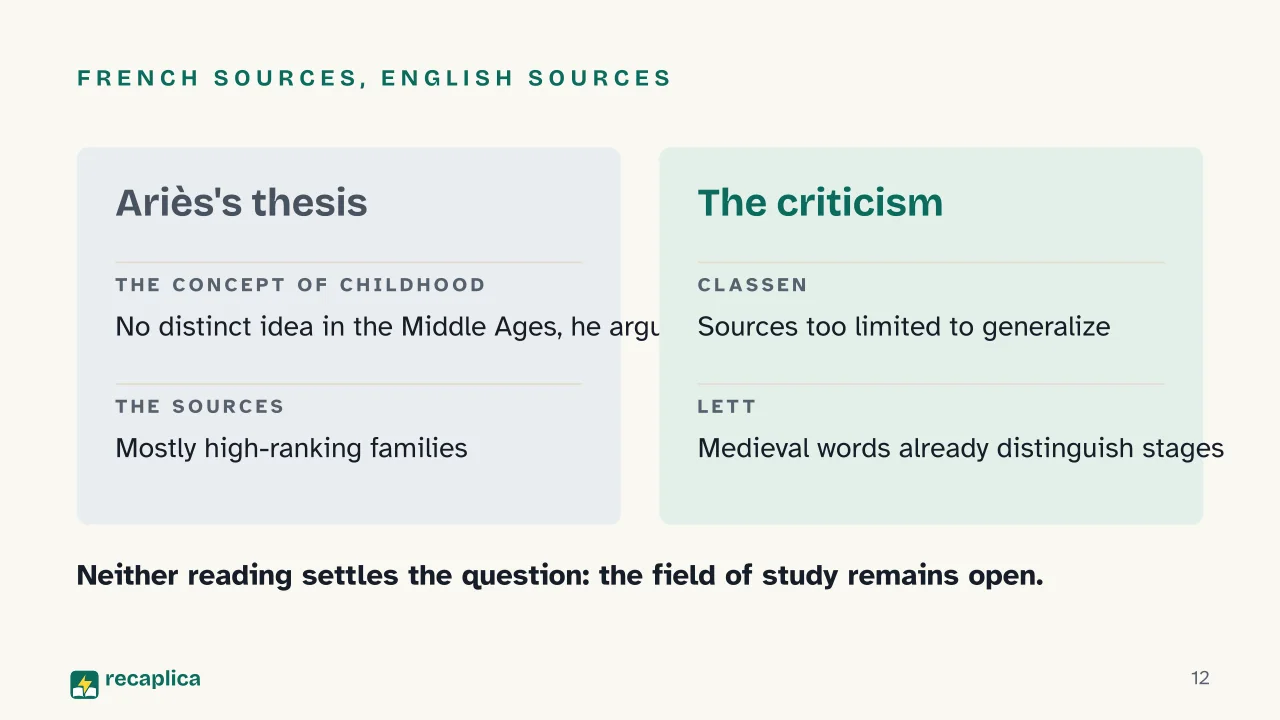
According to Ariès, the Middle Ages had no distinct concept of childhood.
English historian Nicholas Orme flatly rejects this claim, drawing on medieval English sources.
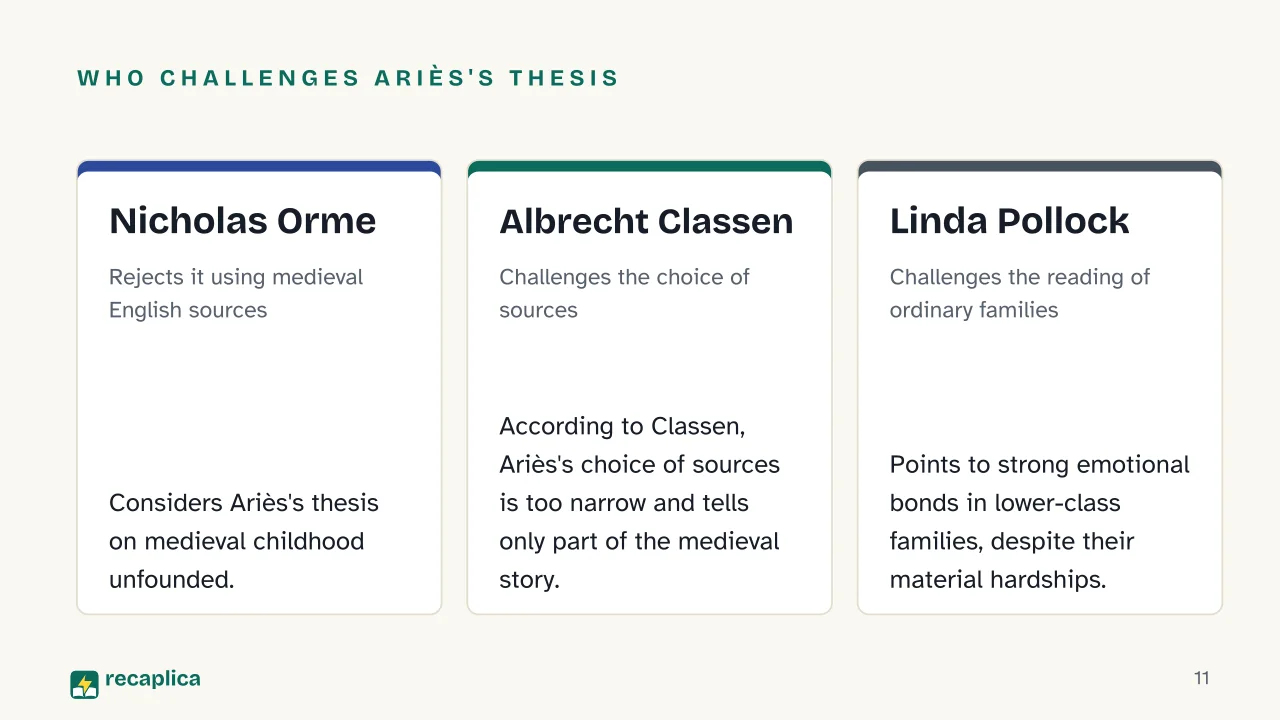
Historians such as Albrecht Classen and Linda Pollock challenge Ariès's choice of sources, which lean toward the upper classes, and his reading of ordinary families.
Ariès's thesis opened up a field of study on the history of childhood that historians still debate.
Deep Dive
In 1960, French historian Philippe Ariès published a book in France that changed how people looked at childhood: L’Enfant et la vie familiale sous l’Ancien Régime. The English translation followed in 1962, titled Centuries of Childhood, carrying the thesis beyond France. According to the source tracing his biography, Ariès argued that children, once pushed to the margins of family life, steadily moved to its center, as parents began openly tending to how they grew up.
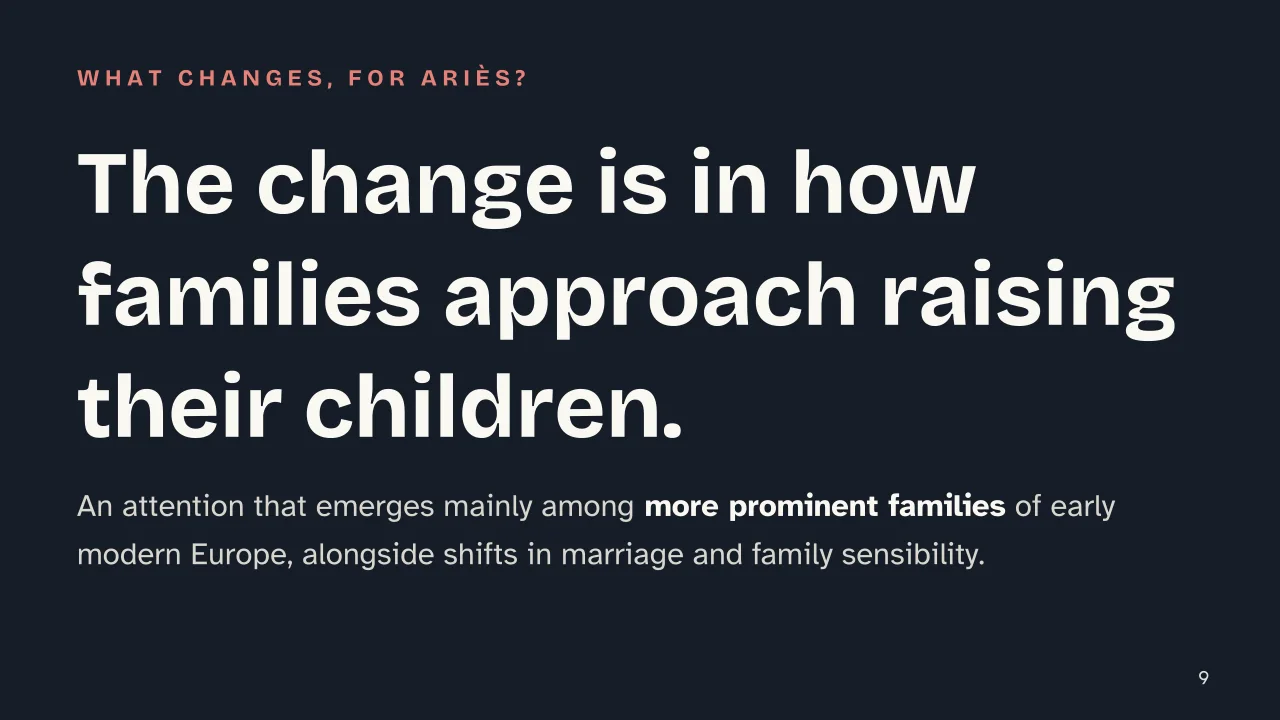
Ariès’s thesis, also covered by Slate, holds that medieval society had no distinct concept of childhood. The claim concerns how families viewed a child’s upbringing, treated as a period of life in its own right. This shift, according to Ariès, emerged mainly among more prominent families of early modern Europe, tied also to changes in marriage and family sensibility — the same period examined from another angle in the Recaps on the Renaissance and on social contract theory from Hobbes, Locke, and Rousseau.
Practical example: historian Didier Lett studied medieval miracle tales written in Latin and in French, and found distinct terms for different stages of childhood. For him, that linguistic clue weighs against the idea that the Middle Ages, covered in full in the Recap on the Middle Ages summary, lacked any concept of childhood at all.
Ariès’s thesis has not gone unchallenged. English historian Nicholas Orme flatly rejects it, drawing on medieval English sources different from the French ones Ariès used. Historian Albrecht Classen’s objection is that Ariès drew on too small a slice of the evidence, leaving a lopsided picture of the Middle Ages; according to the critics cited by the Retrospect Journal, Ariès generalized the history of childhood from sources concerned mostly with the upper classes.
Two other historians, Patricia Crawford and Linda Pollock, challenge Ariès for treating childhood as a fixed category and for projecting Western moral values onto other societies. Pollock, in particular, argues that Ariès overlooks how closely poorer families remained attached to their children, hardship or not.
The result is a field of study still open today, born from a book published in the 1960s. Those who build on Ariès’s thesis use it as a starting point for studying how family attention toward children changes over time; those who challenge it take different routes: Orme draws on medieval English sources Ariès never used, Classen and Crawford revisit the choice of sources and the projection of Western values, and Lett relies on the medieval linguistic clues already mentioned above. The underlying question — when and why a society starts treating childhood as a stage apart — is the same one examined, from different angles, in the Recaps on the Age of Enlightenment and on Roman education, two other moments when Europe rethought what it means to grow up and be educated.
Slide deck
Slides ready to download and make your own in PowerPoint or Google Slides, with speaker notes. Pick the Flash cut or the Full one.
✗ Myth Many people think Ariès proved that medieval parents did not love their children.
✓ Reality Ariès's thesis is actually about the attention families paid to a child's development as a stage distinct from adulthood, not about affection: for Ariès, parental affection is a constant across every era. Linda Pollock adds that poorer households, for all their material hardships, were just as close and loving toward their children.
✗ Myth Many people treat Ariès's thesis as an established historical fact.
✓ Reality It is an interpretation that opened up a field of study. Historians such as Orme, Classen and Pollock challenge it on several fronts, from the choice of sources to the reading of ordinary families.
✗ Myth Many people assume the criticism of Ariès only concerns minor details.
✓ Reality The criticism goes to the heart of the thesis: the choice of sources, concentrated on high-ranking families, the projection of Western values onto other societies, and medieval linguistic clues that, for historian Didier Lett, contradict the idea that the Middle Ages lacked any concept of childhood at all.
Mind map
Drag the background to move around and the nodes to reposition them; use − and + to collapse and expand branches.
No systematic studychildhood was not yet treated as a subject of historical study
A widespread idea of continuitychildren seen as small adults, with no stage of their own
Ariès's book
L'Enfant et la vie familialepublished in France in 1960
Centuries of ChildhoodEnglish edition, 1962
The sentiment of childhoodAriès's term for the new attention paid to children
What changes, according to Ariès
The child at the center of the family
Attention to a child's development
High-ranking familieswhere Ariès locates the new sentiment first
The criticism
Nicholas Ormerejects it, using medieval English sources
Albrecht Classenchallenges the choice of sources
Linda Pollockchallenges the reading of ordinary families
Didier Lettfinds linguistic clues in medieval miracle tales
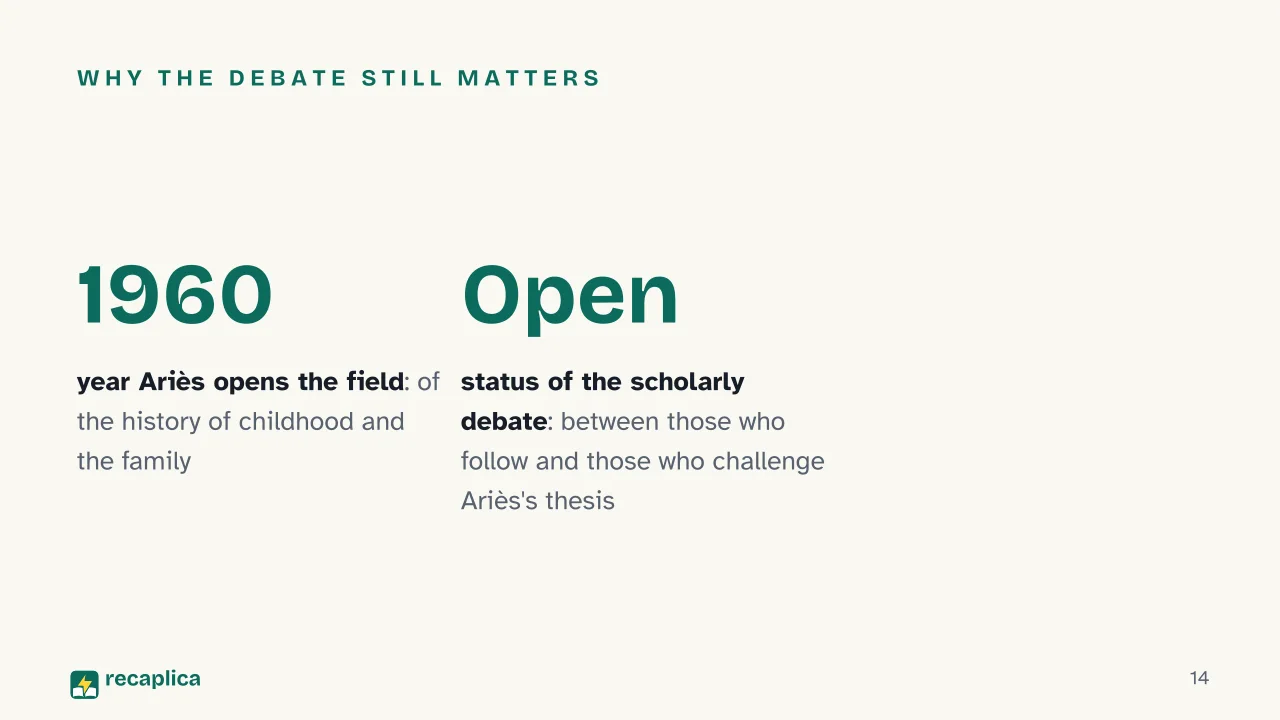
Why it still matters
It opened up a field of study
The debate remains open
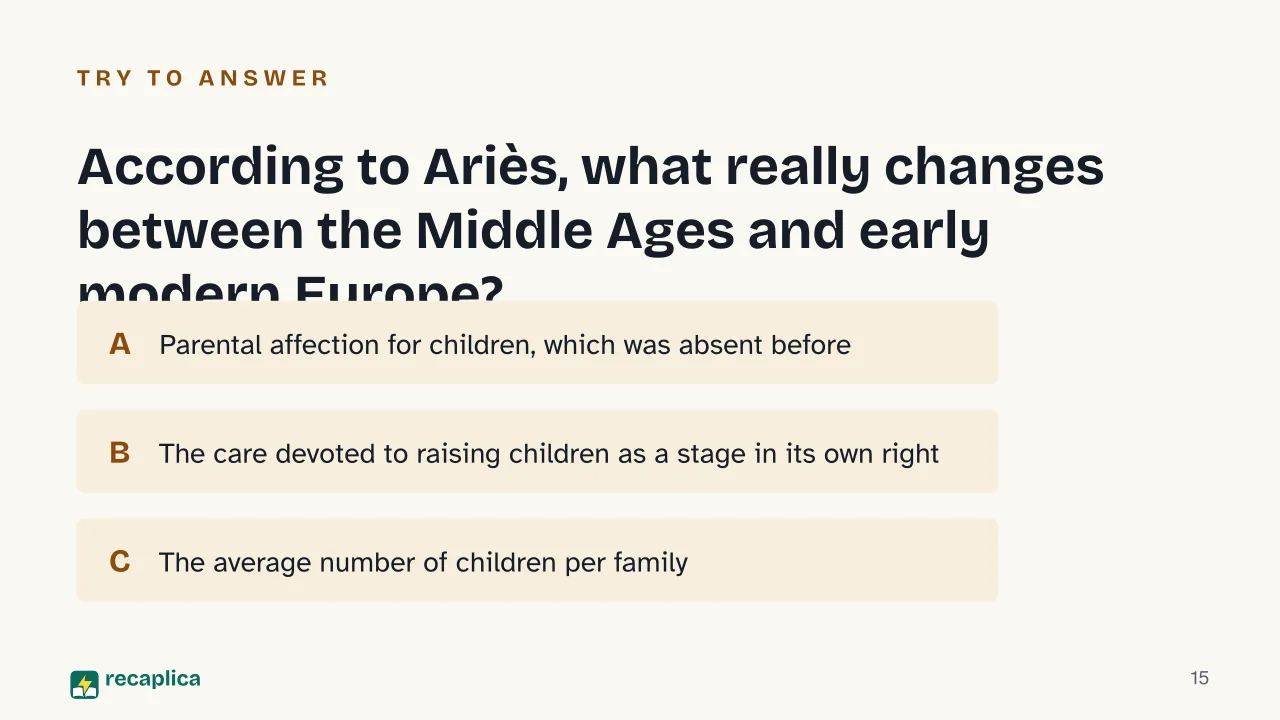
Quiz: test yourself
Answer the questions to check what you have learned: you get instant feedback and a short explanation.
Grade0/100/5
Answers: 1-A · 2-A · 3-B · 4-A · 5-B
Flashcards
Tap the card to flip it and check whether you remember the answer, then move to the next one.
1 / 8
Explain it in your own words
The ultimate test: if you can explain it in simple words, you've truly understood it. Write your explanation, then compare it with the Recap.
Your explanation is saved only on this device.
According to French historian Philippe Ariès, the idea that childhood is a stage of life with its own needs and sensibilities is a historical construction that emerged in early modern Europe. Ariès put forward this thesis in 1960, in a book published in English in 1962 as "Centuries of Childhood". The thesis opened up a new field of study and sparked a long-running debate among historians: some, like Nicholas Orme, reject it using medieval English sources; others, like Linda Pollock, question how Ariès read the sources on ordinary families. The history of childhood remains contested ground among historians.
Frequently asked questions
What is Philippe Ariès's thesis on the history of childhood?
It is the thesis, put forward in 1960, that childhood as a separate, distinctly cared-for phase of growing up is a construction of early modern Europe, which emerged especially among more prominent families.
When was Ariès's book on the history of childhood published?
In France in 1960; the English edition, Centuries of Childhood, followed in 1962.
Which historians have challenged Ariès's thesis on the Middle Ages?
Among others, Nicholas Orme, who rejects it using medieval English sources; Albrecht Classen, who challenges the choice of sources; Linda Pollock and Patricia Crawford, who challenge the reading of ordinary families and the projection of Western values; and Didier Lett, who presents medieval linguistic clues supporting an existing concept of childhood.
Does Ariès's thesis claim medieval parents did not love their children?
No, that is not what the thesis claims: it concerns the attention families paid to how children were raised, not the affection they felt for them, which Ariès treated as unchanged across the centuries. Pollock also found that, despite real hardships, poorer families remained closely bonded to their children.
Why does Ariès's thesis still matter?
Because it opened up the field of study on the history of childhood and the family, even though it remains disputed today: various historians challenge it on several fronts, from the sources used to the reading of social classes.
Every Recap goes through an independent review before publication.
Statistics, only if you say so
To learn which Recaps help most we would use Google Analytics, with aggregate, anonymous data. It starts only with your OK, and you can change your mind anytime. Privacy policy