Skip to content
recaplica

    One moment: security check

    Cloudflare wants to make sure you're not a robot. Tick the box below and your search will continue on its own.

    IT
    recaplica High Renaissance: Who Were Bramante, Leonardo, Michelangelo and Raphael
    © 2026 Recaplica · recaplica.com — All rights reserved
    Home › History

    High Renaissance: Who Were Bramante, Leonardo, Michelangelo and Raphael

    By Recaplica Newsroom · Updated on October 2, 2026

    What to print

    Page numbers appear when printing with default margins.

    Slides

    Choose a cut

    Flash10 slidesThe essential thread, to present in classFull16 slidesEvery chapter and the deeper detail

    Both come with speaker notes.

    Telegram channel
    recaplica Clear in 30 seconds, yours in 10 minutes.
    In 30 seconds Key points Figures Deep dive Slides Myths Mind map Quiz Flashcards FAQ

    In 30 seconds quick read

    Between the late 1400s and the first decades of the 1500s, Bramante, Leonardo, Michelangelo and Raphael worked in the period art historians call the High Renaissance, largely under the patronage of the popes in Rome. Bramante brought a direct study of ancient ruins into architecture. Leonardo built every painting from preparatory drawings, following a theory that pose and gesture should reveal the "motions of the mind" of the person portrayed. Michelangelo studied the anatomy of the body with an eye of his own, departing from the proportions codified by the generation before him, while Raphael pursued a synthesis of beauty, grace and naturalness. Florence trained all four, but it was Rome, through the commissions of Julius II, that became the workshop where their careers converged.

    Key Points

    • The High Renaissance is the period when Bramante, Leonardo, Michelangelo and Raphael worked, almost always commissioned by the popes in Rome.
    • Donato Bramante (1444-1514), trained in Urbino, brought to Rome a direct study of ancient ruins and designed the Greek-cross plan for the new St. Peter's Basilica, commissioned by Julius II.
    • Leonardo da Vinci (1452-1519) painted The Last Supper in a Milan refectory between 1494 and 1497, using dry plaster instead of true fresco so he could rework the painting over time.
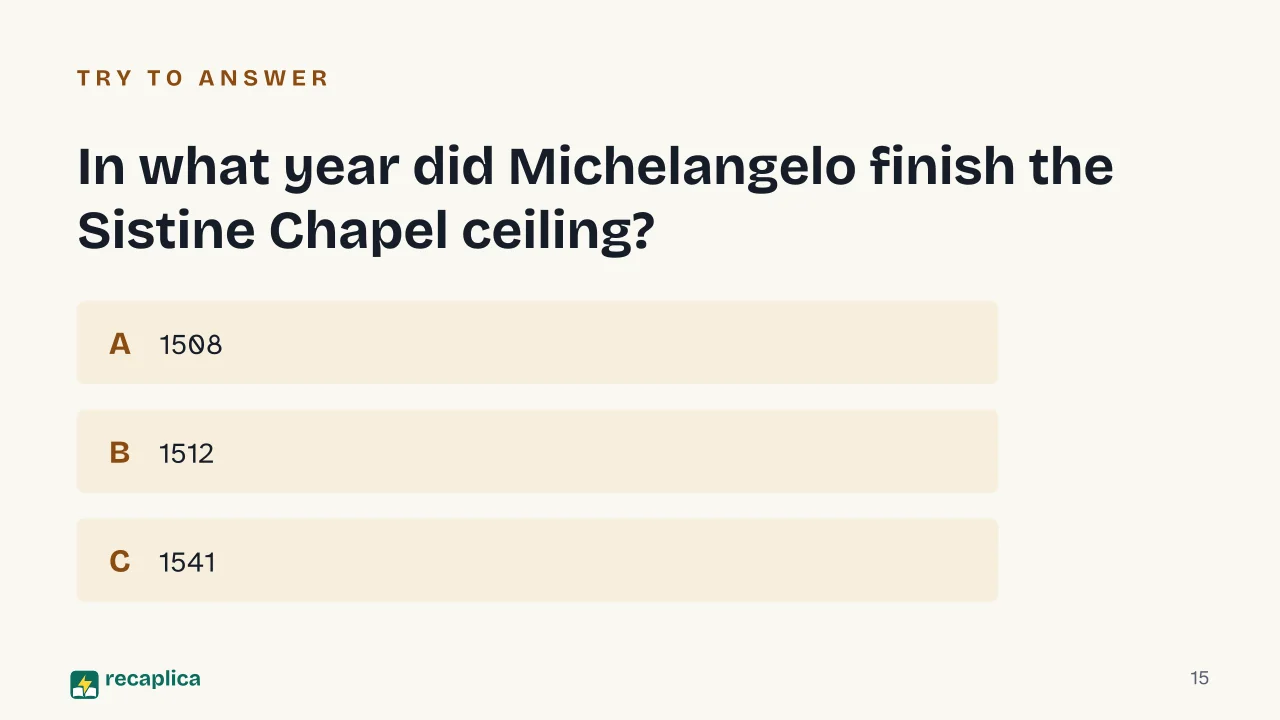
    • Michelangelo (1475-1564) moved from the Pietà (1498) and the David (1501-1504) to the Sistine Chapel ceiling, finished in 1512 for Julius II, and on to the Last Judgment, completed in 1541 under Paul III.
    • Raphael (1483-1520) arrived in Rome in 1508 at the summons of Julius II and, in the Stanza della Segnatura, paired the School of Athens, devoted to philosophical reason, with the Disputation of the Holy Sacrament, devoted to faith.
    • All four masters trained or crossed paths in Florence, but it was in Rome, in the workshops of Julius II, that their work converged within the same handful of years.

    Key figures

    • 1512 Year Michelangelo finished the Sistine Chapel ceiling, commissioned by Julius II Source: Vatican Museums
    • 1511 Year Raphael completed the Stanza della Segnatura in the Vatican, begun in 1508 Source: Vatican Museums
    • 1502 Year Bramante began the Tempietto at San Pietro in Montorio, in Rome Source: Treccani

    Deep Dive

    Bramante, an architect who studied the ancients

    According to sapere.it, Donato Bramante was born in 1444 near Fermignano and trained at the court of Urbino under Federico da Montefeltro, in a classicist environment shaped by Leon Battista Alberti. That is where he absorbed the legacy of Brunelleschi and Alberti themselves, the architects of the early Florentine Renaissance covered in The Florentine Renaissance — not in Rome, which came later. Before moving there he worked in Milan, where he collaborated with Leonardo da Vinci on the plan for the ducal square and castle at Vigevano.

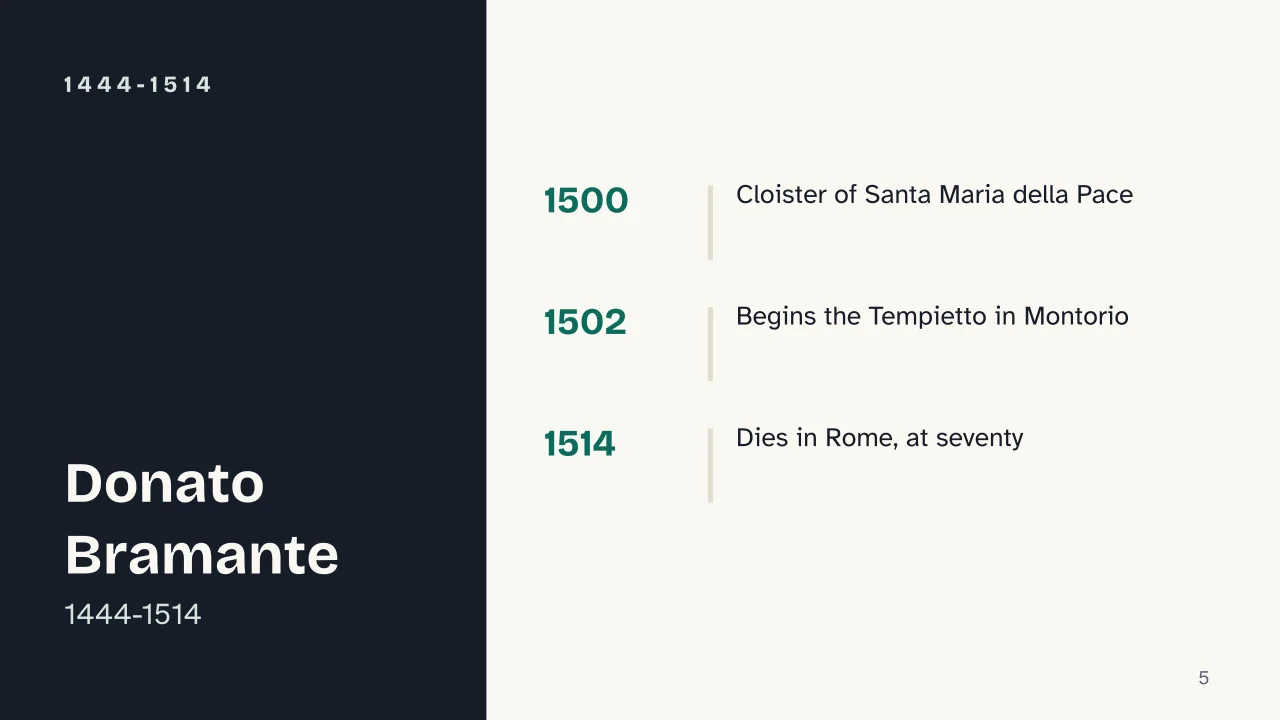
    In Rome, sapere.it notes, Bramante drew his strongest ideas from direct contact with the city’s ancient ruins. In 1500 he designed the cloister of Santa Maria della Pace; in 1502 he began the Tempietto at San Pietro in Montorio, according to Treccani. Once Julius II became pope, he chose Bramante for his own plans to remake Rome along classical lines, and the main commission he gave him was rebuilding St. Peter’s Basilica: for the new church, Bramante settled on a Greek-cross plan, with a central dome over the apostle’s tomb.

    Leonardo, thinking through the drawing

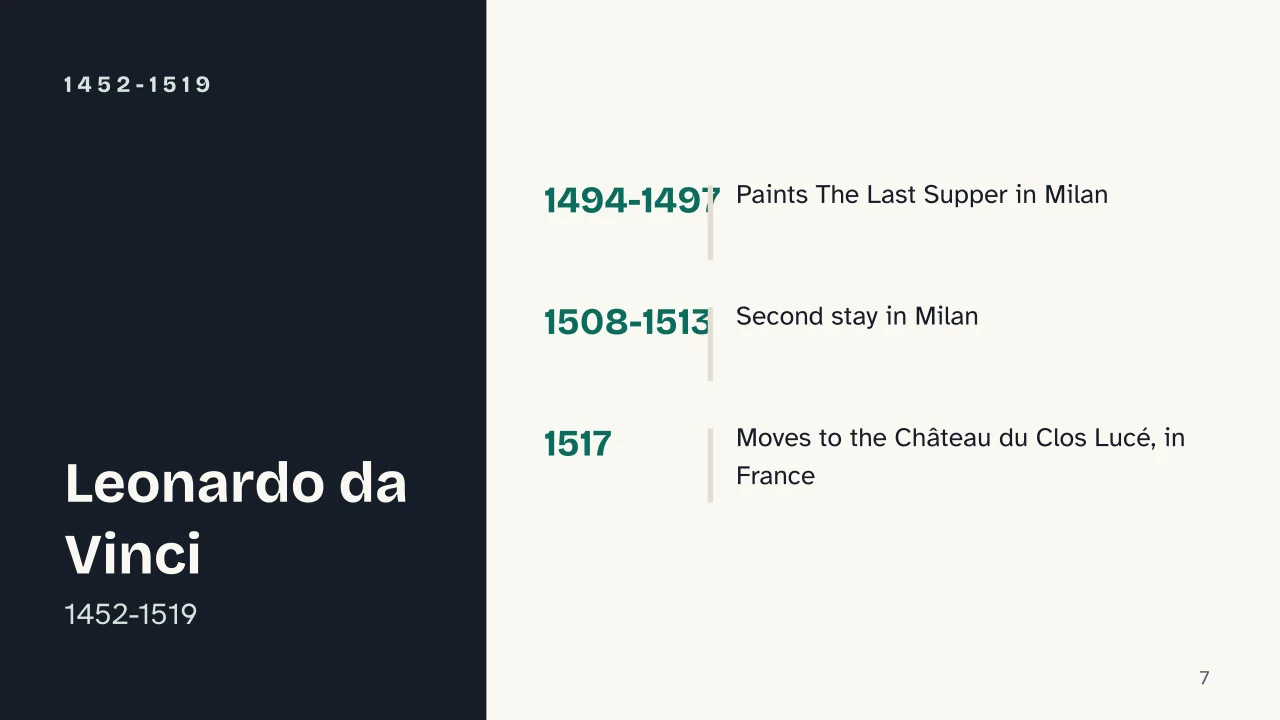
    Leonardo da Vinci was born in 1452 near Vinci and died in 1519, according to the National Gallery in London. In 1517 he moved to the Château du Clos Lucé, near Amboise, in France, where he spent his final years.

    The National Gallery explains that Leonardo worked out a painting’s composition through preparatory drawings before starting the finished piece, following a specific theory: pose, gesture and facial expression were meant to reveal the “motions of the mind” of the sitter. In his mature period that method found its clearest expression in Milan, where he painted The Last Supper for Ludovico Sforza, duke of the city, between 1494 and 1497, as the Ministry of Culture’s page on the Cenacolo Vinciano records. He used a technique that painted on dry plaster instead of true fresco, which let him rework the piece over time. Leonardo returned to Milan in the summer of 1508 and stayed, on this second visit, until 1513.

    Practical example: one way to spot a High Renaissance work is to watch how figures occupy the space around them. In the Stanza della Segnatura, the Vatican Museums note, the School of Athens fresco stages rational philosophical inquiry, and facing it on the opposite wall is the Disputation of the Holy Sacrament, devoted to religious faith: two walls answering each other, as two different routes toward truth.

    Michelangelo, a body that answers to no rulebook

    Michelangelo Buonarroti was born in 1475 in Caprese, near Arezzo, and died on 18 February 1564, according to Treccani. His style is marked by close study of human anatomy and movement, filtered through his own eye and only loosely tied to the proportions the previous generation had codified — the trait that most separates his work from that earlier generation.

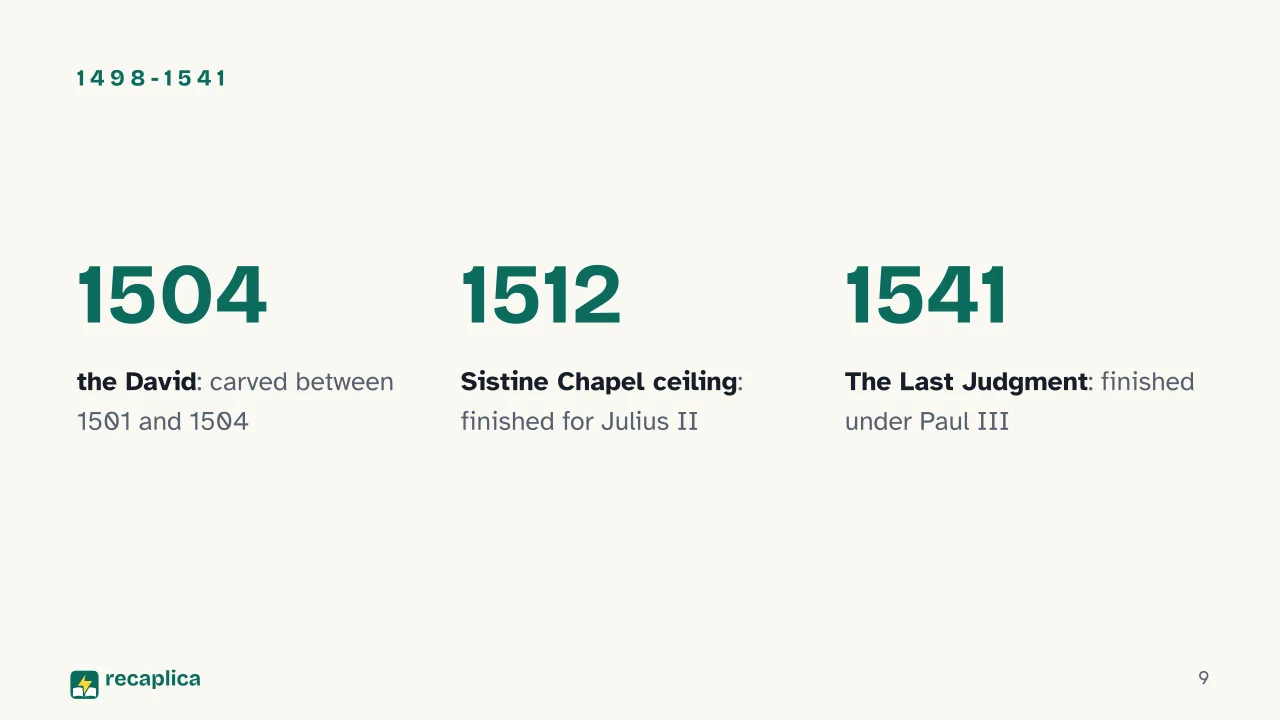
    The milestones of his mature career follow one commission after another. In 1498 the French cardinal Jean de Bilhères gave him the marble group of the Pietà. Between 1501 and 1504 he carved the David. In 1508 Pope Julius II handed him the Sistine Chapel ceiling, finished in October 1512. The Last Judgment came later: Pope Clement VII commissioned it near the end of 1533, but Michelangelo only began painting in 1536, under Pope Paul III, and finished it in the autumn of 1541.

    Raphael, grace in conversation with the other two

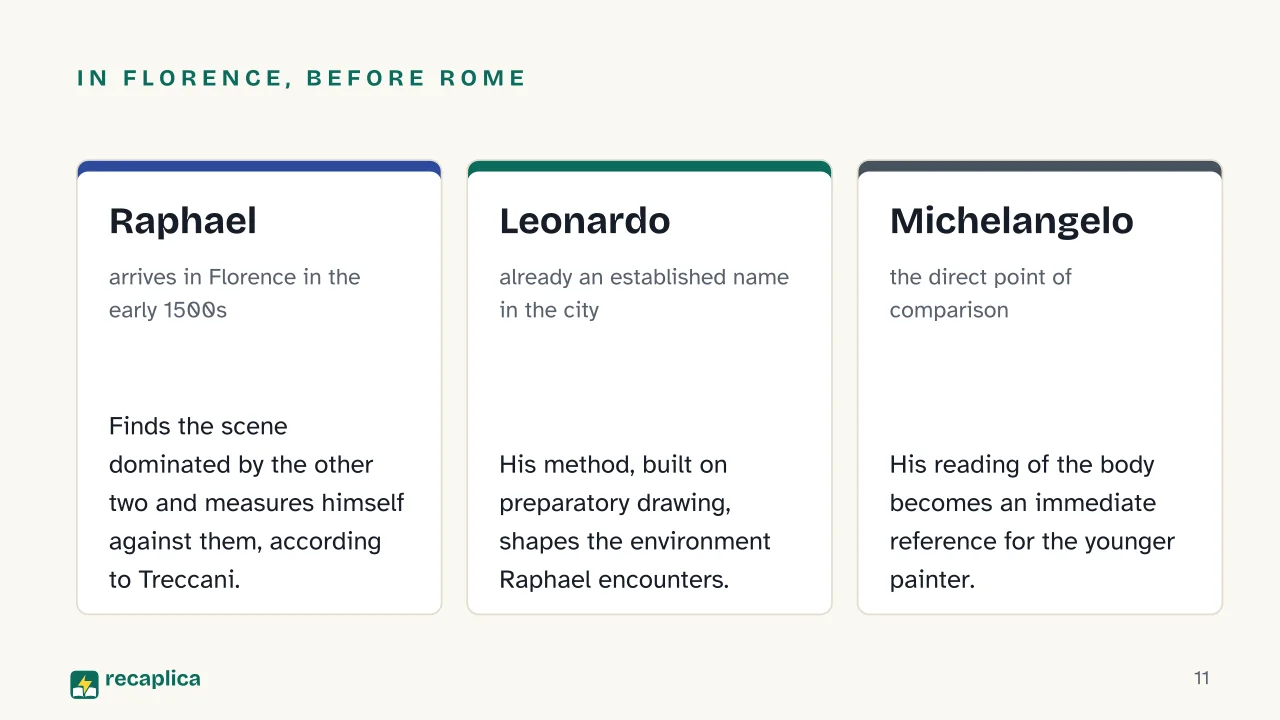
    Raphael Sanzio was born in Urbino in 1483 and died in 1520, at thirty-seven, according to Treccani. He painted the Marriage of the Virgin altarpiece in 1504, shortly before reaching Florence, where he found an art scene dominated by Leonardo and Michelangelo, against whom the young painter measured his own work.

    In 1508 Pope Julius II called him to Rome. The pontiff had first entrusted the decoration of the Stanze to a group of artists, but in 1509 he reserved the entire commission for Raphael alone, the Vatican Museums note. The Stanza della Segnatura, decorated between 1508 and 1511, is the first room to carry his signature alone. His style, according to Treccani, aimed at beauty and grace joined with simplicity and naturalness.

    Art of the High Renaissance: what changed since the 1400s

    Each master left one piece of High Renaissance artwork that historians treat as his signature commission from this period:

    MasterYearsMain work of the mature periodCity
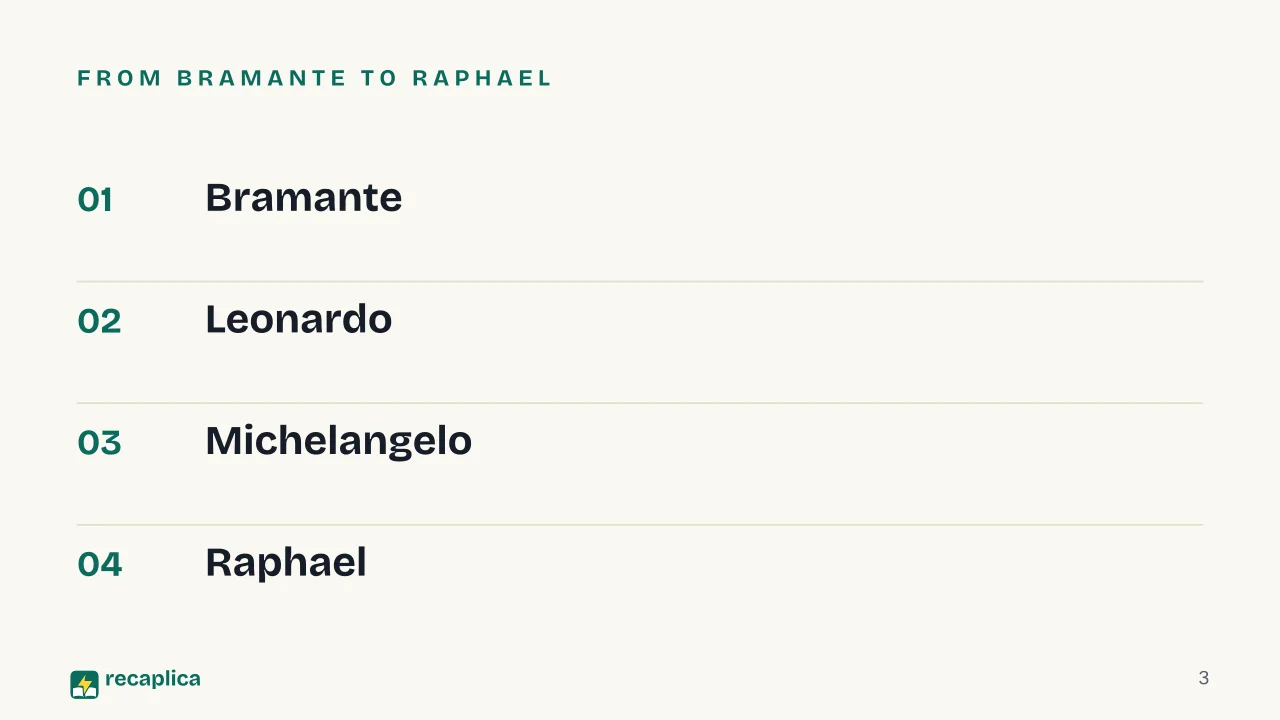
    Bramante1444-1514Design for the new St. Peter’s BasilicaRome
    Leonardo da Vinci1452-1519The Last Supper (1494-1497)Milan
    Michelangelo1475-1564Sistine Chapel ceiling (1508-1512)Rome
    Raphael1483-1520Stanza della Segnatura (1508-1511)Rome

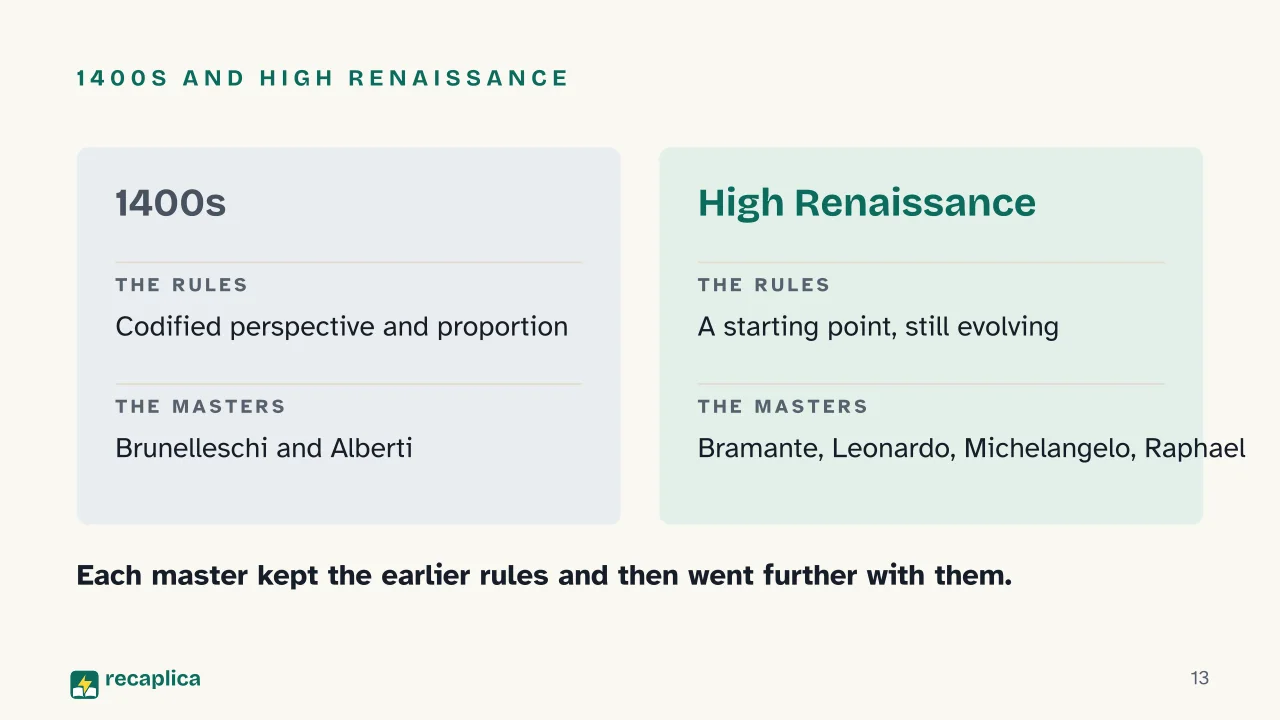
    The 1400s in Florence had fixed the rules of perspective and proportion through Brunelleschi and Alberti, the same masters whose teaching, according to sapere.it, shaped Bramante’s early training. In the following period those rules stayed the starting point, but stopped being the destination: Michelangelo bent them to his own reading of the body, Leonardo subordinated them to a theory of gesture and expression, and Bramante applied them through direct study of Roman ruins. Readers who want the wider arc of the movement, from its Florentine roots, can turn to The Renaissance and, for the painting of the century before, Botticelli’s Birth of Venus. The ruins Bramante built his method on are the subject of The Roman Empire.

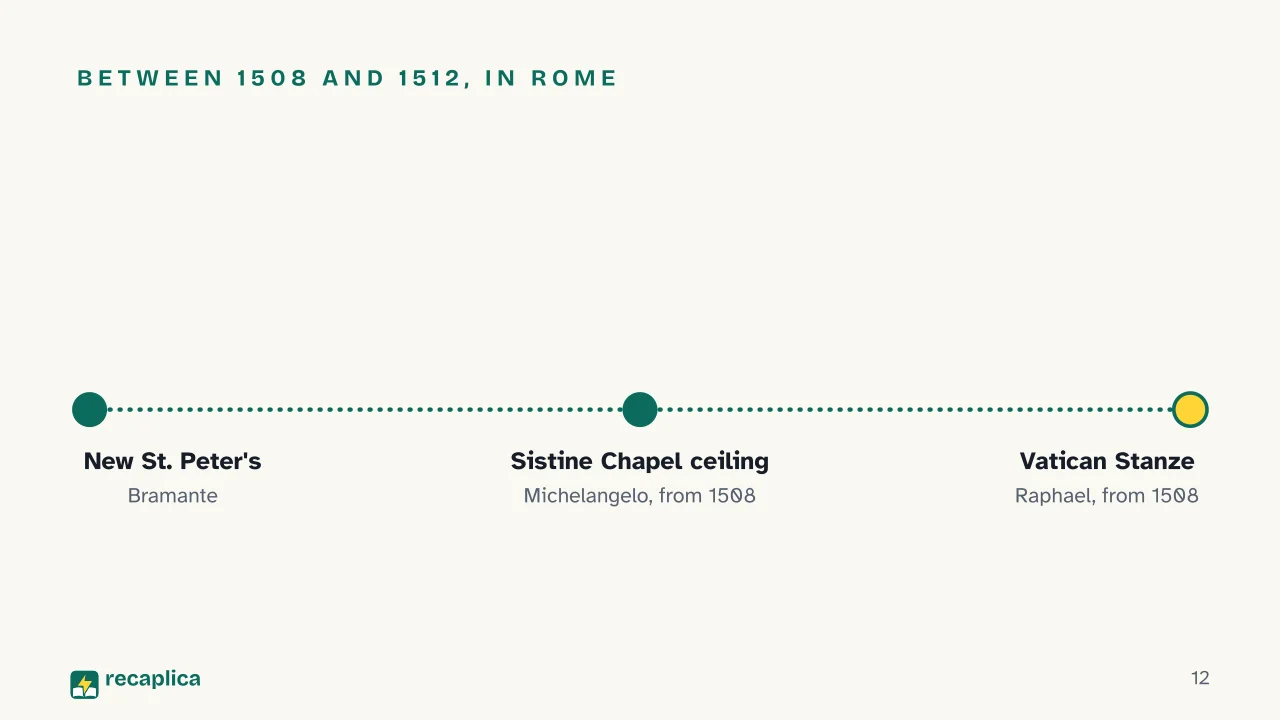
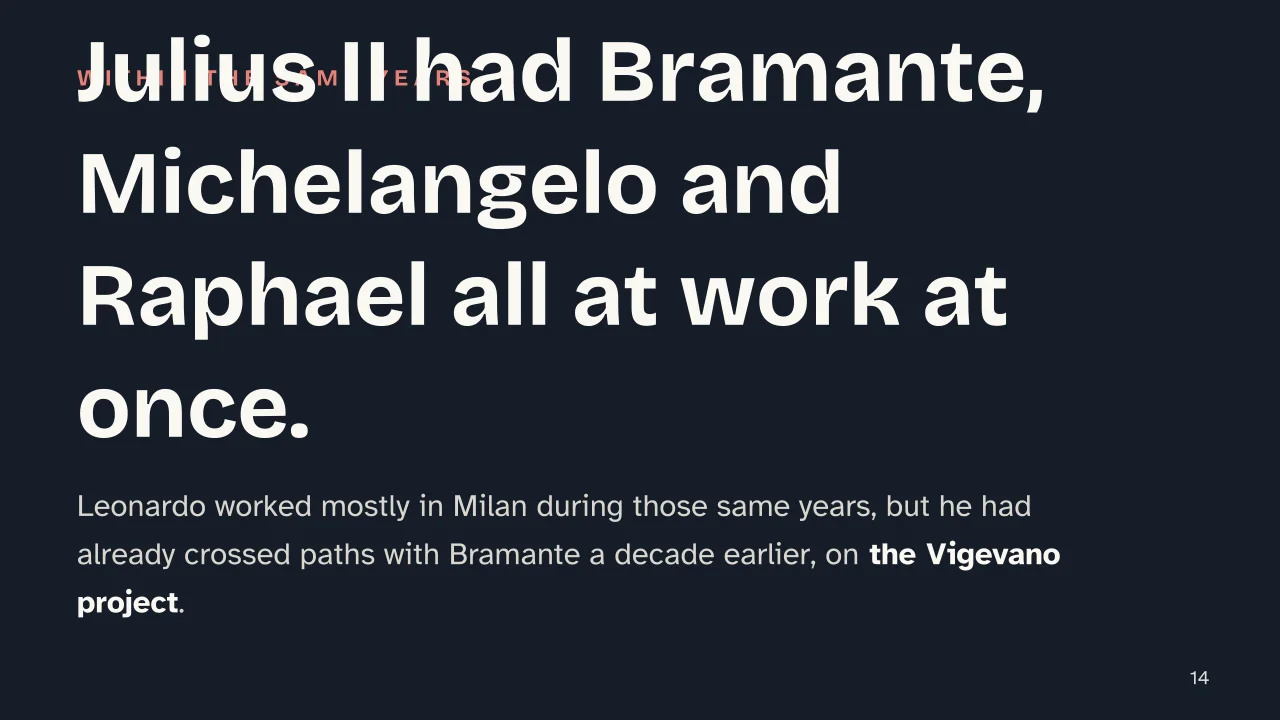
    Rome, in these years, became the workshop where the four careers converged: between 1508 and 1512 Julius II had, running at the same time, the new St. Peter’s Basilica with Bramante, the Sistine Chapel ceiling with Michelangelo and the Vatican Stanze with Raphael. Leonardo followed a parallel course, split between Milan and France, though a decade earlier he had already crossed paths with Bramante on the Vigevano project — a sign that the four paths had brushed against each other before Rome ever brought them together.

    Slide deck

    Slides ready to download and make your own in PowerPoint or Google Slides, with speaker notes. Pick the Flash cut or the Full one.
    Slide 1 of the presentation on High Renaissance: High RenaissanceSlide 2 of the presentation on High Renaissance: Four masters, one patron?Slide 3 of the presentation on High Renaissance: From Bramante to RaphaelSlide 4 of the presentation on High Renaissance: Chapter 01: BramanteSlide 5 of the presentation on High Renaissance: 1444-1514Slide 6 of the presentation on High Renaissance: Chapter 02: LeonardoSlide 7 of the presentation on High Renaissance: 1452-1519Slide 8 of the presentation on High Renaissance: Chapter 03: MichelangeloSlide 9 of the presentation on High Renaissance: 1498-1541Slide 10 of the presentation on High Renaissance: Chapter 04: RaphaelSlide 11 of the presentation on High Renaissance: In Florence, before Rome: Raphael, Leonardo, MichelangeloSlide 12 of the presentation on High Renaissance: Between 1508 and 1512, in RomeSlide 13 of the presentation on High Renaissance: 1400s and High RenaissanceSlide 14 of the presentation on High Renaissance: Between 1508 and 1512 Julius II had Bramante, Michelangelo and Raphael all at work at once.Slide 15 of the presentation on High Renaissance: In what year did Michelangelo finish the Sistine Chapel ceiling?Slide 16 of the presentation on High Renaissance: Now, time to review
    Flash10 slidesThe essential thread, to present in classFull16 slidesEvery chapter and the deeper detail

    Common myths

    • ✗ Myth The High Renaissance was a single movement, with one style shared by all four masters.

      ✓ Reality The sources describe four separate paths: Bramante studied Roman ruins, Leonardo built his paintings through drawing and a theory of mental motion, Michelangelo read the body without binding himself to classical rules, and Raphael searched for a balance of grace and naturalness.

    • ✗ Myth Michelangelo, Leonardo and Raphael always worked apart and never crossed paths.

      ✓ Reality According to Treccani, Raphael's arrival in Florence put him face to face with a scene already dominated by Leonardo and Michelangelo; later, the Roman workshops of Julius II kept all three at work within the same years, alongside Bramante.

    • ✗ Myth The High Renaissance began and ended in Rome.

      ✓ Reality Bramante trained in Urbino and worked in Milan with Leonardo before reaching Rome, and The Last Supper itself was painted in Milan, far from the city of the popes: Rome became the center of gravity only once Julius II started commissioning work there.

    Mind map

    Drag the background to move around and the nodes to reposition them; use − and + to collapse and expand branches.
    Customize
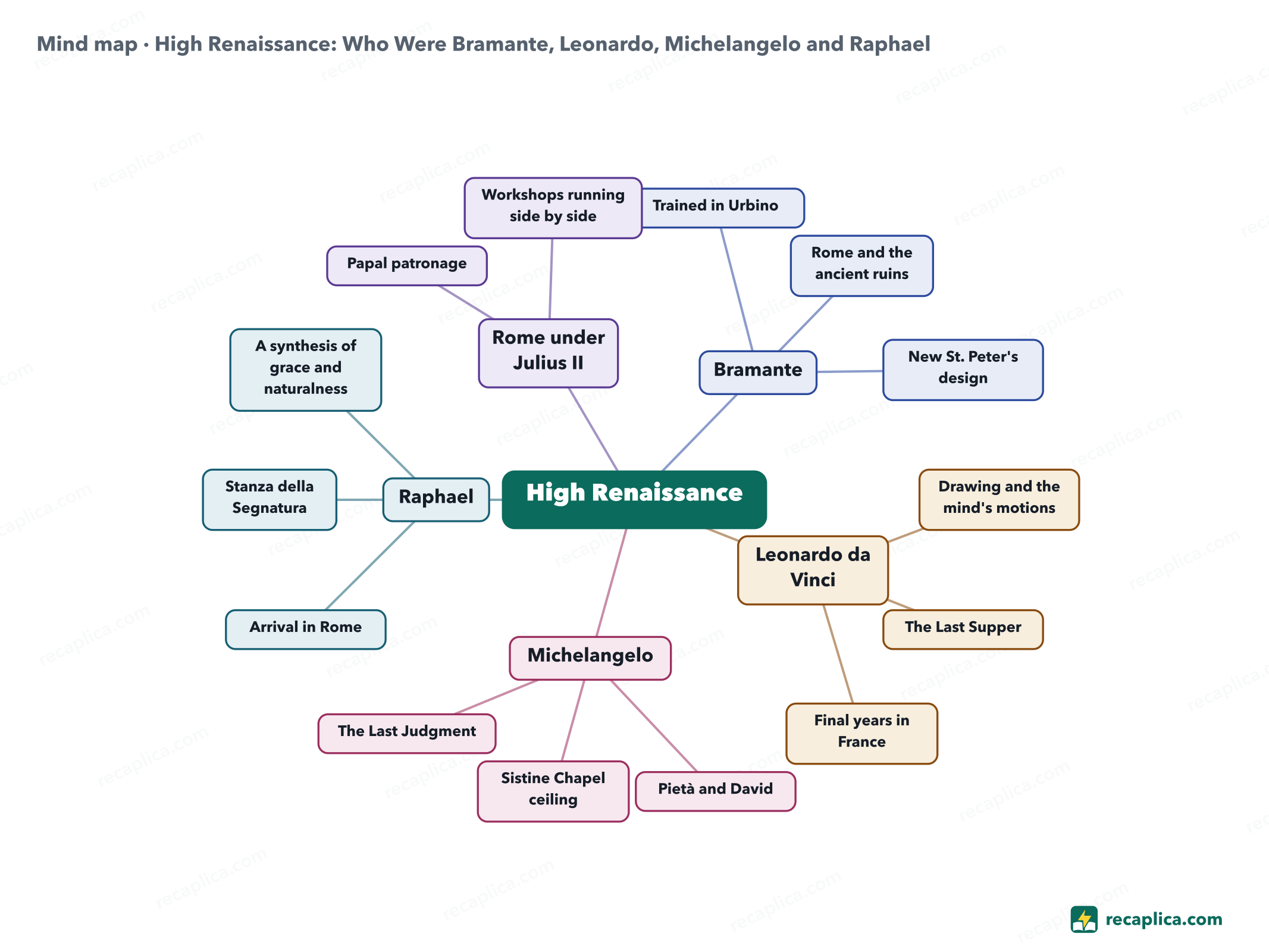
    Mind map: High Renaissance: Who Were Bramante, Leonardo, Michelangelo and Raphael
    • High Renaissance
      • Bramante
        • Trained in Urbino at the court of Federico da Montefeltro
        • Rome and the ancient ruins
        • New St. Peter's design Greek-cross plan, for Julius II
      • Leonardo da Vinci
        • Drawing and the mind's motions
        • The Last Supper Milan, 1494-1497
        • Final years in France Château du Clos Lucé, from 1517
      • Michelangelo
        • Pietà and David
        • Sistine Chapel ceiling 1508-1512
        • The Last Judgment 1536-1541
      • Raphael
        • Arrival in Rome 1508, summoned by Julius II
        • Stanza della Segnatura
        • A synthesis of grace and naturalness
      • Rome under Julius II
        • Papal patronage
        • Workshops running side by side St. Peter's, the Sistine Chapel, the Vatican Stanze

    Quiz: test yourself

    Answer the questions to check what you have learned: you get instant feedback and a short explanation.

    Grade 0/10 0/5
    1 In what year did Michelangelo finish the Sistine Chapel ceiling?

    According to the Vatican Museums, the ceiling was commissioned in 1508 and finished in October 1512.

    2 Where did Donato Bramante train before moving to Rome?

    According to sapere.it, Bramante trained in Urbino in a classicist environment shaped by Leon Battista Alberti.

    3 True or false: Leonardo painted The Last Supper using the traditional fresco technique.

    According to Italy's Ministry of Culture, Leonardo applied paint on dry plaster instead of using true fresco, which let him rework the work over time.

    4 Who commissioned Raphael to decorate the Stanza della Segnatura?

    According to the Vatican Museums, in 1509 Julius II reserved the entire commission for the Stanze to Raphael alone.

    5 Which work did Michelangelo carve between 1501 and 1504?

    According to Treccani, Michelangelo carved the David between 1501 and 1504.

    Answers: 1-B · 2-B · 3-B · 4-A · 5-B

    Flashcards

    Tap the card to flip it and check whether you remember the answer, then move to the next one.

    1 / 8

    Explain it in your own words

    The ultimate test: if you can explain it in simple words, you've truly understood it. Write your explanation, then compare it with the Recap.

    Your explanation is saved only on this device.

    Between the late 1400s and the first decades of the 1500s, Bramante, Leonardo, Michelangelo and Raphael worked in the period art historians call the High Renaissance, largely under the patronage of the popes in Rome. Bramante brought a direct study of ancient ruins into architecture. Leonardo built every painting from preparatory drawings, following a theory that pose and gesture should reveal the "motions of the mind" of the person portrayed. Michelangelo studied the anatomy of the body with an eye of his own, departing from the proportions codified by the generation before him, while Raphael pursued a synthesis of beauty, grace and naturalness. Florence trained all four, but it was Rome, through the commissions of Julius II, that became the workshop where their careers converged.

    Frequently asked questions

    What is the High Renaissance?

    It is the period that followed the early Florentine Renaissance of Brunelleschi and Alberti, when Bramante, Leonardo, Michelangelo and Raphael worked mostly for the papal court in Rome.

    Who are considered the High Renaissance painters?

    Leonardo, Michelangelo and Raphael are the three painters historians place at the center of the High Renaissance; among High Renaissance artists, Bramante stands out as the group's architect, known for buildings and city plans.

    Did Leonardo, Michelangelo and Raphael actually meet?

    Yes: according to Treccani, when Raphael reached Florence he found the scene dominated by Leonardo and Michelangelo and measured himself against both; in Rome, between 1508 and 1512, all three worked within the same years in the workshops of Julius II, alongside Bramante.

    What is Bramante's main work from this period?

    The design for the new St. Peter's Basilica in Rome, with its Greek-cross plan and central dome over the apostle's tomb, commissioned by Julius II, according to Treccani.

    What role did Pope Julius II play in the High Renaissance?

    He was the patron who kept three of the four masters working in the same years: he gave Bramante the new St. Peter's, Michelangelo the Sistine Chapel ceiling, and Raphael the Vatican Stanze.

    Sources

    • Bramante, Donato, Enciclopedia dei ragazzi, Treccani
    • Donato Bramante, I maestri del Rinascimento maturo, sapere.it
    • Stanza della Segnatura, Vatican Museums
    • History of the Sistine Chapel, Vatican Museums
    • Leonardo da Vinci (1452-1519), National Gallery, London
    • Museo del Cenacolo Vinciano, Ministero della Cultura
    • Michelangelo Buonarroti, Enciclopedia dei ragazzi, Treccani
    • Raffaello Sanzio, Enciclopedia dei ragazzi, Treccani

    Every Recap goes through an independent review before publication.

    Every evening, the day's new Recaps on our Telegram channel. Join the channel →

    Keep learning

    • History What Is Existentialism? Heidegger, Being and Time, and Dasein Existentialism is a current of twentieth-century philosophy centered on human existence, freedom and the search for meaning. According to the Stanford Encyclopedia of Philosophy, the German philosopher Martin Heidegger (1889-1976) shaped that current more than almost anyone else, even though he never accepted the label. In 1927 he published Being and Time, his major work, where he introduced the concept of Dasein: the human being as the one entity that questions its own existence. That book influenced Jean-Paul Sartre's existentialism, but in 1946, in the Letter on Humanism, Heidegger openly broke with Sartre and refused to be called an existentialist. In 1933 he was elected rector of the University of Freiburg and became a Nazi party member, keeping that membership until the regime fell - an episode Heidegger himself later denied or played down more than once. Read the Recap →
    • History What Is Phenomenology? Husserl's Philosophy Explained Edmund Husserl founded phenomenology as a philosophical discipline around 1900-1901, with his Logical Investigations. His method starts from the epoché, a suspension of our everyday, unquestioning stance toward the world, and moves toward phenomenological reduction: studying how things appear to consciousness rather than what they are in themselves. At the center sits intentionality, the idea that every experience is always an experience of something specific, whether hoping, perceiving, or desiring. The method Husserl built carried into the 20th century through Heidegger, Sartre, and Merleau-Ponty, moving from German philosophy into French philosophy along the way. Read the Recap →
    • History Legal Positivism: What It Is, from Austin to Kelsen and Hart According to the Stanford Encyclopedia of Philosophy, legal positivism measures legal validity against observable social facts, keeping moral judgment on a separate track. Its roots lie in Hobbes and Hume. Jeremy Bentham produced the theory's first full account, which John Austin later took up and spread: for Austin, a rule is law only when a sovereign commands it under threat of punishment. In the twentieth century, Hans Kelsen grounded legal validity in a hierarchy that traces back to a presupposed basic norm, while Herbert Hart located it instead in a rule of recognition actually followed by judges and officials. Natural law theory takes the opposite view: an unjust law is not really a law. Legal positivism disagrees — a law stays valid even when it is morally unjust, as long as it was made the way the system requires. Read the Recap →

    recaplica

    Clear in 30 seconds, yours in 10 minutes.

    Recaps Mind maps Request a Recap Telegram channel Mind map maker Our method About Privacy & cookies Legal notes & terms of use

    © 2026 Recaplica · A project by Curi S.r.l. — VAT IT05472000750

    Statistics, only if you say so

    To learn which Recaps help most we would use Google Analytics, with aggregate, anonymous data. It starts only with your OK, and you can change your mind anytime. Privacy policy