|
recaplica
Gottfried Leibniz: Logic, Monads, and the Dispute with Newton | |||||||||||||||
| © 2026 Recaplica · recaplica.com — All rights reserved | |||||||||||||||
Gottfried Leibniz: Logic, Monads, and the Dispute with NewtonWhat to print Page numbers appear when printing with default margins. SlidesChoose a cut Flash10 slidesThe essential thread, to present in classFull15 slidesEvery chapter and the deeper detailBoth come with speaker notes. In 30 seconds quick readGottfried Wilhelm Leibniz (Leipzig, 1646 - Hanover, 1716) was a German philosopher and mathematician who spent most of his career as a librarian in the service of the dukes of Hanover. He held that all reasoning rests on signs, and that a universal language could turn thought itself into exact calculation. In his metaphysics, the only true substances are monads, simple and immaterial entities endowed with perception. He is also the mathematician who independently worked out the infinitesimal calculus, at the center of a long priority dispute with Isaac Newton. Key Points
Key figures
Deep DiveGottfried Wilhelm Leibniz was born in Leipzig on July 1, 1646, and died in Hanover on November 14, 1716. He served as librarian to Duke Johann Friedrich of Brunswick-Hanover, and continued in that role under his successors until his death. The Stanford Encyclopedia of Philosophy ranks him among the great thinkers of the 17th and 18th centuries, and calls him the last “universal genius”. Logic as a calculus of thoughtLeibniz took language to be the mind’s truest mirror: the Stanford Encyclopedia of Philosophy notes that paying close attention to what words mean is the most direct way to reach the intellect’s inner workings. Out of this idea grew the project of the characteristica universalis, a universal language or notation that Leibniz imagined as reason’s greatest tool. Underlying all of this is the idea that reasoning always leans on signs or characters: take away the symbols, and precise thought or genuine argument go with them. Leibniz went as far as to say that every operation of the mind is, in some sense, a calculation. Formal logic already had a founder before him, Aristotle, but Leibniz wanted something more ambitious: a calculus that could settle any philosophical or scientific dispute, reaching beyond the fixed forms of the syllogism.
The monadology: Leibniz’s metaphysics of monadsIn Leibniz’s metaphysics, the only true substances are monads: the Stanford Encyclopedia of Philosophy describes them as simple, mind-like entities endowed with perception and appetite. The Internet Encyclopedia of Philosophy adds that in Leibniz’s vocabulary “monad” names something that is one: without parts, and therefore indivisible. Strip away everything physical, and what is left, in Leibniz’s account, is just God and this population of immaterial entities. Two principles hold the system together. The principle of sufficient reason holds that every fact needs an explanation: behind any true predicate of a subject sits a further set of true predicates that account for it. The principle of the identity of indiscernibles states that two substances cannot be perfectly alike and differ only in number; if two things were truly indistinguishable, Leibniz argues, God would have no sufficient reason to place one here and the other there. Monads, though, do not communicate the way two colliding objects do. Under the theory of pre-established harmony, each one mirrors the entire universe on its own terms, the way two witnesses describe the same street from opposite ends of it; nothing passes directly between them. For Leibniz, perception is the expression of a multiplicity within a unity, that is, within a simple substance. He separates it from apperception, the reflective awareness or knowledge of that inner state. Leibniz and Newton: the calculus priority disputeMacTutor History of Mathematics reports that Leibniz worked out the core ideas of his version of the infinitesimal calculus during his years in Paris. On November 21, 1675, he used his integral notation for the first time in a manuscript; by the autumn of 1676 he had already established the power rule for differentiation, valid for both whole and fractional exponents. He published the details of the differential calculus in 1684, in the work “Nova Methodus pro Maximis et Minimis”.
Matters came to a head in 1711, when Leibniz read, in the Transactions of the Royal Society of London, an article by Keill accusing him of plagiarizing Newton. Leibniz answered that until then he had known nothing at all of the method of fluxions Newton used: he had only come across it by reading Wallis. MacTutor sums up the Royal Society inquiry as “totally biased”: it closed without ever asking Leibniz for his own account of events. The final report, favorable to Newton, came from Newton’s own pen. The binary system, ahead of the calculusHis binary arithmetic system was already finished by 1679, according to MacTutor, though Leibniz waited until 1701 to publish it. That same idea of just two digits underlies the binary code computers still use to write numbers. Slide deckSlides ready to download and make your own in PowerPoint or Google Slides, with speaker notes. Pick the Flash cut or the Full one.  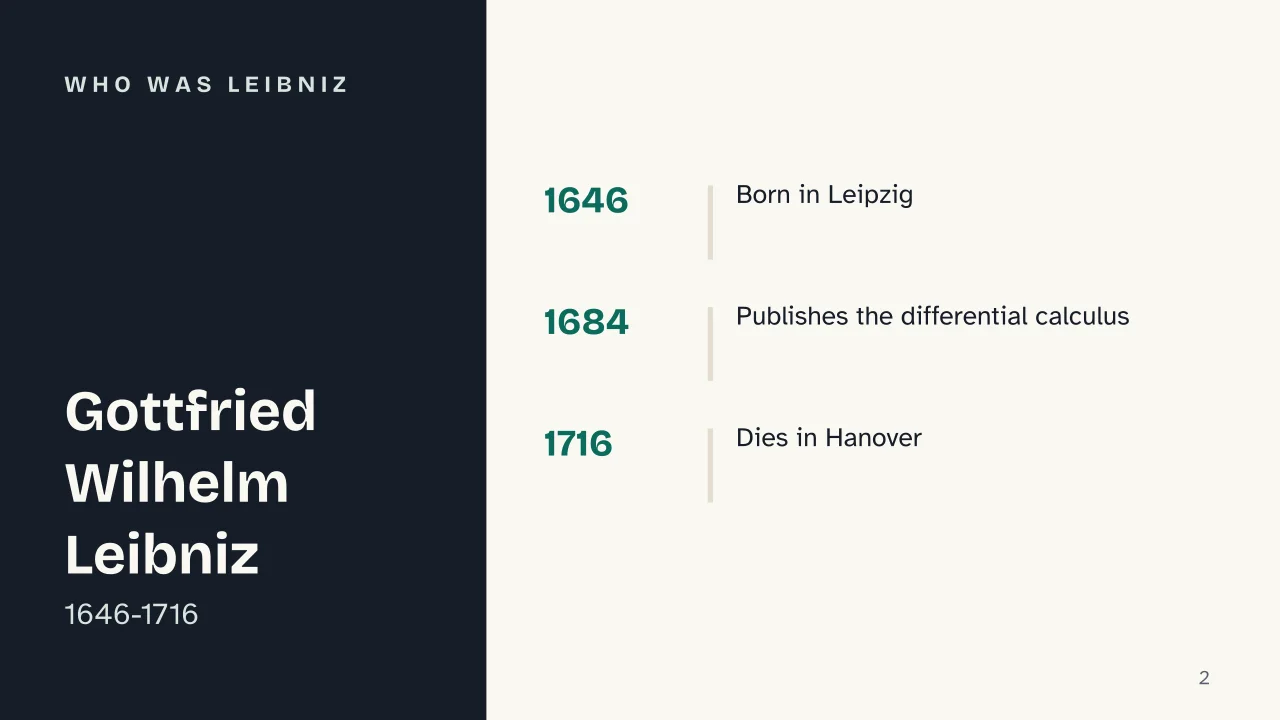    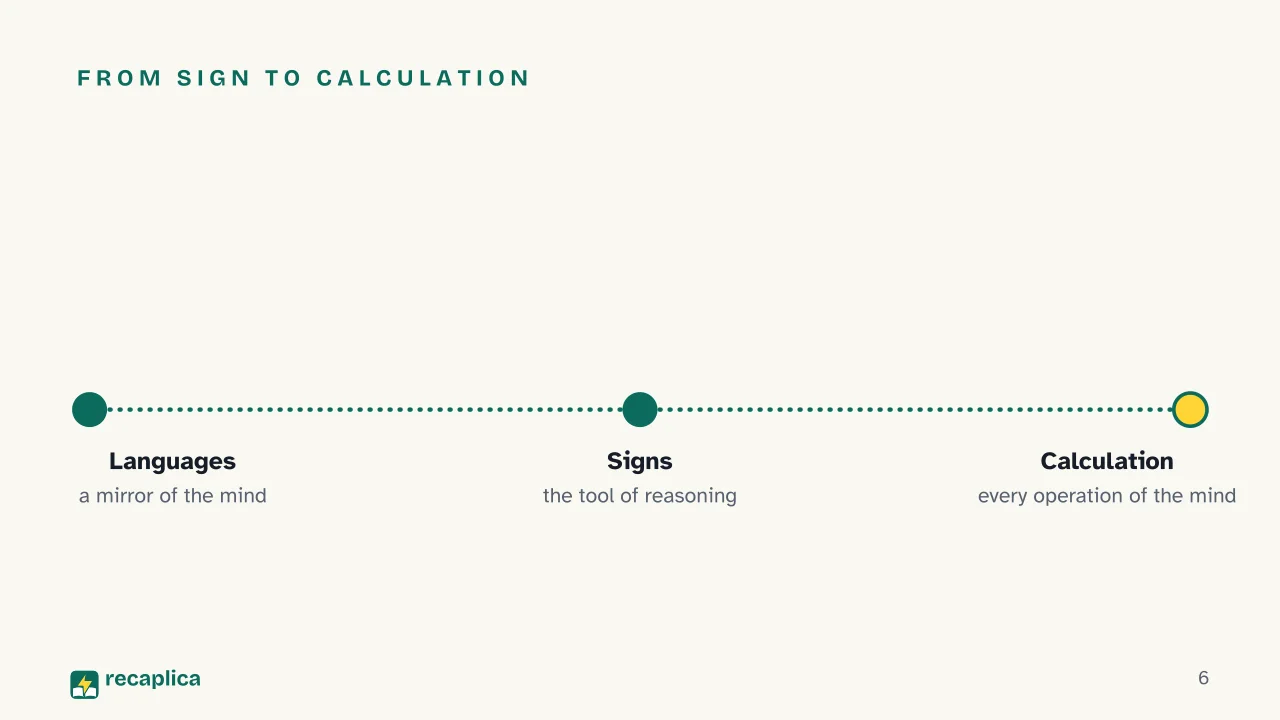  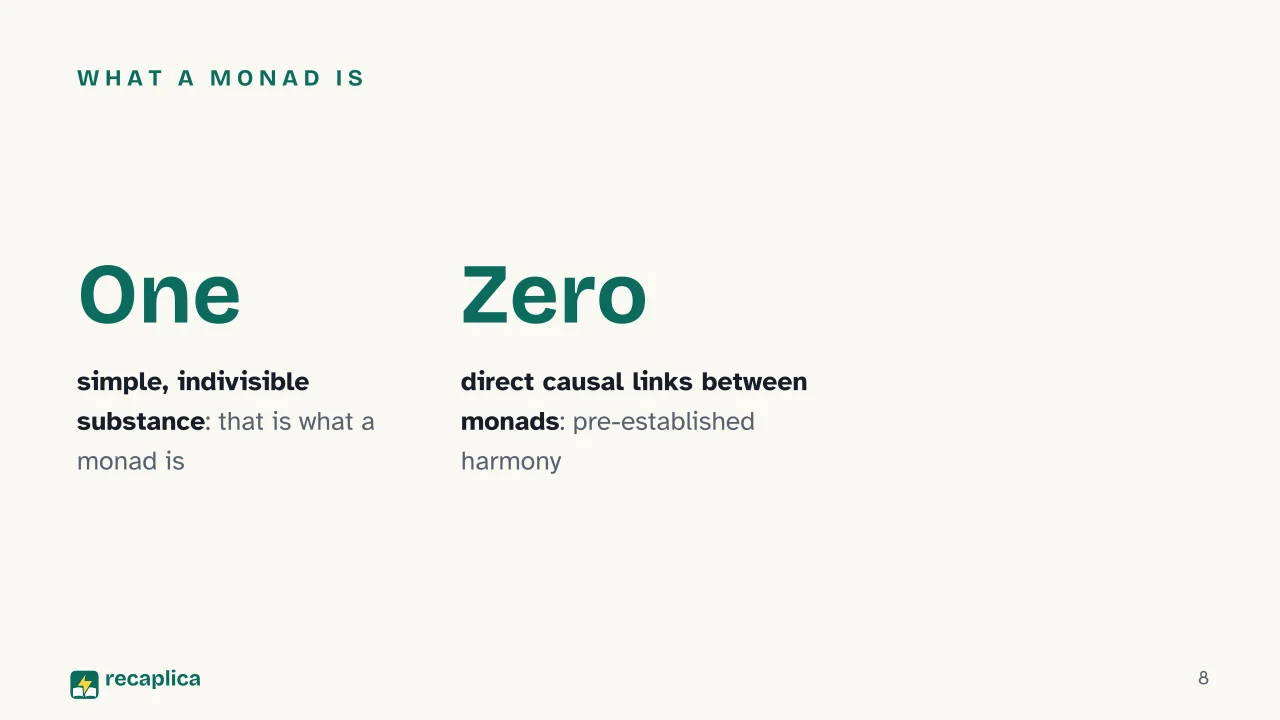  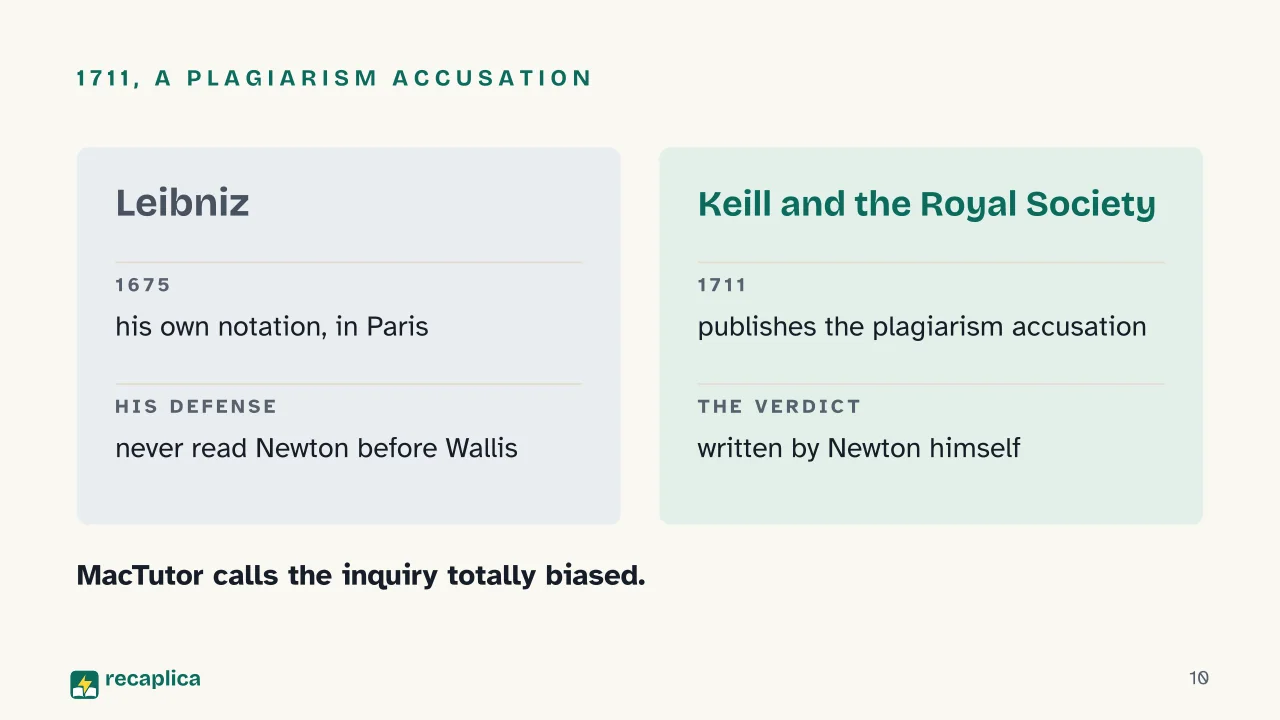 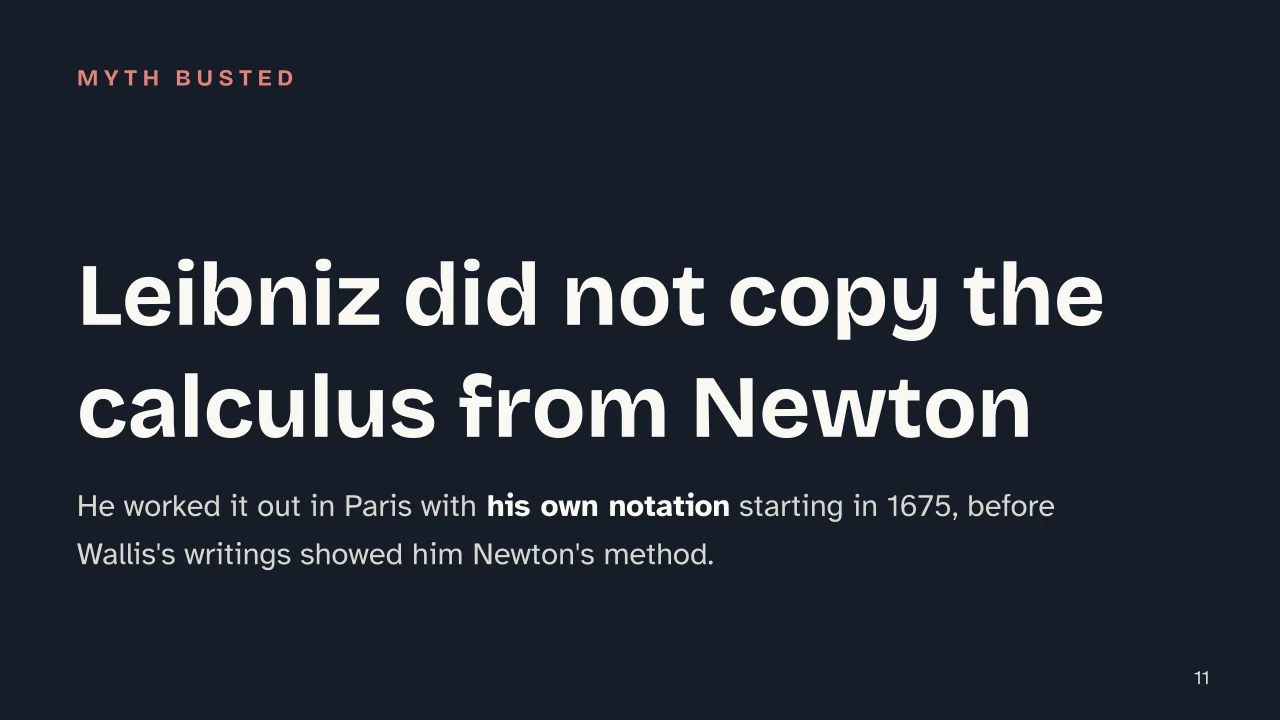  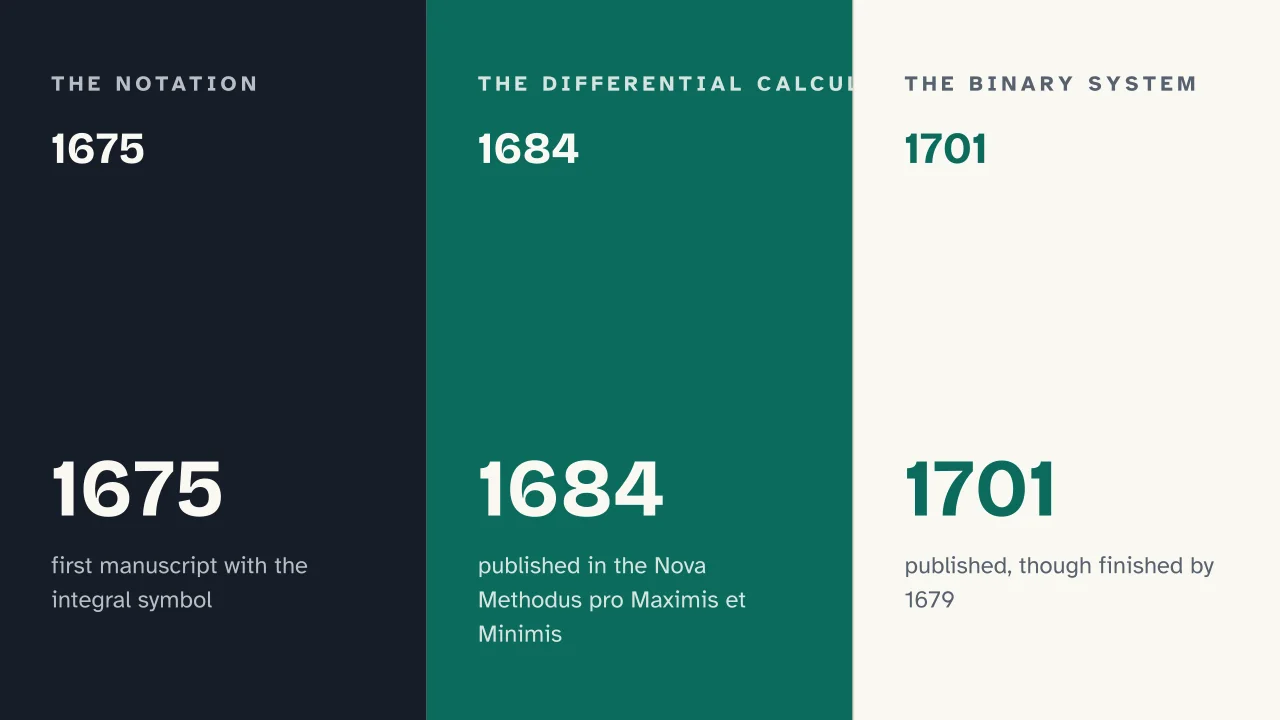 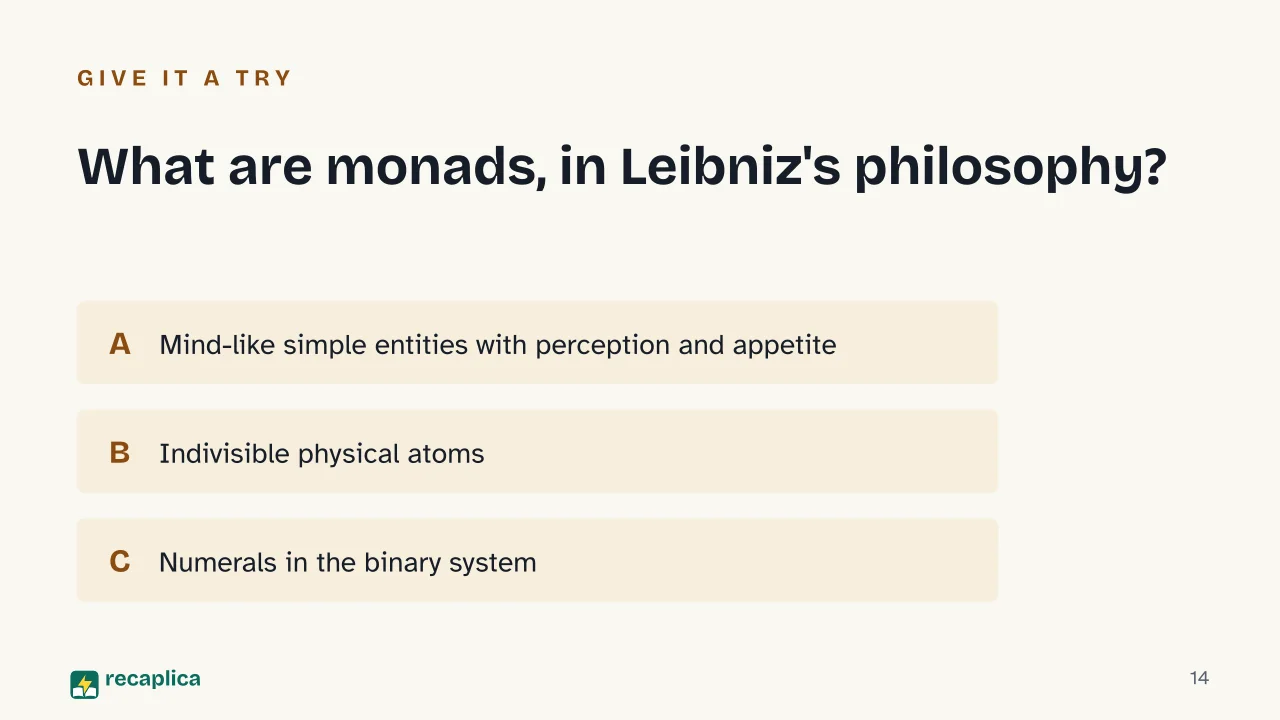  Common myths
Mind mapDrag the background to move around and the nodes to reposition them; use − and + to collapse and expand branches. 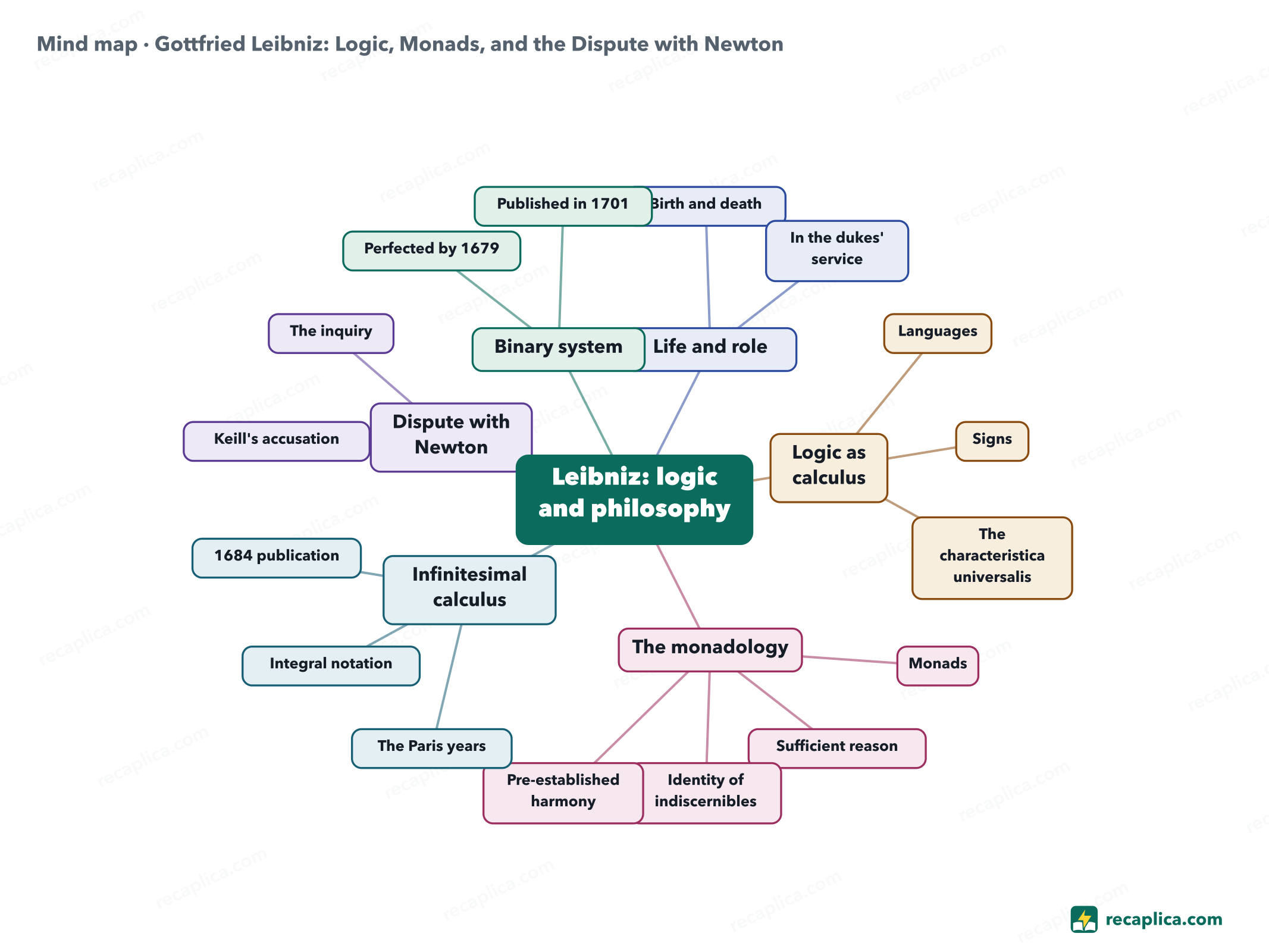
Quiz: test yourselfAnswer the questions to check what you have learned: you get instant feedback and a short explanation. Grade 0/10 0/5
FlashcardsTap the card to flip it and check whether you remember the answer, then move to the next one. 1 / 8 Explain it in your own wordsThe ultimate test: if you can explain it in simple words, you've truly understood it. Write your explanation, then compare it with the Recap. Your explanation is saved only on this device.
Frequently asked questionsWho was Gottfried Leibniz?A German philosopher and mathematician, born in Leipzig in 1646 and dead in Hanover in 1716, who served the dukes of Brunswick-Hanover as a librarian. The Stanford Encyclopedia of Philosophy counts him among the towering figures of 17th- and 18th-century thought, calling him the last "universal genius". What are Leibniz's monads?The only true substances in his metaphysics: simple, immaterial, indivisible, mind-like entities with perception and appetite. Under the theory of pre-established harmony, they never causally interact with one another. Did Leibniz copy the infinitesimal calculus from Newton?No: according to MacTutor, Leibniz developed his own version in Paris, with his own notation already in 1675, before learning of Newton's method through the works of Wallis. The 1711 plagiarism accusation and the Royal Society inquiry, which the same source calls biased, remain a controversial episode, not proof of copying. What is the principle of sufficient reason?The principle that nothing happens without a reason: for every true fact about a subject there is a set of other true facts that explain it. Leibniz also uses it to argue for the identity of indiscernibles. What is the characteristica universalis?Leibniz's project for a universal language or notation, capable of turning reasoning into an exact calculation, the way arithmetic operations already are. Every Recap goes through an independent review before publication. |