|
recaplica
Papal Conclave: How a Pope Is Elected, from Sede Vacante to Habemus Papam | |||||||||||||||||||||||||||||||||||||||||||||||||||||||
| © 2026 Recaplica · recaplica.com — All rights reserved | |||||||||||||||||||||||||||||||||||||||||||||||||||||||
Papal Conclave: How a Pope Is Elected, from Sede Vacante to Habemus PapamWhat to print Page numbers appear when printing with default margins. SlidesChoose a cut Flash10 slidesThe essential thread, to present in classFull15 slidesEvery chapter and the deeper detailBoth come with speaker notes. In 30 seconds quick readA conclave is the closed-door meeting in which cardinals choose a new pope. Only cardinals who had not yet turned 80 when the see fell vacant may vote, and winning takes at least two-thirds of the votes. Voting happens in the Sistine Chapel, up to four times a day, and the burned ballots make the smoke: black when nobody has been elected, white when someone has. The new pope's name only comes out afterwards, with the "Habemus Papam" announcement from the balcony of St Peter's. Key Points
Key figures
Deep DiveWhat a conclave isA conclave is the assembly of cardinals that elects the pope, and also the sealed-off place where that election happens. The word comes from the Latin cum clave, “with a key”: the cardinals vote cut off from the outside world until a name emerges. That seclusion might look like old-fashioned ceremony, but it carries real weight in the rules. The apostolic constitution that governs it, Universi Dominici Gregis, was signed by John Paul II on 22 February 1996 and later revised twice by Benedict XVI, in 2007 and 2013. In its preamble the pope concedes that theologians and canon lawyers do not consider the conclave necessary for a valid election, yet he decides to keep its essential structure anyway. Sede vacante: when the process startsEverything begins when the see of Rome is left without a pope. There are two ways this can happen. The first is the death of the pope. The camerlengo, one of the few Curia officials who stay in office, formally certifies the death and seals the pope’s study and bedroom. The dean of the College of Cardinals informs all the cardinals and summons them to Rome. The funeral rites follow over nine consecutive days, known as the Novendiales. The second is resignation. The Code of Canon Law allows it on two conditions, that it is made freely and that it is expressed in the proper form, and it states that nobody needs to accept it. Universi Dominici Gregis lays down that in this case exactly the same rules apply as after a death. That is what happened in 2013, when Benedict XVI announced on 11 February that the see would be vacant from 8 pm on 28 February. While the see is vacant, the College of Cardinals does not inherit the pope’s powers. It can deal only with ordinary business or with matters that cannot be put off. The heads of the Curia’s dicasteries, the Secretary of State included, lose their posts; the camerlengo and the major penitentiary stay on.
General congregations and the conclave are two separate stagesBefore they shut themselves inside the Sistine Chapel, the cardinals meet in the general congregations. Everyone takes part here, including those over 80 who will not be able to vote, for whom attendance is optional. In the first sessions each cardinal swears to respect the rules and keep the secret. Alongside the general meetings there are particular congregations, made up of the camerlengo and three cardinals drawn by lot, who rotate every three days. The congregations settle practical matters, including the day and time voting will start. In 2025 the date of 7 May was set on 28 April, during the fifth general congregation. The timetable is tight. From the start of the vacancy the cardinals wait 15 full days, so that those who are away have time to arrive. The College can push the opening back by a few days for serious reasons and, since 2013, can also bring it forward if all the electors are already there. Once 20 days at most have gone by, however, the cardinals present must start voting. In 2013 the conclave opened on 12 March, twelve days after the see fell vacant. Who votes and who can be electedThis is where most of the confusion lies. Who votes. The right to elect the pope belongs only to cardinals who had not turned 80 before the day the see became vacant. The rules set a maximum of 120 electors and rule out any other churchman, as well as any interference from a political power. Both rules go back to Paul VI: the exclusion of cardinals over 80 to a 1970 motu proprio, the cap of 120 to his 1975 constitution Romano Pontifici Eligendo. No cardinal elector can be barred from voting for any reason, and a cardinal who arrives late joins in at whatever point the voting has reached. The cap of 120 applies to the conclave, but popes have gone over it several times by creating new cardinals. According to Vatican News, 2025 saw the first conclave with more electors than the limit: 135 cardinals from 71 countries were entitled to vote, and two stayed away for health reasons. The College numbered 252 cardinals in all, 117 of whom were non-electors. Who can be elected. Here the rules are much wider. The constitution gives the vote to cardinals, but it contains no rule restricting the choice to them. In fact it explicitly covers two cases: a man elected who is not yet a bishop, who must be ordained bishop immediately after accepting, and a man elected who lives outside Vatican City. Being under 80 is not required either.
Inside the Sistine Chapel: the oath and extra omnesThe conclave takes place in closed-off areas of Vatican City. The cardinals sleep at the Domus Sanctae Marthae, an arrangement introduced in 1996; before that they stayed in the rooms around the Sistine Chapel for as long as the vote lasted. Voting itself happens only in the Sistine Chapel. The day the cardinals go in starts with the Mass pro eligendo Pontifice in St Peter’s Basilica. In the afternoon they walk in procession into the Sistine Chapel singing the Veni Creator and, one by one, with a hand on the Gospels, swear to obey the rules and to keep secret everything about the election, even afterwards. Then the Master of Pontifical Liturgical Celebrations calls out extra omnes, “everyone out”, and anyone not taking part in the conclave leaves the chapel. The secrecy is taken seriously. Electors may not phone, write letters, read newspapers, listen to the radio or watch television. Anyone who uses devices to record or transmit, whether a cardinal or a member of staff, is automatically excommunicated. The same penalty falls on anyone who buys votes, and on anyone who agrees to act for a government in vetoing a candidate; pacts and promises aimed at steering the vote are void. How the vote works: ballots, rounds and two-thirdsSince 1996 there has been only one way to elect a pope, the secret ballot (per scrutinium). The old methods of acclamation and of compromise, in which a small group of cardinals was entrusted with the choice, were abolished. The rhythm is fixed. If voting starts on the afternoon of the first day there is a single ballot, and from the next day there are two in the morning and two in the afternoon. At the start of each morning and afternoon session, three scrutineers are drawn by lot from among the electors to count the votes, along with three infirmarii, who collect the votes of sick cardinals in their rooms, and three revisers, who check the work. Each cardinal receives a rectangular ballot paper bearing the words Eligo in Summum Pontificem, “I elect as Supreme Pontiff”, and writes a name beneath them. He carries it to the altar, swears an oath before Christ and places it in the receptacle. The last scrutineer pierces each ballot with a needle and threads them together. If the number of ballots does not match the number of electors, they are all burned and the vote is held again at once. Election requires at least two-thirds of the votes, calculated on the cardinals present and voting.
When nobody reaches the quorum: pauses and the runoffThe rules set out a precise sequence for a deadlock. After three days of voting without a result, the ballots stop for up to one day so the cardinals can pray, talk freely and hear a short address from the senior cardinal deacon. Voting then resumes in series of seven ballots, separated by two more pauses with an address given in turn by the senior cardinal priest and the senior cardinal bishop. If three such series still produce no pope, a day is set aside for reflection and the vote moves to a runoff between the two names that received the most votes in the last ballot. According to Vatican News, this comes after the 33rd or 34th ballot. The rules on that runoff have changed over time, and it is the point where most mistakes circulate.
The change was Benedict XVI’s, through a motu proprio of 11 June 2007 that restored the traditional two-thirds rule. The motu proprio Normas nonnullas of 22 February 2013 then fixed the text in force from that date. An election carried out in any other way than the one laid down is null. Black smoke, white smokeAfter each vote the ballots and the cardinals’ notes must be burned. The smoke rises from the chimney above the Sistine Chapel and serves as the signal for the people waiting outside: black if nobody has reached the majority, white if a pope has been elected. When two ballots are held back to back, the papers from the first are burned at the end together with those of the second. The main stove is made of cast iron and stands about a metre tall; according to the Holy See Press Office it was first used at the 1939 conclave. In 2005 a second device was added next to it to burn coloured cartridges and make the smoke easier to read. In 2025 Vatican News published what the mixtures contain: potassium perchlorate, anthracene and sulphur for black, and potassium chlorate, lactose and Greek pitch for white. From acceptance to Habemus PapamOnce someone reaches two-thirds, the cardinal dean, or if he is not in the conclave the most senior cardinal by order and seniority, asks him whether he accepts the election and what name he wishes to take. The Master of Celebrations records it all in writing, acting as a notary. If the man elected is already a bishop, he becomes pope with full authority the moment he accepts, and under the rules the conclave is over at that point. Out in the square, meanwhile, people have seen the white smoke but know nothing more. The new pope withdraws to the so-called Room of Tears next to the Sistine Chapel and puts on one of the papal cassocks prepared in three sizes. He returns to the chapel for the cardinals’ act of homage and the singing of the Te Deum. Only then does the cardinal protodeacon, the senior cardinal deacon, step out onto the balcony of St Peter’s Basilica and announce Habemus Papam along with the new pope’s name. Finally the pope gives the Urbi et Orbi blessing.
While a conclave is under way, predictions, supposed inside stories and wrong dates spread widely, sometimes in reputable outlets. The rules themselves are written down and available on the Holy See’s website: going back to the primary source, as explained in the Recap on how to spot fake news, lets you check them yourself. Three conclaves side by side: 2005, 2013, 2025
The entry dates and smoke times come from Holy See Press Office bulletins and Vatican News; the number of ballots in 2005 and 2013 comes from ANSA. In all three cases the pope was elected the day after the cardinals went in. In 1978, again according to ANSA, John Paul II was elected at the eighth ballot, on the third day. From Viterbo to the Sistine Chapel: the rules through the centuriesThe conclave grew out of an election that would not end. Clement IV died on 29 November 1268, and the cardinals gathered in the papal palace at Viterbo could not agree. At one point the townspeople locked them in to force a decision. Gregory X was elected in 1271, after 2 years and 9 months without a pope, and in 1274 his bull Ubi periculum turned that improvised measure into law: strict seclusion and, if the vote dragged on, ever sparser meals. From the thirteenth century to Universi Dominici Gregis there have been more than thirty sets of rules on the conclave. In 1492 it was decided to hold the assembly in the Sistine Chapel, though the chapel was only named as its fixed venue in 1878. During the nineteenth century, the century of Italian unification, four conclaves met at the Quirinal Palace, and the one of 1800 took place in Venice, on the island of San Giorgio Maggiore. In the twentieth century the rules were rewritten by Pius X in 1904, Pius XII in 1945, John XXIII in 1962 and Paul VI in 1975, before the 1996 constitution. Durations have swung between extremes too. According to Treccani, the conclave that chose Eugenio Pacelli in March 1939 lasted about 20 hours. Slide deckSlides ready to download and make your own in PowerPoint or Google Slides, with speaker notes. Pick the Flash cut or the Full one.     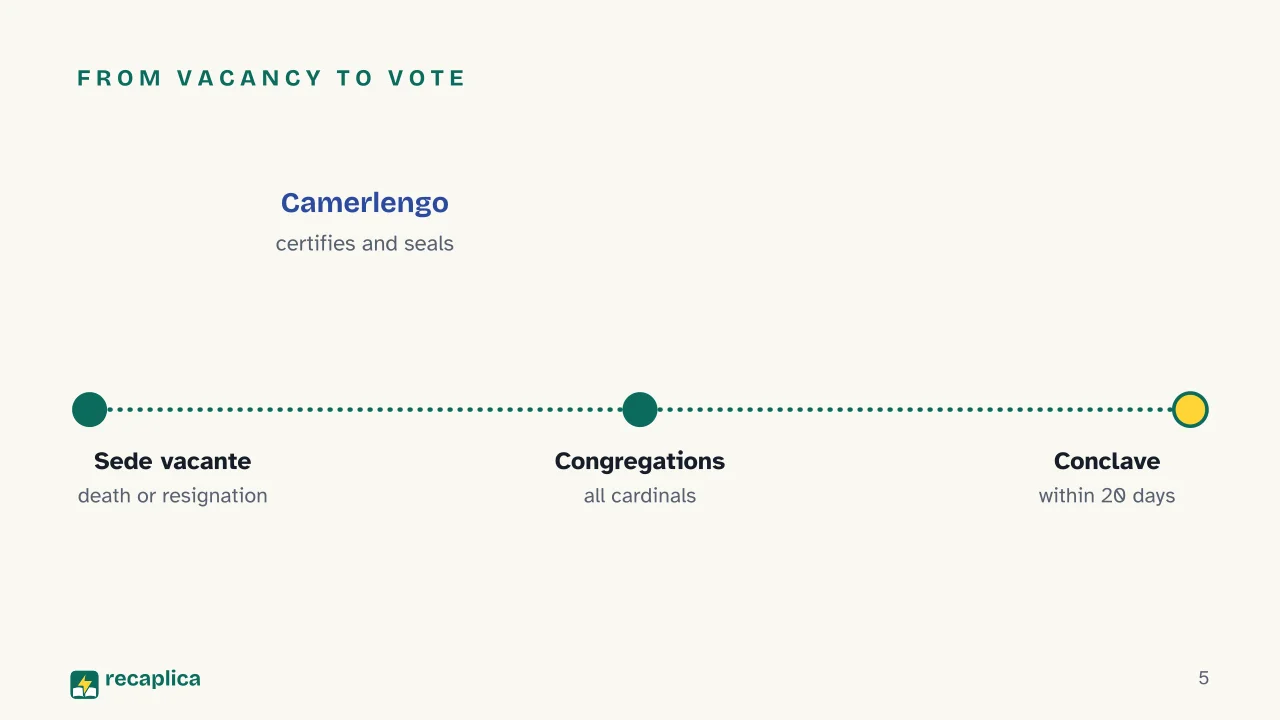  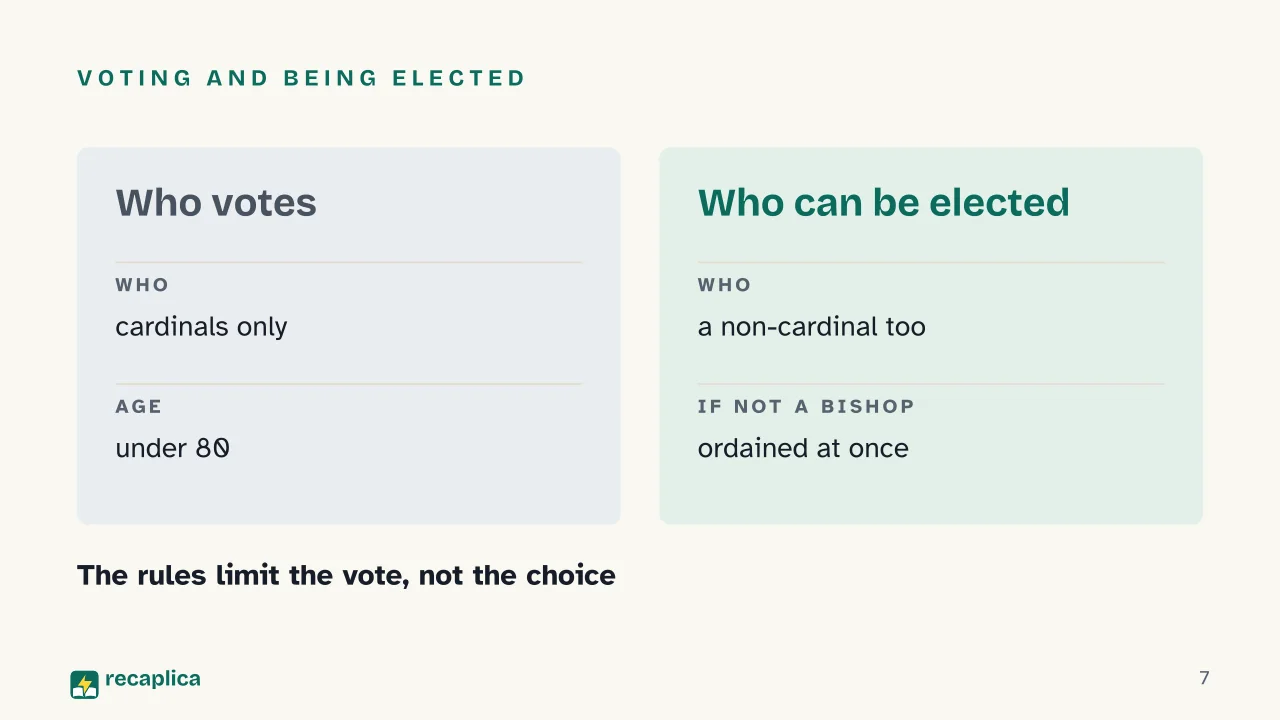 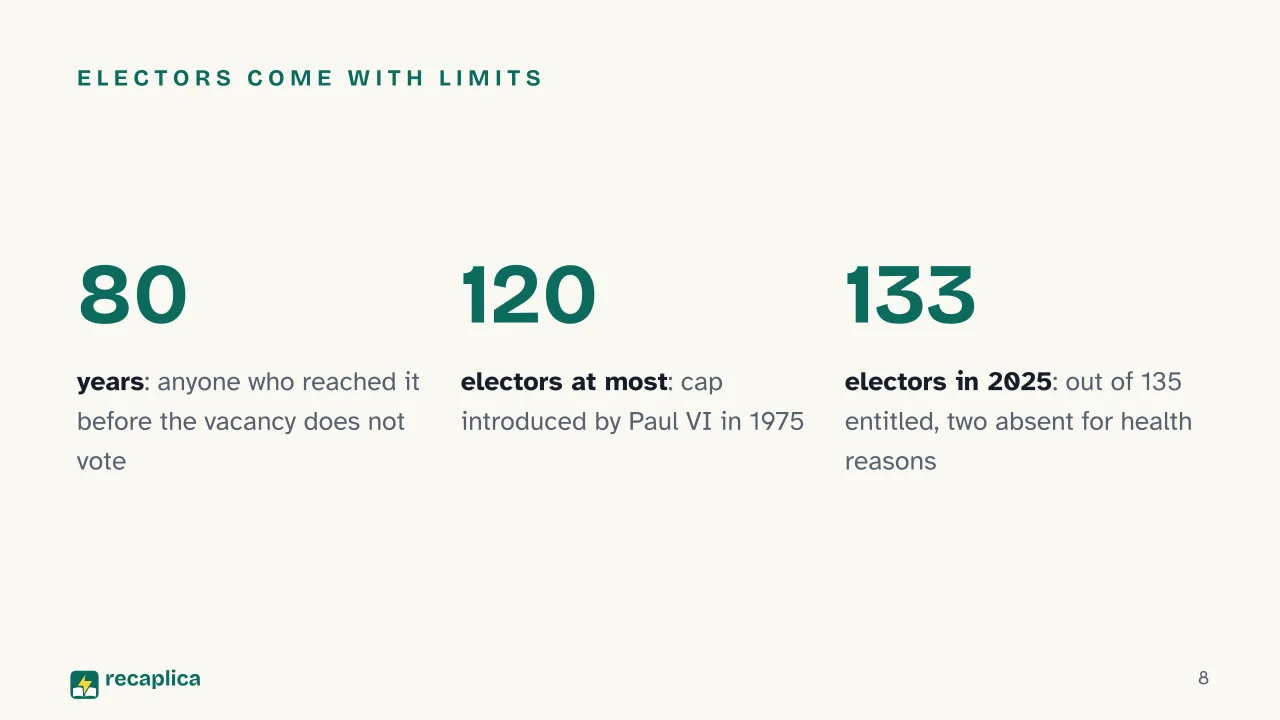  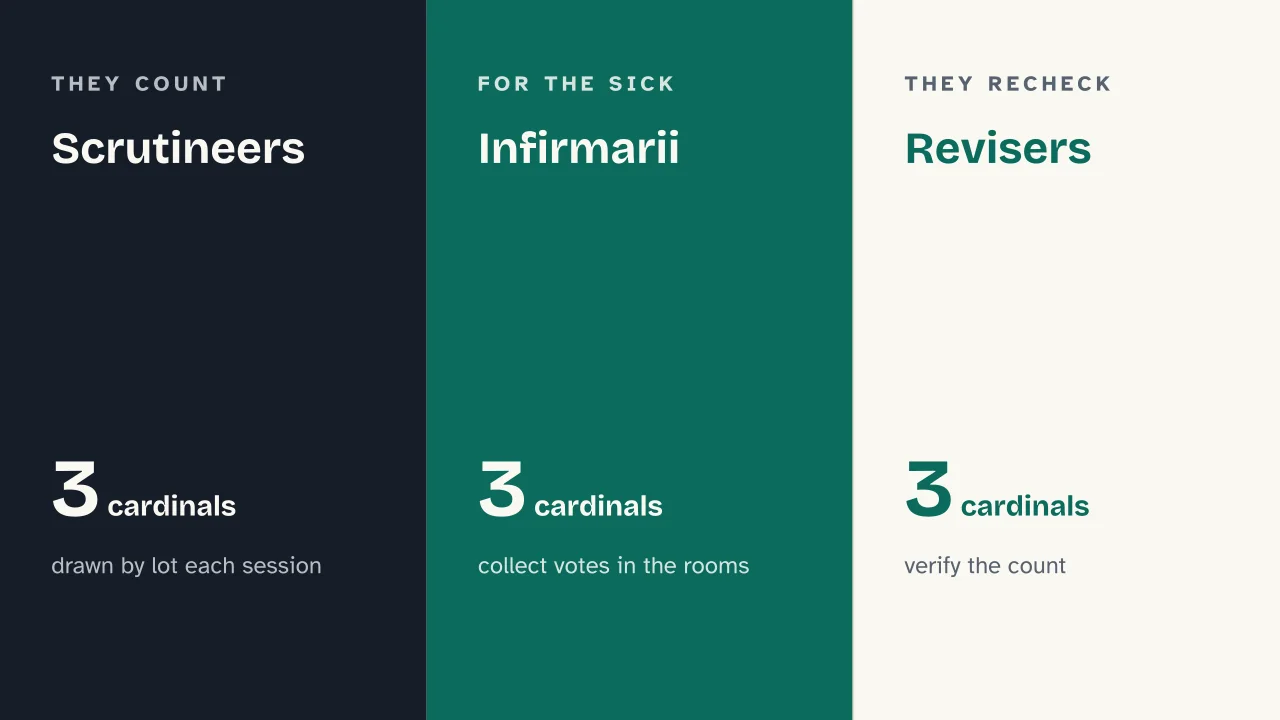 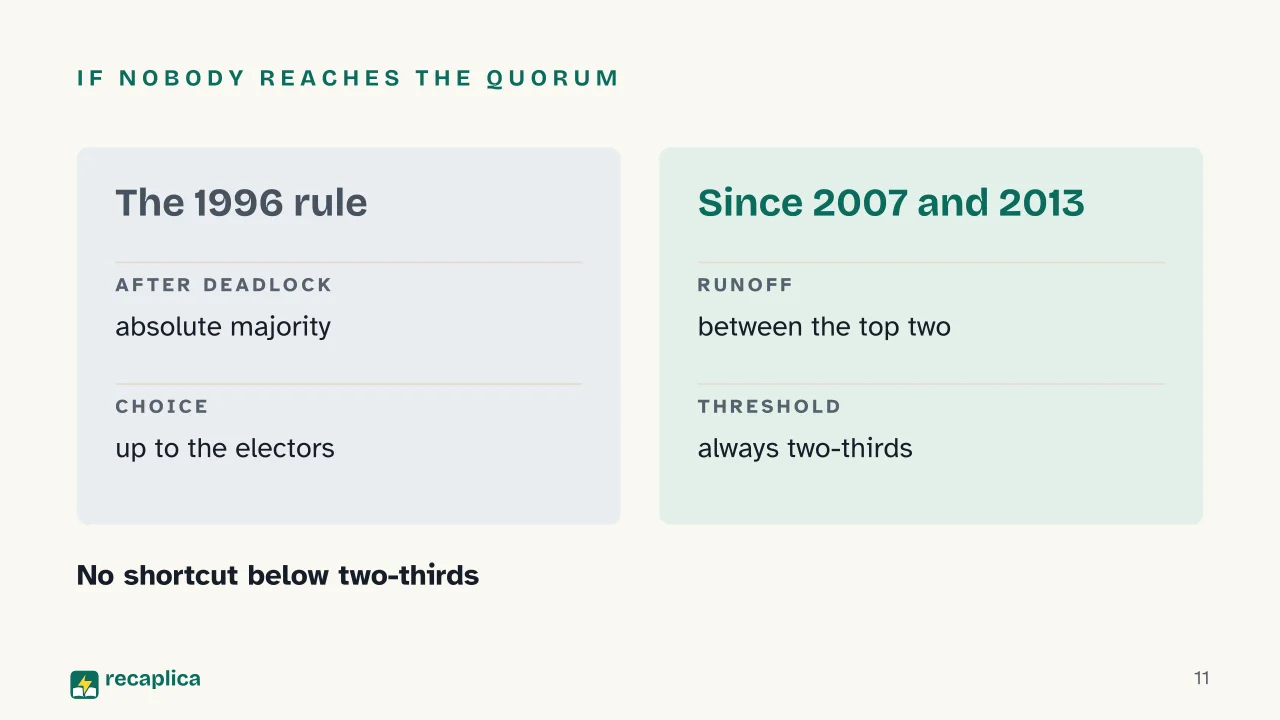  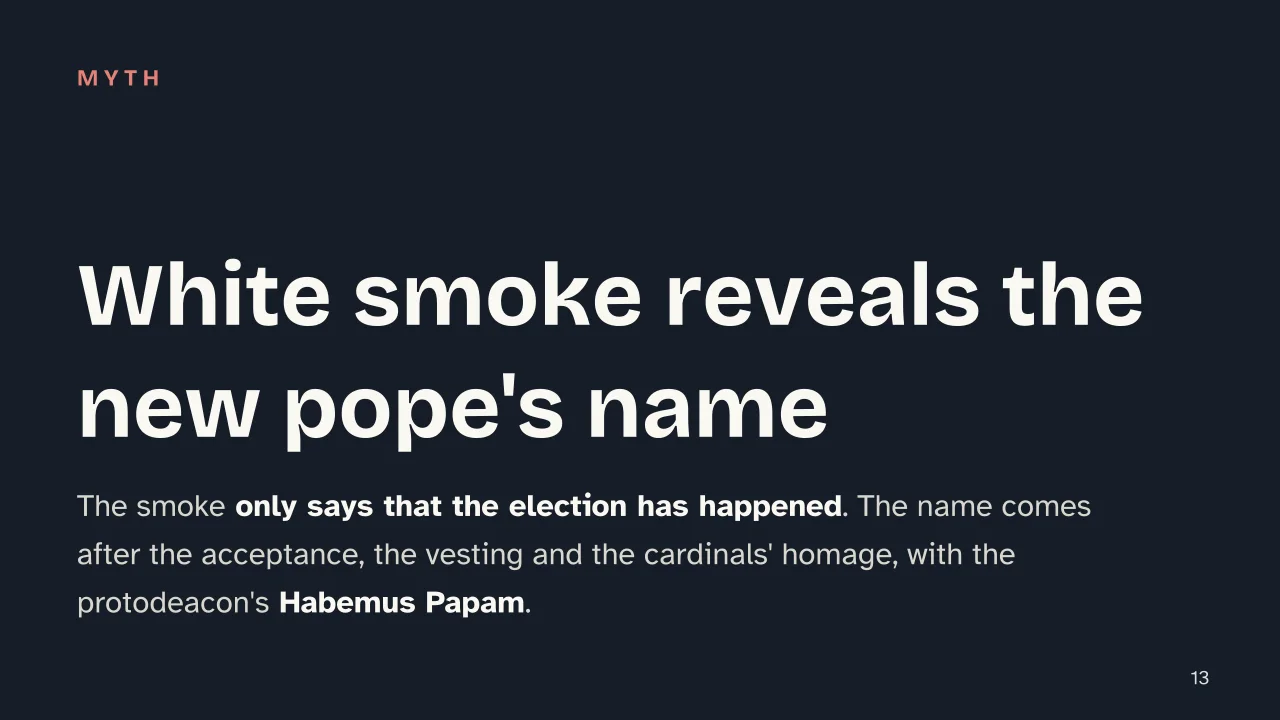 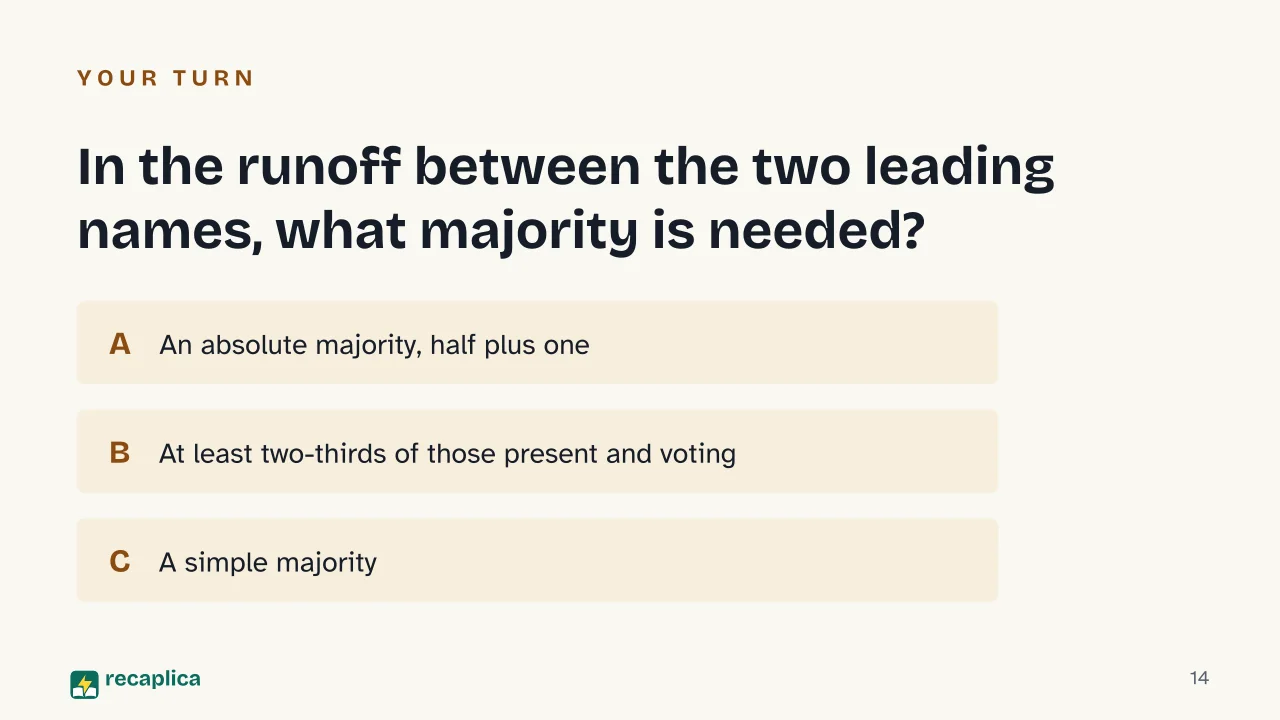  Common myths
Mind mapDrag the background to move around and the nodes to reposition them; use − and + to collapse and expand branches. 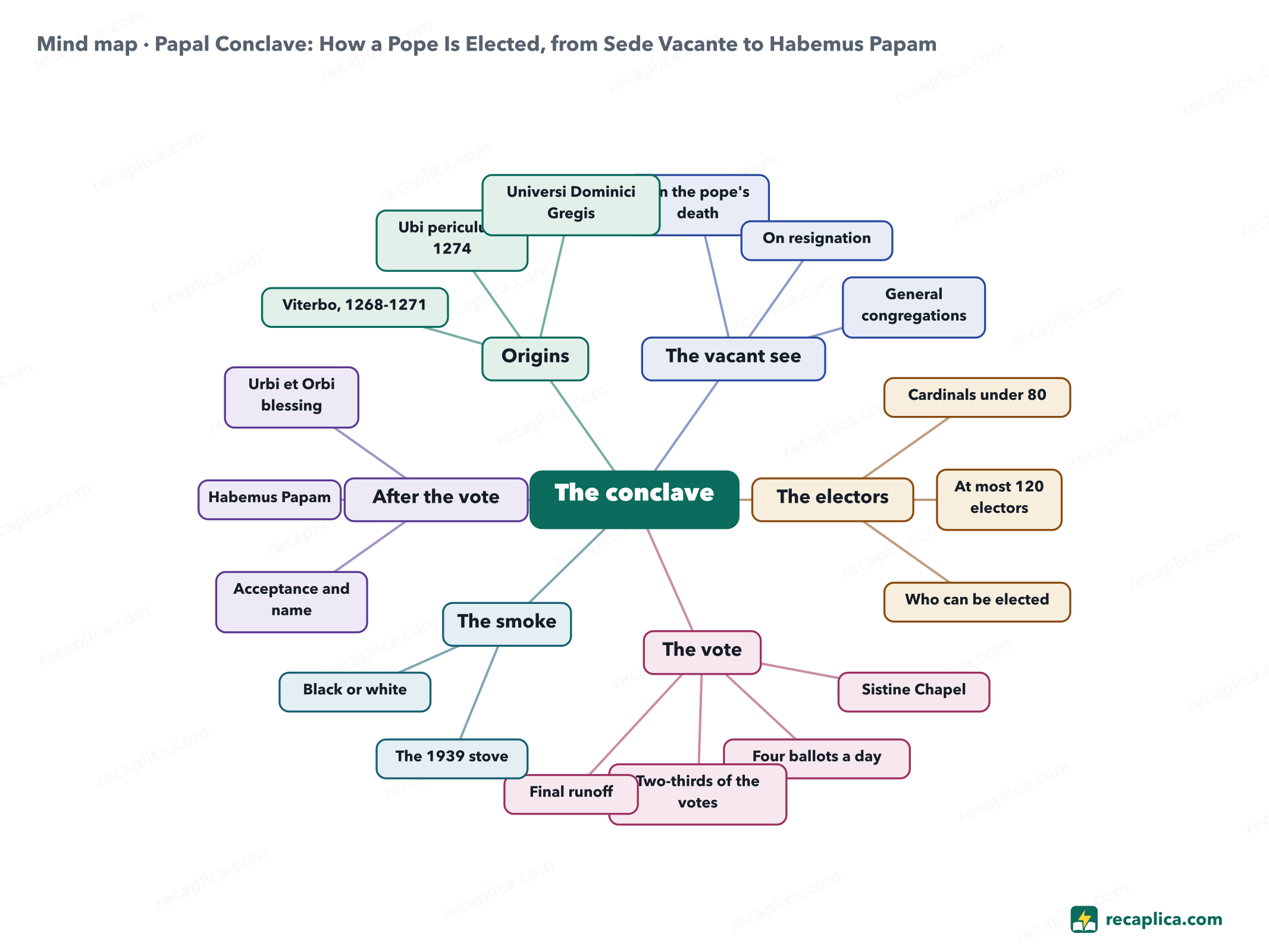
Quiz: test yourselfAnswer the questions to check what you have learned: you get instant feedback and a short explanation. Grade 0/10 0/5
FlashcardsTap the card to flip it and check whether you remember the answer, then move to the next one. 1 / 7 Explain it in your own wordsThe ultimate test: if you can explain it in simple words, you've truly understood it. Write your explanation, then compare it with the Recap. Your explanation is saved only on this device.
Frequently asked questionsHow long does a papal conclave last?There is no set length: voting goes on until someone reaches two-thirds. The conclaves of 2005, 2013 and 2025 all ended the day after the cardinals entered the Sistine Chapel. History has seen very long elections, such as the one at Viterbo that ended in 1271 after 2 years and 9 months, and very short ones, like Pius XII's in 1939, which took about 20 hours according to Treccani. Who can become pope?The conclave rules give the vote to cardinals but do not restrict the choice to them: the man elected need not be a cardinal or be under 80. If he is not already a bishop, he is ordained bishop right after accepting. How is the black and white smoke made?After each vote the ballots and notes are burned in a cast-iron stove first used at the 1939 conclave. A second stove, added in 2005, burns chemical cartridges that colour the smoke. Vatican News reported that in 2025 the black mixture contained potassium perchlorate, anthracene and sulphur, and the white one potassium chlorate, lactose and Greek pitch. What happens if a pope resigns?The Code of Canon Law allows a pope to resign, provided he does so freely and expresses it in the proper form, and it does not require anyone to accept the resignation. From that moment the see is vacant and the conclave follows exactly the same rules as after a death. Benedict XVI announced his resignation on 11 February 2013, taking effect at 8 pm on 28 February. Who runs the Catholic Church while the see is vacant?The College of Cardinals, but only for ordinary business or matters that cannot wait; it does not hold the pope's powers. The heads of the Curia's dicasteries lose their posts, except the camerlengo and the major penitentiary. The camerlengo is the one who certifies the pope's death and seals his study and bedroom. Every Recap goes through an independent review before publication. |