|
recaplica
Cryptocurrency: what it is and how it works | |||||||||
| © 2026 Recaplica · recaplica.com — All rights reserved | |||||||||
Cryptocurrency: what it is and how it worksWhat to print Page numbers appear when printing with default margins. SlidesChoose a cut Flash10 slidesThe essential thread, to present in classFull18 slidesEvery chapter and the deeper detailBoth come with speaker notes. In 30 seconds quick readCryptocurrencies, which Italian authorities prefer to call crypto-assets, are digital representations of value that, unlike the euro or the dollar, carry no legal tender status. They run on the blockchain, a public and decentralized digital ledger where transactions get grouped into blocks linked together, with no bank or central body required. Validating those transactions takes a computing mechanism called proof-of-work, and that very computation is the reason mining uses so much energy; proof-of-stake is a studied alternative that uses far less. Whoever holds crypto-assets keeps them in a wallet protected by a pair of cryptographic keys, but also runs into concrete risks: sharp price volatility, scams and the absence of full legal protection. Key Points
Key figures
Deep DiveWhat crypto-assets really areThe word most people use every day, “cryptocurrency,” isn’t the most precise one. Banca d’Italia, on its financial education portal, defines crypto-assets as digital representations of value or of a right, and immediately clarifies the point that matters most: unlike official currencies such as the euro or the dollar, crypto-assets are not legal tender. No one has to accept them as payment, and no central bank guarantees their value. That’s why the institution prefers the term “crypto-assets.” The “crypto” prefix isn’t decorative. CONSOB explains it by describing a kind of value that is “hidden,” usable only if you know a specific piece of computer code, and existing exclusively in digital form: it’s created and exchanged only electronically, never as a banknote or a coin. The first of these crypto-assets, Bitcoin, was created in 2008 as an alternative payment method to currencies issued by central banks, according to the European Parliament. Since then the phenomenon has multiplied: by 2020 there were already 5,600 different versions of it, worth an estimated 250 billion euros combined. The blockchain: a ledger no one runs aloneThe piece of technology that makes all this possible is the blockchain, literally the “chain of blocks.” Banca d’Italia defines it as a public, decentralized digital ledger that stores transactions securely and in a way that can’t be altered; it’s decentralized because it needs no central intermediary, and its data lives in blocks protected by cryptography. CONSOB adds a practical detail: it’s a constantly growing list of records, the “blocks,” linked together and secured through cryptography. The mechanism that holds the chain together is simple to describe: each block contains part of the information plus the identifying code of the previous block, somewhat like how a network of connected computers exchanges data, the same principle behind the internet.
This structure, according to Banca d’Italia, makes the blockchain more secure than traditional record-keeping systems: there’s no single database that would bring the whole system down if compromised, because the same information is duplicated across a huge number of nodes on the network. Mining and proof-of-work: why validating blocks costs energyAdding a new block to the chain isn’t automatic: Bitcoin’s system requires mining, which CONSOB describes as the computing power needed to solve complex algorithmic calculations — in practice, an algorithm that anyone with enough computing power can run. The Bank for International Settlements explains why that calculation has to be so costly: Bitcoin achieves data immutability, and therefore payment finality, through costly computations, “proof-of-work.” Making the calculation cheap would open the door to what’s known as “double-spending,” spending the same digital coin twice: among the reasons the system is built this way is precisely the goal of making that kind of fraud too expensive to be worth it. Whoever contributes computing power to validate blocks gets newly created bitcoins in return, the so-called “block rewards,” which according to the Bank for International Settlements have made up the bulk of mining income so far. That very race to compute is, according to estimates cited by the European Parliament, one of the factors that pushes Bitcoin’s overall energy consumption to levels comparable to a small country — a general estimate, without an exact kilowatt-hour figure.
Proof-of-stake: a lower-energy alternativeProof-of-work isn’t the only way to keep a network like this running. A Banca d’Italia study, published in its Questioni di Economia e Finanza series, notes that proof-of-work requires large amounts of electricity while several other distributed-ledger protocols consume far less, and it proposes moving from proof-of-work to proof-of-stake as one path to cutting the energy impact. The sources consulted for this Recap don’t go into the technical detail of how proof-of-stake picks who validates blocks: what stays confirmed is that it’s an alternative to mining capable of running on far less energy. Wallets and keys: what “owning” a crypto-asset meansThere’s no physical piggy bank to keep a crypto-asset in: Banca d’Italia defines the wallet as the electronic vault that holds it, and CONSOB calls it, more simply, a “digital wallet.” Inside that vault there aren’t actual coins, but a pair of cryptographic keys — public and private, as CONSOB calls them — that identify the owner and authorize transactions.
The risks, according to financial regulatorsThe picture that emerges from official sources is far from reassuring on practical safety. Banca d’Italia warns that buying crypto-assets exposes people to varying degrees of risk, and that for the unbacked kind, like Bitcoin or Ether, the risk is very high: money can be lost to technical failures, theft, errors, or simply a collapse in value. CONSOB adds that the prices of major cryptocurrencies are subject to very wide swings, even within a single day, and it flags concrete scam risks. There’s also a protection gap: CONSOB notes that, without clear legal rules to fall back on, anyone who suffers harm has no effective legal protection to rely on. The European Parliament notes that people holding crypto-assets aren’t covered by the European Union’s consumer-protection rules, and that transactions are largely anonymous — a feature that, the same source notes, is also one of the reasons cryptocurrencies get used in criminal activity. That’s part of why the European Union introduced tracing rules for crypto-asset transfers above €1,000, through a legislative process the European Parliament formally approved in April 2023 and the Council of the European Union approved in May 2023. It’s worth keeping this separate from a currency that does carry legal tender status, like the euro: its purchasing power can erode over time because of inflation, but it remains a means of payment that must be accepted by law, with a value central banks work to keep stable. Crypto-assets carry none of those institutional guarantees. Slide deckSlides ready to download and make your own in PowerPoint or Google Slides, with speaker notes. Pick the Flash cut or the Full one.     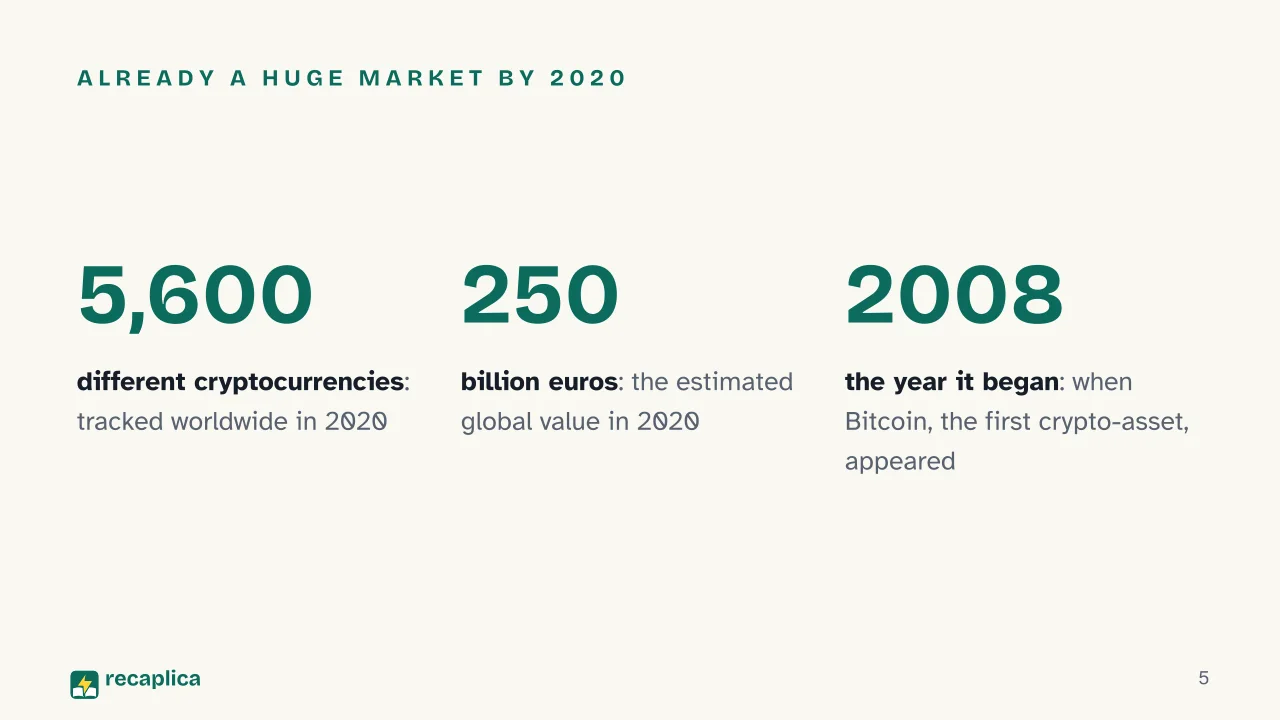 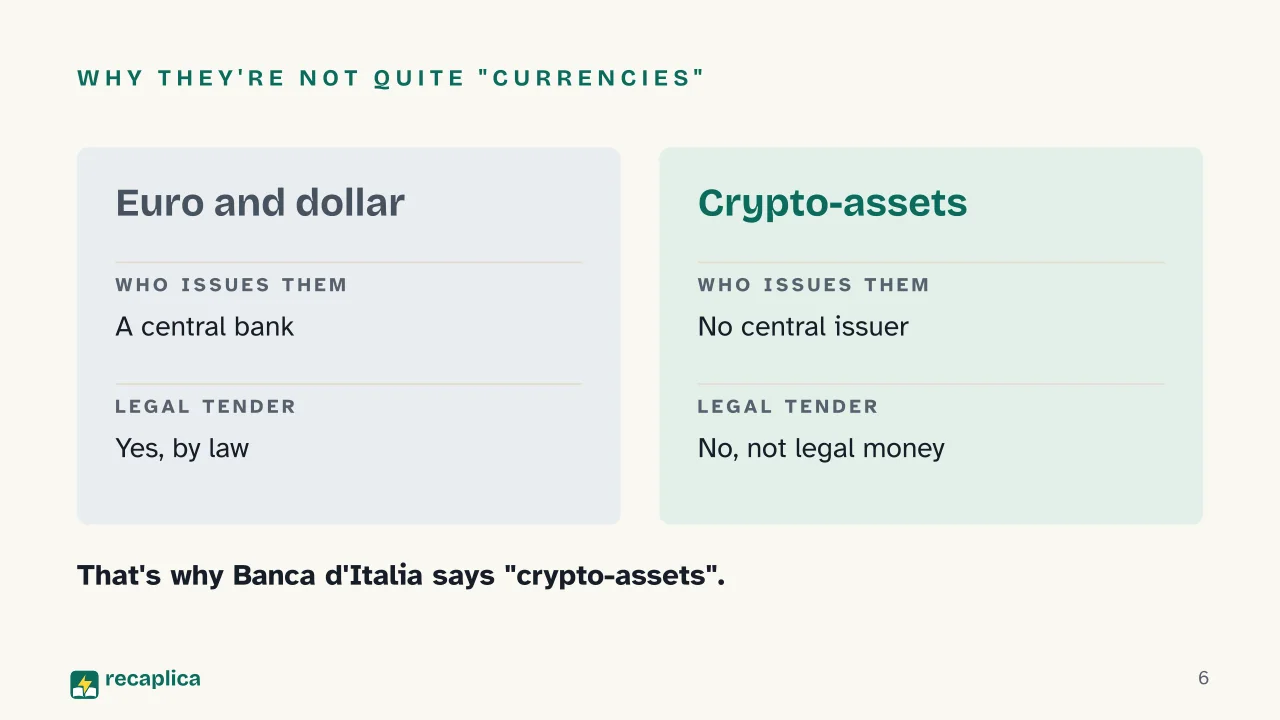  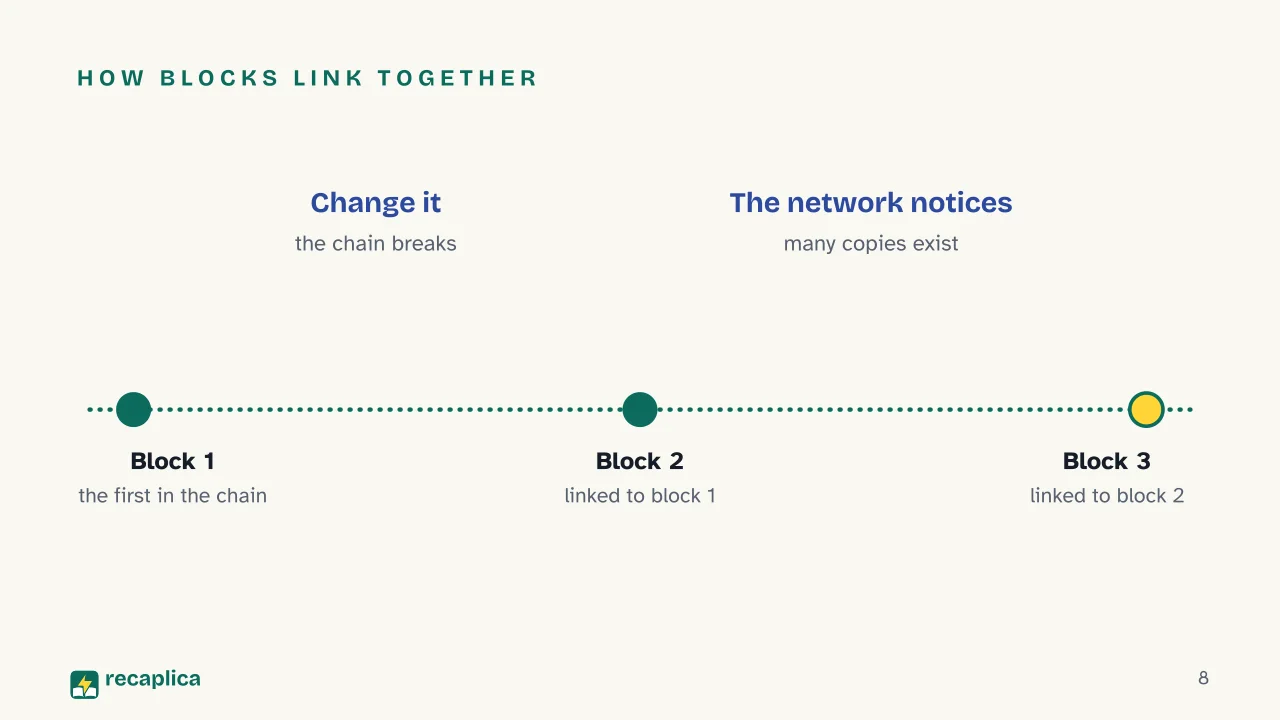 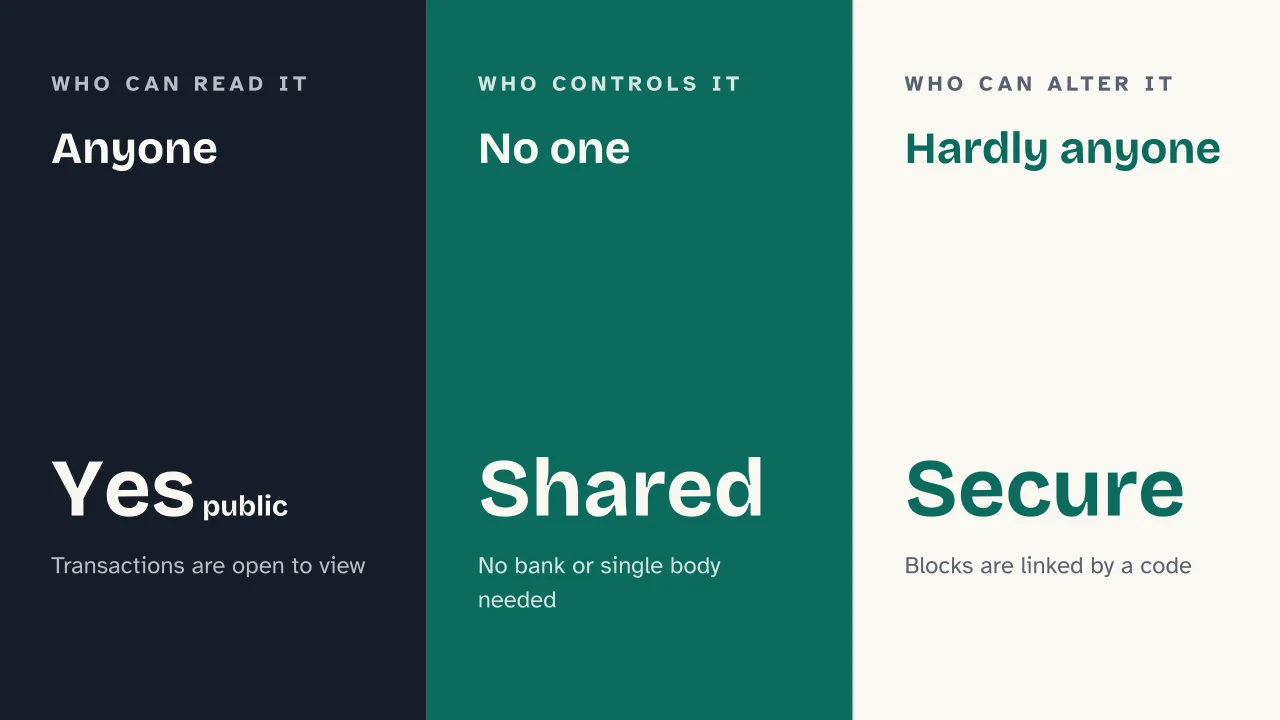  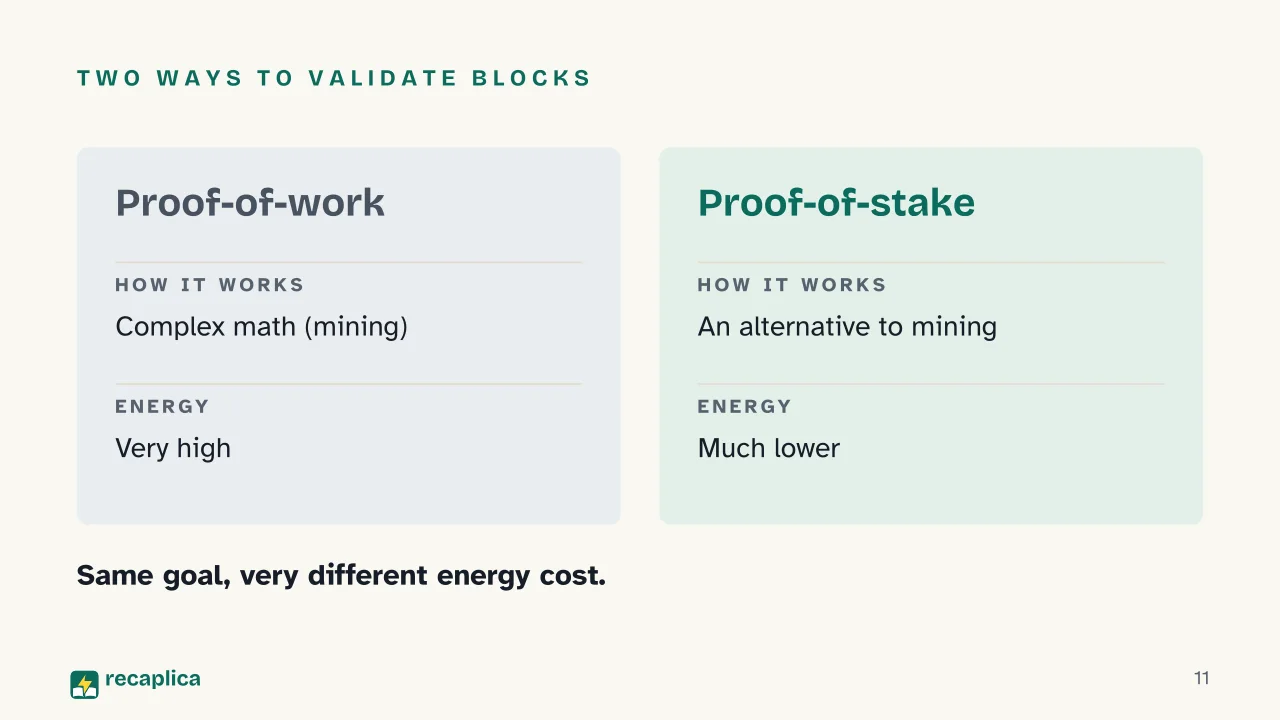   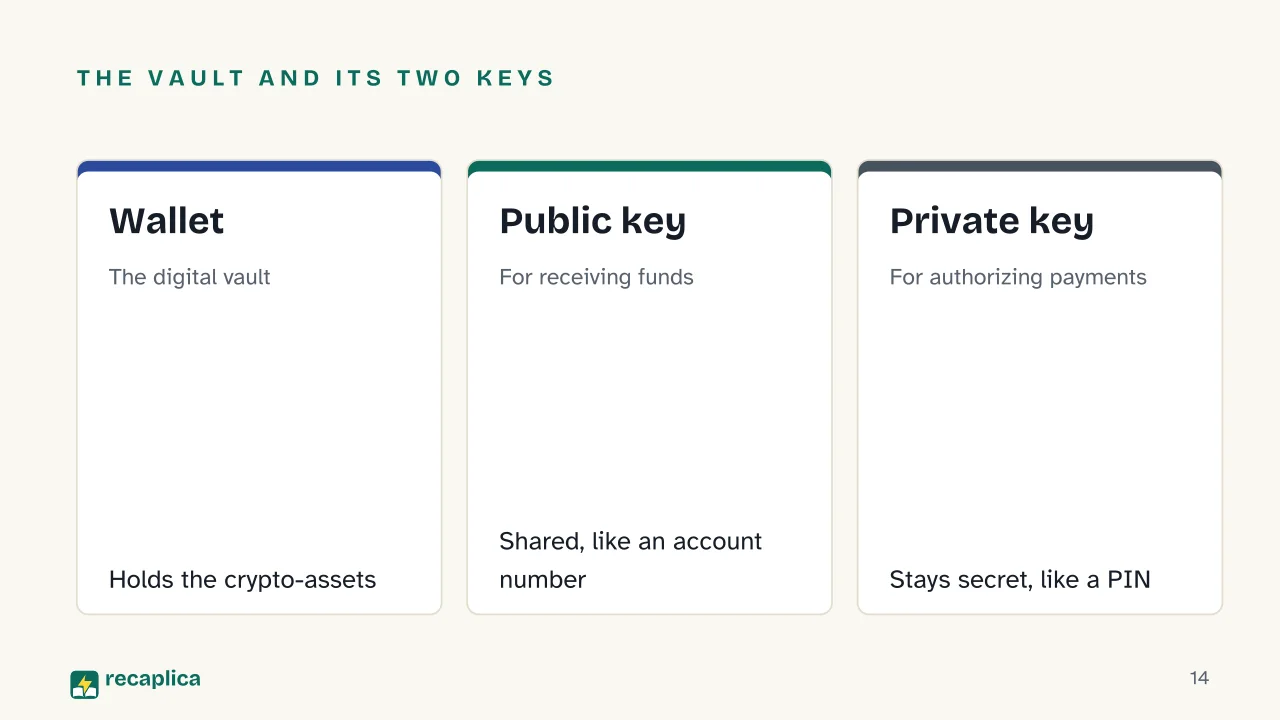 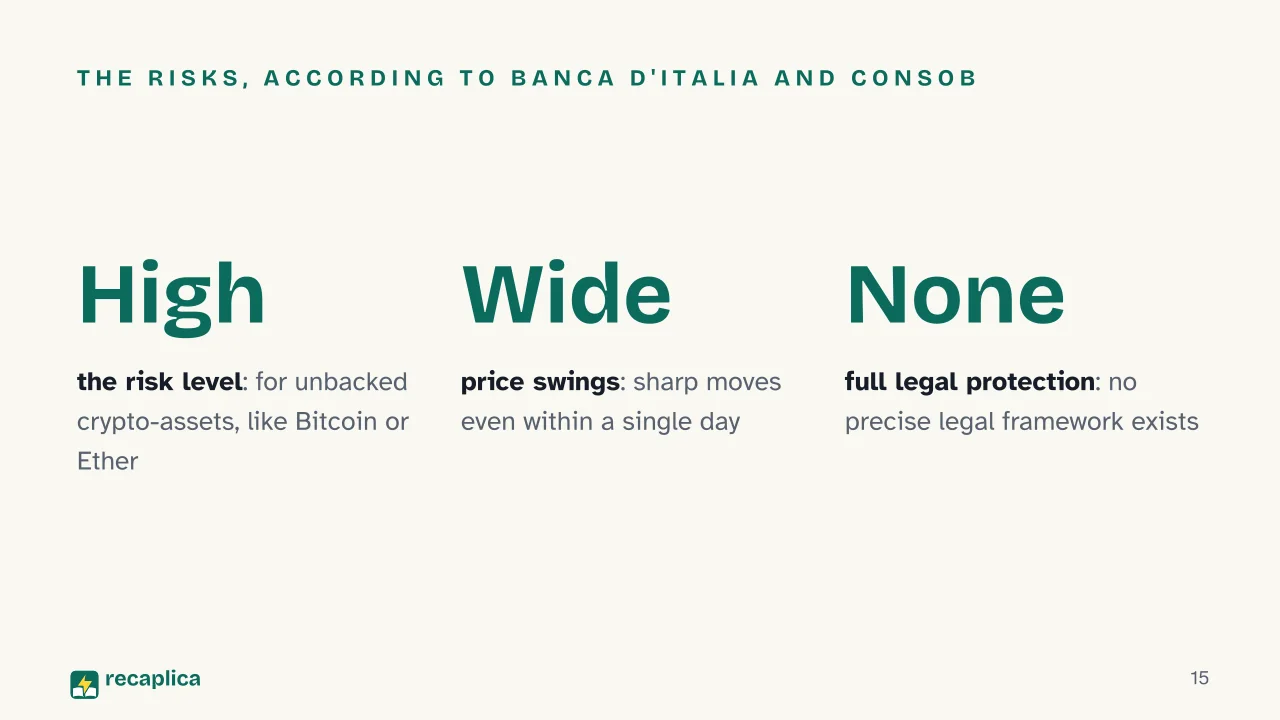 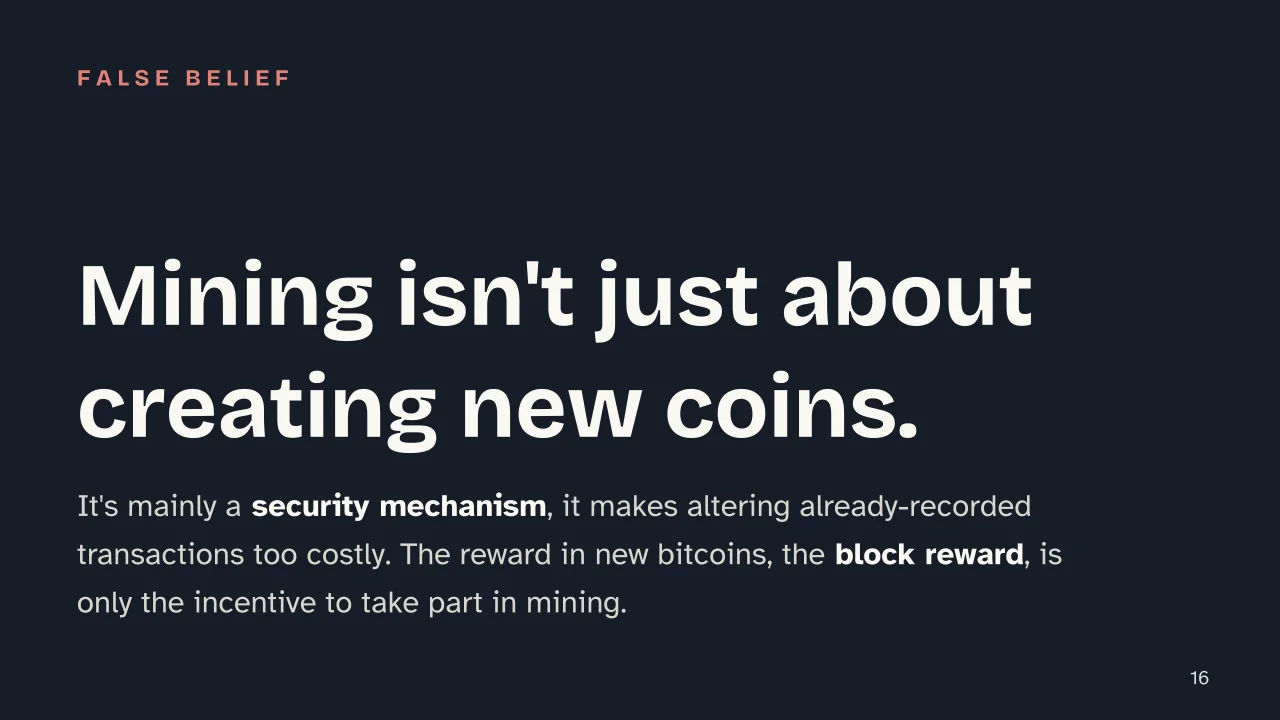 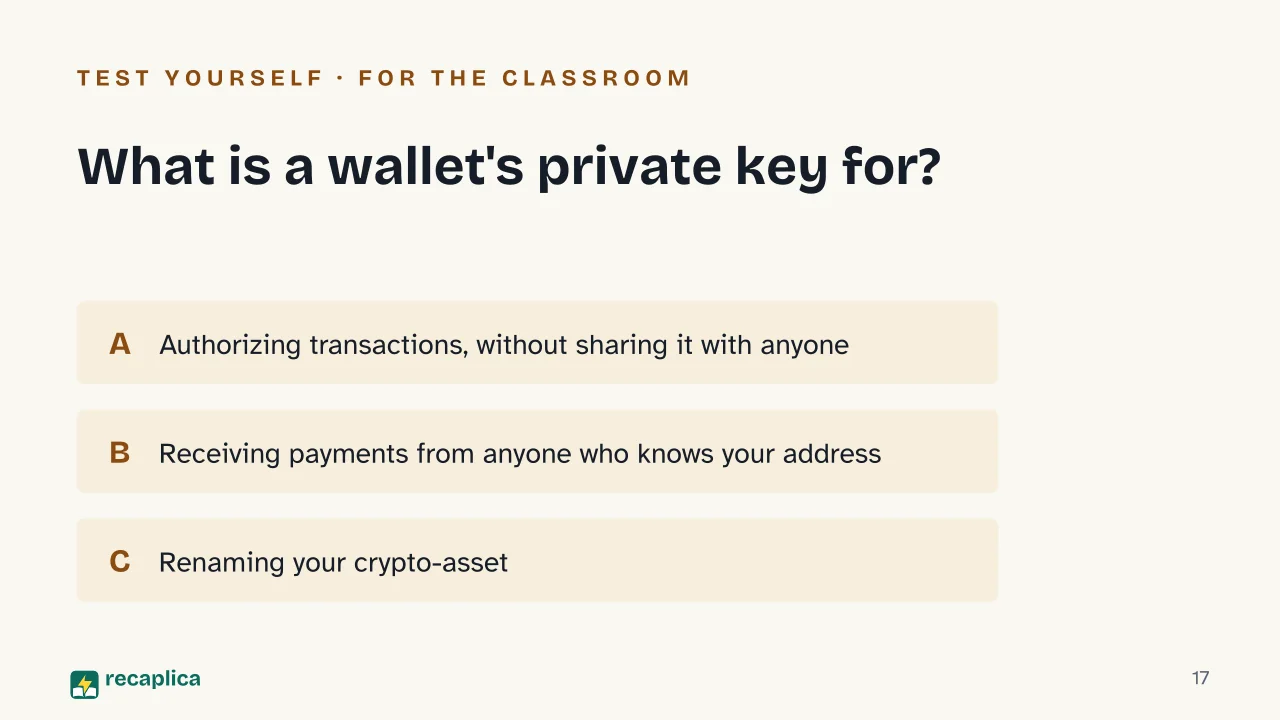  Common myths
Mind mapDrag the background to move around and the nodes to reposition them; use − and + to collapse and expand branches. 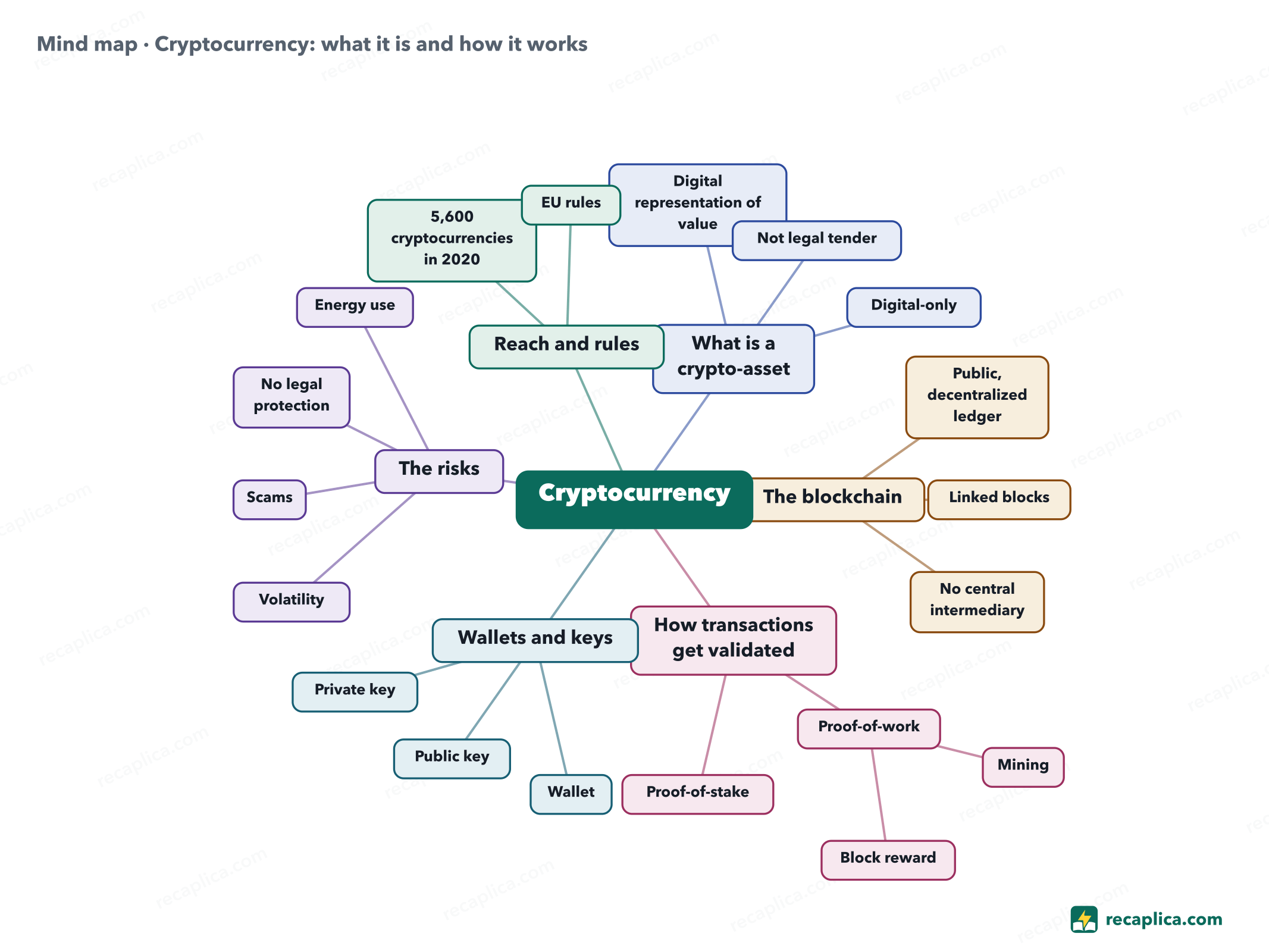
Quiz: test yourselfAnswer the questions to check what you have learned: you get instant feedback and a short explanation. Grade 0/10 0/5
FlashcardsTap the card to flip it and check whether you remember the answer, then move to the next one. 1 / 8 Explain it in your own wordsThe ultimate test: if you can explain it in simple words, you've truly understood it. Write your explanation, then compare it with the Recap. Your explanation is saved only on this device.
Frequently asked questionsIs buying cryptocurrency legal in Italy?There's no blanket ban: owning and trading crypto-assets isn't illegal. Banca d'Italia notes, though, that crypto-assets don't carry legal tender status the way the euro does, and CONSOB points out that people who use them don't get the protections that apply to regulated financial instruments. What is proof-of-work?It's the mechanism Bitcoin uses to make transactions secure and final: according to the Bank for International Settlements, solving costly computational puzzles (mining) makes it very expensive to alter or duplicate coins that have already been recorded. Why does mining use so much energy?Because proof-of-work is designed to be costly on purpose: making the calculation difficult and expensive is, among the main factors, what protects the network from tampering. According to estimates cited by the European Parliament, Bitcoin's overall energy use compares to that of a small country. Is cryptocurrency anonymous?Not entirely. The European Parliament notes that transactions are largely anonymous, which is also one of the reasons cryptocurrencies get used for criminal activity; they still stay permanently recorded on the public blockchain, though, so they can be traced with the right tools. What's the difference between "cryptocurrency" and "crypto-asset"?In everyday use they're often treated as synonyms, but Banca d'Italia prefers 'crypto-asset' as the more accurate term: 'cryptocurrency' suggests money, while these digital representations of value don't carry legal tender status the way the euro or the dollar do. Every Recap goes through an independent review before publication. |