Skip to content
recaplica

    One moment: security check

    Cloudflare wants to make sure you're not a robot. Tick the box below and your search will continue on its own.

    IT
    recaplica Company Liquidation: What It Is and How the Process Works
    © 2026 Recaplica · recaplica.com — All rights reserved
    Home › Economics

    Company Liquidation: What It Is and How the Process Works

    By Recaplica Newsroom · Updated on October 3, 2026

    What to print

    Page numbers appear when printing with default margins.

    Slides

    Choose a cut

    Flash10 slidesThe essential thread, to present in classFull14 slidesEvery chapter and the deeper detail

    Both come with speaker notes.

    Telegram channel
    recaplica Clear in 30 seconds, yours in 10 minutes.
    In 30 seconds Key points Figures Deep dive Slides Myths Mind map Quiz Flashcards FAQ

    In 30 seconds quick read

    Company liquidation is the process by which a court takes charge of a business that can no longer pay its debts, sells off its assets and uses the proceeds to repay creditors as far as possible. A court appoints an administrator who manages the assets in place of the owner, while creditors are grouped together instead of each chasing payment on their own. It does not start over a single missed bill: the business has to be genuinely insolvent, and very small businesses are left out of the process altogether. Italy's own version, called "liquidazione giudiziale", replaced the older word "fallimento" in 2022 but works on the same principle.

    Key Points

    • Company liquidation puts a court-appointed administrator in charge of an insolvent business's assets instead of its owner.
    • It opens only once a business is insolvent, meaning it can no longer keep up with its debts over time, not after a single missed payment.
    • Very small businesses can stay out of the process even while insolvent, if national law sets a size threshold below which it doesn't apply.
    • Once the process opens, creditors stop acting individually and are grouped together against the available assets.
    • In Italy, the procedure was renamed "liquidazione giudiziale" in 2022, replacing the older term "fallimento" (bankruptcy), without changing how it works.
    • In 2025, Italian courts opened 9,795 of these procedures, more than the 9,162 opened in 2024.

    Key figures

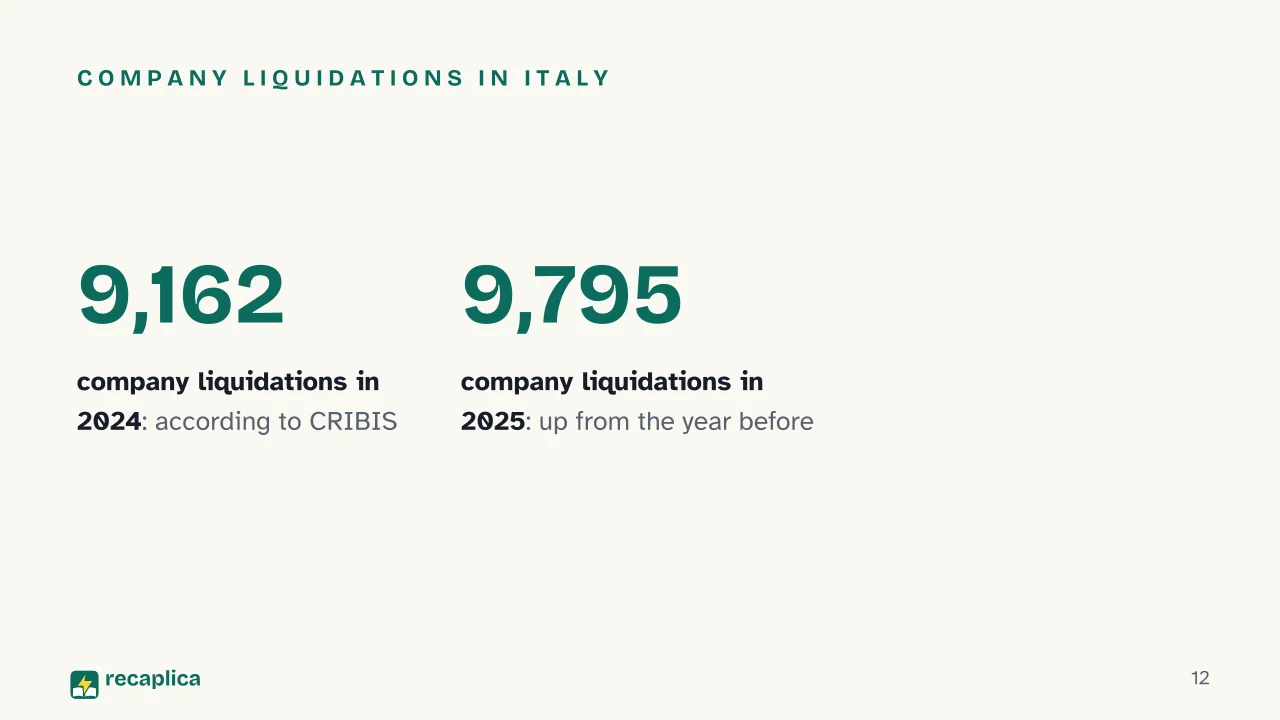
    • 9,795 company liquidations opened in Italy in 2025, up from 9,162 in 2024 Source: CRIBIS, liquidazioni giudiziali observatory, 2025
    • +10.6% growth in severe insolvency procedures (company liquidations and controlled liquidations combined) in Italy by the end of 2025 compared with the same period of 2024, from 9,196 to 10,171 Source: Cerved, procedures and liquidations observatory, 2025

    Deep Dive

    Until 2022, Italian law called it “fallimento”, the word for bankruptcy. Since 15 July 2022, the Codice della crisi d’impresa e dell’insolvenza (Legislative Decree 14 of 2019) has used a new name, “liquidazione giudiziale”, for the same underlying idea: a court takes charge of a business that can no longer keep up with its debts, sells off its assets, and uses the proceeds to repay creditors as far as possible.

    When the process opens

    The 2019 decree describes insolvency as the condition of no longer keeping up with one’s debts. It’s a condition that surfaces over time, through missed payments or other signs visible from the outside, rather than through one isolated late payment.

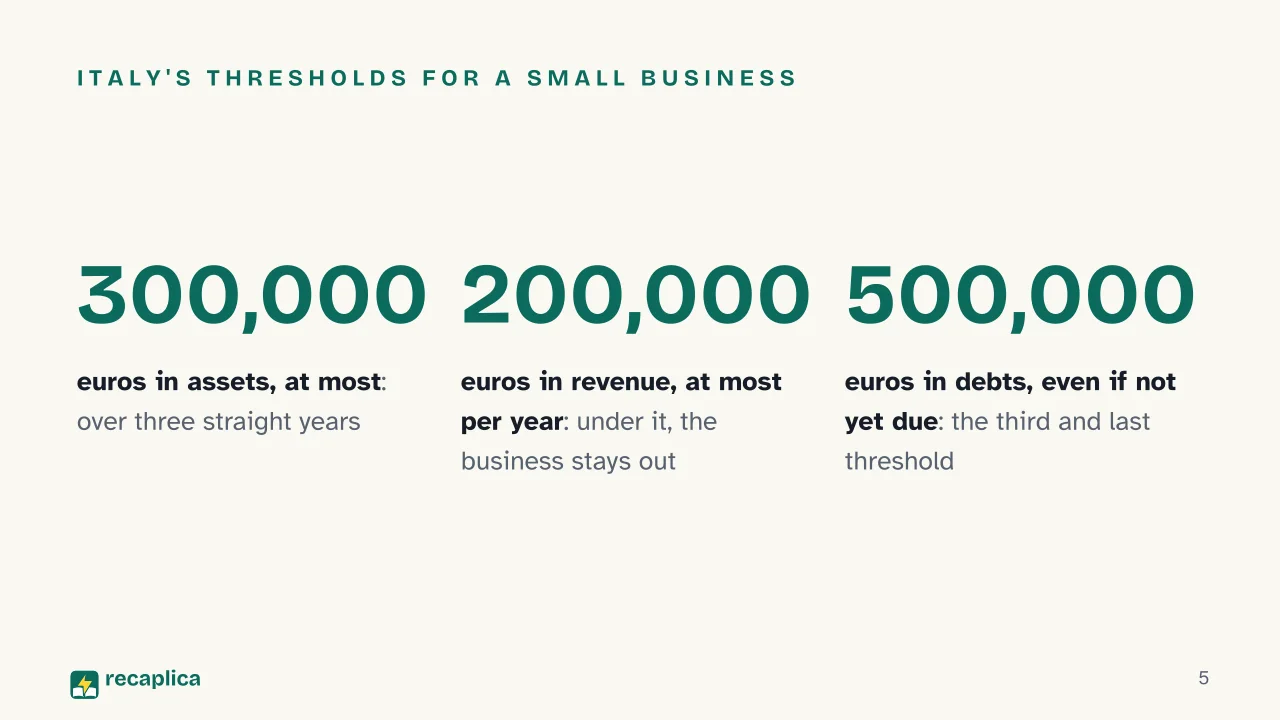
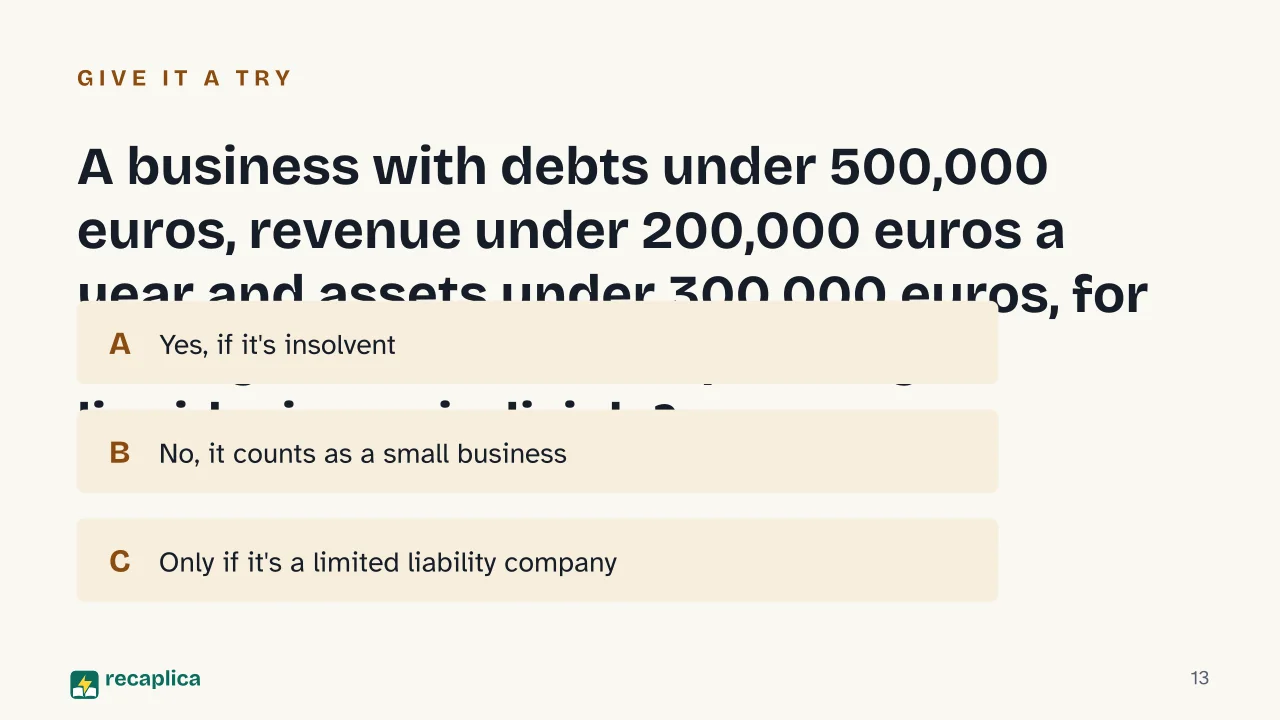
    Not every insolvent business ends up in company liquidation. Italy’s Codice della crisi d’impresa leaves out the smallest businesses, defined as “impresa minore”: those that, for three straight years — or since they started, if younger — stay under all three of these thresholds.

    ThresholdLimit
    Total assetsunder 300,000 euros
    Revenueunder 200,000 euros a year
    Debtsunder 500,000 euros, even if not yet due

    A small shop that has held an asset base of 180,000 euros, yearly revenue of 90,000 euros and debts of 120,000 euros for three years stays under every threshold: even if it couldn’t pay its suppliers, it couldn’t be declared in liquidazione giudiziale. The procedure applies to commercial businesses that sit above these thresholds and are insolvent.

    Worked example: picture a limited liability company selling industrial machinery, with 400,000 euros owed to suppliers and banks and two years of revenue that hasn’t covered them. If it sits above the small-business thresholds and the court declares it insolvent, the liquidazione giudiziale can open: under the Codice della crisi d’impresa, a limited liability company is a commercial business like any other, with no separate treatment for its legal form.

    Who runs the process

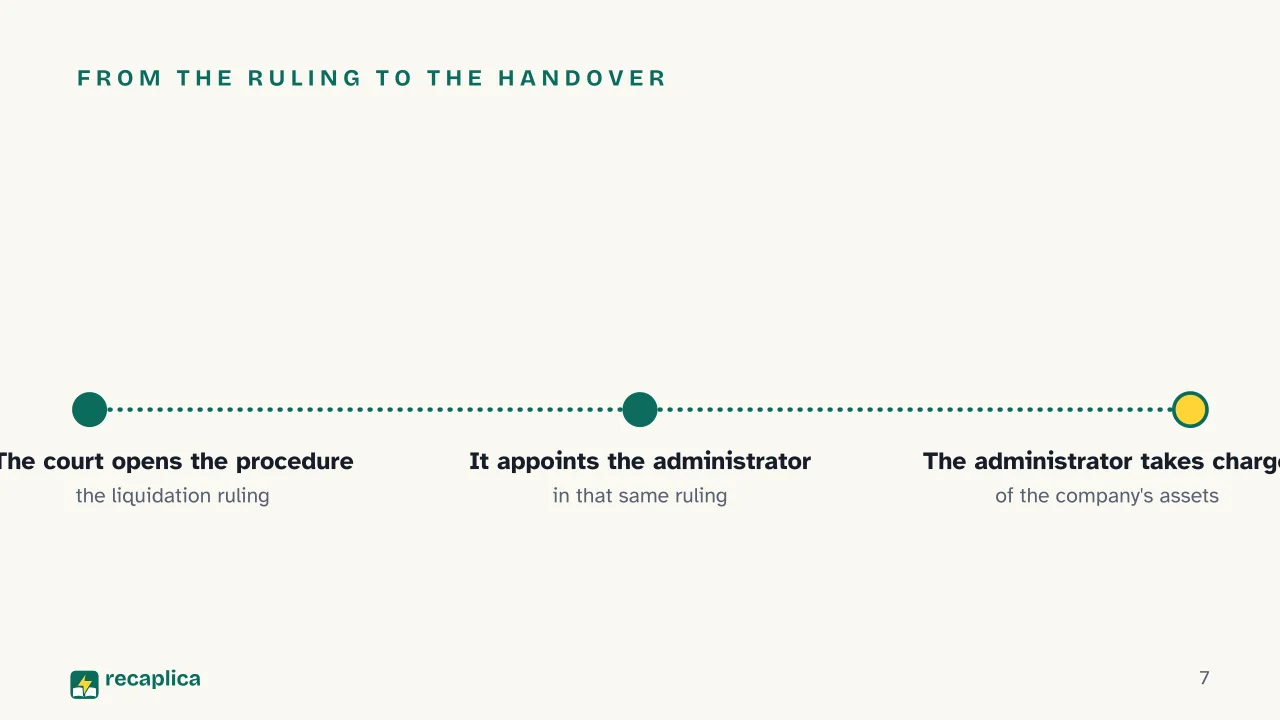
    In Italy, the competent court is the one covering the place where the business has the centre of its main interests, usually its registered office. That same court chooses the administrator in the act that opens the procedure: the appointment and the opening arrive together, in a single ruling.

    Administrator appointments go into a national register kept by the Ministry of Justice, digital and open to public searches.

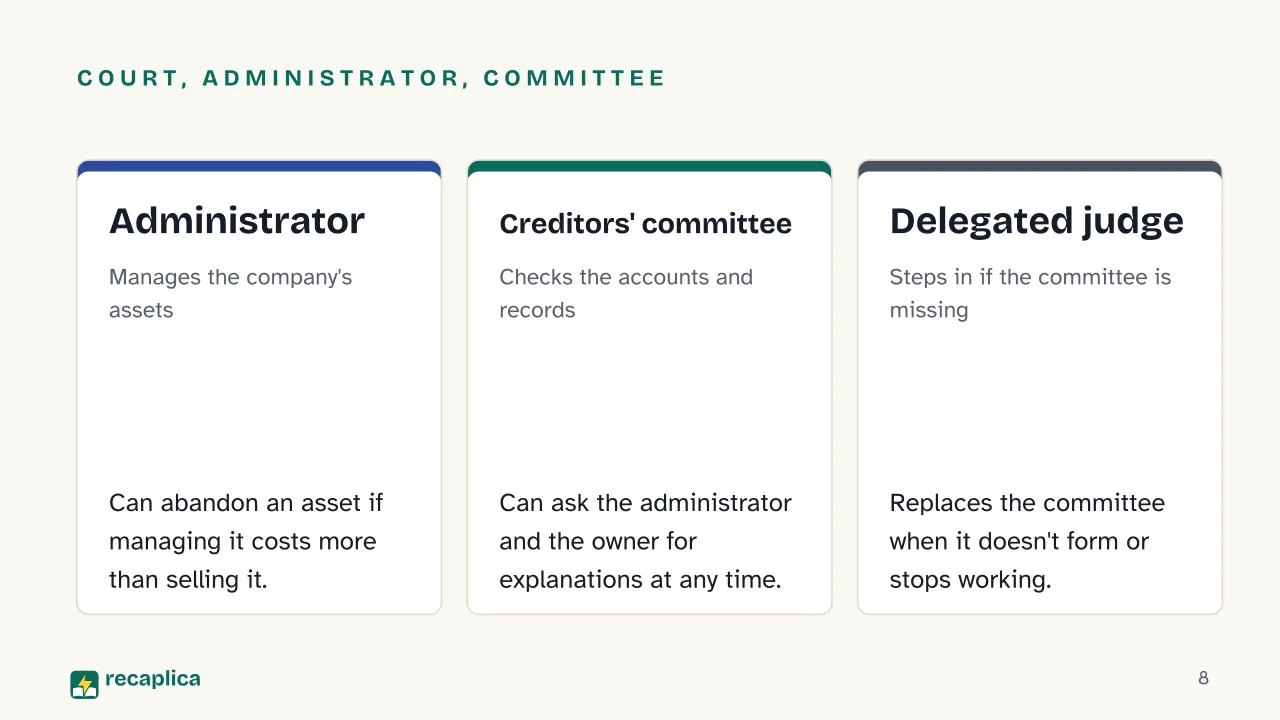
    Alongside the administrator sits the creditors’ committee, which can check the procedure’s accounts and records at any time and can ask both the administrator and the owner for explanations. When the committee is missing or can’t function, its decisions pass to a judge delegated by the court.

    What happens to the company’s assets

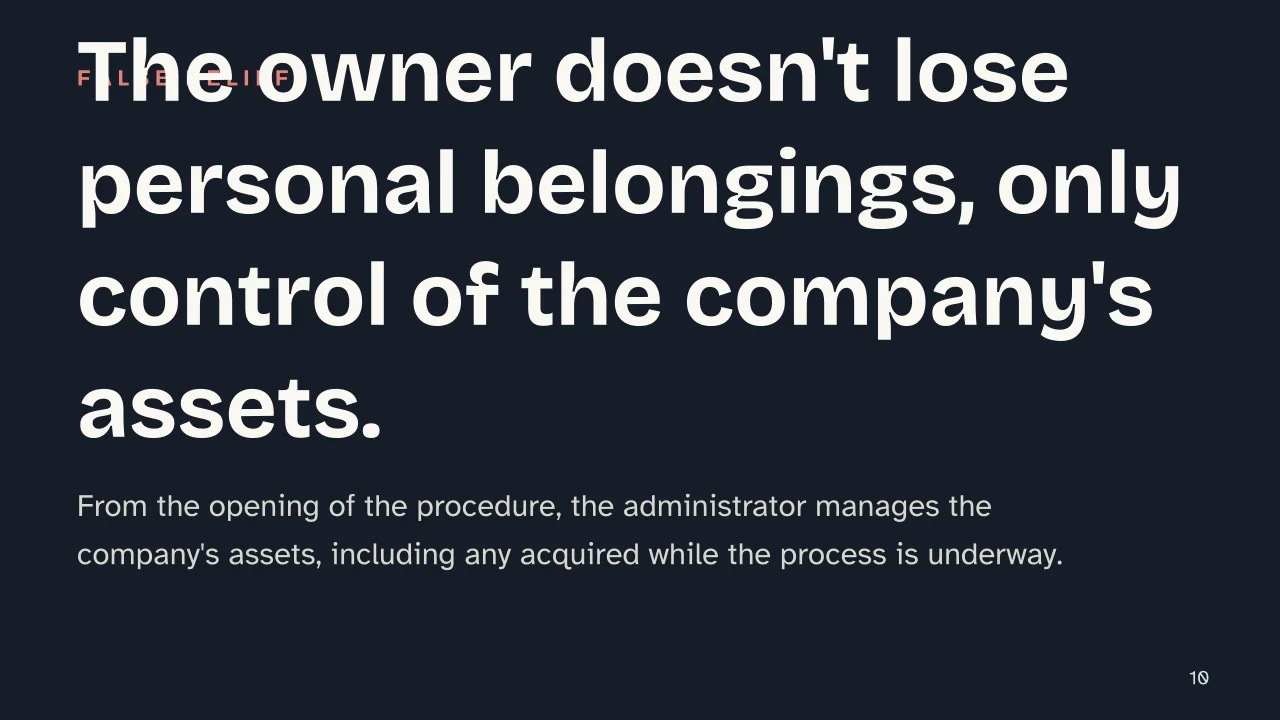
    From the day the court opens the liquidazione giudiziale, the owner loses control and management of their own assets. Assets the company receives while the procedure is under way also become part of it: a payment that arrives after the opening, for instance, still ends up in the pool the administrator manages.

    The administrator has some discretion over each asset. One can be left out of the process when managing or selling it would cost more than it would bring in, once the sums are done.

    What happens to the debts

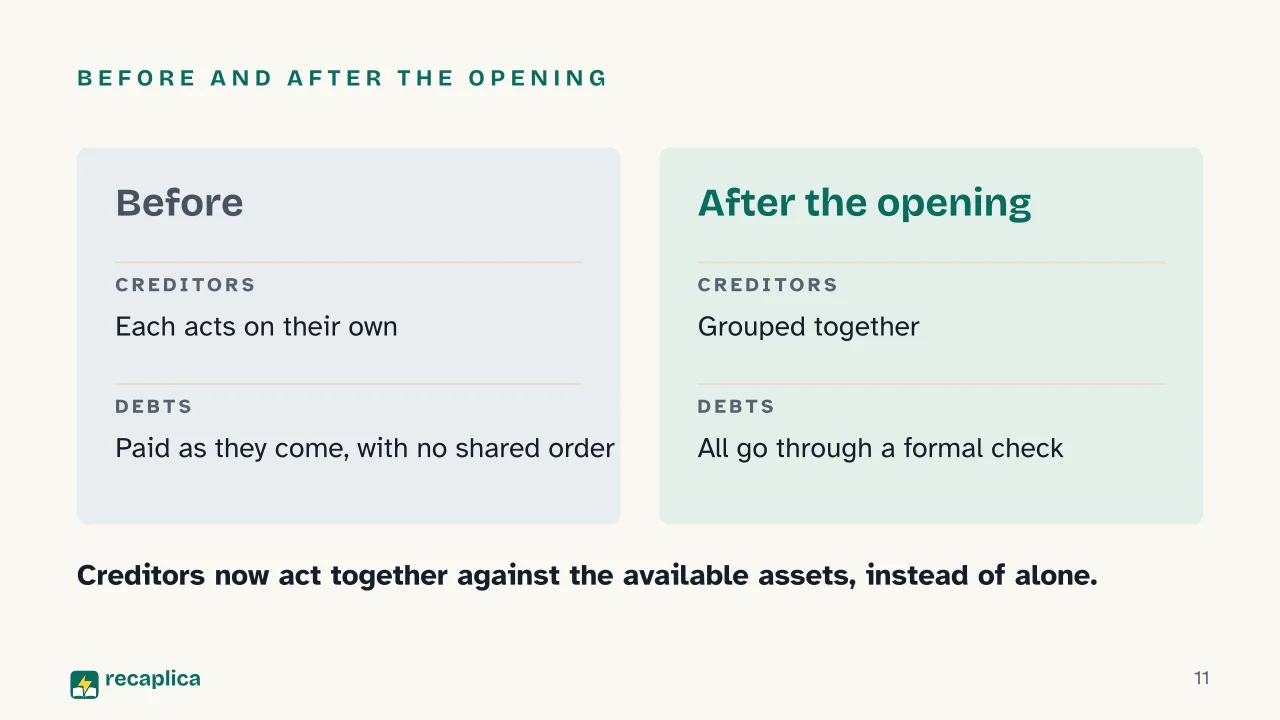
    Once the liquidazione giudiziale opens, every creditor is grouped together against the available assets, instead of each pursuing payment on their own as they could beforehand. Italian law calls this the “concorso dei creditori”: no one can act alone against the debtor or its assets any longer, because the available assets now answer to everyone together, under the procedure’s own rules.

    Every debt the company owes, including those with payment priority, must go through a formal check set out by the procedure before it’s settled. Even a creditor who would normally be paid first doesn’t receive anything automatically: their claim is checked first, and only then, if confirmed, paid in the order the law sets.

    Anyone tracking the health of a country’s economy often finds these numbers next to other indicators, such as the labor market or a recession: openings of company liquidation, alongside other signals, help read how businesses are faring.

    The recent numbers

    According to the CRIBIS observatory, Italian courts opened 9,795 company liquidations in 2025, more than the 9,162 opened in 2024. A wider figure comes from Cerved, which counts company liquidations together with controlled liquidations under the label “severe insolvency procedures”: by the end of 2025 that combined count stood at 10,171, up 10.6% from 9,196 in the same period of 2024. The two figures measure different things — the first only company liquidations, the second a broader category — and shouldn’t be mixed together.

    Slide deck

    Slides ready to download and make your own in PowerPoint or Google Slides, with speaker notes. Pick the Flash cut or the Full one.
    Slide 1 of the presentation on Company Liquidation: Company LiquidationSlide 2 of the presentation on Company Liquidation: Does a company still "go bankrupt"?Slide 3 of the presentation on Company Liquidation: Ahead in this deckSlide 4 of the presentation on Company Liquidation: Chapter 01: When it opensSlide 5 of the presentation on Company Liquidation: Italy's thresholds for a small businessSlide 6 of the presentation on Company Liquidation: Chapter 02: Who runs itSlide 7 of the presentation on Company Liquidation: From the ruling to the handoverSlide 8 of the presentation on Company Liquidation: Court, administrator, committee: Administrator, Creditors' committee, Delegated judgeSlide 9 of the presentation on Company Liquidation: Chapter 03: Assets and debtsSlide 10 of the presentation on Company Liquidation: The owner doesn't lose personal belongings, only control of the company's assets.Slide 11 of the presentation on Company Liquidation: Before and after the openingSlide 12 of the presentation on Company Liquidation: Company liquidations in ItalySlide 13 of the presentation on Company Liquidation: A business with debts under 500,000 euros, revenue under 200,000 euros a year and assets under 300,000 euros, for three years: can it end up in Italy's liquidazione giudiziale?Slide 14 of the presentation on Company Liquidation: Time for a recap
    Flash10 slidesThe essential thread, to present in classFull14 slidesEvery chapter and the deeper detail

    Common myths

    • ✗ Myth Bankruptcy and company liquidation are two different things.

      ✓ Reality In most legal systems they describe the same event under different labels, and sometimes the label changes over time: in Italy, the procedure was called "fallimento" until 2022, when a reform renamed it "liquidazione giudiziale" without changing how it works. Someone who says a company "went bankrupt" is usually describing the same outcome that the law now files under a different name.

    • ✗ Myth The moment a company misses one payment, a court steps in.

      ✓ Reality What matters is an ongoing inability to keep up with debts, not an isolated late payment: a single missed invoice doesn't trigger the process. Many legal systems also carve out very small businesses, which can stay outside company liquidation even when they genuinely cannot pay their debts.

    • ✗ Myth Company liquidation takes the owner's personal belongings too.

      ✓ Reality The process targets the company's own assets: from the day it opens, those assets pass to a court-appointed administrator, not the owner's personal property. In Italy's procedure, strictly personal assets stay separate from the company's and outside the process entirely.

    Mind map

    Drag the background to move around and the nodes to reposition them; use − and + to collapse and expand branches.
    Customize
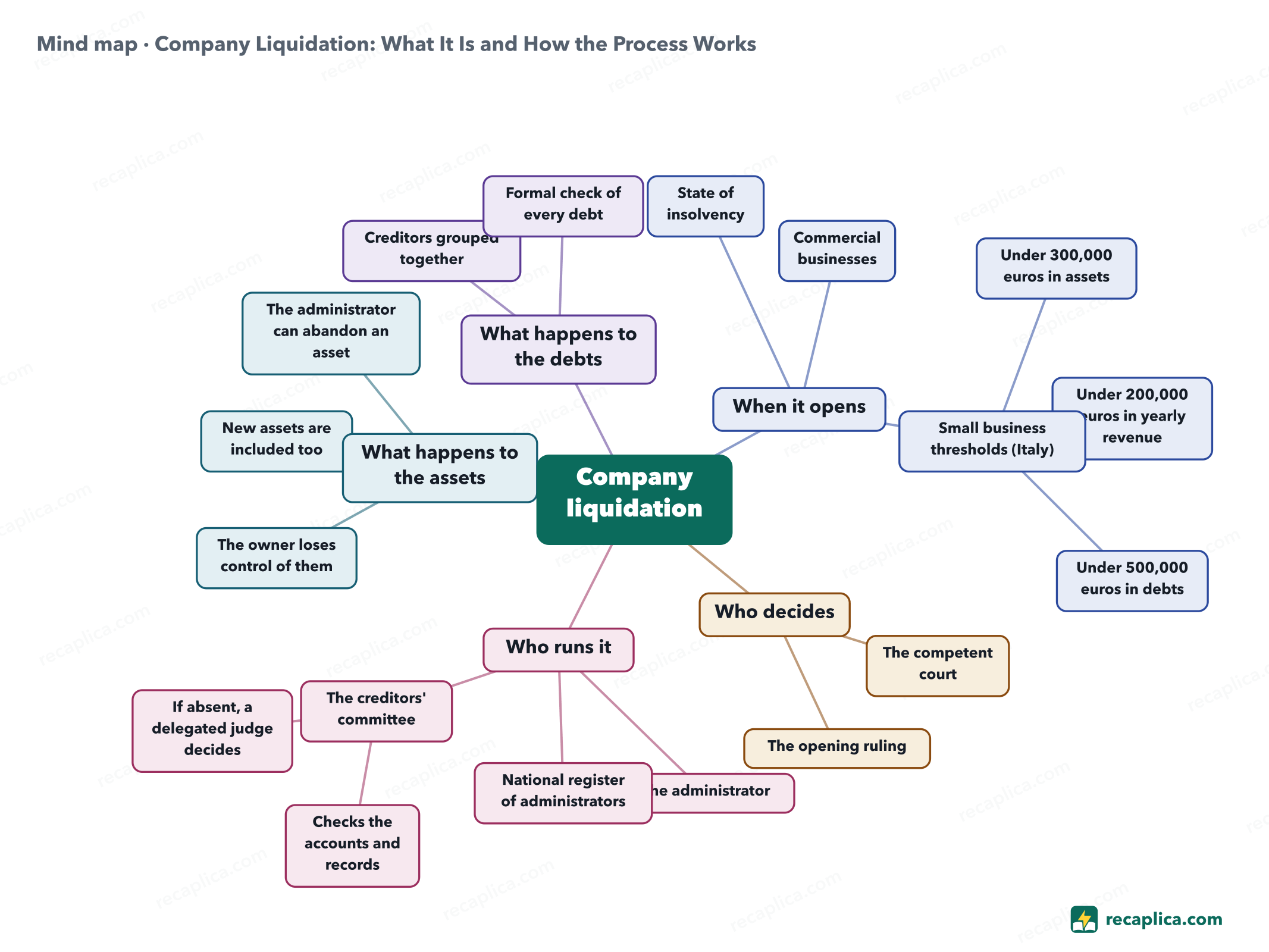
    Mind map: Company Liquidation: What It Is and How the Process Works
    • Company liquidation
      • When it opens
        • State of insolvency can no longer keep up with its debts
        • Commercial businesses
        • Small business thresholds (Italy)
          • Under 300,000 euros in assets
          • Under 200,000 euros in yearly revenue
          • Under 500,000 euros in debts
      • Who decides
        • The competent court where the business has its main interests
        • The opening ruling appoints the administrator in the same ruling
      • Who runs it
        • The administrator takes charge of the company's assets
        • National register of administrators kept by Italy's Ministry of Justice
        • The creditors' committee
          • Checks the accounts and records
          • If absent, a delegated judge decides
      • What happens to the assets
        • The owner loses control of them
        • New assets are included too acquired while the process is open
        • The administrator can abandon an asset if managing it costs more than selling it
      • What happens to the debts
        • Creditors grouped together act jointly instead of each on their own
        • Formal check of every debt even debts with payment priority

    Quiz: test yourself

    Answer the questions to check what you have learned: you get instant feedback and a short explanation.

    Grade 0/10 0/5
    1 What counts as a state of insolvency in company liquidation?

    Insolvency is about an ongoing inability to keep up with due debts, visible through missed payments or other outward signs over time — a single isolated late payment is not enough on its own.

    2 A business with 250,000 euros in assets, 150,000 euros in yearly revenue and 400,000 euros in debts, steadily for the past three years: can it be declared in liquidazione giudiziale in Italy?

    Italy's Codice della crisi d'impresa excludes businesses that stay under all three small-business thresholds for three years (300,000 euros in assets, 200,000 in yearly revenue, 500,000 in debts): this business sits under every one of the three, so it stays out of the procedure.

    3 In Italy's liquidazione giudiziale, who appoints the administrator, and when?

    The same court that opens the procedure also picks the administrator, in the ruling that declares the liquidazione giudiziale: both decisions arrive in a single document.

    4 True or false: once company liquidation opens, a creditor can still chase payment entirely on their own.

    Opening the procedure groups every creditor together against the available assets, replacing the individual actions each one could take beforehand.

    5 In Italy's procedure, what happens if the creditors' committee never forms or stops working?

    When the creditors' committee doesn't form or stops functioning, a delegated judge assigned by the court steps in and decides in its place.

    Answers: 1-B · 2-B · 3-B · 4-B · 5-B

    Flashcards

    Tap the card to flip it and check whether you remember the answer, then move to the next one.

    1 / 7

    Explain it in your own words

    The ultimate test: if you can explain it in simple words, you've truly understood it. Write your explanation, then compare it with the Recap.

    Your explanation is saved only on this device.

    Company liquidation is the process by which a court takes charge of a business that can no longer pay its debts, sells off its assets and uses the proceeds to repay creditors as far as possible. A court appoints an administrator who manages the assets in place of the owner, while creditors are grouped together instead of each chasing payment on their own. It does not start over a single missed bill: the business has to be genuinely insolvent, and very small businesses are left out of the process altogether. Italy's own version, called "liquidazione giudiziale", replaced the older word "fallimento" in 2022 but works on the same principle.

    Frequently asked questions

    Is there a difference between bankruptcy and company liquidation?

    Often it's just a label for the same event, and the label can change over time: in Italy, a 2022 reform replaced the word "fallimento" with "liquidazione giudiziale" for the same procedure, keeping the same underlying rules. Someone who still says a company "went bankrupt" is usually describing that same outcome under its older name.

    What happens if a limited liability company becomes insolvent?

    Under Italy's Codice della crisi d'impresa, a limited liability company is treated the same as any other commercial business: if it's insolvent and above the small-business thresholds, the court can open the liquidazione giudiziale. From that point, a court-appointed administrator manages the company's assets; creditors are grouped together, and every debt, even priority ones, goes through a formal check before being paid.

    Does every insolvent business end up in company liquidation?

    No. Italy's Codice della crisi d'impresa sets aside the smallest businesses, called "impresa minore": those that stay, for three years, under the ceilings set for assets (300,000 euros), revenue (200,000 euros a year) and debts (500,000 euros). A business of that size, even if insolvent, is not declared in liquidazione giudiziale.

    Who decides where the procedure opens?

    Jurisdiction in Italy belongs to the court covering the place where the business actually carries out its activity — in practice, almost always its registered office. That same court picks the administrator in the ruling that opens the procedure.

    Does the owner lose everything they own in company liquidation?

    They lose control of the company's assets, which pass to the administrator from the day the procedure opens, including assets that arrive while it's underway. The administrator can still leave an asset out of the process when taking it over would cost more than it's worth.

    Sources

    • Normattiva - Codice della crisi d'impresa e dell'insolvenza (D.Lgs. 14/2019)
    • CRIBIS - Osservatorio liquidazioni giudiziali
    • Cerved - Osservatorio procedure e liquidazioni

    Every Recap goes through an independent review before publication.

    Every evening, the day's new Recaps on our Telegram channel. Join the channel →

    Keep learning

    • Economics Sustainability: Definition, What It Means and the Three Pillars Sustainability, in the fuller phrase sustainable development, is development that covers the needs of the people living now while leaving future generations able to cover their own: that is how the United Nations defines it. The wording comes from Our Common Future, the report published in 1987 by the World Commission on Environment and Development, also called the Brundtland Commission. Treccani lists three interdependent factors behind the expression. The United Nations describe an integrated approach, where environmental concerns travel alongside economic development. Read the Recap →
    • Economics Sustainable Development Goals (SDGs): What Are the UN's 17 Goals for 2030 The United Nations formally adopted the 2030 Agenda on 25 September 2015, signed by 193 countries, including Italy. The Agenda groups 17 Sustainable Development Goals, from ending poverty to protecting the climate, broken down into 169 Targets and tracked by more than 240 indicators. It is a resolution of the General Assembly: a political commitment that governments made, with a 2030 deadline. The short titles widely used outside the UN's own documents, such as "No Poverty" or "Life on Land", circulate in different versions from country to country; in Italy they come from ASviS, the alliance founded in 2016 to track the Agenda's progress. Read the Recap →
    • Economics Types of Business: Definition and Main Legal Structures A business is an organized economic activity that a person or a group of people runs with continuity to produce or exchange goods and services. Before it can operate formally, the activity takes on a legal structure that decides who owns it, who runs it, and who answers for its debts. The sole proprietorship, the simplest form, keeps no separation between the owner and the business. A partnership splits ownership between two or more people, with liability that can stay personal or become limited depending on the type chosen. An LLC or a corporation goes further still, existing as a legal entity separate from the people who own it. Read the Recap →

    recaplica

    Clear in 30 seconds, yours in 10 minutes.

    Recaps Mind maps Request a Recap Telegram channel Mind map maker Our method About Privacy & cookies Legal notes & terms of use

    © 2026 Recaplica · A project by Curi S.r.l. — VAT IT05472000750

    Statistics, only if you say so

    To learn which Recaps help most we would use Google Analytics, with aggregate, anonymous data. It starts only with your OK, and you can change your mind anytime. Privacy policy