Skip to content
recaplica

    One moment: security check

    Cloudflare wants to make sure you're not a robot. Tick the box below and your search will continue on its own.

    IT
    recaplica Types of Business: Definition and Main Legal Structures
    © 2026 Recaplica · recaplica.com — All rights reserved
    Home › Economics

    Types of Business: Definition and Main Legal Structures

    By Recaplica Newsroom · Updated on October 2, 2026

    What to print

    Page numbers appear when printing with default margins.

    Slides

    Choose a cut

    Flash10 slidesThe essential thread, to present in classFull14 slidesEvery chapter and the deeper detail

    Both come with speaker notes.

    Telegram channel
    recaplica Clear in 30 seconds, yours in 10 minutes.
    In 30 seconds Key points Deep dive Slides Myths Mind map Quiz Flashcards FAQ

    In 30 seconds quick read

    A business is an organized economic activity that a person or a group of people runs with continuity to produce or exchange goods and services. Before it can operate formally, the activity takes on a legal structure that decides who owns it, who runs it, and who answers for its debts. The sole proprietorship, the simplest form, keeps no separation between the owner and the business. A partnership splits ownership between two or more people, with liability that can stay personal or become limited depending on the type chosen. An LLC or a corporation goes further still, existing as a legal entity separate from the people who own it.

    Key Points

    • A business only counts as such when the activity is organized and kept going over time, not a single isolated sale.
    • The legal structure a business takes decides mainly who is liable for its debts, and how it raises money.
    • A sole proprietorship is the simplest structure to set up, but the U.S. Small Business Administration notes the owner remains personally on the hook for the business's debts.
    • A general partnership leaves every partner exposed to the business's debts with their own money; a limited liability partnership caps that exposure for all of them instead.
    • An LLC blends features of a corporation and a partnership, protecting owners' personal assets in most cases.
    • A corporation is a legal entity separate from its owners and, among the structures the SBA describes, offers the strongest protection from personal liability.

    Deep Dive

    What counts as a business

    A business is, at its core, economic activity that’s organized and kept going over time to produce or exchange goods and services, not a one-off transaction. That part of the definition travels well across borders — what changes from country to country is mostly the paperwork, the taxes, and who ends up liable if the business can’t pay what it owes.

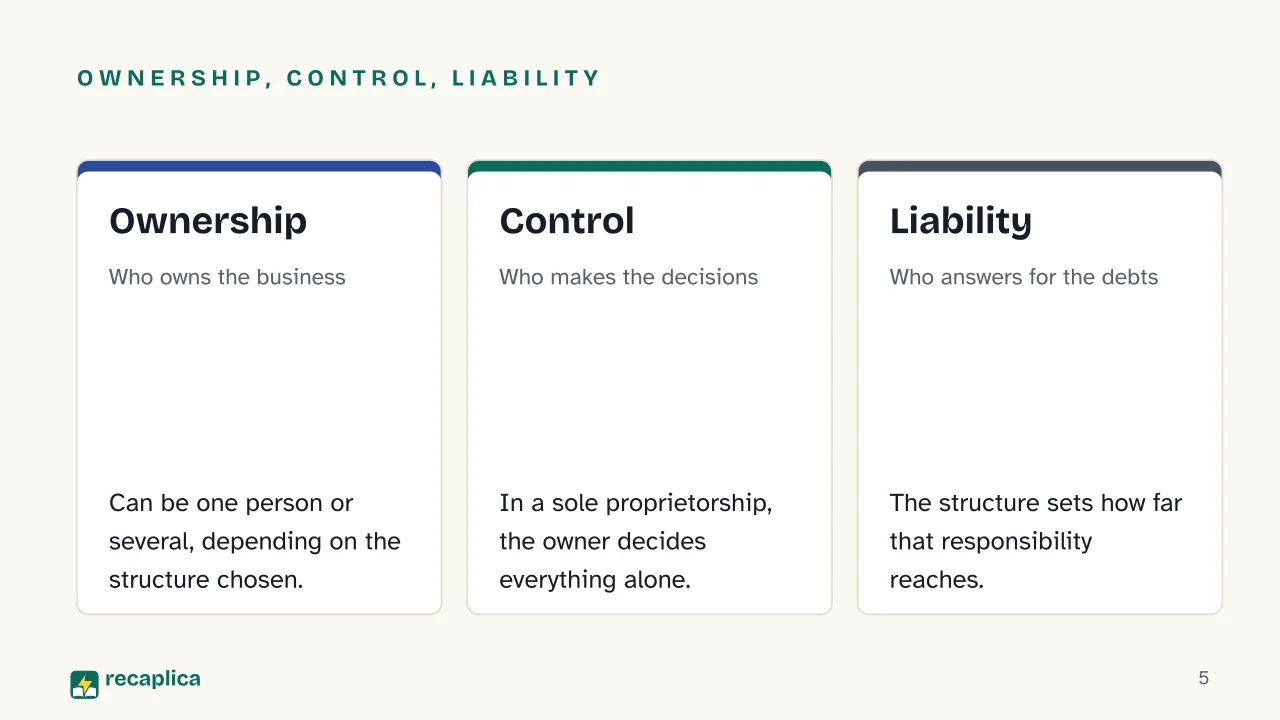
    That last question is exactly what a legal structure is for. Before a business operates formally, it has to take on a structure, and that choice decides who owns the business, who makes the calls, and who answers for its debts.

    Esempio pratico: two friends who bake and sell cakes from a home kitchen on weekends are already running a business, in the plain economic sense, once they do it regularly and for profit. Whether they register that activity as a sole proprietorship or as a partnership is a separate decision — one that mostly matters if an order goes wrong and a customer wants to be paid back.

    Going it alone: the sole proprietorship

    The U.S. Small Business Administration describes the sole proprietorship as the simplest structure a business can take. One person owns it, runs it, and keeps full control over every decision, usually after little more than registering the activity and picking up whatever licenses the trade requires.

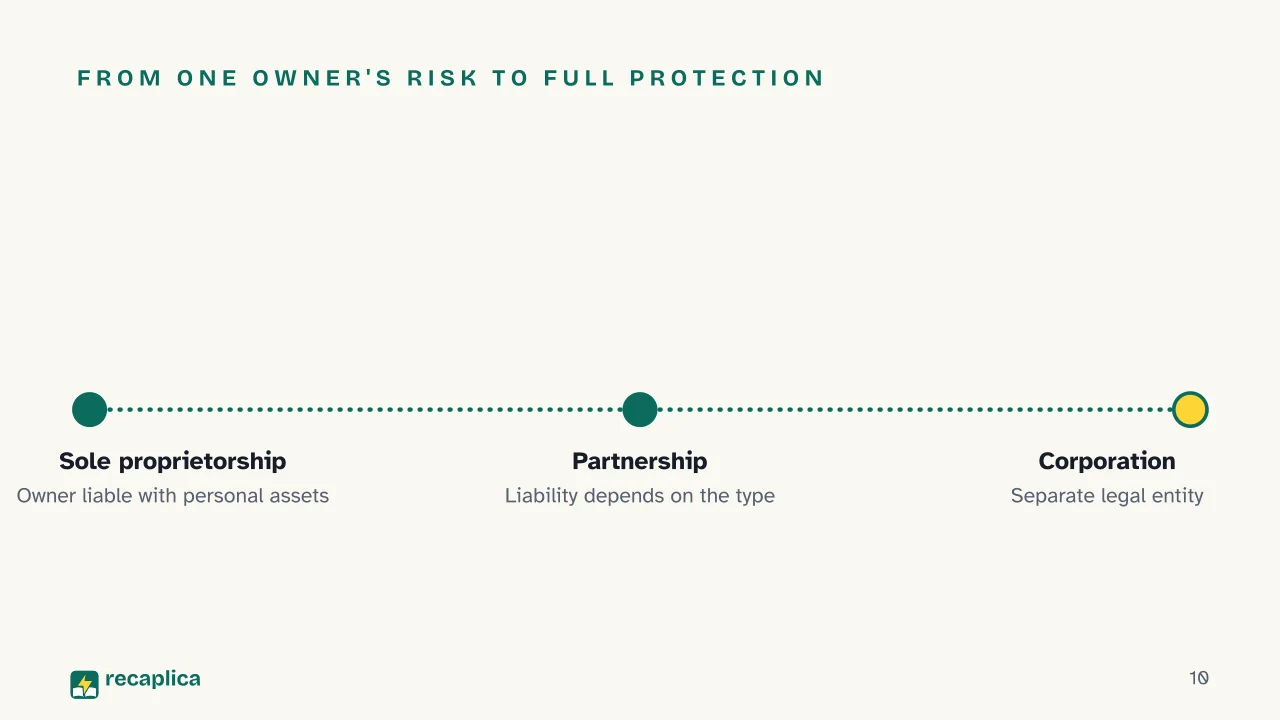
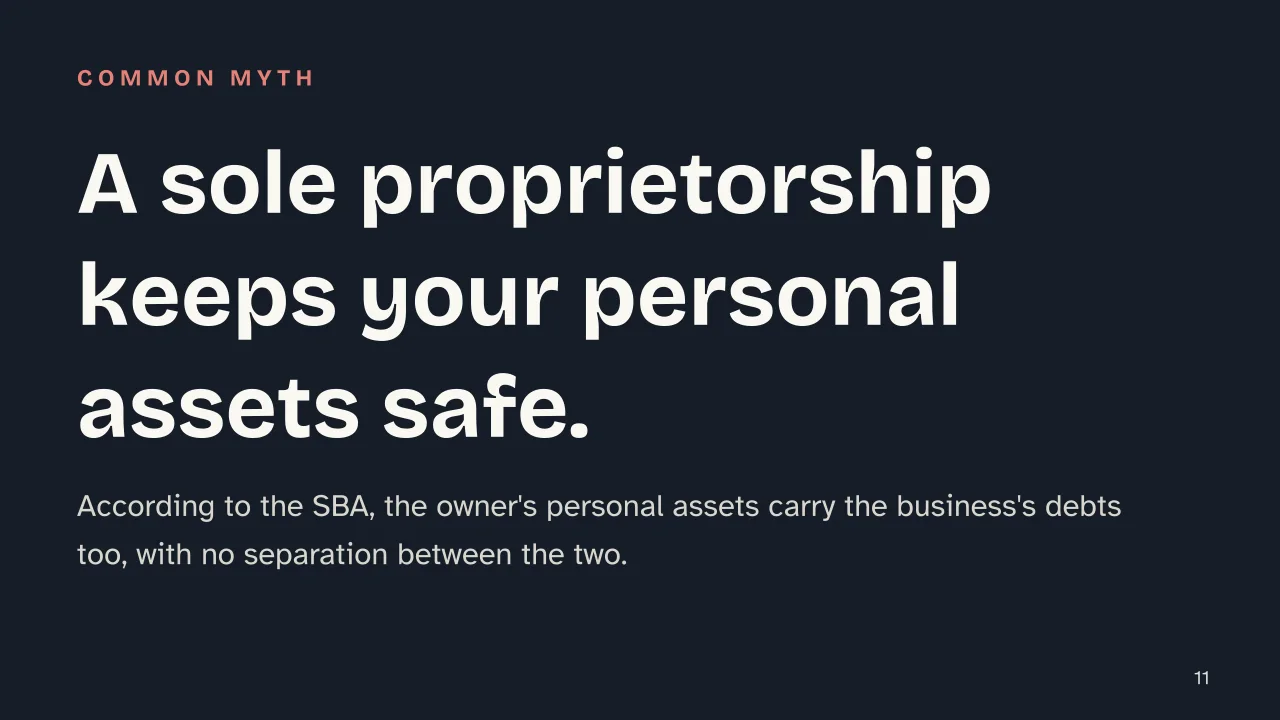
    That simplicity has a cost. A sole proprietorship creates no separation between the owner and the business: its debts and legal obligations fall directly on the person running it, personal savings and property included.

    In the United Kingdom, GOV.UK describes a close match in the sole trader: the easiest structure to start and to keep the books for, run by a single person from day one.

    Sharing the business: partnerships

    A partnership lets two or more people own a business together, and the SBA calls it the simplest way to do that. How much each partner actually risks, though, depends on which kind of partnership they pick.

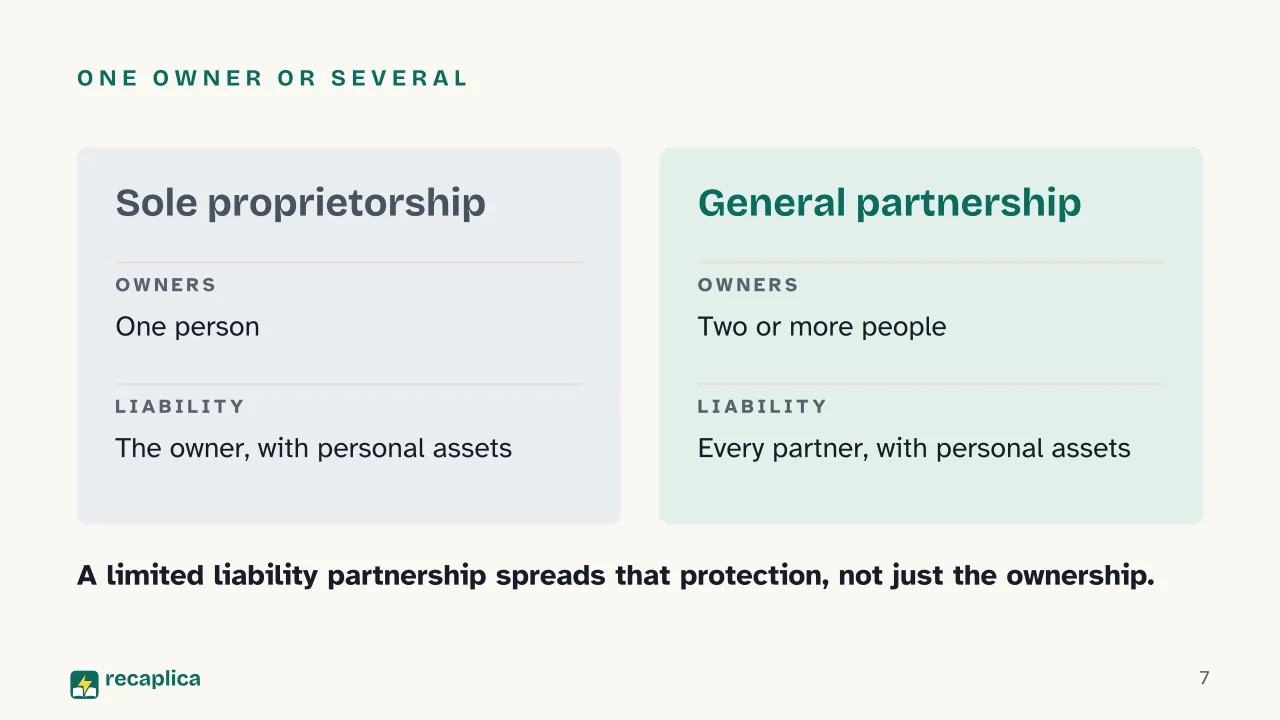
    In a general partnership, every partner can be held personally liable for the business’s debts. A limited partnership changes that for everyone but one person: the general partner still carries unlimited liability, while the limited partners risk only what they put in. A limited liability partnership goes one step further, giving every partner limited liability and protecting each one from debts the others create.

    The United Kingdom runs its business partnerships on a similar idea. Partners share responsibility for the activity and split its profits and losses, and one of them, the nominated partner, takes care of the group’s tax returns and accounting records.

    Becoming a separate legal entity: LLCs and corporations

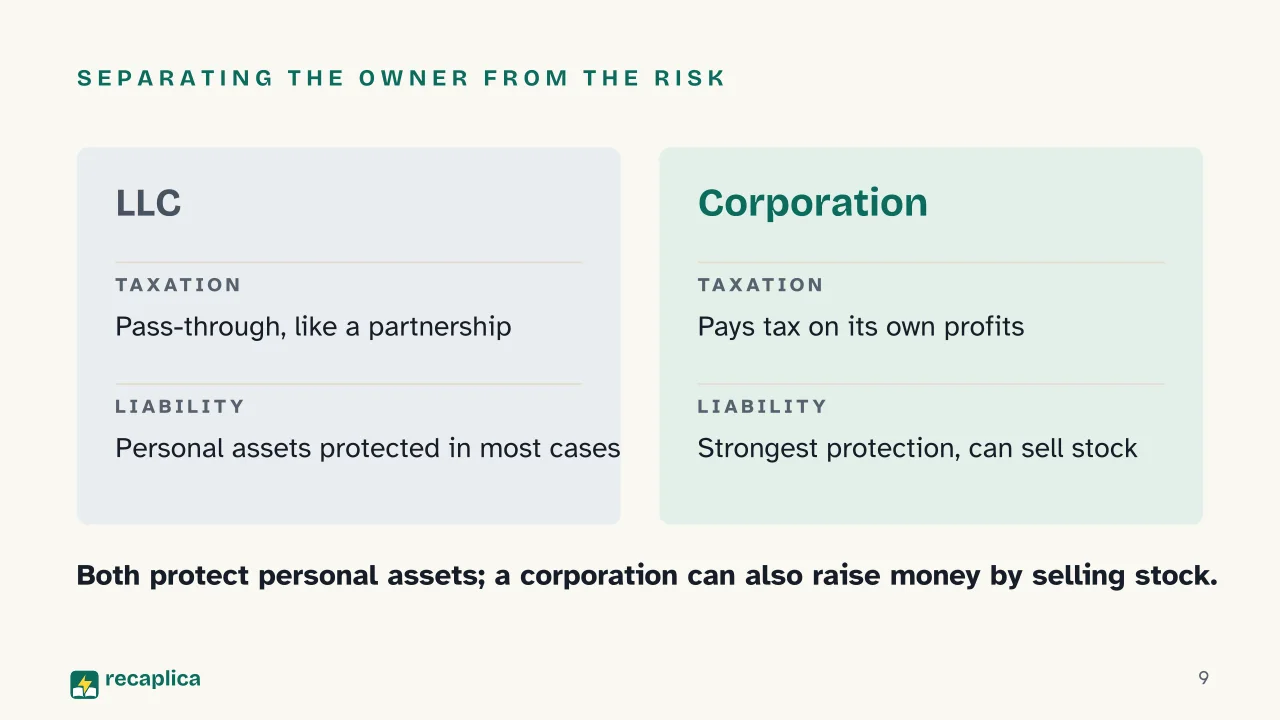
    An LLC, short for limited liability company, mixes features of a partnership with those of a corporation. In most cases it keeps the owners’ personal assets out of reach if the business runs into debt or gets sued.

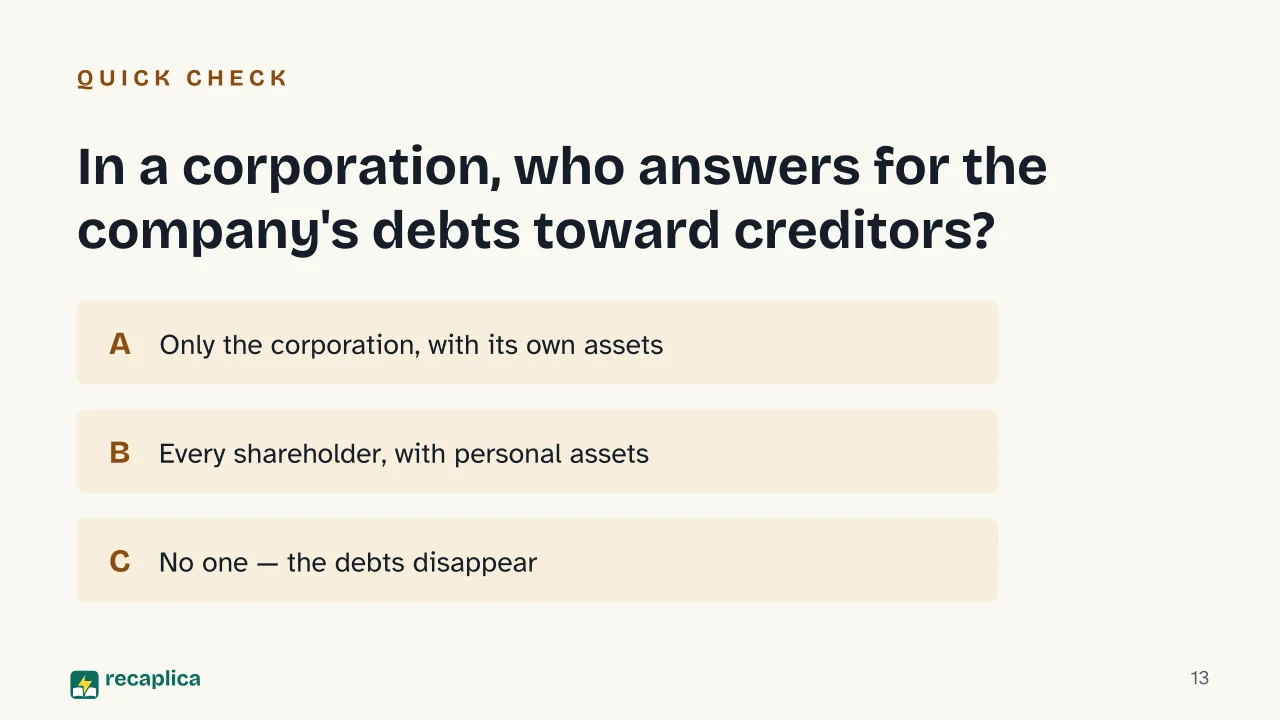
    A corporation goes further: it exists as a legal entity of its own, distinct from the shareholders who own it. Among the structures the SBA describes, it offers the strongest protection from personal liability, and it can raise money by selling stock — useful for a business planning to grow, bring in investors, or go public one day. Setting one up costs more than the other structures, and in the United States a corporation pays income tax directly on its own profits, separate from what shareholders later pay on their dividends.

    StructureLiabilityExample
    Sole proprietorshipOwner liable with personal assetsA freelance graphic designer working alone
    General partnershipEvery partner liable with personal assetsTwo friends who open a shop together
    Limited partnershipGeneral partner liable in full, limited partners only for what they investedAn investor who funds the activity but doesn’t run it
    LLCPersonal assets protected in most casesA small consultancy with two co-owners
    CorporationOnly the company’s own assets are at riskA company raising money by selling stock

    A corporation hiring staff to grow competes for workers in the same labor market as every other employer, and the money it raises by selling shares moves through the same stock market that prices those shares every day. Some organizations, meanwhile, produce goods or services without profit as their main goal: causes like social inclusion or community care tend to sit in the third sector, set apart from the for-profit businesses described here.

    The UK equivalents

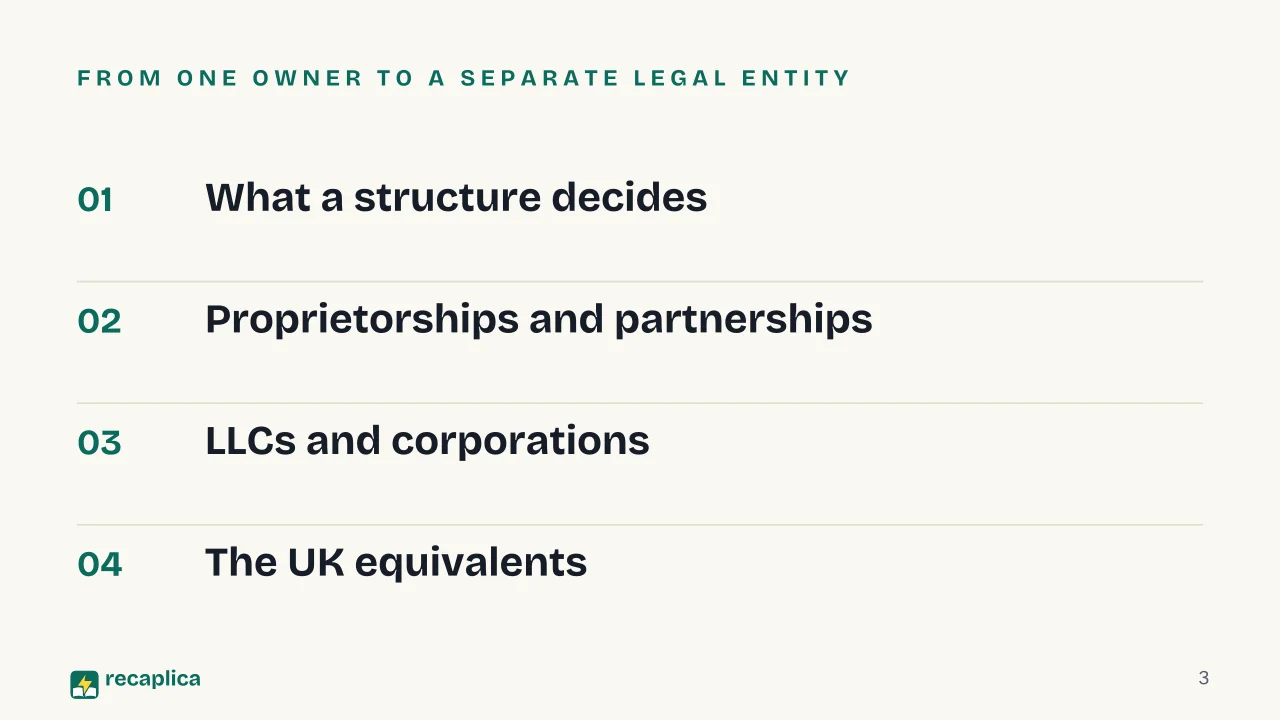
    The sole trader and the business partnership already cover two of the UK structures. The third is the limited company: its own legal entity, administered by one or more directors, and the closest British counterpart to the corporation.

    Slide deck

    Slides ready to download and make your own in PowerPoint or Google Slides, with speaker notes. Pick the Flash cut or the Full one.
    Slide 1 of the presentation on Types of Business: Types of BusinessSlide 2 of the presentation on Types of Business: What actually decides who's on the hook if a business can't pay what it owes?Slide 3 of the presentation on Types of Business: From one owner to a separate legal entitySlide 4 of the presentation on Types of Business: Chapter 01: What a business structure decidesSlide 5 of the presentation on Types of Business: Ownership, control, liability: Ownership, Control, LiabilitySlide 6 of the presentation on Types of Business: Chapter 02: Proprietorships and partnershipsSlide 7 of the presentation on Types of Business: One owner or severalSlide 8 of the presentation on Types of Business: Chapter 03: LLCs and corporationsSlide 9 of the presentation on Types of Business: Separating the owner from the riskSlide 10 of the presentation on Types of Business: From one owner's risk to full protectionSlide 11 of the presentation on Types of Business: A sole proprietorship keeps your personal assets safe.Slide 12 of the presentation on Types of Business: Chapter 04: The UK equivalentsSlide 13 of the presentation on Types of Business: In a corporation, who answers for the company's debts toward creditors?Slide 14 of the presentation on Types of Business: Time for the recap
    Flash10 slidesThe essential thread, to present in classFull14 slidesEvery chapter and the deeper detail

    Common myths

    • ✗ Myth A business and its legal structure are the same thing.

      ✓ Reality A business is the activity: producing or exchanging goods and services. The legal structure — sole proprietorship, partnership, LLC, corporation — is simply the legal form that activity takes, and the same ongoing business can even change structure over time, for instance moving from a sole proprietorship to an LLC.

    • ✗ Myth Anyone who opens a sole proprietorship risks nothing of their own.

      ✓ Reality A sole proprietorship creates no separation between the business and its owner: the U.S. Small Business Administration explains that the owner stays financially on the hook for what the business owes, and a UK sole trader carries the same exposure.

    • ✗ Myth A corporation is just a bigger, more formal sole proprietorship.

      ✓ Reality The difference is legal, more than a matter of size. A corporation exists as its own legal entity, owned by shareholders but distinct from them. A sole proprietorship has no such entity: the owner and the business are, in the eyes of the law, one and the same.

    Mind map

    Drag the background to move around and the nodes to reposition them; use − and + to collapse and expand branches.
    Customize
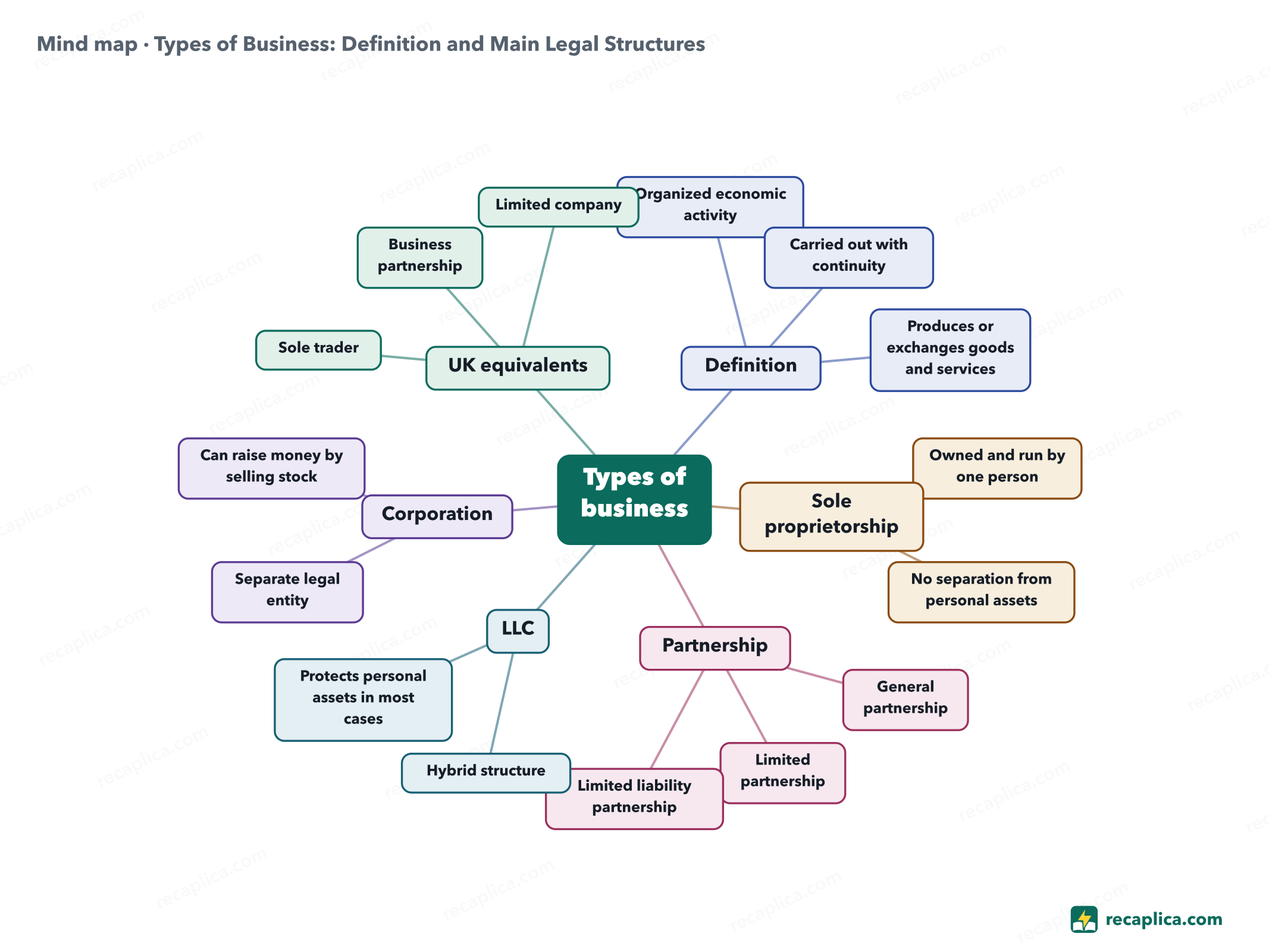
    Mind map: Types of Business: Definition and Main Legal Structures
    • Types of business
      • Definition
        • Organized economic activity
        • Carried out with continuity
        • Produces or exchanges goods and services
      • Sole proprietorship
        • Owned and run by one person
        • No separation from personal assets
      • Partnership
        • General partnership
        • Limited partnership
        • Limited liability partnership
      • LLC
        • Hybrid structure
        • Protects personal assets in most cases
      • Corporation
        • Separate legal entity
        • Can raise money by selling stock
      • UK equivalents
        • Sole trader
        • Business partnership
        • Limited company

    Quiz: test yourself

    Answer the questions to check what you have learned: you get instant feedback and a short explanation.

    Grade 0/10 0/5
    1 According to the U.S. Small Business Administration, what characterizes a sole proprietorship?

    The SBA calls the sole proprietorship the simplest structure around, but it draws no line between the owner's wallet and the business's: a debt for one is a debt for the other.

    2 What is the main difference between a sole proprietorship and a corporation?

    A corporation is its own legal entity, separate from the shareholders who own it. A sole proprietorship has no such separation: the owner and the business are legally the same.

    3 In a limited partnership, who carries unlimited liability for the business's debts?

    The SBA describes the general partner in a limited partnership as the one who carries unlimited liability, while the other, limited partners risk only what they invested.

    4 True or false: according to the SBA, an LLC protects owners' personal assets from the business's debts and lawsuits in most cases.

    The SBA describes the LLC as built so that, in most cases, what happens to the business doesn't reach into the owners' own bank accounts or property.

    5 According to GOV.UK, what is a limited company in the United Kingdom?

    GOV.UK treats the limited company as a legal entity on its own, with directors running it instead of an owner — the UK's closest match to a corporation.

    Answers: 1-B · 2-B · 3-B · 4-A · 5-B

    Flashcards

    Tap the card to flip it and check whether you remember the answer, then move to the next one.

    1 / 8

    Explain it in your own words

    The ultimate test: if you can explain it in simple words, you've truly understood it. Write your explanation, then compare it with the Recap.

    Your explanation is saved only on this device.

    A business is an organized economic activity that a person or a group of people runs with continuity to produce or exchange goods and services. Before it can operate formally, the activity takes on a legal structure that decides who owns it, who runs it, and who answers for its debts. The sole proprietorship, the simplest form, keeps no separation between the owner and the business. A partnership splits ownership between two or more people, with liability that can stay personal or become limited depending on the type chosen. An LLC or a corporation goes further still, existing as a legal entity separate from the people who own it.

    Frequently asked questions

    What is the difference between a business and its legal structure?

    A business is what's actually happening — the goods or services it produces or trades. The structure built on top of that (sole proprietorship, partnership, LLC, corporation) is a legal label that decides who owns it and who covers its debts.

    What is the simplest type of business structure?

    A sole proprietorship in the United States, a sole trader in the United Kingdom: both let one person own and run the business with little paperwork, but neither one separates the owner's personal assets from the business's debts.

    What is the difference between a general partnership and a limited liability partnership?

    A general partnership puts every partner's own money on the line for what the business owes. A limited liability partnership caps each partner's exposure instead, so one partner never pays for debts a different partner ran up.

    Why would a business choose to become a corporation?

    A corporation can raise money by selling stock and offers its owners the strongest protection from personal liability among the structures the SBA describes, which suits a business planning to grow, take on investors, or go public. The trade-off is a higher cost to set up and, in the US, income tax paid on the company's own profits.

    Who is legally responsible for a partnership's debts?

    It depends on the type. General partners answer for what the business owes with everything they own. In a limited partnership, only the general partner carries that full exposure, while the limited partners' liability stops at the amount they invested.

    Sources

    • Choose a business structure — U.S. Small Business Administration
    • Set up a business — GOV.UK
    • Set up a business partnership — GOV.UK

    Every Recap goes through an independent review before publication.

    Every evening, the day's new Recaps on our Telegram channel. Join the channel →

    Keep learning

    • Economics Sustainability: Definition, What It Means and the Three Pillars Sustainability, in the fuller phrase sustainable development, is development that covers the needs of the people living now while leaving future generations able to cover their own: that is how the United Nations defines it. The wording comes from Our Common Future, the report published in 1987 by the World Commission on Environment and Development, also called the Brundtland Commission. Treccani lists three interdependent factors behind the expression. The United Nations describe an integrated approach, where environmental concerns travel alongside economic development. Read the Recap →
    • Economics Sustainable Development Goals (SDGs): What Are the UN's 17 Goals for 2030 The United Nations formally adopted the 2030 Agenda on 25 September 2015, signed by 193 countries, including Italy. The Agenda groups 17 Sustainable Development Goals, from ending poverty to protecting the climate, broken down into 169 Targets and tracked by more than 240 indicators. It is a resolution of the General Assembly: a political commitment that governments made, with a 2030 deadline. The short titles widely used outside the UN's own documents, such as "No Poverty" or "Life on Land", circulate in different versions from country to country; in Italy they come from ASviS, the alliance founded in 2016 to track the Agenda's progress. Read the Recap →
    • Economics Company Liquidation: What It Is and How the Process Works Company liquidation is the process by which a court takes charge of a business that can no longer pay its debts, sells off its assets and uses the proceeds to repay creditors as far as possible. A court appoints an administrator who manages the assets in place of the owner, while creditors are grouped together instead of each chasing payment on their own. It does not start over a single missed bill: the business has to be genuinely insolvent, and very small businesses are left out of the process altogether. Italy's own version, called "liquidazione giudiziale", replaced the older word "fallimento" in 2022 but works on the same principle. Read the Recap →

    recaplica

    Clear in 30 seconds, yours in 10 minutes.

    Recaps Mind maps Request a Recap Telegram channel Mind map maker Our method About Privacy & cookies Legal notes & terms of use

    © 2026 Recaplica · A project by Curi S.r.l. — VAT IT05472000750

    Statistics, only if you say so

    To learn which Recaps help most we would use Google Analytics, with aggregate, anonymous data. It starts only with your OK, and you can change your mind anytime. Privacy policy