Skip to content
recaplica

    One moment: security check

    Cloudflare wants to make sure you're not a robot. Tick the box below and your search will continue on its own.

    IT
    recaplica Bonds: what they are, how they pay and why their price changes
    © 2026 Recaplica · recaplica.com — All rights reserved
    Home › Economics

    Bonds: what they are, how they pay and why their price changes

    By Recaplica Newsroom · Updated on September 13, 2026

    What to print

    Page numbers appear when printing with default margins.

    Slides

    Choose a cut

    Flash10 slidesThe essential thread, to present in classFull18 slidesEvery chapter and the deeper detail

    Both come with speaker notes.

    Telegram channel
    recaplica Clear in 30 seconds, yours in 10 minutes.
    In 30 seconds Key points Figures Deep dive Slides Myths Mind map Quiz Flashcards FAQ

    In 30 seconds quick read

    A bond is a loan: whoever buys one gives money to a government, a bank or a company, which promises to repay the face value on a set date and, often, to pay interest along the way, called the coupon. The bondholder is a lender, not an owner. What you actually earn also depends on the price you paid, which can be higher or lower than the repayment value. When market interest rates rise, the price of fixed-rate bonds already in circulation falls, and vice versa. Bonds are usually less risky than stocks, but they are not free of risk.

    Key Points

    • A bond is a loan to the issuer (a government, bank or company): the buyer becomes a creditor entitled to repayment, not an owner like a shareholder.
    • Yield to maturity adds the coupons to the gap between the price paid and the repayment value; Italy's BOTs pay no coupon and earn only from that gap.
    • Prices and interest rates move in opposite directions: when market rates rise, fixed-rate bond prices fall, and the further away the maturity, the bigger the effect.
    • The main risks are interest rate, credit, liquidity and currency risk; ratings from specialized agencies measure how reliable an issuer is.
    • Italian government bonds include BOTs, BTPs, CCTeu, BTP Italia and BTP€i; since 2021 the BTP Short Term has taken the place of the CTZ.
    • Bonds can be bought at issue (primary market, for government bonds usually through an auction), or later from other investors on an exchange (secondary market, such as Italy's MOT).

    Key figures

    • $925 the price a $1,000 bond with a 3% coupon falls to if, a year later, market interest rates rise to 4% Source: SEC, Investor Bulletin on interest rate risk
    • 12.5% the Italian tax rate on returns from Italian government bonds, against 26% for other bonds (as stated in September 2026) Source: Bank of Italy, L'economia per tutti
    • 50 years the longest maturity for Italian BTPs, which start at 18 months Source: Bank of Italy; Borsa Italiana

    Deep Dive

    A bond is a written promise. Whoever buys one hands a sum of money to someone, the issuer, who commits to paying it back on a set date, the maturity, and often to paying interest along the way. The issuer can be a national government, a bank, a company or a supranational body; what they all want is funding. The amount that will be repaid is called the face value.

    What sets a bond apart from a loan between friends is that the promise is a security: it can be sold to someone else before it matures. Almost everything that makes bonds less simple than they look starts there, beginning with a price that moves. Italy’s government bonds (BOT, BTP and their relatives) serve as the worked example throughout, but the basic mechanics apply to bonds in general.

    A loan with many lenders

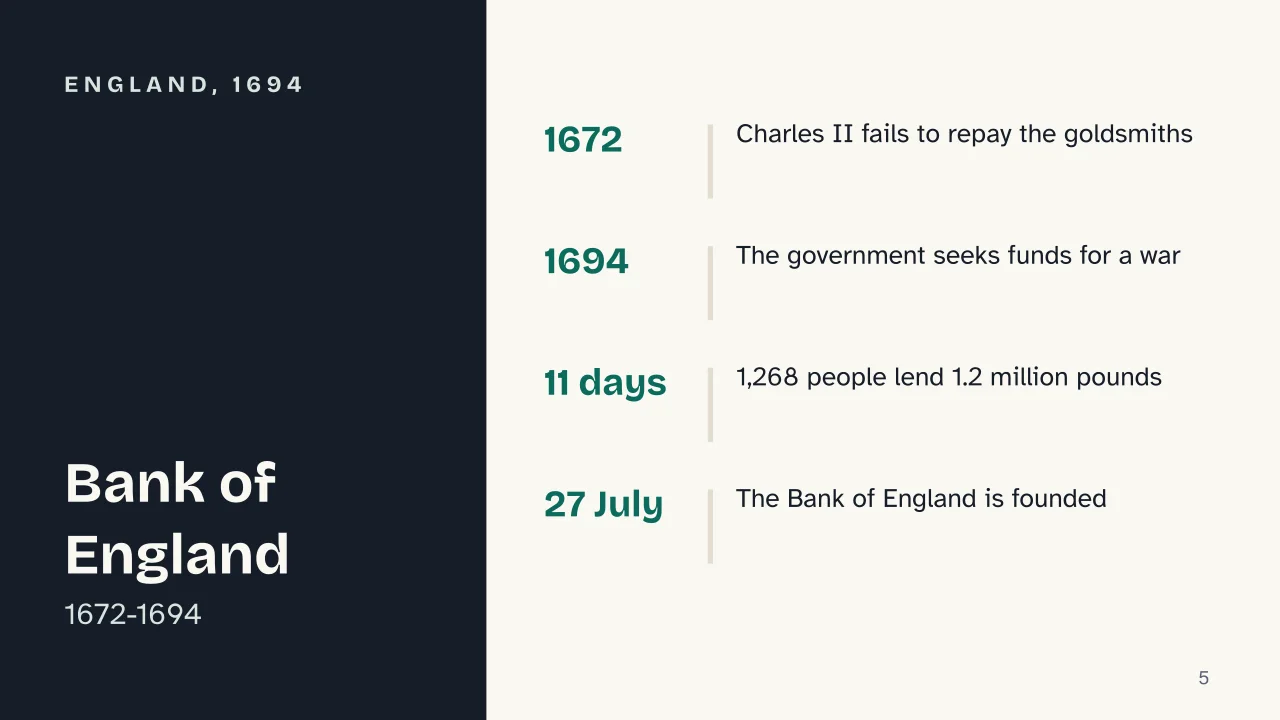
    Borrowing money from the public is an idea with a few centuries behind it. In 1694 King William III of England needed funds for the war against France, and the Scottish merchant William Paterson proposed having ordinary people lend the money directly: £1.2 million, at 8% interest. According to the Bank of England Museum, the sum was raised in 11 days by 1,268 people, and on 27 July that year the Bank of England itself was founded. Trust was not a given: in 1672 Charles II had failed to repay the loans he received from goldsmiths.

    The underlying mechanism hasn’t changed. Borsa Italiana, the Italian stock exchange, defines bonds as securities representing a loan issued by a private company or a public body to raise part of the money it needs. When the borrower is a government, those securities become part of its public debt.

    Owner or lender: stocks and bonds compared

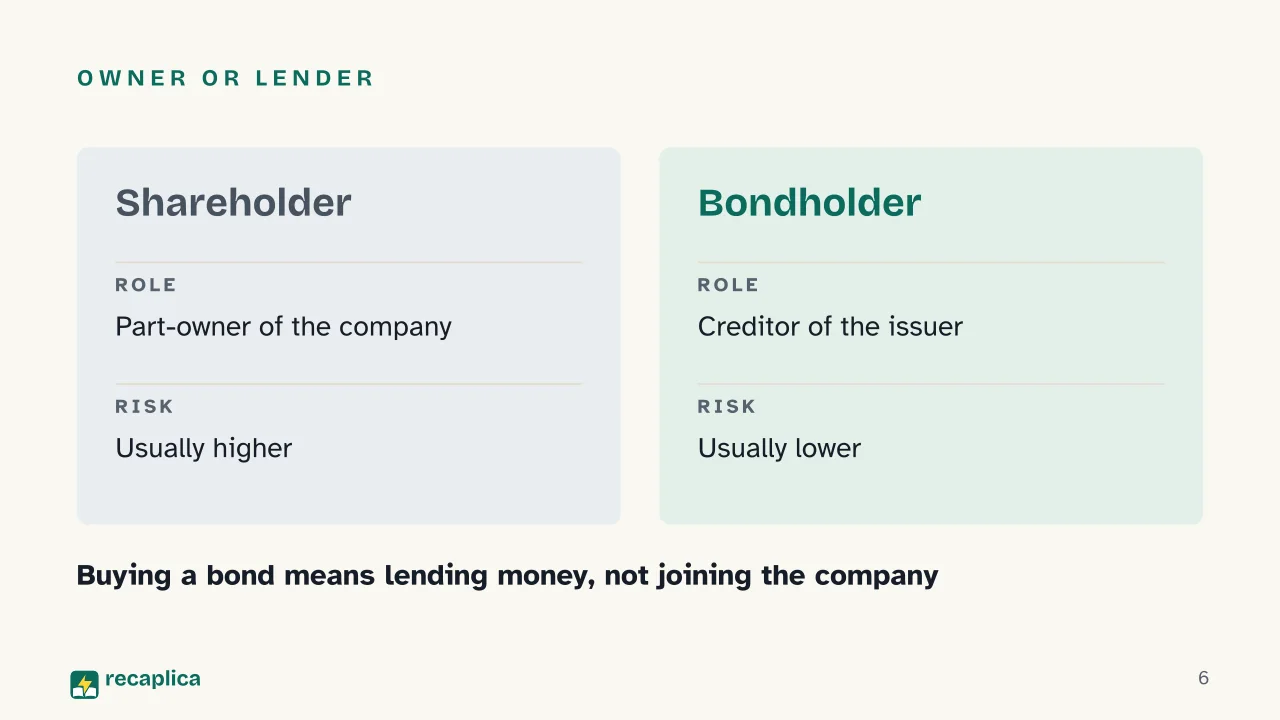
    This is the distinction worth pinning down first. Buying stock makes you a part-owner of a company. Buying a bond makes you its creditor. Consob, Italy’s financial markets regulator, points out that a bondholder’s right to be repaid can be delayed or placed behind other creditors, but not taken away.

    StocksBonds
    The holder isA part-owner (shareholder)A creditor
    Main rightTaking part in the company as a shareholderRepayment of the face value at maturity
    RiskUsually higherUsually lower, never zero
    In a bank crisis (bail-in)Absorb losses firstAbsorb losses after shareholders

    Corporate bondholders aren’t left on their own, either. Under the Italian rules Consob describes, they can gather in a bondholders’ meeting, which can change the terms of the loan by majority vote, and they have a common representative whose job is to protect their interests in dealings with the company.

    The coupon and the real return

    The interest the issuer pays at regular intervals is called the coupon, and its percentage of the face value is the coupon rate. An Italian BTP, for instance, pays a fixed annual coupon split into two six-monthly installments. Consob describes interest as the price an investor demands for lending money, and coupons can follow different rules:

    • fixed-rate, with amounts set from the start;
    • floating-rate, tied to market interest rates;
    • inflation-linked, where the coupon (and often the repayment) grows when prices rise;
    • zero-coupon, with no coupon at all: the only gain is the difference between purchase price and repayment.

    The coupon alone doesn’t tell you how much you earn, though. The yield to maturity, meaning the return for someone who holds the bond to the end, combines the coupons with the gap between the repayment value and the price paid, known as the discount when the bond was bought for less.

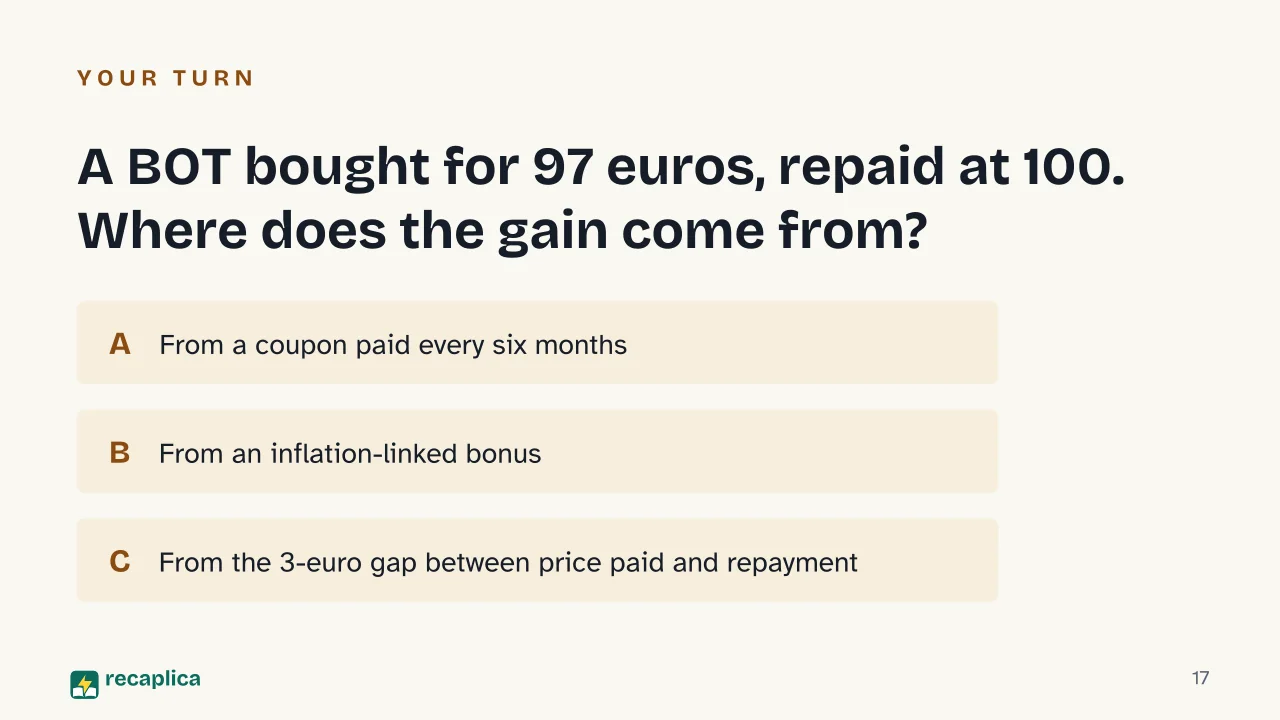
    Practical example: a BOT, an Italian short-term Treasury bill, with a face value of €100 is bought for €97. It pays no coupon, but at maturity it returns €100: that €3 discount is the whole gain.

    A bond’s price rarely matches its face value. The Bank of Italy gives the example of BTPs with a face value of €1,000 bought for €923 or for €1,015. In market jargon a bond trades below par when it costs less than face value and above par when it costs more; BOTs and BTPs are repaid at par. Buying below par adds a gain on top of the coupons. Buying above par gives part of it back, and the yield to maturity ends up lower than the coupon.

    Why bond prices fall when interest rates rise

    Here is the part that confuses people most. Bond prices and market interest rates move in opposite directions, and the reason is concrete. The coupon on a fixed-rate bond is written into the contract and doesn’t change. If similar bonds paying more come out in the meantime, nobody will buy the old one at the same price. To compete, it has to get cheaper.

    Practical example: you paid €100 for a bond paying 4% a year, that is €4. Then rates rise and similar new bonds pay 6%, or €6. Your bond now earns less than the others, and if you want to sell it you’ll have to accept a lower price.

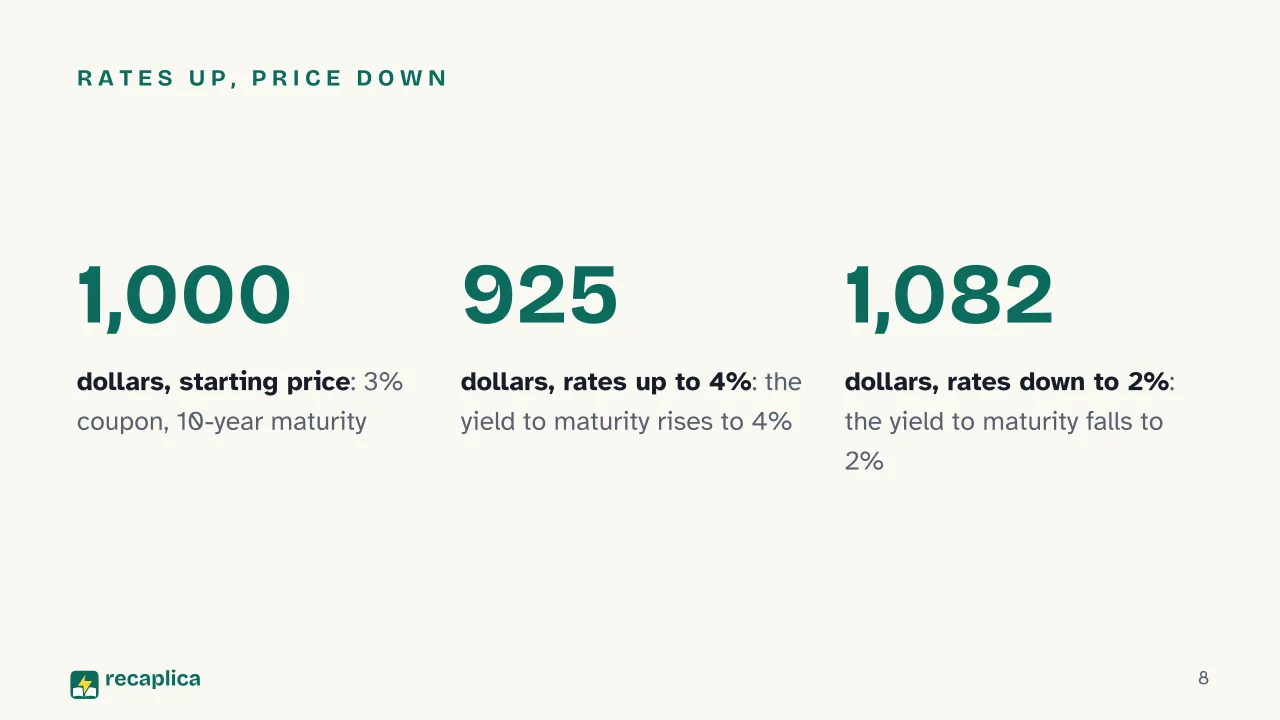
    The SEC, the US securities regulator, runs the numbers on a $1,000 bond with a 3% coupon and a ten-year maturity. If market rates climb to 4% a year later, the price falls to $925 and the yield to maturity for a buyer rises to 4%. If rates drop to 2% instead, the price rises to $1,082 and the yield to maturity falls to 2%.

    Market rates after one yearBond priceYield to maturity
    Unchanged at 3%$1,000 (at par)3%
    Up to 4%$925 (below par)4%
    Down to 2%$1,082 (above par)2%

    The effect isn’t the same for every bond. It is generally stronger when the maturity is far away and when the coupon is low. To measure it, investors use duration. As a rule of thumb, FINRA explains, for every percentage point that rates move, a bond’s price moves the opposite way by a percentage equal to its duration. A bond with a duration of 10 loses about 10% if rates rise by one point.

    Anyone who holds the bond to maturity, the SEC notes, still receives the promised coupons and the face value, whatever happened to the price along the way.

    Not all bonds are alike

    Beyond the type of coupon, what matters is how long a bond lasts and where it stands in the line of creditors. The Bank of Italy calls bonds that mature within one or two years short-term, and those lasting five or ten years or more long-term.

    • Ordinary bonds, also called senior bonds, are repaid before subordinated (or junior) bonds if the issuer runs into trouble. From the same issuer, subordinated bonds are therefore riskier.
    • Convertible bonds give their holders the option of turning them into shares of the company.
    • Structured bonds contain a derivative contract: their return depends on other variables, such as stock indices, exchange rates or commodities. Consob describes them as more complex and harder to understand.

    The risks, one by one

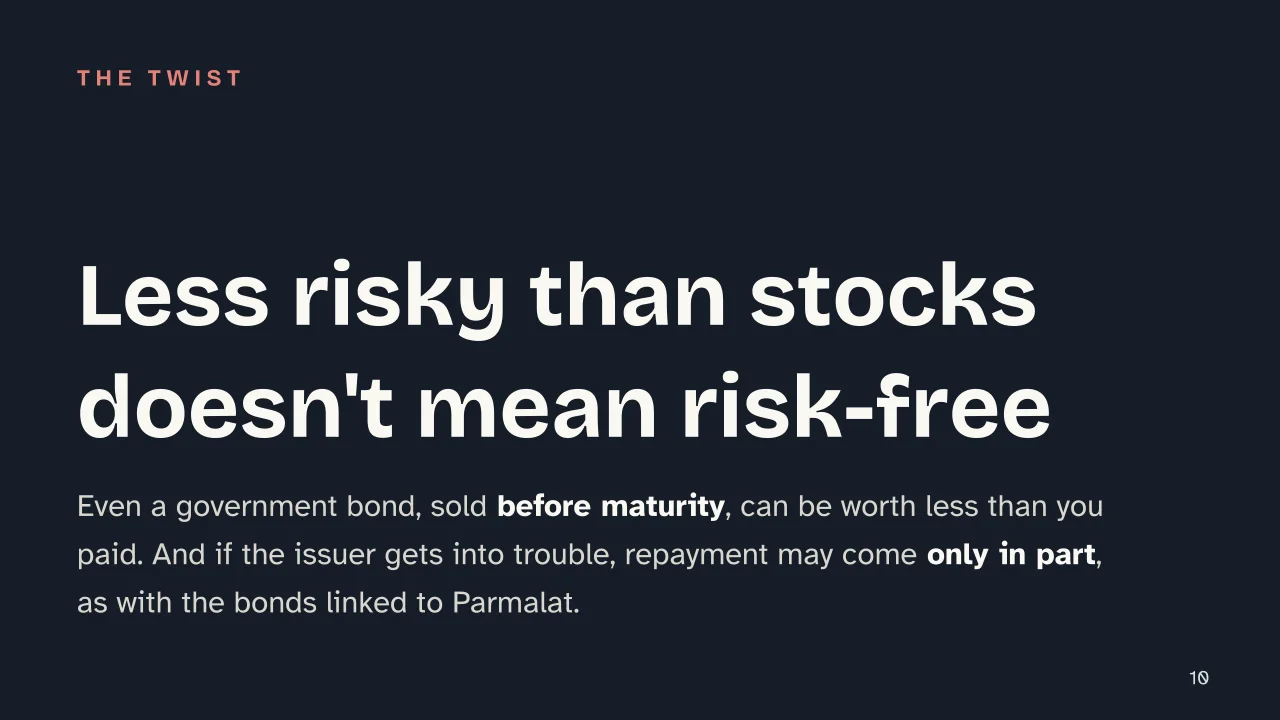
    The Bank of Italy writes that bonds are normally less risky than stocks. “Less” is the word to keep in mind. These are the main risks:

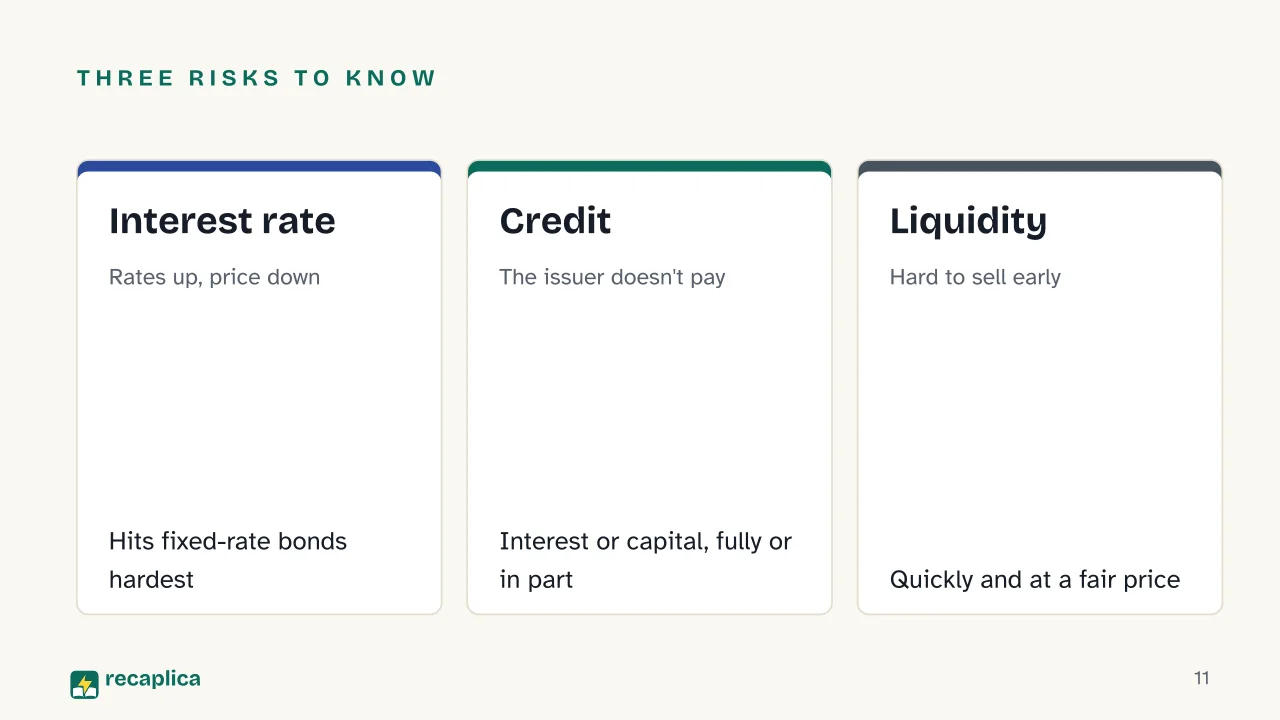
    RiskWhat it meansWho it hits hardest
    Interest rateThe price falls if market rates riseFixed-rate bonds with a distant maturity
    CreditThe issuer fails to pay interest or capital, in full or in partIssuers whose finances are getting worse
    LiquidityIt’s hard to sell quickly and at a good price before maturityBonds that rarely trade
    CurrencyThe value shifts with the exchange rateBonds in a currency other than the one you earn and spend, such as dollars instead of euros
    InflationThe coupons buy lessBonds whose coupon is lower than the rise in prices
    Early redemptionThe issuer repays early, usually when rates are fallingBonds that allow it

    Inflation risk is easy to see with FINRA’s numbers: if a bond pays 5% and prices rise by 8%, the purchasing power of the interest shrinks. The Recap on inflation walks through how that works.

    Credit risk has a textbook Italian case too. Bonds linked to Parmalat, the Bank of Italy recalls, were repaid only in part, and the people who had put their savings into them lost money. The Bank of Italy also warns that concentrating your money in bonds from a single issuer is very risky.

    For banks there is also the bail-in, introduced by the European Union in 2014 and in force in Italy since 1 January 2016. If a bank fails, losses fall in this order: shareholders, holders of subordinated bonds, holders of unsecured ordinary bonds and finally deposits above €100,000. Those left out include deposits up to €100,000 and secured bonds.

    Credit ratings and spreads

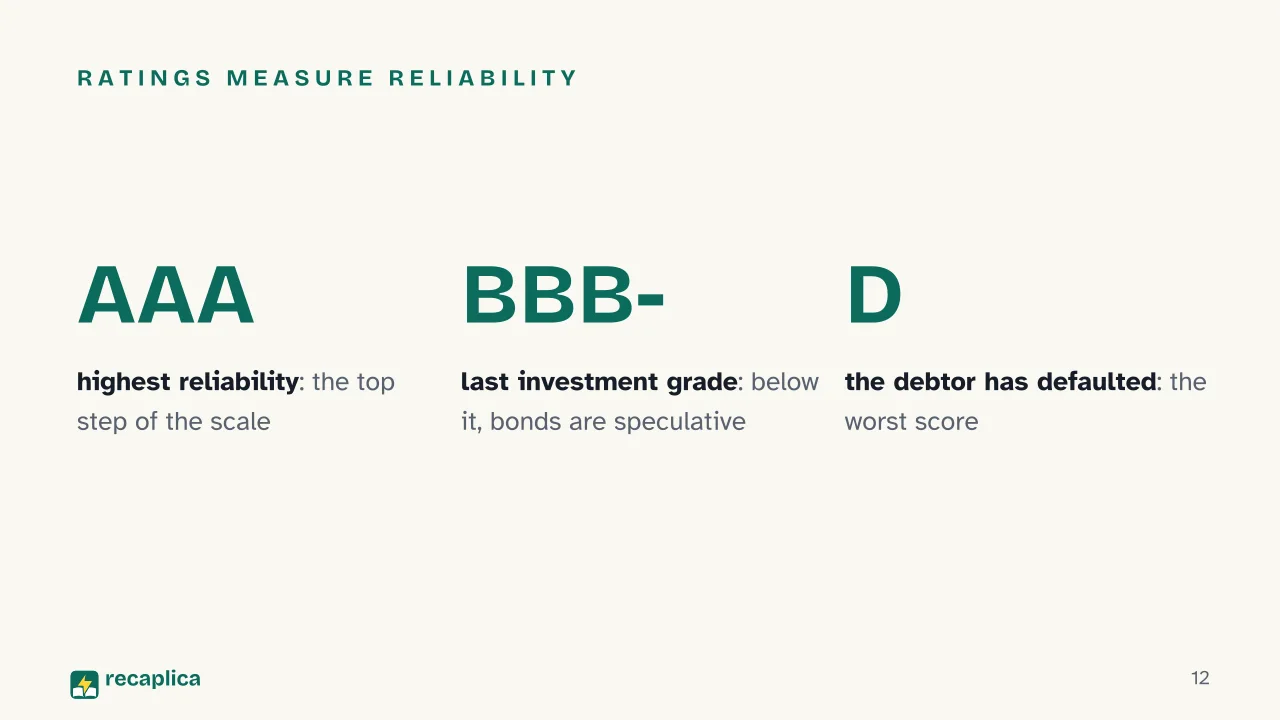
    To gauge how reliable an issuer is, there are credit rating agencies. They grade issuers on a scale that runs from AAA, the highest reliability, down to D, which signals default. Bonds rated from AAA to BBB- are called investment grade; below BBB- they are speculative, or junk. The lower the rating, the more a lender demands in return for the risk.

    The spread measures exactly that difference: it’s the gap between the yields to maturity of bonds from two different issuers. In Italy the usual comparison is the ten-year BTP against its German equivalent, the Bund.

    Practical example: according to the Bank of Italy, on 29 December 2025 the ten-year BTP yielded about 3.5% and the German Bund about 2.8%. The spread was therefore 0.7 percentage points, or 70 basis points.

    Italian government bonds

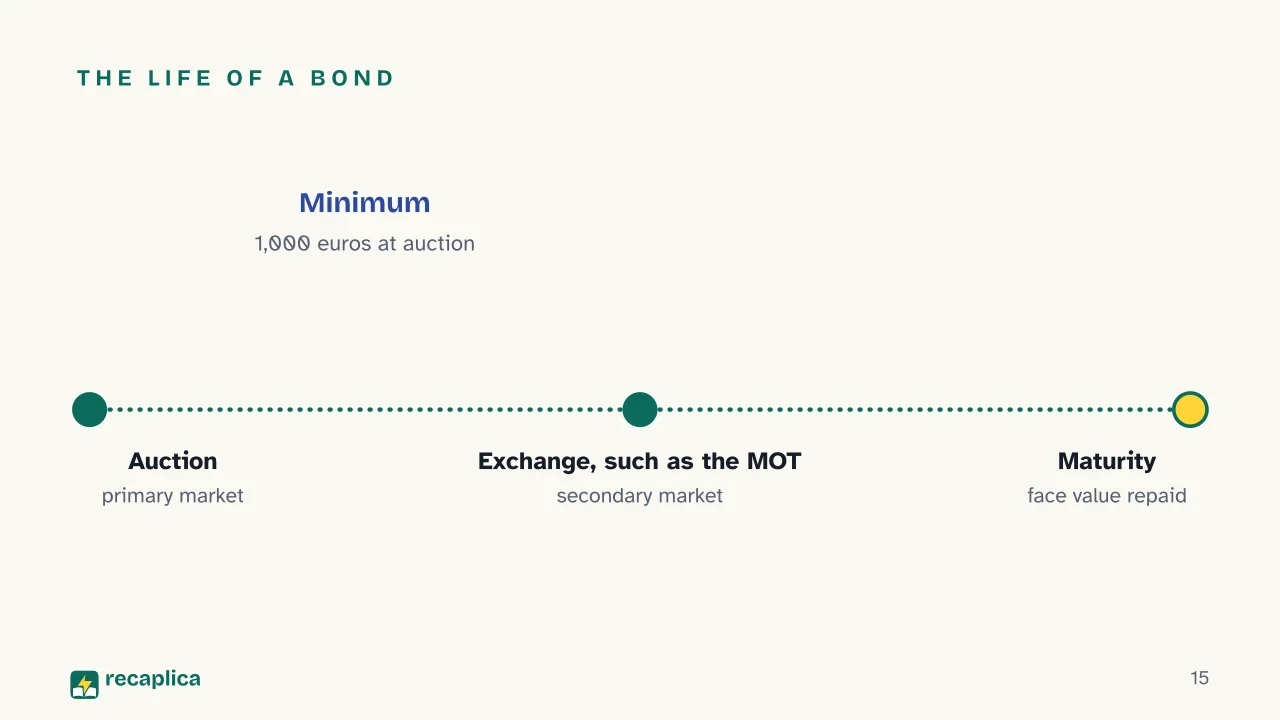
    When the issuer is a national government, the bond is called a government bond. In Italy they are issued by the Treasury Department of the Ministry of Economy and Finance (MEF), with a minimum denomination of €1,000 face value.

    BondMaturityHow it pays
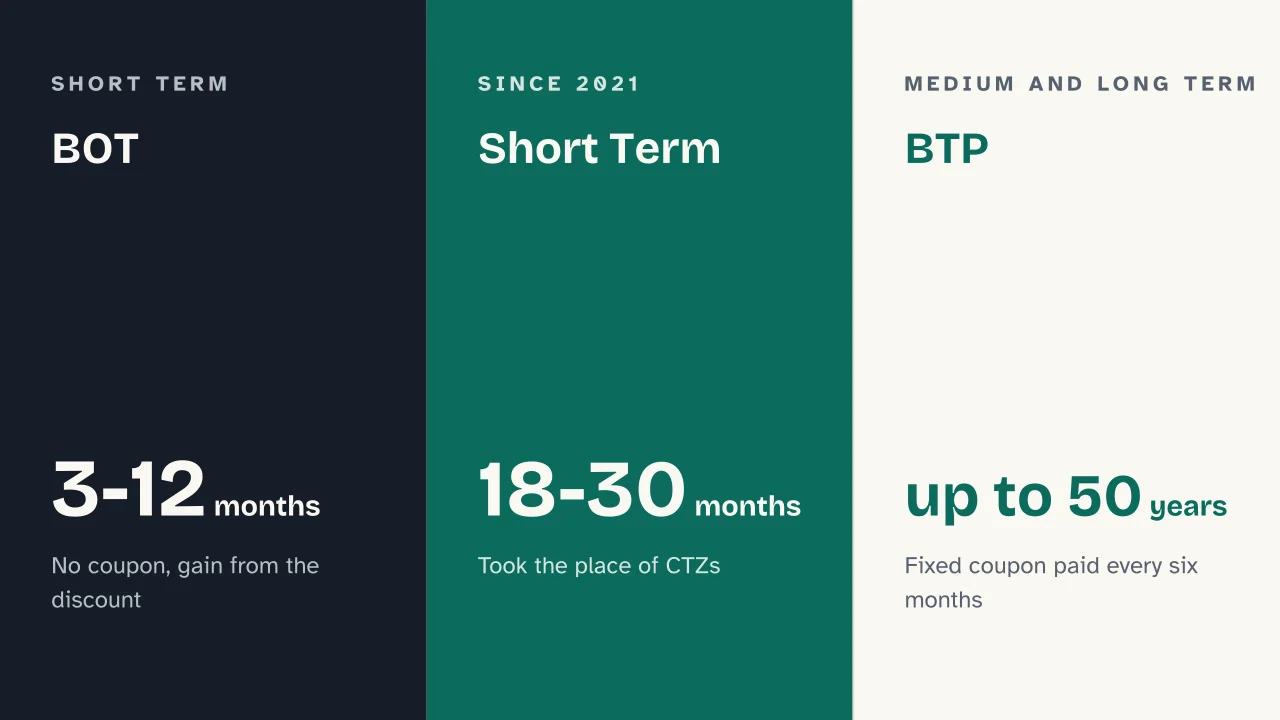
    BOT (Buoni ordinari del Tesoro, Treasury bills)3, 6 or 12 monthsNo coupon, only the issue discount
    BTP Short TermBetween 18 and 30 monthsLike BTPs, a fixed coupon
    BTP (Buoni del Tesoro poliennali, multi-year Treasury bonds)From 18 months to 50 yearsFixed coupon paid every six months
    CCTeuMedium term, between 3 and 7 years according to the Bank of ItalyFloating coupon tied to Euribor
    BTP ItaliaVaries by issuePayments linked to Italian inflation
    BTP€iVaries by issuePayments linked to euro area inflation

    Anyone who comes across CTZs (Certificati del Tesoro zero coupon, zero-coupon Treasury certificates) in textbooks should know they are no longer issued. The Ministry suspended them from the auction of 25 March 2021, when the BTP Short Term made its debut, designed to make the short-term segment more efficient.

    Taxes differ as well. As of September 2026, the Bank of Italy states that returns on Italian government bonds are taxed in Italy at 12.5%, against 26% for other bonds.

    Where to buy bonds: primary and secondary markets

    A bond can be bought at two moments. The primary market is the issue, when the bond is offered for the first time. For Italian government bonds this normally happens through an auction, which savers join through an intermediary such as a bank. The rules depend on the bond. BOT auctions are competitive: bids are made in terms of yield, and each accepted bid is allotted at the rate it offered. For medium- and long-term bonds the auction is a marginal (uniform-price) one, where every accepted bid pays the same price. Settlement takes place two business days after the auction.

    The secondary market covers every later trade between investors. In Italy it includes the MOT, run by Borsa Italiana; MTS, on the other hand, is reserved for authorized intermediaries, with a minimum trade of €2 million.

    Practical example: Giulia buys a BTP at auction, on the primary market. Three years later she sells it on the MOT to Luca, who buys it on the secondary market at that day’s price. From then on, the coupons and the final repayment belong to Luca.

    Slide deck

    Slides ready to download and make your own in PowerPoint or Google Slides, with speaker notes. Pick the Flash cut or the Full one.
    Slide 1 of the presentation on Bonds: BondsSlide 2 of the presentation on Bonds: Does buying a bond make you an owner or a lender?Slide 3 of the presentation on Bonds: Four stopsSlide 4 of the presentation on Bonds: Chapter 01: The loanSlide 5 of the presentation on Bonds: England, 1694Slide 6 of the presentation on Bonds: Owner or lenderSlide 7 of the presentation on Bonds: Chapter 02: Coupon and priceSlide 8 of the presentation on Bonds: Rates up, price downSlide 9 of the presentation on Bonds: Chapter 03: The risksSlide 10 of the presentation on Bonds: Less risky than stocks doesn't mean risk-freeSlide 11 of the presentation on Bonds: Three risks to know: Interest rate, Credit, LiquiditySlide 12 of the presentation on Bonds: Ratings measure reliabilitySlide 13 of the presentation on Bonds: Chapter 04: BOT, BTP and marketsSlide 14 of the presentation on Bonds: BOT · Short Term · BTPSlide 15 of the presentation on Bonds: The life of a bondSlide 16 of the presentation on Bonds: Decisions about your own savings are worth taking to a licensed advisorSlide 17 of the presentation on Bonds: A BOT bought for 97 euros, repaid at 100. Where does the gain come from?Slide 18 of the presentation on Bonds: To review
    Flash10 slidesThe essential thread, to present in classFull18 slidesEvery chapter and the deeper detail

    Common myths

    • ✗ Myth Government bonds never lose value, because the state stands behind them.

      ✓ Reality The state commits to paying the coupons and repaying the face value at maturity, but it does not guarantee the market price. The SEC points out that interest rate risk affects all bonds, US Treasury bonds included: if rates rise and you sell before maturity, you may get back less than you paid.

    • ✗ Myth If I hold a bond until maturity, I run no risk at all.

      ✓ Reality Holding to maturity sidesteps the price swings, but other risks remain. The issuer may fail to pay in full or in part, as the Parmalat case in Italy shows, and inflation can eat into the value of the coupons: with a 5% coupon and prices rising 8%, the purchasing power of the interest shrinks.

    • ✗ Myth The coupon is the bond's return.

      ✓ Reality The coupon is only part of the gain. The yield to maturity also counts the difference between the price paid and the repayment value: a BOT, an Italian Treasury bill, bought for €97 and repaid at €100 pays no coupon, yet earns €3. Buy above face value, on the other hand, and your yield to maturity comes out lower than the coupon.

    Mind map

    Drag the background to move around and the nodes to reposition them; use − and + to collapse and expand branches.
    Customize
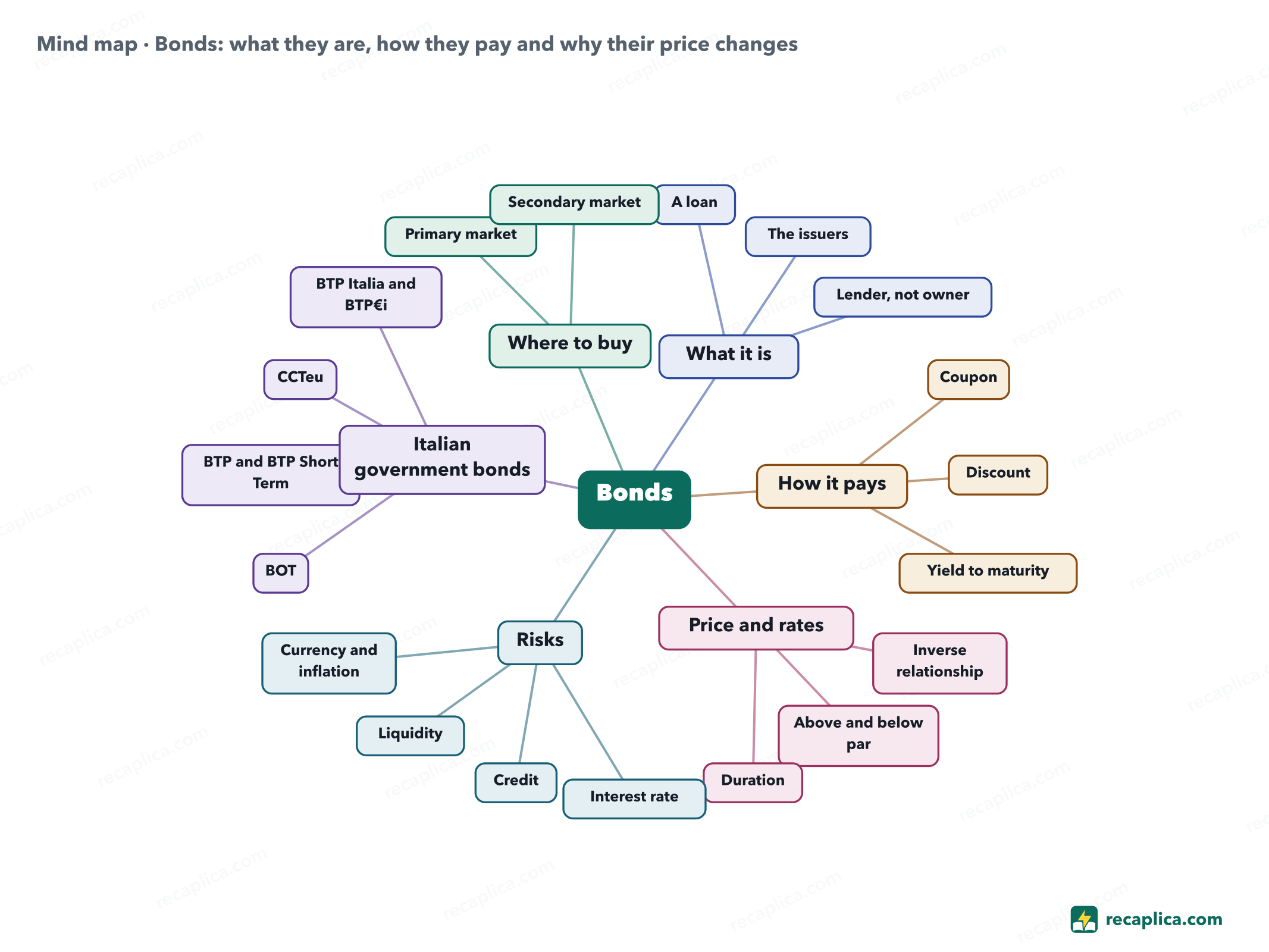
    Mind map: Bonds: what they are, how they pay and why their price changes
    • Bonds
      • What it is
        • A loan the face value is repaid at maturity
        • The issuers governments, banks, companies, supranational bodies
        • Lender, not owner unlike a shareholder
      • How it pays
        • Coupon fixed, floating or inflation-linked interest
        • Discount gap between price paid and repayment
        • Yield to maturity coupons plus the gap
      • Price and rates
        • Inverse relationship rates up, price down
        • Above and below par price above or below face value
        • Duration how strongly the price reacts to rates
      • Risks
        • Interest rate
        • Credit ratings, spread, subordinated bonds, bail-in
        • Liquidity
        • Currency and inflation
      • Italian government bonds
        • BOT 3, 6 or 12 months, no coupon
        • BTP and BTP Short Term 18 months to 50 years, fixed coupon
        • CCTeu coupon tied to Euribor
        • BTP Italia and BTP€i linked to inflation
      • Where to buy
        • Primary market at issue, for government bonds an auction
        • Secondary market after issue, for example on the MOT

    Quiz: test yourself

    Answer the questions to check what you have learned: you get instant feedback and a short explanation.

    Grade 0/10 0/5
    1 Someone who buys a bond issued by a company becomes...

    A bond is a loan: the buyer lends money and is entitled to get the face value back at maturity. Consob, Italy's market regulator, puts it plainly: bondholders are not owners of the company but its creditors. The owners are the shareholders.

    2 Market interest rates rise. What happens to the price of a fixed-rate bond already in circulation?

    A fixed coupon can't adjust to the new rates, so the price does the adjusting. If similar bonds come out paying more, the old one attracts fewer buyers and its price drops. In the SEC's example, a $1,000 bond with a 3% coupon falls to $925 when rates rise to 4%.

    3 You buy a BOT, an Italian Treasury bill, for €97 and get its €100 face value back at maturity. Where does the gain come from?

    BOTs are zero-coupon securities: they pay no coupons. The whole return comes from the difference between what you pay and what you receive at maturity, the issue discount, which here is €3.

    4 True or false: a BTP, an Italian government bond, sold before maturity can't be worth less than you paid, because the state guarantees it.

    False. The state guarantees the coupons and the repayment at maturity, not the market price. If rates have risen in the meantime, selling early can bring in less than you spent. For fixed-rate bonds this risk grows the further away the maturity is.

    5 Two years after issue, Marco buys a BTP on the MOT from another saver. Which market is he on?

    The primary market is where a bond is placed, when it's offered for the first time, usually through an auction. Every trade after that happens on the secondary market, and Borsa Italiana's MOT is one of them.

    Answers: 1-A · 2-B · 3-C · 4-B · 5-D

    Flashcards

    Tap the card to flip it and check whether you remember the answer, then move to the next one.

    1 / 8

    Explain it in your own words

    The ultimate test: if you can explain it in simple words, you've truly understood it. Write your explanation, then compare it with the Recap.

    Your explanation is saved only on this device.

    A bond is a loan: whoever buys one gives money to a government, a bank or a company, which promises to repay the face value on a set date and, often, to pay interest along the way, called the coupon. The bondholder is a lender, not an owner. What you actually earn also depends on the price you paid, which can be higher or lower than the repayment value. When market interest rates rise, the price of fixed-rate bonds already in circulation falls, and vice versa. Bonds are usually less risky than stocks, but they are not free of risk.

    Frequently asked questions

    What's the difference between stocks and bonds?

    A share of stock makes you a part-owner of a company; a bond means you lend money to the issuer and become its creditor. A bondholder is entitled to get the face value back at maturity, a right that can be delayed or placed behind other creditors but not cancelled. According to the Bank of Italy, bonds are normally less risky than stocks, which doesn't mean they carry no risk.

    What happens to bondholders if the issuer gets into trouble?

    They can lose part of their money: bonds linked to the Italian company Parmalat, for example, were repaid only in part. Your place in the queue matters. Holders of ordinary (senior) bonds are paid before holders of subordinated bonds. For banks in the European Union there is the bail-in, in force in Italy since 1 January 2016: losses hit shareholders first, then subordinated bonds, then unsecured senior bonds, then deposits above €100,000.

    How do you buy BTPs and other Italian government bonds?

    At issue, you take part in the Italian Treasury's auction through an intermediary such as a bank, with a minimum of €1,000 face value. After issue, the bonds are bought and sold on the secondary market, for example on Borsa Italiana's MOT.

    What is the spread between Italian and German bonds?

    A spread is the difference between the yields to maturity of two bonds from different issuers. In Italy the usual comparison is the ten-year BTP against the German bond of the same maturity, the Bund. According to the Bank of Italy, on 29 December 2025 the ten-year BTP yielded about 3.5% and the Bund about 2.8%: a spread of 0.7 percentage points, or 70 basis points.

    Are bonds right for my savings?

    This Recap explains how bonds work and can't answer a question that depends on each person's situation: goals, time horizon, how much loss you can tolerate. For a personal decision, it makes sense to talk to a licensed financial advisor. To understand individual products better, investor education material from public bodies helps, such as the Bank of Italy's L'economia per tutti portal and Consob in Italy, or the SEC and FINRA in the United States.

    Sources

    • Obbligazioni (Bonds), L'economia per tutti (Bank of Italy)
    • Titoli di Stato (Government bonds), L'economia per tutti (Bank of Italy)
    • Cosa sono i BTP? (What are BTPs?), L'economia per tutti (Bank of Italy)
    • Spread e rating (Spreads and ratings): what they measure and how to read them (Bank of Italy)
    • Bail-in, L'economia per tutti (Bank of Italy)
    • Obbligazioni? Bond? A quick refresher from the past (Bank of Italy)
    • Le obbligazioni (Bonds), investor education (Consob)
    • Come obbligazionista societario (As a corporate bondholder), investor education (Consob)
    • Riepilogo dei titoli di Stato (Summary of Italian government bonds), Treasury Department (MEF)
    • Aste Titoli di Stato (Government bond auctions), Treasury Department (MEF)
    • BTP Short Term, first issue at the auction of 25 March 2021 (MEF)
    • Obbligazioni (Bonds), Glossary (Borsa Italiana)
    • Obbligazione convertibile (Convertible bond), Glossary (Borsa Italiana)
    • I BTP (BTPs): what they are, what they yield and how to buy them (Borsa Italiana)
    • Investor Bulletin: Interest Rate Risk (SEC)
    • Brush Up on Bonds: Interest Rate Changes and Duration (FINRA)
    • Bonds, Risks (FINRA)
    • Why was the Bank of England founded? (Bank of England Museum)

    Every Recap goes through an independent review before publication.

    Every evening, the day's new Recaps on our Telegram channel. Join the channel →

    Keep learning

    • Economics Interest rates: what they are and how they move the economy The interest rate is the price of money: what it costs to borrow it, or what you earn for lending it. Benchmark rates are set by central banks (the ECB in the euro area) and ripple out to mortgages, loans and savings accounts. High rates cool spending and inflation; low rates fuel consumption and investment. As of mid-2026 the ECB deposit rate stands at 2.25%. Read the Recap →
    • Economics Labor Market: How Supply, Demand and Unemployment Work The labor market is where businesses that need workers to produce goods and services meet the people willing to work for them. In the textbook model, that meeting sets wages and employment levels the way any other market would, but imperfect information, bargaining power and legal rules push the real market away from pure competition. Those gaps are where unemployment comes from, and economists split it into frictional, structural, cyclical and technological types depending on the cause. Official statistics, such as Italy's ISTAT, measure it against the labor force — people employed plus people actively looking for work — not the whole population. As of July 2026, Italy's unemployment rate stood at 5.8%, provisional, against 6.4% for the euro area. Read the Recap →
    • Economics Mercantilism: History, Examples, and Definition Mercantilism was the dominant economic doctrine in Western Europe from the 16th to the 18th century: a state grew powerful by selling more abroad than it bought, building up reserves of gold and silver. Britannica Money describes it as "an economic practice by which governments used their economies to augment state power at the expense of other countries." Colonies had one job under this system: supply raw materials to the mother country and buy finished goods back from it, while at home tariffs and monopolies shielded domestic industry. The name itself came later, from the doctrine's most famous critic: Adam Smith made it current in The Wealth of Nations, published in 1776. Read the Recap →

    recaplica

    Clear in 30 seconds, yours in 10 minutes.

    Recaps Mind maps Request a Recap Telegram channel Mind map maker Our method About Privacy & cookies Legal notes & terms of use

    © 2026 Recaplica · A project by Curi S.r.l. — VAT IT05472000750

    Statistics, only if you say so

    To learn which Recaps help most we would use Google Analytics, with aggregate, anonymous data. It starts only with your OK, and you can change your mind anytime. Privacy policy