|
recaplica
What Is a Deepfake? How It Works and How to Spot One | ||||||
| © 2026 Recaplica · recaplica.com — All rights reserved | ||||||
What Is a Deepfake? How It Works and How to Spot OneWhat to print Page numbers appear when printing with default margins. SlidesChoose a cut Flash10 slidesThe essential thread, to present in classFull14 slidesEvery chapter and the deeper detailBoth come with speaker notes. In 30 seconds quick readA deepfake is audio or video content that artificial intelligence creates or alters to make fake images or words look real, sometimes depicting people who don't exist at all. The technique began with generative adversarial networks and has relied mainly on diffusion models since 2023, tools capable of producing convincing results within minutes. In January 2024, a Hong Kong company lost $25 million after a video call in which the colleagues present, including the chief financial officer, turned out to be synthetic reconstructions, a case that shows how usable the technology already is for real-world fraud. Spotting a deepfake is no longer a matter of watching for odd shadows or listening closely, and this Recap explains which signals still hold up and what European law requires. Key Points
Key figures
Deep DiveWhat it actually isThe EU AI Act, the regulation governing artificial intelligence across the European Union, defines a deepfake in Article 3(60) as AI-generated or manipulated image, audio, or video content that resembles existing (or plausible) persons, objects, places, entities, or events and gives a false impression of their authenticity. Three elements have to coexist: resemblance to a real or plausible subject, the existence of that subject, and the content’s ability to look authentic to whoever sees or hears it. UNESCO places it within a broader category, synthetic content: any material, audio, image, or video, produced by generative artificial intelligence, of which the deepfake is the most deceptive case because it convincingly mimics a real person’s voice or likeness. How it’s made, in briefUntil around 2022, the leading technique was generative adversarial networks, or GANs: two neural networks pitted against each other, a generator that produces a fake image and a discriminator that judges its authenticity. The process repeats for hours or days, until the generator produces results the discriminator can no longer catch. Since 2023, this architecture has largely given way to diffusion models, the family that includes Stable Diffusion, Sora, and Runway Gen-3.
In practice, a few seconds of real voice or a handful of images are enough to train a model that can generate a video within minutes: some commercial tools, such as HeyGen, make the process accessible to anyone with a starting video of the person being imitated. Within a few years, machine learning applied to this purpose went from a research lab to a widely available tool. A real case: the video call that cost $25 million
Misuses beyond disinformationThe 2022 report from the Europol Innovation Lab lists a range of criminal uses for deepfake technology that goes well beyond false news: online harassment and humiliation, extortion and fraud like the case above, document forgery, digital identity theft, non-consensual explicit material, child sexual exploitation, manipulation of evidence in legal proceedings, and finally disinformation and political polarization. A Recap on spotting fake news covers a different problem: fake news is a false story in any form, while a deepfake is synthetic content built with AI to look real. Why eyes and ears aren’t enough anymoreA study published in Nature Communications in 2024, led by Matt Groh and colleagues at the MIT Media Lab, tested how well people can recognize a political deepfake using a set of 32 short speeches by Presidents Joe Biden and Donald Trump. On the audio side the picture is even starker: a 2025 study cited by UNESCO found that people often perceive an AI-generated voice as identical to a real one, without being able to tell them apart reliably. UNESCO also points to a parallel limit on the technology side: automated detection tools consistently lag behind the techniques used to create deepfakes. How to spot a deepfake, in practiceSome precautions remain useful precisely because they don’t depend on catching a visual or audio detail. UNESCO suggests that families agree on a code word to verify each other during a suspicious call, and proposes the “prove you’re live” technique: asking the other person to perform an unplanned physical action in real time, something live-generation systems struggle to reproduce naturally. The rules: what the EU AI Act requiresSince August 2, 2026, the AI Act has required anyone who distributes a deepfake, the so-called “deployer” of the system, to disclose it clearly to whoever views or hears it, at the latest upon first contact with the content. Works that are evidently artistic, creative, satirical, or fictional are exempt from the strict version of the rule, needing only a disclosure that doesn’t get in the way of enjoying the content. Content generated before August 2, 2026, doesn’t need to be labeled retroactively, even though the European Commission recommends it. For systems already on the market, the technical marking obligations begin on December 2, 2026. Non-compliance carries penalties of up to €15 million or 3% of worldwide annual turnover. The rules are covered in more depth in the Recap on the EU AI Act. Slide deckSlides ready to download and make your own in PowerPoint or Google Slides, with speaker notes. Pick the Flash cut or the Full one.     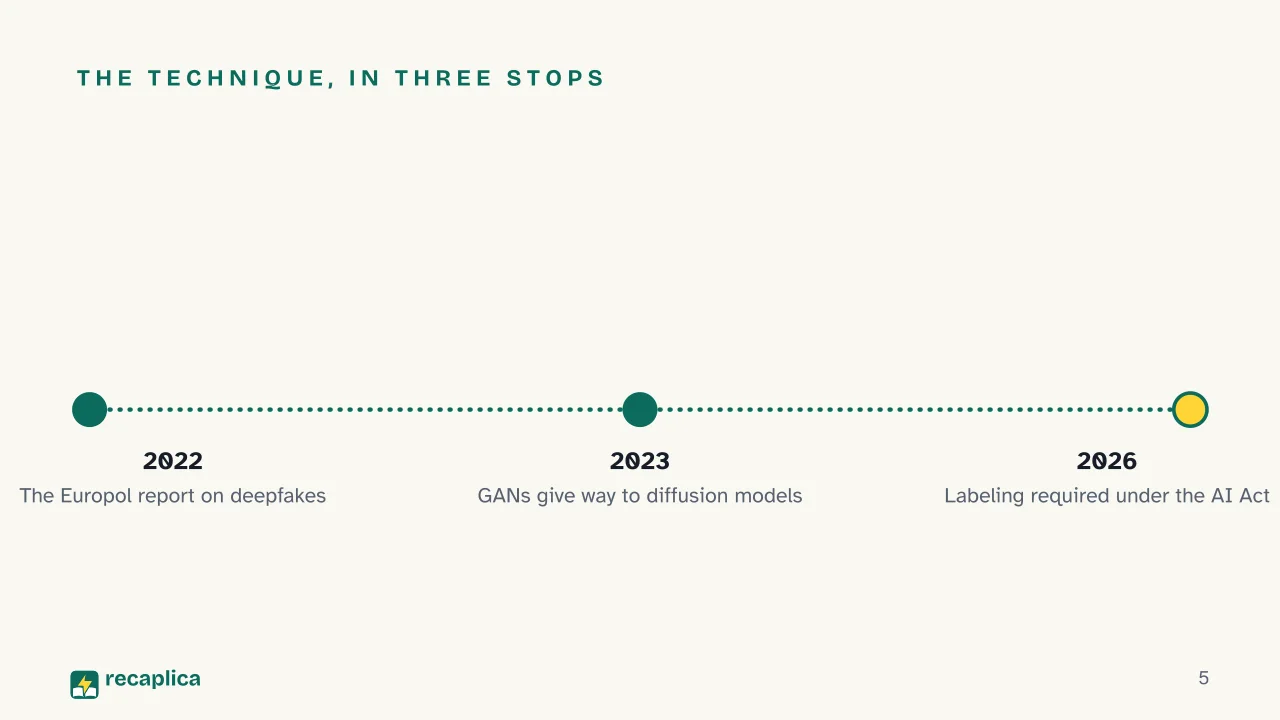  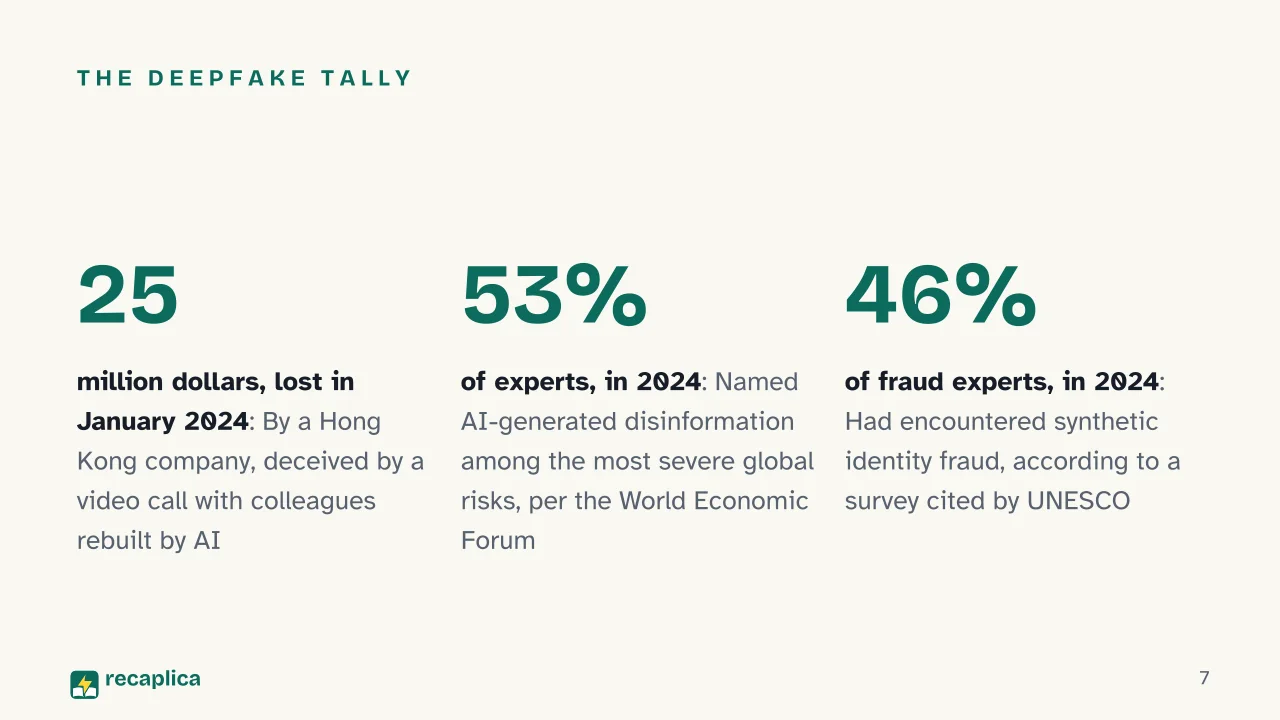 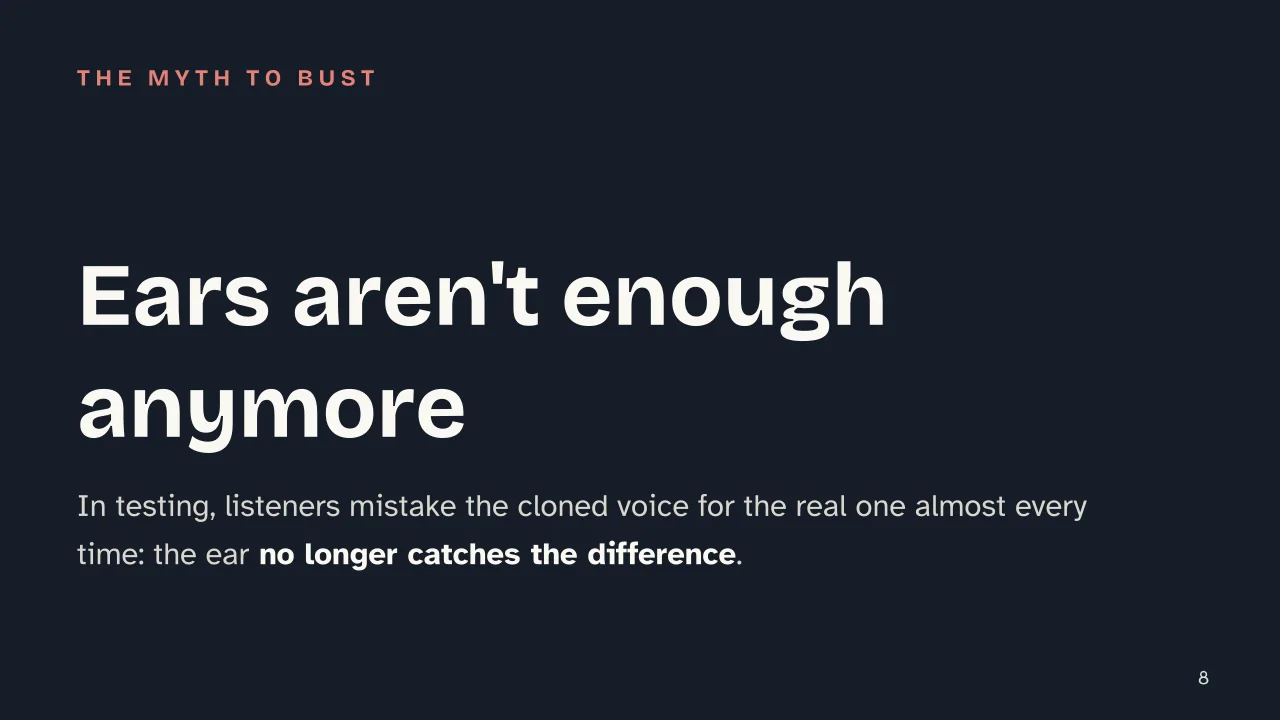  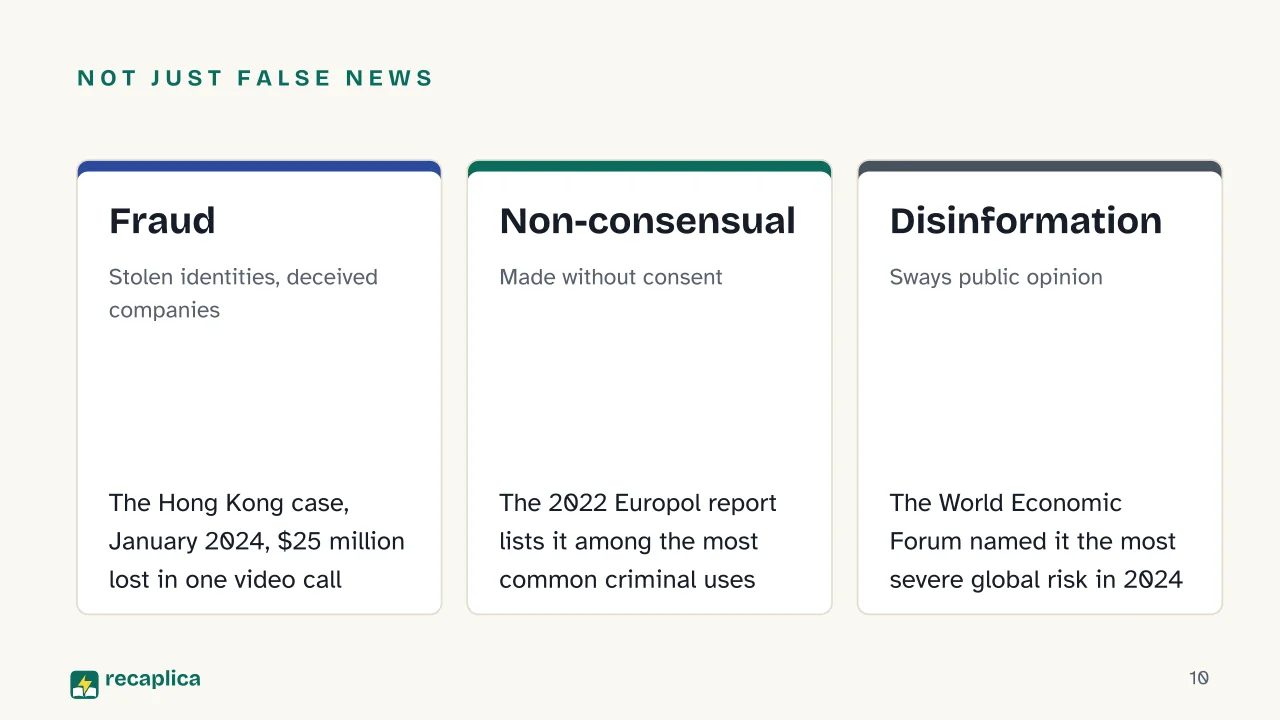  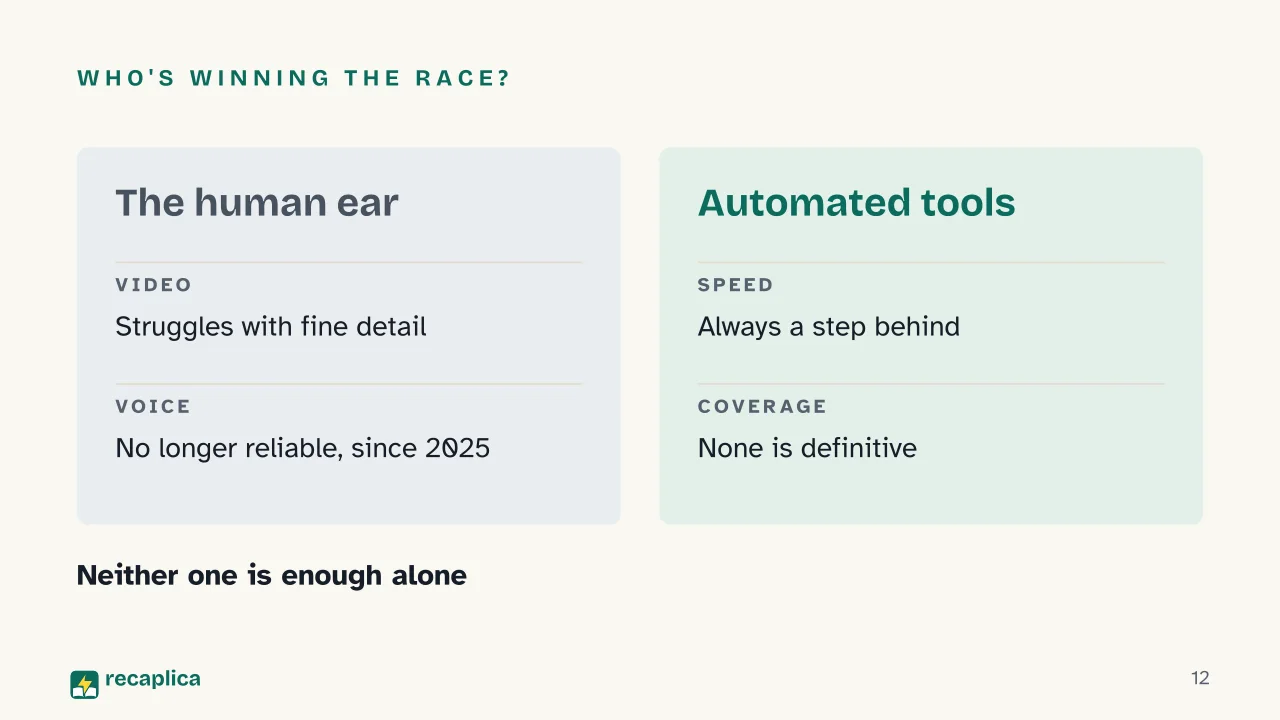 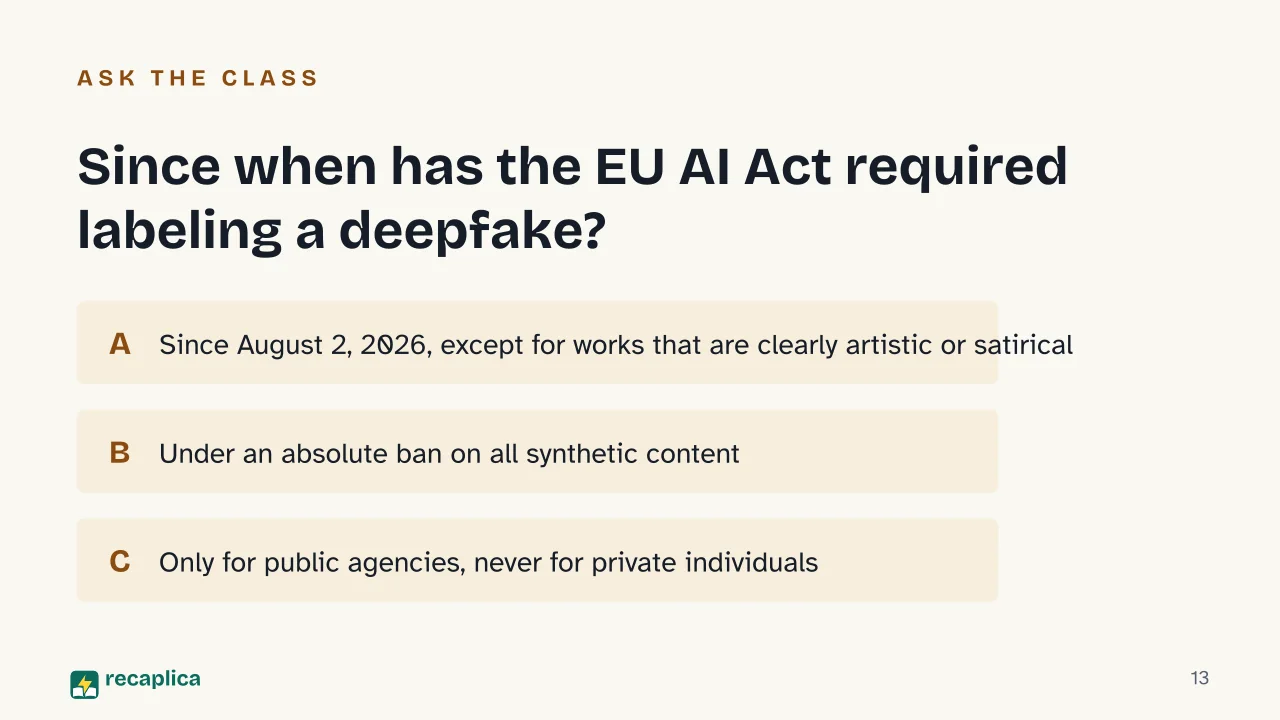  Common myths
Mind mapDrag the background to move around and the nodes to reposition them; use − and + to collapse and expand branches. 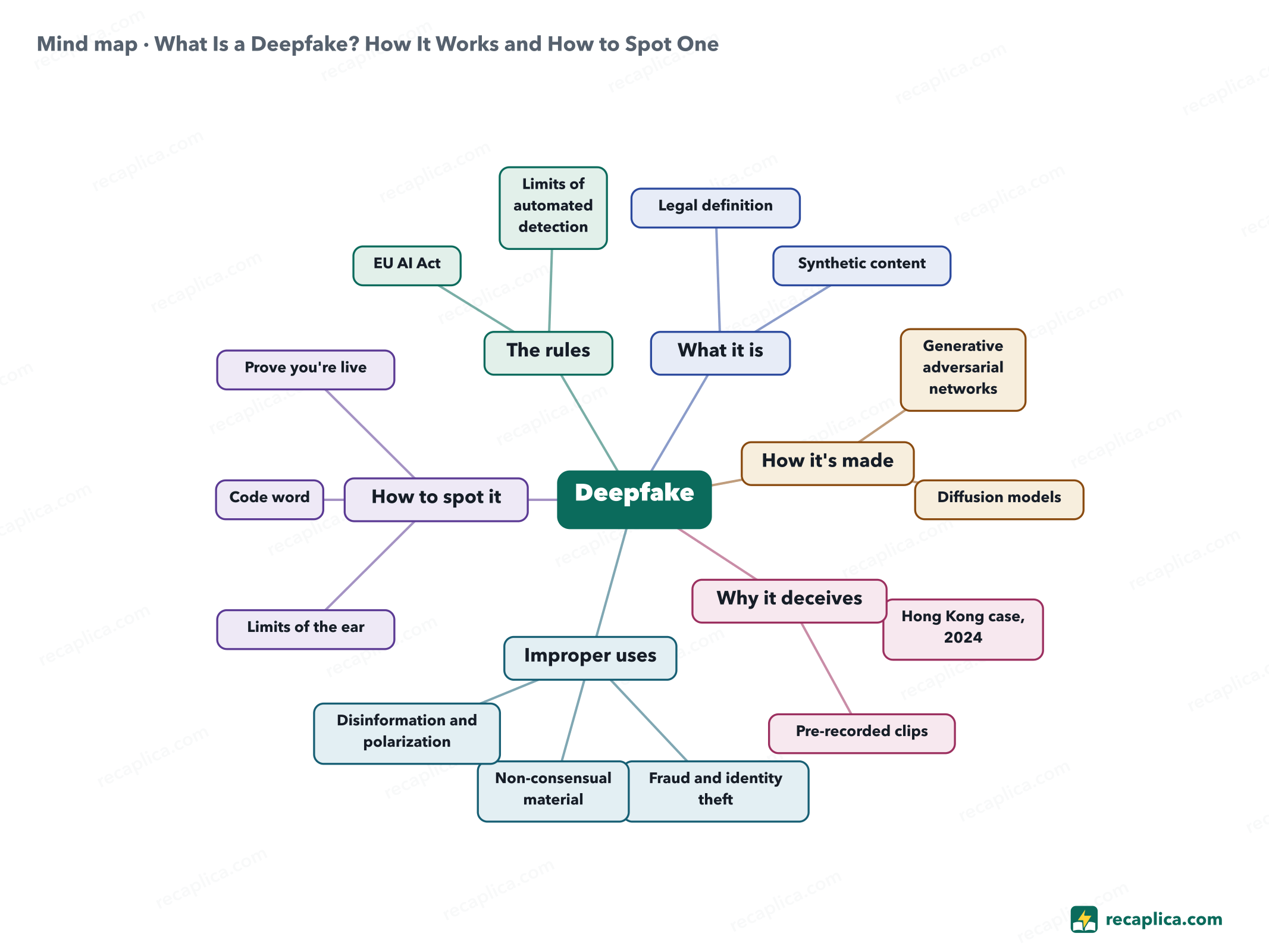
Quiz: test yourselfAnswer the questions to check what you have learned: you get instant feedback and a short explanation. Grade 0/10 0/5
FlashcardsTap the card to flip it and check whether you remember the answer, then move to the next one. 1 / 7 Explain it in your own wordsThe ultimate test: if you can explain it in simple words, you've truly understood it. Write your explanation, then compare it with the Recap. Your explanation is saved only on this device.
Frequently asked questionsWhat is a deepfake?It's audio, an image, or a video that artificial intelligence creates or alters to look authentic: it can show a real person saying or doing something that never happened, or reconstruct a face that doesn't exist. The EU AI Act defines it in Article 3(60) as content that resembles a real or plausible subject and gives a false impression of authenticity. How is a deepfake made?Until around 2022, the leading technique was generative adversarial networks (GANs): two neural networks trained against each other for hours or days. Since 2023, production has relied mainly on diffusion models such as Stable Diffusion, Sora, or Runway Gen-3, now built into commercial tools that can generate a video in minutes from a handful of images or a few seconds of real voice. How do you spot a deepfake?Listening or watching closely is no longer enough: a 2025 study found that people can't reliably tell a cloned voice from a real one, and automated detection tools still lag behind the techniques used to create deepfakes. UNESCO suggests practical steps instead, such as agreeing on a family code word for suspicious calls, or asking the other person for an unplanned physical gesture that a real-time system struggles to reproduce. What does European law say about deepfakes?Since August 2, 2026, the AI Act has required anyone distributing a deepfake to clearly disclose it to viewers or listeners, with a lighter exception for works that are clearly artistic, satirical, or fictional. Content generated before that date doesn't need to be labeled retroactively. Penalties for non-compliance reach up to €15 million or 3% of worldwide annual turnover. What's the difference between a deepfake and fake news?Fake news is a false story in any form, even a simple text written to mislead. A deepfake is a synthetic audio or video piece built with AI to look real: it can spread disinformation, but it's also used for fraud, identity theft, or non-consensual material that has nothing to do with news at all. Every Recap goes through an independent review before publication. |