Skip to content
recaplica

    One moment: security check

    Cloudflare wants to make sure you're not a robot. Tick the box below and your search will continue on its own.

    IT
    recaplica Food Sovereignty: What It Is and Where the Concept Comes From
    © 2026 Recaplica · recaplica.com — All rights reserved
    Home › Civics Food and cooking

    Food Sovereignty: What It Is and Where the Concept Comes From

    By Recaplica Newsroom · Updated on September 19, 2026

    What to print

    Page numbers appear when printing with default margins.

    Telegram channel
    recaplica Clear in 30 seconds, yours in 10 minutes.
    In 30 seconds Key points Figures Deep dive Myths Mind map Quiz Flashcards FAQ

    In 30 seconds quick read

    Food sovereignty is the right of peoples to decide for themselves how their food is grown and eaten, using ecologically sound methods that respect local cultures. La Via Campesina, an international network of peasant organizations, coined the term in 1996 and presented it at the World Food Summit in Rome. It is not the same as food security, which the FAO defines as everyone having access to enough safe food without saying who controls how that food is produced. In practice, food sovereignty also depends on local control over seeds and crop varieties, an area where genetic diversity has shrunk dramatically over the past century.

    Key Points

    • Food sovereignty is the right of peoples to shape their own food system, a term coined by La Via Campesina in 1996.
    • It differs from food security (FAO definition, 1996): the latter is about access to food, not who decides how it is produced.
    • The movement launched at the 1996 Rome summit, took shape at the 2001 Havana forum, and consolidated at the 2007 Nyéléni forum in Mali.
    • Small-scale farmers, fishers, pastoralists, and Indigenous peoples have been part of the movement's foundation from the start, not a later addition.
    • Just thirty crops, including wheat, rice, maize, and potatoes, supply the bulk of the world's food: a narrower genetic base than in the past.
    • Community seed banks, such as those in Peru, are trying to reverse that loss by cataloguing local varieties.

    Key figures

    • 22% Share of wild relatives of peanuts, potatoes, and beans that a study cited by the FAO projects could disappear by 2055 due to climate change. Source: FAO (projection)

    Deep Dive

    What is food sovereignty?

    La Via Campesina, the international network of peasant organizations that coined the term, defines food sovereignty as the right of peoples to healthy, culturally appropriate food produced through ecologically sound methods, and their right to define their own food and agriculture systems on their own terms. The concept was launched in 1996, when the movement brought it to the World Food Summit in Rome to push small-scale food producers into the center of global food policy debates.

    From the start, the movement tied the idea to concrete control over resources: the rights to use and manage land, territories, water, seeds, livestock, and biodiversity, it argued, belong in the hands of the people who actually produce the food. It is not a vague political slogan. It is a specific claim about who gets to hold the reins on seeds, land, and water.

    Food sovereignty vs. food security

    The two terms get mixed up often, but they answer different questions. Food security, in the FAO definition adopted the same year, 1996, exists when all people, at all times, have physical and economic access to sufficient, safe, and nutritious food for an active and healthy life. It measures availability and access. It says nothing about who grows that food, using what methods, or under whose decisions.

    DimensionFood securityFood sovereignty
    Question it answersIs there enough accessible food for everyone?Who decides what, how, and where food is produced?
    OriginFAO, Rome Summit, 1996La Via Campesina, Rome Summit, 1996
    FocusAvailability, access, use, stability of foodLocal control over land, seeds, water, and methods
    Neutral on production modelYesNo — favors ecological, small-scale methods

    A country can look food secure by FAO’s own statistics and still depend heavily on imports, multinational suppliers, or decisions made on other continents. Food sovereignty was defined to address that gap.

    From Rome to Nyéléni: a brief history

    After the 1996 launch, the concept developed as a direct challenge to a globalized, market-driven model of food production, the same territory that microeconomics and macroeconomics map out when they describe how prices and distribution chains form across international markets.

    In 2001, a World Forum on Food Sovereignty convened in Havana, Cuba, drawing delegates from peasant, fisher, Indigenous, and civil society organizations, the point at which the concept began taking a shared shape among very different groups. In 2007, more than 500 people from 80 countries met in Nyéléni, Mali, at a forum that became the movement’s reference point. Its closing declaration compressed the whole claim into a line that has since traveled widely through the movement: every struggle for food sovereignty, anywhere in the world, is treated as a shared struggle.

    Indigenous peoples and the peasant movement

    Founding documents describe the core of the food sovereignty movement as small-scale producers: farmers, fishers, pastoralists, Indigenous peoples, and rural workers. This is not a later add-on. Indigenous peoples already appear in the list of groups that built the shared definition at Nyéléni in 2007, standing alongside the peasant organizations that had coined the term eleven years earlier.

    For many Indigenous communities, indigenous food sovereignty means, concretely, deciding where, how, and by whom food is gathered, hunted, fished, grown, prepared, and shared on their own terms, without those decisions being made elsewhere.

    The link to agricultural biodiversity

    Local control over seeds also answers a real problem, even if the exact scale is disputed. For years, a figure of 75% of the world’s crop genetic diversity lost between 1900 and 2000 circulated widely, but a 2022 review in New Phytologist traced that number back to a non-scientific 1993 paper and found that, at the level of crop species, evidence for such a sharp worldwide decline remains thin. What the data do show is narrower but real: modern commercial agriculture has replaced countless local varieties with a handful of standardized ones, so that just thirty crops, wheat, rice, maize, millet, and potatoes among them, supply the bulk of the world’s food.

    The pressure has not let up since the twentieth century. A study cited by the FAO projects that, as climate change tied to the greenhouse effect intensifies, up to 22% of the wild relatives of peanuts, potatoes, and beans could disappear by 2055. Those are the same wild species breeders draw on when they need to introduce new resistance traits into cultivated varieties.

    Real-world example: in the Cuyocuyo agrobiodiversity zone in Peru, 200 kilometers north of Lake Titicaca, researchers have catalogued 243 potato varieties, 33 maize varieties, and 129 varieties of Andean tubers such as oca, mashua, and olluco. With support from the Wildlife Conservation Society, two community seed banks have been set up in the communities of Punalaqueque and Huancasayani, built to collect seed after the potato harvest.

    Similar efforts exist on a larger scale. Community seed banks in Kenya and Uganda give thousands of farmers, especially women, access to diverse seed for staple food-security crops like sorghum and finger millet. Globally, the Alliance of Bioversity International and CIAT holds more than 66,000 seed samples in partnership with the Crop Trust, with dedicated hubs such as the world banana collection in Belgium and the Future Seeds center in Colombia for beans, tropical forages, and cassava. La Via Campesina’s peasant seed campaigns apply the same logic on a local scale: keeping the choice of what to plant in the hands of the communities that plant it.

    Common myths

    • ✗ Myth A frequently cited figure says the FAO measured a 75% loss of the world's crop genetic diversity between 1900 and 2000.

      ✓ Reality that number was never an FAO measurement. A 2022 review in New Phytologist by Khoury and colleagues traced its origin to a 1993 paper written for Earth Day by Hope Shand of the non-governmental group RAFI, a claim that was never backed by real global data. The same authors write that, at the level of individual crop species worldwide, evidence for such a sharp decline in diversity remains thin; the loss that is well documented instead concerns traditional varieties grown within each species, a different phenomenon from crop species going extinct.

    • ✗ Myth A widely repeated statistic claims Indigenous peoples protect 80% of the planet's biodiversity.

      ✓ Reality that figure has no solid basis. An analysis published in Nature in 2024 traced it back to a 2008 World Bank report, which in turn borrowed a 2005 World Resources Institute figure describing just seven communities in the Philippines, not a global measurement. Even so, it circulated for roughly two decades in UN and World Bank documents before anyone checked where it came from.

    • ✗ Myth Food sovereignty and food security are the same idea under two different names.

      ✓ Reality the FAO's 1996 definition of food security covers physical and economic access to enough safe food, without specifying who controls production. Food sovereignty adds exactly that missing question: who controls production. A country can be food secure by the numbers and still depend on imports and decisions made elsewhere.

    Mind map

    Drag the background to move around and the nodes to reposition them; use − and + to collapse and expand branches.
    Customize
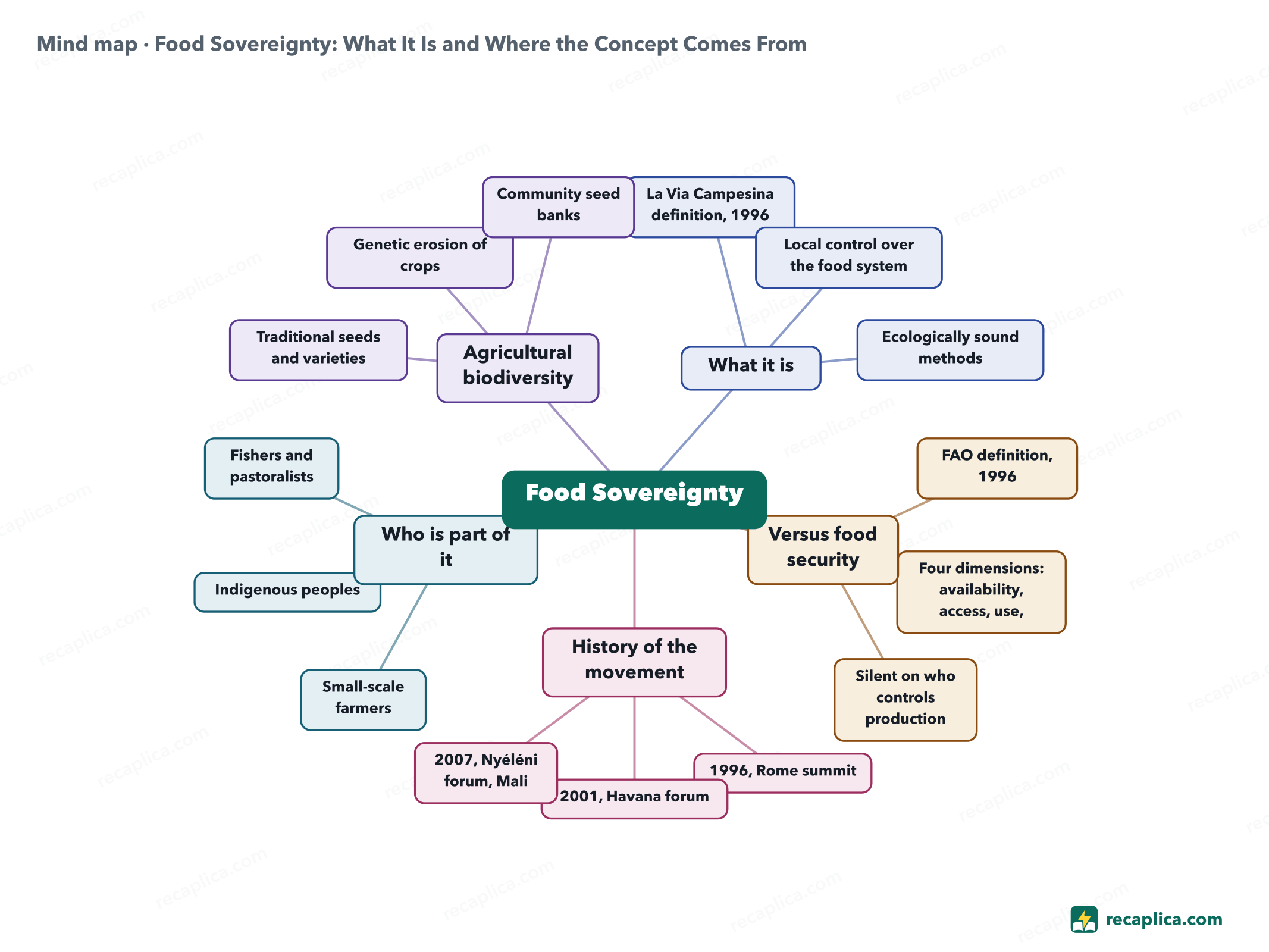
    Mind map: Food Sovereignty: What It Is and Where the Concept Comes From
    • Food Sovereignty
      • What it is
        • La Via Campesina definition, 1996
        • Local control over the food system
        • Ecologically sound methods
      • Versus food security
        • FAO definition, 1996
        • Four dimensions: availability, access, use, stability
        • Silent on who controls production
      • History of the movement
        • 1996, Rome summit
        • 2001, Havana forum
        • 2007, Nyéléni forum, Mali
      • Who is part of it
        • Small-scale farmers
        • Indigenous peoples
        • Fishers and pastoralists
      • Agricultural biodiversity
        • Traditional seeds and varieties
        • Genetic erosion of crops
        • Community seed banks

    Quiz: test yourself

    Answer the questions to check what you have learned: you get instant feedback and a short explanation.

    Grade 0/10 0/5
    1 In what year did La Via Campesina coin the term "food sovereignty"?

    The term was launched in 1996, at the World Food Summit in Rome.

    2 What is the main difference between food security and food sovereignty?

    Food security (FAO, 1996) is neutral about who produces food and how; food sovereignty adds the right of peoples to decide their own food system.

    3 Where was the 2007 forum held that consolidated the food sovereignty movement?

    In 2007, more than 500 people from 80 countries gathered in Nyéléni, Mali.

    4 How many crops supply the bulk of the food eaten worldwide?

    Just thirty crops, including wheat, rice, maize, millet, and potatoes, supply the bulk of the world's food, a narrower genetic base than in past centuries.

    5 True or false: Indigenous peoples have been part of the food sovereignty movement since its founding.

    Founding documents of the movement, including the 2007 Nyéléni Declaration, explicitly list Indigenous peoples among the founding groups, alongside small-scale farmers, fishers, and pastoralists.

    Answers: 1-C · 2-B · 3-D · 4-A · 5-A

    Flashcards

    Tap the card to flip it and check whether you remember the answer, then move to the next one.

    1 / 7

    Explain it in your own words

    The ultimate test: if you can explain it in simple words, you've truly understood it. Write your explanation, then compare it with the Recap.

    Your explanation is saved only on this device.

    Food sovereignty is the right of peoples to decide for themselves how their food is grown and eaten, using ecologically sound methods that respect local cultures. La Via Campesina, an international network of peasant organizations, coined the term in 1996 and presented it at the World Food Summit in Rome. It is not the same as food security, which the FAO defines as everyone having access to enough safe food without saying who controls how that food is produced. In practice, food sovereignty also depends on local control over seeds and crop varieties, an area where genetic diversity has shrunk dramatically over the past century.

    Frequently asked questions

    What is food sovereignty, in simple terms?

    Food sovereignty is the right of peoples to define their own food and agricultural systems, using ecologically sound methods and food that fits their own culture. La Via Campesina, a network of peasant organizations, coined the term in 1996 at the World Food Summit in Rome.

    What is the food sovereignty definition compared to food security?

    Food security (FAO, 1996) is about everyone having access to enough safe food. Food sovereignty adds the question of who controls the production system, including the right to ecologically sound and culturally appropriate methods.

    What is indigenous food sovereignty?

    Indigenous food sovereignty is the ability of Indigenous nations and communities to feed themselves on their own terms, controlling where, how, and by whom food is gathered, hunted, fished, grown, prepared, and shared. Indigenous peoples are named as founding participants in the movement's 2007 Nyéléni Declaration in Mali, alongside small-scale farmers, fishers, and pastoralists.

    What are community seed banks?

    Local archives, often run by communities themselves, where traditional seed varieties are stored and catalogued. In the Cuyocuyo agrobiodiversity zone in Peru, researchers have catalogued 243 potato varieties and 33 maize varieties.

    Sources

    • La Via Campesina, "What is Food Sovereignty?"
    • Nyéléni, "The International food sovereignty movement"
    • FAO, Rome Declaration on World Food Security (1996)
    • FAO Newsroom, "Crop biodiversity: use it or lose it"
    • Khoury CK et al., "Crop genetic erosion: understanding and responding to loss of crop diversity", New Phytologist 233 (2022)
    • Alliance of Bioversity International and CIAT, community seed banks in Peru
    • Nature, "No basis for claim that 80% of biodiversity is found in Indigenous territories"

    Every Recap goes through an independent review before publication.

    Every evening, the day's new Recaps on our Telegram channel. Join the channel →

    Keep learning

    • Civics Climate Refugees: What They Are and Why the Law Doesn't Recognize Them Climate refugees is the popular name for people who leave their homes, inside or across national borders, because of sudden climate events or slow-moving environmental change. Some regions risk becoming uninhabitable not for one reason but for a combination of factors: water scarcity, falling farm output and rising sea levels. The World Bank projects that more than 216 million people could be forced to move within their own country for these reasons by 2050. International law, though, still has no recognized legal status for people who flee the climate: the 1951 Refugee Convention protects only those who fear persecution for race, religion, nationality, membership of a particular social group or political opinion, and climate is not among these five grounds. Read the Recap →
    • Science Weather Forecasting: How It Works, From Data to Models to Forecasters A weather forecast starts with thousands of measurements collected every day by ground stations, radar, satellites and radiosondes carried aloft by balloons. A numerical model takes that data as a starting snapshot and uses the equations of physics to calculate how the atmosphere will change hour by hour. The further out the forecast reaches, the more a tiny error in the starting data grows, which is why detailed forecasts hold up for roughly a week, while beyond 15 days large models such as the ECMWF's work only in probabilities. In the end it's still a forecaster who settles on what to communicate to the public, uncertainty included. Read the Recap →
    • Economics Critical Minerals: Why the Energy Transition Runs on Them Solar panels, wind turbines, batteries and electric motors run on materials that fossil-fuel technology barely needs: lithium, cobalt, nickel, copper, graphite and rare earths. Mining, and especially refining, these minerals is concentrated in a small number of countries — by 2024 the top three refining nations controlled 86% of world output, up from 82% in 2020, according to the International Energy Agency. China has already used that position as leverage, from the 2010 embargo on Japan to export licences imposed in 2025 on seven heavy rare-earth elements. The European Union answers with the Critical Raw Materials Act, which sets domestic extraction, processing and recycling targets and caps dependence on any single supplier outside the bloc by 2030. Read the Recap →

    recaplica

    Clear in 30 seconds, yours in 10 minutes.

    Recaps Mind maps Request a Recap Telegram channel Mind map maker Our method About Privacy & cookies Legal notes & terms of use

    © 2026 Recaplica · A project by Curi S.r.l. — VAT IT05472000750

    Statistics, only if you say so

    To learn which Recaps help most we would use Google Analytics, with aggregate, anonymous data. It starts only with your OK, and you can change your mind anytime. Privacy policy