|
recaplica
Italian Government Structure: Which Bodies Do What |
| © 2026 Recaplica · recaplica.com — All rights reserved |
Italian Government Structure: Which Bodies Do WhatWhat to print Page numbers appear when printing with default margins. SlidesChoose a cut Flash10 slidesThe essential thread, to present in classFull18 slidesEvery chapter and the deeper detailBoth come with speaker notes. In 30 seconds quick readThe Italian state rests on five bodies that the Constitution sets up and regulates directly: Parliament makes the laws, the Government carries them out, the President of the Republic represents national unity, the judiciary applies the law to individual cases, and the Constitutional Court checks that laws respect the Constitution. Alongside them sit four bodies of constitutional relevance — the High Council of the Judiciary, the Court of Auditors, the CNEL and the Council of State — auxiliary bodies the Constitution sets up but keeps in a separate category from the five essential ones. Knowing who does what, and which bodies the system cannot run without, is the fastest way into how Italy is actually governed. Key Points
Deep DiveIn the Italian state, power is not concentrated in one office: the Constitution hands the work to several separate bodies, and each one covers a distinct part of it. Five of them count as constitutional bodies in the strict sense, because the Constitution regulates them directly and their existence is a condition for the system to work at all: Parliament, the Government, the President of the Republic, the judiciary, and the Constitutional Court. Around them sit other bodies, also set up by the Constitution but with a supporting role — a difference that goes beyond labels. Parliament: who makes the lawsPassing laws is only one job among several for the Italian Parliament, which also keeps watch on how the Government uses its powers, can open an inquiry into a matter of public concern, and decides whether to grant it — or take away — its confidence. What sets the system apart is its structure: the Chamber of Deputies and the Senate do not split these duties between them, each holds the full set, and that is why Italy calls it perfect bicameralism (a bill, something the legal norm entry helps define more precisely, needs an identical text passed by both chambers before it becomes law). There is a third way the two chambers act together: sitting as one body in joint session, with regional delegates added to their ranks, they elect the President of the Republic; in that same expanded assembly, they also choose some of the Constitutional Court’s judges and some members of the High Council of the Judiciary.
The Government: who sets the country’s policyThe Government is the country’s executive branch, built around the Council of Ministers: Article 92 of the Constitution defines it as the Prime Minister plus every minister, with or without portfolio, meeting under the Prime Minister’s chairmanship. Before any of them can take up their duties, each takes an oath before the President of the Republic, as Article 93 requires. The Council’s job does not end on the day it is sworn in: it sets the country’s general policy and steers, day by day, how the public administration puts that policy into practice. The Government needs the confidence of both chambers: without it, the Government cannot stay in office, and that is the channel through which Parliament keeps checking it day to day, not just at the moment it is formed. The President of the Republic: a neutral powerThe President of the Republic holds two roles at once: head of state and symbol of national unity. Legal scholars also describe the office as a guarantor body, a “neutral” power sitting outside the three traditional branches — the President neither legislates, nor governs, nor judges. The term lasts seven years, as Article 85 of the Constitution sets out: as it nears its end, the President of the Chamber of Deputies convenes Parliament in joint session, joined by regional delegates, thirty days before the term expires. None of the President’s powers work alone, without someone else’s involvement: the President signs off on appointing the Prime Minister and the ministers, signs laws to bring them into force, can dissolve Parliament ahead of schedule, and chairs the High Council of the Judiciary. Because presidential acts need a minister’s countersignature, it is that minister — not the President — who answers for them: the head of state carries no personal liability for what gets signed. Choosing a powerful office through a dedicated electoral body rather than a direct popular vote is not unique to Italy, even if the rules involved look nothing alike: the conclave that elects the pope is one well-known example, despite sharing no procedural ground with the election of Italy’s President. The judiciary and the Constitutional Court: who checks legalityThe Constitutional Court’s job starts one step further along than the judiciary’s: it decides whether a law, or a decree carrying the same weight as a law, issued by the state or a region, holds up against the Constitution — both in how it was passed (the procedures the Constitution requires, what legal scholars call formal constitutionality) and in what it says (whether its content matches constitutional principles, substantive constitutionality). The judiciary, for its part, applies the law to individual cases, and the Constitution safeguards its independence specifically, largely through the High Council of the Judiciary. Most often, the Court does not get involved on its own initiative: a judge, partway through a trial, raises the concern that the law in question might be unconstitutional, unable either to ignore it outright or to apply it without question. Three further jobs fall to the Court: settling disputes when one state power believes another has overstepped into territory the Constitution assigns to it; deciding whether a repeal referendum — the kind Article 75 of the Constitution allows once at least five hundred thousand voters request it — can actually go to a vote, since without the Court’s sign-off no vote takes place; and ruling on any impeachment brought against the President, a proceeding where sixteen citizens join the fifteen regular judges. Constitutional bodies versus bodies of constitutional relevance: the difference that mattersAlongside the five bodies covered so far, the Constitution sets up others known as bodies of constitutional relevance: the High Council of the Judiciary, the Court of Auditors, the National Council for Economics and Labour (CNEL), and the Council of State. The Constitution labels them auxiliary bodies, a category apart from the five essential ones, whose existence is instead a condition for the system to exist at all. Not every textbook draws this line identically — some place the High Council of the Judiciary closer to the judiciary than to the auxiliary bodies — but the underlying framework, set up by the Constitution without being indispensable to it, is widely shared. Among these three auxiliary bodies, each works a different angle. The Court of Auditors supports Parliament directly, supplying it with data on how the public administration is performing, and under Article 103 of the Constitution it also carries out a judicial function of its own; to protect the independence of its own judges, an office functionally similar to the High Council of the Judiciary exists for it as well. The CNEL, created by the law of 5 January 1957, no. 33, under Article 99 of the Constitution, plays a different role: it advises Parliament and the Government on the economic and social matters assigned to it by law, and can even propose new legislation in that field. The Council of State, finally, combines two functions: it acts as the leading advisory body on administrative law and looks after the fairness of public administration, and since Italy set up regional administrative courts it has also ruled on appeals from them — a final ruling, since no appeal to the Court of Cassation is available against its decisions. The High Council of the Judiciary protects the independence of ordinary judges by managing their careers end to end: it decides who joins the judiciary, where they are assigned, when they are transferred or promoted, and what disciplinary sanctions apply when needed. The President of the Republic chairs it. This layered structure — essential bodies and supporting bodies — is not unique to Italy in the sense that every legal system distributes power somehow, but the precise rules (who elects whom, what majorities are needed, what thresholds apply to citizens) are written into Italy’s own Constitution; a useful comparison, to keep the two levels apart, is with how the European Union works: the entry on how the European Union works shows a different institutional setup, with its own balance between bodies. Slide deckSlides ready to download and make your own in PowerPoint or Google Slides, with speaker notes. Pick the Flash cut or the Full one.     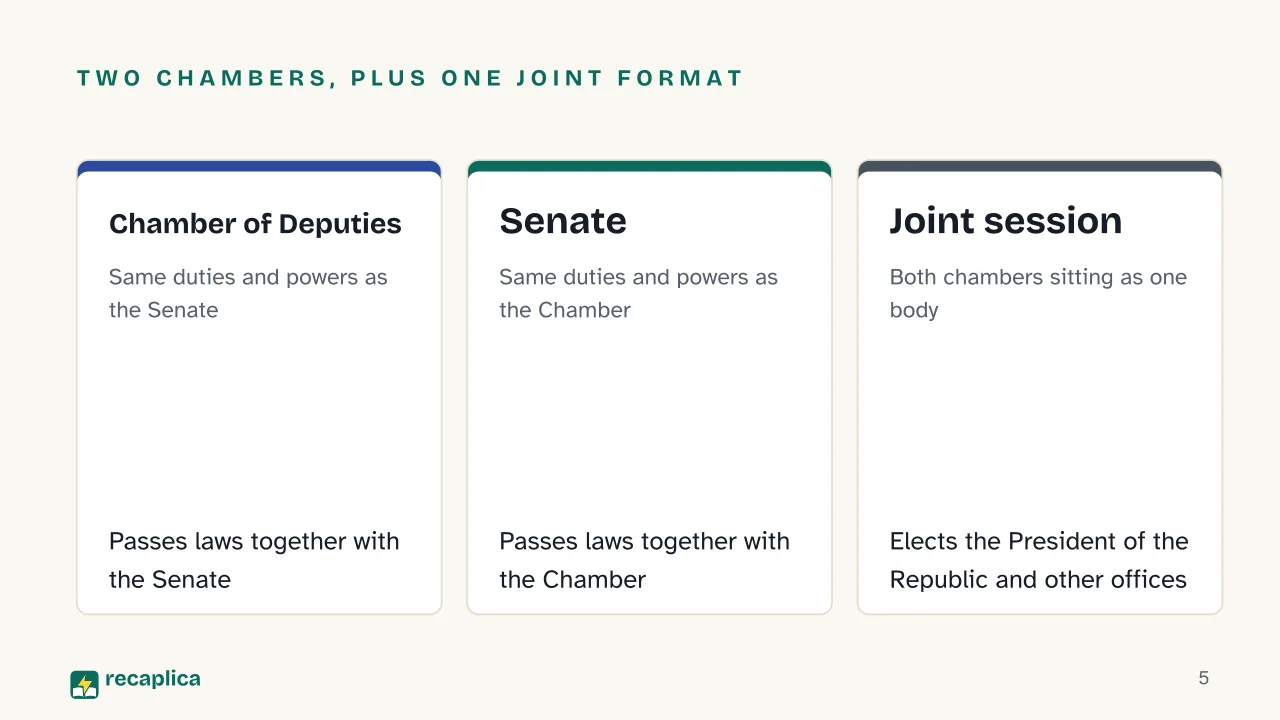 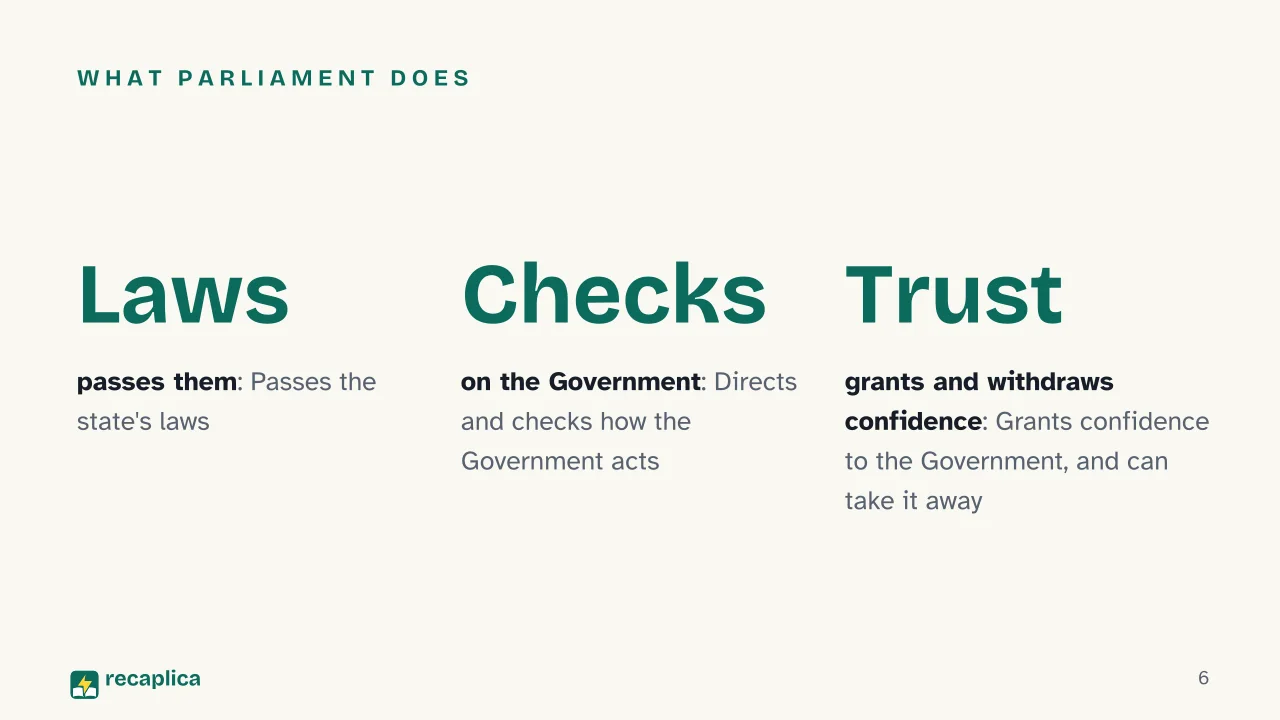  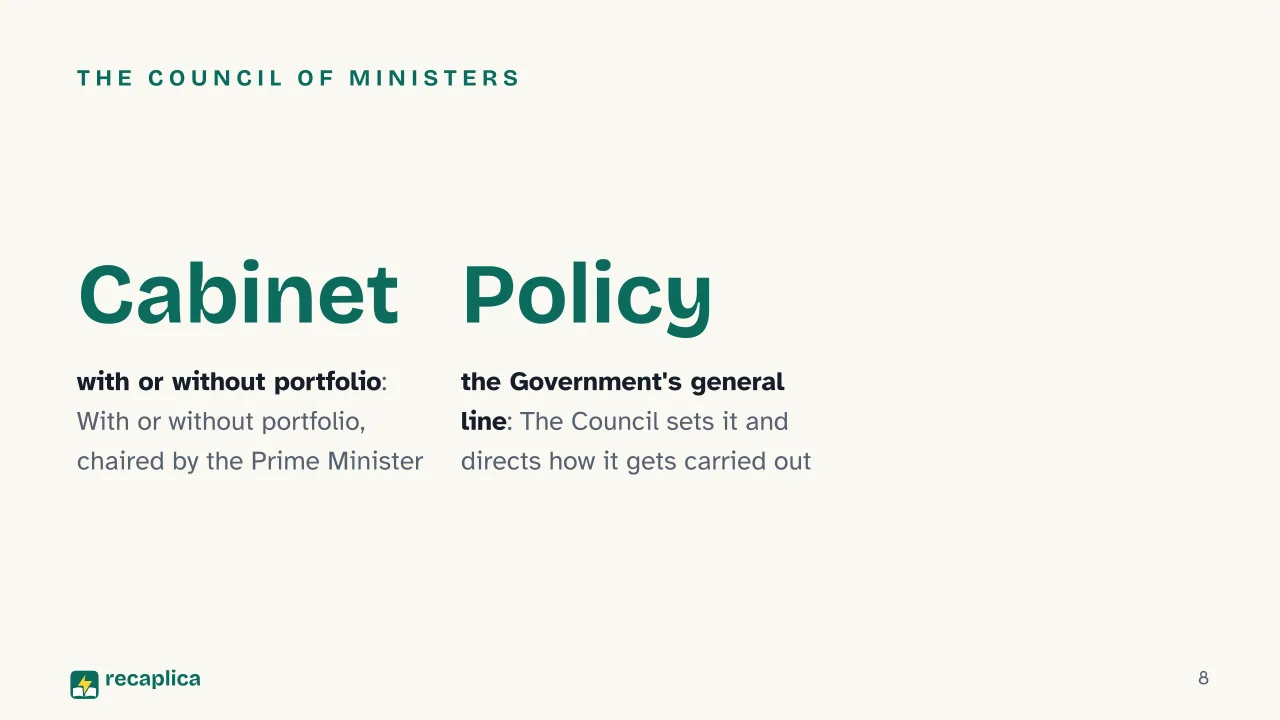 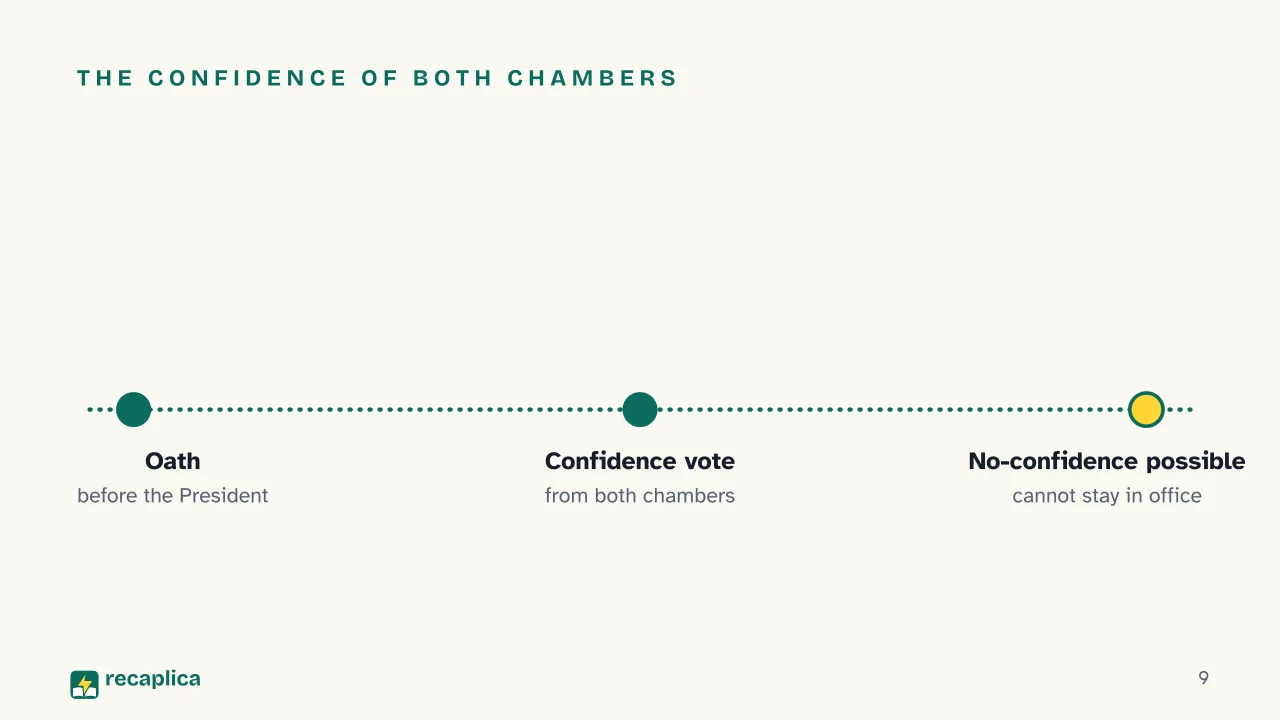  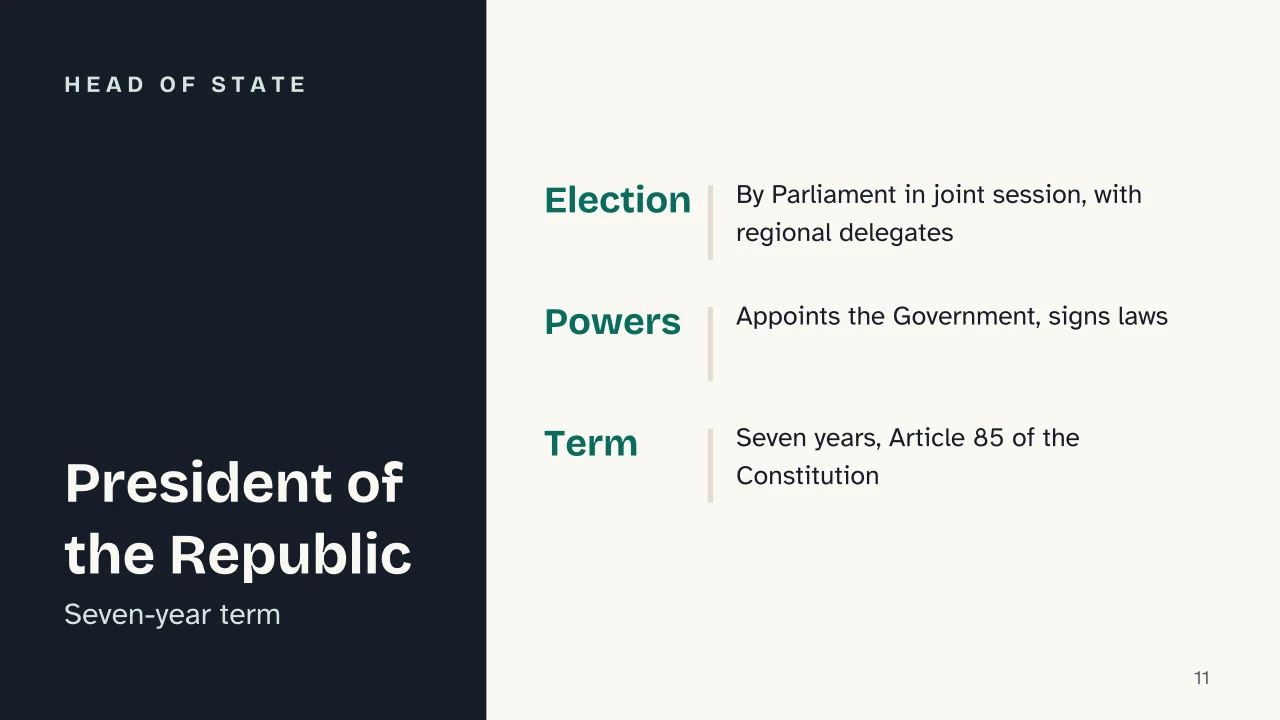 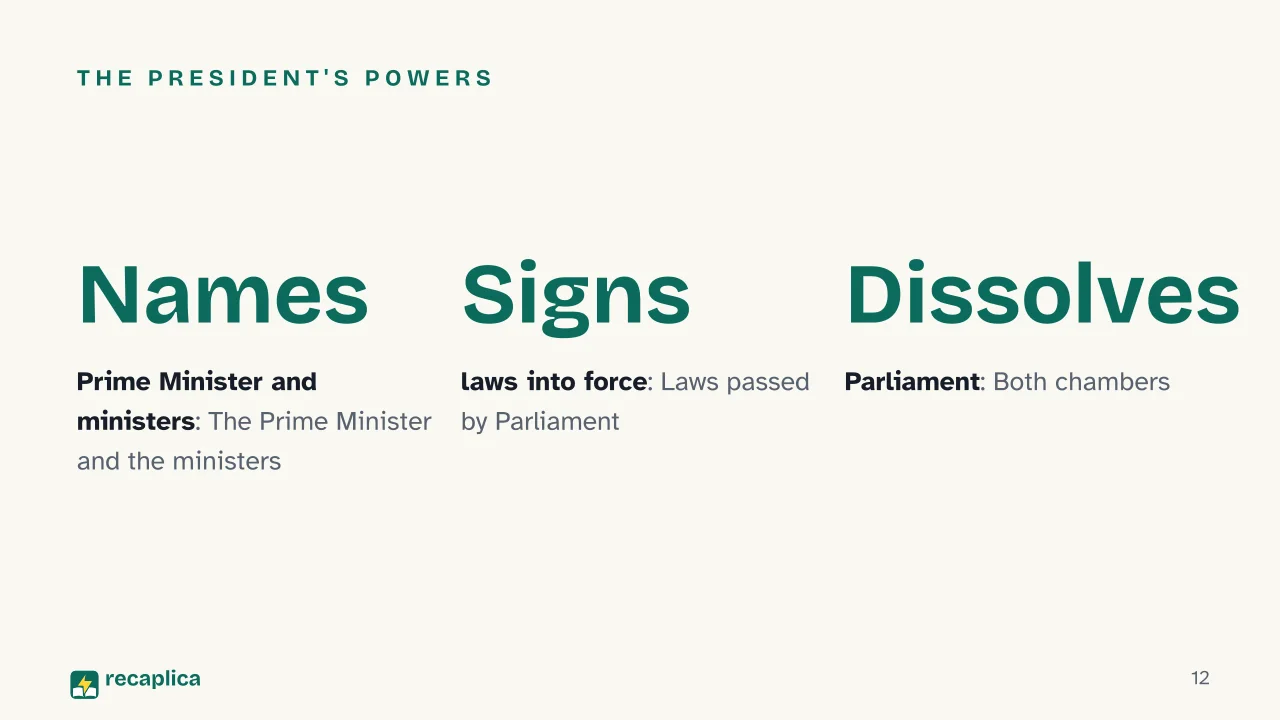  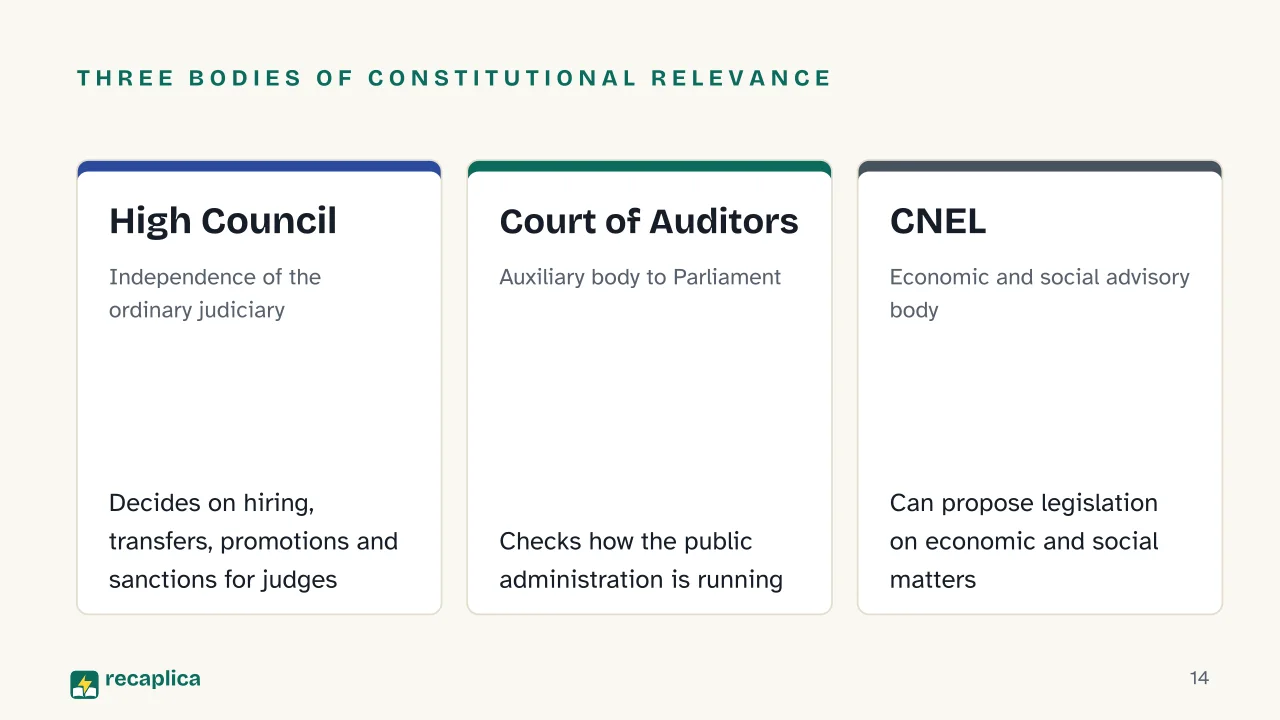 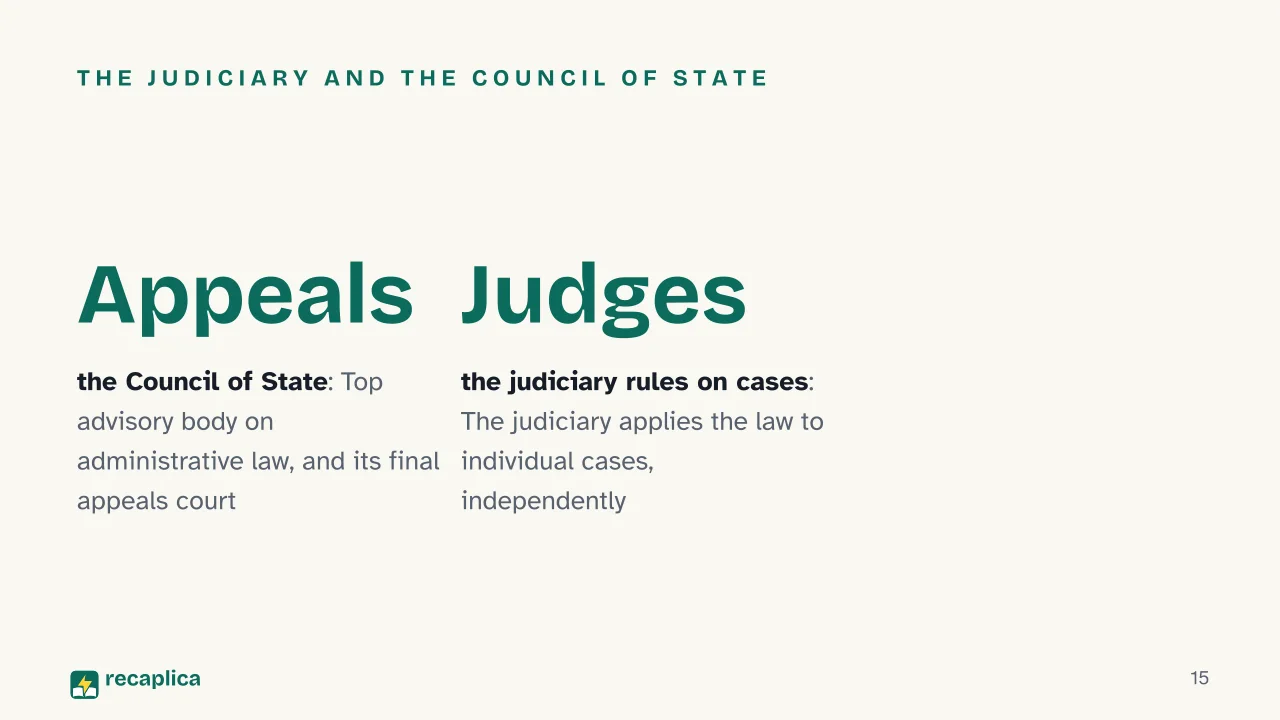 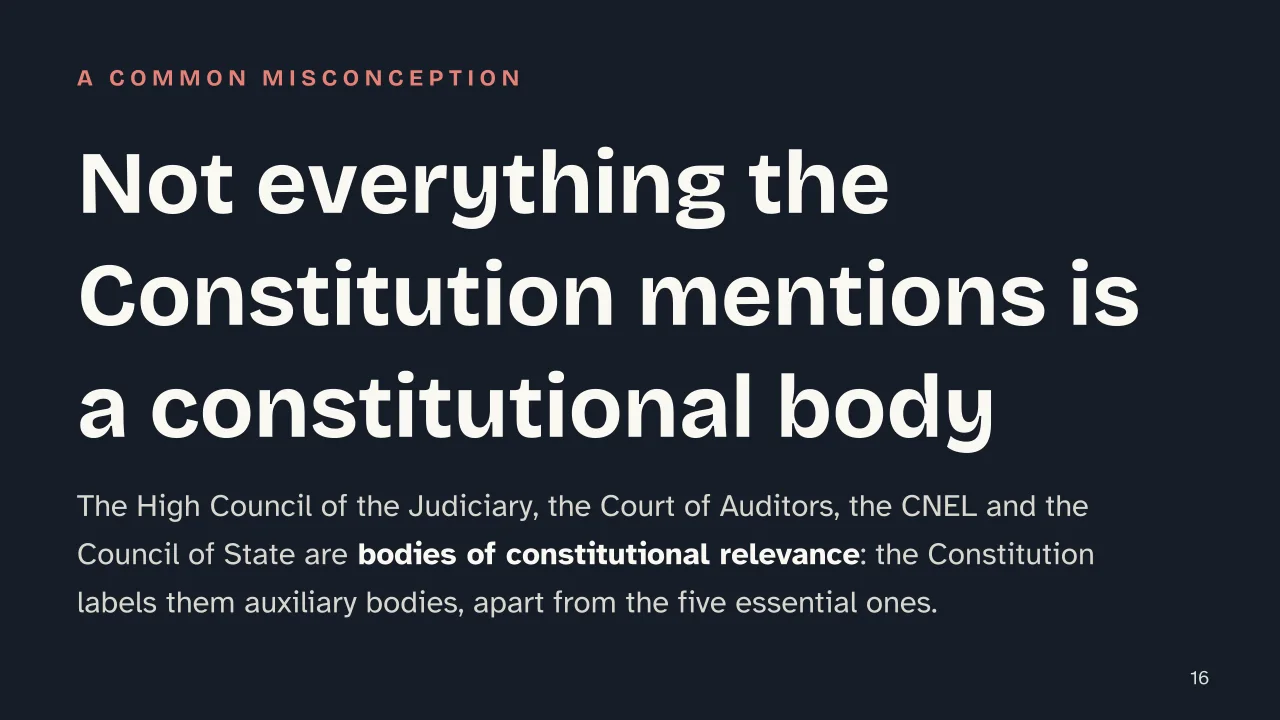 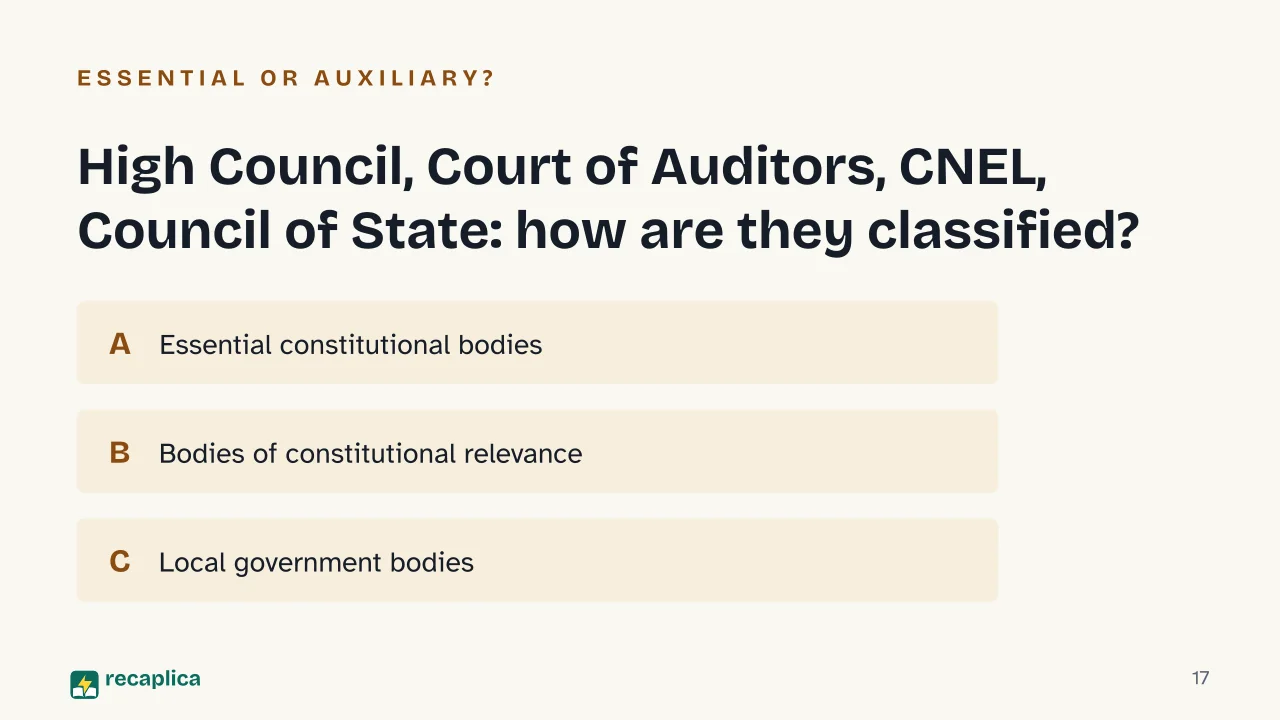  Common myths
Mind mapDrag the background to move around and the nodes to reposition them; use − and + to collapse and expand branches. 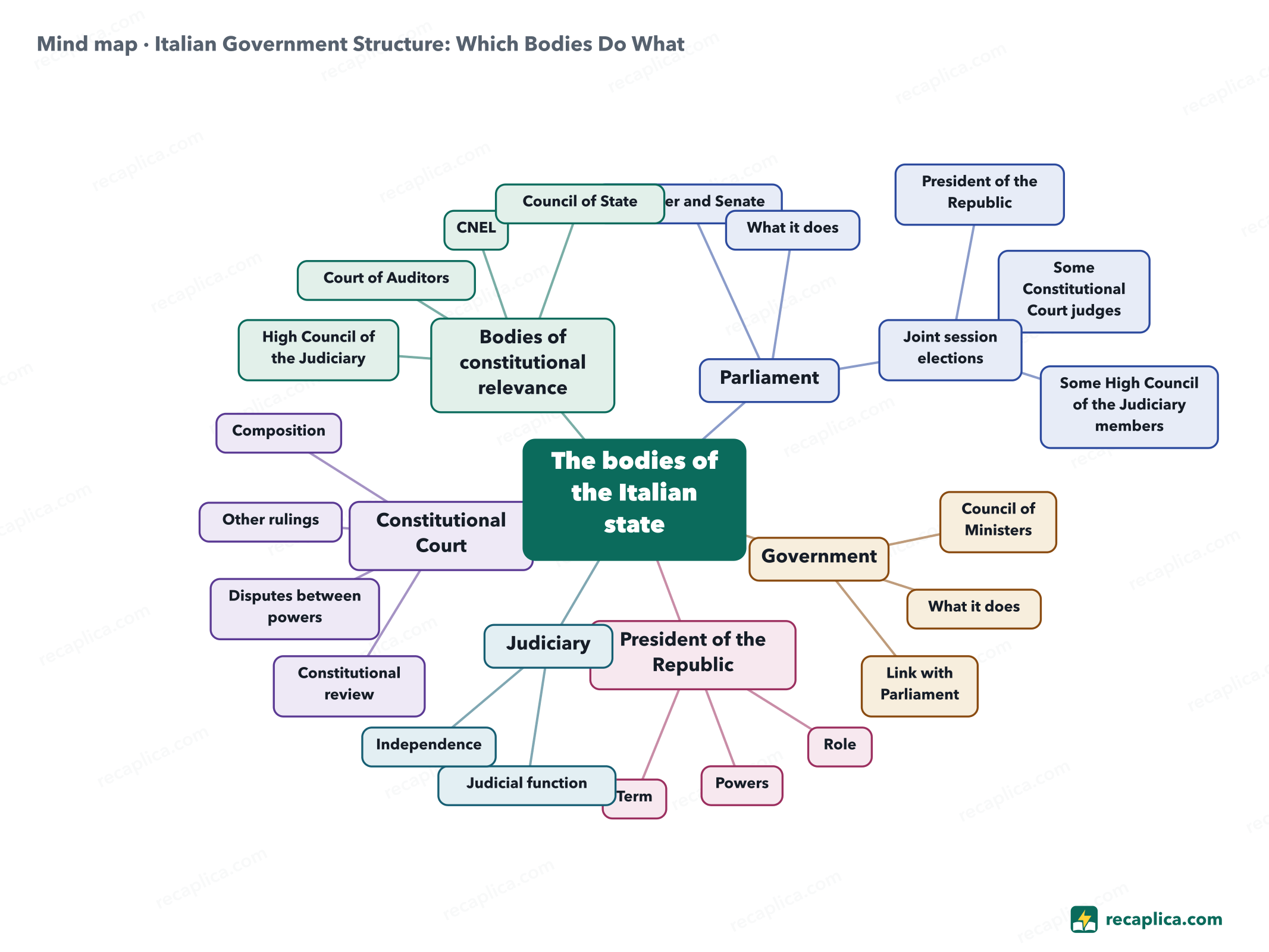
Quiz: test yourselfAnswer the questions to check what you have learned: you get instant feedback and a short explanation. Grade 0/10 0/5
FlashcardsTap the card to flip it and check whether you remember the answer, then move to the next one. 1 / 8 Explain it in your own wordsThe ultimate test: if you can explain it in simple words, you've truly understood it. Write your explanation, then compare it with the Recap. Your explanation is saved only on this device.
Frequently asked questionsHow many constitutional bodies does the Italian state have?Five - Parliament, the Government, the President of the Republic, the judiciary and the Constitutional Court. Alongside them sit the bodies of constitutional relevance (the High Council of the Judiciary, the Court of Auditors, the CNEL, the Council of State), which the Constitution sets up but does not treat as indispensable like the first five. What is the difference between constitutional bodies and bodies of constitutional relevance?The five essential bodies are a condition for the state to function at all. Bodies of constitutional relevance, such as the High Council of the Judiciary, the Court of Auditors, the CNEL and the Council of State, are auxiliary bodies the Constitution sets up: a separate category, without the same weight of indispensability. Who appoints the Italian Prime Minister?The President of the Republic appoints the Prime Minister and, on the Prime Minister's proposal, the ministers. What does the Italian Court of Auditors do?The Court of Auditors is an auxiliary body to Parliament, supplying it with information on how the public administration is running; it also carries out a judicial function under Article 103 of the Constitution. How long does the Italian President of the Republic stay in office?Seven years, under Article 85 of the Constitution. Thirty days before the term ends, the President of the Chamber of Deputies convenes Parliament in joint session, joined by regional delegates, to elect the new President. Every Recap goes through an independent review before publication. |