Skip to content
recaplica

    One moment: security check

    Cloudflare wants to make sure you're not a robot. Tick the box below and your search will continue on its own.

    IT
    recaplica Codice Fiscale: What It Is, Structure and Everyday Uses
    © 2026 Recaplica · recaplica.com — All rights reserved
    Home › Civics

    Codice Fiscale: What It Is, Structure and Everyday Uses

    By Recaplica Newsroom · Updated on September 24, 2026

    What to print

    Page numbers appear when printing with default margins.

    Telegram channel
    recaplica Clear in 30 seconds, yours in 10 minutes.
    In 30 seconds Key points Figures Deep dive Myths Mind map Quiz Flashcards FAQ

    In 30 seconds quick read

    The codice fiscale is the code that uniquely identifies a person in every dealing with Italian public bodies and administrations, from healthcare to official paperwork. It is made up of 16 alphanumeric characters derived from the holder's personal data. Only the Agenzia delle Entrate, Italy's tax agency, can issue a valid one: any code generated by an outside tool has no official standing. The system dates back to 1973, created by the same decree that set up Italy's taxpayer register. It is a different thing from the partita IVA, which identifies an economic activity.

    Key Points

    • The codice fiscale uniquely identifies an individual (or other subject) in every dealing with Italian public bodies and administrations.
    • It consists of 16 alphanumeric characters, built from surname, first name, date of birth, sex and place of birth.
    • The only valid codice fiscale is the one issued by the Agenzia delle Entrate: a code produced by an unofficial tool has no legal standing.
    • People enrolled in the National Health Service receive the codice fiscale printed on the Tessera Sanitaria (health card); everyone else receives it on the Tesserino del Codice Fiscale (tax code card).
    • The codice fiscale system and Italy's taxpayer register were established by Presidential Decree 605 of 29 September 1973.
    • The codice fiscale identifies a person; the partita IVA, an 11-digit code, identifies an economic activity.

    Key figures

    • 1973 Year of the decree that established Italy's codice fiscale system and taxpayer register Source: Presidential Decree No. 605 of 29 September 1973, Gazzetta Ufficiale

    Deep Dive

    What the codice fiscale is

    According to the Agenzia delle Entrate, Italy’s tax agency, the codice fiscale is the identification code for individuals — and for subjects other than individuals — in every dealing with public bodies and administrations. It is, in short, how the Italian state recognizes exactly who it is dealing with, whatever office or service is involved.

    For individuals, the codice fiscale is made up of 16 alphanumeric characters. The first letters come from the surname, three more from the first name; these are followed by characters encoding the year, month and day of birth and sex, and finally a code for the Italian municipality — or foreign country — of birth. This Recap does not walk through the character-by-character algorithm: what matters is that the sequence is never random, but always derives from the same set of personal data.

    Practical example: two people with the same surname, first name, date of birth and sex, one born in Milan and one in Turin, will have codice fiscale numbers that differ only in the final characters, the ones that encode the place of birth.

    Who issues the codice fiscale: the Agenzia delle Entrate

    The Agenzia delle Entrate is the only body authorized to issue a valid codice fiscale. The agency itself says so directly: the only valid codice fiscale is the one it issues, never one generated through software or procedures it does not manage. Various online tools let people work out the character sequence from their personal data, but even when the result happens to be technically correct, it carries no official standing — for any use that requires an assigned codice fiscale, only the one actually issued by the Agenzia delle Entrate will do.

    The agency’s role in this area goes back to 1973: Presidential Decree No. 605 of 29 September 1973 — “Provisions on the taxpayer register and the codice fiscale of taxpayers”, published in the Gazzetta Ufficiale on 16 October 1973 — is the law that created the system. Broadly, the decree allows the tax administration to assign a codice fiscale on its own initiative when it already holds the necessary identifying details, or on request from anyone required to state it in acts provided for by law. It is the same kind of source that gives shape to a legal norm: a text that establishes rights and obligations binding on everyone, not an internal regulation.

    Where the codice fiscale appears

    Anyone entitled to healthcare and enrolled in Italy’s National Health Service receives a Tessera Sanitaria that also carries the codice fiscale: the two pieces of information travel on the same physical card. Anyone not enrolled in the National Health Service instead receives only the Tesserino del Codice Fiscale, without the card’s healthcare functions.

    The codice fiscale comes up in dealings with public bodies and administrations generally, of which National Health Service enrollment is one example. A similar idea — a single identity the state recognizes across different services — also underpins other digital tools available to Italian residents, such as SPID, even though it is a system with a different history and purpose.

    Codice fiscale vs partita IVA: two different codes

    The codice fiscale and the partita IVA are often mixed up, but they identify different things. The codice fiscale identifies the person — an individual or another subject — in every dealing with public administration. The partita IVA is a separate code, 11 digits long, that identifies an economic activity carried out in Italy — the business itself, distinct from the individual who runs it.

    FeatureCodice fiscalePartita IVA
    What it identifiesThe person (individual or other subject)An economic activity
    Number of characters1611
    Who has oneEvery residentAnyone running an economic activity

    Opening a partita IVA, choosing its tax regime or handling its obligations are separate subjects that deserve a Recap of their own; here, the essential distinction between the two codes is enough.

    The rules on who issues the documents and codes that shape everyday life in Italy sit within the broader workings of the bodies of the Italian state, of which the tax administration is one operational branch.

    Common myths

    • ✗ Myth You can calculate your own codice fiscale with an outside tool and use it as if it were official.

      ✓ Reality That is not the case: the Agenzia delle Entrate states directly that the only valid codice fiscale is the one it issues, never one generated through software or procedures it does not manage. A calculation done elsewhere does not count as an official assignment.

    • ✗ Myth The codice fiscale and the Tessera Sanitaria are two separate, unrelated documents.

      ✓ Reality For anyone enrolled in the National Health Service, they are combined into a single item: the Tessera Sanitaria carries the codice fiscale. Only people not entitled to healthcare receive the codice fiscale on a separate document, the Tesserino del Codice Fiscale.

    • ✗ Myth The codice fiscale and the partita IVA are two names for the same thing.

      ✓ Reality They are two distinct codes with different roles: the codice fiscale identifies a person in every dealing with public administration. The partita IVA, 11 digits, identifies someone carrying out an economic activity in Italy. A person can hold both, but they remain two different numbers.

    Mind map

    Drag the background to move around and the nodes to reposition them; use − and + to collapse and expand branches.
    Customize
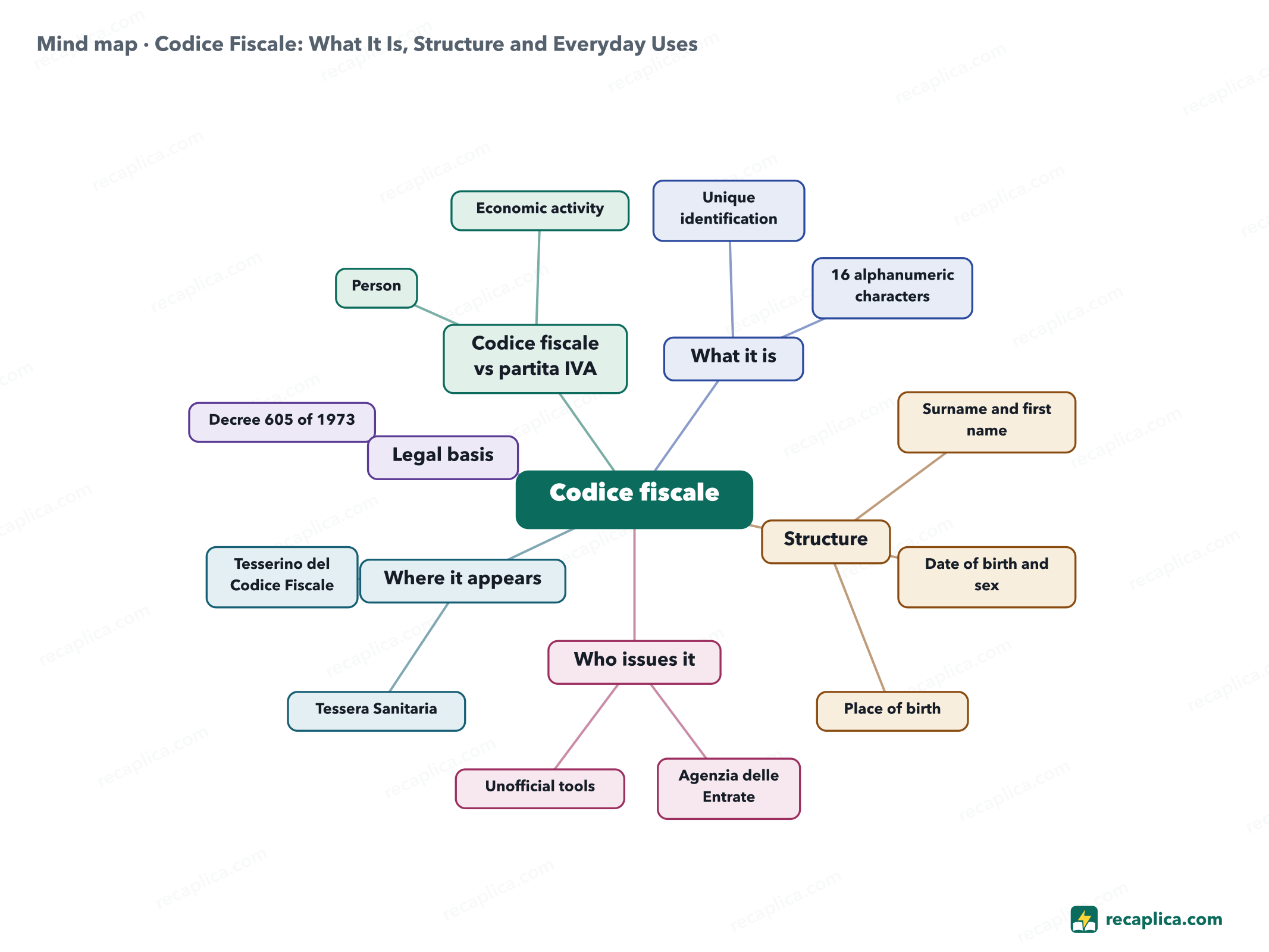
    Mind map: Codice Fiscale: What It Is, Structure and Everyday Uses
    • Codice fiscale
      • What it is
        • Unique identification Of individuals in dealings with public administration
        • 16 alphanumeric characters
      • Structure
        • Surname and first name First letters of the code
        • Date of birth and sex
        • Place of birth
      • Who issues it
        • Agenzia delle Entrate The only authorized body
        • Unofficial tools Cannot produce a valid code
      • Where it appears
        • Tessera Sanitaria For those enrolled in the National Health Service
        • Tesserino del Codice Fiscale For everyone else
      • Legal basis
        • Decree 605 of 1973 Established the taxpayer register and codice fiscale
      • Codice fiscale vs partita IVA
        • Person Codice fiscale, 16 characters
        • Economic activity Partita IVA, 11 digits

    Quiz: test yourself

    Answer the questions to check what you have learned: you get instant feedback and a short explanation.

    Grade 0/10 0/5
    1 What is the codice fiscale?

    According to the Agenzia delle Entrate, the codice fiscale is the identification code for individuals (and other subjects) in every dealing with public bodies and administrations.

    2 How many characters make up an individual's codice fiscale?

    An individual's codice fiscale is made up of 16 alphanumeric characters, encoding the person's personal data.

    3 Who is the only body authorized to issue a valid codice fiscale?

    The Agenzia delle Entrate states clearly that the only valid codice fiscale is the one it issues: never a code generated with software or procedures it does not manage.

    4 True or false: the codice fiscale and the partita IVA are the same thing.

    They are two separate codes: the codice fiscale identifies a person in dealings with public administration, while the partita IVA (11 digits) identifies someone carrying out an economic activity in Italy.

    5 In what year was Italy's codice fiscale system created?

    The codice fiscale system and the taxpayer register were established by Presidential Decree No. 605 of 29 September 1973, published in the Gazzetta Ufficiale on 16 October 1973.

    Answers: 1-B · 2-B · 3-C · 4-B · 5-B

    Flashcards

    Tap the card to flip it and check whether you remember the answer, then move to the next one.

    1 / 7

    Explain it in your own words

    The ultimate test: if you can explain it in simple words, you've truly understood it. Write your explanation, then compare it with the Recap.

    Your explanation is saved only on this device.

    The codice fiscale is the code that uniquely identifies a person in every dealing with Italian public bodies and administrations, from healthcare to official paperwork. It is made up of 16 alphanumeric characters derived from the holder's personal data. Only the Agenzia delle Entrate, Italy's tax agency, can issue a valid one: any code generated by an outside tool has no official standing. The system dates back to 1973, created by the same decree that set up Italy's taxpayer register. It is a different thing from the partita IVA, which identifies an economic activity.

    Frequently asked questions

    What is the codice fiscale used for?

    It uniquely identifies a person in every dealing with Italian public bodies and administrations: from enrollment in the National Health Service to official acts and paperwork that require identifying who is involved.

    Who issues the codice fiscale?

    Only the Agenzia delle Entrate, Italy's tax agency, issues it. A code obtained from an outside tool has no official standing.

    Are the codice fiscale and the Tessera Sanitaria the same thing?

    No, but they are linked. Anyone entitled to healthcare and enrolled in the National Health Service receives the Tessera Sanitaria (health card), which also carries the codice fiscale. Anyone not enrolled receives only the Tesserino del Codice Fiscale, without the card's healthcare functions.

    How is the codice fiscale structured?

    It has 16 alphanumeric characters: the first letters come from the surname and first name, followed by characters encoding the year, month and day of birth and sex, and finally a code for the municipality (or foreign country) of birth.

    What is the difference between the codice fiscale and the partita IVA?

    The codice fiscale identifies the person as such, in every dealing with public administration. The partita IVA, a separate 11-digit code, identifies an economic activity: it is a distinct subject that concerns starting a business.

    Sources

    • Il Codice Fiscale – Che cos'è e come si ottiene — Agenzia delle Entrate
    • Codice fiscale, tessera sanitaria, partita Iva — Agenzia delle Entrate
    • Partita Iva — Agenzia delle Entrate
    • D.P.R. 29 settembre 1973, n. 605 — Gazzetta Ufficiale

    Every Recap goes through an independent review before publication.

    Every evening, the day's new Recaps on our Telegram channel. Join the channel →

    Keep learning

    • Civics Carabinieri Ranks: The Four-Role Hierarchy of the Corps Every member of the Carabinieri sits inside one of four legally defined roles, in force since a 2000 law: Officers, Inspectors, Supervisors, and Corporals and Privates. Promotion happens inside a role first, and the four roles themselves run from the most operational to the most senior. The lowest rank is Carabiniere; the highest is Generale di Corpo d'Armata, in the Officer role. Two abbreviations, Q.S. and C.S., show up next to a handful of ranks — they aren't extra rungs on the ladder, just a qualification attached to the top rank already sitting there. Read the Recap →
    • Civics Italian Government Structure: Which Bodies Do What The Italian state rests on five bodies that the Constitution sets up and regulates directly: Parliament makes the laws, the Government carries them out, the President of the Republic represents national unity, the judiciary applies the law to individual cases, and the Constitutional Court checks that laws respect the Constitution. Alongside them sit four bodies of constitutional relevance — the High Council of the Judiciary, the Court of Auditors, the CNEL and the Council of State — auxiliary bodies the Constitution sets up but keeps in a separate category from the five essential ones. Knowing who does what, and which bodies the system cannot run without, is the fastest way into how Italy is actually governed. Read the Recap →
    • Civics Types of Government: Forms of State vs. Forms of Government A form of state and a type of government answer two different questions about how a country is organized. The form of state is about how a people, a territory and a government fit together, while the type of government is about which constitutional body actually steers political direction. Aristotle was among the first to classify governments, sorting six constitutional forms by whether power serves the common good or only those who hold it. The most common types of government today are parliamentary, presidential, semi-presidential, constitutional monarchy and the rare directorial system used in Switzerland, while territorially a state can be unitary or federal. Read the Recap →

    recaplica

    Clear in 30 seconds, yours in 10 minutes.

    Recaps Mind maps Request a Recap Telegram channel Mind map maker Our method About Privacy & cookies Legal notes & terms of use

    © 2026 Recaplica · A project by Curi S.r.l. — VAT IT05472000750

    Statistics, only if you say so

    To learn which Recaps help most we would use Google Analytics, with aggregate, anonymous data. It starts only with your OK, and you can change your mind anytime. Privacy policy