Skip to content
recaplica

    One moment: security check

    Cloudflare wants to make sure you're not a robot. Tick the box below and your search will continue on its own.

    IT
    recaplica Carabinieri Ranks: The Four-Role Hierarchy of the Corps
    © 2026 Recaplica · recaplica.com — All rights reserved
    Home › Civics

    Carabinieri Ranks: The Four-Role Hierarchy of the Corps

    By Recaplica Newsroom · Updated on September 24, 2026

    What to print

    Page numbers appear when printing with default margins.

    Slides

    Choose a cut

    Flash10 slidesThe essential thread, to present in classFull16 slidesEvery chapter and the deeper detail

    Both come with speaker notes.

    Telegram channel
    recaplica Clear in 30 seconds, yours in 10 minutes.
    In 30 seconds Key points Deep dive Slides Myths Mind map Quiz Flashcards FAQ

    In 30 seconds quick read

    Every member of the Carabinieri sits inside one of four legally defined roles, in force since a 2000 law: Officers, Inspectors, Supervisors, and Corporals and Privates. Promotion happens inside a role first, and the four roles themselves run from the most operational to the most senior. The lowest rank is Carabiniere; the highest is Generale di Corpo d'Armata, in the Officer role. Two abbreviations, Q.S. and C.S., show up next to a handful of ranks — they aren't extra rungs on the ladder, just a qualification attached to the top rank already sitting there.

    Key Points

    • Carabinieri personnel are split into four roles: Officers, Inspectors, Supervisors, and Corporals and Privates.
    • The split rests on Legislative Decree 297 of 2000, Article 19.
    • The lowest rank is Carabiniere; the highest is Generale di Corpo d'Armata.
    • The Inspector role covers the marshals and, at its top, the lieutenants.
    • The Supervisor role runs from Vicebrigadiere to Brigadiere Capo.
    • Q.S. stands for Qualifica Speciale, C.S. for Carica Speciale: internal qualifications on the top rank of a category, not separate ranks.

    Deep Dive

    A stranger looking at a Carabiniere’s shoulder boards sees a rank. Someone who knows the system sees something more: a role, and a specific slot inside it. Those are two separate pieces of information, and the second one is why a Maresciallo and a Brigadiere, both loosely called “NCOs” in everyday speech, actually belong to different categories with their own separate ladders.

    Four Roles, Set by Law

    Carabinieri personnel are split into four roles: Officers, Inspectors, Supervisors, and Corporals and Privates. This isn’t an in-house arrangement decided by Carabinieri command: the split rests on Legislative Decree 297 of 2000, whose Article 19 lists both the roles and the ranks inside each one. A legislative decree carries the same binding force as an act of Parliament — a legal norm in every sense, issued by the government under authority the Chambers themselves delegated, for matters and principles the Chambers had already set. It’s the same principle the Italian Constitution applies to how state bodies are organized in general.

    Real-world example: a Maresciallo Capo and a Brigadiere Capo share part of a name, but they aren’t “the same level, different role.” The Maresciallo Capo sits in the Inspector role, the Brigadiere Capo in the Supervisor role, and the two roles rank differently overall, with Inspectors above Supervisors.

    The Corporals and Privates Role

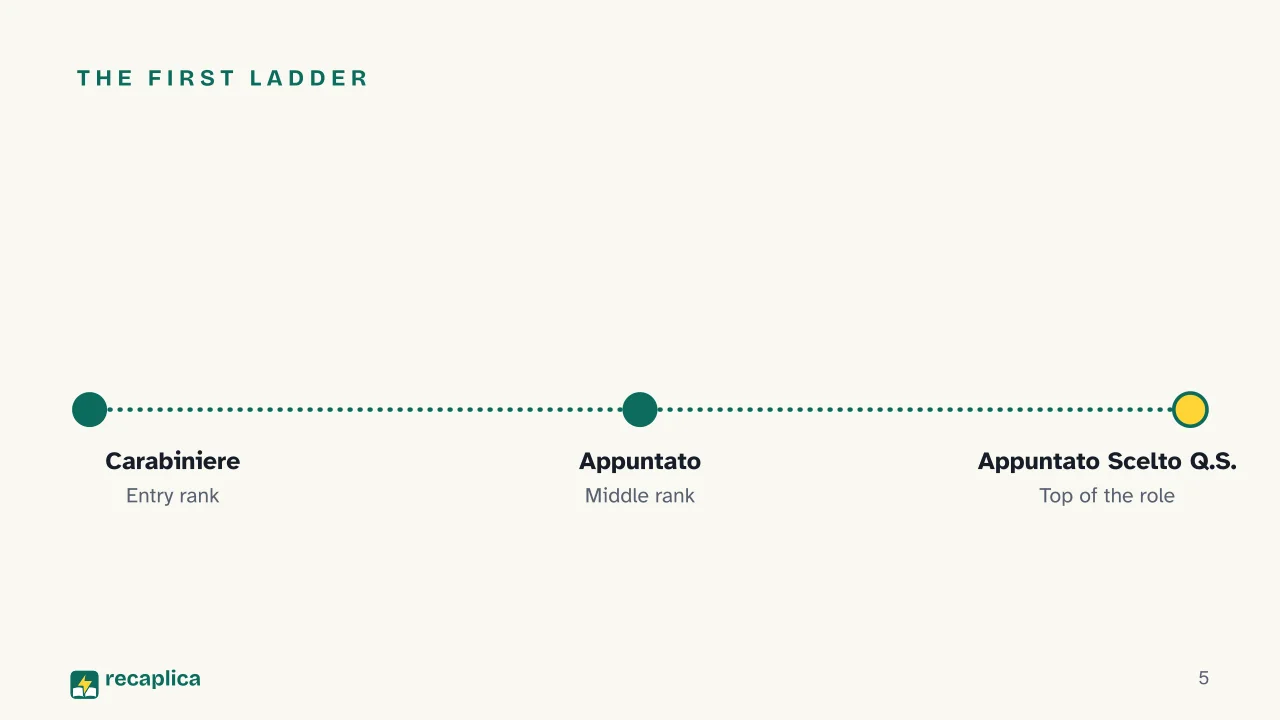
    This is the entry role, where a career starts. From lowest to highest, the ranks run Carabiniere, Carabiniere Scelto, Appuntato, Appuntato Scelto, and finally Appuntato Scelto with the special qualification (Q.S.). A plain Carabiniere holds the lowest rank in the entire corps.

    The Supervisor Role

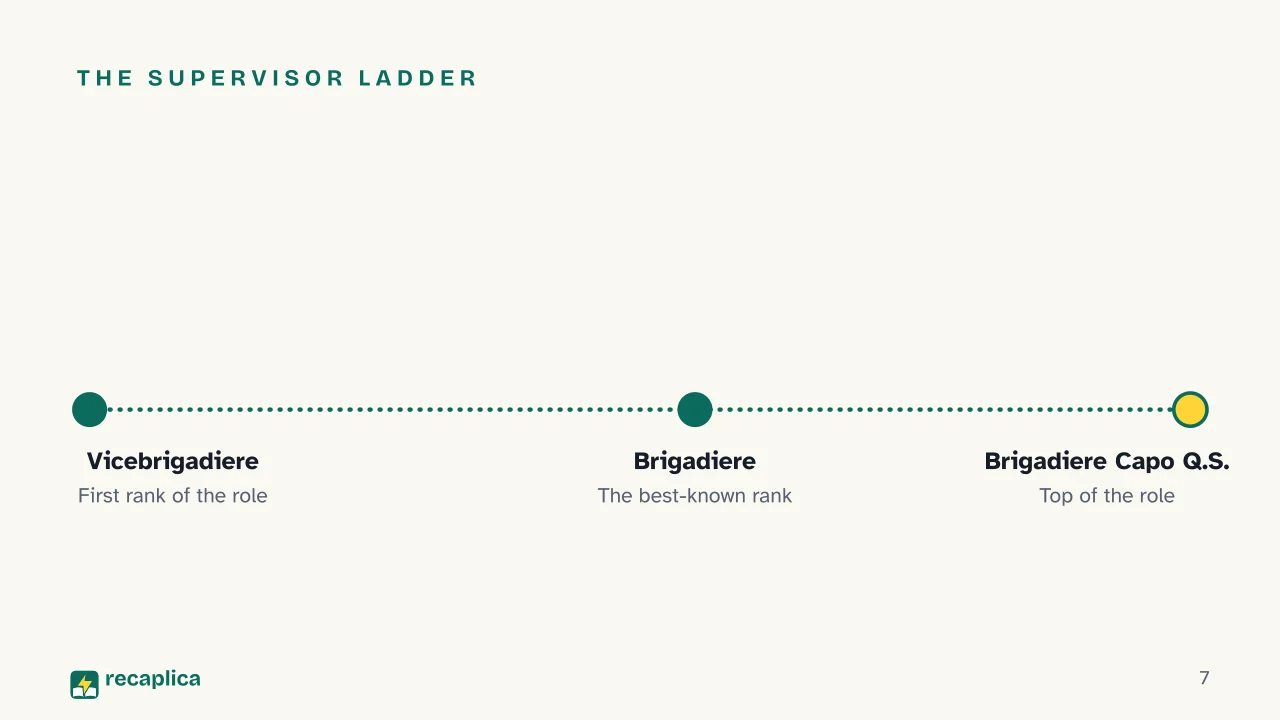
    Above the entry role sits the Supervisor role, with four ranks: Vicebrigadiere, Brigadiere, Brigadiere Capo, Brigadiere Capo Q.S. This is home to the rank most people outside the corps actually recognize, Brigadiere — but it isn’t the top of the hierarchy. The role above it, Inspectors, climbs higher still.

    The Inspector Role

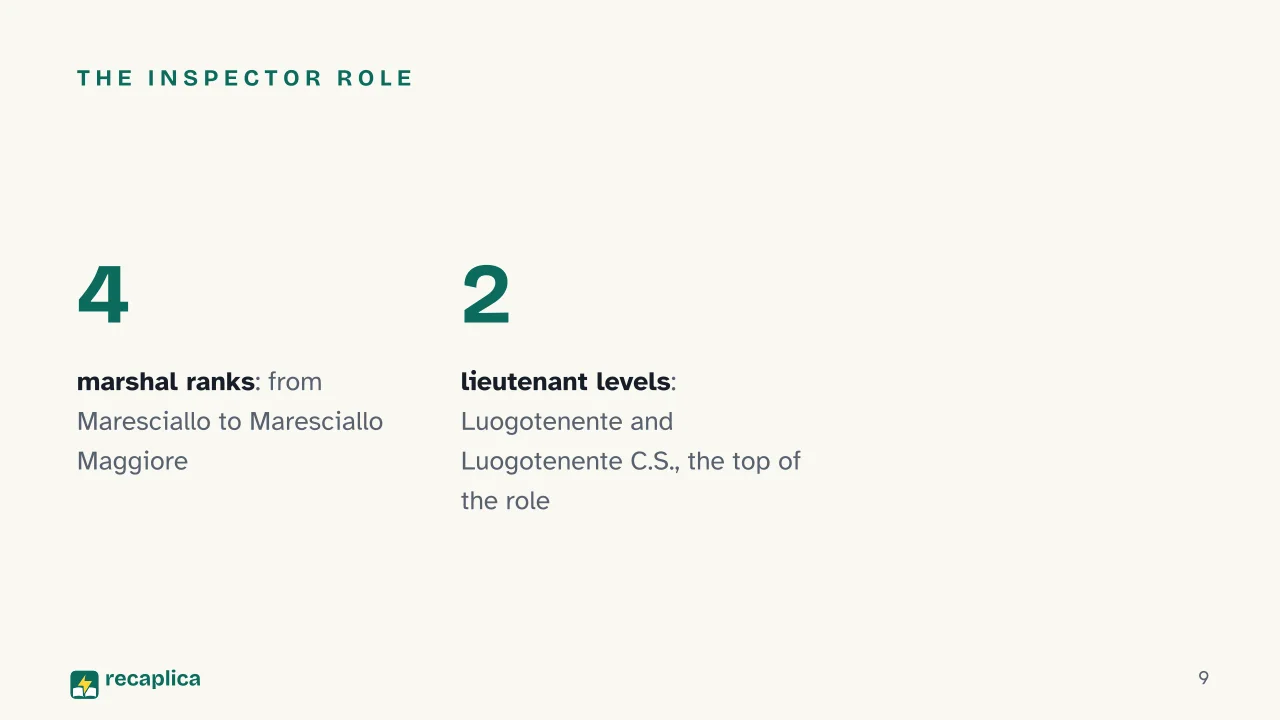
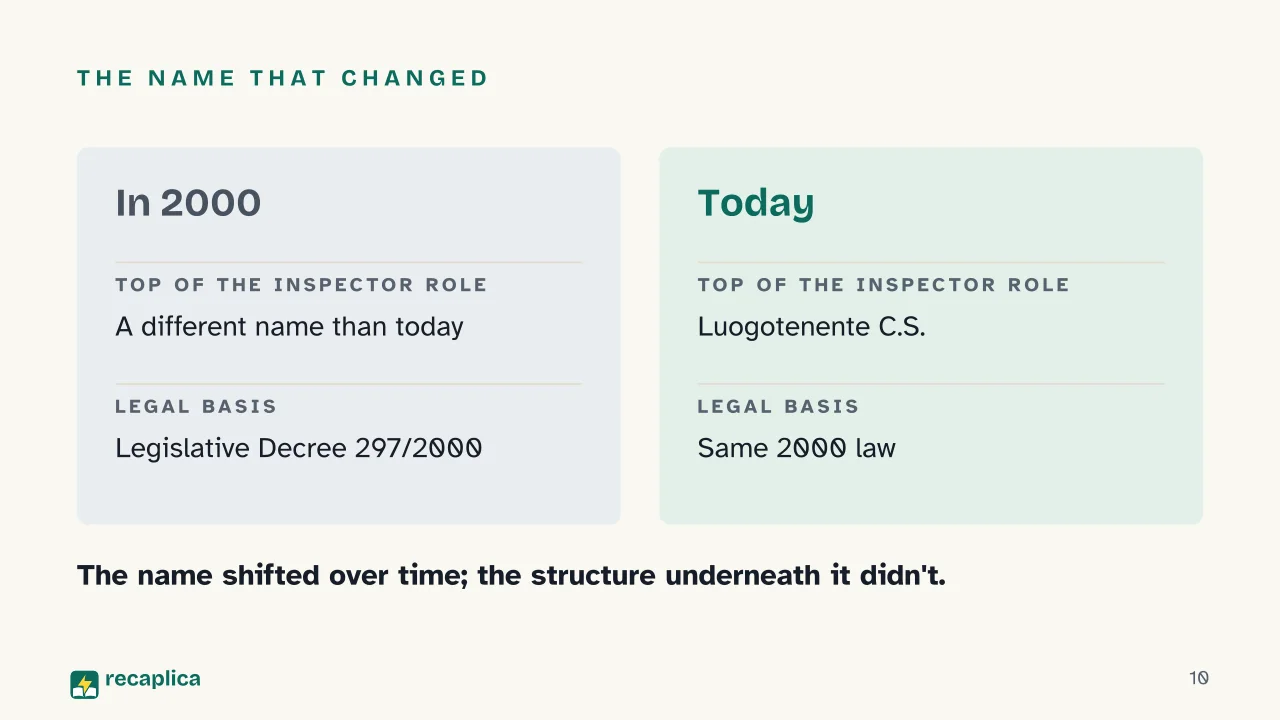
    Here sit the marshals: Maresciallo, Maresciallo Ordinario, Maresciallo Capo, Maresciallo Maggiore. At the top of the role are the lieutenants, Luogotenente and Luogotenente C.S. (special appointment). Comparing the wording of the 2000 law with the name the corps’ own website uses today shows that this top rank has changed its label over time: the 2000 decree calls it “maresciallo aiutante sostituto ufficiale di pubblica sicurezza,” while the institutional site now lists the same post as Luogotenente C.S. The four-role structure underneath it, though, hasn’t moved.

    The abbreviations Q.S. (Qualifica Speciale) and C.S. (Carica Speciale) recur through this hierarchy doing the same job every time: they aren’t further ranks, but a recognition — of duty or of seniority — given to someone who has already reached the top rank of their category. Whoever gets it keeps the same rank.

    The Officer Role

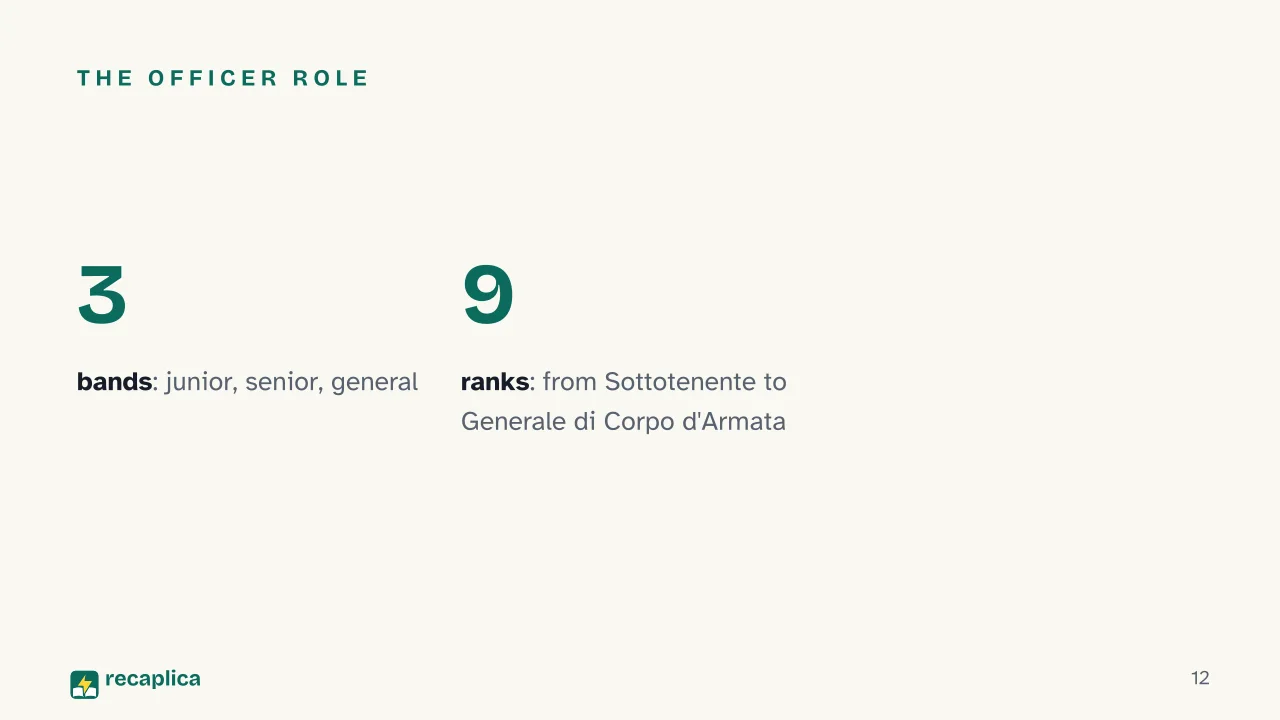
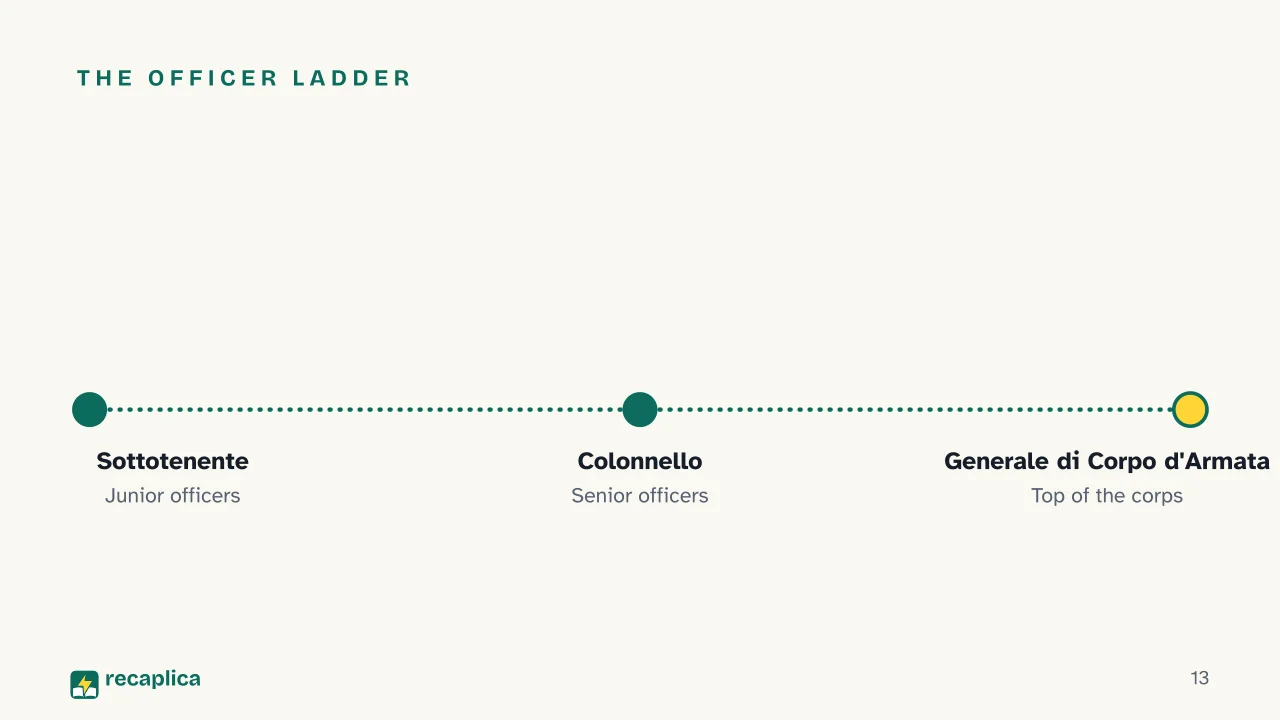
    The Officer role sits at the top of the hierarchy, with nine ranks spread across three bands. Junior officers: Sottotenente, Tenente, Capitano. Senior officers: Maggiore, Tenente Colonnello, Colonnello. General officers: Generale di Brigata, Generale di Divisione, Generale di Corpo d’Armata — the highest rank anywhere in the Carabinieri.

    According to the corps’ own institutional website, the Carabinieri count roughly 118,000 people on strength, spread across different bodies and units — a workforce large enough to explain why it runs on four separate role ladders rather than one single chain of command.

    Role and Rank: The Distinction That Matters

    A role is the category someone belongs to, fixed by law; a rank is the exact slot inside that role. Moving up in rank happens inside a role — Maresciallo to Maresciallo Ordinario, say — while moving into a different role is a category jump, with its own requirements and its own career path. Keeping the two apart avoids the most common mistake: treating a rank from one role as directly comparable to a rank from another, when the actual hierarchy places them on different footing entirely.

    RoleRanks, lowest to highest
    Corporals and PrivatesCarabiniere, Carabiniere Scelto, Appuntato, Appuntato Scelto, Appuntato Scelto Q.S.
    SupervisorsVicebrigadiere, Brigadiere, Brigadiere Capo, Brigadiere Capo Q.S.
    InspectorsMaresciallo, Maresciallo Ordinario, Maresciallo Capo, Maresciallo Maggiore, Luogotenente, Luogotenente C.S.
    OfficersSottotenente, Tenente, Capitano, Maggiore, Tenente Colonnello, Colonnello, Generale di Brigata, Generale di Divisione, Generale di Corpo d’Armata

    Slide deck

    Slides ready to download and make your own in PowerPoint or Google Slides, with speaker notes. Pick the Flash cut or the Full one.
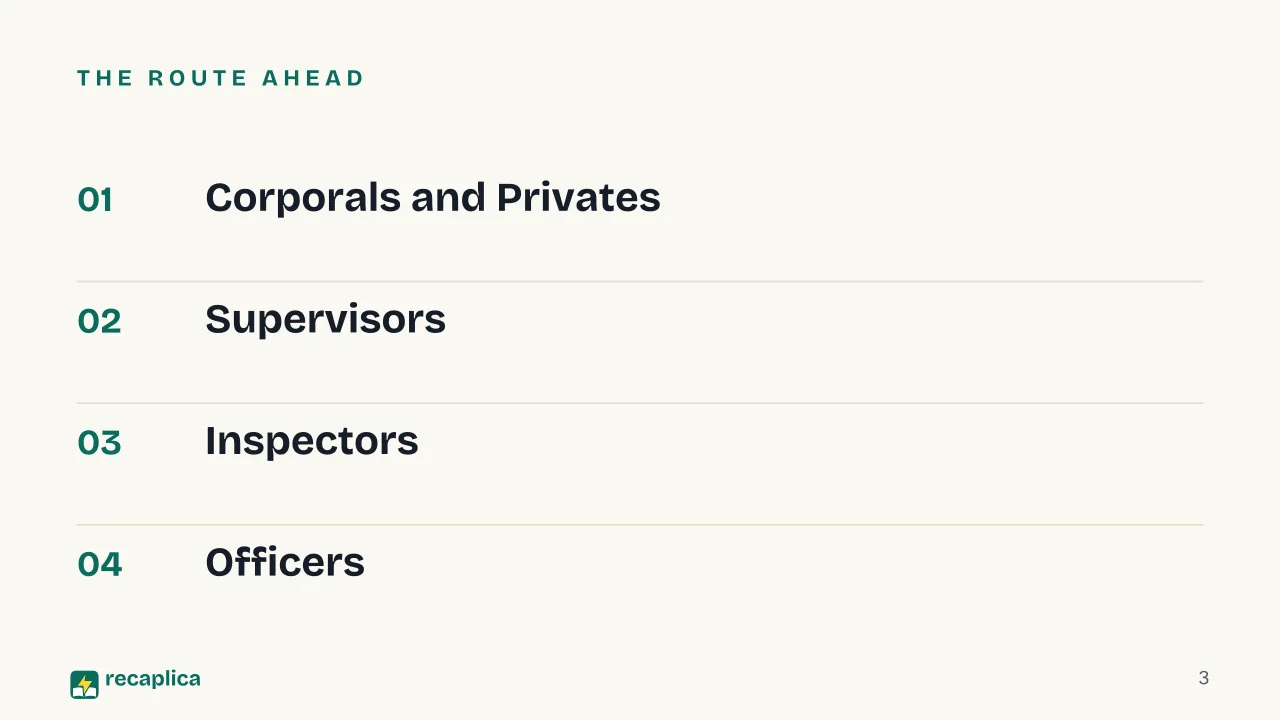
    Slide 1 of the presentation on Carabinieri Ranks: Carabinieri RanksSlide 2 of the presentation on Carabinieri Ranks: How many roles split Carabinieri personnel?Slide 3 of the presentation on Carabinieri Ranks: The route aheadSlide 4 of the presentation on Carabinieri Ranks: Chapter 01: Corporals and PrivatesSlide 5 of the presentation on Carabinieri Ranks: The first ladderSlide 6 of the presentation on Carabinieri Ranks: Chapter 02: SupervisorsSlide 7 of the presentation on Carabinieri Ranks: The Supervisor ladderSlide 8 of the presentation on Carabinieri Ranks: Chapter 03: InspectorsSlide 9 of the presentation on Carabinieri Ranks: The Inspector roleSlide 10 of the presentation on Carabinieri Ranks: The name that changedSlide 11 of the presentation on Carabinieri Ranks: Chapter 04: OfficersSlide 12 of the presentation on Carabinieri Ranks: The Officer roleSlide 13 of the presentation on Carabinieri Ranks: The Officer ladderSlide 14 of the presentation on Carabinieri Ranks: Brigadiere isn't the top NCO-style rankSlide 15 of the presentation on Carabinieri Ranks: Which role does the rank of Maresciallo belong to?Slide 16 of the presentation on Carabinieri Ranks: For review
    Flash10 slidesThe essential thread, to present in classFull16 slidesEvery chapter and the deeper detail

    Common myths

    • ✗ Myth Brigadiere is the highest NCO-style rank in the Carabinieri.

      ✓ Reality Brigadiere belongs to the Supervisor role, not the top of the hierarchy. The highest rank grouping the marshals is Luogotenente C.S., in the Inspector role — a different role, with its own ladder.

    • ✗ Myth The four Carabinieri roles are an internal filing system, set up by the corps' own command.

      ✓ Reality The split into Officers, Inspectors, Supervisors, and Corporals and Privates rests on Legislative Decree 297 of 2000, whose Article 19 also lists the ranks inside each role.

    • ✗ Myth Q.S. and C.S. mark extra ranks stacked above the last one on each role's list.

      ✓ Reality They mark a qualification attached to a rank that already exists at the top of that category: Qualifica Speciale for Supervisors and for Corporals and Privates, Carica Speciale for Inspectors. Whoever earns it keeps the same rank, with added duty or seniority recognized on top.

    Mind map

    Drag the background to move around and the nodes to reposition them; use − and + to collapse and expand branches.
    Customize
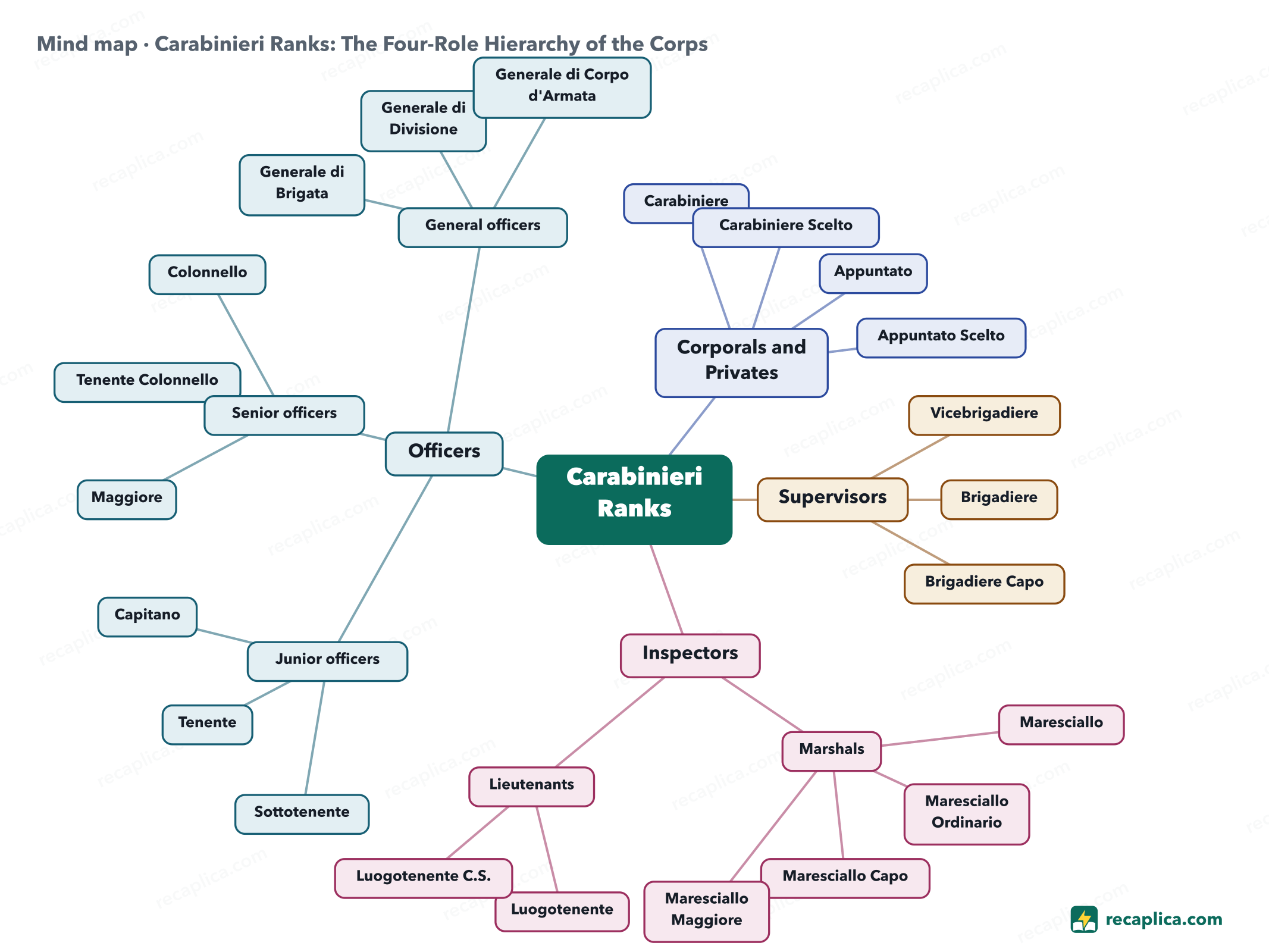
    Mind map: Carabinieri Ranks: The Four-Role Hierarchy of the Corps
    • Carabinieri Ranks
      • Corporals and Privates The entry role, four ranks plus one qualification
        • Carabiniere The lowest rank in the hierarchy
        • Carabiniere Scelto
        • Appuntato
        • Appuntato Scelto Top of the role, with the Appuntato Scelto Q.S. qualification
      • Supervisors Four ranks, from Vicebrigadiere to Brigadiere Capo
        • Vicebrigadiere
        • Brigadiere
        • Brigadiere Capo Also carries the Brigadiere Capo Q.S. qualification
      • Inspectors The marshals and, at the top, the lieutenants
        • Marshals
          • Maresciallo
          • Maresciallo Ordinario
          • Maresciallo Capo
          • Maresciallo Maggiore
        • Lieutenants The top of the role
          • Luogotenente
          • Luogotenente C.S. Carica Speciale, the highest rank in the Inspector role
      • Officers Nine ranks across three bands, up to the top of the corps
        • Junior officers
          • Sottotenente
          • Tenente
          • Capitano
        • Senior officers
          • Maggiore
          • Tenente Colonnello
          • Colonnello
        • General officers
          • Generale di Brigata
          • Generale di Divisione
          • Generale di Corpo d'Armata The highest rank in the Carabinieri hierarchy

    Quiz: test yourself

    Answer the questions to check what you have learned: you get instant feedback and a short explanation.

    Grade 0/10 0/5
    1 How many roles does Carabinieri personnel split into?

    Legislative Decree 297 of 2000, Article 19, organizes personnel into four roles: Officers, Inspectors, Supervisors, and Corporals and Privates.

    2 What is the highest rank in the Carabinieri hierarchy?

    Generale di Corpo d'Armata sits at the top of the Officer role, and of the hierarchy overall.

    3 Which role does the rank of Brigadiere belong to?

    Brigadiere is one of four ranks in the Supervisor role, between Vicebrigadiere and Brigadiere Capo.

    4 What does "Q.S." mean next to a rank, as in "Appuntato Scelto Q.S."?

    Q.S. stands for Qualifica Speciale: whoever earns it keeps the same rank, with added duty or seniority recognized, not a new rank.

    5 True or false: the four-role split of Carabinieri personnel is set by a national law.

    True: Legislative Decree 297 of 2000, Article 19, lists roles and ranks with the force of law, not as an internal regulation of the corps.

    Answers: 1-B · 2-A · 3-B · 4-A · 5-A

    Flashcards

    Tap the card to flip it and check whether you remember the answer, then move to the next one.

    1 / 8

    Explain it in your own words

    The ultimate test: if you can explain it in simple words, you've truly understood it. Write your explanation, then compare it with the Recap.

    Your explanation is saved only on this device.

    Every member of the Carabinieri sits inside one of four legally defined roles, in force since a 2000 law: Officers, Inspectors, Supervisors, and Corporals and Privates. Promotion happens inside a role first, and the four roles themselves run from the most operational to the most senior. The lowest rank is Carabiniere; the highest is Generale di Corpo d'Armata, in the Officer role. Two abbreviations, Q.S. and C.S., show up next to a handful of ranks — they aren't extra rungs on the ladder, just a qualification attached to the top rank already sitting there.

    Frequently asked questions

    How many ranks does the Carabinieri have?

    The ranks are spread across four separate roles, each with its own scale: Corporals and Privates, Supervisors, Inspectors, and Officers. Promotion happens inside a role, and moving up to the next role is a career step of its own.

    What's the difference between a role and a rank in the Carabinieri?

    The role is the legal category someone belongs to (Officers, Inspectors, Supervisors, Corporals and Privates); the rank is the exact position inside that role, for example Maresciallo Capo inside the Inspector role.

    What is the highest Carabinieri rank?

    Generale di Corpo d'Armata, at the top of the Officer role and of the corps' hierarchy overall.

    What do Q.S. and C.S. mean in Carabinieri ranks?

    Q.S. (Qualifica Speciale) and C.S. (Carica Speciale) aren't extra ranks: they mark a recognized qualification attached to the top rank already existing in a category, for example Brigadiere Capo Q.S. or Luogotenente C.S.

    What's the difference between an Appuntato and a Brigadiere?

    They belong to two different roles: Appuntato sits in the Corporals and Privates role, Brigadiere in the Supervisor role, which ranks above it.

    Sources

    • Carabinieri.it — Roles and Ranks
    • Gazzetta Ufficiale — Legislative Decree 297/2000, Art. 19

    Every Recap goes through an independent review before publication.

    Every evening, the day's new Recaps on our Telegram channel. Join the channel →

    Keep learning

    • Civics Codice Fiscale: What It Is, Structure and Everyday Uses The codice fiscale is the code that uniquely identifies a person in every dealing with Italian public bodies and administrations, from healthcare to official paperwork. It is made up of 16 alphanumeric characters derived from the holder's personal data. Only the Agenzia delle Entrate, Italy's tax agency, can issue a valid one: any code generated by an outside tool has no official standing. The system dates back to 1973, created by the same decree that set up Italy's taxpayer register. It is a different thing from the partita IVA, which identifies an economic activity. Read the Recap →
    • Civics Italian Government Structure: Which Bodies Do What The Italian state rests on five bodies that the Constitution sets up and regulates directly: Parliament makes the laws, the Government carries them out, the President of the Republic represents national unity, the judiciary applies the law to individual cases, and the Constitutional Court checks that laws respect the Constitution. Alongside them sit four bodies of constitutional relevance — the High Council of the Judiciary, the Court of Auditors, the CNEL and the Council of State — auxiliary bodies the Constitution sets up but keeps in a separate category from the five essential ones. Knowing who does what, and which bodies the system cannot run without, is the fastest way into how Italy is actually governed. Read the Recap →
    • Civics Types of Government: Forms of State vs. Forms of Government A form of state and a type of government answer two different questions about how a country is organized. The form of state is about how a people, a territory and a government fit together, while the type of government is about which constitutional body actually steers political direction. Aristotle was among the first to classify governments, sorting six constitutional forms by whether power serves the common good or only those who hold it. The most common types of government today are parliamentary, presidential, semi-presidential, constitutional monarchy and the rare directorial system used in Switzerland, while territorially a state can be unitary or federal. Read the Recap →

    recaplica

    Clear in 30 seconds, yours in 10 minutes.

    Recaps Mind maps Request a Recap Telegram channel Mind map maker Our method About Privacy & cookies Legal notes & terms of use

    © 2026 Recaplica · A project by Curi S.r.l. — VAT IT05472000750

    Statistics, only if you say so

    To learn which Recaps help most we would use Google Analytics, with aggregate, anonymous data. It starts only with your OK, and you can change your mind anytime. Privacy policy