Skip to content
recaplica

    One moment: security check

    Cloudflare wants to make sure you're not a robot. Tick the box below and your search will continue on its own.

    IT
    recaplica Crimes Against Humanity: Definition and the Link to Human Dignity
    © 2026 Recaplica · recaplica.com — All rights reserved
    Home › Civics

    Crimes Against Humanity: Definition and the Link to Human Dignity

    By Recaplica Newsroom · Updated on September 28, 2026

    What to print

    Page numbers appear when printing with default margins.

    Slides

    Choose a cut

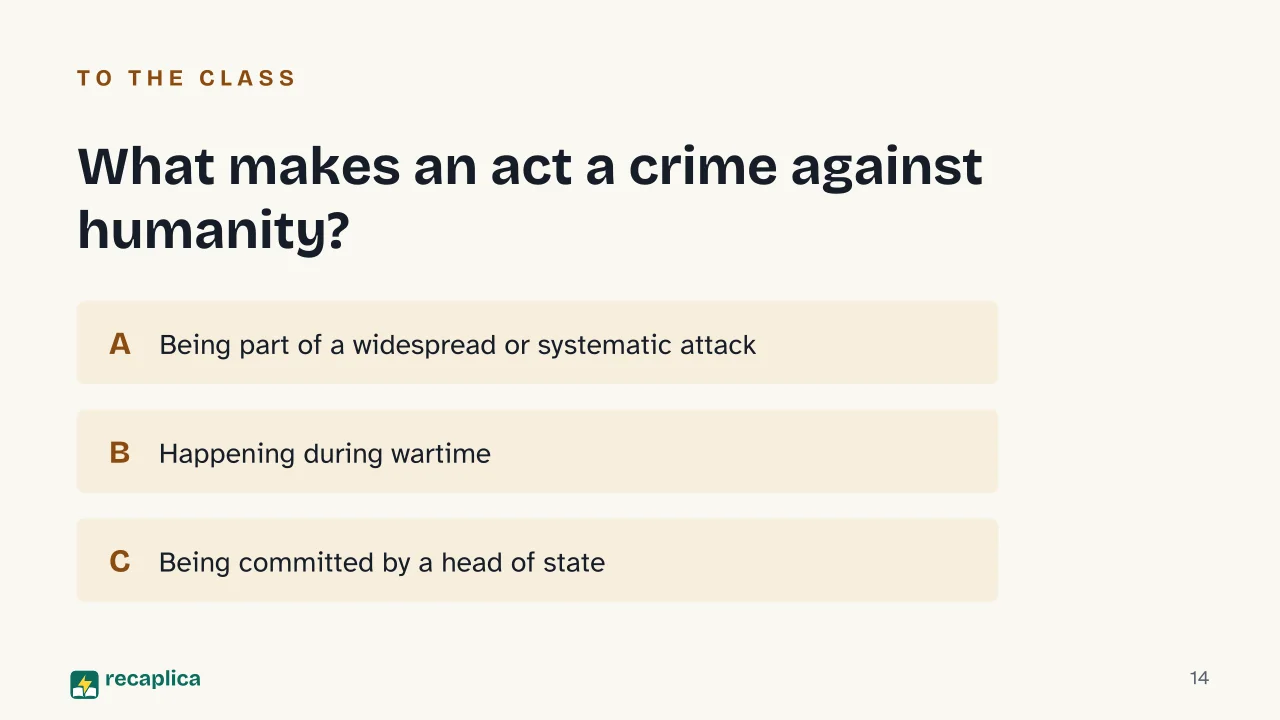
    Flash10 slidesThe essential thread, to present in classFull15 slidesEvery chapter and the deeper detail

    Both come with speaker notes.

    Telegram channel
    recaplica Clear in 30 seconds, yours in 10 minutes.
    In 30 seconds Key points Figures Deep dive Slides Myths Mind map Quiz Flashcards FAQ

    In 30 seconds quick read

    Crimes against humanity are a category of international criminal law: acts such as murder, extermination, or persecution, committed as part of a widespread or systematic attack against a civilian population. The 1998 Rome Statute defines them in Article 7 and assigns them to the International Criminal Court, operational since 2002. The concept is older, though: it dates back to 1945, with the charter that created the Nuremberg tribunal. This Recap explains the definition, where it stops and genocide or war crimes begin, and why we connect it to the principle of human dignity written into Italy's constitution.

    Key Points

    • A crime against humanity is an act such as murder, extermination, deportation, or persecution, committed as part of a widespread or systematic attack against a civilian population (Article 7 of the Rome Statute).
    • It differs from genocide because it does not require the specific intent to destroy a national, ethnic, racial, or religious group.
    • It differs from war crimes because it can happen even without an armed conflict under way.
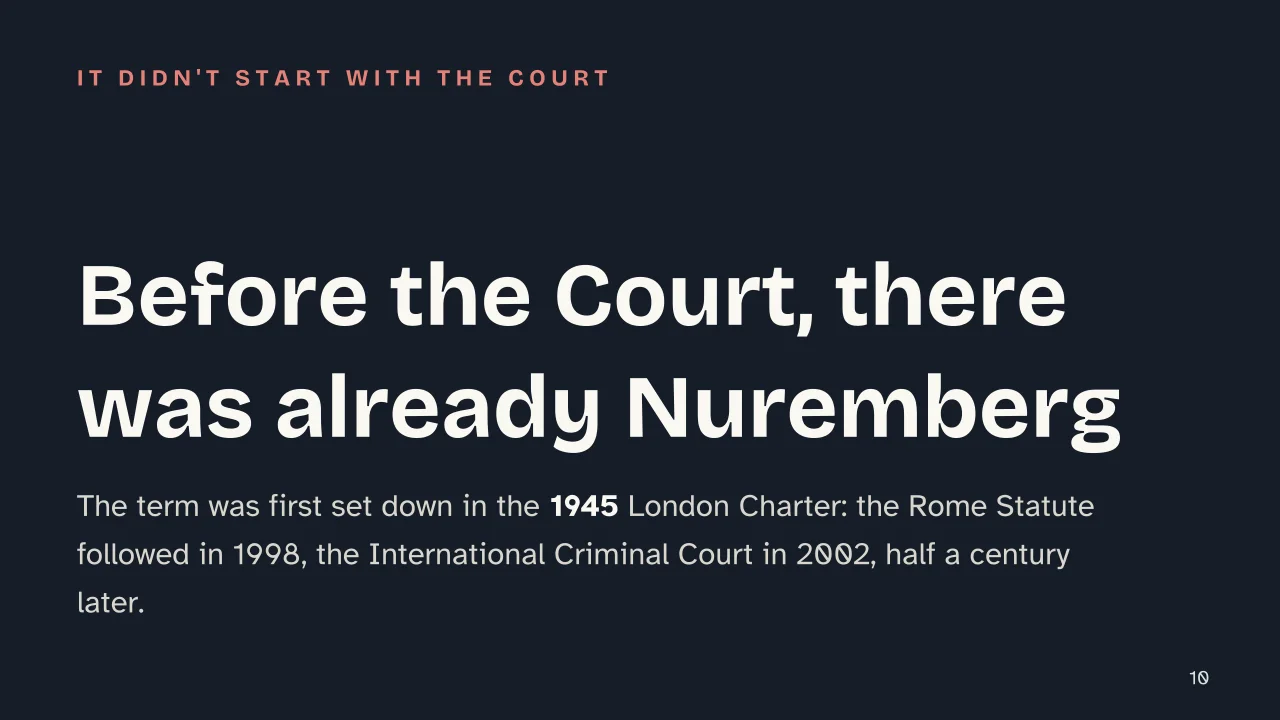
    • The concept began with the 1945 London Charter, which created the Nuremberg tribunal, well before the International Criminal Court existed.
    • The International Criminal Court, a permanent body, was created by the 1998 Rome Statute, became operational in 2002, and issued its first conviction in 2012.
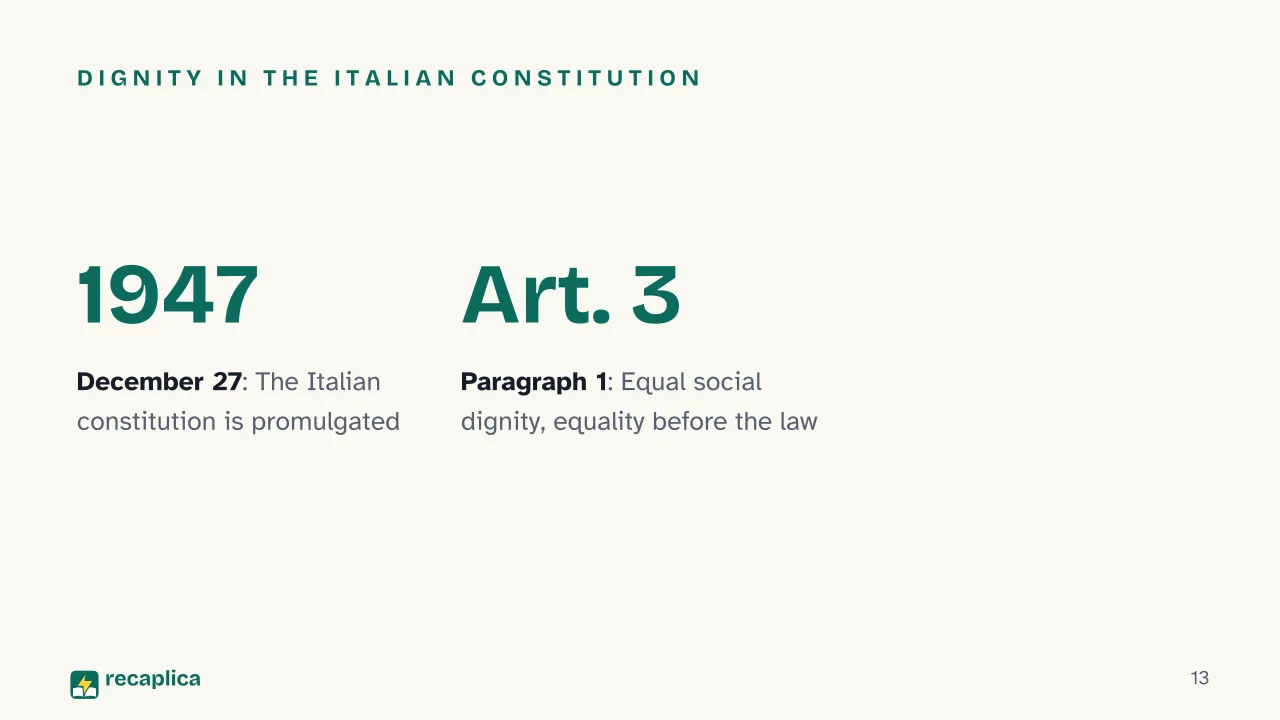
    • Article 3 of the Italian constitution states that every citizen holds equal social dignity before the law.

    Key figures

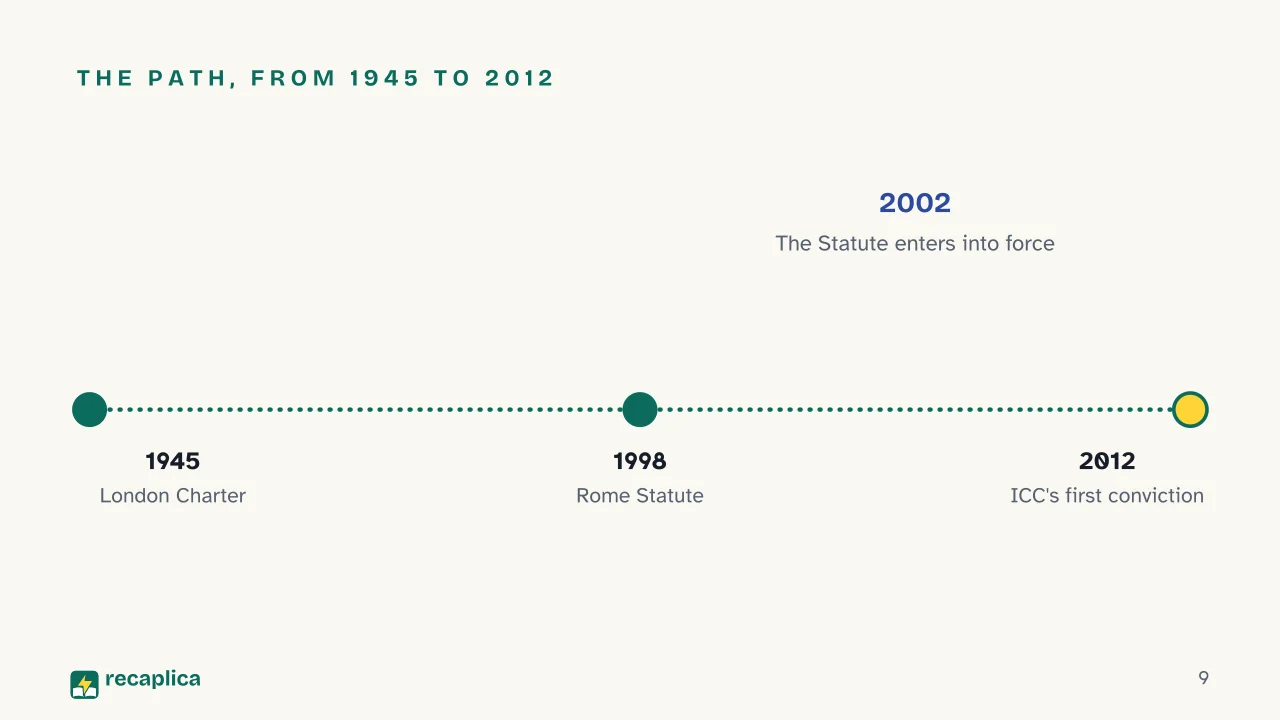
    • 1945 The London Charter, which created the Nuremberg international military tribunal, is the first legal act to define crimes against humanity. Source: United States Holocaust Memorial Museum
    • 1998 The Rome Statute, adopted in Rome, creates a permanent International Criminal Court for crimes against humanity, genocide, war crimes, and aggression. Source: United Nations, Rome Statute
    • 2012 The International Criminal Court hands down its first conviction, in the case of Thomas Lubanga Dyilo. Source: Treccani, Enciclopedia Italiana

    Deep Dive

    What the Rome Statute says

    The Rome Statute of the International Criminal Court, adopted in Rome in 1998, defines crimes against humanity in Article 7: a list of acts — murder, extermination, enslavement, deportation, unlawful imprisonment, torture, sexual violence, persecution, enforced disappearance, apartheid, and other inhumane acts causing great suffering — that become a crime against humanity only under one precise condition. The act must be part of a widespread or systematic attack directed against a civilian population, committed with knowledge of the attack. It’s this requirement, not the severity of the single act, that separates a crime against humanity from an ordinary crime: an isolated murder is still a murder; the same act, repeated on a large scale or carried out under an organized plan against civilians, moves into a different legal category.

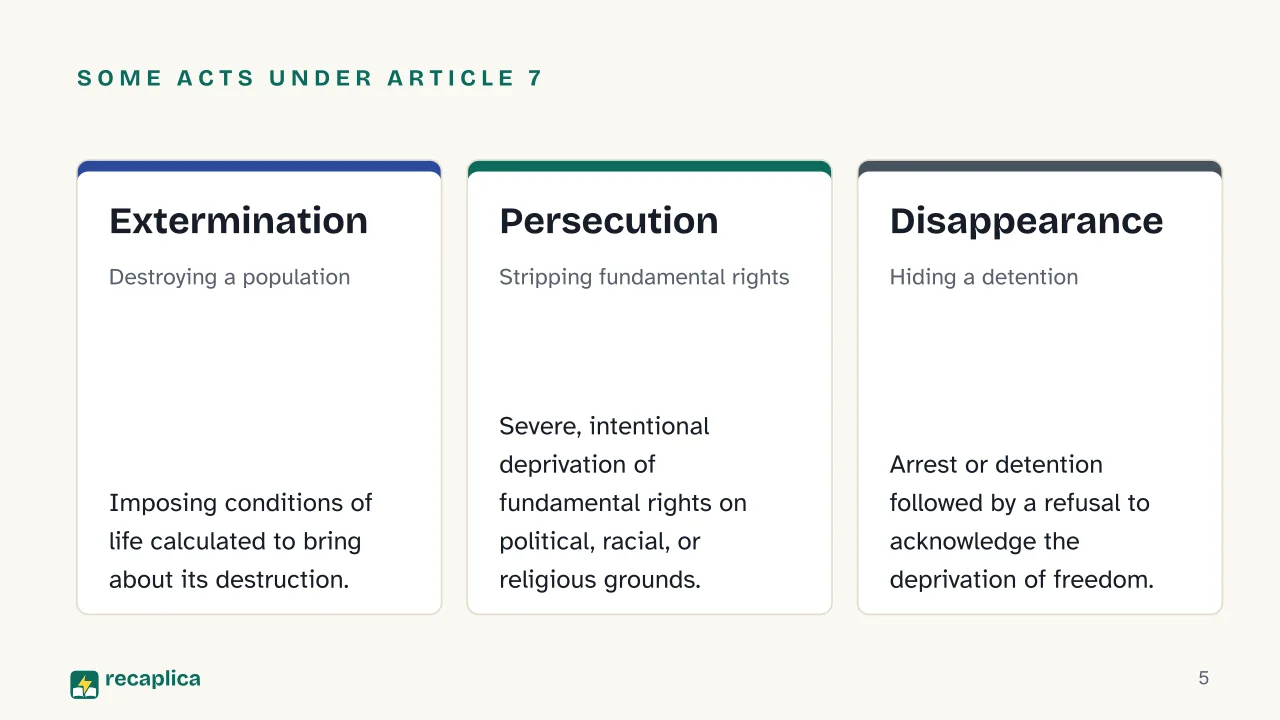
    The Statute also spells out some of the acts on that list. Extermination includes imposing conditions of life calculated to destroy part of a population. Persecution means the severe, intentional deprivation of fundamental rights. Enforced disappearance is the arrest or detention of a person followed by a refusal to acknowledge the deprivation of their liberty. These are technical, court-facing definitions, not loose descriptions.

    Where genocide and war crimes begin

    The three offenses are often mixed up, but the Rome Statute keeps them apart: each one turns on a different requirement.

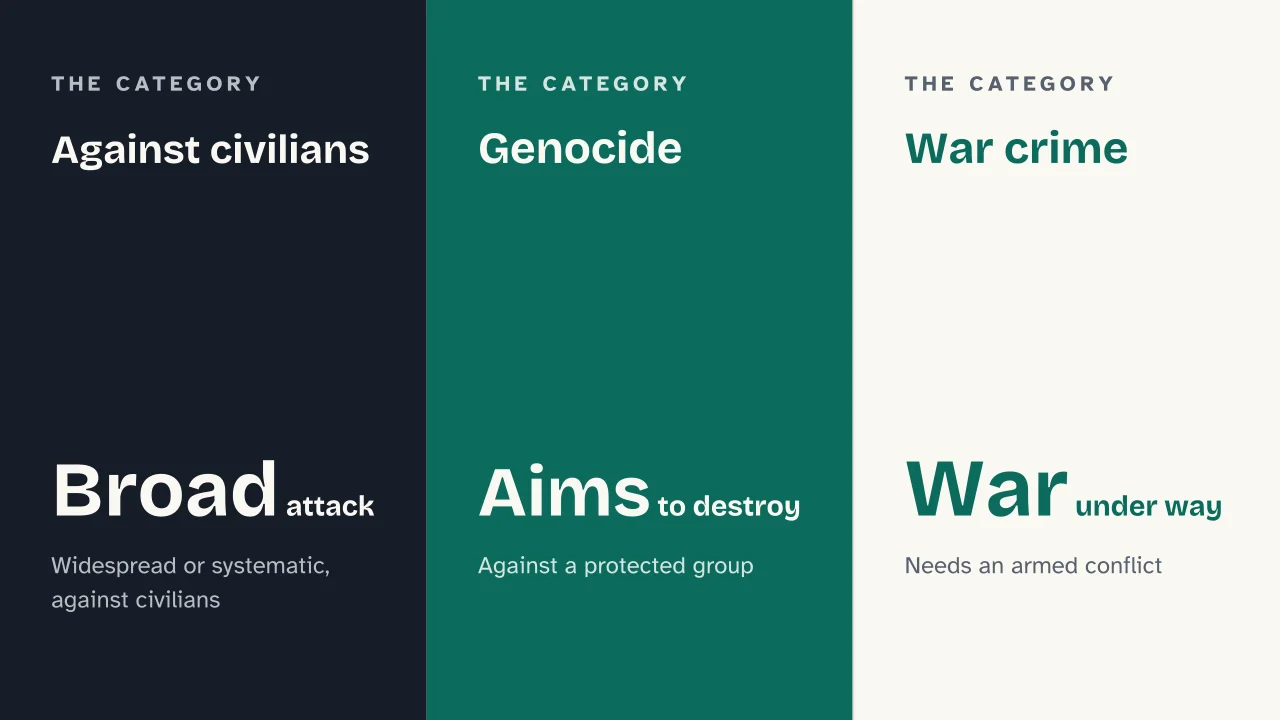
    CategoryKey requirementContext needed
    Crimes against humanityWidespread or systematic attack against civiliansNo armed conflict required
    GenocideIntent to destroy, in whole or in part, a national, ethnic, racial, or religious groupNo armed conflict required
    War crimesViolation of the rules of armed conductArmed conflict, international or not

    Genocide, defined by the 1948 Convention, requires an element crimes against humanity lack: the specific intent to eliminate a group defined by its national, ethnic, racial, or religious identity. Crimes against humanity, by contrast, target a civilian population without the perpetrator needing to want to destroy a group as such — a widespread or systematic attack is enough. War crimes, finally, exist only where an armed conflict is under way: they are violations of the rules that conflict is supposed to follow, a theme that also runs through our Recap on World War 2.

    From Nuremberg to the International Criminal Court

    The phrase “crimes against humanity” didn’t start with the International Criminal Court. It first appears in the London Charter of August 8, 1945, the act that created the Nuremberg international military tribunal. The trial of Nazi leaders opened on November 20, 1945, and closed on October 1, 1946: of the defendants, three were acquitted, nineteen convicted, twelve of them sentenced to death. It was the first tribunal to formally try this category of crime, defined at the time as murder, extermination, enslavement, deportation, or inhumane treatment of civilians, plus persecution on political, racial, or religious grounds.

    From that trial to the International Criminal Court lie one treaty and several decades. In 1998, states meeting in Rome adopted the Statute that gave crimes against humanity — alongside genocide, war crimes, and aggression — a permanent court, instead of tribunals set up case by case as at Nuremberg. The Court became operational in 2002, when the Statute entered into force, and issued its first conviction in 2012, in the case of Thomas Lubanga Dyilo.

    Practical example: someone accused of ordering the systematic deportation of civilians from a region, as part of an organized policy, can be tried either by a national court or, if the state won’t or can’t prosecute, by the International Criminal Court — the same route, through a different court, that the Nuremberg judges took in 1945.

    The principle of human dignity

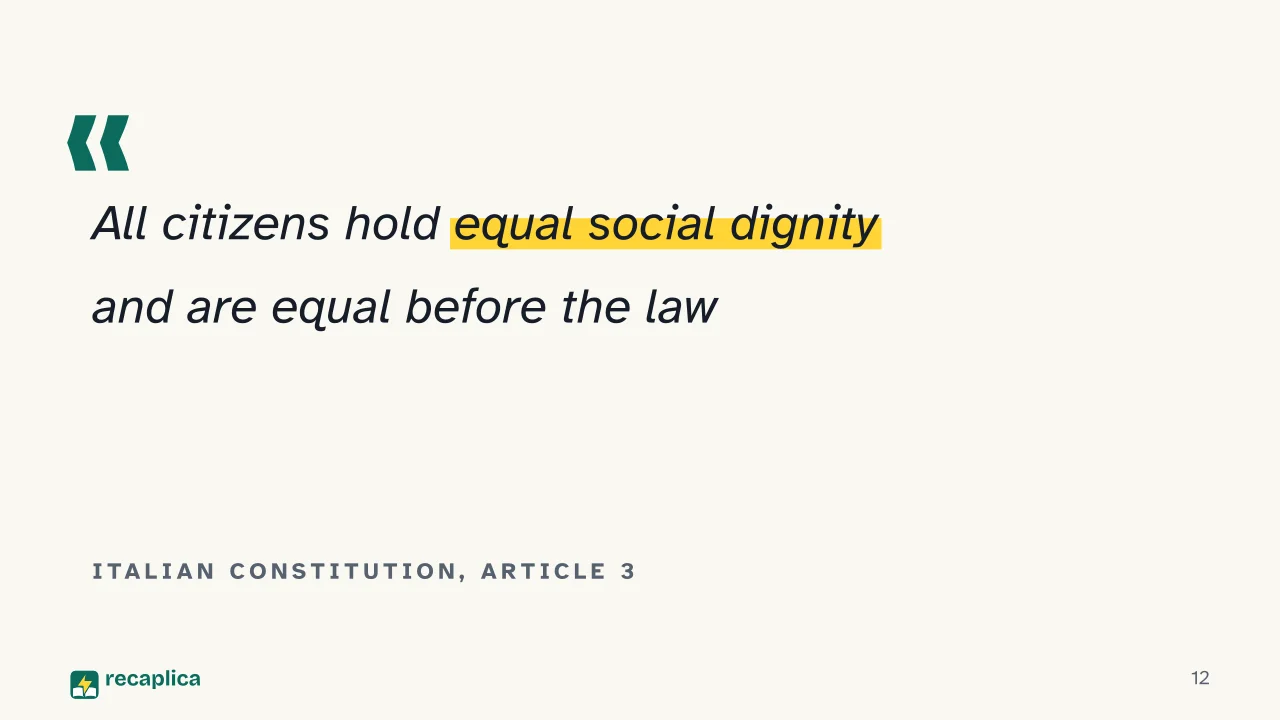
    Italy’s constitution, in Article 3, states that “all citizens hold equal social dignity and are equal before the law, regardless of sex, race, language, religion, political opinion, or personal and social condition.” It’s a principle that the bodies of the Italian state apply and protect every day, from Parliament to the judiciary, and one described in full on our page about the structure of the Italian constitution.

    Article 3 doesn’t name crimes against humanity: it’s our own reading, not the text of the law, that puts the two on the same plane. Here’s the reading we propose: the crimes against humanity listed in the Rome Statute — extermination, persecution, enforced disappearance — are each, in their own way, the most radical denial of the equal social dignity that Article 3 sets out as a principle. It isn’t a link written into any statute: it’s a way of understanding why international criminal law treats these acts as a category apart from ordinary crime. The very definition of a legal norm also helps explain why the Rome Statute, though a treaty between states rather than domestic law, works in a similar way: it sets a general, abstract rule, binding on anyone who falls under the Court’s jurisdiction.

    Slide deck

    Slides ready to download and make your own in PowerPoint or Google Slides, with speaker notes. Pick the Flash cut or the Full one.
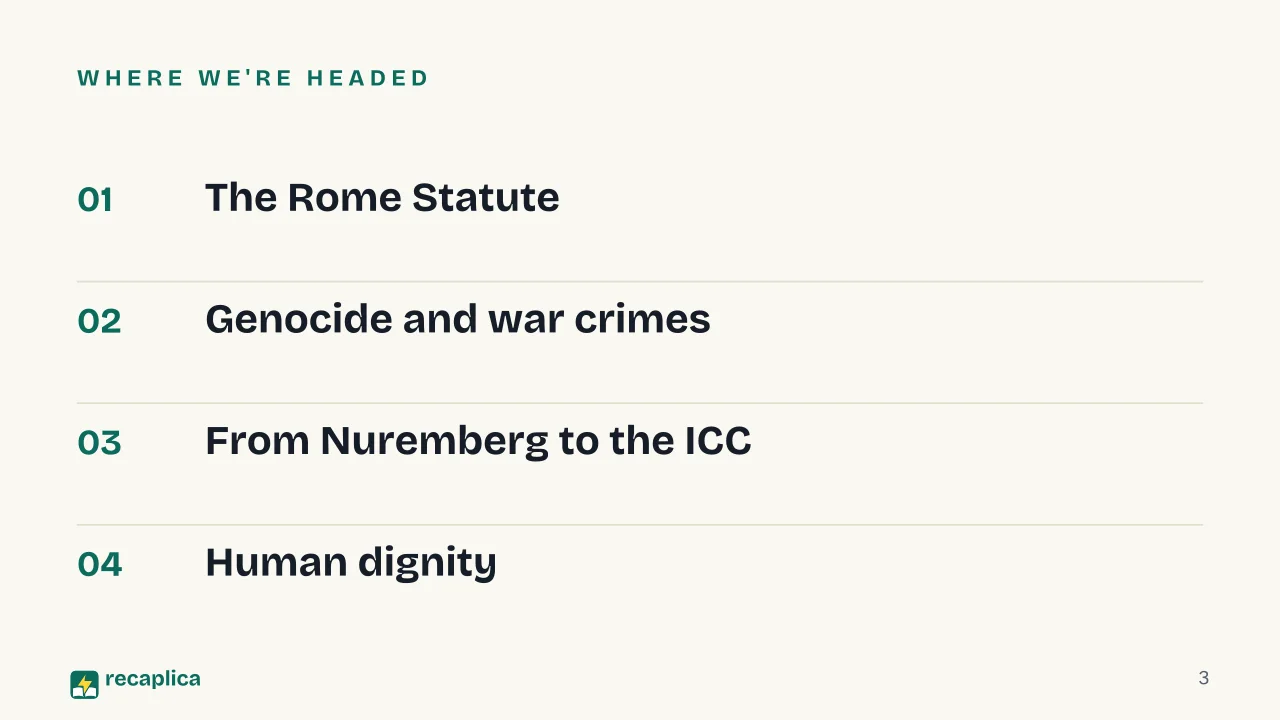
    Slide 1 of the presentation on Crimes Against Humanity: Crimes Against HumanitySlide 2 of the presentation on Crimes Against Humanity: What actually counts as a crime against humanity?Slide 3 of the presentation on Crimes Against Humanity: Where we're headedSlide 4 of the presentation on Crimes Against Humanity: Chapter 01: The Rome StatuteSlide 5 of the presentation on Crimes Against Humanity: Some acts under Article 7: Extermination, Persecution, DisappearanceSlide 6 of the presentation on Crimes Against Humanity: Chapter 02: Genocide and war crimesSlide 7 of the presentation on Crimes Against Humanity: Against civilians · Genocide · War crimeSlide 8 of the presentation on Crimes Against Humanity: Chapter 03: From Nuremberg to the ICCSlide 9 of the presentation on Crimes Against Humanity: The path, from 1945 to 2012Slide 10 of the presentation on Crimes Against Humanity: Before the Court, there was already NurembergSlide 11 of the presentation on Crimes Against Humanity: Chapter 04: Human dignitySlide 12 of the presentation on Crimes Against Humanity: Italian constitution, Article 3Slide 13 of the presentation on Crimes Against Humanity: Dignity in the Italian constitutionSlide 14 of the presentation on Crimes Against Humanity: What makes an act a crime against humanity?Slide 15 of the presentation on Crimes Against Humanity: To learn more
    Flash10 slidesThe essential thread, to present in classFull15 slidesEvery chapter and the deeper detail

    Common myths

    • ✗ Myth Crimes against humanity and genocide are the same thing.

      ✓ Reality Genocide requires the specific intent to destroy, in whole or in part, a national, ethnic, racial, or religious group (1948 Convention); crimes against humanity, defined by the Rome Statute, carry no such requirement — it is enough that the act is part of a widespread or systematic attack against a civilian population.

    • ✗ Myth A crime against humanity can only happen during a war.

      ✓ Reality War crimes require an armed conflict, international or not. Crimes against humanity do not: they can happen even with no conflict under way, as long as there is a widespread or systematic attack against a civilian population.

    • ✗ Myth The term "crimes against humanity" was coined by the International Criminal Court.

      ✓ Reality It dates back to 1945, with the London Charter that created the Nuremberg tribunal. The 1998 Rome Statute and the International Criminal Court, operational since 2002, arrived decades later, giving that existing concept a permanent court.

    Mind map

    Drag the background to move around and the nodes to reposition them; use − and + to collapse and expand branches.
    Customize
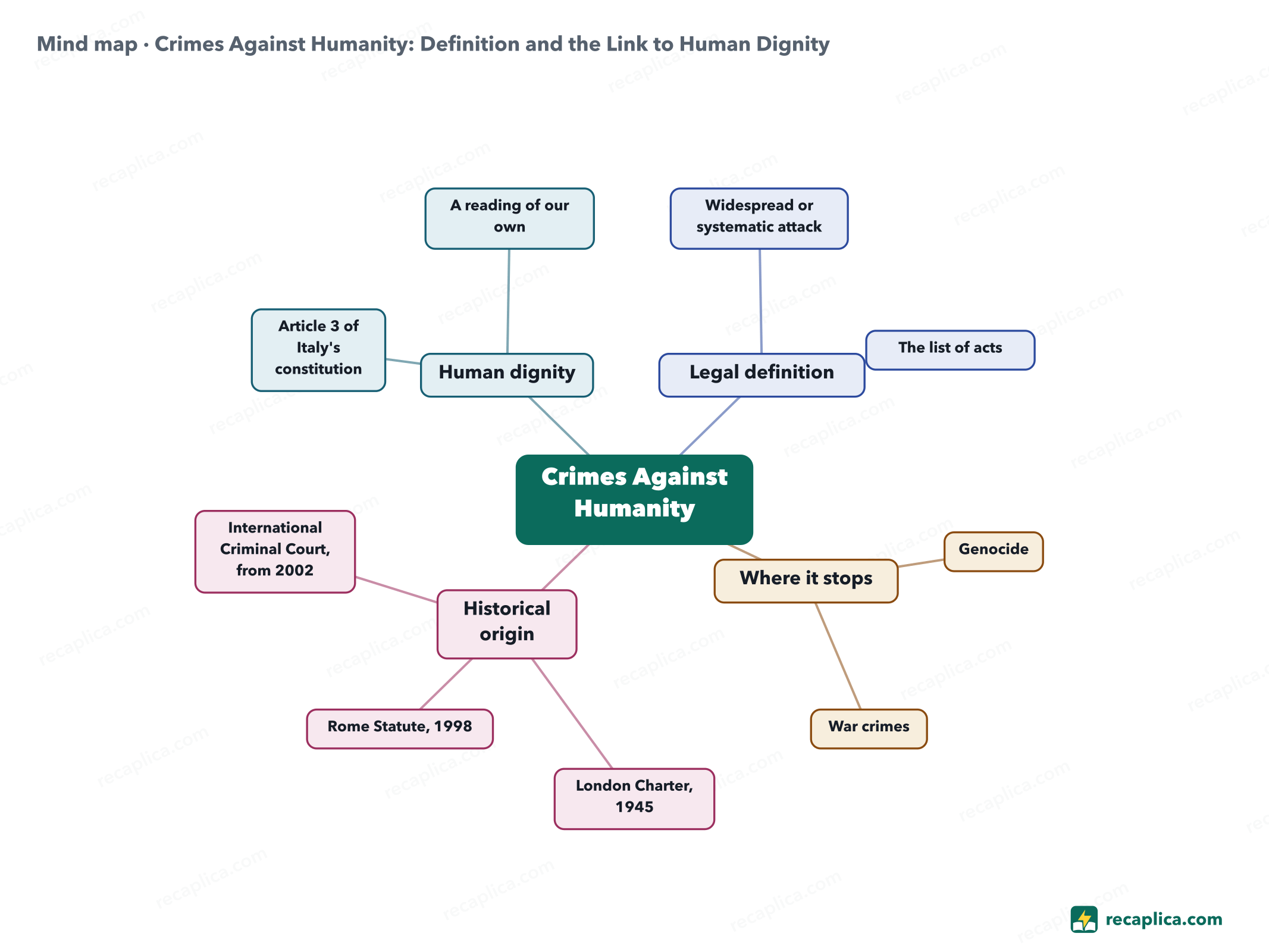
    Mind map: Crimes Against Humanity: Definition and the Link to Human Dignity
    • Crimes Against Humanity
      • Legal definition Rome Statute, Article 7
        • Widespread or systematic attack Against a civilian population, with knowledge of the attack
        • The list of acts Murder, extermination, persecution, enforced disappearance, and others
      • Where it stops
        • Genocide Requires intent to destroy a group
        • War crimes Require an armed conflict under way
      • Historical origin
        • London Charter, 1945 Creates the Nuremberg tribunal
        • Rome Statute, 1998 Creates the International Criminal Court
        • International Criminal Court, from 2002 First conviction in 2012
      • Human dignity
        • Article 3 of Italy's constitution Equal social dignity before the law
        • A reading of our own The link to crimes against humanity isn't written into the article itself

    Quiz: test yourself

    Answer the questions to check what you have learned: you get instant feedback and a short explanation.

    Grade 0/10 0/5
    1 Under Article 7 of the Rome Statute, what must accompany an act for it to count as a crime against humanity?

    Article 7 of the Rome Statute requires the act to be part of a widespread or systematic attack against a civilian population, with knowledge of that attack: who commits it and how many victims there are don't come into it.

    2 What sets genocide apart from a crime against humanity?

    The 1948 Convention defines genocide precisely through the intent to destroy a group defined by nationality, ethnicity, race, or religion — an element crimes against humanity don't require.

    3 True or false: unlike crimes against humanity, war crimes require an armed conflict under way.

    War crimes only exist in the context of an armed conflict, international or not; crimes against humanity can occur even with no war under way.

    4 What was the first act to define crimes against humanity?

    The London Charter of August 8, 1945, is the first international act to name and define crimes against humanity, well before the Rome Statute.

    5 In what year did the International Criminal Court hand down its first conviction?

    The International Criminal Court's first conviction dates to 2012, in the case of Thomas Lubanga Dyilo.

    Answers: 1-A · 2-A · 3-A · 4-A · 5-C

    Flashcards

    Tap the card to flip it and check whether you remember the answer, then move to the next one.

    1 / 7

    Explain it in your own words

    The ultimate test: if you can explain it in simple words, you've truly understood it. Write your explanation, then compare it with the Recap.

    Your explanation is saved only on this device.

    Crimes against humanity are a category of international criminal law: acts such as murder, extermination, or persecution, committed as part of a widespread or systematic attack against a civilian population. The 1998 Rome Statute defines them in Article 7 and assigns them to the International Criminal Court, operational since 2002. The concept is older, though: it dates back to 1945, with the charter that created the Nuremberg tribunal. This Recap explains the definition, where it stops and genocide or war crimes begin, and why we connect it to the principle of human dignity written into Italy's constitution.

    Frequently asked questions

    What are crimes against humanity?

    They are a category of international criminal law defined by Article 7 of the Rome Statute: acts such as murder, extermination, deportation, torture, or persecution, committed as part of a widespread or systematic attack against a civilian population, with knowledge of that attack.

    What's the difference between crimes against humanity and genocide?

    Genocide requires the specific intent to destroy, in whole or in part, a national, ethnic, racial, or religious group. Crimes against humanity carry no such requirement: a widespread or systematic attack against a civilian population is enough.

    Do crimes against humanity require a war to be under way?

    No. Unlike war crimes, which presuppose an armed conflict, crimes against humanity can occur even in peacetime, as long as there's a widespread or systematic attack against civilians.

    Since when has the International Criminal Court existed?

    The Rome Statute that created it was adopted in 1998 and entered into force in 2002. The Court handed down its first conviction in 2012, in the case of Thomas Lubanga Dyilo.

    What are some examples of crimes against humanity?

    The Nuremberg trial (1945-1946) prosecuted Nazi leaders for crimes against humanity, among other charges, under the London Charter — the first time the category was tried in court. Decades later, the International Criminal Court, operational since 2002, became the permanent forum for the same category of crime, alongside genocide and war crimes.

    Sources

    • Rome Statute of the International Criminal Court, official text (United Nations)
    • Definitions of Genocide and Related Crimes (United Nations, Office on Genocide Prevention)
    • Corte penale internazionale (Treccani, Enciclopedia Italiana)
    • Constitution of the Italian Republic, Article 3 (Normattiva)
    • How Were the Crimes Defined? (United States Holocaust Memorial Museum, Holocaust Encyclopedia)

    Every Recap goes through an independent review before publication.

    Every evening, the day's new Recaps on our Telegram channel. Join the channel →

    Keep learning

    • Civics Popular Sovereignty and Citizenship: What They Mean Popular sovereignty is the principle, written into Article 1 of Italy's Constitution, that state power belongs to the people, who exercise it within the forms and limits the Constitution itself sets, through Parliament, elections, and the tools it provides, not through a direct vote on every law. Citizenship is a different matter: the legal status that ties a person to a state, together with the rights and duties that relationship carries, as the Enciclopedia Treccani defines it. In Italy, Law No. 91 of February 5, 1992 makes a person a citizen at birth mainly through jus sanguinis, at least one citizen parent, reserving birth on Italian soil for cases where both parents are unknown or stateless. The idea that power comes from the people themselves, rather than from a sovereign standing above them, traces back to Jean-Jacques Rousseau and his 1762 Social Contract, and it is, according to the Stanford Encyclopedia of Philosophy, the version of sovereignty most widespread in contemporary constitutional governments around the world. Read the Recap →
    • Civics Italian Government Structure: Which Bodies Do What The Italian state rests on five bodies that the Constitution sets up and regulates directly: Parliament makes the laws, the Government carries them out, the President of the Republic represents national unity, the judiciary applies the law to individual cases, and the Constitutional Court checks that laws respect the Constitution. Alongside them sit four bodies of constitutional relevance — the High Council of the Judiciary, the Court of Auditors, the CNEL and the Council of State — auxiliary bodies the Constitution sets up but keeps in a separate category from the five essential ones. Knowing who does what, and which bodies the system cannot run without, is the fastest way into how Italy is actually governed. Read the Recap →
    • Civics Italian Constitution: Structure, Principles, and How It Works Italy's Constitution took effect on January 1, 1948, after the Constituent Assembly gave it final approval on December 22, 1947, and Enrico De Nicola signed it into law on December 27, 1947. The text runs to 139 articles, grouped into Fundamental Principles, Part I on the rights and duties of citizens, Part II on the structure of the Republic, plus 18 transitional and final provisions. It was drafted by 556 deputies elected on June 2, 1946, including 21 women. Amending it is possible but deliberately hard: Article 138 requires two votes in each chamber at least three months apart, with qualified majorities. Read the Recap →

    recaplica

    Clear in 30 seconds, yours in 10 minutes.

    Recaps Mind maps Request a Recap Telegram channel Mind map maker Our method About Privacy & cookies Legal notes & terms of use

    © 2026 Recaplica · A project by Curi S.r.l. — VAT IT05472000750

    Statistics, only if you say so

    To learn which Recaps help most we would use Google Analytics, with aggregate, anonymous data. It starts only with your OK, and you can change your mind anytime. Privacy policy