Skip to content
recaplica

    One moment: security check

    Cloudflare wants to make sure you're not a robot. Tick the box below and your search will continue on its own.

    IT
    recaplica Retention of Title: What It Is and How It Works in Italian Law
    © 2026 Recaplica · recaplica.com — All rights reserved
    Home › Civics

    Retention of Title: What It Is and How It Works in Italian Law

    By Recaplica Newsroom · Updated on October 1, 2026

    What to print

    Page numbers appear when printing with default margins.

    Slides

    Choose a cut

    Flash10 slidesThe essential thread, to present in classFull15 slidesEvery chapter and the deeper detail

    Both come with speaker notes.

    Telegram channel
    recaplica Clear in 30 seconds, yours in 10 minutes.
    In 30 seconds Key points Deep dive Slides Myths Mind map Quiz Flashcards FAQ

    In 30 seconds quick read

    A retention-of-title clause, set out in article 1523 of the Italian civil code, lets a seller keep ownership of goods sold in installments until the buyer pays the final installment. The buyer takes delivery right away and bears the risk of loss or damage from that moment, but only becomes full owner once the price is paid in full. The reservation also binds the buyer's creditors, provided a written document with a certifiable date shows it was agreed before any seizure (art. 1524 c.c.). If the buyer misses an installment, the contract is terminated only when that installment is worth more than one-eighth of the total price: the parties cannot override this threshold by agreement (art. 1525 c.c.).

    Key Points

    • A retention-of-title clause (art. 1523 c.c.) delays the transfer of ownership until the buyer pays the last installment.
    • The buyer takes delivery of the goods right away, and from that moment any loss or damage falls on the buyer.
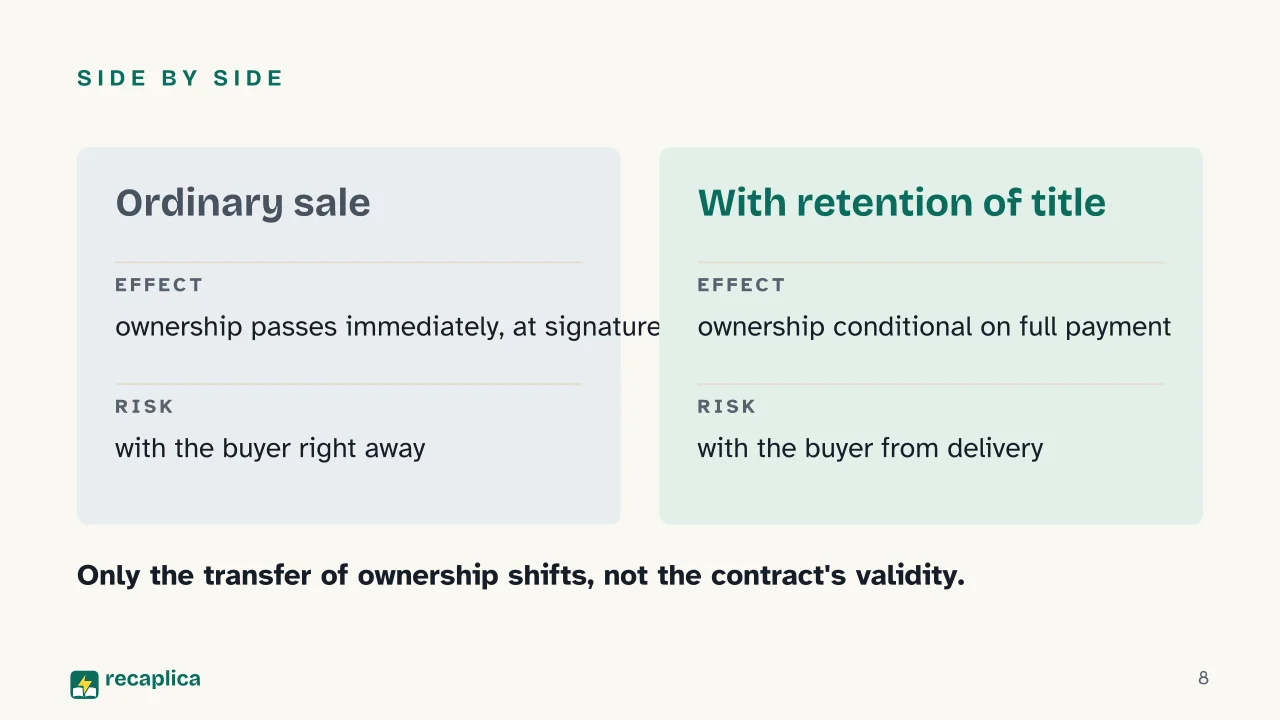
    • The sale contract is binding from signature; only the transfer of ownership is conditional on full payment.
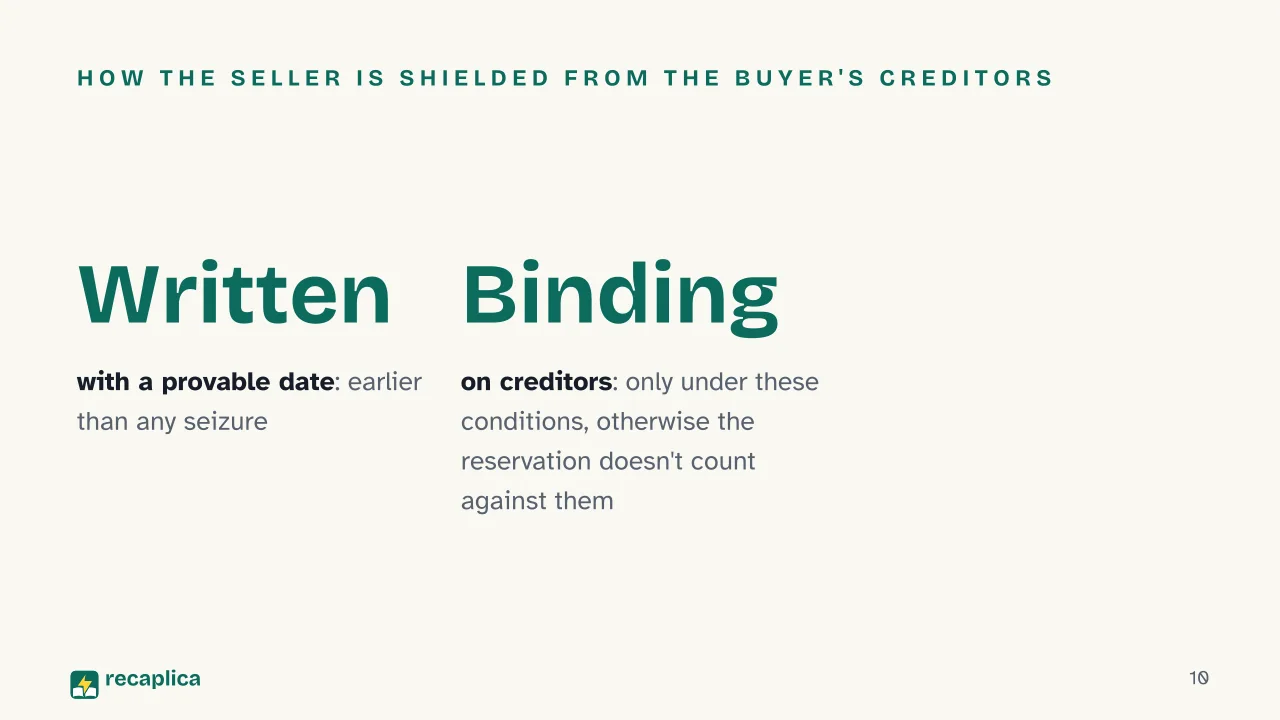
    • The reservation binds the buyer's creditors only with a written document dated earlier than any seizure (art. 1524 c.c.).
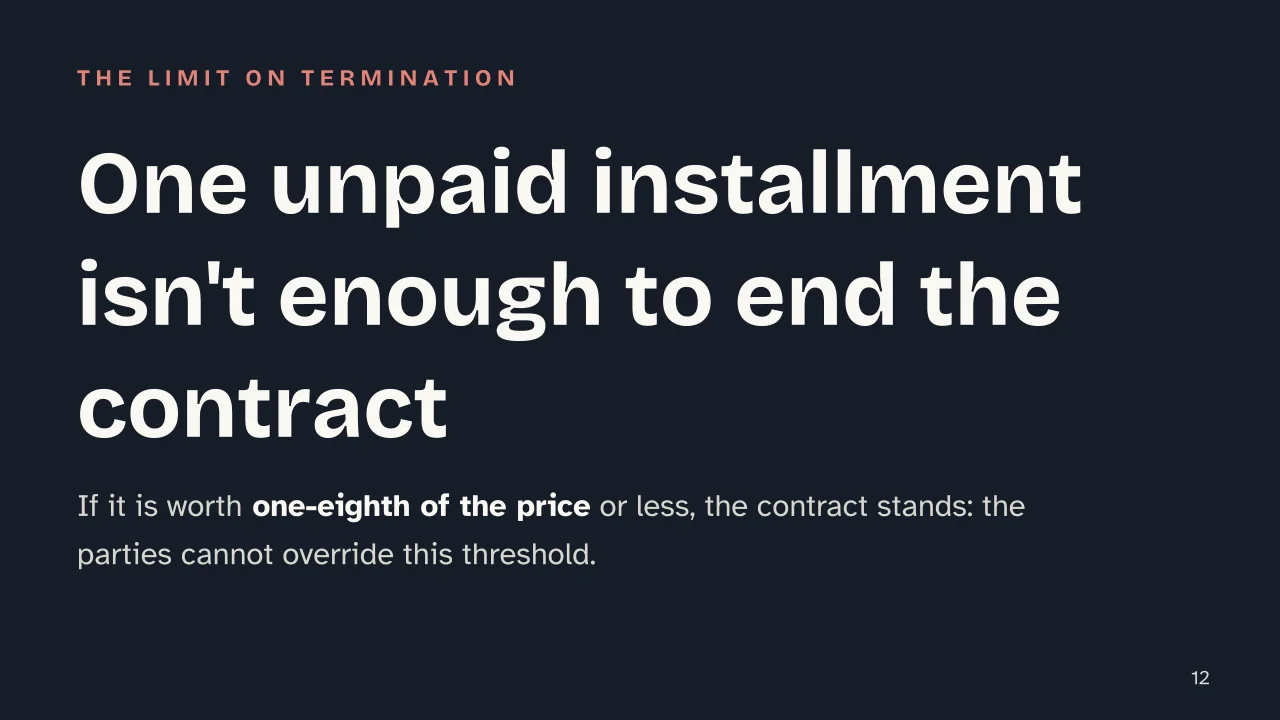
    • Missing a single installment does not terminate the contract if it is worth one-eighth of the price or less (art. 1525 c.c.).
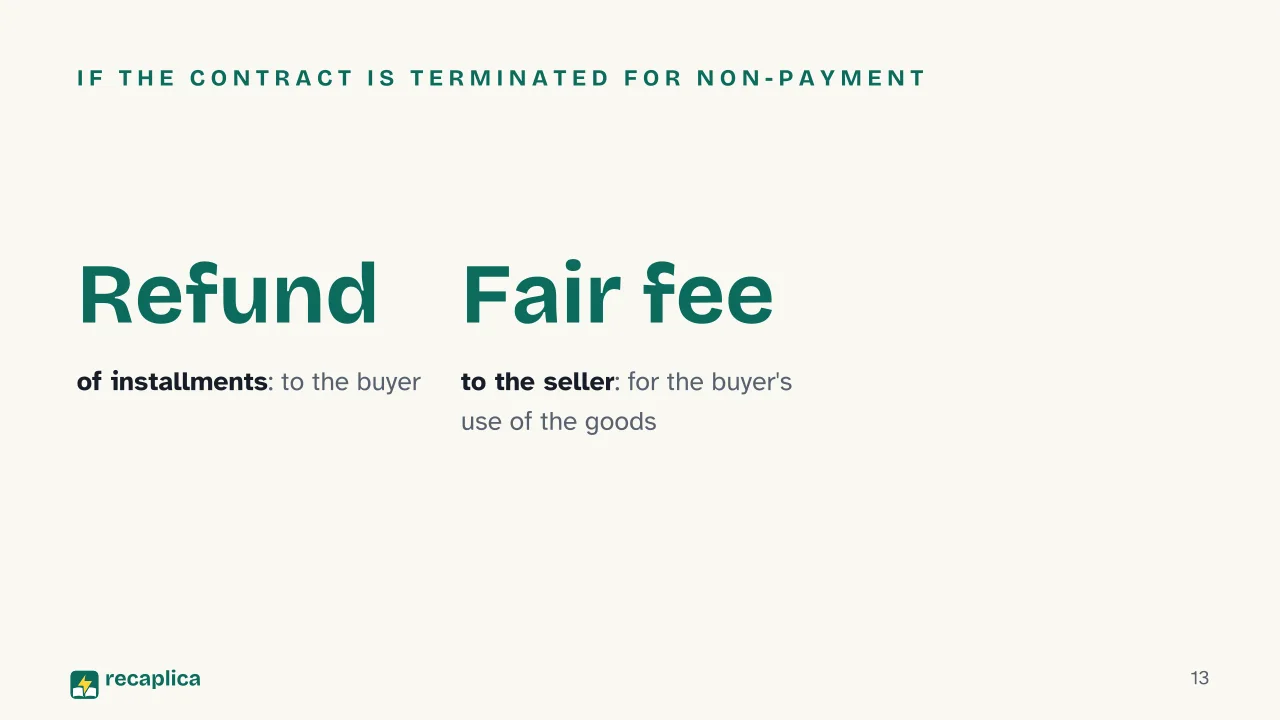
    • If the contract is terminated for non-payment, the seller must return the installments collected, minus a fair fee for the buyer's use of the goods.

    Deep Dive

    Under the general rule of Italian law, ownership of goods passes with the simple agreement between the parties: it is called consensual transfer, and it is the principle behind full property rights. A sale with retention of title is an exception to that rule, set out in article 1523 of the civil code for installment sales: the contract binds both sides from signature, but the transfer of ownership itself is pushed further out, to the payment of the final installment.

    What article 1523 of the civil code says

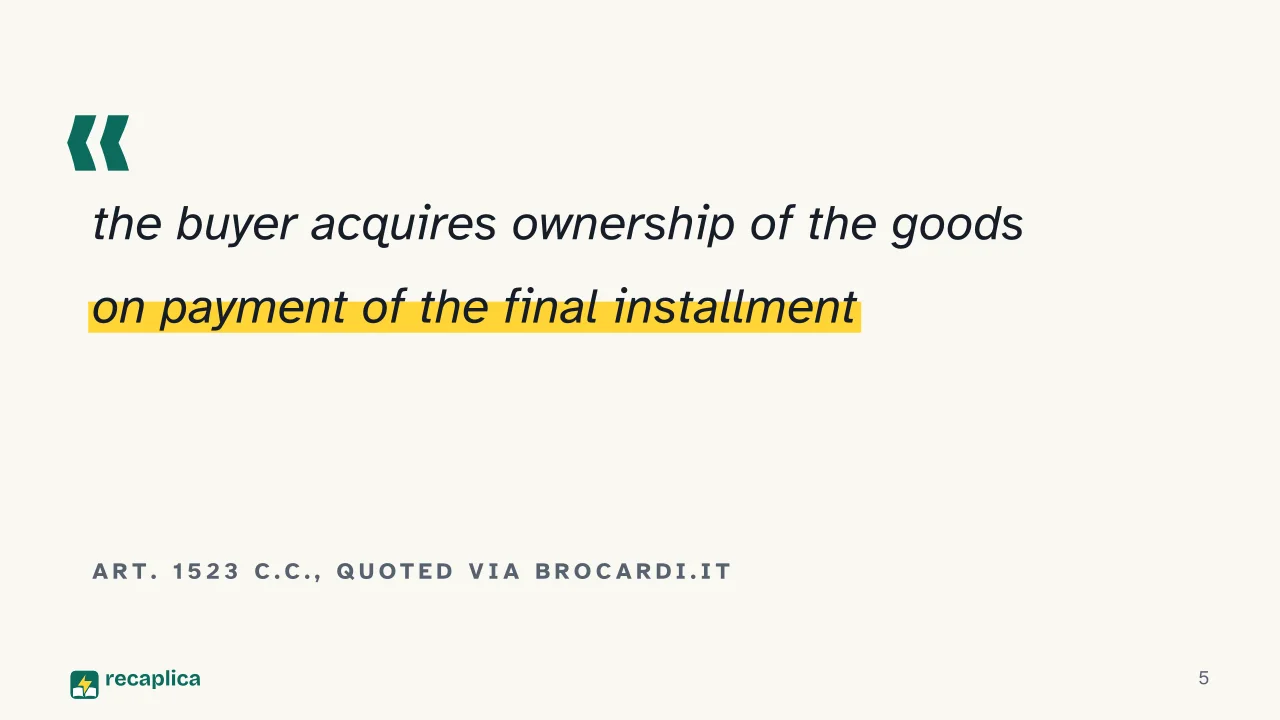
    The wording is precise: “In an installment sale with retention of title, the buyer acquires ownership of the goods on payment of the final installment, but bears the risk from the moment of delivery.” The rule splits two moments that coincide in an ordinary sale: the transfer of possession, meaning physical delivery of the goods, and the transfer of ownership, meaning the full right to dispose of them. In an installment sale with retention of title, the buyer receives the goods right away and can use them, but remains, on paper, a possessor waiting for something: full ownership arrives only with the balance. That is a different setup from usufruct, where the right to use the goods and the right to dispose of them are already split between two separate holders; here a single, undivided ownership stays entirely with the seller until a future, certain event — payment of the final installment.

    It is the clause set out in article 1523 c.c., a legal norm within the book on obligations, that postpones only the transfer effect. Both parties are bound from the moment of signature, with every mutual obligation of an ordinary sale contract; what changes is the timing of just one of the contract’s effects — the transfer of ownership.

    Conditional sale: how retention of title works in an installment sale

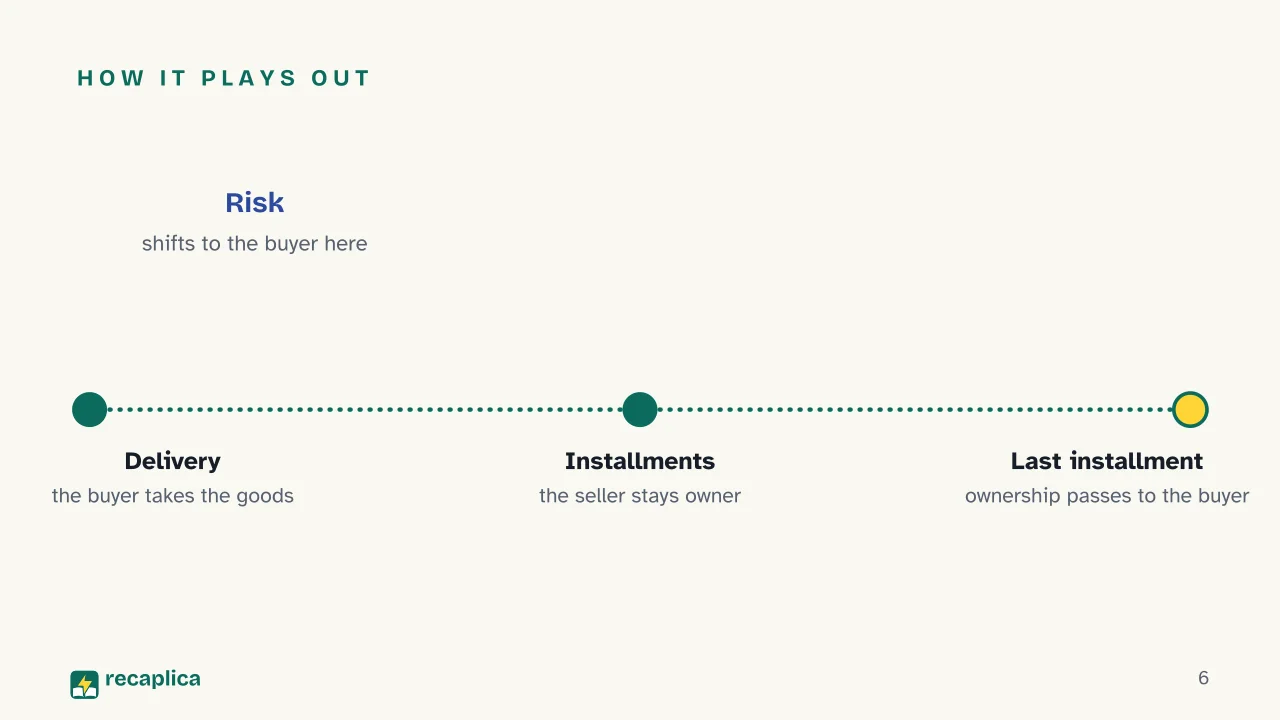
    In practice, a sale with retention of title unfolds in three stages.

    At delivery, the buyer receives the goods and starts using them. From that point, under article 1523 c.c., the buyer also takes on the risk of loss or damage: if the goods are ruined by an accident, the loss falls on the buyer, even though the buyer is not yet the owner. This departs from the general rule that risk follows ownership (res perit domino): here risk detaches from ownership and follows possession instead.

    For as long as the installments run, the seller stays the owner of the goods. That is the security function of the clause: the seller hands over the goods immediately, but keeps a title over them that provides protection if the buyer stops paying.

    Only on payment of the final installment does the buyer acquire full ownership. From that point on, the buyer’s position is no different from someone who paid the full price in a single instalment.

    Worked example: picture a factory buying a piece of industrial equipment under a contract that spreads the price over several installments, with a retention-of-title clause attached. The factory takes the equipment and puts it to work straight away, but until the last installment is paid it remains, on paper, only a possessor: ownership of the equipment still belongs to the seller. If the equipment is damaged by an accident during that period, the cost of the damage falls on the factory using it, not on the seller who still formally owns it.

    Protecting the seller: binding the buyer’s creditors

    The advantage of a retention-of-title clause for the seller is not limited to the relationship with the buyer: it extends to third parties too. Article 1524 c.c. states that the retention of title binds the buyer’s creditors only if it is recorded in a written document with a date provably earlier than any seizure. In other words, if a creditor of the buyer tried to seize the goods believing they already belonged to the buyer, the seller can invoke the reservation and keep the goods out of the seizure — but only by producing a document with a certifiably earlier date than the seizure, proving the reservation already existed. Without that formal proof, the reservation remains valid between the parties but gives the seller no protection against third parties.

    RequirementEffect if presentEffect if absent
    Written documentProves the date of the reservationThe reservation cannot be proven against third parties
    Date provably earlier than the seizureThe goods stay outside the seizureThe goods can be seized by the buyer’s creditors

    Protecting the buyer: the one-eighth threshold

    A retention-of-title clause is not built for the seller alone. Article 1525 c.c. sets a limit on terminating the contract for non-payment: missing a single installment, when it is worth one-eighth of the total price or less, cannot trigger termination, and the parties cannot override this by agreement. It is a safeguard against terminations that would be disproportionate to a minor delay, and the law does not let a contract clause remove it.

    If, despite that limit, the contract is terminated for the buyer’s default, the seller must return the installments already collected. The seller can, however, keep — or claim — a fair fee for the use the buyer made of the goods in the meantime: the refund is therefore neither automatic nor complete, but accounts for the benefit the buyer still got from using the goods.

    Movable goods and real estate

    Article 1523 c.c. governs installment sales of goods, whether movable or immovable: the core mechanism — ownership with the seller until full payment, risk with the buyer from delivery — does not change with the type of goods, whether movable, such as a piece of equipment or a vehicle, or real estate.

    Slide deck

    Slides ready to download and make your own in PowerPoint or Google Slides, with speaker notes. Pick the Flash cut or the Full one.
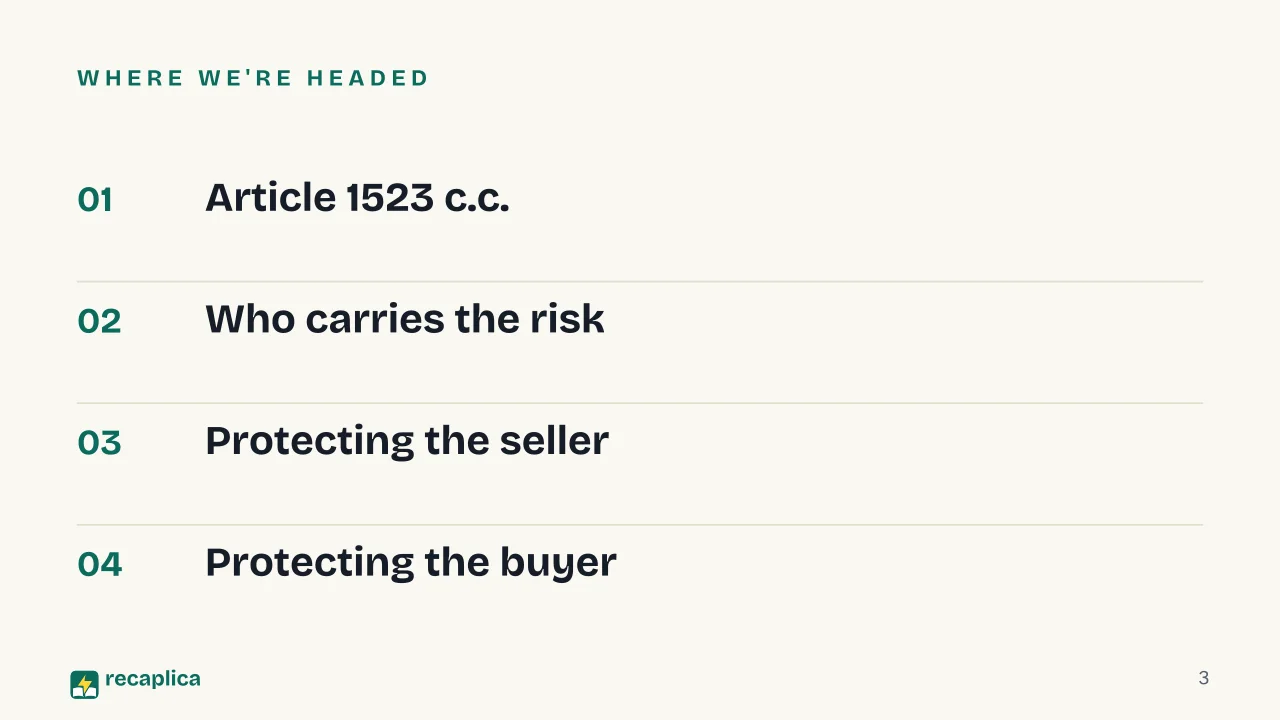
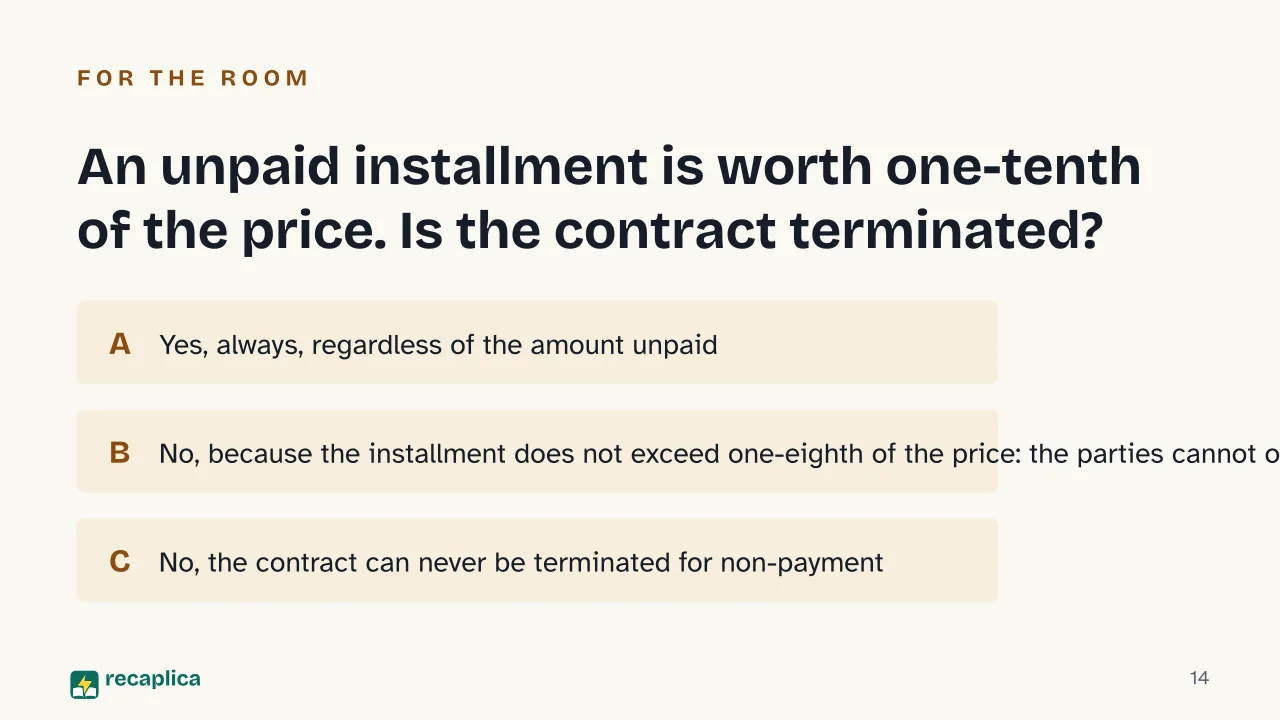
    Slide 1 of the presentation on Retention of Title: Retention of TitleSlide 2 of the presentation on Retention of Title: Who really owns goods bought on installments, before the last one is paid?Slide 3 of the presentation on Retention of Title: Where we're headedSlide 4 of the presentation on Retention of Title: Chapter 01: Article 1523 c.c.Slide 5 of the presentation on Retention of Title: Art. 1523 c.c., quoted via Brocardi.itSlide 6 of the presentation on Retention of Title: How it plays outSlide 7 of the presentation on Retention of Title: Chapter 02: Who carries the riskSlide 8 of the presentation on Retention of Title: Side by sideSlide 9 of the presentation on Retention of Title: Chapter 03: Protecting the sellerSlide 10 of the presentation on Retention of Title: How the seller is shielded from the buyer's creditorsSlide 11 of the presentation on Retention of Title: Chapter 04: Protecting the buyerSlide 12 of the presentation on Retention of Title: One unpaid installment isn't enough to end the contractSlide 13 of the presentation on Retention of Title: If the contract is terminated for non-paymentSlide 14 of the presentation on Retention of Title: An unpaid installment is worth one-tenth of the price. Is the contract terminated?Slide 15 of the presentation on Retention of Title: Read more
    Flash10 slidesThe essential thread, to present in classFull15 slidesEvery chapter and the deeper detail

    Common myths

    • ✗ Myth Many people assume that until every installment is paid, the buyer has no rights over the goods at all.

      ✓ Reality In reality the buyer takes delivery immediately and carries the risk from that point on, because article 1523 c.c. separates possession and use of the goods from ownership, which stays with the seller only until full payment.

    • ✗ Myth Many people assume a verbal agreement is enough to make a retention-of-title clause count against the buyer's creditors.

      ✓ Reality In reality article 1524 c.c. asks for written proof whose date can be shown to come before the seizure, because without that formal proof the buyer's creditors could treat the goods as already belonging to the buyer.

    • ✗ Myth Many people assume that missing any single installment ends the contract right away.

      ✓ Reality In reality article 1525 c.c. shields the buyer from disproportionate terminations: if the unpaid installment is worth one-eighth of the price or less, the contract stands, and the parties cannot override this protection by agreement.

    Mind map

    Drag the background to move around and the nodes to reposition them; use − and + to collapse and expand branches.
    Customize
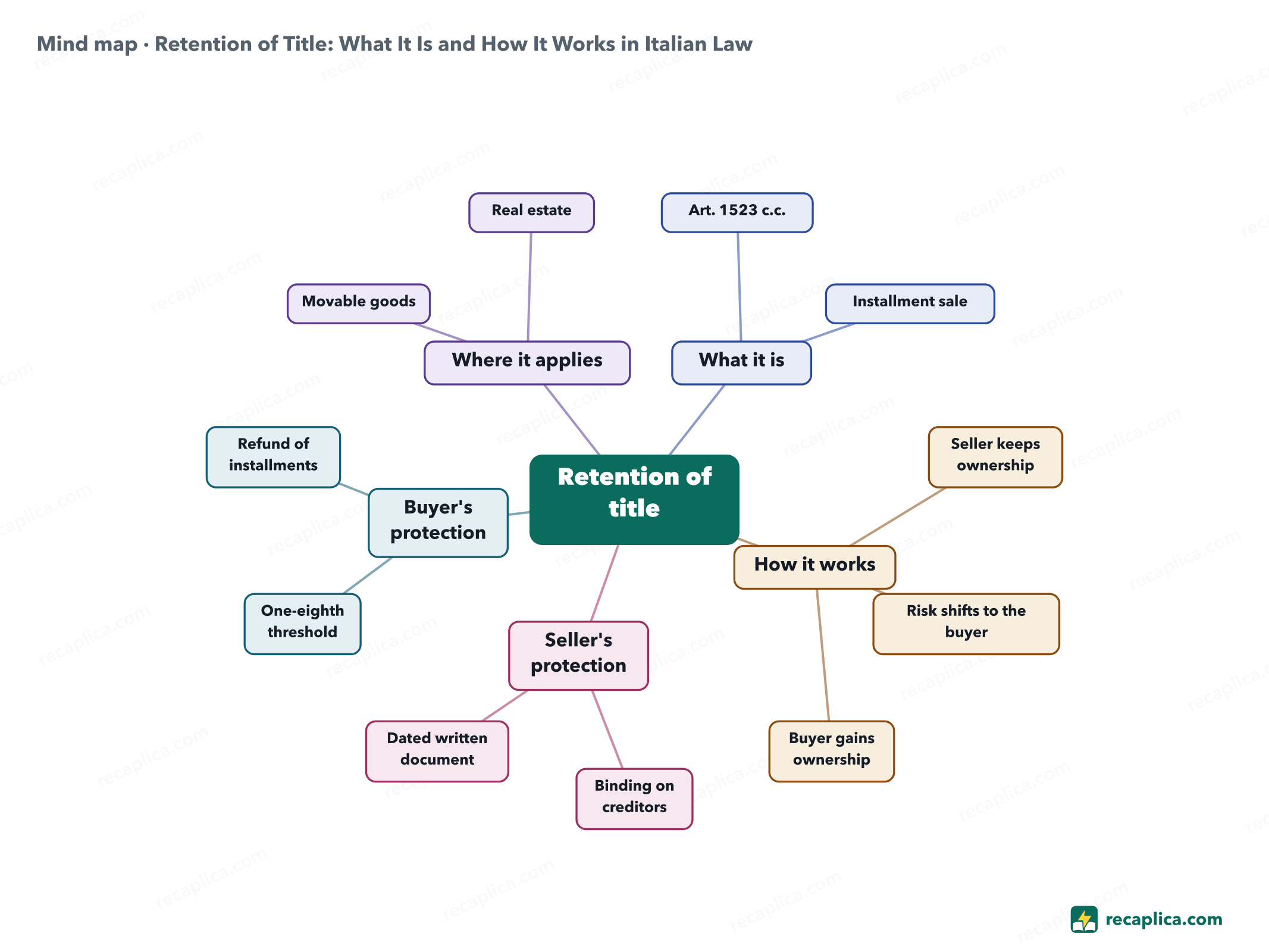
    Mind map: Retention of Title: What It Is and How It Works in Italian Law
    • Retention of title
      • What it is
        • Art. 1523 c.c. the rule governing installment sales with retention of title
        • Installment sale the contract type the clause attaches to
      • How it works
        • Seller keeps ownership until the last installment is paid
        • Risk shifts to the buyer from the moment of delivery
        • Buyer gains ownership on payment of the final installment
      • Seller's protection
        • Binding on creditors art. 1524 c.c.
        • Dated written document earlier than any seizure
      • Buyer's protection
        • One-eighth threshold art. 1525 c.c.
        • Refund of installments minus a fair fee for use
      • Where it applies
        • Movable goods
        • Real estate

    Quiz: test yourself

    Answer the questions to check what you have learned: you get instant feedback and a short explanation.

    Grade 0/10 0/5
    1 What happens to ownership of the goods under a retention-of-title clause?

    Article 1523 c.c. states that the buyer acquires ownership only on payment of the final installment, not before.

    2 From when does the buyer bear the risk of loss or damage to the goods?

    Article 1523 c.c. shifts the risk to the buyer from delivery, even though ownership stays with the seller: it is an exception to the general rule that risk follows ownership.

    3 True or false: a sale with retention of title is conditional and not binding from the moment it is signed.

    False: the contract binds both parties as soon as it is signed. What waits for the final installment is only the transfer of ownership.

    4 When does a retention-of-title clause bind the buyer's creditors?

    Under article 1524 c.c. the seller needs a written document, and its date must be provable and earlier than the seizure by the buyer's creditors; otherwise the reservation does not count against them.

    5 The buyer misses an installment worth one-tenth of the total price. Is the contract terminated?

    Article 1525 c.c. rules out termination when the unpaid installment does not exceed one-eighth of the price, and this protection cannot be overridden even by agreement.

    Answers: 1-B · 2-C · 3-B · 4-B · 5-B

    Flashcards

    Tap the card to flip it and check whether you remember the answer, then move to the next one.

    1 / 6

    Explain it in your own words

    The ultimate test: if you can explain it in simple words, you've truly understood it. Write your explanation, then compare it with the Recap.

    Your explanation is saved only on this device.

    A retention-of-title clause, set out in article 1523 of the Italian civil code, lets a seller keep ownership of goods sold in installments until the buyer pays the final installment. The buyer takes delivery right away and bears the risk of loss or damage from that moment, but only becomes full owner once the price is paid in full. The reservation also binds the buyer's creditors, provided a written document with a certifiable date shows it was agreed before any seizure (art. 1524 c.c.). If the buyer misses an installment, the contract is terminated only when that installment is worth more than one-eighth of the total price: the parties cannot override this threshold by agreement (art. 1525 c.c.).

    Frequently asked questions

    What is a retention-of-title clause?

    It is the clause, set out in art. 1523 c.c., under which a seller in an installment sale keeps ownership of the goods until the buyer pays the final installment, even though the buyer takes delivery right away.

    What changes for a buyer under a conditional sale with retention of title?

    The buyer takes delivery of the goods immediately and can use them, but is not yet the full owner: that happens only with the last installment. In the meantime the buyer already carries the risk of loss or damage, from the moment of delivery.

    Can a retention-of-title clause be used for real estate?

    Article 1523 c.c. governs installment sales in general, of movable or immovable goods: the mechanism, ownership with the seller until full payment and risk with the buyer from delivery, is the same.

    What happens if the buyer misses an installment?

    It depends on the amount: if it does not exceed one-eighth of the total price, the contract is not terminated, and the parties cannot override this by agreement (art. 1525 c.c.). If the contract is terminated, the installments already paid go back to the buyer, minus a fair fee for the period of use.

    Sources

    • Brocardi.it — Art. 1523 Codice Civile (Passaggio della proprietà e dei rischi)
    • Diritto.it — Vendita di un bene con patto di riservato dominio in base all'art. 1523 c.c.
    • Studio Cataldi — Vendita con riserva di proprietà
    • Egregio Avvocato — Il patto di riservato dominio

    Every Recap goes through an independent review before publication.

    Every evening, the day's new Recaps on our Telegram channel. Join the channel →

    Keep learning

    • Civics What Is Pi Day? Why It Falls on March 14 Pi Day is a yearly observance on March 14, chosen because the US date format writes that day as 3/14, matching pi's first digits. Larry Shaw, a physicist at San Francisco's Exploratorium, came up with it in 1988 during a staff retreat at the museum. What started as a small party among coworkers grew into a public celebration with a parade, pie, and a 2009 resolution from the US Congress. Today it's mostly marked in schools and science museums, with digit-memorization contests and discounts at pizza and dessert shops. Read the Recap →
    • Civics Mass Media: What They Are Mass society is a type of society where ordinary people carry real weight in political and social life, but at a cost: more conformity, less individual autonomy, greater exposure to manipulation. The Treccani encyclopedia places its rise between the late 19th and early 20th century, when population growth, urbanization, mass schooling, wider voting rights and industrial organization converge. Mass media, radio and film first, then satellites and the internet, make it possible on a scale never seen before. The Frankfurt School and Ortega y Gasset turned it into an object of criticism, from two different angles: a culture industry that standardizes, and a mass man who blends into the average. Read the Recap →
    • Civics Secularization: Definition, Theories, and How It Shapes Society Secularization is the process through which religious institutions, practices, and beliefs lose social weight, as a society leans more on reason and science, according to EBSCO Research Starters. It shows up on three different levels: institutions, a country's shared culture, and the religious choices each person makes. Max Weber described it as the disenchantment of the world, the modern rationalization that pushed religion and metaphysics outside the boundaries of legitimate knowledge; Émile Durkheim linked it, in 1912, to the split between the sacred and the profane. Pew Research Center data from 2024 show how unevenly the process plays out: in India, Israel, Nigeria, and Thailand, 95% or more of adults still belong to the religion they grew up in, while in South Korea half of adults have left theirs behind. Read the Recap →

    recaplica

    Clear in 30 seconds, yours in 10 minutes.

    Recaps Mind maps Request a Recap Telegram channel Mind map maker Our method About Privacy & cookies Legal notes & terms of use

    © 2026 Recaplica · A project by Curi S.r.l. — VAT IT05472000750

    Statistics, only if you say so

    To learn which Recaps help most we would use Google Analytics, with aggregate, anonymous data. It starts only with your OK, and you can change your mind anytime. Privacy policy